Interviews are opportunities to demonstrate your expertise, and this guide is here to help you shine. Explore the essential Mixers interview questions that employers frequently ask, paired with strategies for crafting responses that set you apart from the competition.
Questions Asked in Mixers Interview
Q 1. Explain the difference between a digital and analog mixing console.
The core difference between digital and analog mixing consoles lies in how they process audio signals. Analog consoles use physical components like resistors, capacitors, and transformers to manipulate the audio signal. Think of it like plumbing – the signal flows through a network of physical parts. This leads to a certain warmth and character, often described as ‘organic,’ but can be prone to noise and signal degradation over long signal paths. Digital consoles, on the other hand, convert the audio signal into a digital representation (a series of numbers) and process it using digital signal processing (DSP). This allows for greater flexibility, precision (in terms of recall and automation), and potentially lower noise levels. However, some purists argue that digital consoles can lack the ‘soul’ of their analog counterparts.
Think of it like drawing: analog is like working with paints and brushes – direct manipulation, subtle nuances, but potentially messy and less precise. Digital is like working with a graphics tablet and software – more precision, easier edits, and infinite undo options, but perhaps lacking some of the spontaneity.
Q 2. Describe your experience with various mixing consoles (e.g., Yamaha, Avid, SSL).
I’ve had extensive experience with a range of consoles, including Yamaha’s high-end digital mixers like the RIVAGE PM series, Avid’s VENUE systems frequently used in live touring, and the legendary Solid State Logic (SSL) consoles, renowned for their warm and detailed analog sound. The Yamaha RIVAGE PM series impressed me with its intuitive interface and powerful DSP capabilities, making it ideal for complex live sound reinforcement. Avid VENUE’s scalability and user-friendly workflow are excellent for larger productions where seamless integration and remote control are crucial. The SSL consoles, with their iconic EQ and dynamic processing, offer a truly classic and musical approach, particularly beneficial for recording sessions where capturing the essence of an instrument or vocalist is paramount. Each console has its strengths and weaknesses; the best choice ultimately depends on the specific project’s needs.
For instance, while the SSL might be perfect for meticulously crafting a studio recording, the Yamaha’s extensive recall capabilities and routing options would be more advantageous in a fast-paced live setting with frequent changes.
Q 3. How do you achieve a balanced mix across different frequency ranges?
Achieving a balanced mix across different frequency ranges requires a keen ear and understanding of frequency response. The process usually begins with careful gain staging – ensuring that each signal is at an appropriate level before any processing. Then, I’d use equalization (EQ) to shape the individual sounds, addressing any frequency imbalances. Low frequencies (bass) require careful management to avoid muddiness, while high frequencies (treble) need attention to prevent harshness. Mid-range frequencies are crucial for clarity and presence. The goal is not to create a ‘flat’ sound but rather a balanced and cohesive one where each instrument occupies its own space in the frequency spectrum without clashing.
For example, a bass guitar might require a slight cut around 250 Hz to remove muddiness, while a vocal track could benefit from a boost around 4 kHz to enhance clarity. I frequently use spectrum analyzers (visual representations of frequencies) to help identify areas needing attention and to ensure a balanced final mix.
Q 4. Explain your process for setting up a microphone for voice recording.
Setting up a microphone for voice recording is a critical step. Firstly, I choose an appropriate microphone based on the desired sound characteristics – a large-diaphragm condenser for a warm, detailed sound, a dynamic microphone for durability and handling loud sounds, or a small-diaphragm condenser for a bright and precise sound. Then, I carefully position the microphone to optimize the sound pickup. The distance from the sound source significantly impacts the sound quality. Generally, a closer distance provides a more intimate and present sound, while a further distance creates a more natural, less intimate sound. I usually aim for around 6-12 inches away from the mouth. I would also pay attention to the microphone’s polar pattern (cardioid, omnidirectional, etc.) to minimize background noise pickup and optimize off-axis rejection. Finally, I carefully consider the room acoustics to minimize reflections and unwanted resonances that might color the vocal sound.
A good pop filter is crucial to reduce plosives (hard ‘p’ and ‘b’ sounds) that could distort the recording. Proper gain staging is crucial to ensure an optimal signal-to-noise ratio, preventing clipping and distortion.
Q 5. How do you handle feedback issues during a live sound mixing session?
Feedback is a common problem in live sound. It’s that ear-piercing squeal caused when a sound system picks up its own output. My approach involves several steps. First, I identify the offending frequency using an equalizer or by simply listening carefully. Then, I’ll use a notch filter on the problematic channel’s equalizer to specifically cut the offending feedback frequency. Additionally, I reduce the gain on the microphone channels, ensuring appropriate levels. I might also slightly adjust the microphone position to minimize its sensitivity to reflected sound. Finally, careful monitoring of gain staging throughout the sound system is essential to prevent feedback from occurring in the first place. If the feedback is persistent, I might need to strategically use directional microphones and strategically place monitors.
Prevention is key: Proper microphone placement, EQing, careful gain staging, and understanding the acoustics of the venue all play a crucial role in minimizing feedback issues.
Q 6. Describe your approach to EQing vocals and instruments.
My approach to EQing vocals and instruments is always subtle and musical. I avoid drastic EQ cuts or boosts unless absolutely necessary. For vocals, I focus on enhancing clarity and presence. This often involves subtle cuts in the muddy mid-range frequencies (around 250-500 Hz) and gentle boosts in the higher frequencies (around 4-8 kHz) for air and detail. For instruments, the approach is instrument-specific. A bass guitar might require a low-cut filter to remove subsonic rumble, a boost around 80-100 Hz for warmth and punch, and careful attention to the mid-range to avoid mud. A guitar might need a boost in the mid-range for presence and clarity. Throughout the EQ process, I continuously listen to the entire mix, ensuring that each instrument sits well within the context of the overall arrangement. I always aim for natural-sounding enhancement, avoiding unnatural or artificial results.
A/B comparisons are key – I’ll often A/B the processed sound with the unprocessed sound to ensure that my changes are positive improvements.
Q 7. What are your preferred techniques for achieving a clear and punchy bass sound?
Achieving a clear and punchy bass sound involves a combination of techniques. Firstly, I ensure proper gain staging and appropriate microphone placement for the bass instrument. I usually utilize a low-cut filter to remove unwanted subsonic frequencies that can cloud the mix and strain speakers. Then, I carefully use EQ to shape the sound. A gentle boost in the 80-100 Hz range can enhance the bass’s warmth and body. I often pay attention to the mid-range frequencies around 250-500 Hz, carefully cutting if needed to avoid muddiness. Compression can help control the dynamics, adding punch and evenness. Using a compressor strategically, with a moderate ratio, can provide a more controlled and consistent bass response without losing the natural dynamics.
Finally, the bass sound’s overall integration within the mix is crucial. It shouldn’t dominate the other instruments, but it should provide a strong and solid foundation. This requires attention to the overall balance and frequency spectrum of the entire mix.
Q 8. Explain your understanding of compression and its application in mixing.
Compression is a crucial mixing technique that reduces the dynamic range of an audio signal. Think of it like a volume control that automatically adjusts itself; loud parts get quieter, and quiet parts get slightly louder. This results in a more even, controlled sound, preventing peaks from clipping and allowing quieter details to be heard more clearly. It’s applied to individual tracks (like vocals or drums) or to the entire mix bus to achieve specific effects.
For example, applying compression to a vocal track can even out the volume differences between sung phrases, making it sit better in the mix. A light compression on a drum track can add punch and tightness. On the master bus, compression can glue the elements together and create a cohesive sound.
Different compressors offer varied characteristics, such as attack and release times. The attack time determines how quickly the compressor begins reducing the signal’s gain, while the release time determines how quickly it returns to its normal gain. These parameters heavily influence the sound. A fast attack might preserve the initial transient of a drum hit, while a slow release can add sustain to a guitar solo.
Q 9. How do you use reverb and delay effectively in your mixes?
Reverb and delay are crucial for creating depth, space, and atmosphere in a mix. Reverb simulates the natural reflections of sound in a space, while delay adds echoes. The key is using them judiciously, avoiding overdoing it.
For example, I might use a short, natural reverb on a vocal to add a sense of space without making it sound too washed out. A longer, more ambient reverb might be used on a pad sound to create a sense of vastness. For drums, I’d typically use less reverb, focusing instead on using subtle room mics or gated reverb for snare and toms. Delay can create rhythmic interest or a sense of space; for instance, a short delay on a guitar could add a subtle rhythmic texture, or a longer delay could be used as a creative effect.
Effective reverb and delay usage means finding the right balance and exploring different types of reverbs (plate, hall, room) and delay algorithms to get the best result. Often the choice of reverb and delay should depend on the genre of music, and the instrument.
Q 10. What are your strategies for creating a cohesive stereo image?
Creating a wide, cohesive stereo image involves carefully placing instruments and effects in the stereo field. It’s about balance, not just width.
My strategy involves using panning to position instruments appropriately. For instance, lead vocals are typically centered, while guitars and other instruments might be panned slightly left or right. I also utilize stereo widening effects (like chorus or stereo imagers) sparingly, only on specific tracks that benefit from it, avoiding unnatural or phase-related issues. It is crucial to maintain a balance to ensure the entire stereo image holds together cohesively. Over-using stereo widening can create a hollow or unnatural sound.
Another crucial aspect is the low-end; often mono-compatible low-end is preferable for a more cohesive sound and to avoid phase cancellation issues. This is achieved by carefully managing the low frequencies on panned instruments. This will ensure a solid, well-defined foundation for the mix.
Q 11. How do you handle phase cancellation issues during mixing?
Phase cancellation occurs when two identical signals are out of sync, resulting in a reduction or cancellation of the sound. This often happens when using multiple microphones on the same sound source or when doubling tracks.
My strategy for handling phase cancellation begins with careful mic placement. Maintaining consistent polarity during recording is key. Once phase issues arise in the mix, I visually inspect the waveforms to identify if signals are out of phase. If they are, I might flip the polarity of one of the signals to align them. Alternatively, I might apply a phase correction plug-in, but I always use it sparingly. Sometimes adjusting the timing of the out-of-phase signal may also solve the problem. Lastly, I frequently use a mid/side equalizer to address phase problems in the stereo field.
Prevention is better than cure. Careful recording techniques – such as using a coincident pair of microphones in an XY configuration – can greatly reduce the likelihood of phase issues.
Q 12. Describe your workflow for mixing a song from start to finish.
My mixing workflow is iterative and involves several stages:
- Preparation: I start by organizing the tracks, ensuring they are properly labeled and edited. This includes removing any unwanted noise or clicks.
- Gain Staging: I set the input gains of each track to appropriate levels to prevent clipping and maximize headroom.
- Rough Mix: I create a rough mix, focusing on getting the overall balance and arrangement right. This includes basic EQ and compression.
- Detailed Mixing: I refine individual tracks, using EQ, compression, and other effects to shape their sound and make them fit well within the mix.
- Stereo Imaging: I focus on creating a cohesive stereo image, using panning and stereo effects as needed.
- Automation: I use automation to create dynamic changes in the mix, such as adjusting levels, panning, and effects over time.
- Mastering Prep: I prepare the mix for mastering by ensuring the overall levels are correct and the mix sounds good on various playback systems.
- Final Checks: I listen to the mix on various speakers and headphones to verify its consistency across different systems.
Throughout this process, I consistently evaluate my work and make adjustments until the mix is exactly how I want it.
Q 13. What are some common mistakes to avoid when mixing?
Common mixing mistakes include:
- Ignoring Gain Staging: Not setting appropriate input levels can lead to clipping and a lack of headroom.
- Overusing Effects: Too many effects can muddy the sound and obscure the natural tone of the instruments.
- Poor EQ Decisions: Aggressive or poorly targeted EQ can result in a thin or muddy sound.
- Neglecting Phase Issues: Ignoring phase cancellation can lead to a weak or hollow-sounding mix.
- Lack of Stereo Imaging: A flat or poorly defined stereo image can sound boring and lifeless.
- Mixing Too Loud: Mixing at excessively high levels can mask subtle details and lead to fatigue.
- Not Listening Critically: Mixing without properly listening critically on various playback systems leads to a mix that sounds good on just one system.
Avoiding these mistakes requires patience, critical listening skills, and a good understanding of mixing fundamentals.
Q 14. How do you ensure your mixes translate well across different playback systems?
Ensuring mixes translate well across different playback systems is crucial for professional work. My approach involves several strategies:
- Reference Tracks: I listen to reference tracks – professionally mixed songs in a similar genre – on different systems to establish a baseline for comparison.
- Calibration: I use proper monitoring techniques, calibrating my studio monitors to ensure accurate frequency response.
- Low-End Management: I carefully manage the low frequencies to avoid muddiness, which often sounds different on various systems.
- Mono Compatibility: I check the mix in mono to identify any phase cancellation or stereo imbalances. It shouldn’t sound drastically different in mono.
- Headroom: I leave sufficient headroom during mixing to allow for mastering without any clipping.
- Test on Different Systems: This includes listening on various speakers, headphones, and even in a car to ensure consistency.
By following these practices, I aim to create a mix that sounds good regardless of the playback system.
Q 15. Explain your experience with automation in a mixing environment.
Automation in mixing is crucial for efficiency and consistency. It allows me to program changes in parameters like volume, panning, effects sends, and even plug-in settings over time, freeing me to focus on other aspects of the mix. I extensively use automation in DAWs like Pro Tools and Logic Pro. For instance, I might automate a subtle volume swell on a vocal during a particular phrase or create a gradual widening of stereo image using panning automation. I prefer to automate in a way that’s musical and expressive rather than just relying on generic fades. I carefully plan my automation passes, often previewing sections and making small, iterative adjustments to ensure a natural feel. This helps avoid abrupt changes and maintain a smooth, polished final product. I also frequently utilize automation to create dynamic effects, such as automating the wet/dry mix of a reverb to add movement and depth to the sound.
Career Expert Tips:
- Ace those interviews! Prepare effectively by reviewing the Top 50 Most Common Interview Questions on ResumeGemini.
- Navigate your job search with confidence! Explore a wide range of Career Tips on ResumeGemini. Learn about common challenges and recommendations to overcome them.
- Craft the perfect resume! Master the Art of Resume Writing with ResumeGemini’s guide. Showcase your unique qualifications and achievements effectively.
- Don’t miss out on holiday savings! Build your dream resume with ResumeGemini’s ATS optimized templates.
Q 16. How do you monitor your mixes accurately?
Accurate mix monitoring is paramount. I utilize a combination of techniques to achieve this. First, I carefully calibrate my monitoring system using reference tracks – songs with known good mixes in the same genre as the project I am working on. This helps to ensure a consistent frequency response. I also regularly switch between different monitoring environments, such as headphones and studio monitors, to check for potential problems that might be specific to one listening setup. Furthermore, I frequently take listening breaks to avoid ear fatigue, which can distort my perception of the mix balance. A crucial element is maintaining an organized mix session. This includes clear labeling of tracks and busses to easily locate and address specific issues. Finally, I frequently check the mix in different playback contexts – in my car, on a phone, and on various speaker systems – to ensure the mix translates well across different listening environments.
Q 17. Describe your familiarity with various audio plug-ins (e.g., compressors, EQs, reverbs).
My experience with audio plug-ins is extensive. I’m proficient with compressors (like Waves CLA-76, Universal Audio 1176), EQs (FabFilter Pro-Q 3, Brainworx bx_digital V3), reverbs (Lexicon PCM Native Reverb, ValhallaRoom), and many others. I understand the subtle nuances of each plug-in and how they interact with each other. For example, I know when to use a transparent compressor to glue a drum bus together, versus a more aggressive compressor for creative effects on a vocal. I also understand the importance of using EQ surgically rather than generically; a little EQ can often go a long way. My familiarity extends to various types of effects processing, including delays, modulation effects, and distortion. I use plug-ins not merely as tools to fix problems, but as instruments to shape and enhance the sonic character of the music. A perfect example is using a subtle chorus on a lead vocal to add texture and width without making it sound unnatural.
Q 18. How do you collaborate effectively with other audio professionals (e.g., producers, engineers)?
Effective collaboration is key to successful mixing. I prioritize clear and consistent communication with producers and engineers. This involves regular check-ins, detailed feedback sessions, and transparent discussions about the creative vision for the project. Before starting the mix, I establish clear expectations about the overall sound, and regularly share progress updates. I value active listening and actively seek feedback. I also use collaborative tools such as shared cloud storage to easily share files and track progress. For instance, I might use a shared project folder on Google Drive, enabling real-time feedback on the mix. Ultimately, I view collaboration as a partnership, where everyone contributes their expertise to achieve a cohesive, compelling outcome. I strive to maintain a positive and supportive environment, fostering creative exchange and open communication.
Q 19. What software (DAWs) are you proficient in (e.g., Pro Tools, Logic Pro, Ableton Live)?
I’m proficient in several DAWs, including Pro Tools, Logic Pro X, and Ableton Live. Pro Tools is my primary DAW, and I’ve utilized it for countless projects, mastering its intricate workflows and extensive plugin support. Logic Pro X offers a fantastic balance of intuitive design and powerful features. I often use this DAW for its powerful MIDI capabilities and integrated virtual instruments. I have experience using Ableton Live, primarily for projects involving electronic music and its unique workflow for looping and arrangement. My proficiency across these different DAWs allows me to adapt to various project requirements and client preferences.
Q 20. Describe your troubleshooting skills when dealing with technical issues during a mix.
Troubleshooting is an inherent part of mixing. My approach is systematic. If I encounter a problem, I first identify the source – is it a hardware issue, a software glitch, or a problem within the mix itself? I then isolate the problem by testing different parts of the signal chain. If it’s a software issue, I check for updates, restart the DAW, and consult online resources or support documentation. If it’s a hardware problem, I try alternative cables or equipment. For instance, if I’m experiencing unexpected distortion, I methodically check each track’s levels, plug-in settings, and the master bus levels to determine the source. I always keep a backup of my session to avoid data loss. Furthermore, my troubleshooting skills extend to resolving creative challenges. If a mix isn’t sounding quite right, I use my experience to analyze the sonic characteristics and try different approaches such as adjusting EQ, compression, or other processing to find a solution.
Q 21. How do you handle tight deadlines and pressure in a mixing environment?
Handling tight deadlines requires efficient workflow management. I prioritize tasks, create detailed schedules, and maintain open communication with the client to ensure we’re all aligned on the timeline. I’m comfortable working under pressure, as it pushes me to optimize my workflow and focus on the essential aspects of the mix. I avoid procrastination by breaking down large tasks into smaller, manageable steps. For example, I might focus on completing the rough mix before moving on to detailed polishing and automation. I use time-management techniques, such as the Pomodoro Technique, to maintain focus and avoid burnout. Ultimately, a proactive and organized approach is key to delivering high-quality mixes while meeting tight deadlines. My experience has taught me that effective planning and clear communication are crucial for managing pressure and delivering outstanding results even under time constraints.
Q 22. What is your experience with different microphone types and their applications?
My experience with microphones spans a wide range of types, each suited to specific applications. Understanding the nuances of each is crucial for capturing the best possible sound. For instance, dynamic microphones, known for their robustness and handling of high sound pressure levels, are ideal for live performances and loud instruments like drums or guitar amps. Their rugged construction makes them less susceptible to damage from stage handling. Conversely, condenser microphones, with their greater sensitivity and frequency response, excel in studio recordings where capturing subtle details is paramount. They’re perfect for vocals, acoustic instruments, and situations requiring a detailed, nuanced sound. I also have extensive experience with ribbon microphones, which offer a unique, warm coloration and are often used for instruments requiring a vintage or classic tone. The choice of microphone is always dictated by the source and the desired sonic outcome.
For example, in a recent orchestral recording, I used a combination of large-diaphragm condenser microphones for the strings, capturing their full body and richness, while employing smaller diaphragm condensers for the woodwinds to capture their delicate details. Similarly, when recording a rock band, I would utilize dynamic mics for the close-miked guitar amps and bass cabinet to manage high SPLs without distortion, and complement this with condenser mics for overheads to capture the ambience of the drum kit. Finally, I have experience with specialized microphones like boundary mics for conferencing, and shotgun mics for film and television productions, highlighting the versatile nature of my microphone selection skills.
Q 23. Explain your understanding of signal flow in a mixing console.
The signal flow in a mixing console is a fundamental concept that dictates how audio is processed and routed. Think of it as a pipeline where audio signals are taken from their source, processed, and then directed to their destination—typically an output such as speakers or a recording device. It begins with the input stage, where microphones or line-level sources are connected. Each input channel then typically features preamplification (to boost the signal level), equalization (to shape the frequency response), dynamics processing (like compression or gating to control signal level and noise), and auxiliary sends (for routing to effects processors or monitor mixes). These processed signals then proceed to the summing amplifier, which combines all the channels into a stereo or multi-track output. This process is often augmented with features such as subgroups for easier mixing, master bus processing (EQ and compression to apply final adjustments to the entire mix), and metering to monitor levels and prevent clipping.
Imagine a recipe where each channel is an ingredient. The preamp boosts the flavor, EQ refines the taste profile, and dynamics processing keeps the overall balance just right. Then, all ingredients are mixed together in the sum, just like the channels are combined in the mix bus to create the final dish.
Q 24. How do you achieve a natural-sounding mix?
Achieving a natural-sounding mix is a delicate balance of technical skill and artistic judgment. It’s about capturing the essence of the original performance and preserving its integrity, not creating something artificial. A crucial element is proper gain staging – managing signal levels throughout the entire process to prevent distortion and unwanted noise. Furthermore, careful equalization, specifically using subtractive EQ to address problem frequencies rather than adding boost where it isn’t needed, plays a vital role. This ensures a balanced and clear sound without introducing artificial coloration. Precise use of dynamics processing such as compression helps to control level fluctuations and create evenness without squashing the life out of the audio. Finally, a holistic approach considers the overall sonic landscape and context, considering factors such as room acoustics, microphone placement and the inherent character of the instruments and vocals.
For instance, a great example is working with acoustic instruments. Instead of using excessive EQ to ‘brighten’ a dull sound, I’d focus on getting the best possible performance and microphone placement to achieve a naturally resonant sound. This approach ensures a mix that sounds realistic and doesn’t exhibit any unnatural artefacts often caused by over-processing.
Q 25. Describe your experience working with various genres of music.
My experience encompasses a broad spectrum of musical genres, from classical and jazz to rock, pop, and electronic music. Each genre demands a distinct approach to mixing, demanding careful consideration of the individual sonic characteristics. Classical music, for example, requires a highly transparent mix that highlights the clarity and nuance of each instrument; whereas, a rock mix might use more aggressive dynamics processing and distortion effects to achieve its desired power and energy. Jazz often focuses on capturing the intimacy and improvisation of the performance, allowing for a more natural sound, while electronic music frequently involves layered sounds, complex effects processing, and precise timing to create atmosphere and dynamism.
In a recent project, I mixed a jazz album featuring a quintet. The focus was on maintaining the intimate feeling of a live performance—capturing the interplay between musicians and the natural ambience of the recording space. This involved minimal signal processing, concentrating mainly on maintaining a balanced soundstage and ensuring the clarity of each instrumental part. In contrast, working on a pop project demanded a polished sound, utilizing more compression and automated effects for evenness and impact.
Q 26. Explain your approach to mixing dialogue for film or television.
Mixing dialogue for film or television requires a very different skill set compared to music mixing, primarily focusing on clarity and intelligibility. This process prioritizes delivering clean, clear dialogue that is free from noise and artefacts. A key component is dialogue editing, where audio clips are cleaned and prepared for mixing. This includes removing background noise, clicks, pops and other imperfections. Gain staging is again critical, ensuring consistent levels without clipping or excessive gain reductions. EQ is used sparingly, to address specific frequency issues and avoid altering the natural sound of the voice, preserving the subtleties in the performer’s voice.
I often use noise reduction plugins strategically to remove background ambience without affecting the clarity of the dialogue. Furthermore, I use panning and delay effects to create a more naturalistic soundstage, enhancing the realism of the scene. The ultimate goal is for the audience to perceive dialogue as natural and effortless, so that audio doesn’t draw attention away from the story.
Q 27. What are your strategies for creating a dynamic and engaging mix?
Creating a dynamic and engaging mix involves a combination of techniques aimed at capturing and maintaining listener interest. Careful arrangement of the elements is key; ensuring that there’s a good balance of sonic space and movement throughout the track. Dynamics play a crucial role – a mix that is too loud and compressed can sound tiring and unengaging. I employ dynamic processing tools to create a wide range of levels and intensities. This is complemented by creative use of automation to move sounds around in the mix, introducing subtle shifts and surprises that prevent listener fatigue. This can involve panning, level automation, effects automation—anything that maintains an interesting soundscape and keeps the listener hooked.
For example, during a recent project mixing a pop track, I used automation to subtly pan the backing vocals, creating a sense of movement and depth. I also automated the reverb on the lead vocals to build intensity during the chorus, making it feel larger and more powerful than the verses.
Q 28. How do you stay updated on the latest trends and technologies in audio mixing?
Staying current in the ever-evolving world of audio mixing requires a multi-pronged approach. I regularly attend industry conferences and workshops to learn about new techniques and technologies from leading professionals. This provides an invaluable opportunity to network and learn from others. I actively engage with online communities, forums, and educational resources, including high-quality online courses and tutorials, to expand my knowledge on the latest developments in mixing software and hardware. I always experiment with new plugins and workflows, seeking out new creative solutions to familiar challenges. Staying abreast of changes in technology, software, and mixing trends is an ongoing and vital component to my success.
Specifically, I’ve recently been experimenting with immersive audio formats and the challenges associated with creating mixes for various spatial audio systems. This ongoing exploration allows me to expand my technical skillset and stay at the forefront of this rapidly developing field.
Key Topics to Learn for Mixers Interview
- Mixer Architecture: Understand the fundamental design principles and components of mixers, including their role in signal processing and various applications.
- Types of Mixers: Explore different mixer topologies (e.g., active, passive, single-ended, differential) and their respective advantages and disadvantages in different scenarios. Consider factors like noise performance, linearity, and power consumption.
- Signal Mixing Techniques: Grasp the underlying mathematical principles of signal mixing and how different techniques (e.g., analog, digital) affect the resulting output signal. Practice analyzing the impact of various parameters.
- Practical Applications: Familiarize yourself with real-world applications of mixers in areas like telecommunications, radio frequency (RF) systems, and instrumentation. Be prepared to discuss specific examples and their challenges.
- Performance Metrics: Understand key performance indicators (KPIs) for mixers, including conversion loss, intermodulation distortion (IMD), noise figure, and input/output impedance matching. Know how to interpret and analyze these metrics.
- Troubleshooting and Design Considerations: Develop your problem-solving skills related to mixer design and implementation. This includes addressing issues like impedance mismatches, harmonic distortion, and spurious responses.
- Advanced Topics (Optional): Depending on the seniority of the role, explore more advanced concepts such as high-frequency mixer design, active mixer design techniques, and mixer optimization for specific applications.
Next Steps
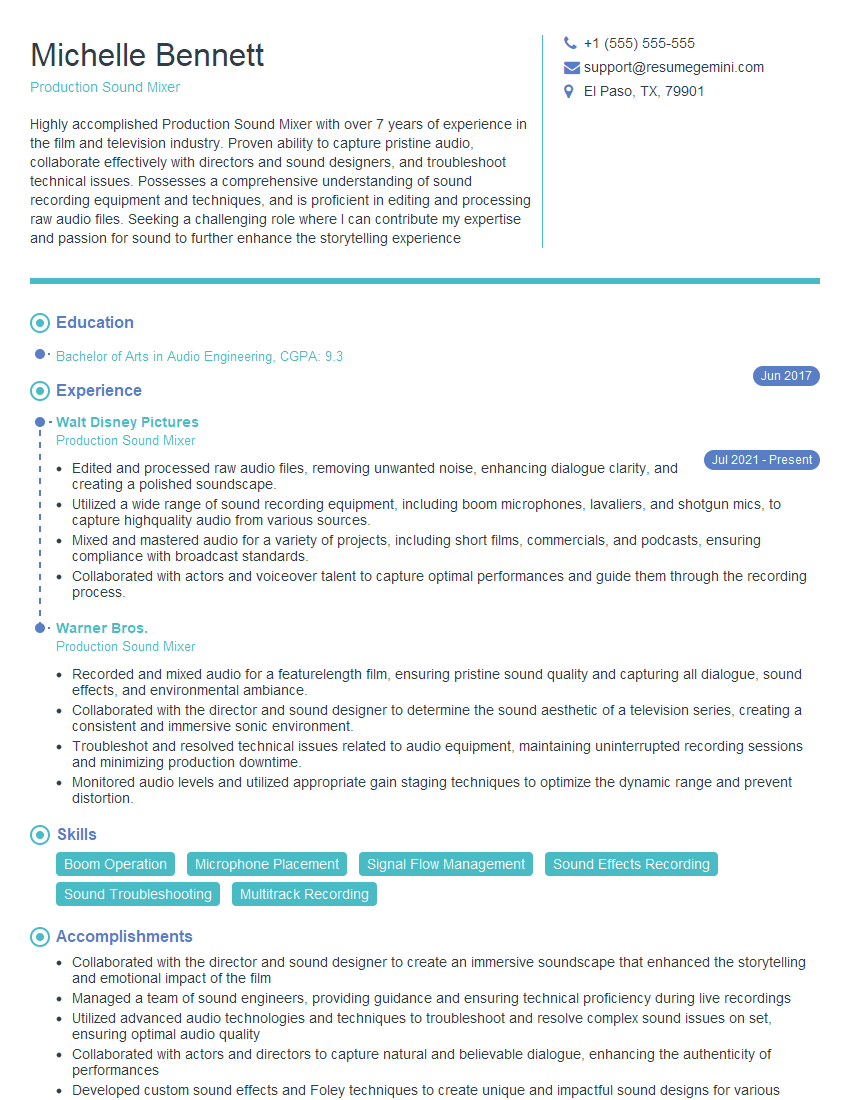
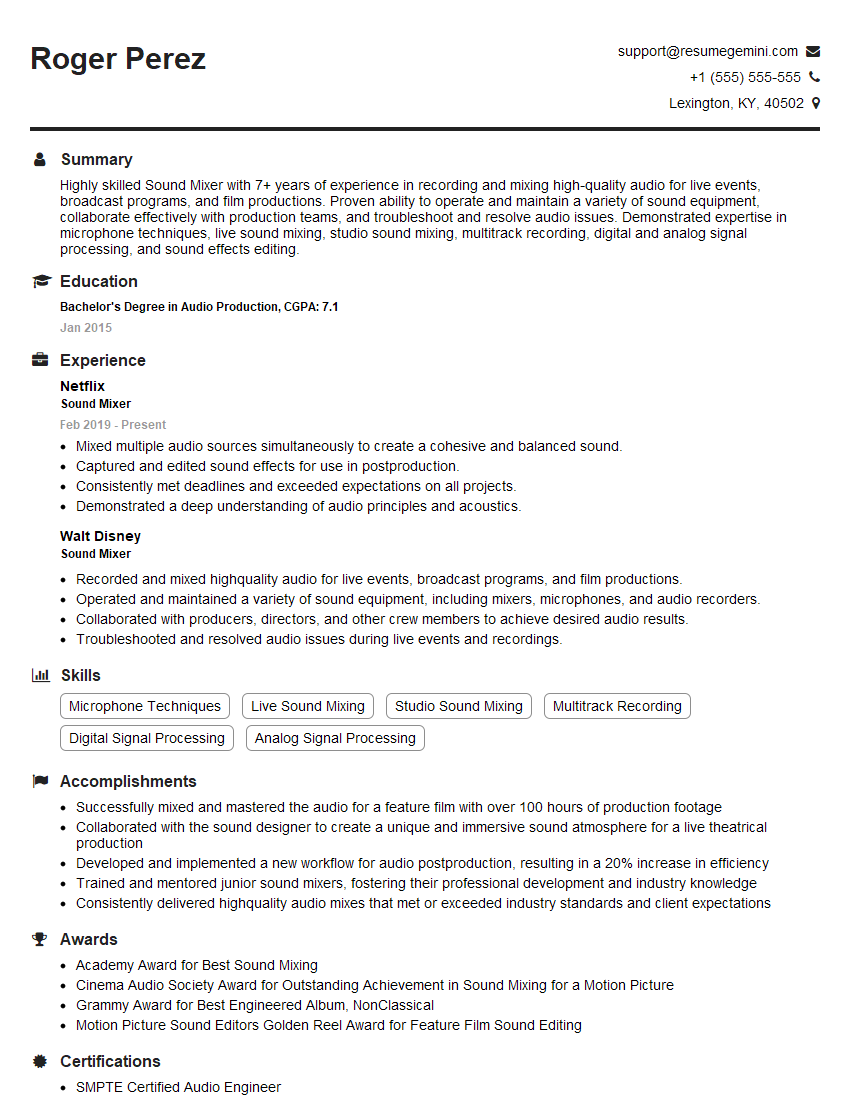
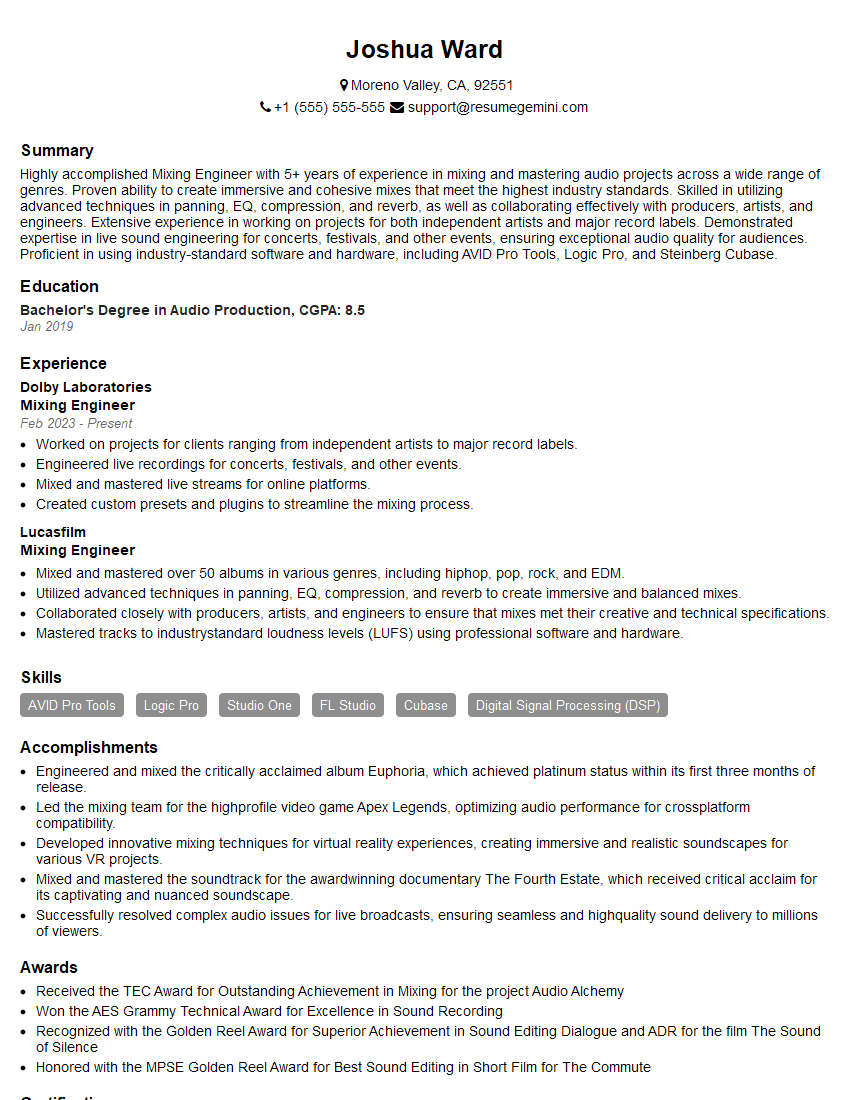
Mastering the concepts of mixers is crucial for advancing your career in signal processing and related fields. A strong understanding of mixer theory and practical applications demonstrates valuable skills to potential employers. To significantly boost your job prospects, create an ATS-friendly resume that effectively highlights your expertise. We highly recommend using ResumeGemini to build a professional and impactful resume. ResumeGemini offers a streamlined process and examples of resumes tailored to Mixers roles are available to help you present your qualifications effectively.
Explore more articles
Users Rating of Our Blogs
Share Your Experience
We value your feedback! Please rate our content and share your thoughts (optional).
What Readers Say About Our Blog
Very informative content, great job.
good