Cracking a skill-specific interview, like one for Dimensional Tolerancing and Metrology, requires understanding the nuances of the role. In this blog, we present the questions you’re most likely to encounter, along with insights into how to answer them effectively. Let’s ensure you’re ready to make a strong impression.
Questions Asked in Dimensional Tolerancing and Metrology Interview
Q 1. Explain the difference between unilateral and bilateral tolerances.
Unilateral and bilateral tolerances define the permissible variation of a dimension from its nominal (target) value. The key difference lies in the direction of that variation.
- Unilateral Tolerance: Allows variation in only one direction from the nominal value. Think of it like a one-way street for your dimension. For example, a shaft might need to be a minimum of 10mm but can be larger than 10mm without issue up to a maximum of 10.2mm. This is represented as 10 +0.2. The dimension must be at least 10mm, but can be up to 10.2mm.
- Bilateral Tolerance: Permits variation in both positive and negative directions from the nominal value. Imagine a two-way street where your dimension can go a certain distance above or below the center. A 10mm ±0.1mm tolerance means the acceptable range is from 9.9mm to 10.1mm. The dimension can vary in both plus and minus directions.
Choosing between unilateral and bilateral tolerances depends on the application. If a minimum size is critical for functionality (e.g., preventing interference), unilateral tolerance on the lower limit is chosen. If equal variation on either side of the nominal value is acceptable (e.g., for assembly fit), bilateral tolerance is suitable.
Q 2. Describe the concept of Geometric Dimensioning and Tolerancing (GD&T).
Geometric Dimensioning and Tolerancing (GD&T) is a symbolic language used on engineering drawings to communicate precisely the size, form, orientation, location, and runout of features on a part. Unlike traditional tolerancing, which only specifies size tolerances, GD&T adds control over the shape and position of features, ensuring that parts function correctly within an assembly. Imagine building a complex clock; GD&T helps ensure all gears mesh properly, not just that the individual gears have the correct size.
It uses symbols and tolerances to define acceptable variations, improving communication and reducing ambiguity between designers, manufacturers, and inspectors. This leads to improved product quality, reduced rework, and lower manufacturing costs. A clear example is specifying the perpendicularity of a hole in a block – traditional tolerancing wouldn’t cover the angle, but GD&T can provide a precise and concise way to control this.
Q 3. What are the fundamental symbols used in GD&T and their meanings?
GD&T employs several fundamental symbols. Here are some of the most common:
∂ (Position):Specifies the allowable variation of a feature’s location from its theoretical exact position. Think of it as defining a zone within which the center of a hole, for example, must reside.⌠ (Perpendicularity):Controls the degree of perpendicularity of a feature relative to a datum feature. Ensures that a surface or feature is at a 90-degree angle to a reference surface, within a defined tolerance zone.↢ (Parallelism):Controls the parallelism of a feature relative to a datum feature. Ensures two features run parallel to each other, within specified tolerance.∃ (Flatness):Controls the flatness of a surface within a defined tolerance.⇼ (Circularity):Defines the roundness of a circular feature within a specified tolerance zone.↩ (Cylindricity):Controls the roundness and straightness of a cylindrical feature.→ (Runout):Measures the combined effect of form and orientation errors relative to a datum axis or feature.
Each symbol is accompanied by a tolerance value and often references datum features (reference surfaces or features used for establishing coordinate systems) which are denoted using capital letters, e.g., A, B, C. These datums provide a stable reference for geometric controls.
Q 4. How do you interpret a tolerance stack-up analysis?
Tolerance stack-up analysis, also known as tolerance accumulation, is a crucial process that determines the overall tolerance of an assembly by considering the individual tolerances of its components. It’s essentially predicting the worst-case scenario of how much variation could exist in your final product due to the tolerance range of each part. Imagine building a tower of LEGO bricks. Even small deviations in each brick’s height could lead to significant variation in the tower’s total height.
The analysis helps determine if the assembly will function correctly given the accumulated tolerances. Methods include:
- Worst-Case Stack-Up: This method adds the maximum possible deviations of each component’s dimensions. It provides the most conservative estimate. (This is the most common)
- Root Sum Square (RSS) Method (Statistical): This method uses statistical principles to estimate the total tolerance based on the standard deviations of individual component tolerances. It’s more optimistic than the worst-case scenario.
Interpreting the results requires comparing the accumulated tolerance to the desired or functional tolerance. If the accumulated tolerance exceeds the functional tolerance, design changes are needed to ensure the assembly will function properly. Software tools are commonly used for automated tolerance stack-up analysis.
Q 5. Explain the different types of measurement uncertainties.
Measurement uncertainty refers to the doubt associated with the measured value. It’s a quantification of the range within which the true value likely resides. Several types of uncertainties can contribute:
- Random Uncertainty (Type A): Results from unpredictable variations in the measurement process. Think of slightly different readings each time you measure the same object with a micrometer. It’s often determined statistically through repeated measurements.
- Systematic Uncertainty (Type B): Stems from known sources of error, such as instrument calibration errors, environmental conditions (temperature, humidity), or operator bias. It’s assessed using prior knowledge about the measurement system and its components.
- Calibration Uncertainty: Uncertainty associated with the accuracy of the measuring instrument itself, due to its calibration process and known defects.
Understanding these uncertainties is essential for evaluating the reliability of measurement results. They should always be reported alongside the measured value to provide a complete picture of the measurement’s quality.
Q 6. Describe the process of calibrating measuring instruments.
Calibrating measuring instruments is a crucial process for ensuring accuracy and reliability. It involves comparing the instrument’s readings to those of a known standard (a traceable standard with a known uncertainty). This ensures your measuring instrument provides the correct results, as otherwise your measurement uncertainties will be even higher than normal.
The process generally involves these steps:
- Preparation: Clean the instrument and allow it to reach thermal equilibrium if necessary.
- Comparison: Make repeated measurements using the instrument and a traceable standard on a set of calibrated test blocks or gauges.
- Analysis: Analyze the difference between the instrument’s readings and those of the standard to determine the calibration errors (and assess uncertainty).
- Adjustment (if applicable): Some instruments allow for adjustments to correct the errors. However, adjustments should be done only by qualified personnel.
- Documentation: Record the calibration results, including date, instrument ID, standard used, and uncertainties. The report should include a statement of conformity, demonstrating the instrument is acceptable for continued use.
Calibration frequency depends on the instrument’s type, usage, and the required accuracy. Calibration certificates are essential documentation providing evidence of the calibration procedure, the instrument’s accuracy, and the measurement uncertainty.
Q 7. What are the common methods for measuring surface roughness?
Surface roughness measurement quantifies the irregularities of a surface. Several methods exist:
- Profilometry (Contact Methods): Uses a stylus that traces the surface profile, recording the height variations. This provides a detailed representation but can potentially damage delicate surfaces.
- Optical Methods: Employ techniques like confocal microscopy, interferometry, and laser scanning to measure surface roughness non-contact. These are usually preferred for non-destructive testing and provide high precision.
- Non-contact techniques based on imaging and vision systems: These are often used in quality control and provide fast surface texture evaluation, allowing for efficient production line monitoring.
The choice of method depends on factors like surface material, required accuracy, and the need for non-destructive testing. The results are typically expressed using parameters like Ra (average roughness), Rz (ten-point height), and Rq (root mean square roughness), among others.
Q 8. What are the limitations of different measurement techniques (e.g., CMM, optical comparators)?
Different measurement techniques, while powerful, each have limitations. Let’s consider CMMs and optical comparators:
- CMMs (Coordinate Measuring Machines): CMMs excel at high-accuracy 3D measurements but can be limited by factors like probe size (affecting access to small features), setup time (fixturing complex parts takes time), and the need for skilled operators to avoid errors in probing strategy. For instance, measuring the internal diameter of a very small, deep hole might be impossible with a standard CMM probe.
- Optical Comparators: These are excellent for 2D measurements and comparing parts against a master drawing, offering rapid visual inspection. However, they are limited to surface measurements and struggle with complex 3D shapes. Accuracy is also dependent on the quality of the optical system and the operator’s skill in interpreting the projected image. For example, detecting small surface defects on a highly reflective surface could prove challenging.
In short, the choice of measurement technique depends heavily on the part’s geometry, the required accuracy, and the available resources. No single technique is universally superior; each has its strengths and weaknesses that must be carefully considered.
Q 9. How would you assess the accuracy and precision of a measurement system?
Assessing the accuracy and precision of a measurement system is crucial for reliable results. We use several methods:
- Calibration: Regularly calibrating the measurement system against traceable standards establishes its accuracy – how close measurements are to the true value. This often involves using certified artifacts with known dimensions.
- Repeatability and Reproducibility Studies: These evaluate precision – how close repeated measurements are to each other. Repeatability tests the system’s consistency by the same operator, while reproducibility tests consistency between different operators and instruments.
- Gauge R&R (Repeatability and Reproducibility) Studies: This statistical method quantifies the variation due to the measurement system (gauge variation), the operator, and the part-to-part variation. This allows us to assess the overall measurement uncertainty and identify which sources of error contribute most significantly.
- Control Charts: These graphically display measurement data over time, helping to monitor the system’s stability and detect any shifts or trends indicating a potential problem. (This is further detailed in the next question).
By combining these methods, we obtain a comprehensive understanding of the measurement system’s performance, enabling informed decisions on data validity and process adjustments.
Q 10. Explain the concept of a control chart and its application in metrology.
Control charts are powerful tools for monitoring process stability and identifying potential problems. In metrology, they visualize measurement data over time, allowing us to track consistency and detect shifts or trends that may indicate a problem with the measurement system or the manufacturing process.
For example, a common chart type is the X-bar and R chart. The X-bar chart tracks the average of measurements within subgroups, and the R chart tracks the range (difference between the highest and lowest values) within those subgroups. Control limits (typically 3 standard deviations from the average) are calculated and plotted. Points outside the control limits suggest special cause variation (a problem requiring investigation), while points clustering near the limits warrant attention.
Application in Metrology: Control charts are used to monitor:
- CMM performance: Tracking the measurements of a standard artifact over time can identify shifts in accuracy or precision.
- Manufacturing process stability: Monitoring key dimensions of manufactured parts reveals if the process is producing parts within tolerance consistently.
- Calibration stability: Tracking calibration data helps ensure the continued accuracy of measuring instruments.
By using control charts, we proactively identify and address potential issues before they impact product quality or lead to costly scrap or rework.
Q 11. Describe the different types of coordinate measuring machines (CMMs).
Coordinate Measuring Machines (CMMs) come in various types, primarily categorized by their measuring mechanism:
- Bridge-type CMMs: These are the most common type, featuring a bridge structure that moves along a horizontal beam and a probe that moves vertically. They are versatile and suitable for a wide range of parts.
- Gantry-type CMMs: These have a larger measurement volume than bridge-type CMMs due to their gantry structure (similar to a crane). They’re ideal for large parts and offer exceptional stiffness.
- Horizontal-arm CMMs: These use a horizontal arm with multiple rotating axes, offering great access to complex shapes. They are well-suited for parts with intricate geometries.
- CMMs with different probe systems: CMMs can be equipped with different probe systems like touch probes (for contact measurements), laser scanners (for non-contact measurements), or vision systems.
The choice depends on the application and the size and complexity of the parts to be measured. Large parts might necessitate a gantry-type CMM, whereas intricate features might benefit from a horizontal-arm or a CMM with a laser scanner.
Q 12. What are the advantages and disadvantages of using CMMs?
CMMs offer several advantages and disadvantages:
- Advantages:
- High accuracy and precision: CMMs offer extremely precise measurements in three dimensions.
- Versatility: They can measure a wide range of shapes and sizes.
- Automation capabilities: CMMs can be automated to perform repetitive measurements efficiently.
- Comprehensive data collection: CMMs provide detailed data, including coordinates, dimensions, and geometric parameters.
- Disadvantages:
- High cost: CMMs are significant investments.
- Specialized training required: Operators need extensive training to use CMMs effectively.
- Setup time: Preparing parts for measurement (fixturing) can be time-consuming.
- Environmental sensitivity: CMMs are sensitive to temperature and vibration.
The decision to use a CMM involves weighing the benefits of high accuracy and versatility against the considerable investment and training requirements. For high-precision applications where many parts need to be measured, the investment is justified; however, for low-volume, simple parts, alternative methods may be more cost-effective.
Q 13. Explain the principles of laser scanning technology in metrology.
Laser scanning technology in metrology uses a laser beam to create a 3D point cloud representing the surface of an object. This non-contact method provides several advantages over traditional contact measurement methods.
Principles: A laser beam is projected onto the object’s surface. The reflected light is detected by a sensor, and the time of flight or triangulation of the reflected light is used to determine the distance between the sensor and the surface. By systematically scanning the laser across the object’s surface, a dense point cloud is generated. This data is then processed using software to construct a 3D model of the object’s shape and dimensions.
Types of Laser Scanning: There are various types, including:
- Triangulation: Based on measuring the angle of the reflected laser beam.
- Time-of-flight: Measures the time it takes for the laser pulse to travel to the surface and back.
Laser scanning is highly efficient for capturing complex shapes quickly and accurately, making it ideal for reverse engineering, rapid prototyping, and quality control applications. It’s particularly useful for delicate or difficult-to-access parts where contact measurement methods might be unsuitable.
Q 14. How would you handle a situation where a measurement result is outside the specified tolerance?
Finding a measurement result outside specified tolerances necessitates a systematic investigation:
- Verify the Measurement: Repeat the measurement several times to ensure the initial result wasn’t a fluke. Use different operators and equipment if feasible.
- Check the Measurement System: Ensure the CMM or other equipment is properly calibrated and functioning correctly. Review recent calibration reports and control charts.
- Inspect the Part: Carefully examine the part for any defects, damage, or anomalies that could explain the deviation from tolerance. Use magnifying tools or microscopes as needed.
- Review the Measurement Procedure: Ensure the correct measurement technique was followed precisely. Check for any errors in the setup, probe selection, or data acquisition process.
- Analyze the Data: Use statistical methods to assess the overall uncertainty of the measurement and rule out random variations.
- Investigate the Process: If the problem is consistently observed, investigate the manufacturing process to identify potential sources of variation leading to the out-of-tolerance measurements.
- Document Findings: Meticulously record all findings, including measurements, procedures, and analysis. This documentation is vital for corrective actions and future prevention.
- Implement Corrective Actions: Based on the investigation, implement corrective actions to address the root cause. This may involve adjusting the manufacturing process, recalibrating equipment, retraining operators, or modifying the part design.
The approach must be thorough and systematic. A rushed decision could lead to unnecessary rework or rejection of perfectly good parts. Thorough investigation ensures accurate and reliable quality control.
Q 15. Describe your experience with statistical process control (SPC).
Statistical Process Control (SPC) is a powerful methodology used to monitor and control manufacturing processes by analyzing data collected over time. It helps identify variations in the process, predict potential problems, and implement corrective actions to prevent defects. My experience with SPC includes implementing and managing control charts (like X-bar and R charts, p-charts, and c-charts) to monitor key process parameters. I’ve used these charts to identify assignable causes of variation – issues like machine malfunctions or operator errors – distinguishing them from common cause variation, which is inherent in the process. I’ve also used SPC to analyze capability studies (Cp, Cpk) to determine how well a process meets specified tolerances, making data-driven decisions regarding process improvements. For instance, in a previous role, we used SPC to reduce the defect rate in a precision machining process by 60% by pinpointing and addressing a recurring tool wear issue detected through an X-bar and R chart.
Career Expert Tips:
- Ace those interviews! Prepare effectively by reviewing the Top 50 Most Common Interview Questions on ResumeGemini.
- Navigate your job search with confidence! Explore a wide range of Career Tips on ResumeGemini. Learn about common challenges and recommendations to overcome them.
- Craft the perfect resume! Master the Art of Resume Writing with ResumeGemini’s guide. Showcase your unique qualifications and achievements effectively.
- Don’t miss out on holiday savings! Build your dream resume with ResumeGemini’s ATS optimized templates.
Q 16. How do you determine the appropriate sampling plan for a given inspection?
Determining the appropriate sampling plan involves considering several factors. First, we need to understand the Acceptable Quality Level (AQL), which is the maximum percentage of defective items that is considered acceptable. Next, we assess the producer’s risk (alpha), the probability of rejecting a good batch, and the consumer’s risk (beta), the probability of accepting a bad batch. The Acceptable Sample Size (ASN) is also determined based on factors such as the cost of inspection and the potential consequences of a faulty product. Different sampling plans, like those outlined in MIL-STD-105E or ANSI/ASQ Z1.4, provide tables that dictate the sample size based on the batch size, AQL, and desired risk levels. The choice of a single, double, or multiple sampling plan depends on the inspection cost and time constraints. In practice, I utilize statistical software to calculate the ideal sample plan according to the risk profile and cost considerations for the given process and product. A simple example: If we’re inspecting a large batch of precision-cut components with a low AQL and low risk tolerance, a double or even multiple sampling plan might be more appropriate to ensure higher confidence in the final quality. Conversely, for a smaller batch with less critical tolerances, a single sampling plan could suffice.
Q 17. What software packages are you familiar with for dimensional metrology?
My experience encompasses several software packages widely used in dimensional metrology. I’m proficient in PolyWorks, a powerful software for 3D scanning data processing and inspection, enabling detailed analysis of complex geometries and creation of comprehensive reports. I also have extensive experience with CMM programming software such as PC-DMIS, which allows for the creation, execution, and analysis of CMM inspection routines for various applications. Furthermore, I am familiar with CAD software such as SolidWorks and AutoCAD, allowing me to effectively integrate measurement data with design specifications. Finally, I have utilized statistical software like Minitab for data analysis and SPC chart generation, helping create a complete picture from data collected by various instruments and software packages.
Q 18. Explain the importance of traceability in metrology.
Traceability in metrology is crucial for ensuring the accuracy and reliability of measurement results. It establishes an unbroken chain of comparisons between the measuring instrument, the measurement standard, and ultimately, the national or international standard. This means that any measurement made can be traced back to a known and verified standard, confirming the accuracy of the equipment and the validity of the data. Without traceability, measurement results are essentially meaningless as there’s no way to verify their accuracy. For example, a micrometer used for critical measurements needs to be calibrated against a traceable standard, which in turn is calibrated against a higher-order standard, and so on up to a national standard maintained by a metrology institute. This ensures consistent and reliable measurements across different locations and over time. Lack of traceability can lead to significant costs in rejected parts, warranty issues, and product recalls.
Q 19. Describe your experience with different types of measuring instruments (e.g., calipers, micrometers, dial indicators).
I have extensive practical experience with various measuring instruments. Calipers are routinely used for quick, approximate measurements, particularly when checking dimensions to within a few tenths of a millimeter. Micrometers offer higher precision for accurate measurement of smaller dimensions and tolerances, typically in the range of micrometers. I am comfortable with both vernier and digital micrometers. Dial indicators excel in measuring surface irregularities, run-out, and small displacements, offering high sensitivity. In addition to these, I’m experienced with more advanced instruments like coordinate measuring machines (CMMs), optical comparators, and laser scanners, understanding their application based on accuracy requirements and the complexity of the measured object. For instance, during a project involving inspecting intricate turbine blades, the high precision demanded required the utilization of a CMM, while checking the overall dimensions of a cast part used a simpler vernier caliper to provide a rapid check. The choice of instrument depends directly on the tolerances and geometries being measured.
Q 20. How would you interpret a drawing with GD&T annotations?
Interpreting a drawing with GD&T (Geometric Dimensioning and Tolerancing) annotations requires a systematic approach. First, I identify the datum features, which are reference surfaces or points used to establish a coordinate system for the part. These are typically designated with a symbol (A, B, C, etc.). Next, I examine the feature control frames (FCFs), which specify the tolerance and geometric control of a particular feature. Each FCF contains information such as the type of tolerance (e.g., position, parallelism, perpendicularity), the tolerance value, and the associated datum references. For example, a position tolerance specified with a maximum material condition (MMC) modifier means the tolerance zone is smaller when the feature is at its maximum size, allowing for more variation when it is smaller. I then analyze the relationships between the different features and the datums, understanding how the tolerances interact to ensure the part functions correctly. I would use this information to verify whether a produced part meets the design specifications. A critical part of this interpretation is understanding that GD&T defines not just the size but also the location, orientation, and form of features, resulting in more precise and unambiguous design communication compared to traditional tolerancing.
Q 21. Explain the concept of datum features and their importance in GD&T.
Datum features are fundamental in GD&T. They are the reference points, axes, or planes from which all other dimensions and tolerances are measured. They establish a stable and consistent coordinate system for the part. Without datum references, tolerances would be ambiguous and the part’s functionality could be compromised. For example, imagine a hole that needs to be positioned accurately on a plate. The position tolerance might be specified relative to two datum planes (A and B) on the plate. These datum planes provide a stable and unambiguous reference for the position of the hole. The choice of datum features is crucial and depends on how the part will function. A poor datum reference selection can lead to misinterpretations and manufacturing issues. Datums, therefore, create a stable and measurable framework for precisely controlling the form, orientation, location, and runout of a part’s features, ensuring consistent functionality and assembly.
Q 22. How do you handle non-conformances related to dimensional tolerances?
Handling non-conformances related to dimensional tolerances requires a systematic approach. It begins with identifying the deviation from the specified tolerances, documented in engineering drawings using Geometric Dimensioning and Tolerancing (GD&T). This often involves using Coordinate Measuring Machines (CMMs) or other precision measuring instruments. Once a non-conformance is identified, a thorough investigation is initiated to understand the root cause. This may involve examining the manufacturing process, the measuring equipment calibration, and the part design itself.
The next step is to determine the severity of the non-conformance. This depends on factors like the functional impact of the deviation and the applicable quality standards. For example, a minor deviation might be acceptable depending on the feature’s function. However, a larger deviation that compromises the part’s functionality necessitates corrective action. This might involve reworking the affected parts, adjusting the manufacturing process, or even redesigning the part. Proper documentation throughout this entire process, including photographic evidence, is crucial for traceability and future improvement efforts. Finally, a corrective action plan (CAPA) is implemented to prevent recurrence. This plan is usually reviewed by quality control and then implemented across the relevant departments. Using a robust CAPA system, including statistical process control techniques, enhances the overall quality and reduces future defects.
Q 23. Explain the role of metrology in ensuring product quality.
Metrology plays a vital role in ensuring product quality by providing the means to accurately and precisely measure critical dimensions and geometric characteristics. It’s the science of measurement, and its application confirms that manufactured parts conform to the design specifications. Without precise metrology, we wouldn’t know if our products meet the required tolerances and, consequently, whether they will function as intended. Imagine building a car engine – if the cylinder bores are not within the specified tolerance, the pistons won’t fit correctly, leading to catastrophic failure.
Metrology encompasses various techniques and instruments, ranging from simple calipers and micrometers to advanced CMMs and laser scanning systems. These tools allow us to collect data that is then used for quality control, process optimization, and design verification. By comparing measured values to design specifications, we can identify potential issues early on in the manufacturing process, preventing costly rework or scrap. Metrology, therefore, provides the objective evidence necessary for continuous improvement and guarantees that products consistently meet the highest standards of quality and reliability.
Q 24. Describe a time you had to troubleshoot a measurement problem.
During a project involving the manufacture of high-precision injection-molded parts, we encountered a persistent measurement discrepancy. The CMM repeatedly indicated that a crucial dimension was consistently outside the specified tolerance. Initially, we suspected a problem with the manufacturing process. We meticulously reviewed the mold design, injection parameters, and post-molding processes, but found no significant anomalies.
Our troubleshooting involved a systematic approach. We first verified the CMM’s calibration, checking its accuracy using certified standards. The calibration was within acceptable limits. Next, we examined the measurement setup on the CMM, considering the fixture design, probe type, and the methodology used to take the measurements. It turned out the problem stemmed from an improper probe alignment. By correcting the probe alignment and improving our measurement methodology, we eliminated the discrepancy. This highlighted the importance of not only validating the manufacturing process but also meticulously reviewing the measurement process itself to guarantee the accuracy and reliability of the data.
Q 25. What are the key differences between ISO and ANSI standards for GD&T?
While both ISO and ANSI standards for GD&T aim to provide a common language for specifying tolerances on engineering drawings, there are key differences. ISO (International Organization for Standardization) standards, primarily ISO 1101, provide a more comprehensive and globally recognized approach. ANSI (American National Standards Institute) standards, although widely used in the US, are less internationally adopted. The most noticeable difference is the terminology and symbols used. While functionally similar, specific terms and symbols may differ slightly.
For example, ISO uses different symbols for some features of size and position tolerances than ANSI. There might also be subtle differences in how certain tolerances are defined or interpreted. Ultimately, both systems aim to achieve the same goal: unambiguously defining the acceptable variation in a part’s geometry. However, inconsistencies can arise if drawings created using one standard are interpreted using the other. It is crucial for engineers to be familiar with both systems to avoid confusion and maintain accurate manufacturing and inspection processes. Choosing a standard depends on project scope and international collaboration requirements, with ISO gaining more global acceptance.
Q 26. How do you ensure the integrity of the measurement process?
Ensuring the integrity of the measurement process is paramount. It relies on a multi-faceted approach. The first step is to use properly calibrated and maintained measuring equipment. This includes regular calibration checks against traceable standards to confirm their accuracy. This is usually done by certified metrology laboratories. The equipment’s maintenance, including regular cleaning and servicing, is also critical. This prevents wear and tear from affecting the accuracy of measurements.
Secondly, the measurement process itself must be standardized. This involves using well-defined procedures, ensuring consistent operator technique, and minimizing sources of error. This could involve controlled environmental conditions to minimize effects from temperature or humidity. Using statistical methods, like control charts, provides continuous monitoring of the measurement process and helps identify and address any drifting or variability. Lastly, proper documentation is crucial for traceability. Recording all measurements, calibration records, and environmental conditions allows for review and provides evidence of the measurement process integrity. Adherence to these principles builds confidence in the accuracy and reliability of the measurement data, forming the foundation for sound product quality decisions.
Q 27. Describe your experience with root cause analysis in relation to dimensional issues.
I’ve had several experiences with root cause analysis for dimensional issues. One involved a recurring out-of-tolerance condition on a critical shaft diameter during mass production. We used a structured approach, incorporating the ‘5 Whys’ technique and a fishbone diagram.
The initial problem was the shaft diameter being consistently oversized. The ‘5 Whys’ led us to the root cause: tool wear on the CNC lathe used for machining the shafts. The tool had not been replaced according to the scheduled maintenance plan, ultimately causing the machining process to drift beyond the acceptable tolerance. The fishbone diagram further highlighted contributing factors, such as inadequate training for machine operators and an insufficient monitoring system. As a result, we implemented several corrective actions: improved operator training, a revised maintenance schedule with automated alerts for tool replacement, and the installation of a more robust monitoring system with real-time feedback. This systematic analysis not only solved the immediate problem but also significantly reduced the likelihood of similar incidents in the future.
Key Topics to Learn for Dimensional Tolerancing and Metrology Interview
- Geometric Dimensioning and Tolerancing (GD&T): Understand the fundamental principles of GD&T, including symbols, datums, and tolerance zones. Be prepared to discuss how GD&T ensures part functionality and interchangeability.
- Types of Tolerances: Familiarize yourself with various tolerance types (e.g., bilateral, unilateral, limits of size) and their applications in manufacturing processes. Be able to explain how to interpret and apply these tolerances in drawings and specifications.
- Measurement Techniques: Master different measurement techniques for dimensional verification, including coordinate measuring machines (CMMs), optical comparators, and laser scanners. Understand the principles behind each technique and their limitations.
- Statistical Process Control (SPC): Learn the fundamentals of SPC and its role in ensuring dimensional accuracy and consistency in manufacturing. Be ready to discuss control charts and process capability analysis.
- Calibration and Traceability: Understand the importance of calibration and traceability in maintaining accurate measurements. Be able to explain how to ensure measurement equipment is properly calibrated and traceable to national standards.
- Tolerance Stack-up Analysis: Practice performing tolerance stack-up analysis to predict the overall tolerance of an assembly based on individual component tolerances. Understand different methods for performing this analysis.
- Root Cause Analysis for Dimensional Issues: Develop your ability to identify and troubleshoot issues related to dimensional variation and non-conformances. Be prepared to discuss problem-solving methodologies and process improvement strategies.
- Material Properties and their Influence on Dimensional Stability: Understand how material characteristics (e.g., thermal expansion, shrinkage) affect dimensional accuracy and stability.
Next Steps
Mastering Dimensional Tolerancing and Metrology is crucial for career advancement in manufacturing, quality control, and engineering. A strong understanding of these concepts significantly enhances your problem-solving skills and your ability to contribute to efficient and high-quality production. To increase your job prospects, creating an ATS-friendly resume is essential. ResumeGemini is a trusted resource that can help you build a professional and impactful resume. ResumeGemini provides examples of resumes tailored to Dimensional Tolerancing and Metrology to guide you in crafting your own compelling application. Take the next step towards your dream career – build a resume that showcases your expertise!

Manufacturing Manager Resume Sample

Quality Assurance Manager Resume Sample

Quality Control Manager Resume Sample

Process Engineer Resume Sample

Test Engineer Resume Sample

Manufacturing Engineer Resume Sample

Production Engineer Resume Sample

Quality Control Engineer Resume Sample

Quality Assurance Engineer Resume Sample
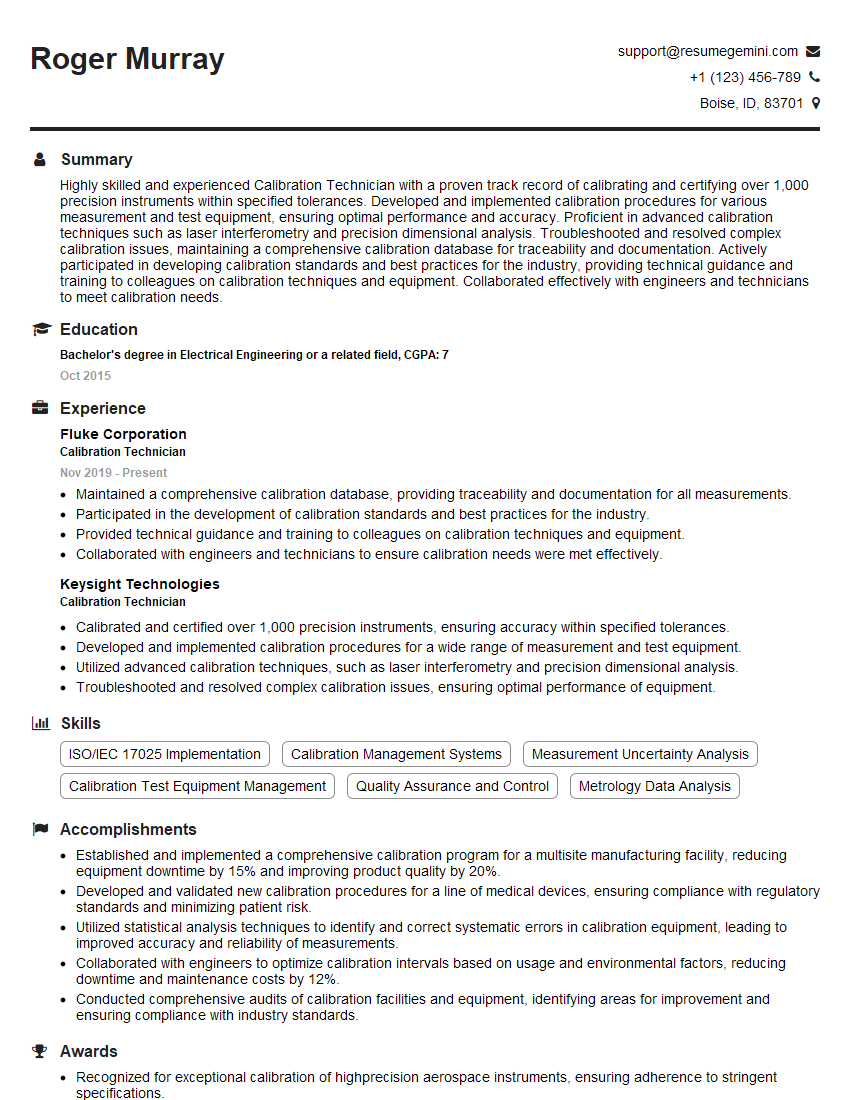
Calibration Technician Resume Sample

Metrology Technician Resume Sample
Explore more articles
Users Rating of Our Blogs
Share Your Experience
We value your feedback! Please rate our content and share your thoughts (optional).
What Readers Say About Our Blog
Very informative content, great job.
good