The right preparation can turn an interview into an opportunity to showcase your expertise. This guide to Classical Repertoire Performance interview questions is your ultimate resource, providing key insights and tips to help you ace your responses and stand out as a top candidate.
Questions Asked in Classical Repertoire Performance Interview
Q 1. Describe your experience performing works by Bach.
My experience with Bach’s works has been profoundly rewarding. I’ve performed numerous pieces, from the iconic Goldberg Variations to various concertos and solo works for keyboard. Performing Bach demands a meticulous approach, focusing on clarity of counterpoint, articulation, and a deep understanding of his intricate structures. For example, in the Goldberg Variations, I strive to illuminate the variations’ individual characters while maintaining a sense of unity and overall architectural coherence. This involves detailed study of the score, considering phrasing, dynamics, and ornamentation within the context of the entire work. It’s not merely playing notes but conveying the emotional depth and intellectual rigor that defines Bach’s genius. I’ve also found that historical performance practice, such as using period instruments or employing historically informed ornamentation, significantly enhances the expressive potential of his music.
Q 2. Explain the stylistic differences between the Classical and Romantic periods.
The Classical and Romantic periods represent a significant shift in musical aesthetics. The Classical period (roughly 1730-1820), exemplified by Haydn, Mozart, and Beethoven’s early works, emphasizes clarity, balance, and formal structure. Think of the elegant symmetry of a Mozart symphony or the balanced phrasing in a Haydn string quartet. Homophonic texture (melody with accompaniment) predominates. The Romantic period (roughly 1820-1900), with composers like Beethoven (later works), Schubert, Chopin, and Brahms, emphasizes emotional expression, individualism, and expansive forms. Harmony becomes more chromatic and complex, reflecting a wider range of emotions. Orchestral forces expand, and the emphasis shifts from formal balance to expressive intensity. A simple comparison: a Classical sonata might have a clear, concise structure with relatively restrained dynamics, while a Romantic sonata might explore a wider dynamic range and employ more elaborate thematic development, often blurring the lines between movements.
Q 3. What is your approach to interpreting a Baroque sonata?
Interpreting a Baroque sonata demands a thorough understanding of historical performance practice. This includes considerations like ornamentation (adding notes based on period conventions), articulation (using techniques like terraced dynamics and articulation patterns common to the era), and tempo relationships. I approach it through rigorous scholarly research, studying treatises from the period and listening to recordings of historically informed performances. For example, understanding the use of ‘affections’ (emotions) as described in Baroque treatises informs my expressive choices. My approach also involves a deep engagement with the score’s structure, recognizing the interplay of different sections and the overall architecture of the work. The goal isn’t to impose a modern sensibility but to unveil the music’s inherent beauty and emotional depth through the lens of its historical context. I also find engaging with the composer’s biography helpful, as it can provide insights into the social and cultural environment in which the music was created.
Q 4. How do you handle stage fright?
Stage fright is a common experience for performers. My approach involves a combination of preparation and mental strategies. Thorough rehearsal is crucial; the more familiar I am with the music, the more confident I feel. Physical techniques, like deep breathing exercises and relaxation techniques, can help manage physical symptoms of anxiety. I also visualize successful performances, focusing on positive outcomes rather than dwelling on potential mistakes. Furthermore, remembering that the audience wants me to succeed helps reduce performance anxiety. I’ve found that focusing on connecting with the music and the audience, rather than on my own anxieties, allows me to channel my nervous energy into a powerful performance.
Q 5. Discuss your experience with ensemble playing.
Ensemble playing is a vital aspect of my musical life. It requires a high level of communication, active listening, and mutual respect among the players. In ensemble work, I prioritize blending my sound with others seamlessly while maintaining my individual expression within the overall ensemble texture. This means carefully listening to other musicians and adjusting my own playing accordingly to create a cohesive and unified musical experience. I’ve had the privilege of playing in various ensembles, from small chamber groups to larger orchestras, each requiring a unique approach to collaboration. The dynamics within an ensemble are as important as the musical execution itself; finding a balance between leadership and collaboration is essential for producing a successful performance.
Q 6. Describe your rehearsal process for a solo performance.
My rehearsal process for a solo performance is a multi-stage approach. It begins with a careful study of the score, understanding the structure, harmony, and the composer’s intent. I then work through the piece section by section, slowly and meticulously, focusing on technical accuracy and musical phrasing. I gradually increase the tempo as I gain confidence and fluency. I pay close attention to details such as articulation, dynamics, and ornamentation. I incorporate regular breaks to avoid fatigue and maintain focus. As the performance date approaches, I incorporate full run-throughs to ensure the piece flows smoothly and consistently. I also frequently record myself to identify areas for improvement and refine my interpretation. Finally, mock performances in front of a small, trusted audience can help simulate performance conditions and alleviate stage fright.
Q 7. What is your preferred method for memorizing musical scores?
Memorizing scores is a gradual process. I don’t focus on rote memorization but rather on understanding the music’s structure and internal logic. I begin by learning sections in small chunks, focusing on the musical phrases and their relationships. I use different learning methods, such as playing along with a recording, writing out sections, and mentally rehearsing passages. I also find that linking musical ideas to visual images or narratives can aid in memorization. Ultimately, it’s a process that requires patience, persistence, and a deep understanding of the music itself. The goal is not simply to remember the notes but to internalize the music to the point where it becomes an extension of myself.
Q 8. How do you approach learning a new piece of classical music?
Learning a new piece is a journey, not a sprint. It begins with a deep dive into the score, understanding the composer’s intentions through the notation itself. I start by carefully examining the structure – identifying the thematic material, its development, and the overall form (sonata form, rondo, etc.). Then, I focus on individual sections, gradually building my understanding.
Next, I work on technical aspects, breaking down challenging passages into smaller, manageable chunks. This involves slow practice to perfect fingerings, bowing, or voicing. I often record myself to identify areas needing improvement. Simultaneously, I listen to various interpretations by renowned artists to gain insight into different stylistic approaches, but always striving for my own unique voice.
Finally, I integrate the technical mastery with musical expression. This stage focuses on phrasing, dynamics, and articulation, bringing the composer’s emotions to life. I might even explore the historical context of the piece to fully grasp its intended impact. The process is iterative, constantly refining and polishing until a cohesive and expressive performance emerges.
Q 9. Explain your understanding of phrasing and articulation in classical music.
Phrasing and articulation are fundamental to conveying the musical narrative. Phrasing is the shaping of musical lines, creating breath and continuity. Think of it like sculpting a piece of clay – you need to build the shape and form, creating peaks and valleys in the musical line. This is achieved through careful attention to dynamics (crescendo, diminuendo), tempo (ritardando, accelerando), and articulation.
Articulation, on the other hand, refers to the way individual notes are played – legato (smooth and connected), staccato (short and detached), etc. Choosing the appropriate articulation helps to delineate phrases and emphasize certain notes or motifs. For example, a legato passage might express serenity, while a staccato passage could evoke excitement or agitation. The interplay of phrasing and articulation creates a rich tapestry of musical expression, giving the piece its unique character and emotional depth.
Consider the opening of Beethoven’s Moonlight Sonata. The slow, sustained legato creates a serene mood, contrasting sharply with the more dramatic passages later in the piece. This contrast is expertly crafted through the phrasing and articulation. I approach each piece by meticulously examining the score for composer-indicated articulation and phrasing to inform my own interpretation.
Q 10. Describe your experience with different performance venues.
My performance experience spans a wide range of venues, from intimate recital halls with exceptional acoustics like the Wigmore Hall in London, to grand concert halls like Carnegie Hall, where the sheer scale and reverberation present a different set of challenges. I’ve also performed in smaller, more informal settings like churches or university auditoriums, each with its own unique sonic character.
Each venue demands a different approach. In intimate spaces, nuances in tone and dynamics are amplified, allowing for a more introspective performance. Larger halls require a more robust sound projection, with careful consideration of resonance and blend. The audience proximity in smaller venues can impact the emotional intimacy of the performance as well. Adapting to the specific acoustics is crucial for optimal sound quality and an effective communication of the music.
Q 11. How do you adapt your performance to different acoustic settings?
Adapting to different acoustic settings is a crucial skill for any classical musician. The same performance will sound dramatically different in a dry, reverberant space versus a naturally resonant one. My approach involves careful listening and adjustments during rehearsals, if possible. In a dry hall, I might play with a slightly fuller tone and more dynamic range to compensate for the lack of natural reverberation. In a highly resonant space, I might play with a slightly lighter touch to avoid muddiness and maintain clarity.
I also consider the size and shape of the hall. A large, high-ceilinged hall will generally require a broader projection than a smaller, more intimate setting. I might adjust my articulation and phrasing subtly to account for the different acoustic reflections. Ultimately, it’s about finding a balance between projecting the music effectively while maintaining the intended nuances and emotional depth.
Q 12. Explain your understanding of historical performance practice.
Historical performance practice (HPP) is the study and application of the performance conventions and techniques used during the time period in which a piece was composed. It involves researching the instruments, techniques, and musical styles prevalent at the time to inform a more authentic interpretation. This includes understanding the available instruments and their limitations, typical ornamentation styles, and the prevalent tempo and dynamics.
For example, playing a Bach prelude on a modern piano would sound drastically different than on a harpsichord, the instrument for which it was originally intended. The harpsichord’s different timbre and touch would affect the articulation and overall texture. Understanding HPP allows me to provide a deeper understanding of the music, conveying the composer’s intent as accurately as possible. While I don’t necessarily adhere strictly to HPP in all instances, I believe its principles enrich my interpretations, adding another layer of depth and meaning.
Q 13. How do you maintain your musical skills and technique?
Maintaining musical skills and technique is an ongoing process requiring consistent dedication. This includes regular practice sessions focused on technical exercises (scales, arpeggios, etudes) to maintain dexterity and accuracy. I also work with a teacher regularly to address any technical challenges or refine my interpretation. Beyond technical practice, I dedicate time to studying scores, listening to recordings, and attending concerts – a continuous learning process.
Physical health is also paramount. I maintain a healthy lifestyle with regular exercise and mindful rest, allowing my body to perform optimally. Regular stretching and warming up before practice minimizes the risk of injuries. It is a holistic approach, balancing physical and mental well-being to maintain my highest level of musical performance.
Q 14. Describe your approach to collaborating with a conductor.
Collaboration with a conductor is a vital aspect of orchestral performance. It’s a partnership built on mutual respect and understanding. The rehearsal process involves a dialogue between the conductor and the soloist, where we discuss the overall interpretation, phrasing, and dynamics. The conductor provides guidance on the context within the larger orchestral work, helping to shape the solo part’s role within the complete musical narrative.
Open communication is key. I value the conductor’s vision and expertise while also asserting my own artistic interpretation. Finding a balance between following the conductor’s guidance and maintaining my individual musical voice is crucial for a successful collaboration. I always engage in respectful and constructive conversations during rehearsals, clarifying any ambiguities and ensuring we’re on the same page regarding tempo, dynamics, and articulation.
Q 15. Discuss your experience working with other musicians in an ensemble.
Collaboration is the lifeblood of ensemble playing. My experience spans various chamber music settings, from string quartets to larger orchestral collaborations. In a string quartet, for instance, the success hinges on seamless communication, a shared understanding of the musical phrasing, dynamics, and articulation. We spend countless hours rehearsing, not just playing our individual parts, but actively listening to each other, finding a balance in tone and volume, and ensuring a cohesive interpretation. In orchestral work, the challenge expands to coordinating with a much larger group, requiring acute awareness of the overall texture and my own role within the ensemble’s sound. This involves understanding the conductor’s vision, adapting to different conducting styles, and being sensitive to the nuances of other players’ performances. One memorable experience involved performing Brahms’ Clarinet Quintet. We spent weeks fine-tuning the balance between the clarinet and strings, ensuring that each instrument had its moment to shine without overwhelming the others. This collaborative process, though demanding, ultimately yields a richness and depth far exceeding individual efforts. The shared journey towards a unified interpretation is incredibly rewarding.
Career Expert Tips:
- Ace those interviews! Prepare effectively by reviewing the Top 50 Most Common Interview Questions on ResumeGemini.
- Navigate your job search with confidence! Explore a wide range of Career Tips on ResumeGemini. Learn about common challenges and recommendations to overcome them.
- Craft the perfect resume! Master the Art of Resume Writing with ResumeGemini’s guide. Showcase your unique qualifications and achievements effectively.
- Don’t miss out on holiday savings! Build your dream resume with ResumeGemini’s ATS optimized templates.
Q 16. How do you handle unexpected technical difficulties during a performance?
Unexpected technical difficulties are an unfortunate reality of live performance. My approach is a blend of preparedness and improvisation. Firstly, I ensure that my instrument is meticulously maintained and that I have backup solutions where possible, such as spare strings or reeds. During the performance, if a problem arises, I prioritize maintaining composure and avoiding panic. A simple slip of a bow, for example, can be recovered by calmly readjusting and continuing. For more serious issues – say, a broken string – I have developed strategies for quick, silent repairs or for discreetly improvising a passage until the issue is resolved, without disrupting the flow of the music for the audience. It’s about resourcefulness. During a performance of Beethoven’s Piano Sonata No. 8, a key on my piano stuck. Instead of stopping, I swiftly adapted the passage, avoiding the affected note. The audience was unaware of the issue. The key is to approach the unexpected with a calm, problem-solving mindset, prioritizing the musical continuity and the audience’s experience.
Q 17. What are your strengths and weaknesses as a classical musician?
My strengths lie in my technical proficiency, my ability to connect deeply with the emotional content of the music, and my collaborative spirit. I am a quick learner, eager to embrace new challenges, and I maintain a consistent practice routine to hone my skills. I’ve also received positive feedback on my ability to convey nuance and expressiveness in my playing. However, I am also aware of my weaknesses. I can sometimes be overly critical of my performances, which occasionally affects my confidence. I am actively working on developing a healthier, more balanced approach to self-critique, focusing on celebrating progress rather than dwelling solely on imperfections. Another area I’m actively developing is improvisation; while I’m competent, I aim to improve spontaneity and improvisational skills within the context of classical music, particularly ornamentation and cadenza embellishment.
Q 18. Describe your understanding of musical form and structure.
Understanding musical form and structure is fundamental to a compelling classical performance. It allows me to shape the narrative arc of the piece, building tension and release in a meaningful way. I am adept at identifying and interpreting various forms, including sonata form (with its exposition, development, and recapitulation), rondo form, and theme and variations. Sonata form, for example, is a large-scale structure with contrasting themes that are developed and transformed throughout the piece. Recognizing the function of each section allows me to create dynamic contrasts and shape the overall narrative effectively. For instance, in a Beethoven sonata, I would carefully craft the exposition to present the themes clearly, the development to explore them dramatically, and the recapitulation to provide resolution and closure. Understanding the formal architecture of a piece is critical in communicating its emotional depth and intellectual sophistication to the audience. It guides my phrasing, dynamics, and overall interpretation.
Q 19. How do you incorporate dynamics and tempo into your performances?
Dynamics and tempo are the crucial elements shaping the emotional landscape of a classical piece. I approach them as tools for storytelling, not simply as technical exercises. Dynamics – the variations in volume – add color, drama, and emotional weight to a performance. A gradual crescendo can build suspense, while a sudden fortissimo can express power and excitement. Similarly, tempo – the speed of the music – influences the mood and character of a piece. A slower tempo might convey solemnity, while a faster tempo could communicate energy and joy. I avoid mechanical or predictable changes; instead, I strive for subtle, expressive shifts that enhance the narrative flow and the emotional impact. For example, in a slow movement, I might use rubato – slight alterations in tempo – to emphasize certain phrases or create a sense of intimacy. The interplay of dynamics and tempo is crucial; it’s like painting with sound, each brushstroke contributing to the overall masterpiece.
Q 20. Discuss your experience with different types of classical music genres.
My experience encompasses a wide range of classical music genres. I’ve performed works from the Baroque period, characterized by elaborate ornamentation and contrapuntal textures (e.g., Bach’s Cello Suites), through the Classical period, with its elegant clarity and formal structures (e.g., Mozart’s Piano Concertos), the Romantic period, with its emotional intensity and expressive harmonies (e.g., Schumann’s Piano Trio), and into the 20th century, exploring atonal and serial techniques (e.g., selected works by Schoenberg). This exposure has broadened my understanding of musical evolution and the diverse ways composers have expressed themselves. Each period presents unique challenges and opportunities; I find the process of immersing myself in different stylistic contexts both intellectually stimulating and artistically fulfilling. The contrast between the precise articulation required for Bach and the passionate abandon of a Romantic piece, for instance, helps to refine one’s technical skills and expressive palette.
Q 21. How do you approach the interpretation of a specific composer’s style?
Interpreting a composer’s style requires a deep dive into their historical context, musical language, and compositional techniques. I begin by studying the composer’s biography, understanding their influences and the social and cultural forces that shaped their work. Then, I meticulously analyze the score, looking at the formal structure, harmonic language, melodic contours, and rhythmic patterns. I seek to understand the composer’s intentions, but I also bring my own artistic sensibilities to the interpretation. For example, when approaching a Beethoven sonata, I would consider his struggle with deafness, his revolutionary spirit, and his dramatic contrasts, these informing my performance. I would also consult various scholarly writings and recordings to gain a broader understanding of existing interpretations, yet preserving my own unique artistic voice. However, the balance is essential – respecting the composer’s style while infusing the performance with personal expression. A nuanced interpretation results from a sophisticated blend of historical understanding and individual artistic vision.
Q 22. What is your understanding of musical notation and theory?
Musical notation and theory are the bedrock of classical music performance. Notation provides a visual representation of musical ideas, allowing composers to communicate their intentions precisely to performers. It encompasses elements like pitch (represented by notes on the staff), rhythm (indicated by note values and rests), dynamics (loudness and softness, indicated by symbols like p for piano and f for forte), articulation (how notes are played, e.g., legato, staccato), and tempo (speed, indicated by terms like Allegro or Adagio).
Theory, on the other hand, provides the underlying framework for understanding the structure and function of music. It involves studying concepts like harmony (the relationship between chords and notes), counterpoint (the combination of independent melodic lines), form (the overall structure of a piece, such as sonata form or rondo), and analysis (interpreting the meaning and function of musical elements). A strong understanding of both notation and theory allows for a deeper understanding of the composer’s intent and enables a more nuanced and expressive performance.
For example, understanding the harmonic progression in a Beethoven sonata allows a performer to shape phrasing and dynamics in a way that highlights the emotional arc of the music. Similarly, recognizing a fugue’s subject and countersubject allows for a clear and well-balanced rendition of the interwoven melodic lines. Without a strong grasp of these elements, a performance can lack depth and expressive power.
Q 23. Describe your experience teaching classical music.
My teaching experience spans over fifteen years, encompassing private instruction, masterclasses, and group workshops. I’ve worked with students of all ages and skill levels, from beginners exploring the basics to advanced students preparing for professional careers. My approach emphasizes a holistic understanding of music, integrating technical proficiency with musicality and expressive interpretation. I believe in fostering a supportive and encouraging learning environment where students feel comfortable taking risks and exploring their musical potential.
I often tailor my teaching to individual student needs, identifying strengths and weaknesses and developing personalized learning plans. For instance, with a student struggling with intonation, I might incorporate exercises that focus on ear training and aural skills. For students lacking confidence in performance, I emphasize the importance of effective practice strategies and performance preparation techniques. I also incorporate historical context and stylistic analysis into my lessons to enrich the learning experience and foster a deeper appreciation for the music.
Beyond technical instruction, I encourage my students to develop a personal connection with the music they perform. This involves exploring the composer’s intentions, delving into the emotional landscape of the piece, and conveying that emotional depth to the audience. My success is measured not only by my students’ technical achievements but also by their growth as musical artists.
Q 24. How do you communicate effectively with non-musicians about classical music?
Communicating the beauty and complexity of classical music to non-musicians requires finding common ground and using relatable language. Instead of focusing solely on technical aspects, I emphasize the emotional impact and storytelling aspects of the music. I might draw parallels to literature, painting, or other art forms, highlighting the universal human experiences expressed through the music. For example, I might describe the dramatic tension in a Beethoven symphony as similar to the rising action in a Shakespearean play or connect the melancholic beauty of a Chopin nocturne to the feelings evoked by a poignant painting.
I often use vivid descriptions, avoiding overly technical jargon. Instead of saying “the composer uses a diminished seventh chord,” I might describe the effect as creating a sense of unease or mystery. I also use analogies and real-world experiences to illustrate musical concepts. For example, I might compare a crescendo to the gradual increase in volume of a crowd cheering at a sporting event.
In addition, I find that active listening experiences are valuable. I will often play excerpts of music and ask the listener to describe the emotions they are feeling, thus fostering an open dialogue about the music’s impact. This approach makes classical music accessible and engaging, bridging the gap between the expert and the novice listener.
Q 25. What are your career goals as a classical musician?
My career goals center around a multifaceted approach to classical music. I aim to maintain a vibrant performance career, engaging with diverse audiences through solo recitals, chamber music collaborations, and orchestral performances. This includes exploring a wide repertoire, constantly challenging myself to master new works and expand my artistic horizons. I also aspire to nurture the next generation of musicians through continued teaching and mentoring. Sharing my passion and knowledge with aspiring artists is a crucial aspect of my professional vision.
Further, I hope to contribute to the broader classical music community through collaborations with other musicians and organizations. This involves participating in educational projects, community outreach programs, and initiatives that promote the appreciation and accessibility of classical music to a wider audience. Ultimately, I seek a career that balances my artistic pursuits with a commitment to fostering musical growth and appreciation within the community.
Q 26. What is your approach to preparing for auditions?
Preparing for auditions requires meticulous planning and a disciplined approach. It begins long before the audition date itself. I start by thoroughly analyzing the required repertoire, considering the historical context, stylistic features, and the composer’s intentions. I create a detailed practice plan, breaking down the music into smaller manageable sections, focusing on technical accuracy, musical phrasing, and expressive interpretation. This often includes identifying areas requiring extra attention, like challenging passages or complex harmonies.
Regular practice sessions are crucial, and I incorporate various strategies to ensure efficient and effective preparation. This includes working on scales and etudes to maintain technical proficiency, listening to recordings of other musicians to understand different interpretations, and performing mock auditions to simulate the pressure of the actual event. The importance of memorization is also critical. I memorize the entire repertoire well in advance to free myself to focus on musical interpretation during the audition itself.
Finally, I ensure my physical and mental well-being during the preparation process. This includes getting adequate sleep, maintaining a balanced diet, and incorporating relaxation techniques to manage stress. A calm and focused mind is essential for giving a confident and compelling performance.
Q 27. Discuss your experience with recording classical music.
My experience with recording classical music has been both rewarding and challenging. The process differs significantly from live performance, requiring greater attention to detail and technical precision. In a recording studio, imperfections are magnified, and nuance becomes even more crucial. I’ve worked with various recording engineers, each with their own approach and technical expertise, which necessitates adaptability and collaboration. Understanding microphone placement, acoustics, and digital editing techniques is essential for producing a high-quality recording.
The recording environment itself can be quite different from the usual concert hall. It often demands a high level of concentration and stamina to maintain consistency and emotional intensity over multiple takes. Unlike a live performance where there’s immediate audience feedback, the recording process is more solitary and analytical, demanding a careful consideration of each note and phrase. Moreover, post-production editing can involve significant work, requiring the musician to collaborate closely with the engineers to achieve the desired final product. The process teaches patience, precision, and the ability to work effectively within a collaborative team.
Q 28. Describe your familiarity with different types of classical instruments.
My familiarity with classical instruments extends beyond a basic understanding. I possess an in-depth knowledge of the instrumental families within the orchestra: strings (violin, viola, cello, double bass), woodwinds (flute, oboe, clarinet, bassoon), brass (trumpet, horn, trombone, tuba), and percussion (timpani, snare drum, cymbals, etc.). This knowledge goes beyond simply identifying the instruments. I understand the unique technical challenges and expressive capabilities of each instrument and how these characteristics contribute to the overall musical texture and balance.
This understanding allows me to better appreciate and interpret chamber music and orchestral scores. For example, knowing the limitations of the oboe’s dynamic range helps me understand a composer’s choices in writing for that instrument. Similarly, understanding the resonance of the cello allows me to appreciate the emotional depth it brings to a specific passage. This broader understanding helps me to create a more well-rounded and informed musical performance regardless of whether I’m playing or listening.
Beyond orchestral instruments, I also have a working knowledge of keyboard instruments (piano, harpsichord, fortepiano), which provides a wider perspective on different performance practices and stylistic approaches across historical periods. This broad instrumental knowledge significantly enhances my capabilities as a musician and educator.
Key Topics to Learn for Classical Repertoire Performance Interview
- Historical Context and Stylistic Analysis: Understanding the historical period and stylistic conventions of your chosen repertoire is crucial. This includes researching composers, their influences, and the socio-cultural context of the music.
- Technical Proficiency and Interpretation: Demonstrate a deep understanding of the technical demands of the pieces you’ll perform. Be prepared to discuss your interpretive choices and the reasoning behind them, showcasing your musicality and artistry.
- Program Building and Sequencing: Articulate your understanding of creating a cohesive and engaging concert program. Explain how you select pieces and consider their order to create a narrative or thematic arc.
- Collaboration and Communication: Discuss your experience working with conductors, other musicians, and stage directors. Highlight your ability to effectively communicate your artistic vision and collaborate effectively within an ensemble.
- Critical Listening and Self-Assessment: Demonstrate your ability to critically analyze your own performances and identify areas for improvement. Explain your process for self-evaluation and refinement.
- Responding to Artistic Challenges: Be ready to discuss how you approach challenges in performance, such as technical difficulties, unexpected situations, or artistic differences of opinion.
Next Steps
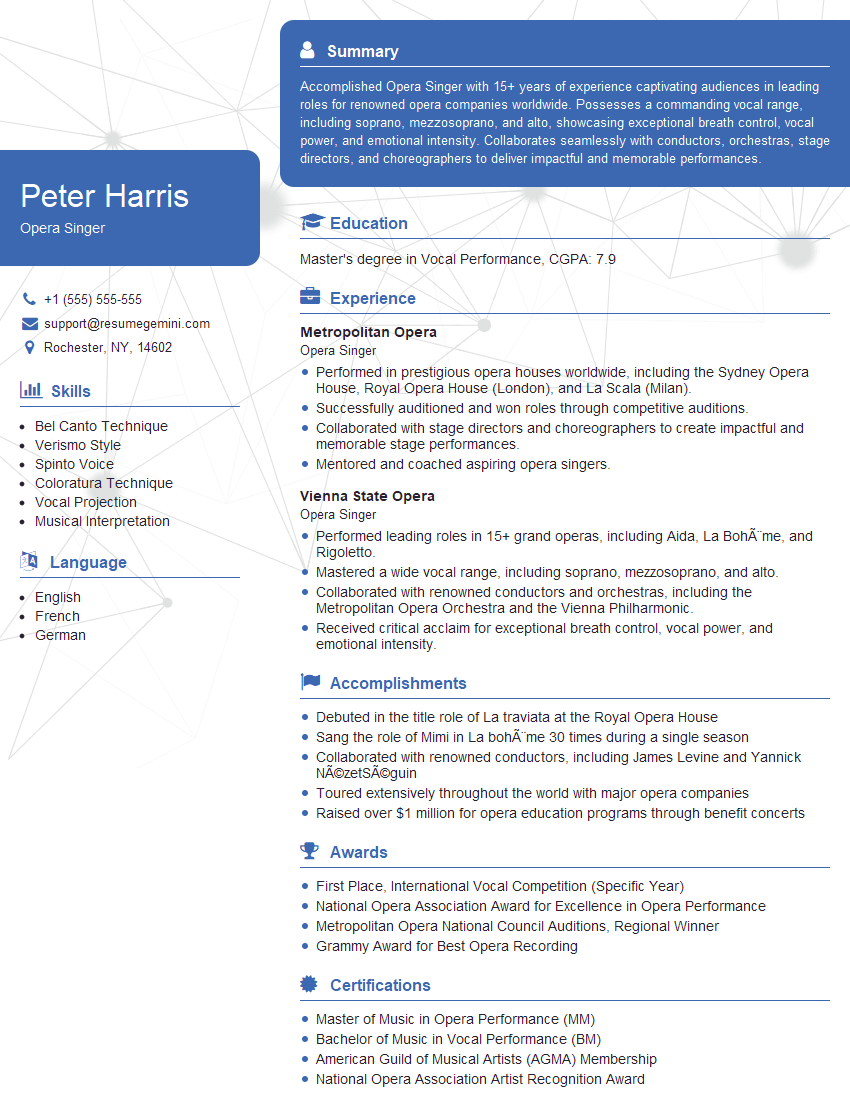
Mastering Classical Repertoire Performance is paramount for career advancement in the competitive world of music. A strong command of your repertoire and the ability to articulate your artistic vision confidently are essential for securing desirable positions. To significantly boost your job prospects, creating an ATS-friendly resume is crucial. This ensures your application gets noticed by recruiters and hiring managers. We highly recommend using ResumeGemini, a trusted resource, to craft a professional and effective resume that highlights your unique skills and experience. ResumeGemini provides examples of resumes tailored to Classical Repertoire Performance to help you get started.
Explore more articles
Users Rating of Our Blogs
Share Your Experience
We value your feedback! Please rate our content and share your thoughts (optional).
What Readers Say About Our Blog
Very informative content, great job.
good