Interviews are opportunities to demonstrate your expertise, and this guide is here to help you shine. Explore the essential Dive Operations interview questions that employers frequently ask, paired with strategies for crafting responses that set you apart from the competition.
Questions Asked in Dive Operations Interview
Q 1. Describe your experience with different diving techniques (e.g., surface supplied, scuba, mixed gas).
My experience encompasses a wide range of diving techniques, each suited to different depths, durations, and operational needs. I’m proficient in scuba diving, the most common method for recreational and some professional dives, using both open-circuit and (with appropriate certifications) closed-circuit rebreathers. Surface-supplied diving (SSD) forms a significant part of my professional experience, providing unlimited gas supply for longer, deeper dives, ideal for commercial and scientific operations. I’ve also worked extensively with mixed gas diving, employing helium-oxygen (Heliox) or trimix (helium-oxygen-nitrogen) blends to mitigate the effects of nitrogen narcosis and oxygen toxicity at significant depths. This involves meticulous planning, gas management, and specialized equipment. For example, during a recent underwater pipeline inspection, the use of Heliox allowed the team to efficiently complete the task while minimizing decompression obligations.
- Scuba: Used for shallower, shorter dives. I have extensive experience with various scuba configurations and emergency procedures.
- Surface Supplied: Employed for deep dives and prolonged underwater operations, providing constant gas flow and communication with the surface.
- Mixed Gas: Utilized for deep and technical dives to prevent nitrogen narcosis and oxygen toxicity. I’m experienced in calculating gas mixtures and managing decompression obligations.
Q 2. Explain the different types of dive profiles and their applications.
Dive profiles illustrate the depth and time spent underwater during a dive. Understanding different profiles is crucial for safe and efficient diving. They are essentially graphs showing depth over time. Here are some common types:
- No-Decompression Dive Profile: This profile remains within the no-decompression limits, meaning the diver can ascend directly to the surface without planned decompression stops. This is typically for recreational dives. The maximum depth and bottom time depend on the diver’s training and the decompression tables or dive computer used.
- Decompression Dive Profile: Involves exceeding no-decompression limits. This necessitates planned decompression stops at various depths during ascent to allow the body to off-gas dissolved inert gases. These profiles are common in technical and commercial diving and are carefully planned using decompression models or dive software.
- Multilevel Dive Profile: Involves multiple depths within a single dive. This can occur in underwater survey or photography where different depths are examined. Proper planning is necessary to determine total bottom time and subsequent decompression obligations.
- Repetitive Dive Profile: When multiple dives are undertaken within a 24-hour period, the residual inert gases in the body increase the risk of decompression sickness. Decompression obligations are usually increased and meticulously managed in accordance with established guidelines.
The choice of dive profile directly impacts the safety and efficiency of the operation. A thorough understanding of dive physiology and decompression theory is paramount when choosing and implementing a dive profile.
Q 3. What are the primary considerations for dive planning?
Dive planning is paramount to diver safety and mission success. Key considerations include:
- Dive Site Assessment: Understanding the underwater terrain, currents, visibility, potential hazards (e.g., strong currents, wrecks, marine life), and access points is crucial.
- Environmental Conditions: Weather forecasts, water temperature, surface conditions (sea state), and tide information directly impact dive safety and the feasibility of the operation.
- Dive Profile and Decompression: Selecting an appropriate dive profile that accounts for depth, bottom time, and decompression requirements based on the dive objectives, experience level of the divers, and gas supply. I utilize dive planning software to generate decompression schedules.
- Equipment Checks: Comprehensive pre-dive equipment checks are vital to ensure all gear is functioning correctly and safely.
- Communication Plan: Establishing clear communication protocols (hand signals, underwater communications, surface support) is essential, particularly for complex or deep dives.
- Contingency Plans: Having well-defined emergency procedures in place for unexpected situations, including equipment malfunctions, diver emergencies, or changes in environmental conditions.
- Team Dynamics and Roles: Assigning clear roles and responsibilities to each team member, if working in a team, to ensure efficient and safe dive execution.
I consistently follow a structured dive planning process using dedicated software and established checklists to minimize risks and maximize the safety and efficiency of each dive operation.
Q 4. Outline the emergency procedures for a diver experiencing decompression sickness.
Decompression sickness (DCS), also known as ‘the bends,’ is a serious condition resulting from dissolved gases coming out of solution in the body during ascent. Emergency procedures include:
- Immediate Ascent: If symptoms appear, the diver should ascend slowly and steadily to the surface, avoiding rapid ascents which can exacerbate the condition.
- 100% Oxygen: Administering 100% oxygen immediately helps to speed up the removal of inert gases from the body. This is often done using an oxygen mask or rebreather.
- Fluid Intake: Encouraging the diver to drink plenty of fluids helps to flush out the gases.
- Evacuation: Contacting emergency medical services (EMS) or a recompression chamber facility immediately is critical. Time is of the essence in treating DCS.
- Recompression Treatment: In most cases of DCS, recompression in a hyperbaric chamber is necessary to force the dissolved gases back into solution, and is administered by trained medical personnel.
Early recognition of symptoms and rapid initiation of treatment are crucial for a positive outcome. I have personal experience in managing DCS situations in the field. In one instance, we successfully evacuated a diver exhibiting DCS symptoms after initiating immediate oxygen therapy and following the established emergency protocols, which resulted in a favorable recovery in the hyperbaric chamber.
Q 5. What are the limitations of scuba diving compared to surface supplied diving?
Scuba diving and surface-supplied diving have distinct limitations:
- Scuba Diving Limitations:
- Limited bottom time due to air supply.
- Depth limitations based on air pressure and decompression requirements.
- Reduced gas supply in emergencies.
- Limited communication capabilities.
- Surface-Supplied Diving Limitations:
- Tethered to the surface, limiting maneuverability.
- Potential for entanglement or snagging.
- Requires skilled surface support personnel.
- More complex and expensive equipment.
The choice between scuba and surface-supplied diving depends on the specific operational requirements. Deep dives, extended underwater tasks, or those requiring significant gas supply generally necessitate surface-supplied diving. Shallower dives with shorter durations, are often best suited to Scuba.
Q 6. Explain the importance of pre-dive checks and equipment maintenance.
Pre-dive checks and equipment maintenance are critical for diver safety. Neglecting this can lead to equipment failure resulting in injury or death. My pre-dive check routine is meticulous and follows a standardized checklist:
- Visual Inspection: Thoroughly inspect all equipment for any damage, wear, or corrosion.
- Functional Tests: Test all equipment functions: regulator, buoyancy compensator (BCD), gauges, lights, etc.
- Gas Supply Check: Verify the quantity and quality of gas supply, including checking for proper cylinder pressure and valve operation.
- Communications Checks: Confirm that all communication devices are functioning.
Regular equipment maintenance, including servicing of regulators, BCDs, and other key components by qualified technicians, is equally important. I adhere strictly to manufacturers’ guidelines, and maintain detailed records of all maintenance operations. A well-maintained and properly checked equipment ensures a safer and more reliable diving experience.
Q 7. How do you calculate decompression stops?
Calculating decompression stops is a complex process that goes beyond simple formulas. It involves considering several factors using specialized decompression models or dive computers. These models account for numerous variables including:
- Depth: The deeper and longer the dive, the greater the amount of inert gases dissolved in the body’s tissues.
- Bottom Time: The duration spent at depth directly impacts the tissue saturation levels.
- Dive Profile: As mentioned before, the actual dive profile impacts the inert gas loading.
- Decompression Algorithm: Dive computers and planning software use complex decompression algorithms (e.g., Bühlmann, ZHL-16B, VPM-B) to calculate decompression stops, accounting for various tissue compartments and gas elimination rates.
- Individual Factors: These include the diver’s age, health, fitness level, and recent dive history which can slightly modify the decompression obligations.
I utilize dive planning software that incorporates these algorithms to generate accurate and safe decompression schedules. Relying on simplified calculations or disregarding established models can be hazardous. The software factors in various parameters and provides a detailed schedule of decompression stops needed to minimize the risk of decompression sickness. Manually calculating decompression stops is rarely undertaken and generally requires significant expertise.
Q 8. Describe your experience with various diving equipment, including its maintenance.
My experience encompasses a wide range of diving equipment, from basic scuba gear to specialized technical diving apparatus. I’m proficient with regulators, buoyancy compensators (BCDs), dive computers, underwater communication systems, dry suits, and various types of underwater lighting and cameras. Maintenance is crucial for safety and equipment longevity. My routine includes pre-dive checks of all equipment, ensuring proper functioning of all valves, gauges, and seals. Post-dive, I meticulously rinse all gear with fresh water, paying close attention to removing any salt or sand. Regular servicing is conducted, involving professional inspections and repairs of regulators, BCDs, and other critical components. I meticulously keep maintenance logs detailing all inspections, repairs, and replacements, adhering to manufacturer recommendations and industry best practices. For example, I once discovered a small crack in my regulator’s second stage during a pre-dive check; this preventative measure averted a potential life-threatening situation during a deep dive.
- Regulators: I regularly check for free-flow, proper air delivery, and overall functionality.
- BCDs: I inspect inflation/deflation mechanisms, ensuring the power inflator works correctly and there are no leaks.
- Dive Computers: I make sure the battery is charged, the software is up-to-date, and the depth gauge and time are accurate.
Q 9. What are the signs and symptoms of nitrogen narcosis and oxygen toxicity?
Nitrogen narcosis and oxygen toxicity are two serious risks associated with scuba diving, particularly at depth. Nitrogen narcosis, often called ‘rapture of the deep,’ is a condition caused by the increased partial pressure of nitrogen at depth, affecting the brain’s function. Symptoms range from mild euphoria and impaired judgment to confusion, disorientation, and hallucinations, similar to alcohol intoxication. The severity increases with depth and individual susceptibility. Oxygen toxicity, conversely, is caused by breathing high partial pressures of oxygen, usually at depth or during prolonged exposure to enriched air nitrox. Mild symptoms include coughing, chest pain, and eye irritation. Severe cases can result in seizures, lung damage, and even death. Recognizing these symptoms is critical. For example, if a diver becomes unusually jovial or starts making poor decisions, it could indicate nitrogen narcosis. Similarly, persistent coughing or breathing difficulties could be signs of oxygen toxicity. Immediate ascent is necessary in such situations.
Q 10. What are your procedures for managing a diver experiencing an emergency underwater?
My emergency procedures for an underwater diver are based on the principles of prioritizing safety, swift response, and efficient problem-solving. The first step is assessment – determining the nature and severity of the emergency. This involves observing the diver’s behaviour, checking their air supply, and assessing their overall condition. Immediate actions will depend on the problem. In a case of a diver running out of air, I’d signal for assistance and provide an emergency air supply using an alternate air source. If the diver seems injured or unconscious, I’d initiate a controlled ascent, while signaling for a surface support team, providing immediate first aid upon reaching the surface. If a diver experiences a decompression illness, my actions involve a controlled, slow ascent, emergency oxygen administration, and contacting emergency medical services. In every scenario, thorough documentation of the incident, including the time, location, depth, and actions taken, is crucial for investigations.
Q 11. How do you handle different types of underwater emergencies?
Underwater emergencies are diverse and require adaptable responses. I handle them by employing a systematic approach, starting with identifying the problem. Equipment failure (like a regulator malfunction) necessitates using backup equipment or assisting the affected diver with an alternate air source. Decompression sickness requires immediate, controlled ascent and oxygen administration. Entanglement involves a careful and controlled disentanglement procedure while maintaining constant communication and monitoring the diver’s air supply. Marine life encounters (e.g., shark or stingray attack) demand a calm and swift response to minimize injury and risk. I am trained in the use of emergency oxygen, and in various techniques for disentanglement, surface signaling, and first aid. I would prioritize stabilizing the victim and getting them to the surface safely while calling for backup or emergency services if necessary.
Q 12. Explain the role of a Dive Safety Officer (DSO).
The Dive Safety Officer (DSO) is the key figure responsible for the safety of all diving operations. They oversee all aspects of the dive, from pre-dive planning and risk assessment to the execution of the dive and post-dive debriefing. The DSO ensures that all divers are adequately trained and equipped, that the dive plan is appropriate for the conditions, and that emergency procedures are in place. Their responsibilities extend to managing the dive support team, ensuring proper communication, and providing medical oversight. They also maintain detailed dive logs, documenting all aspects of the operation. A strong DSO will make sure the dive site is well-surveyed, communication is established, backup equipment is available, and that emergency plans are in place and understood by all personnel. Think of them as the air traffic control of the underwater world, ensuring smooth and safe operation.
Q 13. Describe your understanding of decompression models and tables.
Decompression models and tables are crucial for managing the risks of decompression sickness. They provide guidelines on safe ascent rates and decompression stops based on factors like depth, dive time, and gas mixtures. Various models exist, such as the Bühlmann and Haldane algorithms, each employing different approaches to calculate the dissolved inert gases in the diver’s tissues. Tables present these calculations in a tabular format, making it easier to determine appropriate decompression stops. Modern dive computers use these models to calculate real-time decompression schedules, adjusting for factors like dive profile and individual diver settings. Understanding these models is essential for safely managing prolonged or deep dives. For example, a diver performing a deep dive must strictly adhere to the decompression schedule calculated by the dive computer, and any deviation could result in serious health issues. These tables are not just mathematical formulas; they are the backbone of safe deep dives and reduce risks of decompression sickness.
Q 14. What are the different types of dive computers and their functionalities?
Dive computers are sophisticated instruments that calculate and display vital dive information, greatly enhancing dive safety. There are various types, broadly categorized as basic, recreational, and technical. Basic dive computers display depth, time, and air pressure. Recreational dive computers add features like decompression calculations, ascent rate warnings, and multiple gas capabilities. Technical dive computers offer even more advanced features such as multiple gas mixtures, complex decompression algorithms, and integration with other equipment. For example, some advanced computers can provide real-time calculation for multiple gases used during a dive, or provide integrated data logs for post-dive analysis, essential for dive planning and safety. The functionalities offered depend on the model and intended use, with the choice guided by the complexity and depth of the dive.
Q 15. How do you manage communication during a dive operation?
Effective communication is paramount in dive operations, where lives depend on clear and concise information exchange. We employ a multi-layered approach, starting with pre-dive briefings where the dive plan, potential hazards, and contingency plans are meticulously discussed. This briefing includes assigning roles and responsibilities to each diver and support personnel. During the dive, we use a combination of hand signals (essential underwater), surface markers for visual communication, and underwater communication devices like dive computers with built-in communication systems or diver-to-surface communication systems (DSCS) for voice communication when conditions allow. Post-dive debriefings are crucial for analyzing the dive’s success, identifying areas for improvement, and documenting any incidents. For example, during a recent wreck penetration dive, using pre-arranged hand signals allowed us to efficiently communicate about the location of a critical structural component while maintaining situational awareness.
Career Expert Tips:
- Ace those interviews! Prepare effectively by reviewing the Top 50 Most Common Interview Questions on ResumeGemini.
- Navigate your job search with confidence! Explore a wide range of Career Tips on ResumeGemini. Learn about common challenges and recommendations to overcome them.
- Craft the perfect resume! Master the Art of Resume Writing with ResumeGemini’s guide. Showcase your unique qualifications and achievements effectively.
- Don’t miss out on holiday savings! Build your dream resume with ResumeGemini’s ATS optimized templates.
Q 16. How do you ensure compliance with relevant diving standards and regulations?
Compliance with diving standards and regulations is non-negotiable. We adhere strictly to guidelines set by organizations like the Divers Alert Network (DAN), and any relevant national or international standards specific to the location and type of dive. This includes maintaining meticulous dive logs for each diver, ensuring proper equipment maintenance and certification, and conducting regular safety checks before each dive. We utilize checklists and standardized procedures to guarantee consistent compliance. For example, before every technical dive, we conduct a thorough equipment check using a pre-dive checklist, verifying the proper functioning of all equipment, including redundant systems like backup lights and air supplies. We also ensure that each diver’s certifications are up-to-date and relevant to the dive’s complexity. Failure to comply can result in serious injury or death and significant legal repercussions.
Q 17. Explain the principles of buoyancy control.
Buoyancy control is the art of managing your position in the water column by adjusting your buoyancy. It’s achieved primarily by manipulating the amount of air in your buoyancy compensator (BCD). Adding air makes you more buoyant, allowing you to ascend, while releasing air makes you more negatively buoyant, causing you to descend. Fine-tuning buoyancy is achieved through small adjustments to the BCD, combined with breath control. Proper buoyancy control is crucial for conserving air, preventing accidental ascents or descents, and protecting the marine environment by avoiding contact with the seabed or coral. Imagine it like balancing a scale; you’re constantly adjusting your air supply to maintain a neutral position in the water. In practice, this involves practicing controlled breathing to compensate for small changes in buoyancy and utilizing the BCD to maintain a comfortable hovering position.
Q 18. How do you assess and mitigate dive-related risks?
Risk assessment and mitigation are fundamental to safe diving. We start by identifying potential hazards, such as weather conditions, water currents, visibility, depth, and the experience level of the divers. We then evaluate the likelihood and severity of each hazard. This leads to developing mitigation strategies, which might include choosing an alternative dive site, changing the dive plan, or employing specific equipment. For example, if strong currents are predicted, we might select a sheltered dive site or adjust the dive profile to minimize exposure to the current. This also involves regular equipment checks, contingency planning (e.g., emergency ascent procedures), and having the necessary rescue and first-aid equipment readily available. A thorough risk assessment minimizes potential accidents and ensures diver safety.
Q 19. Describe your experience with underwater navigation and orientation.
Underwater navigation and orientation are essential skills. I’m proficient in using a compass, employing natural navigation techniques (like following a reef line or using the sun/surface as reference points), and utilizing dive computers with GPS capabilities. I have extensive experience in navigating complex underwater environments, including caves, wrecks, and open ocean dives. For instance, during a recent multi-day cave diving expedition, precise compass navigation was crucial to maintain our position within the underwater cave system and to successfully locate the planned exit point. Effective navigation ensures we reach our planned destination safely and efficiently, and it’s crucial for preventing disorientation and accidents.
Q 20. What are the different types of diving hazards and how are they mitigated?
Diving hazards are numerous and can be broadly categorized as environmental (currents, poor visibility, cold water), equipment-related (malfunctioning equipment, air supply issues), and physiological (decompression sickness, nitrogen narcosis). Mitigation involves pre-dive planning (weather checks, equipment inspection, assessing diver fitness), employing appropriate equipment (dry suits for cold water, redundant air supplies, appropriate dive computers), and strict adherence to established dive procedures (decompression stops, controlled ascents). For example, the risk of decompression sickness is mitigated by careful planning of dive profiles, adhering to no-decompression limits, and performing appropriate decompression stops. A thorough understanding of these hazards and their mitigation is crucial for minimizing risk and ensuring safe dives.
Q 21. Explain your experience with working in a team environment during dives.
Teamwork is the cornerstone of safe and efficient diving. I have extensive experience working within highly skilled dive teams, where clear communication, mutual respect, and trust are vital. We rely on established protocols and procedures for buddy checks, emergency response, and task delegation. Each team member has a clearly defined role and understands their responsibilities. In a recent deep technical dive, effective teamwork was critical to the mission’s success. Each member was responsible for specific tasks—equipment monitoring, navigation, and safety—and seamless collaboration allowed us to handle an unexpected equipment malfunction without compromising safety. Team cohesion and mutual support are essential to address challenges and ensure the well-being of all team members.
Q 22. Describe your experience with underwater rescue techniques.
Underwater rescue techniques are crucial for diver safety. My experience encompasses a range of scenarios, from assisting mildly disoriented divers to performing complex rescues in challenging environments. This includes proficiency in:
- Emergency Ascent Techniques: Knowing how to safely and efficiently manage an emergency ascent, considering factors like depth, gas supply, and the diver’s condition. I’m trained in various controlled ascent techniques, including using a safety sausage for buoyancy and signaling.
- Diver Recovery and Support: I’m skilled in using various methods to recover an incapacitated diver, including underwater lifts, assisting with buoyancy control, and using lift bags or specialized rescue equipment. This involves careful assessment of the situation to determine the safest and most efficient approach.
- Search and Rescue Procedures: My training includes systematic search patterns, using visual cues and sonar, when necessary, to locate a missing diver. This involves understanding the effects of currents and underwater visibility.
- Providing Emergency First Aid Underwater: I can administer basic life support under water, including managing airway obstruction and supporting breathing, until the diver can be brought to the surface for advanced medical care.
For example, during a dive in a strong current, I successfully recovered a diver who had run out of air by using a lift bag and maintaining constant communication with the surface support team. Understanding diver physiology and panic management is paramount in these scenarios.
Q 23. How do you maintain accurate dive logs and records?
Maintaining accurate dive logs and records is essential for diver safety and legal compliance. I utilize a combination of methods to ensure accuracy and completeness. This includes:
- Dedicated Dive Logbook: I meticulously record each dive, including date, time, location, depth, duration, air pressure used, dive buddy’s name, and any significant events or observations.
- Digital Dive Log Software: I complement my physical logbook with digital software that allows for easier data organization and analysis. Many apps also incorporate features for tracking equipment maintenance and calculating decompression requirements.
- Regular Reviews and Cross-Checking: I regularly review my logs to ensure accuracy and consistency. Where possible, I compare my data with my dive buddy’s records to identify any discrepancies and ensure complete records.
- Secure Storage: Both physical and digital logs are stored securely to prevent loss or damage. Regular backups of digital data are maintained.
Accurate records are crucial for tracking dive experience, identifying potential health issues related to repetitive diving, and complying with regulatory requirements. Think of it like a pilot’s flight log – essential for safety and professional accountability.
Q 24. Explain your understanding of hyperbaric chamber operations.
Hyperbaric chambers are used to treat diving-related injuries, such as decompression sickness (DCS) and arterial gas embolism (AGE). My understanding encompasses the chamber’s operation, safety protocols, and the role of a medical professional in treating patients.
- Chamber Operation: I understand the procedures for entering, pressurizing, and depressurizing a hyperbaric chamber. This includes the various safety mechanisms and emergency procedures in case of malfunction.
- Treatment Protocols: I am aware of the different treatment protocols used for various diving injuries, understanding that treatment involves recompression therapy with carefully controlled pressure changes and oxygen administration.
- Safety Procedures: Safety is paramount. I know the importance of following strict protocols, including regular equipment checks and monitoring patient vital signs throughout the treatment process.
- Communication and Coordination: Effective communication between chamber operators, medical personnel, and the diving support team is critical for successful treatment.
While I don’t operate the chamber myself, I understand its function and the vital role it plays in emergency dive medicine. It’s a critical piece of safety infrastructure for any serious diving operation.
Q 25. What are your strengths and weaknesses as a diver?
Strengths: I’m a highly disciplined and methodical diver, with excellent buoyancy control and situational awareness. I possess strong problem-solving skills and remain calm under pressure, vital in emergency situations. I’m a strong team player and effective communicator, critical for maintaining safety in diving operations.
Weaknesses: Like any diver, I’m constantly striving to improve. One area I’m focusing on is enhancing my proficiency in low-visibility diving techniques, and I regularly participate in training exercises to address this.
Q 26. Describe a challenging dive situation you overcame.
During a wreck penetration dive, a sudden surge of current dislodged a large portion of sediment, resulting in near-zero visibility. My dive buddy and I were separated, and I quickly lost orientation. Using my training, I remained calm, activated my safety light, and slowly ascended to a point where I could better navigate. Maintaining proper buoyancy, I used my compass to find our planned exit point and successfully rejoined my buddy at the surface. This experience reinforced the importance of detailed dive planning, situational awareness, and maintaining composure in challenging conditions.
Q 27. How do you stay current with the latest developments in dive technology?
Staying current with dive technology is a continuous process. I achieve this through several methods:
- Professional Journals and Publications: I regularly read journals and industry publications to stay informed about new equipment, techniques, and research in diving safety and technology.
- Industry Conferences and Workshops: Attending conferences and workshops provides the opportunity to learn from experts, network with peers, and see new equipment demonstrations.
- Online Resources and Forums: Reputable online resources and forums offer valuable insights into the latest developments and practical experiences from other divers.
- Manufacturer Websites and Training Courses: Directly engaging with manufacturers and attending training courses allows for a deeper understanding of new technologies and improved techniques.
Staying informed ensures that I’m using the safest and most effective equipment and techniques for any diving situation.
Q 28. Explain your understanding of different types of diving suits and their applications.
Different diving suits serve different purposes, depending on the environment and the type of dive. Here are a few examples:
- Wetsuits: These suits use a layer of neoprene to trap water, allowing the water to be heated by the diver’s body. They provide moderate thermal protection and are suitable for warmer waters and recreational diving.
- Drysuits: Drysuits create an air space between the diver and the water, offering superior thermal protection in cold water. They are essential for technical diving or diving in extreme conditions. Various materials like neoprene or trilaminate are used.
- Semidry Suits: A compromise between wetsuits and drysuits. They are more waterproof than a wetsuit but less so than a drysuit offering better thermal protection than a wetsuit in colder waters.
- Exposure Suits: These are thinner, less insulating suits designed to protect the diver from abrasion and minor stings. Commonly worn over wetsuits.
Selecting the appropriate suit is crucial for diver comfort, safety, and performance, as it directly impacts thermal protection, buoyancy, and mobility.
Key Topics to Learn for Dive Operations Interview
- Dive Planning & Procedures: Understanding dive profiles, decompression models, emergency procedures, and risk assessment methodologies. Practical application: Explain your process for planning a complex dive, considering factors like depth, duration, and environmental conditions.
- Dive Equipment & Maintenance: Familiarity with various diving equipment (SCUBA, surface supplied, etc.), their functionality, limitations, and routine maintenance checks. Practical application: Describe your experience troubleshooting equipment malfunctions and performing preventative maintenance.
- Dive Safety & Emergency Response: Proficiency in rescue techniques, emergency ascent procedures, and managing diver stress and panic situations. Practical application: Detail your experience handling a diving emergency scenario, highlighting your decision-making process.
- Environmental Awareness & Conservation: Knowledge of marine environments, potential hazards (currents, tides, marine life), and responsible diving practices. Practical application: Discuss how you contribute to environmental sustainability in your diving activities.
- Dive Supervision & Teamwork: Experience leading or assisting dive teams, communicating effectively underwater, and ensuring team safety. Practical application: Describe a situation where you successfully coordinated a dive team to accomplish a challenging task.
- Dive Regulations & Compliance: Understanding and adhering to local, national, and international diving regulations and standards. Practical application: Explain how you ensure compliance with safety regulations during dive operations.
- Specific Dive Applications (if applicable): Depending on the role, this could include commercial diving, scientific diving, underwater construction, or other specialized areas. Practical application: Showcase your expertise in your chosen area of dive operations.
Next Steps
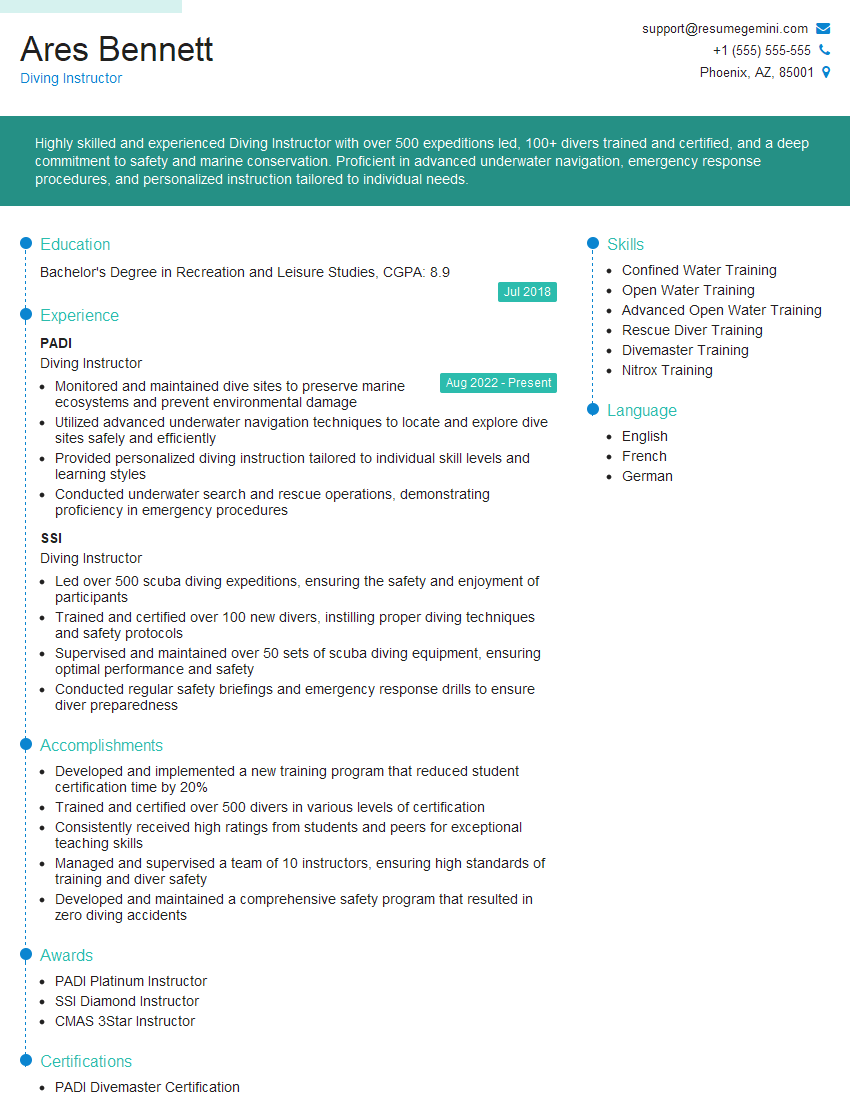
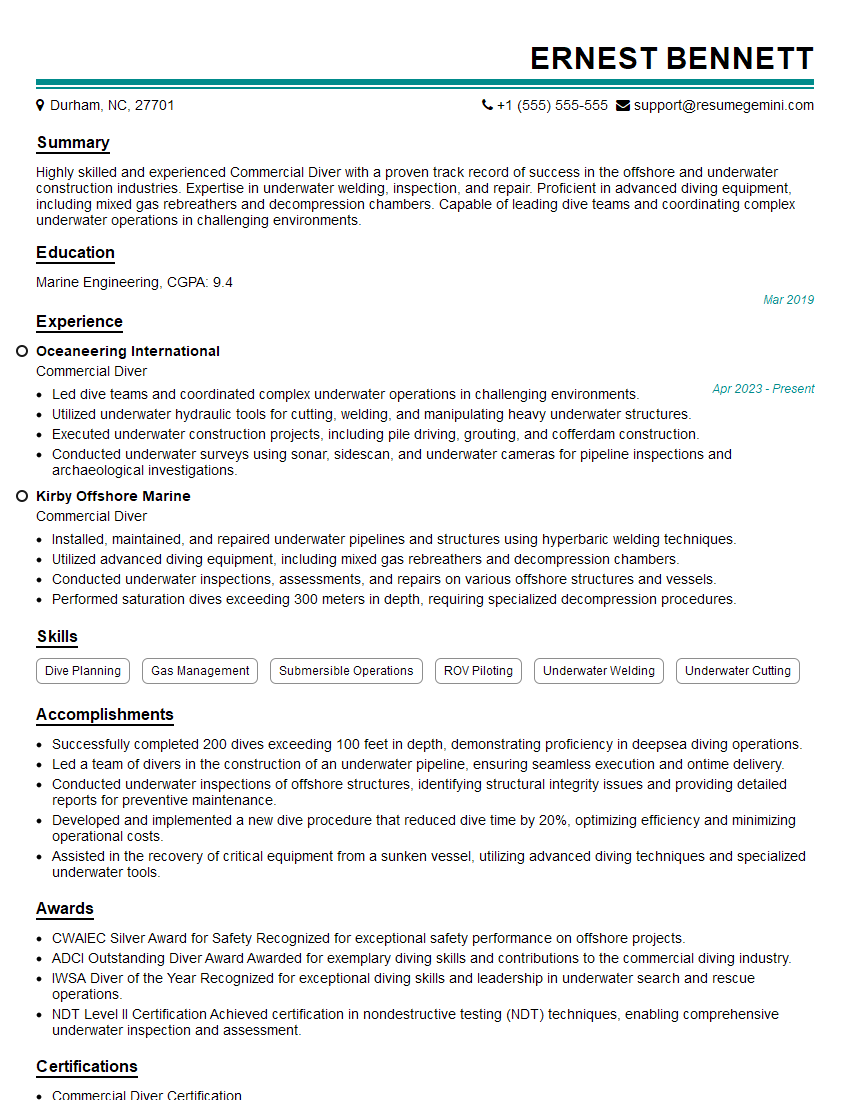
Mastering Dive Operations opens doors to exciting and rewarding career opportunities, offering diverse roles and continuous professional development. To maximize your job prospects, create an ATS-friendly resume that effectively highlights your skills and experience. ResumeGemini is a trusted resource to help you build a professional and impactful resume. We provide examples of resumes tailored to Dive Operations to guide you in crafting a compelling application. Take the next step towards your dream dive operations career today!
Explore more articles
Users Rating of Our Blogs
Share Your Experience
We value your feedback! Please rate our content and share your thoughts (optional).
What Readers Say About Our Blog
Very informative content, great job.
good