Unlock your full potential by mastering the most common Double head machine operation interview questions. This blog offers a deep dive into the critical topics, ensuring you’re not only prepared to answer but to excel. With these insights, you’ll approach your interview with clarity and confidence.
Questions Asked in Double head machine operation Interview
Q 1. Explain the function of a double head sewing machine.
A double head sewing machine is essentially two independent sewing machines integrated into a single unit. This allows for simultaneous sewing of two parallel seams, significantly increasing productivity compared to a single-head machine. Imagine it like having two skilled seamstresses working in perfect synchronization. Each head operates independently, allowing for different stitch types, stitch lengths, and even different thread types on each head if the machine is designed to allow it. This makes them ideal for tasks requiring parallel stitching, such as sewing trouser legs, sleeves, or creating double seams for added strength and durability.
Q 2. Describe the different types of needles used in double head machines.
The type of needle used in a double head machine depends on the fabric and the desired stitch. Common needle types include:
- System needles: These are the most common type, offering a wide range of sizes and points for various fabric weights. System needles are typically coded (e.g., 130/705 H), with the numbers indicating the system and size.
- Ballpoint needles: Ideal for knit fabrics, these needles have a rounded point that glides between the loops of the fabric to prevent snagging or piercing the fabric.
- Sharp needles: Used for woven fabrics, these needles have a sharp point that penetrates the fabric cleanly. They’re also used for sewing tougher materials.
- Stretch needles: Designed for stretch fabrics, these needles have a slightly larger eye and a special point to reduce skipped stitches and thread breakage.
Choosing the correct needle is crucial for quality stitching. Using the wrong needle can lead to skipped stitches, broken needles, and damage to the fabric.
Q 3. How do you adjust the stitch length and width on a double head machine?
Adjusting stitch length and width on a double head machine is typically done independently for each head. Most machines have separate controls for each head. The specific location and type of controls will vary depending on the machine’s manufacturer and model, but generally, you’ll find:
- Stitch length adjustment: This is usually a dial or knob, often marked with numbers or a scale, allowing you to adjust the spacing between stitches. A shorter stitch length provides a more durable seam, while a longer stitch is faster but might be less robust.
- Stitch width adjustment: This control, often a lever or dial, sets the width of the zig-zag or decorative stitches. A narrower width creates a more compact stitch, while a wider width is suitable for decorative purposes or stitching edges.
Always refer to your machine’s manual for precise instructions on adjusting stitch length and width for each head. Improper adjustment can lead to inconsistent stitching and potential sewing problems.
Q 4. What are the common maintenance procedures for a double head machine?
Regular maintenance is key to ensuring the longevity and smooth operation of your double head sewing machine. Key procedures include:
- Daily cleaning: Remove lint, dust, and thread scraps from the bobbin area, feed dogs, and around the needles. This prevents build-up that can cause jams or skipped stitches.
- Lubrication: Apply sewing machine oil to designated lubrication points as recommended by the manufacturer. This ensures smooth movement of parts and prevents wear.
- Needle and bobbin replacement: Regularly replace needles and bobbins to prevent breakage and ensure optimal sewing performance. Bent or dull needles lead to poor stitching.
- Tension adjustment: Check and adjust the upper and lower thread tensions periodically. Improper tension is a frequent source of thread breakage or skipped stitches.
- Regular servicing: Schedule professional servicing at recommended intervals. This involves thorough cleaning, lubrication, and inspection of critical components by a qualified technician.
Think of maintenance as preventative medicine – a little effort goes a long way in preventing costly repairs and downtime.
Q 5. How do you troubleshoot common problems such as skipped stitches or thread breakage?
Troubleshooting skipped stitches or thread breakage often involves systematically checking various components:
- Check the needles: Bent, dull, or incorrectly inserted needles are a major cause of skipped stitches. Replace them immediately if there are any issues.
- Examine the thread: Ensure you’re using the correct thread type and size for your fabric and machine. Damaged or tangled thread can also cause problems.
- Verify thread tension: Both upper and lower thread tensions need to be correctly balanced. Too much or too little tension will result in skipped stitches or thread breakage.
- Inspect the bobbin: A improperly wound or damaged bobbin can cause problems. Ensure the bobbin is correctly inserted and is winding smoothly.
- Check the feed dogs: Make sure the feed dogs are clean and functioning correctly. Dirty or jammed feed dogs can affect the fabric movement and cause skipped stitches.
By following this process of elimination, you can usually identify and rectify the issue quickly. Remember to always unplug the machine before any maintenance or repair.
Q 6. Explain the process of threading a double head sewing machine.
Threading a double head machine is essentially threading two single-head machines simultaneously. The process generally involves:
- Raise the presser feet: Lift both presser feet to allow easy thread access.
- Thread the upper threads: Follow the thread path indicated on your machine, guiding the thread through the tension discs and down to the needle. Each head has its own individual thread path.
- Insert and wind the bobbins: Place the bobbins in their respective compartments. Ensure they’re correctly wound and inserted.
- Thread the bobbin cases: This typically involves carefully threading the bobbin thread through the bobbin case. Each bobbin case will need to be threaded individually.
- Lower the presser feet: Gently lower the presser feet once both heads are correctly threaded.
- Test stitch: Before starting your project, do a test stitch to ensure both threads are feeding correctly and that the stitch quality is satisfactory.
Always consult your machine’s manual for specific threading instructions as variations exist between models. A well-threaded machine is essential for smooth and flawless sewing.
Q 7. Describe the safety precautions you would take while operating a double head machine.
Safety is paramount when operating a double head sewing machine. Key precautions include:
- Proper training: Ensure you have received adequate training on how to safely operate the machine. Never attempt to use it without proper training.
- Keep hands clear: Keep your hands and fingers away from the moving parts of the machine, especially needles and presser feet. Avoid reaching into the sewing area while the machine is running.
- Use appropriate safety guards: Ensure all safety guards are in place and functioning correctly before operating the machine.
- Unplug the machine: Always unplug the machine when not in use, before cleaning, or during maintenance.
- Report damages: Immediately report any malfunction or damage to the machine to prevent accidents. Do not attempt to repair the machine yourself unless properly trained.
- Maintain a clean workspace: Keep the area around the machine free of clutter and obstacles to prevent tripping or accidental contact with the machine.
Remember, safety isn’t just a suggestion – it’s a necessity. Following these precautions will significantly reduce the risk of injury.
Q 8. How do you ensure the consistent quality of your work on a double head machine?
Consistent quality on a double head machine hinges on meticulous attention to detail throughout the entire sewing process. It starts with proper machine setup: ensuring correct needle and thread selection for the fabric, precise stitch length adjustment, and optimal tension balance between the two heads. Regular maintenance, including cleaning and lubrication, is paramount. I always perform a test run on a scrap piece of the same fabric before starting a production run to fine-tune settings and catch any potential issues early. During production, I consistently monitor the stitch formation, fabric feed, and overall seam quality. Any deviation from the expected standard triggers immediate adjustments. For example, if I notice inconsistent stitch length, I’ll check the stitch length dial, the bobbin tension, and the needle condition. Consistent quality isn’t a single action but a continuous process of monitoring, adjusting, and maintaining the machine’s optimal performance.
Think of it like baking a cake: you wouldn’t expect a perfect result without precise measurements, the right ingredients, and consistent oven temperature. The same applies to a double head machine. Each step is crucial to a flawless end-product.
Q 9. What is the difference between a lockstitch and a chainstitch double head machine?
The key difference between lockstitch and chainstitch double head machines lies in the type of stitch they produce and their respective applications. A lockstitch machine creates a strong, interlocked stitch that’s highly durable and resistant to unraveling, ideal for seams requiring significant strength like in denim or upholstery. Each stitch is formed by interlocking the upper and lower threads, creating a secure bond. Conversely, a chainstitch machine produces a series of loops linked together to form a chain. This stitch is less strong than a lockstitch but is often preferred for decorative stitching, embroidery, or applications where ease of seam opening is desirable, like temporary seams in garment manufacturing. Imagine lockstitch as a solid brick wall and chainstitch as a sturdy chain link fence – both serve a purpose but have different strengths.
The choice between the two depends entirely on the intended use. A lockstitch is the workhorse for heavy-duty applications, while chainstitch shines in decorative or less-stressful sewing jobs.
Q 10. How do you identify and fix timing issues on a double head machine?
Timing issues on a double head machine manifest as skipped stitches, inconsistent stitch formation, or needle breakage. Troubleshooting involves a systematic approach. First, I’d visually inspect the machine for any obvious problems like loose belts, misaligned needles, or damage to the needle bar. Then, I’d check the timing marks on the machine’s components, ensuring they align correctly according to the manufacturer’s specifications. Often, a simple adjustment of these marks can resolve the issue. If the problem persists, I’d check the hook timing – the precise synchronization between the needle and hook mechanism is essential for proper stitch formation. Misalignment here often requires specialized tools and expertise, and in such cases, I would contact a qualified technician. The process is much like adjusting the timing belt on a car engine; a small misalignment can cause significant problems.
Systematic checks, beginning with the simplest visually obvious problems and working toward the more intricate mechanical components, are key to efficient troubleshooting.
Q 11. Describe your experience with different types of fabrics on a double head machine.
My experience encompasses a broad range of fabrics, from lightweight silks and delicate chiffons to heavy-duty denim and robust canvas. Each fabric necessitates unique machine settings. For delicate fabrics, I use fine needles, reduce stitch density, and carefully adjust the fabric feed to prevent puckering or breakage. Heavier fabrics, on the other hand, demand stronger needles, higher stitch density, and potentially different presser foot pressure to ensure the fabric is fed evenly through both sewing heads. The adjustments are akin to adjusting the brush on a painter’s palette – the right technique and tool is vital for the desired result.
I’ve worked with knits, wovens, and even non-woven materials, always adapting my technique to suit the specific demands of the fabric type. The key is understanding the behavior and characteristics of different fabrics under the stress of sewing to achieve optimal results.
Q 12. How do you handle fabric tension issues on a double head machine?
Fabric tension issues can lead to puckering, broken stitches, or uneven seams. Addressing them involves a methodical approach. I start by checking the upper and lower thread tensions, adjusting the dials until a balanced tension is achieved. Then, I verify the presser foot pressure – too much pressure can cause puckering, while too little can lead to skipped stitches. Next, I examine the fabric feed mechanism, making sure it’s moving the fabric evenly through both sewing heads. Sometimes the issue lies within the fabric itself – excessively stretchy or stiff fabrics might require pre-treatment or special needle types. I regularly use test pieces to fine-tune the machine settings, ensuring they are optimal for the particular fabric and stitch design. For example, using a Teflon foot for delicate or slippery fabrics prevents the fabric from sticking or puckering under the pressure foot.
Troubleshooting fabric tension often requires a nuanced understanding of how the machine interacts with the fabric itself.
Q 13. Explain the importance of proper lubrication for a double head machine.
Proper lubrication is vital for the longevity and smooth operation of a double head machine. It minimizes friction between moving parts, reducing wear and tear and preventing premature failure. Regular lubrication also enhances the machine’s efficiency, ensuring consistent stitch quality and reduced noise levels. The lubrication process involves applying the appropriate lubricant – often a specialized sewing machine oil – to designated areas, such as the needle bar, hook mechanism, and feed dogs. Over-lubrication can be as damaging as under-lubrication; it can attract lint and dust, creating a gummy residue that negatively impacts the machine’s performance. I follow the manufacturer’s recommended lubrication schedule and use only approved lubricants. Think of it like oiling the hinges on a door; proper lubrication ensures smooth, quiet, and long-lasting performance.
Neglecting lubrication is a surefire path to increased maintenance costs and shorter machine lifespan.
Q 14. Describe your experience with different types of double head machine brands and models.
My experience extends to various brands and models of double head machines, including but not limited to [Mention specific brands and models, e.g., Juki, Brother, etc.]. Each brand and model has its own unique features, strengths, and quirks. For instance, some brands excel in speed and durability, while others focus on precision and ease of operation. Understanding these differences enables me to optimize my work based on the specific machine being used. I’m adept at adapting my techniques to various control panels and operating systems. Switching between brands is similar to driving different cars—each has a unique feel and control, requiring a brief adjustment period to optimize performance.
This experience ensures adaptability and proficiency across a variety of industrial sewing machines, making me a versatile asset in any sewing environment.
Q 15. How do you maintain accurate stitch counts on a double head machine?
Maintaining accurate stitch counts on a double-head machine is crucial for consistency and quality. It’s not simply about a single counter; it involves a multi-faceted approach. First, ensure your machine is properly calibrated. This involves checking the stitch length setting against a known standard, often using a test fabric. Discrepancies might indicate a need for adjustment via the machine’s control panel or internal mechanisms.
Secondly, regularly inspect the feed dogs. Uneven feed can drastically impact stitch counts. Clean any lint or debris that may accumulate, ensuring smooth fabric movement. Thirdly, pay attention to the thread tension. Incorrect tension can cause skipped stitches or inconsistent stitch formation, skewing the count. Periodic tension adjustments, often machine-specific, are necessary to maintain accuracy. Finally, using a stitch counter (either built-in or an external device) provides a direct measure of stitches per unit of time or fabric length. Comparing these counts against planned production allows for immediate identification of discrepancies and necessary corrective actions.
For instance, I once encountered a situation where a client’s order required a precise stitch count per inch for a delicate lace fabric. By meticulously checking calibration, feed dog alignment, and thread tension, and utilizing the machine’s built-in counter, I was able to achieve the exact specifications and ensure the final product met the client’s rigorous standards.
Career Expert Tips:
- Ace those interviews! Prepare effectively by reviewing the Top 50 Most Common Interview Questions on ResumeGemini.
- Navigate your job search with confidence! Explore a wide range of Career Tips on ResumeGemini. Learn about common challenges and recommendations to overcome them.
- Craft the perfect resume! Master the Art of Resume Writing with ResumeGemini’s guide. Showcase your unique qualifications and achievements effectively.
- Don’t miss out on holiday savings! Build your dream resume with ResumeGemini’s ATS optimized templates.
Q 16. How do you handle jams or blockages in the machine?
Handling jams or blockages on a double-head machine requires a systematic approach to avoid further damage. Firstly, safety is paramount – always turn the machine off and unplug it before any intervention. Never attempt to clear a jam with the machine running. Next, carefully identify the location of the blockage. This often involves inspecting the needle area, the bobbin case, and the thread path.
Common causes include tangled thread, broken needles, or fabric buildup. A broken needle, for instance, can easily cause a thread jam. In this case, replacement with a needle of the correct size and type is crucial. If it’s a thread jam, gently unwind the tangle, ensuring to remove any broken pieces that might be obstructing the flow. Fabric buildup needs to be carefully removed with the appropriate tools, avoiding damage to delicate components. Always refer to the machine’s manual for specific instructions on jam clearance for your particular model.
For example, I once had a significant jam involving two different color threads getting tangled. Through careful disassembly of the relevant components (following the manual diligently), I was able to untangle the mess without damaging the machine. Patience and systematic examination are key to efficient jam resolution.
Q 17. What is your experience with computerized double head machines?
My experience with computerized double-head machines is extensive. I am proficient in operating various models, from basic computerized machines to those with advanced features such as pattern memory, automatic thread trimming, and integrated diagnostics. I understand the importance of programming stitch patterns, setting parameters like stitch density and speed, and utilizing the diagnostic tools to troubleshoot issues.
Computerized machines offer significant advantages in terms of precision, repeatability, and efficiency. They can handle complex patterns easily and maintain consistency far better than manual machines. However, proper programming and maintenance are crucial for optimal performance. I am comfortable with various programming interfaces and have experience troubleshooting software and hardware issues. I understand how to use the machine’s diagnostics to pinpoint errors efficiently, minimizing downtime and increasing productivity.
In one project, we were tasked with producing intricate embroidered patches. The client provided complex designs requiring precise stitching. The computerized double-head machine, with its ability to store and recall patterns, played a vital role in meeting the production deadline with flawless quality. My proficiency in programming the machine was crucial to the project’s success.
Q 18. How do you read and interpret sewing machine patterns?
Reading and interpreting sewing machine patterns is fundamental to operating a double-head machine effectively. These patterns, usually provided as digital files or paper blueprints, define the stitch sequences, fabric placement, and overall design for a given product. Understanding these patterns involves deciphering symbols, measurements, and specific instructions.
Common symbols represent stitch types (e.g., straight stitch, zigzag stitch), stitch lengths, and thread colors. Precise measurements are essential for accurate fabric placement, ensuring that the final product meets the design specifications. The instructions often guide the operator through the sequence of stitching operations, including how to handle fabric folds, turns, and transitions between different stitch patterns.
For example, a complex pattern might involve multiple color changes, requiring the operator to understand the color codes and efficiently change threads to achieve the desired visual result. The pattern could specify precise distances for seams, leading the operator to use appropriate guides and measurements throughout the sewing process.
Q 19. How do you adjust the pressure foot on a double head machine?
Adjusting the pressure foot on a double-head machine is crucial for consistent stitch quality and fabric handling. The pressure foot applies pressure to the fabric, ensuring it’s held firmly against the feed dogs during stitching. Incorrect pressure can lead to skipped stitches, puckering, or damage to the fabric.
The adjustment mechanism varies slightly depending on the machine model, but generally involves a dial, screw, or lever typically found near the pressure foot itself. Higher pressure is usually needed for thicker fabrics to ensure adequate feed, while lower pressure is necessary for delicate materials to prevent damage. The adjustment is an iterative process; start with a moderate pressure and fine-tune it based on the fabric’s response. Experimenting with a test swatch is highly recommended before working on the actual production run.
I once worked with a very delicate silk fabric. An improper pressure foot setting caused puckering and inconsistent stitches, ruining several pieces. By carefully adjusting the pressure to the lowest setting while ensuring adequate feed, I was able to sew the remaining fabric with perfect results, demonstrating the importance of precise pressure foot adjustment.
Q 20. How do you identify and repair broken needles?
Identifying and repairing broken needles is a routine task for a double-head machine operator. A broken needle is often immediately noticeable by a missed stitch, a skipped row, or an abrupt stop in the stitching process. Broken needles are typically caused by hitting an object like a pin or a hard material in the fabric, or by improper use or dull needles.
Identifying the broken needle usually involves visually inspecting the needle and the needle plate. Remove the broken needle using needle nose pliers or tweezers carefully. After removing the broken needle, carefully examine the needle plate for any damage, since the broken needle can sometimes cause scratches or damage to the needle plate. Always replace the needle with a new one of the same size and type, specified in the machine’s manual. Never attempt to continue stitching with a broken needle, as it could cause damage to the fabric, the machine, or even result in personal injury.
I recall an incident where a small metal piece embedded in the fabric caused a needle to break. By promptly identifying the cause and replacing the needle, I averted further damage to the fabric and machine. Thorough inspection and prompt replacement are crucial for preventing further issues.
Q 21. Describe your experience with different types of thread and its applications.
My experience encompasses a wide range of threads, each with its own characteristics and applications. The choice of thread significantly influences the stitch quality, durability, and overall aesthetics of the finished product. Factors such as fiber type (cotton, polyester, rayon, silk, etc.), thickness (denier or tex), and twist all play a crucial role.
For example, polyester threads offer excellent strength and durability, making them suitable for heavy-duty applications and fabrics requiring resistance to abrasion or fading. Cotton threads provide a softer hand and are preferred for delicate materials and applications where a natural look is desired. Rayon threads exhibit a beautiful sheen and are often used for decorative stitching. Choosing the right thread for the fabric and application is crucial. Using a heavier thread on delicate fabrics can cause damage, whereas a lighter thread may break when used on heavier materials. Understanding thread properties is essential for successful sewing operations on a double-head machine.
In one project, I used a specialty thread for a high-end garment. The thread, made from a blended micro-fiber, provided both strength and a unique luxurious sheen. The knowledge of different thread types and their applications allowed me to achieve the desired aesthetic and functional requirements for that project.
Q 22. How do you ensure the consistent feeding of fabric through the machine?
Consistent fabric feeding is paramount for efficient and high-quality stitching on a double head machine. It involves a multi-step process starting with proper material preparation. First, I ensure the fabric is properly unwound and free from wrinkles or knots. This prevents jams and ensures even tension throughout the stitching process. The tension on the fabric is then carefully adjusted using the machine’s controls, often through a series of rollers and guides. This adjustment is critical as too much tension can cause stretching or breakage, while too little can lead to inconsistent stitching or puckering. I regularly inspect the feeding mechanism, looking for any signs of wear or misalignment. Think of it like a conveyor belt – it needs regular maintenance to operate smoothly. For example, I’ll check the roller alignment and replace worn components promptly. Finally, I maintain a steady and controlled feeding speed, adapting as needed depending on the fabric type and stitch design. This prevents overloading the machine and ensures a consistent flow of fabric.
Q 23. What is your experience with different types of seams produced by a double head machine?
My experience encompasses a wide range of seams achievable with a double head machine. I’m proficient in producing flat seams, ideal for garments requiring a clean, unblemished finish. I also have extensive experience with welt seams, used in pockets and other structural garment components. These require precise control of the machine to create a neat, sturdy seam. Furthermore, I can create decorative seams for enhanced aesthetics, adapting stitch settings and even incorporating different thread types for variety. For instance, I’ve worked on projects needing complex decorative stitching, requiring careful coordination between both needle heads to create intricate patterns. The key is understanding the relationship between stitch settings (length, width, density), fabric properties, and the desired aesthetic outcome.
Q 24. How do you troubleshoot and repair problems with the motor and drive systems?
Troubleshooting motor and drive system issues requires a systematic approach. I begin with visual inspections, checking for loose connections, frayed wires, or any signs of physical damage. If a problem is detected, I’ll carefully follow the machine’s maintenance manual, often involving checking belt tension, lubricating moving parts, or replacing worn components. I’m experienced with diagnosing electrical problems such as faulty switches or motor controllers. For example, if the machine is making unusual noises, I’ll check for bearing wear or belt slippage. If the issue persists, I may need to utilize a multimeter to check voltage and current readings, isolating faulty components before repair or replacement. Safety is always paramount; I always disconnect the power supply before undertaking any repair work.
Q 25. Describe your experience working with high-volume production on a double head machine.
I’ve consistently worked on high-volume production runs, often exceeding daily targets. This experience has honed my skills in efficient machine operation and preventative maintenance. I understand the importance of minimizing downtime, utilizing techniques like pre-emptive checks and keeping a well-stocked supply of needles and thread. In high-volume settings, time is money, so I’ve developed the ability to identify and resolve minor issues quickly to avoid production delays. For example, during one particular rush order, I noticed a slight misalignment in the needle feed, leading to inconsistent stitching. By quickly adjusting the settings and monitoring closely, I was able to avoid a significant production backlog. The key is maintaining focus and proactively addressing potential problems before they escalate.
Q 26. How do you prioritize tasks and manage your time efficiently when operating a double head machine?
Effective task prioritization and time management are crucial when operating a double head machine. My approach involves analyzing the production schedule, identifying tasks based on urgency and complexity. I use a combination of visual aids, such as checklists, to track progress. For instance, if I have a mix of high-volume, simple seams and a smaller batch of complex ones, I might prioritize the high-volume tasks initially to maximize output, interspersed with shorter runs of the complex seams to maintain workflow balance. Breaking down large tasks into smaller, manageable steps also helps. This methodical approach allows me to maintain a consistent workflow and meet deadlines without feeling overwhelmed.
Q 27. What steps do you take to ensure the safety of yourself and your colleagues around the machine?
Safety is my top priority. Before starting work, I always ensure the machine is properly grounded and all safety guards are in place. I wear appropriate personal protective equipment (PPE), including safety glasses and protective clothing to shield against accidental needle pricks or fabric entanglement. I maintain a clean and clutter-free workspace around the machine to prevent trips and falls. Furthermore, I understand and follow all lockout/tagout procedures during maintenance or repairs to prevent accidental machine starts. This isn’t just about my safety; it’s about the safety of my colleagues, and promoting a safe work environment is a shared responsibility.
Q 28. How do you contribute to maintaining a clean and organized workspace while operating the machine?
Maintaining a clean and organized workspace is essential for both safety and efficiency. I regularly clear away fabric scraps, thread ends, and other debris. This prevents accidental entanglement or jams. I organize tools and materials in designated areas for easy access, and I keep the machine itself clean and free of dust and lint, which can affect its performance. This prevents breakdowns and prolongs the machine’s life. Think of it as an extension of preventative maintenance; a clean machine is a happy, efficient machine. This proactive approach contributes to a more pleasant and safer working environment for everyone.
Key Topics to Learn for Double Head Machine Operation Interview
- Machine Setup and Calibration: Understanding the intricacies of setting up the machine, including tool adjustments, material feed configurations, and precise calibration techniques for optimal performance.
- Operational Procedures and Safety Protocols: Mastering the standard operating procedures (SOPs), emphasizing safety regulations, emergency shutdowns, and preventative maintenance routines.
- Troubleshooting and Diagnostics: Developing the ability to identify, analyze, and resolve common operational issues, including malfunctions, jams, and quality defects. This includes understanding error codes and preventative maintenance.
- Material Handling and Quality Control: Gaining proficiency in handling various materials, ensuring consistent material flow, and implementing quality control checks throughout the operational process. This includes understanding material specifications and their impact on machine operation.
- Production Optimization and Efficiency: Learning techniques to maximize production output, minimize downtime, and improve overall efficiency. This includes understanding cycle times and optimizing machine parameters.
- Understanding the Machine’s Control System (PLC, HMI): Familiarity with the machine’s control system, including basic programming concepts (if applicable), troubleshooting using the HMI, and interpreting data from the control system.
- Maintenance and Preventative Measures: Developing a strong understanding of routine maintenance tasks, including lubrication, cleaning, and part replacement, to extend the machine’s lifespan and prevent unexpected breakdowns.
Next Steps
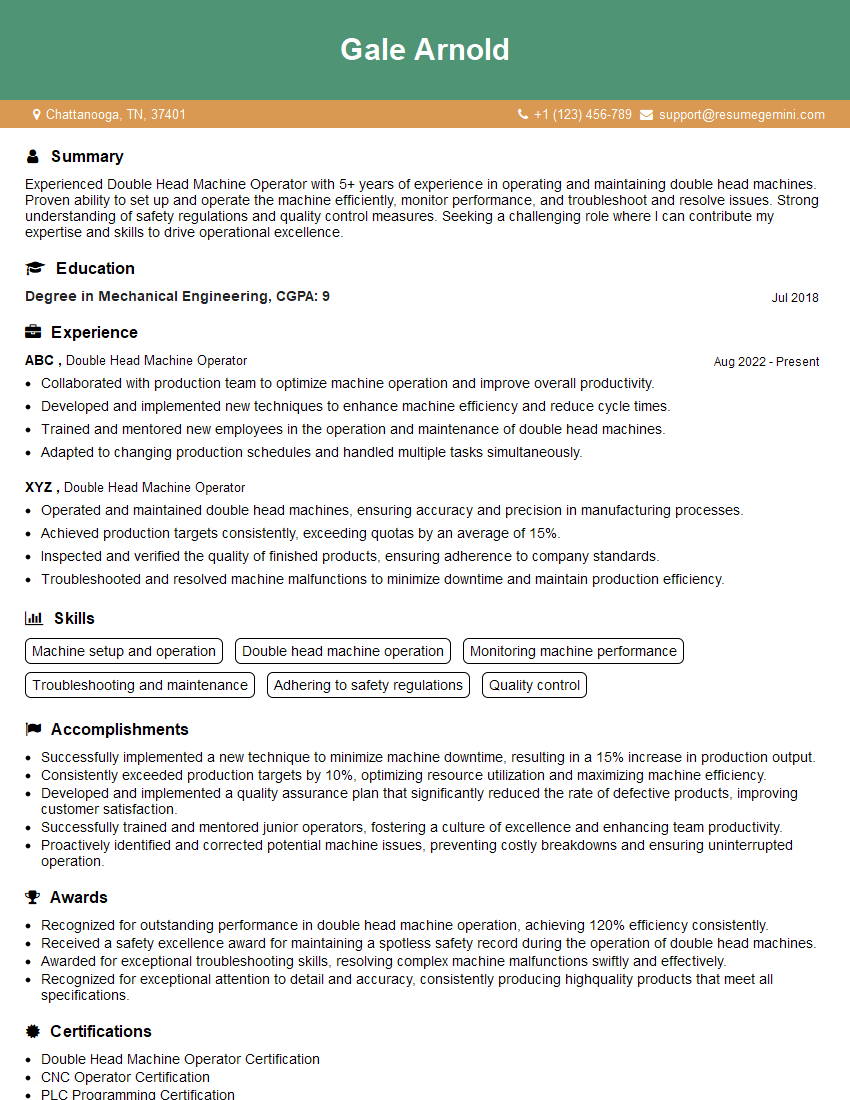
Mastering double head machine operation opens doors to exciting career advancements within manufacturing and related industries, offering opportunities for specialization and increased earning potential. To significantly boost your job prospects, focus on creating an ATS-friendly resume that highlights your skills and experience effectively. ResumeGemini is a trusted resource to help you build a professional resume that stands out. We provide examples of resumes tailored to double head machine operation to guide you in showcasing your qualifications in the best possible light.
Explore more articles
Users Rating of Our Blogs
Share Your Experience
We value your feedback! Please rate our content and share your thoughts (optional).
What Readers Say About Our Blog
Very informative content, great job.
good