Interviews are opportunities to demonstrate your expertise, and this guide is here to help you shine. Explore the essential Knowledge of Sports Terminology and Concepts interview questions that employers frequently ask, paired with strategies for crafting responses that set you apart from the competition.
Questions Asked in Knowledge of Sports Terminology and Concepts Interview
Q 1. Define ‘offside’ in soccer.
Offside in soccer is a rule designed to prevent a team from camping near the opponent’s goal and waiting for a pass. It’s called when an attacking player is in an advantageous position beyond the second-to-last defender (not including the goalkeeper) when the ball is passed to them.
- Advantageous position: This means closer to the opponent’s goal line than both the ball and the second-to-last defender.
- The moment of the pass: The offense is only offside at the exact moment the pass is played. If the player is level with the defender or behind them at the time of the pass, they are not offside, even if they subsequently run into an advantageous position.
Imagine a race: The attacking player is ‘racing’ the ball towards the goal. If they are ahead of the ball and also ahead of the second-to-last defender, they’re offside.
Practical Application: Understanding offside is crucial for both players and referees to maintain fair play and prevent overly defensive tactics. A wrongly called offside can lead to missed scoring opportunities, while failing to call an offside can give an unfair advantage to the attacking team.
Q 2. Explain the difference between a ‘fastball’ and a ‘curveball’ in baseball.
The difference between a fastball and a curveball lies primarily in their trajectory and the way they are thrown:
- Fastball: A fastball is thrown with a straight trajectory, aiming to reach the batter as quickly as possible. Its speed is its primary weapon, often exceeding 90 mph (145 km/h) in professional baseball. The grip is generally a four-seam or two-seam grip, maximizing speed and minimizing curve.
- Curveball: A curveball is thrown with a spinning motion that makes it curve (break) significantly in the air. The grip and wrist action contribute to this curve. The curveball is usually slower than a fastball and relies on its unpredictable trajectory to fool the hitter.
Think of it like throwing a frisbee: a fastball is like throwing it straight, while a curveball is like putting a spin on it to make it curve to the side.
Practical Application: Pitchers use a variety of fastballs and curveballs, along with other pitches, to keep batters guessing and to exploit their weaknesses. A successful pitcher strategically mixes these pitch types throughout the game.
Q 3. What is a ‘slam dunk’ in basketball?
A slam dunk in basketball is a spectacular scoring move where a player jumps high above the basket and throws the ball forcefully downward into the hoop.
It’s considered a high-percentage shot, as it avoids the need for accuracy from distance. The ball is forcefully driven through the hoop from above the rim. The shot usually involves an impressive display of athleticism and power.
Practical Application: Slam dunks are used as a highlight reel play and are an effective scoring method when close to the basket. They provide an immediate morale boost for the team performing the dunk and often demoralize the opponent.
Q 4. What is the purpose of a ‘free kick’ in soccer?
A free kick in soccer is an indirect or direct kick awarded to a team to restart play after a foul committed by the opposing team.
- Indirect free kick: The goal cannot be scored directly from an indirect free kick. The ball must touch another player before it enters the goal. Often awarded for minor fouls.
- Direct free kick: The goal *can* be scored directly from a direct free kick. This is usually given for more serious fouls, such as a trip or handball inside the penalty area.
The purpose is to provide a fair way for the non-fouling team to regain possession and potentially score. The location of the free kick will depend upon where the foul was committed.
Practical Application: Free kicks are often a strategic opportunity for a team. They can lead to goals from direct shots, create set-piece plays (like corner kicks) or allow for reset of the play and a quick counterattack.
Q 5. Describe the role of a ‘quarterback’ in American football.
The quarterback in American football is the leader of the offense. They are responsible for calling plays, receiving the snap from the center, and either handing off the ball to a running back, throwing a pass to a receiver, or running the ball themselves.
Beyond their primary role, they are the offensive captain, directing the other players. They make critical decisions during the game based on the opposing defense’s strategy and the game situation. They need exceptional leadership skills to manage the team’s offensive scheme.
Practical Application: The quarterback’s performance is highly influential on the success of the whole offensive unit. A skilled quarterback possesses a deep understanding of the playbook, can read defensive formations, and accurately throws the ball to receivers, enabling the team to score.
Q 6. What constitutes a ‘touchdown’ in American football?
A touchdown in American football is scored when a player carrying the ball legally crosses the opponent’s goal line. This can be achieved by running with the ball, catching a pass, or recovering a fumble.
It’s worth six points. Following a touchdown, the scoring team is given the opportunity to score an extra point by kicking a field goal or running/passing the ball into the end zone again.
Practical Application: The touchdown is the primary objective of an offensive team. It’s the most significant scoring play in the game, and success in scoring touchdowns determines the outcome of the game.
Q 7. Explain the difference between a ‘forehand’ and a ‘backhand’ in tennis.
The difference between a forehand and a backhand in tennis lies in the direction from which the player strikes the ball:
- Forehand: In a forehand, the player hits the ball with the face of the racket on the same side of their body as their dominant hand. This is generally a more powerful and natural stroke for most players.
- Backhand: In a backhand, the player hits the ball with the back of the racket’s face (usually utilizing a ‘one-handed’ or ‘two-handed’ grip). It’s usually a more challenging stroke to master, requiring specific techniques and coordination.
Imagine yourself hitting a ball with a tennis racket. A forehand would be hitting it in front of you, using your natural, dominant hand, while a backhand would be hitting it across your body using your other hand.
Practical Application: The ability to effectively execute both forehands and backhands is essential for a complete tennis game. Players use a variety of strokes to cover different court positions and return various types of shots.
Q 8. What is a ‘hole-in-one’ in golf?
A hole-in-one in golf, also known as an ‘ace,’ is when a player hits the ball into the hole in exactly one stroke, from the tee to the cup. It’s an incredibly rare and exciting event, requiring a perfect combination of skill, precision, and a bit of luck. Imagine hitting a ball 150 yards, navigating any obstacles, and having it perfectly roll into the cup – that’s a hole-in-one!
The significance lies not just in the rarity but also the immediate impact on the player’s score. It instantly reduces the score for that hole to one, a significant advantage over par. Professional golfers and amateurs alike celebrate this achievement greatly.
For example, in a professional tournament, a hole-in-one might be the difference between a win and a loss, particularly if it happens late in the game. It also often leads to sponsor bonuses or other rewards.
Q 9. What is the significance of the ‘red zone’ in American football?
In American football, the red zone refers to the area on the field within the opponent’s 20-yard line. It’s called the red zone because it’s typically marked in red on television broadcasts and scoreboards. Its significance lies in its proximity to the end zone, making it a critical scoring area. Teams are far more likely to score a touchdown from within the red zone than from further out.
The closer a team gets to the end zone, the higher their chances of scoring. Offensive plays and strategies change significantly once inside the red zone, with a greater emphasis on short, controlled passes and running plays to maximize scoring opportunities.
Think of it like this: if you’re close to the goal in basketball, you’re going to attempt a layup or a short shot, not a three-pointer. The red zone in football works in a similar fashion.
Q 10. Explain the concept of ‘icing the kicker’ in American football.
‘Icing the kicker’ is a tactic in American football where the opposing team calls a timeout immediately before the opposing team attempts a field goal or extra point. The theory is that this disruption can negatively impact the kicker’s concentration and potentially lead to a missed kick. It’s a strategic move, albeit a somewhat controversial one.
The effectiveness of icing the kicker is debated. Some studies suggest a negligible effect, while others show a slight increase in missed kicks. However, the mere possibility of impacting the kicker’s performance is enough for coaches to utilize this tactic regularly, especially in high-pressure situations.
The psychological element plays a significant role. The timeout adds unexpected pressure and breaks the kicker’s rhythm. Even if it doesn’t directly affect their kicking ability, it can cause a mental lapse at a crucial moment.
Q 11. What is a ‘penalty’ in hockey?
In hockey, a penalty is a punishment given to a player for violating the rules of the game. Penalties can range from minor infractions, like tripping or slashing, to more serious offenses, like fighting or checking from behind. When a player is penalized, they are sent to the penalty box for a specified amount of time, during which their team plays shorthanded.
The severity of the penalty dictates the length of time spent in the penalty box. Minor penalties usually result in two minutes, while major penalties can be five minutes or even longer. Penalties dramatically affect the flow of the game and can often decide the outcome, particularly in close games.
For instance, a team playing shorthanded might allow a power-play goal, giving the other team a significant advantage. Understanding penalty calls and strategies for both avoiding penalties and capitalizing on opponents’ penalties is crucial for success in hockey.
Q 12. Define ‘grand slam’ in baseball.
In baseball, a grand slam is a home run hit with bases loaded (meaning all three base runners are on base). This is the most impactful single play in baseball, resulting in four runs being scored immediately – one for the batter and one for each runner already on base. It’s an incredibly exciting moment for both the hitter and their team.
The strategic implication of a grand slam is huge. Four runs often swing the momentum of a game significantly, even in late innings. A grand slam can completely demoralize the opposing team and energize the hitting team’s bench and fans. It’s the ultimate clutch hit.
Think of it like hitting a game-winning basket at the buzzer, except amplified due to the four runs scored at once. It’s a rare and spectacular event in baseball that can instantly change the game’s dynamic.
Q 13. What is a ‘triple crown’ in horse racing?
In horse racing, the Triple Crown refers to winning three specific prestigious races in the same year: the Kentucky Derby, the Preakness Stakes, and the Belmont Stakes. These races are run over different distances and are held at different racetracks in the US. Achieving the Triple Crown is an incredible feat of athleticism and horsemanship, demonstrating the horse’s exceptional talent and stamina.
The Triple Crown is considered one of the most difficult achievements in all of sports. The races are demanding, and horses must perform at peak condition over a relatively short time frame. The victories are incredibly prestigious and establish the winning horse as one of the greatest of all time.
Only a select few horses throughout history have completed the Triple Crown; it stands as a testament to their abilities and a mark of legendary status.
Q 14. What does ‘KO’ mean in boxing?
In boxing, ‘KO’ stands for knockout. A knockout occurs when a boxer is rendered incapable of continuing the fight by the referee, typically due to a punch or a series of punches that have left them unable to defend themselves or have suffered a significant injury. It’s a decisive victory, ending the match instantly.
A KO is a result that requires immediate attention from the referee and medical staff. Safety is paramount. The severity of a KO varies; some boxers recover quickly, while others may require more extensive medical care. The ability to deliver or withstand a knockout is a significant factor determining a boxer’s success.
For example, a knockout victory is often more celebrated than a decision victory, as it demonstrates superior punching power and the ability to incapacitate the opponent. The thrill of a sudden knockout is a cornerstone of boxing’s appeal.
Q 15. Explain the term ‘no-hitter’ in baseball.
A no-hitter in baseball is a game where a pitcher, or a team of pitchers, prevents the opposing team from getting a single hit throughout the entire game. It’s a remarkable feat of pitching skill and control, requiring precision, stamina, and often a bit of luck. Think of it like a perfect game, but with the crucial difference of allowing walks (bases on balls).
Example: Imagine a pitcher throws 9 innings, and despite facing batters who manage to get on base via walks, errors, or hit batsmen, none of those batters actually hit a fair ball that the fielders didn’t successfully catch or make a play on. That’s a no-hitter.
Practical Application: A no-hitter is a significant achievement in baseball statistics and a testament to a pitcher’s dominance. It highlights their ability to consistently locate their pitches, change speeds, and keep batters off balance. Teams often celebrate no-hitters as major accomplishments.
Career Expert Tips:
- Ace those interviews! Prepare effectively by reviewing the Top 50 Most Common Interview Questions on ResumeGemini.
- Navigate your job search with confidence! Explore a wide range of Career Tips on ResumeGemini. Learn about common challenges and recommendations to overcome them.
- Craft the perfect resume! Master the Art of Resume Writing with ResumeGemini’s guide. Showcase your unique qualifications and achievements effectively.
- Don’t miss out on holiday savings! Build your dream resume with ResumeGemini’s ATS optimized templates.
Q 16. What is a ‘perfect game’ in baseball?
A perfect game in baseball is an even rarer accomplishment than a no-hitter. It’s a game where a pitcher, or a team of pitchers, does not allow the opposing team to reach base at all—no hits, no walks, and no errors. Every batter is retired via a putout. It’s the ultimate demonstration of pitching mastery and is considered one of the most prestigious achievements in baseball.
Example: Imagine a pitcher retiring 27 batters in a row, with every batter making an out either by strikeout, fly out, ground out, or being forced out. That’s a perfect game. The opposing team never even gets a runner on base.
Practical Application: A perfect game is exceptionally rare, and it showcases an extremely high level of pitching performance and defensive support. It’s a moment etched in baseball history, and achieving one is a significant mark of a pitcher’s career.
Q 17. What is ‘VAR’ in soccer and how is it used?
VAR, or Video Assistant Referee, is a technology used in soccer (football) to help referees make accurate decisions during a match. It involves reviewing video footage of potentially controversial incidents to ensure fair play. The VAR system doesn’t replace the on-field referee; instead, it acts as a support system to help correct clear and obvious errors or missed incidents.
How it’s used: VAR is used for four key situations: goals, penalty decisions, direct red cards, and cases of mistaken identity (when a referee may have penalized the wrong player).
- Goals: VAR reviews potential offside calls or whether a goal was scored legally.
- Penalties: VAR checks if a foul deserving a penalty occurred inside or outside the penalty area.
- Direct Red Cards: VAR checks if a red card issued was appropriate, ensuring that a serious foul was actually committed.
- Mistaken Identity: VAR clarifies if a card or free kick was issued to the correct player.
Practical Application: VAR aims to improve the accuracy and fairness of refereeing decisions, reducing subjective bias and minimizing controversial outcomes. While it has faced criticism for disrupting the flow of the game, the overall aim is to ensure sporting integrity.
Q 18. Explain the term ‘power play’ in hockey.
In hockey, a power play is a situation where a team has a numerical advantage—more players on the ice than the opposing team. This typically happens when an opposing player receives a penalty, resulting in their temporary removal from the game (e.g., two minutes for tripping).
Example: If a player on Team A receives a penalty for slashing, Team B will have a power play. Team B will have either 5 players on the ice to Team A’s 4 (5 on 4), or they might even have a 6 on 4 if one team had a player already in the penalty box from a previous penalty..
Practical Application: Power plays are crucial strategic moments in hockey. The team with the power play seeks to capitalize on the extra player by generating more scoring opportunities, using their speed, passing skills, and aggressive shooting, The team on the penalty kill focuses on defending their net and preventing goals.
Q 19. What are the different types of penalties in basketball?
Basketball penalties are broadly categorized into fouls, and those fouls can be further divided into different types. The severity of the foul dictates the penalty imposed.
- Personal Foul: Illegal contact with an opponent, such as pushing, holding, or illegal screens. One free throw is awarded if the foul occurred during a shooting attempt. If not attempting a shot, the ball is given to the team who was fouled.
- Shooting Foul: A personal foul that occurs while a player is attempting a shot. The number of free throws awarded depends on where the shot was taken (one, two, or three). If successful, the basket is counted in addition to the free throws.
- Technical Foul: A foul not involving physical contact but rather for unsportsmanlike conduct, such as arguing with a referee or excessive celebrations.
- Flagrant Foul: Excessive or violent contact, usually resulting in a suspension or ejection of the offending player (Type 1 and Type 2 flagrant fouls have different penalties).
- Charging: An offensive foul where the offensive player runs into a stationary defender.
- Blocking: A defensive foul where the defender illegally impedes the path of an offensive player who already has momentum.
Practical Application: Understanding the various types of fouls is essential for both players and referees in basketball. It helps maintain fair play and ensures that game decisions are made consistently and accurately, as each foul incurs various penalties including free throws, ball possession, and potential ejection from the game.
Q 20. Describe the roles of different positions in volleyball.
Volleyball positions have specific roles and responsibilities, though these can vary slightly based on team strategy.
- Setter: The quarterback of the team. The setter’s main role is to set the ball for the hitters, usually using a two-handed overhead pass, using angles, placement and speed.
- Outside Hitter (Left hitter): Usually the team’s most powerful hitter, they attack the ball from the front left position and play a key role in offense and defense.
- Opposite Hitter (Right hitter): Hit from the right front, complementing the outside hitter. Usually this hitter is expected to be a powerful hitter but also be defensively strong.
- Middle Blocker (Middle hitter): Plays a key role in blocking the opponent’s attacks at the net. Usually this hitter is a solid blocker, not necessarily a very strong offensive player.
- Libero: A defensive specialist who can receive serves and pass. They wear a different color jersey.
- Defensive Specialist: Similar to a libero, they focus on defense but without the same restrictions on play as the libero.
Practical Application: Effective teamwork and positional understanding are critical for a volleyball team. Each position needs to work in sync to maximize attacks and minimize opponent’s scores; different positions are responsible for different skill sets, but the ultimate goal for each player on the court is to score and to be defensively solid.
Q 21. What is a ‘sweep’ in curling?
In curling, a sweep is the act of brushing the ice in front of a moving stone. The sweepers use brooms to alter the stone’s trajectory and speed. It’s a crucial skill requiring precise technique and teamwork.
How it’s done: Sweepers use a combination of speed and pressure on the ice to either reduce friction (making the stone travel farther) or increase friction (slowing the stone down). The lead and second typically act as sweepers, working collaboratively with the skip to ensure their stone lands accurately in the house.
Practical Application: Sweeping significantly affects a stone’s path and position, allowing curlers to improve their accuracy and make strategic adjustments to get their stone into a more favorable position on the ice. It’s a critical aspect of the game that distinguishes excellent curlers from good curlers.
Q 22. Explain the concept of ‘offside’ in rugby.
In rugby, offside refers to a player being in an illegal position relative to the ball and the opposing team. It’s a crucial rule affecting gameplay and strategy. Essentially, a player is offside if they are ahead of the ball carrier in the direction of play.
Imagine a rugby match: the ball carrier is running forward. Any player from their team who is ahead of the ball, beyond the last player from their team who touched the ball before the current carrier (or, in the case of a kick, the point where the ball was last kicked), is in an offside position. This varies based on whether the ball has been kicked or carried. There’s more nuance involving the ‘last player touching the ball’ or the ‘play of the ball’. Once a player is in this forward position, they can’t participate in the play until the ball goes past them, except in specified circumstances (e.g., a scrum). Offside penalties significantly impact possession and can lead to crucial turnovers.
- Forward Pass: If an attacking player is ahead of the ball carrier when the ball is passed, it is considered an offside and the opposing team is awarded a penalty.
- Kicked Ball: The offside line is determined by where the ball was last kicked from.
Understanding offside is critical for both players and referees. A player’s awareness of their position relative to the ball directly impacts their ability to contribute effectively to the game. Referees must accurately judge the location of each player to ensure fair play.
Q 23. What is a ‘try’ in rugby?
A ‘try’ in rugby is the equivalent of a touchdown in American football. It’s a fundamental scoring play. The scoring player must ground the ball completely over the opponent’s try line; essentially touching the ground with the ball in the opponent’s in-goal area. It is worth 5 points.
Think of it like this: Imagine the rugby field as a long rectangle. At each end are the in-goal areas. To score a try, a player from the attacking team has to successfully place the ball down on the ground within their opponent’s in-goal area. A try is usually followed by a conversion attempt where the team will kick the ball between the uprights for an additional 2 points, or 1 point from a conversion kick in a simpler attempt. A try is a major achievement and often a turning point in a match because of its high points value. Scoring tries takes skill, teamwork, and strategy. The excitement of a try is felt by players and spectators alike.
Q 24. Define ‘love’ in tennis.
In tennis, ‘love’ means zero. It’s a unique term with historical roots. It’s not related to romantic love, but rather, it’s believed to be derived from the French word ‘l’oeuf,’ meaning ‘egg,’ which was a similar shape to the zero. When a player has scored zero points in a game, the score is announced as ‘love.’ So, if a player is down ‘love-15,’ they have zero points and their opponent has 15.
For example, if the score is 0-0 it is called ‘Love-Love’. The term persists even in modern tennis, representing a score of zero points within a tennis game.
Q 25. What is a ‘deuce’ in tennis?
In tennis, ‘deuce’ indicates a tie score when both players have reached at least 3 points in a game. A game is won when a player scores 4 points with a margin of at least 2 points over their opponent. Reaching ‘deuce’ signals a tight contest and extends the game.
Reaching deuce often increases the intensity of the game. From deuce, the next point won is called ‘advantage’ for the winner. If the same player wins the next point after the advantage point, they win the game. However, if the player who lost the advantage point wins the next point, the score returns to deuce and the process repeats.
Q 26. Explain the difference between a ‘single’ and a ‘double’ in tennis.
In tennis, a ‘single’ refers to a match played between two individual players, while a ‘double’ involves two teams of two players each. The fundamental difference lies in the team format. In singles, each player serves to their own side of the court; whereas in doubles, there are 2 people on each side of the court. Doubles introduces a dynamic of strategic partnerships and teamwork to the gameplay.
Singles matches focus on individual skill and strategy, whereas doubles matches often involve more tactical play and rely on effective communication and coordination between partners.
Q 27. What is the significance of the ’18th hole’ in golf?
The 18th hole in golf holds significant meaning; it concludes the round of play on a standard 18-hole course. It is the final test of skill and nerves, often the most memorable hole of the round. The scores from the 18 holes are added together to determine the total score for the round, hence the final hole dictates how the round ends for a player. The 18th hole also frequently features a more challenging layout or a dramatic setting, adding to its importance.
Many tournaments’ final results are determined by a strong final play on the 18th. This makes the 18th hole a significant moment for players, and a source of anticipation for spectators.
Q 28. Explain the concept of ‘momentum’ in sports.
In sports, ‘momentum’ refers to a psychological and competitive advantage gained during a contest. A team with momentum plays with increased confidence, making more effective plays, and seeming to have better luck. It’s a shift in the balance of power, often stemming from a series of successful plays or a significant event. Momentum is a psychological and competitive advantage, not a physical quantity.
Imagine a basketball game: a team goes on a 10-0 run; suddenly, their confidence soars, their shots fall, and their defensive intensity increases. This is momentum. Conversely, a team that consistently makes mistakes or has several unsuccessful plays may lose momentum, leading to a decrease in confidence and performance. Coaches often work to maintain and shift momentum through strategic substitutions, timeouts, and motivational tactics.
Key Topics to Learn for Knowledge of Sports Terminology and Concepts Interview
- Fundamental Rules and Gameplay: Understanding the core rules and gameplay mechanics of major sports (e.g., basketball, football, soccer, baseball). This includes key terms, positions, and scoring systems.
- Sports Analytics and Statistics: Familiarity with common statistical metrics used to analyze player and team performance (e.g., batting average, ERA, points per game, completion percentage). Understanding how these metrics are applied practically.
- Sports Psychology and Strategy: Knowledge of psychological factors influencing athletic performance and the strategic approaches used in coaching and game planning. Consider concepts like team dynamics and motivational techniques.
- Sports Injuries and Rehabilitation: Understanding common sports injuries, their prevention, and rehabilitation strategies. This could involve familiarity with basic medical terminology relevant to athletic injuries.
- Sports Broadcasting and Media: Familiarity with common terminology and concepts used in sports broadcasting, journalism, and media coverage. Understanding the role of different media platforms in shaping public perception.
- Legal and Business Aspects of Sports: Basic understanding of contract negotiations, player agents, league regulations, and the financial aspects of professional sports. This is particularly relevant for roles within the business side of sports.
- Specific Sport Expertise: Deepen your knowledge in a specific sport that aligns with your career goals. Demonstrating in-depth expertise in one area can be highly valuable.
Next Steps
Mastering sports terminology and concepts is crucial for career advancement in various fields, from sports journalism and coaching to analytics and sports management. A strong grasp of these topics demonstrates your passion and competence, setting you apart from other candidates. To maximize your job prospects, it’s vital to create an ATS-friendly resume that effectively highlights your skills and experience. ResumeGemini is a trusted resource that can help you build a professional and impactful resume tailored to your specific career aspirations. Examples of resumes tailored to Knowledge of Sports Terminology and Concepts are available to guide you through the process.

Athletic Director Resume Sample

Sports Agent Resume Sample
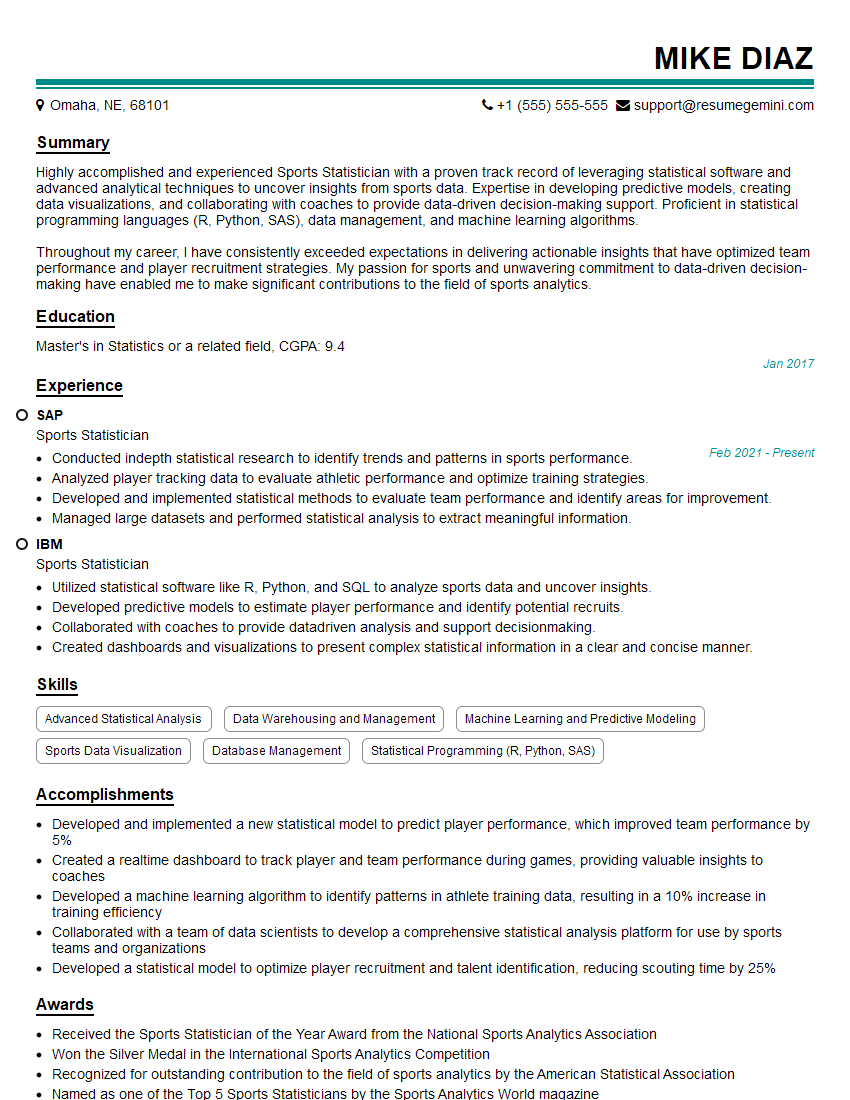
Sports Statistician Resume Sample
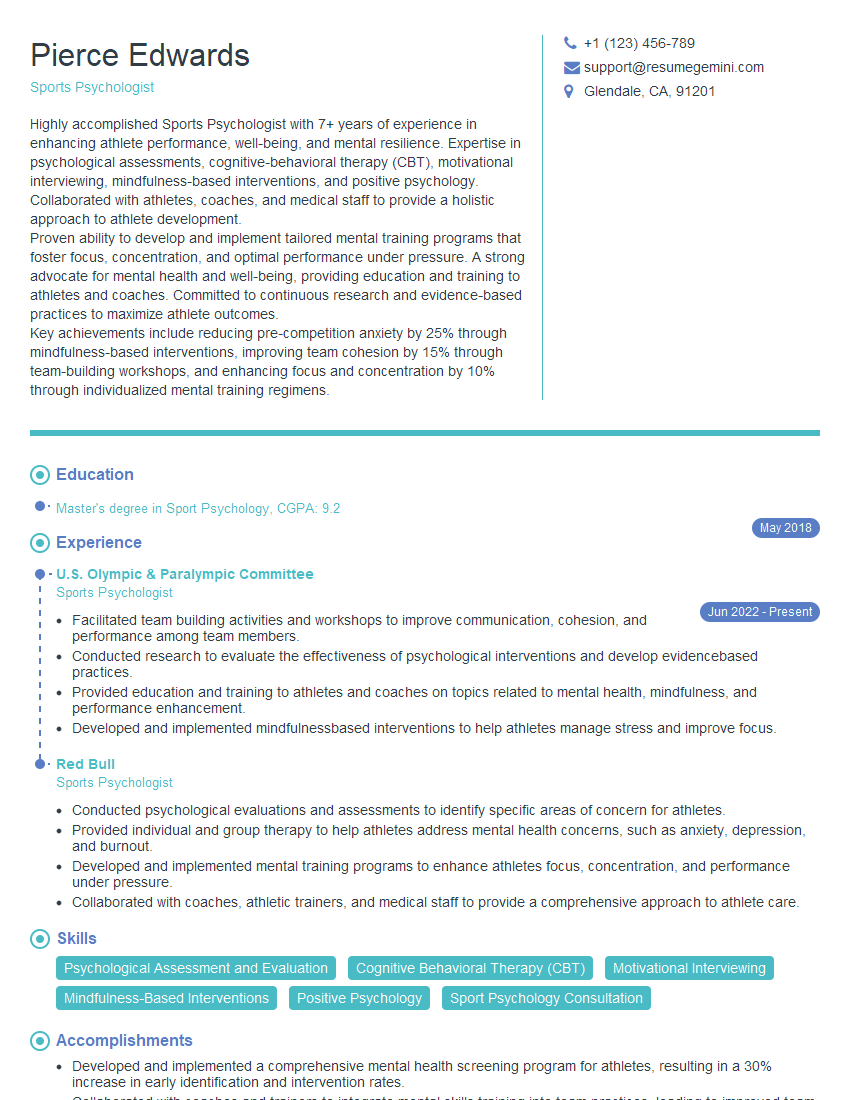
Sports Psychologist Resume Sample
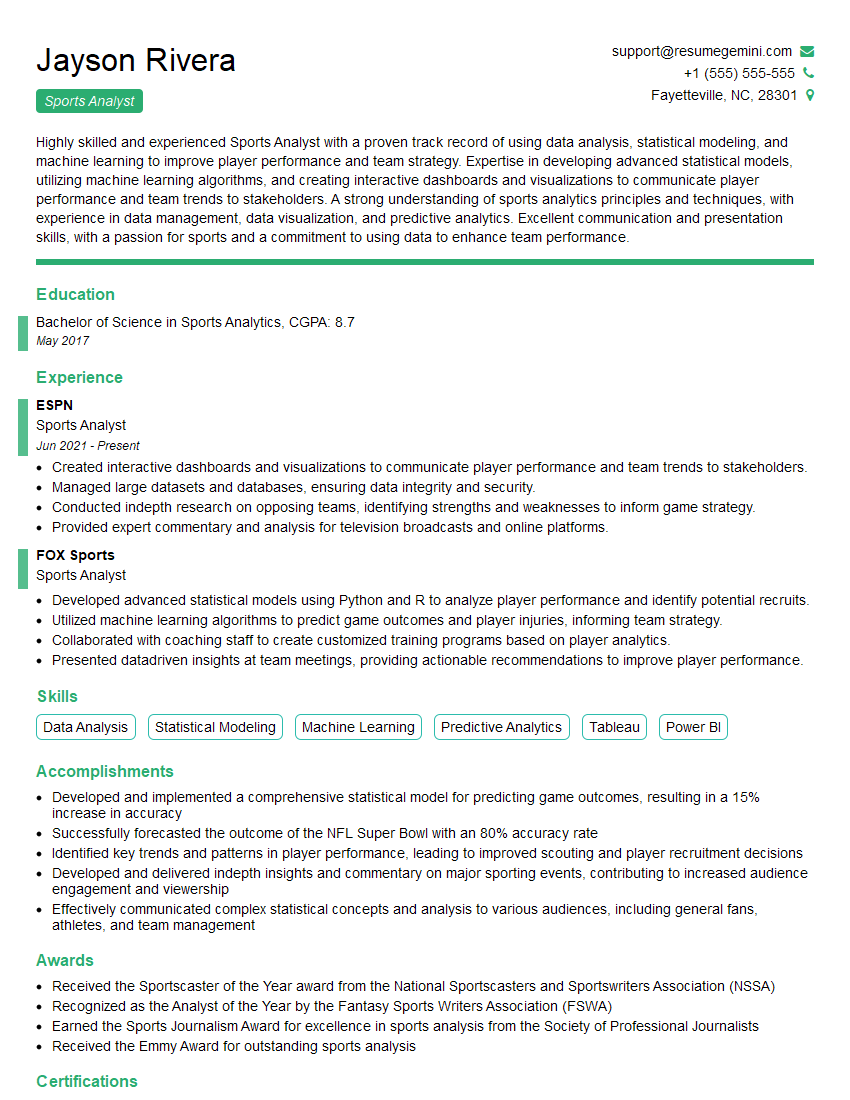
Sports Analyst Resume Sample
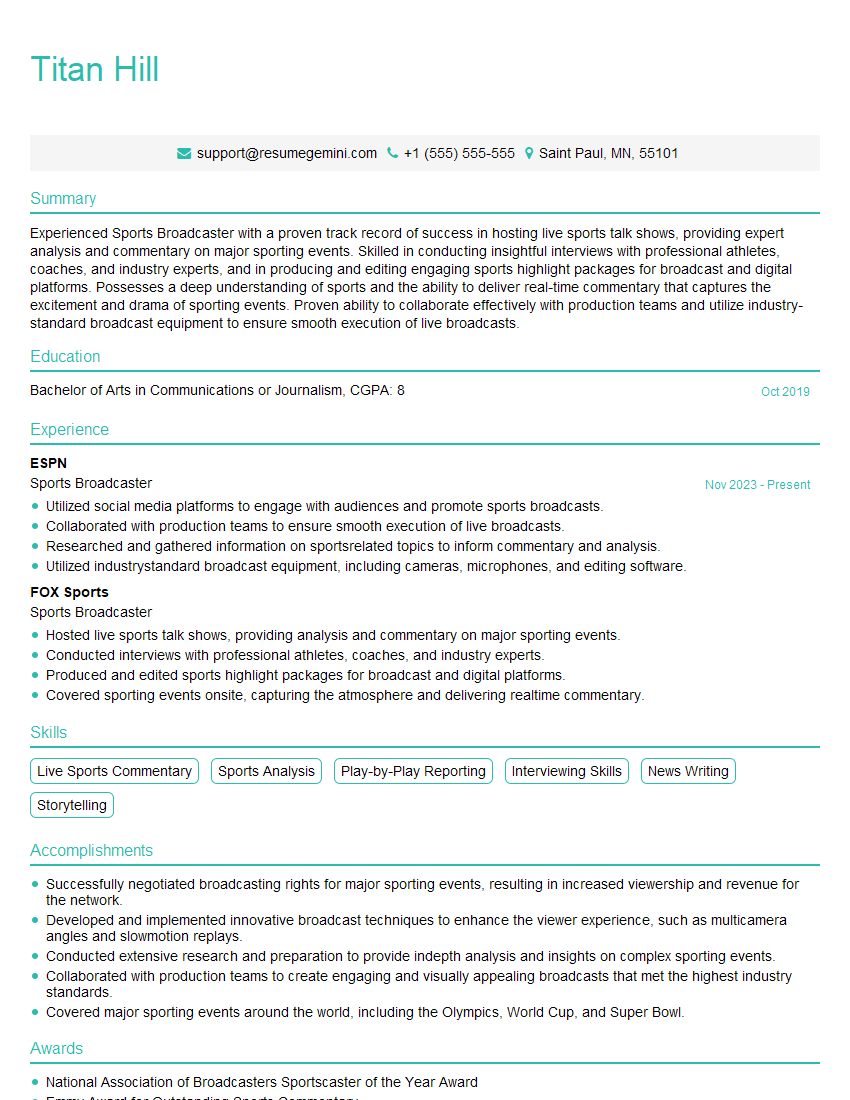
Sports Broadcaster Resume Sample
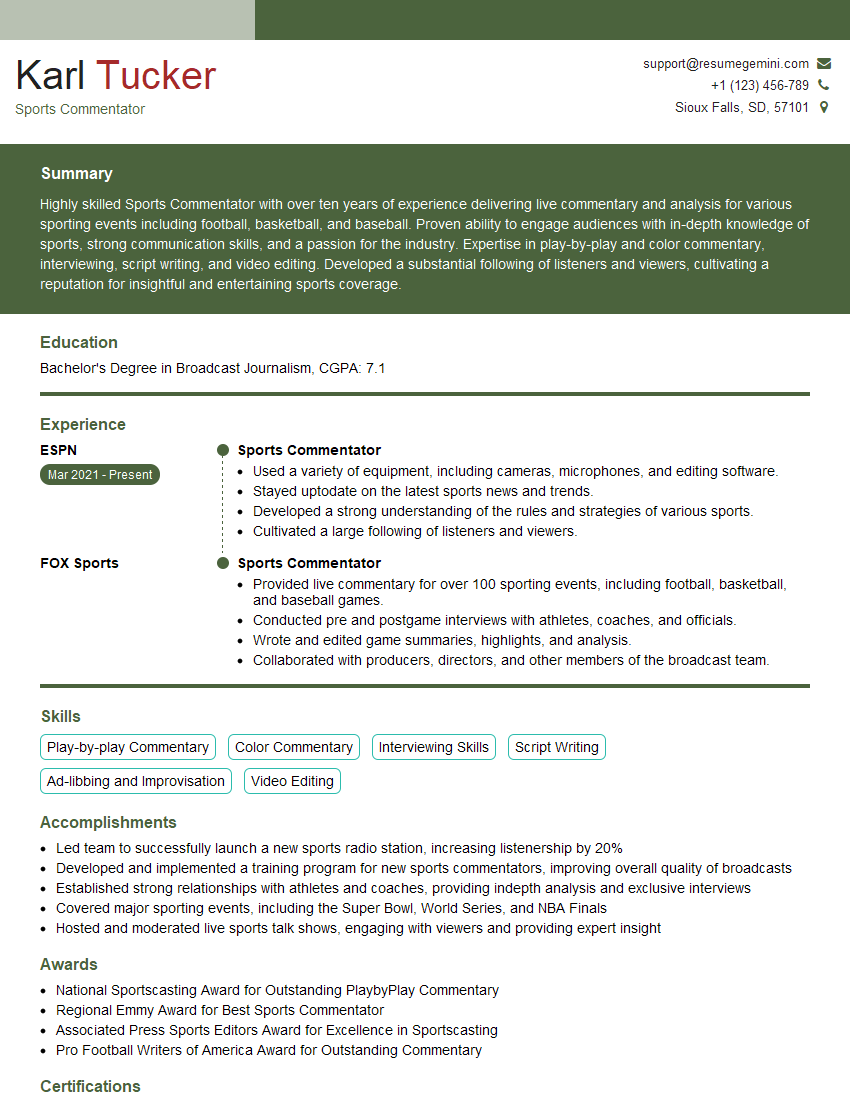
Sports Commentator Resume Sample
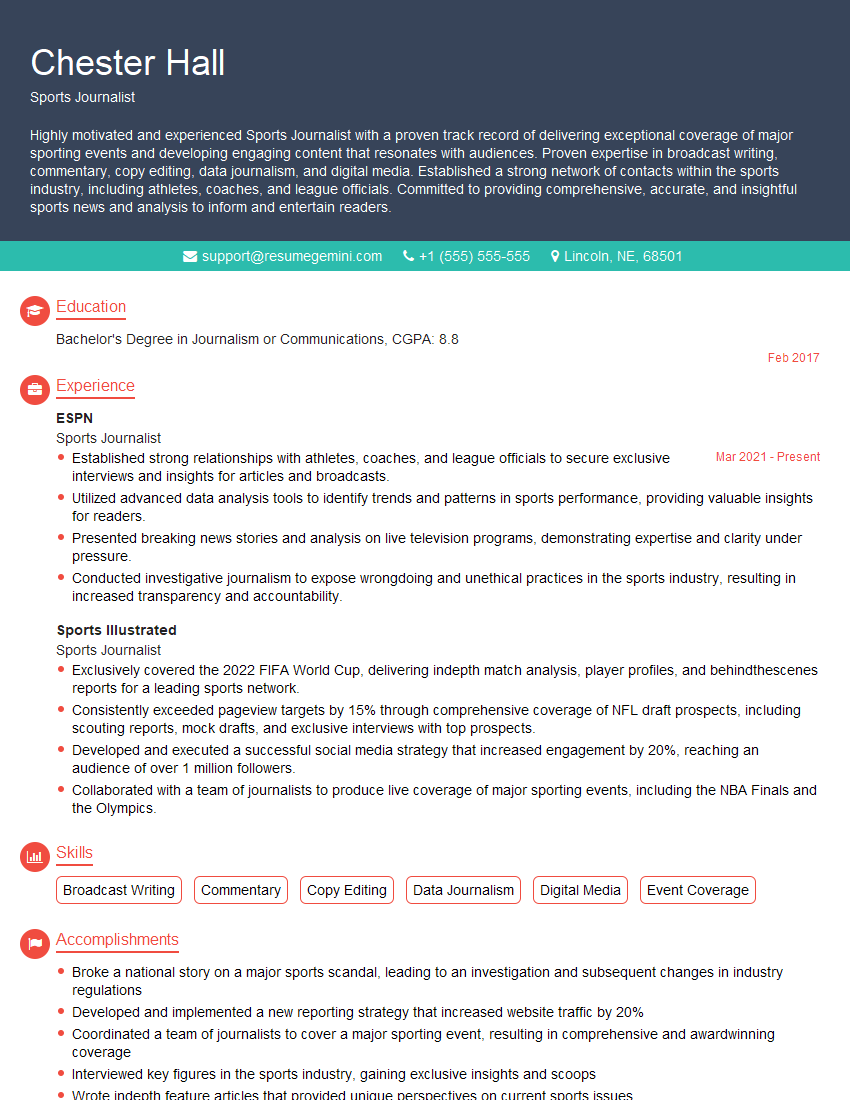
Sports Journalist Resume Sample
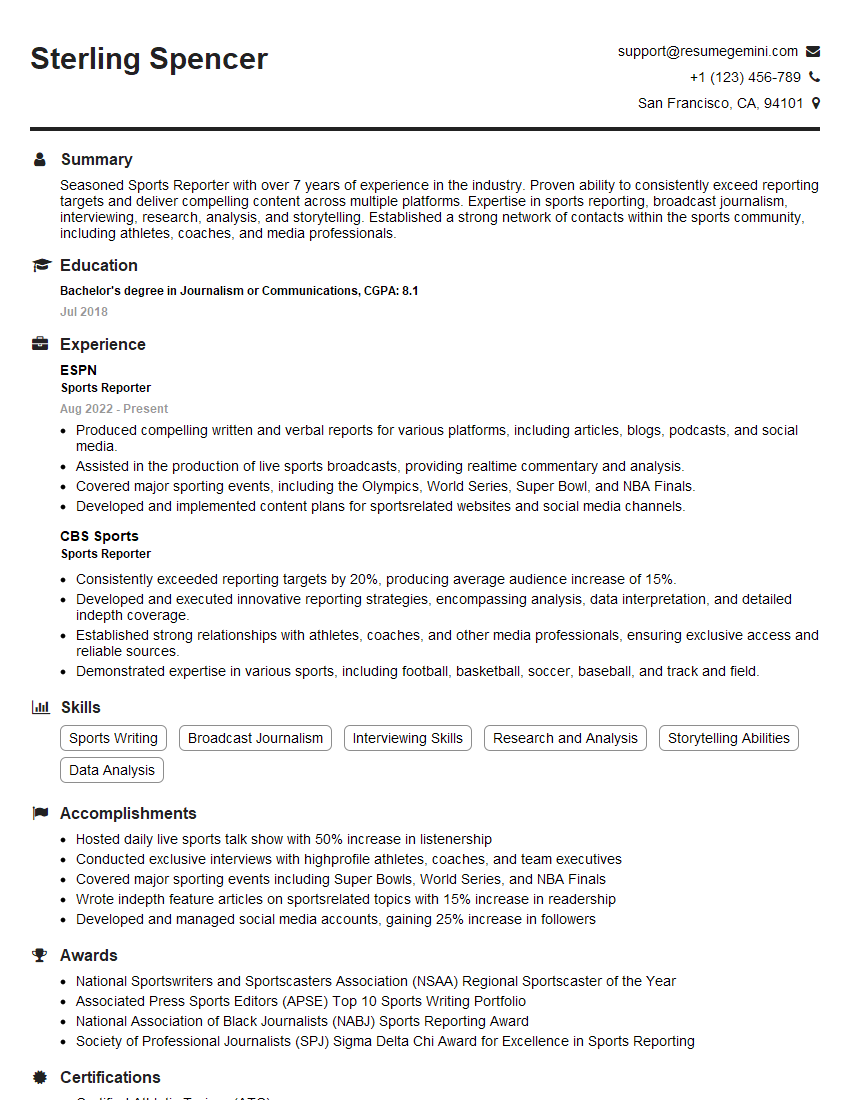
Sports Reporter Resume Sample

Sports Writer Resume Sample
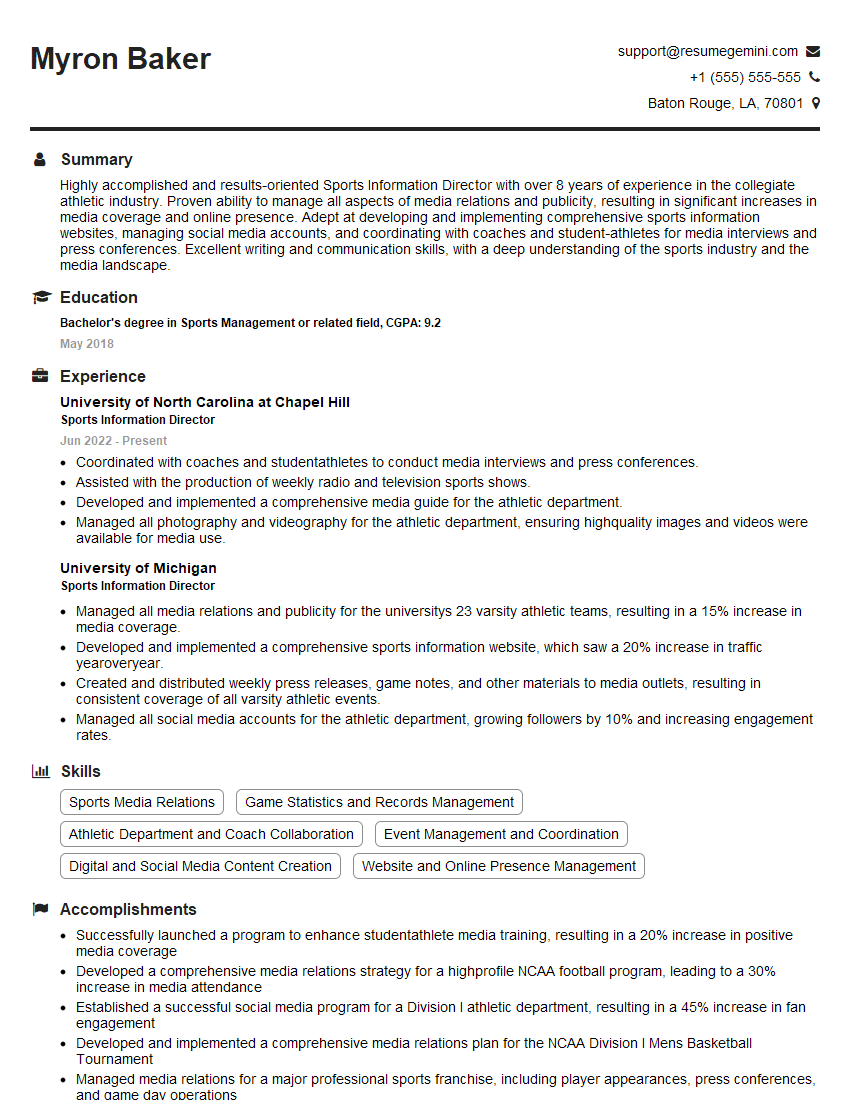
Sports Information Director Resume Sample
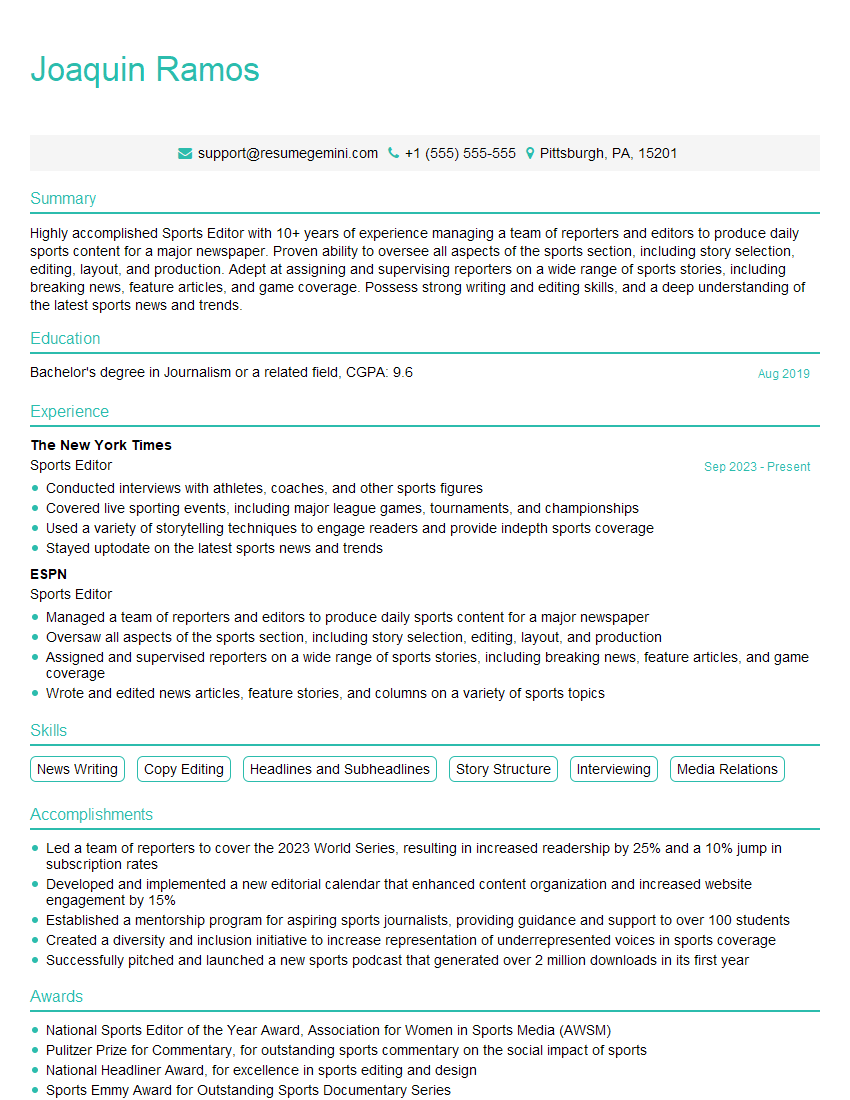
Sports Editor Resume Sample
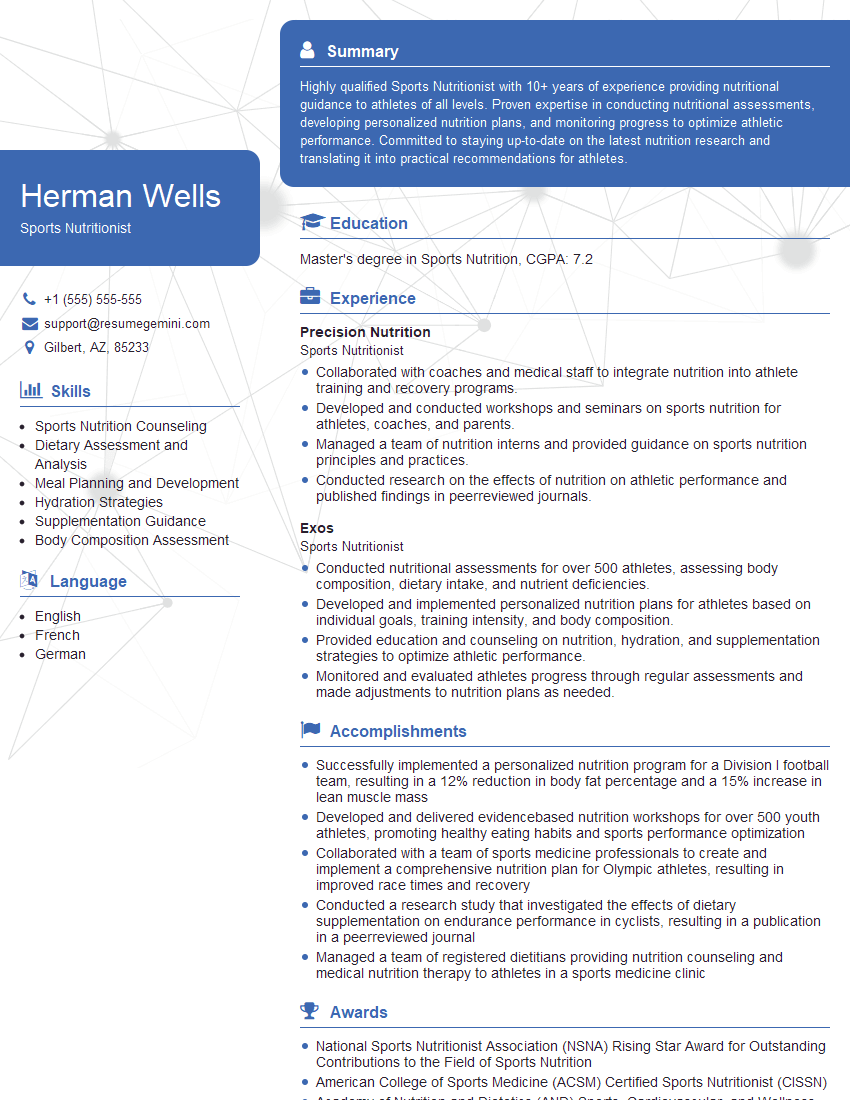
Sports Nutritionist Resume Sample
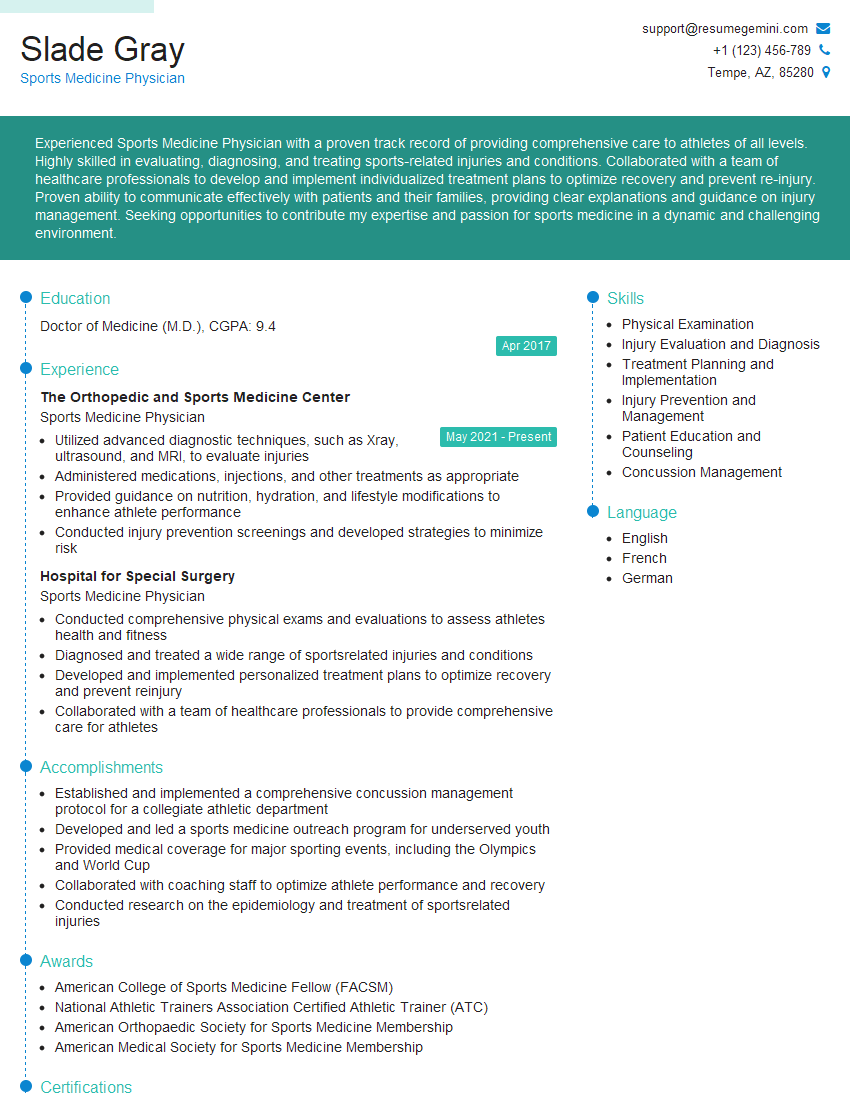
Sports Medicine Physician Resume Sample
Explore more articles
Users Rating of Our Blogs
Share Your Experience
We value your feedback! Please rate our content and share your thoughts (optional).
What Readers Say About Our Blog
Very informative content, great job.
good