Interviews are more than just a Q&A session—they’re a chance to prove your worth. This blog dives into essential Drapery Skills interview questions and expert tips to help you align your answers with what hiring managers are looking for. Start preparing to shine!
Questions Asked in Drapery Skills Interview
Q 1. What types of fabrics are best suited for drapery and why?
Choosing the right fabric is paramount in drapery making. The ideal fabric depends on the desired drape, light control, and overall aesthetic. Heavier fabrics like velvet, damask, and brocade offer luxurious texture and excellent light blockage, perfect for formal settings or bedrooms needing darkness. However, they require more robust hardware. Lighter fabrics such as linen, silk, and sheer voiles create a more airy and elegant feel, suitable for living rooms or areas needing softer light diffusion. Consider the weight and texture – heavier fabrics will create deeper folds, while lighter ones create softer, more delicate folds. For instance, a heavy velvet would be stunning in a theater-style room, while a sheer linen would be perfect for a sunroom. Always test a fabric swatch for how it drapes before committing to a large purchase.
- Heavy Fabrics: Velvet, Damask, Brocade (Excellent light blocking, luxurious feel)
- Medium Fabrics: Linen, Cotton, Taffeta (Versatile, good drape)
- Light Fabrics: Silk, Voile, Sheer (Airy, light diffusion)
Q 2. Explain the process of measuring for drapery installation.
Accurate measurements are the foundation of successful drapery installation. Begin by measuring the width of the window, adding extra width for fullness (typically 1.5 to 2.5 times the window width for proper pleating). Then, measure the length from the top of the rod to where you want the drapery to fall – consider the desired length below the window sill, hitting the floor, or pooling on the floor. Remember to account for the type of heading and any extra fabric needed for hems and pleats. Consider if the rod will be inside or outside the window frame. Always measure multiple times in different spots to ensure consistency. Taking detailed notes and creating sketches will help avoid mistakes. For instance, you might note: ‘Window A: Width 48”, Length 60”, Inside Mount, 2.5x fullness required.’ This level of detail ensures success even on complex projects.
Q 3. Describe different drapery heading styles and their applications.
Drapery heading styles significantly impact the overall look. The choice depends on the desired aesthetic and window type. Popular styles include:
- Pinch Pleat: Elegant and classic, created by evenly spaced, pinched folds of fabric. Suitable for formal settings and heavier fabrics.
- Goblet Pleat: Similar to pinch pleat but with rounded, goblet-shaped folds. Adds a touch of sophistication.
- French Pleat: Soft, cascading folds with a flowing, romantic look. Ideal for lighter fabrics and casual settings.
- Box Pleat: Sharp, well-defined, rectangular folds providing a tailored, structured appearance. Often used in contemporary designs.
- Ripplefold: Creates soft, even waves of fabric across the top. Modern and minimalist, best suited for softer fabrics.
Consider the room’s style and the fabric’s weight when selecting a heading. A formal setting might call for pinch pleats, while a contemporary space could benefit from ripplefold headings.
Q 4. How do you calculate fabric yardage for drapery projects?
Calculating fabric yardage requires careful consideration of several factors. First, determine the total width needed based on window width and fullness factor (e.g., 2.5 times the width). Then, measure the finished length, adding extra for hems, heading, and any desired floor pooling. This total length should be divided by the fabric’s usable width (width after accounting for shrinkage or pattern matching), resulting in the number of lengths needed. Finally, multiply the number of lengths by the required length to arrive at the total yardage. For example: If the total width is 150”, the usable width of the fabric is 54”, the length is 80”, then you’ll need (150/54) ≈ 3 lengths. Total yardage required would be (3 * 80) / 36 (inches to yards conversion) ≈ 6.67 yards. It’s always wise to add extra yardage for mistakes or pattern matching.
Q 5. What are the common tools and equipment used in drapery making?
Drapery making involves specialized tools and equipment. Essential tools include:
- Measuring Tape: Accurate measurements are crucial.
- Sewing Machine: For efficient stitching.
- Iron and Ironing Board: For crisp pleats and hems.
- Shears or Rotary Cutter: For precise fabric cutting.
- Pins and Clips: For holding fabric in place during construction.
- Seam Ripper: For correcting mistakes.
- Drapery Hardware: Rods, rings, hooks, etc., specific to the chosen heading style.
- Sewing Gauge: Accurate measurement of hems and pleats.
Investing in good quality tools enhances efficiency and precision, resulting in professional-looking drapes.
Q 6. Explain the importance of proper lining in drapery construction.
Proper lining is crucial for several reasons. It enhances the drape and durability of the drapery, provides privacy by blocking light, and protects the face fabric from fading and damage caused by sunlight. Lining also creates a more luxurious feel and improves the overall appearance. Different linings are suitable for various face fabrics. For instance, a blackout lining would be appropriate for a bedroom where darkness is desired. A light-weight lining would enhance the drape and texture of delicate fabrics.
Q 7. How do you handle complex window shapes or configurations?
Complex window shapes and configurations require a tailored approach. For arched windows, create a template of the shape and cut the fabric accordingly. For bay windows, measure each section individually and create panels for each segment. Consider using a combination of drapery panels and valances to create a cohesive design and balance the window’s proportions. For irregularly shaped windows, custom fabrication may be necessary, involving pattern making and detailed measurements. Creating accurate templates and sketches for each section is essential for success. Consulting with experienced professionals can be particularly beneficial for very intricate window shapes.
Q 8. Describe your experience with different drapery hardware.
My experience with drapery hardware spans a wide range, encompassing various materials, styles, and functionalities. I’m proficient with both traditional and contemporary hardware options. This includes:
- Rods: From simple tension rods for lightweight curtains to decorative rods made of wood, metal (brass, iron, etc.), or even more unique materials like bamboo. I understand the importance of selecting rods with appropriate weight capacity and diameter for different fabric weights and window sizes. For instance, a heavier velvet curtain would demand a sturdier rod than a sheer linen panel.
- Tracks: I’m experienced with various track systems, including those designed for bay windows, curved windows, and specialty applications. Understanding the mechanics of different track types—such as single, double, or triple track systems—is crucial for creating smooth and functional drapery operations.
- Finials: I’m familiar with a wide variety of finials, ranging in style from classic to modern, influencing the overall aesthetic of the drapery treatment. Careful consideration of the finial’s design in relation to the rod and the room’s décor ensures a cohesive look.
- Rings and Carriers: I’m knowledgeable about various ring types – grommets, clips, and traditional rings – and their compatibility with different rod styles and drapery fabrics. Selecting the right carriers ensures smooth gliding and prevents damage to the fabric.
- Installation Hardware: This includes brackets, screws, anchors, and other components necessary for secure and reliable installation. I understand how to choose the appropriate hardware based on wall type, window frame construction, and drapery weight.
Throughout my career, I’ve worked with numerous hardware manufacturers and suppliers, gaining a thorough understanding of their product lines and quality standards. This allows me to effectively advise clients on the best options for their specific needs and budget.
Q 9. How do you address wrinkles or imperfections in finished drapery?
Addressing wrinkles and imperfections in finished drapery requires a methodical approach. The key is to identify the cause of the imperfection before attempting a fix. For instance, wrinkles could be caused by improper fabric preparation, incorrect hanging, or simply the fabric’s natural tendency to crease.
- Steam Ironing: For minor wrinkles, steam ironing is the most common and effective method. This requires using a low to medium heat setting and carefully maneuvering the iron to avoid scorching the fabric. Always test a small, inconspicuous area first. For delicate fabrics, a steamer may be preferred.
- Press Cloths: To prevent scorching, a press cloth is frequently used between the iron and the fabric. This is especially important for fabrics like silk or velvet.
- Fabric Stretching: For stubborn wrinkles or areas of distortion, gently stretching the fabric while it’s damp can often resolve the issue. This might require pinning the fabric temporarily in its corrected position to maintain the shape.
- Professional Cleaning: In cases of significant damage or if the fabric is delicate, professional cleaning and pressing services are recommended. This ensures that the drapery is handled correctly without risking further damage.
Sometimes, more drastic measures might be needed. If the imperfection is a result of a cutting or sewing error, it’s often best to either recut and resew the section or, depending on the severity and location, use creative techniques such as embellishments to cover up the flaws.
Q 10. What are some common drapery maintenance issues and solutions?
Common drapery maintenance issues and their solutions:
- Dust and Dirt Accumulation: Regularly vacuuming or dusting with a soft brush helps prevent dust buildup. For delicate fabrics, consider using a specialized upholstery attachment. Severe soiling might require professional cleaning.
- Fading and Sun Damage: Use of UV-filtering curtains or liners protects the drapery from sun damage. Regularly rotating or reversing the panels helps prevent uneven fading.
- Shrinkage: Always pre-wash fabrics before cutting and sewing to minimize shrinkage. Following the manufacturer’s care instructions prevents further shrinkage.
- Hardware Issues: Regularly inspect the hardware for loose screws, damaged rings, or other issues. Tighten loose screws or replace damaged parts as needed. Lubricating the tracks may improve functionality.
- Wrinkles and Creases: Regularly steam or iron the drapes to reduce wrinkles and creases; this often helps extend their lifespan.
Preventive measures, like proper installation and regular cleaning, are key to minimizing maintenance issues and prolonging the life of your draperies. A small investment in preventative care translates to a large return in terms of aesthetics and the lifespan of the product.
Q 11. Explain your experience with different sewing machine types and their applications in drapery work.
My experience with sewing machines is extensive, covering various types for different drapery applications.
- Industrial Sewing Machines: These machines are essential for heavy-duty tasks like sewing through multiple layers of thick fabric, or creating sturdy seams for heavier drapes. Their power and speed are invaluable for large-scale projects.
- Domestic Sewing Machines: I use domestic machines for intricate details, lighter fabrics, and smaller projects. They offer versatility and are suitable for a range of stitch types, enabling precision work such as creating pleats or hems.
- Serger (Overlock) Machines: A serger is crucial for creating neat and professional finishes on raw edges, preventing fraying and enhancing durability. This machine is particularly important when working with delicate or flowing fabrics.
The choice of sewing machine depends heavily on the project at hand. For example, a heavy velvet curtain requires an industrial machine to handle the fabric’s weight and density, whereas sheer linen panels are better suited to a domestic machine to ensure precision stitching without causing damage. My proficiency across machine types ensures I can handle any drapery project, regardless of fabric weight or complexity.
Q 12. How do you ensure the accuracy of pattern cutting for drapery?
Accuracy in pattern cutting is paramount in drapery making. Inaccurate cutting directly impacts the final drape and appearance of the finished product. Here’s how I ensure precision:
- Accurate Measurements: Precise measurements of the window and desired drapery length are the cornerstone of accurate pattern cutting. I use measuring tapes to take multiple measurements, verifying accuracy to minimize errors.
- Proper Fabric Preparation: The fabric needs to be thoroughly inspected for any flaws, pre-washed to remove shrinkage, and laid out smoothly before cutting. This eliminates unforeseen issues during the process.
- Sharp Shears or Rotary Cutter: Using sharp tools ensures clean, precise cuts and prevents fraying, creating a professional finish.
- Pattern Layout: Careful pattern layout on the fabric, considering the grain and pattern direction, ensures consistent and symmetrical drapes. I often make a full-scale pattern that allows for accurate placement of pleats and other design features.
- Marking and Notching: Clear marking and notching of the pattern pieces enable accurate assembly and pleat formation. I use tailor’s chalk or washable markers to prevent permanent staining.
- Double Checking: A final check of all cut pieces before sewing is crucial to identify and rectify any cutting errors before they become embedded in the finished product.
By following these steps, I consistently achieve accuracy in pattern cutting, leading to flawlessly tailored drapery that meets the client’s expectations.
Q 13. Describe your experience working with different types of pleats.
My experience encompasses a wide variety of pleat styles, each offering a distinct aesthetic and functional quality.
- Pinch Pleats: These classic pleats are created by carefully folding and securing fabric in evenly spaced pinches. They offer a formal and elegant look, well-suited to traditional or luxurious settings.
- Box Pleats: Similar to pinch pleats, but with two folds creating a box-like shape, adding structure and visual interest. Box pleats add a sense of grandeur and are versatile in terms of fabric choice and application.
- French Pleats: More complex than pinch or box pleats, French pleats involve a series of meticulously folded and sewn pleats that are both elegant and visually impressive. These are often seen in high-end custom drapery projects.
- Goblet Pleats: Elegant and flowing, these pleats are softly rounded at the top, cascading gracefully. They are perfect for creating a soft, romantic look.
- Inverted Pleats: Inverted pleats are a modern alternative to traditional pleats; they add a unique design flair to more contemporary spaces.
The selection of pleat style is often driven by the client’s aesthetic preference, the type of fabric, and the overall design scheme of the room. I guide clients in choosing the style that best complements their décor, taking into consideration the weight of the fabric and desired level of formality.
Q 14. What is your process for installing drapery hardware?
My drapery hardware installation process is meticulous and ensures a secure, aesthetically pleasing result. It involves the following steps:
- Planning and Measurement: Precise measurements of the window and wall are taken to determine the optimal rod placement and hardware requirements.
- Hardware Selection: The appropriate hardware is selected based on the drapery weight, window type, and overall design aesthetic. This includes the rod, brackets, finials, rings, and carriers.
- Bracket Installation: Brackets are securely installed into the wall or ceiling, using appropriate screws and anchors based on the wall type (drywall, plaster, etc.). Leveling is crucial for a perfectly straight hang.
- Rod Installation: The rod is inserted into the brackets, ensuring a secure and stable fit. Finials are then added to complete the look.
- Drapery Hanging: The drapery panels are carefully hung onto the rod using the chosen rings or carriers. This step requires attention to detail to ensure even pleat distribution and a smooth, graceful drape.
- Final Adjustments: Final adjustments are made to ensure the drapes hang evenly and smoothly. Any minor adjustments are made to the pleats and fabric placement for a perfect finish.
Throughout the installation process, safety is paramount. I always use appropriate safety equipment and ensure the stability of the installed hardware before moving on to the next step. Client satisfaction is a priority, so I always communicate each stage of the process and address any client concerns.
Q 15. How do you handle customer requests or modifications to a drapery project?
Handling customer requests and modifications is crucial for client satisfaction. My approach begins with active listening – truly understanding their vision and concerns. I then clarify their requests, providing realistic expectations about feasibility and potential impacts on timelines or budget. We discuss alternatives if necessary, exploring different fabrics, styles, or hardware to meet their needs within the project’s constraints. For example, if a customer wants to change the lining after the initial consultation, we’ll discuss the cost implications, the timeline adjustment, and any design implications. Every change is documented and approved in writing to avoid misunderstandings. I always aim for a collaborative process, ensuring they’re informed and involved every step of the way.
Career Expert Tips:
- Ace those interviews! Prepare effectively by reviewing the Top 50 Most Common Interview Questions on ResumeGemini.
- Navigate your job search with confidence! Explore a wide range of Career Tips on ResumeGemini. Learn about common challenges and recommendations to overcome them.
- Craft the perfect resume! Master the Art of Resume Writing with ResumeGemini’s guide. Showcase your unique qualifications and achievements effectively.
- Don’t miss out on holiday savings! Build your dream resume with ResumeGemini’s ATS optimized templates.
Q 16. What are your preferred methods for hemming drapery?
Hemming drapery requires precision. My preferred methods depend on the fabric weight and desired finish. For lightweight fabrics like sheer voiles, I often use a rolled hem, creating a delicate, almost invisible finish. This involves turning the raw edge under twice and then stitching close to the fold. For heavier fabrics such as velvet or brocade, a double-stitched hem provides strength and durability. This involves a wider hem allowance, often interfaced for added structure, with two rows of stitching to secure the hem. Finally, for particularly delicate or expensive materials, I might opt for a blind hem, stitching the raw edge to the inner fold, leaving no visible stitches on the finished surface. Choosing the right method ensures a professional, long-lasting finish appropriate to the fabric.
Q 17. How do you manage time and resources effectively in a drapery project?
Efficient time and resource management is key to successful drapery projects. I begin by creating a detailed project plan, breaking down each stage – from measurements and fabric selection to installation – with assigned timelines. This allows me to accurately estimate the total project time and identify potential bottlenecks. I carefully source materials, ensuring quality and availability within the allocated budget. I also meticulously manage my tools and equipment, keeping them clean, organized, and well-maintained to prevent delays due to malfunction. Effective communication with clients regarding timelines and any unforeseen circumstances is vital. For example, I recently had to adjust my schedule when a fabric supplier experienced a delay. I immediately contacted the client, explained the situation, and offered alternative solutions, maintaining transparency and minimizing any disruption to the project.
Q 18. Describe your experience with different drapery installation techniques.
I’m experienced with various drapery installation techniques, including track systems, rod installation, and more specialized methods. Track systems offer versatility, allowing for smooth operation and easy access to windows. Rod installations, particularly with decorative finials, provide a classic and elegant look. I’ve worked with both standard curtain rods and more decorative, heavier options. For heavier drapery or special applications, I use reinforced brackets and appropriate support systems. I’m familiar with installing various drapery hardware, from simple rings and clips to more complex systems involving pulleys and cords. For example, recently I installed a series of floor-length velvet drapes using a traverse rod system for a large bay window, ensuring a smooth and precise opening and closing mechanism.
Q 19. How do you troubleshoot common drapery installation problems?
Troubleshooting is an integral part of drapery installation. Common issues include uneven hanging, fabric wrinkles, or malfunctioning hardware. Uneven hanging is often addressed by checking for properly leveled tracks or rods, and adjusting bracket placement as needed. Wrinkles usually result from improper measuring or hanging; re-measuring and re-hanging often resolves this. Malfunctioning hardware frequently requires lubrication or replacement. Sometimes, the issue stems from poor-quality hardware or inadequate support for heavy fabrics. For example, recently I encountered a situation where heavy drapes were pulling down a lightweight rod. I diagnosed the problem, suggested switching to a sturdier rod with increased support brackets, and the issue was resolved.
Q 20. What safety precautions do you take while installing drapery?
Safety is paramount during drapery installation. I always use a sturdy ladder or step stool, ensuring it’s positioned correctly and on a stable surface. When working at heights, I employ a safety harness if necessary. I use appropriate personal protective equipment (PPE) such as work gloves to prevent cuts or abrasions from sharp fabric edges or hardware. I carefully inspect all hardware for damage or wear and tear before installation and I always disconnect any electrical power to the areas I am working near. Power tools are handled with care, and I ensure the work area is clear of obstacles to prevent tripping hazards. Before starting any job I survey the site for potential hazards, like low-hanging ceilings or fragile fixtures.
Q 21. Describe your experience with working with different types of interlining materials.
Interlining plays a significant role in enhancing the drape and appearance of curtains. I have extensive experience with various interlining materials, each offering unique benefits. Lightweight interlinings like muslin improve drape and provide a subtle body to sheer fabrics. Medium-weight interlinings, such as cotton or polyester blends, offer both drape and insulation. Heavier interlinings such as fleece offer added warmth and insulation, ideal for colder climates. The choice of interlining depends on the fabric’s weight, the room’s climate, and the desired level of opacity and insulation. Recently, I used a heavyweight interlining with a luxurious velvet to enhance its richness and provide excellent insulation for a client’s living room. Choosing the appropriate interlining truly elevates the finished product.
Q 22. How do you determine the appropriate weight and drape of a fabric for a specific application?
Selecting the right fabric weight and drape is crucial for achieving the desired aesthetic and functionality of your drapery. It’s like choosing the right material for a garment – a lightweight silk will drape differently than a heavy velvet. We consider several factors:
- Intended Use: Sheer fabrics are ideal for filtering light, while heavier fabrics offer better insulation and privacy. For instance, a sheer linen would be perfect for a bedroom window needing soft light, whereas a heavy brocade would be more suitable for a formal living room needing blackout capabilities.
- Room Size and Style: Larger rooms can handle heavier fabrics and more elaborate designs, while smaller rooms benefit from lighter, less bulky materials to avoid overwhelming the space. Imagine a small room with heavy velvet drapes – it could feel cramped! Conversely, lightweight sheers in a large room may look inadequate.
- Fabric Type: Different fabrics naturally drape differently. Linen tends to have a more relaxed drape, while silk is known for its fluid movement. Understanding these inherent qualities is essential for selecting the right fabric.
- Window Size and Style: The size and shape of your window dictates how much fabric you’ll need and the overall weight and drape required. Long, wide windows need heavier fabrics to prevent sagging, whereas smaller windows might suit lighter fabrics.
Ultimately, the process involves a careful balance of aesthetics and practicality. Client consultation and fabric swatch analysis are vital steps in this process.
Q 23. How do you create a seamless finish for drapery seams?
Creating a seamless finish for drapery seams is key to a professional, polished look. Visible seams detract from the overall elegance. My preferred method is French seams, especially for lighter-weight fabrics. This technique encloses all raw edges, creating a clean and durable finish.
Here’s how it’s done:
- Sew the seam allowance with wrong sides together.
- Trim the seam allowance to 1/4 inch.
- Press the seam open.
- Fold the fabric with right sides together, encasing the raw edges inside the previous seam line.
- Stitch again, close to the first seam line.
For heavier fabrics, I might use a Hong Kong seam, which involves finishing the raw edges with bias binding. This provides a beautiful, tailored look and adds extra durability. This is particularly effective for fabrics like velvet or brocade. The choice depends on the fabric’s weight and the overall style of the drapery.
Q 24. Describe your experience with creating custom valances or swags.
I have extensive experience creating custom valances and swags, often incorporating intricate details and unique designs tailored to the client’s vision and room style. One memorable project involved designing a custom swag-and-tail valance for a Victorian-style dining room. The client wanted a rich, luxurious feel, so we used a heavy damask fabric with hand-stitched details. The process included:
- Detailed measurements: Accurate measurements are paramount to ensure proper fit and drape.
- Pattern creation: Designing the pattern for the specific shape and style – including the swag’s curve, the tail’s length, and the overall size – is crucial.
- Fabric selection: Choosing a fabric with the right weight, drape, and color to complement the room’s décor.
- Construction: Careful stitching and finishing techniques are essential to create a flawless look.
- Installation: Securing the valance correctly to enhance the overall aesthetic appeal.
This project demonstrated not only technical skill but also a deep understanding of design principles and the ability to bring a client’s vision to life. I approach each project with the same level of meticulous attention to detail.
Q 25. What is your experience with working with motorized drapery systems?
I’m proficient in working with various motorized drapery systems, from basic automated tracks to sophisticated systems with integrated lighting and scheduling options. My experience includes installing, programming, and troubleshooting these systems. This includes understanding the different control mechanisms, such as remote controls, wall switches, and smartphone apps. One recent project involved installing a Lutron system in a large home theater. The client wanted precise light and drapery control for optimal movie viewing. The installation required careful planning and coordination with other contractors to ensure seamless integration. My expertise extends to different motor types, power sources, and safety protocols, ensuring efficient and safe operation.
Q 26. How do you deal with unexpected challenges during a drapery installation?
Unexpected challenges are part of the drapery installation process. My approach centers around proactive problem-solving and adaptability. For instance, I once encountered a situation where the existing window frames were not level, causing issues with drapery alignment. My solution involved custom-fabricated brackets to compensate for the unevenness. Other scenarios I’ve handled include unexpected changes in wall construction, inaccurate measurements, and unforeseen fabric defects.
My approach involves:
- Thorough planning and pre-installation checks: This significantly reduces the likelihood of unexpected problems.
- Open communication with clients: Keeping clients informed about any challenges and potential solutions helps avoid misunderstandings and ensures everyone is on the same page.
- Creativity and resourcefulness: Finding inventive solutions to overcome unforeseen obstacles.
- High-quality materials and tools: Using superior materials and tools ensures the project’s success and durability.
Maintaining a calm, professional demeanor under pressure, coupled with problem-solving expertise, is essential.
Q 27. How do you ensure client satisfaction throughout the drapery process?
Client satisfaction is my top priority. I believe it’s a continuous process, beginning with the initial consultation and extending through installation and beyond. I achieve this through:
- Clear communication: Maintaining open and honest communication throughout the process, keeping clients informed of progress, potential challenges, and any necessary decisions.
- Careful listening: Truly listening to the client’s needs and preferences to understand their vision for their space.
- Professionalism and attention to detail: Demonstrating expertise and a meticulous approach to every aspect of the project.
- Follow-up and post-installation support: Providing excellent after-sales service, addressing any concerns or questions promptly.
- Seeking feedback: Asking for feedback on the completed project helps to improve my service continually and ensures client satisfaction.
Building trust and rapport with clients are essential components of delivering a truly satisfying experience. A happy client is the best endorsement!
Q 28. Describe your experience with creating and interpreting drapery patterns.
Creating and interpreting drapery patterns is a fundamental skill in drapery making. It requires a blend of artistic vision and technical precision. The process begins with careful measurements of the window and desired drapery style. I then translate these measurements into a working pattern, considering factors such as fullness, heading style, and fabric drape. Many times, I’ll create a mock-up using inexpensive muslin to refine the design before cutting into the final fabric.
Interpreting existing patterns also forms a key part of my expertise. Understanding different pattern notations and adapting patterns for various fabrics and styles is crucial. A well-drafted pattern ensures a perfect fit and minimizes fabric waste. Software such as CAD programs can also assist in pattern making for complex projects, adding a layer of precision and efficiency to the process. Ultimately, the pattern is the blueprint for the entire project, and accuracy is paramount for a successful outcome.
Key Topics to Learn for Drapery Skills Interview
- Fabric Selection and Properties: Understanding different fabric types (weight, drape, texture), their suitability for various drapery styles, and potential challenges in handling them.
- Measurement and Calculation: Accurate measuring techniques for windows and doorways, calculating fabric yardage requirements, and understanding industry standard allowances for fullness and shrinkage.
- Pattern Making and Cutting: Creating and interpreting drapery patterns, efficient fabric cutting techniques to minimize waste, and adapting patterns to fit specific window treatments.
- Sewing and Construction Techniques: Proficiency in various sewing methods relevant to drapery construction (e.g., hems, seams, pleats), understanding different heading types (e.g., pinch pleats, goblet pleats), and finishing techniques for a professional look.
- Hardware and Installation: Familiarity with different types of drapery hardware (rods, tracks, rings, hooks), proper installation techniques ensuring functionality and aesthetics, and troubleshooting common installation issues.
- Drapery Styles and Trends: Knowledge of various drapery styles (e.g., Roman shades, Austrian shades, French pleats), understanding current trends in drapery design, and adapting styles to meet client needs and interior design themes.
- Problem-Solving and Troubleshooting: Identifying and resolving common issues encountered during the drapery making process, such as fabric imperfections, fitting problems, and hardware malfunctions.
Next Steps
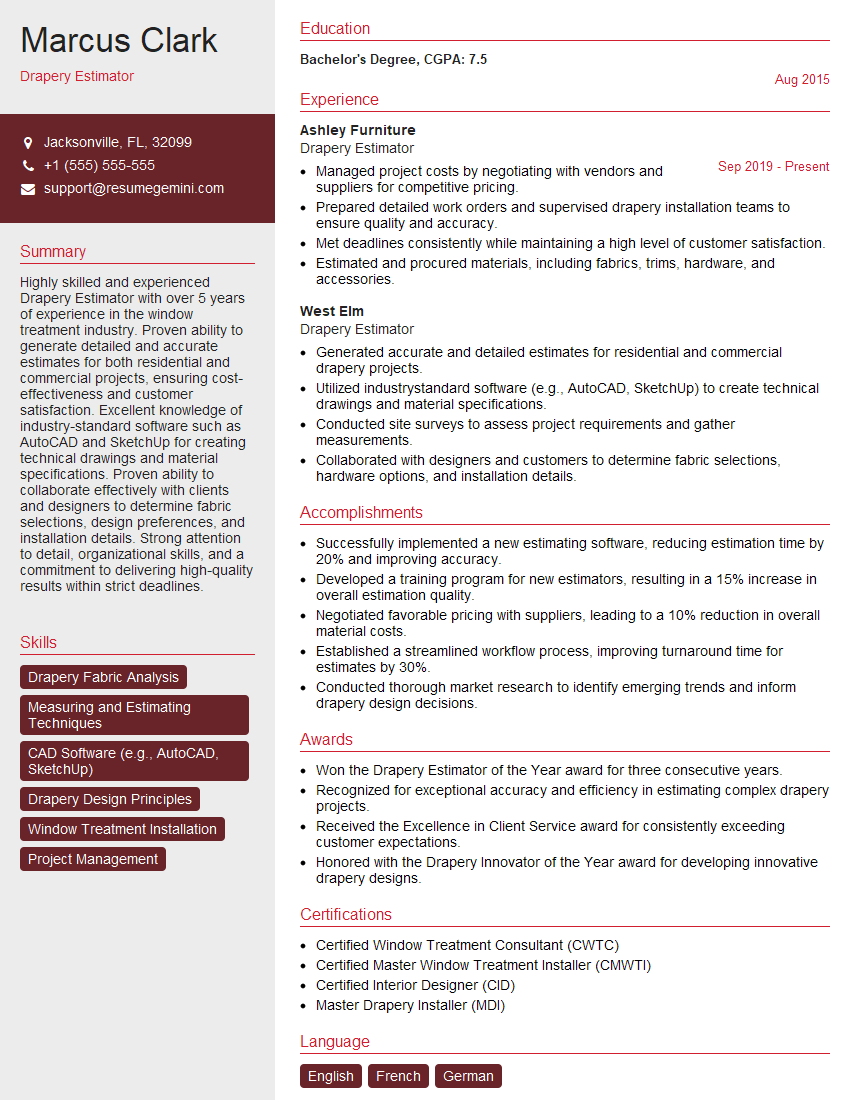
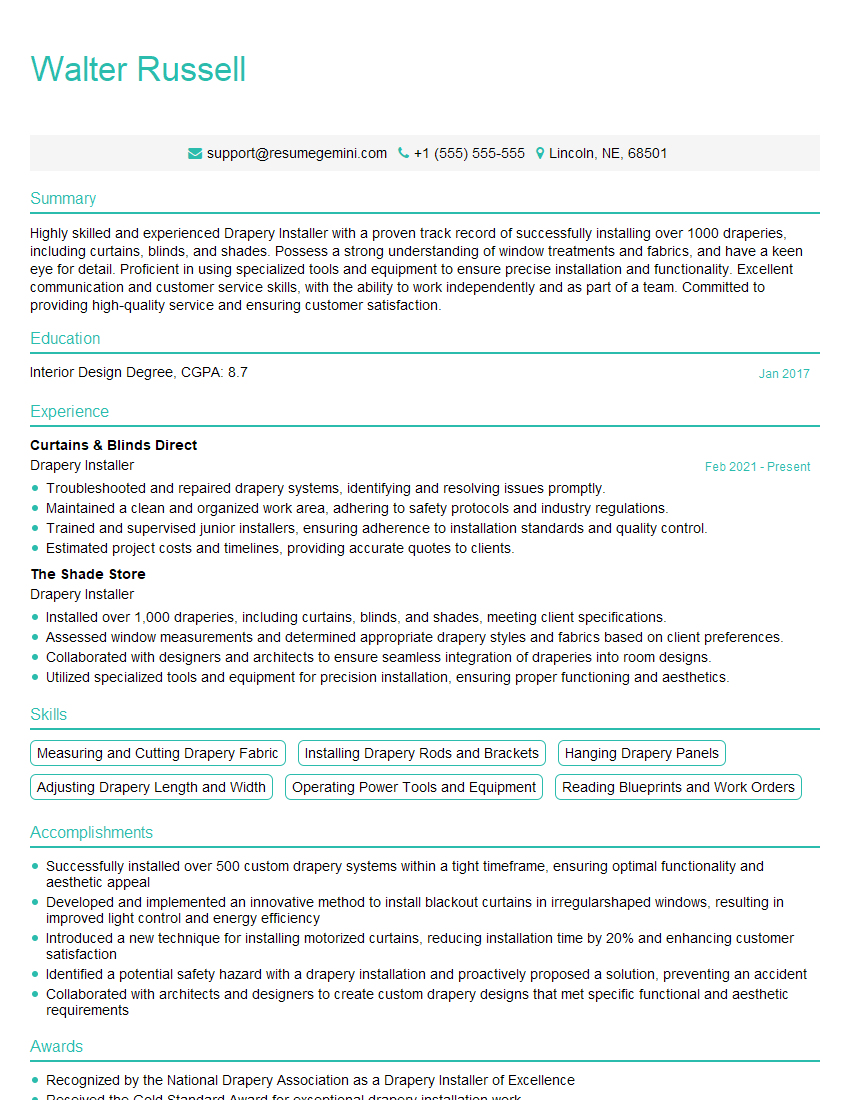
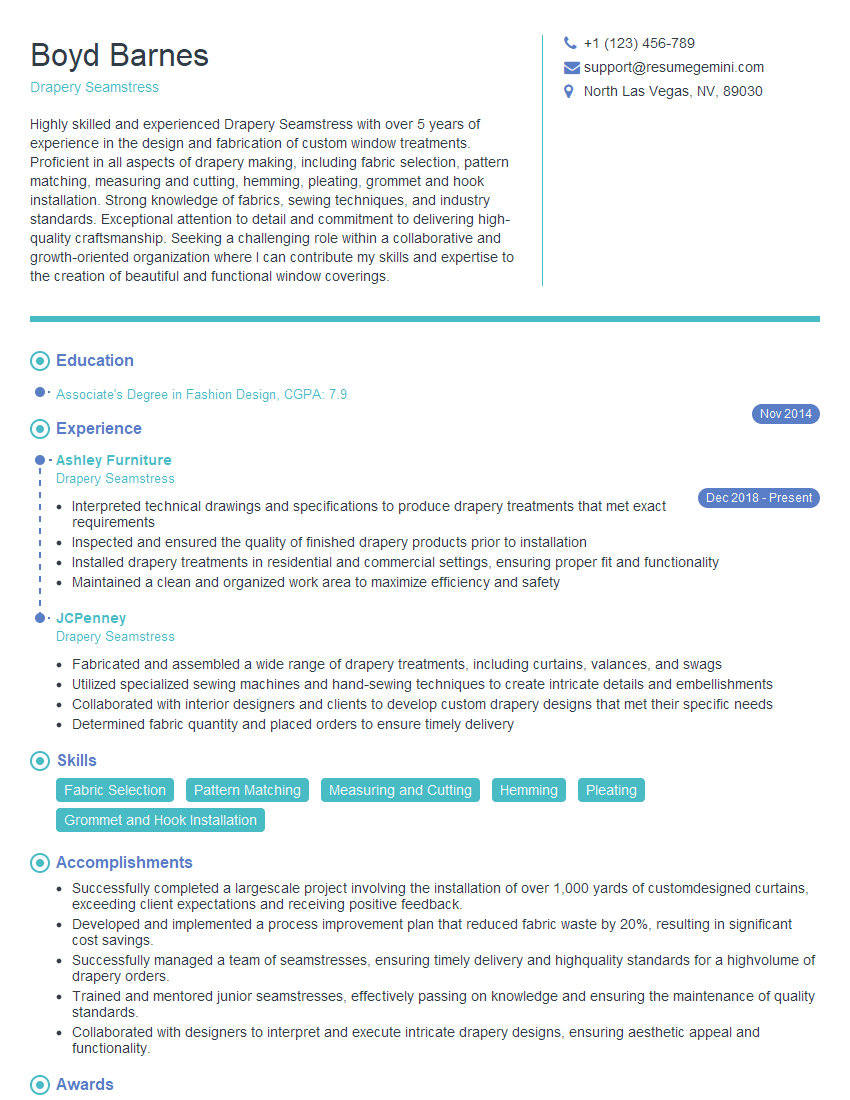
Mastering drapery skills opens doors to exciting opportunities in the design and interior decorating industries. A strong grasp of these techniques demonstrates professionalism and attention to detail – highly valued qualities in this field. To significantly boost your job prospects, create an ATS-friendly resume that highlights your abilities effectively. ResumeGemini is a trusted resource to help you build a professional and impactful resume that showcases your skills and experience. Examples of resumes tailored to Drapery Skills are available to guide you through this process.

Explore more articles
Users Rating of Our Blogs
Share Your Experience
We value your feedback! Please rate our content and share your thoughts (optional).
What Readers Say About Our Blog
Very informative content, great job.
good