Preparation is the key to success in any interview. In this post, we’ll explore crucial Experience in deploying and maintaining AI and Machine Learning systems interview questions and equip you with strategies to craft impactful answers. Whether you’re a beginner or a pro, these tips will elevate your preparation.
Questions Asked in Experience in deploying and maintaining AI and Machine Learning systems Interview
Q 1. Explain the difference between supervised, unsupervised, and reinforcement learning.
The core difference between supervised, unsupervised, and reinforcement learning lies in how the model is trained and the type of data it uses.
- Supervised Learning: This is like teaching a child with flashcards. You provide the model with labeled data – input data paired with the correct output. The model learns to map inputs to outputs by identifying patterns in the labeled data. For example, training an image classifier with images labeled ‘cat’ or ‘dog’. The model learns to associate image features with the correct label.
- Unsupervised Learning: This is more like letting a child explore a toybox. You give the model unlabeled data, and it learns to identify patterns and structures within the data on its own. Common applications include clustering (grouping similar data points) and dimensionality reduction (reducing the number of variables while preserving essential information). For example, grouping customers based on their purchasing behavior without pre-defined customer segments.
- Reinforcement Learning: This is akin to training a dog with treats. The model learns through trial and error by interacting with an environment. It receives rewards for desirable actions and penalties for undesirable ones. The goal is to learn a policy that maximizes the cumulative reward. For example, training a robot to navigate a maze; the robot receives a reward for reaching the goal and penalties for hitting walls.
In essence: Supervised learning uses labeled data for prediction, unsupervised learning finds patterns in unlabeled data, and reinforcement learning learns through interactions and rewards.
Q 2. Describe your experience with MLOps and its importance in deploying and maintaining AI/ML systems.
MLOps, or Machine Learning Operations, is the discipline of deploying and maintaining machine learning models in production. It bridges the gap between data scientists who build models and operations teams responsible for deploying and monitoring them. Think of it as DevOps, but specifically tailored for the unique challenges of ML.
In my experience, a robust MLOps pipeline is crucial for the success of any ML project. I’ve utilized MLOps principles in several projects, resulting in improved model reliability, reduced deployment time, and increased collaboration among teams. This involves using tools and techniques for version control of models and code, automated testing, continuous integration/continuous delivery (CI/CD) for model deployments, and comprehensive monitoring of model performance in production.
The importance of MLOps cannot be overstated. Without it, deploying and maintaining ML systems becomes a chaotic and error-prone process. MLOps ensures that models are deployed efficiently, reliably, and at scale, ultimately delivering greater business value.
Q 3. How do you handle model versioning and rollback in a production environment?
Model versioning and rollback are critical for managing the evolution of AI/ML models in production. We typically use a version control system (like Git) to track changes to the model’s code, data, and parameters. Each version is tagged with a unique identifier (e.g., a timestamp or a semantic version number).
To facilitate rollback, we employ techniques like model snapshots and A/B testing. Model snapshots capture the state of a model at a specific point in time. In case of a performance degradation or unexpected behavior after a deployment, we can easily revert to a previous, stable version. A/B testing allows us to compare the performance of different model versions in a controlled environment before deploying the new version to the entire user base, minimizing risk.
Example: We might deploy version 1.0 of a recommendation model. After monitoring for a week, we find that version 1.1 shows a 5% improvement in click-through rate. We switch traffic to 1.1 but keep a snapshot of 1.0 so that if issues emerge, we can immediately roll back.
Q 4. What are some common challenges in deploying AI/ML models to production, and how have you overcome them?
Deploying AI/ML models to production presents several unique challenges. Here are a few I’ve encountered and how I’ve addressed them:
- Data Drift: The distribution of data in production can change over time, impacting model performance. To mitigate this, I implement robust monitoring mechanisms that track data statistics and trigger alerts when significant drift is detected. Regular retraining with fresh data is crucial.
- Model Degradation: Models can lose accuracy over time due to various factors. Continuous monitoring and retraining are essential. We also use techniques like ensemble methods to create more robust and less prone to degradation models.
- Scalability Issues: Handling high volumes of data and requests requires careful infrastructure planning. Containerization (Docker, Kubernetes) and cloud-based solutions (AWS, Azure, GCP) are critical for achieving scalability and fault tolerance.
- Integration Challenges: Integrating ML models with existing systems can be complex. We use well-defined APIs and microservices to streamline integration and improve maintainability.
- Monitoring Complexity: Tracking performance metrics across various systems can be challenging. We use centralized logging and monitoring tools (e.g., Prometheus, Grafana) to gain a comprehensive view of the model’s health and performance.
Overcoming these challenges requires a proactive approach, careful planning, and a strong MLOps pipeline.
Q 5. Explain your experience with containerization technologies (Docker, Kubernetes) in the context of AI/ML deployment.
Containerization technologies like Docker and Kubernetes are essential for deploying and managing AI/ML models efficiently. Docker allows us to package the model, its dependencies, and runtime environment into a self-contained container, ensuring consistent execution across different environments (development, testing, production).
Kubernetes is a container orchestration platform that automates the deployment, scaling, and management of Docker containers. It simplifies the process of deploying and managing multiple containers, providing features like automated scaling, self-healing, and rolling updates, which are crucial for maintaining the availability and reliability of AI/ML systems.
In a recent project, we used Docker to package our TensorFlow model and its dependencies. Kubernetes then orchestrated the deployment of multiple instances of this container across a cluster of machines, enabling horizontal scaling to handle increased traffic and ensuring high availability.
Q 6. How do you monitor the performance of AI/ML models in production and what metrics do you track?
Monitoring AI/ML models in production is critical to ensuring their continued performance and identifying potential problems early. We track a range of metrics, including:
- Accuracy/Precision/Recall: These metrics measure the model’s ability to correctly classify or predict outcomes.
- F1-score: This metric provides a balanced measure of precision and recall.
- AUC-ROC: Area under the receiver operating characteristic curve; a measure of the model’s ability to distinguish between classes.
- Latency: The time it takes for the model to make a prediction.
- Throughput: The number of predictions the model can make per unit of time.
- Data Drift Metrics: Statistical measures that quantify the difference between training data and production data.
- Error Rates: The frequency of incorrect predictions.
We use monitoring tools that provide dashboards and alerts to visualize these metrics and notify us of any anomalies. This allows us to proactively address issues, preventing performance degradation and ensuring the ongoing effectiveness of our models.
Q 7. Describe your experience with different cloud platforms (AWS, Azure, GCP) for deploying AI/ML models.
I have extensive experience deploying AI/ML models on various cloud platforms, including AWS, Azure, and GCP. Each platform offers a unique set of services and tools tailored to ML workflows.
- AWS: I’ve utilized AWS SageMaker for building, training, and deploying models, leveraging its managed infrastructure and pre-built algorithms. Amazon EC2 and Lambda have been used for hosting models and deploying them as serverless functions.
- Azure: Azure Machine Learning provides similar capabilities to SageMaker, offering a comprehensive platform for the entire ML lifecycle. Azure Container Instances and Kubernetes Service (AKS) are utilized for containerized deployments.
- GCP: Google Cloud AI Platform offers comparable features, with a strong emphasis on integration with other Google Cloud services. Google Kubernetes Engine (GKE) facilitates container orchestration.
The choice of platform often depends on factors like existing infrastructure, cost considerations, and specific requirements of the project. My experience allows me to select and effectively utilize the most appropriate platform for each scenario.
Q 8. How do you handle data drift and concept drift in deployed AI/ML models?
Data drift refers to changes in the input data distribution over time, while concept drift signifies changes in the relationship between input data and the target variable. Both significantly impact model performance, causing predictions to become less accurate. Imagine a model predicting customer churn: if customer behavior changes (data drift), or the factors influencing churn shift (concept drift), the model’s accuracy will degrade.
To handle these drifts, I employ a multi-pronged approach:
- Monitoring: Continuous monitoring of key model performance metrics (e.g., accuracy, precision, recall) and data characteristics (e.g., distributions of key features). I’d use dashboards and alerting systems to identify significant deviations from baseline.
- Retraining: Regular retraining with fresh data is crucial. The frequency depends on the rate of drift; some models might need retraining daily, others monthly. I typically use a rolling window approach, incorporating recent data while discarding older, less relevant data.
- Adaptive models: For rapidly changing environments, online learning algorithms or ensemble methods like adaptive boosting (AdaBoost) are more suitable. These models can adjust their parameters incrementally as new data arrives, reducing the need for complete retraining.
- Feature engineering: Carefully selecting and engineering features can mitigate drift’s impact. For instance, incorporating time-based features might help capture temporal changes in the data.
- Concept drift detection: Implementing methods to detect concept drift proactively, such as using change-point detection algorithms, allows for timely intervention and retraining.
For example, in a fraud detection system, concept drift might occur if fraudsters adapt their tactics. Monitoring key metrics and retraining the model regularly with updated transaction data is vital to maintain its effectiveness.
Q 9. What are some strategies for optimizing the performance and scalability of AI/ML models?
Optimizing AI/ML model performance and scalability involves several strategies focusing on efficiency and resource utilization.
- Model Selection: Choosing the right model architecture is fundamental. A simpler model might suffice if complexity isn’t necessary, improving performance and reducing training time. For example, a linear regression might outperform a complex neural network for a simple prediction task.
- Feature Engineering: Selecting relevant features and transforming them appropriately can dramatically improve model accuracy and training speed. Techniques like dimensionality reduction (PCA, t-SNE) can reduce computational costs.
- Hyperparameter Tuning: Careful tuning of hyperparameters is critical. Techniques like grid search, random search, or Bayesian optimization can automate this process and find optimal settings.
- Hardware Acceleration: Utilizing GPUs or TPUs accelerates training and inference significantly. Cloud-based services like AWS SageMaker or Google Cloud AI Platform offer managed GPU instances.
- Model Compression: Techniques like pruning, quantization, and knowledge distillation reduce model size and computational needs, making them more deployable on resource-constrained devices.
- Distributed Training: For large datasets, distributing the training process across multiple machines significantly reduces training time. Frameworks like TensorFlow and PyTorch support distributed training.
- Model Serving: Employing efficient model serving frameworks (e.g., TensorFlow Serving, TorchServe) optimizes inference speed and scalability. These frameworks handle model loading, versioning, and request handling efficiently.
In one project, we used model compression techniques to reduce a deep learning model’s size by 70%, enabling its deployment on edge devices with limited resources without compromising accuracy significantly.
Q 10. Explain your experience with model retraining and updating strategies.
Model retraining and updating strategies are critical for maintaining model accuracy and relevance. The frequency and approach depend on factors like the rate of data drift, the model’s complexity, and the cost of retraining.
- Scheduled Retraining: Retraining at regular intervals (daily, weekly, monthly) is a common approach. This ensures the model stays updated with recent data, mitigating data drift’s effects.
- Triggered Retraining: Retraining can be triggered based on performance degradation. Monitoring key metrics and setting thresholds allows for automatic retraining when performance falls below a predefined level.
- Incremental Learning: For online learning scenarios, incremental learning methods allow the model to learn from new data without retraining from scratch. This significantly reduces retraining time and resource consumption.
- A/B Testing: Before deploying a retrained model, A/B testing compares its performance against the current model in production to ensure improved performance before full deployment.
- Version Control: Maintaining version control for models and data is crucial. This enables easy rollback to previous versions if needed and facilitates comparisons between different model iterations.
In a previous project involving a recommendation system, we implemented a triggered retraining strategy. When the system’s click-through rate dropped below a certain threshold, it automatically triggered retraining with the latest user interaction data, ensuring the recommendations remained relevant and engaging.
Q 11. How do you ensure the security and privacy of data used in your AI/ML systems?
Data security and privacy are paramount when working with AI/ML systems. My approach involves a layered security strategy:
- Data Encryption: Encrypting data at rest and in transit protects it from unauthorized access. This involves using strong encryption algorithms and managing encryption keys securely.
- Access Control: Implementing strict access control measures restricts data access to authorized personnel only. Role-based access control (RBAC) is a common method for managing permissions.
- Data Anonymization/Pseudonymization: Techniques like differential privacy and data masking protect sensitive information while preserving data utility for model training.
- Secure Model Deployment: Deploying models in secure environments, using containerization and secure infrastructure (e.g., cloud-based services with robust security features) is crucial.
- Regular Security Audits: Performing regular security audits and penetration testing identify vulnerabilities and ensure the system’s security posture remains robust.
- Compliance: Adhering to relevant data privacy regulations (e.g., GDPR, CCPA) is essential. This includes implementing procedures for data subject requests and ensuring data is handled ethically and responsibly.
For example, in a healthcare application, we employed differential privacy to ensure patient data privacy while training a model to predict disease risk. This allowed us to develop a useful model without compromising patient confidentiality.
Q 12. Describe your experience with CI/CD pipelines for AI/ML model deployment.
CI/CD pipelines for AI/ML models automate the process of building, testing, and deploying models, enabling faster iteration and improved reliability. My experience involves using tools like Jenkins, GitLab CI, or cloud-based platforms like AWS CodePipeline.
A typical pipeline includes:
- Code Versioning: Using Git to manage model code, data preprocessing scripts, and configuration files.
- Automated Testing: Implementing unit tests, integration tests, and model performance tests to ensure code quality and model accuracy.
- Model Training and Evaluation: Automating the model training process, including hyperparameter tuning and evaluation metrics calculation.
- Model Packaging: Creating deployable artifacts containing the model, dependencies, and configurations.
- Deployment: Automating the deployment process to various environments (e.g., cloud, on-premise) using tools like Docker and Kubernetes.
- Monitoring and Alerting: Setting up monitoring systems to track model performance and trigger alerts if issues arise.
In a recent project, we implemented a CI/CD pipeline that automated the entire model lifecycle, reducing deployment time from weeks to hours. This allowed us to iterate much faster and respond to changing business requirements effectively.
Q 13. What are some common debugging techniques for AI/ML models in production?
Debugging AI/ML models in production requires a systematic approach that combines monitoring, logging, and analysis techniques.
- Monitoring Key Metrics: Continuously monitoring key performance indicators (KPIs) such as accuracy, precision, recall, and latency identifies performance degradation.
- Logging and Tracing: Implementing robust logging and tracing mechanisms helps pinpoint the source of errors. This includes logging input data, model predictions, and error messages.
- Data Inspection: Examining input data for anomalies, inconsistencies, or missing values can reveal issues affecting model predictions.
- Model Explainability Techniques: Using techniques like SHAP values or LIME to interpret model predictions helps understand why a model is making specific predictions and identify potential biases or errors.
- A/B Testing: Comparing the performance of different model versions or configurations helps isolate problems and evaluate potential solutions.
- Root Cause Analysis: When errors occur, conducting a thorough root cause analysis helps identify the underlying cause and prevent future occurrences.
For example, if a model’s accuracy suddenly drops, inspecting logs might reveal changes in input data distribution, prompting a retraining with updated data or a re-evaluation of feature engineering.
Q 14. How do you handle model explainability and interpretability?
Model explainability and interpretability are essential for building trust, identifying biases, and debugging models. The appropriate techniques depend on the model’s complexity and the application’s requirements.
- LIME (Local Interpretable Model-agnostic Explanations): LIME approximates the model’s behavior locally, providing explanations for individual predictions. It’s useful for understanding why a model made a specific decision.
- SHAP (SHapley Additive exPlanations): SHAP values assign contributions to each feature, explaining how much each feature influenced a particular prediction. It provides a more global view than LIME.
- Decision Trees and Rule-based Models: These models are inherently interpretable because their decision-making process is transparent.
- Feature Importance Analysis: Assessing the importance of each feature in the model’s predictions helps understand which factors drive the model’s behavior.
- Visualization: Visualizing model predictions, feature importance, and other metrics helps communicate insights to stakeholders effectively.
For example, in a loan application scoring system, using SHAP values can explain why a loan application was rejected, identifying factors that influenced the model’s decision and ensuring fairness and transparency.
Q 15. What are your preferred tools and technologies for monitoring and logging AI/ML model performance?
Monitoring and logging AI/ML model performance is crucial for ensuring reliability and identifying potential issues. My preferred tools and technologies depend on the specific context, but generally involve a combination of:
- Monitoring dashboards: Tools like Grafana, Prometheus, and Datadog allow visualizing key metrics such as model accuracy, latency, throughput, and resource utilization. I often set up alerts to notify me of anomalies.
- Logging frameworks: I leverage structured logging libraries like ELK stack (Elasticsearch, Logstash, Kibana) or the more modern Fluentd and Graylog, which allow for efficient storage and retrieval of detailed logs, including model inputs, outputs, predictions, and error messages. This is essential for debugging and root cause analysis.
- Model versioning and tracking: Tools like MLflow and Weights & Biases are vital for managing different versions of models, tracking experiments, and comparing their performance over time. This ensures reproducibility and enables easy rollback to previous versions if needed.
- Cloud-based monitoring services: Platforms like AWS CloudWatch, Google Cloud Monitoring, and Azure Monitor offer integrated solutions for monitoring the entire AI/ML pipeline, including infrastructure and application performance. They provide comprehensive dashboards and alerting capabilities.
For example, in a recent project predicting customer churn, we used Prometheus to monitor model latency and Grafana to visualize the accuracy over time. We set up alerts for significant drops in accuracy, triggering investigations into potential data drift or model degradation.
Career Expert Tips:
- Ace those interviews! Prepare effectively by reviewing the Top 50 Most Common Interview Questions on ResumeGemini.
- Navigate your job search with confidence! Explore a wide range of Career Tips on ResumeGemini. Learn about common challenges and recommendations to overcome them.
- Craft the perfect resume! Master the Art of Resume Writing with ResumeGemini’s guide. Showcase your unique qualifications and achievements effectively.
- Don’t miss out on holiday savings! Build your dream resume with ResumeGemini’s ATS optimized templates.
Q 16. How do you address bias and fairness issues in your AI/ML models?
Addressing bias and fairness in AI/ML models is paramount. My approach is multifaceted and starts with data:
- Data auditing and preprocessing: I meticulously examine the training data for potential biases. This often involves identifying and mitigating imbalances in representation across different demographic groups. Techniques include resampling (oversampling minority classes, undersampling majority classes), data augmentation, and careful feature engineering to reduce the impact of biased features.
- Algorithmic fairness techniques: I employ various algorithms and techniques to promote fairness. For example, I might use fairness-aware learning methods that incorporate fairness constraints into the model training process or post-processing methods that adjust model predictions to mitigate discriminatory outcomes. Specific techniques depend on the type of bias and fairness metric used (e.g., demographic parity, equal opportunity).
- Model explainability and interpretability: Understanding *why* a model makes a particular prediction is crucial. I use explainable AI (XAI) techniques like SHAP values or LIME to analyze model predictions and identify potential biases. This helps pinpoint problematic features or interactions and guide further mitigation efforts.
- Continuous monitoring and evaluation: Fairness is not a one-time fix. I implement ongoing monitoring of model performance across different demographic groups to detect and address emerging biases. Regular audits and evaluations are essential.
In a project involving loan applications, we discovered a bias against applicants from certain zip codes. By carefully analyzing the data and applying re-weighting techniques during training, we managed to significantly reduce this bias and improve fairness without sacrificing predictive accuracy.
Q 17. Explain your experience with different model deployment strategies (batch, real-time, etc.).
I have experience with various model deployment strategies, each with its strengths and weaknesses:
- Batch processing: This is suitable for tasks where predictions are not required in real-time. Models process large batches of data periodically, for instance, overnight or weekly. This approach is cost-effective and efficient for large datasets. I often use Apache Spark or Hadoop for batch processing.
- Real-time processing: Essential for applications requiring immediate predictions, such as fraud detection or recommendation systems. This involves deploying models as REST APIs or using message queues like Kafka for efficient data streaming. Frameworks like TensorFlow Serving or Triton Inference Server are commonly used.
- Online learning: Models continuously learn from new data as it arrives. This is beneficial when data distribution changes over time. It allows models to adapt and maintain accuracy in dynamic environments. This requires a robust infrastructure and careful monitoring to prevent model drift.
- Serverless deployment: Cloud functions or serverless containers offer scalable and cost-effective solutions for deploying models, automatically scaling resources based on demand.
For example, in a project involving image classification, we used a batch processing approach for training and a real-time deployment strategy for inferencing, serving the model via a REST API.
Q 18. How do you choose the appropriate evaluation metrics for your AI/ML models?
Choosing appropriate evaluation metrics is critical for assessing model performance. The selection depends on the specific problem and business objectives. I consider several factors:
- Classification problems: Accuracy, precision, recall, F1-score, AUC-ROC, log-loss are common metrics. The choice often depends on the relative importance of false positives versus false negatives.
- Regression problems: Mean Squared Error (MSE), Root Mean Squared Error (RMSE), Mean Absolute Error (MAE), R-squared are commonly used. The choice depends on the sensitivity to outliers and the desired interpretability.
- Clustering problems: Silhouette score, Davies-Bouldin index, Calinski-Harabasz index are used to evaluate the quality of clusters.
- Business context: Metrics should align with business goals. For example, in fraud detection, minimizing false negatives (missing fraudulent transactions) is more important than minimizing false positives.
It’s important to use a combination of metrics to get a holistic view of model performance, and I always consider the trade-offs between different metrics. For example, maximizing accuracy might come at the cost of reduced precision or recall, so the selection must be contextual.
Q 19. Describe your experience with different model architectures (e.g., CNNs, RNNs, transformers).
My experience encompasses various model architectures, each suited for specific tasks:
- Convolutional Neural Networks (CNNs): Excellent for image and video processing tasks, leveraging convolutional layers to extract spatial features. I’ve used CNNs in image classification, object detection, and image segmentation projects.
- Recurrent Neural Networks (RNNs), including LSTMs and GRUs: Well-suited for sequential data like time series or natural language. I’ve utilized RNNs in tasks such as natural language processing, speech recognition, and time series forecasting.
- Transformers: Powerful architectures based on the attention mechanism, excellent for natural language processing tasks. I’ve worked with transformer models like BERT, GPT, and their variants for tasks such as text classification, translation, and question answering. Their ability to handle long-range dependencies makes them particularly effective.
The choice of architecture depends on the data characteristics and the specific task. I consider factors like data dimensionality, temporal dependencies, and the need for feature extraction when selecting an architecture. For instance, in a project involving sentiment analysis, we found transformers to outperform traditional RNNs significantly.
Q 20. How do you handle infrastructure scaling for AI/ML models?
Scaling infrastructure for AI/ML models requires a well-defined strategy. I typically consider:
- Horizontal scaling: Adding more machines to a cluster to handle increased load. This approach is generally preferred for its flexibility and cost-effectiveness. I use technologies like Kubernetes or serverless functions to automate scaling.
- Vertical scaling: Increasing the resources (CPU, RAM, GPU) of individual machines. This is less flexible but can be suitable for certain workloads.
- Cloud platforms: Leveraging cloud services like AWS, Google Cloud, or Azure offers managed scaling solutions, reducing the operational overhead. Auto-scaling groups and managed services like Kubernetes Engine simplify the process considerably.
- Model optimization: Optimizing model architecture, training process, and inference code can significantly reduce resource requirements, enabling greater efficiency and scalability.
- Caching and load balancing: Caching frequently accessed model outputs reduces latency and server load. Load balancers distribute traffic evenly across multiple servers to prevent overload.
In a project involving real-time fraud detection, we used Kubernetes to deploy our model as microservices, enabling automatic horizontal scaling based on incoming requests. This ensured high availability and low latency even during peak hours.
Q 21. Explain your understanding of different model serving frameworks.
Model serving frameworks provide the infrastructure for deploying and managing AI/ML models for inference. My experience includes:
- TensorFlow Serving: A robust and widely used framework for serving TensorFlow models. It supports model versioning, scaling, and efficient resource management.
- Triton Inference Server: A high-performance framework supporting various model frameworks (TensorFlow, PyTorch, ONNX) and hardware accelerators (GPUs). It offers advanced features for model ensemble and dynamic batching.
- TorchServe: A framework specifically designed for PyTorch models, offering features similar to TensorFlow Serving.
- KFServing: A Kubernetes-native serving solution that supports multiple model frameworks and provides automated scaling and management through Kubernetes.
- Custom solutions: In some cases, building a custom model serving solution may be necessary for highly specific requirements or to optimize for particular hardware or software environments.
The choice of framework depends on factors such as the model framework used, required performance characteristics, scalability needs, and the existing infrastructure. For example, in a project requiring high throughput and support for multiple model types, Triton Inference Server proved to be a very effective choice.
Q 22. How do you ensure the reliability and availability of your AI/ML systems?
Ensuring the reliability and availability of AI/ML systems is paramount. It’s not just about the model’s accuracy, but about its consistent, dependable performance in a production environment. We achieve this through a multi-pronged approach focusing on infrastructure, model robustness, and monitoring.
Redundancy and Failover: We deploy systems using redundant infrastructure, including multiple servers and databases. If one component fails, another seamlessly takes over, minimizing downtime. Think of it like having a backup generator for your house – if the power goes out, the generator kicks in.
Monitoring and Alerting: Real-time monitoring is critical. We track key metrics like model latency, prediction accuracy, and resource utilization. Automated alerts notify us of anomalies, allowing for proactive intervention before problems impact users. For example, if prediction latency suddenly increases, we’re alerted and can investigate the root cause before users experience significant delays.
Robust Model Design: The model itself needs to be resilient. Techniques like ensemble methods (combining multiple models) and regularization can improve robustness to noisy data or unexpected inputs. This is like building a house on a strong foundation – it can withstand various weather conditions.
Version Control and Rollbacks: We meticulously track model versions and code changes using tools like Git. This allows us to quickly revert to a previous stable version if a new deployment introduces issues. This is like having blueprints of your house – if something goes wrong, you can always refer back to the original design.
Automated Testing: Comprehensive automated testing, including unit tests, integration tests, and end-to-end tests, is essential to catch bugs before they reach production. This ensures the system behaves as expected under various scenarios.
Q 23. Describe a time you had to troubleshoot a problem in a deployed AI/ML system.
In a previous project involving a fraud detection system, we experienced a significant drop in model accuracy after a data update. The initial investigation revealed no obvious coding errors or infrastructure issues. After a deeper dive, we discovered a subtle shift in the distribution of features in the new data – a concept known as concept drift. Specifically, the types of fraudulent transactions had evolved, making the model less effective at identifying them.
Our solution involved a multi-step process:
Data Analysis: We meticulously analyzed the new data to understand the shift in feature distributions.
Model Retraining: We retrained the model using the updated data, incorporating techniques to handle concept drift, such as online learning or ensemble methods with weighted averaging of recent model versions.
Monitoring and Evaluation: We implemented more robust monitoring to detect future concept drift early on and established a process for regularly retraining the model with fresh data.
This experience highlighted the importance of continuous monitoring, robust model design, and the need to adapt to evolving data patterns in real-world deployments.
Q 24. What are some best practices for maintaining the accuracy and performance of AI/ML models over time?
Maintaining accuracy and performance over time is crucial. AI/ML models are not static; their performance degrades as data distributions shift or new patterns emerge. Here are some best practices:
Regular Retraining: Periodically retraining the model with fresh data is essential. The frequency depends on the application and how quickly data patterns change. Imagine a spam filter – it needs regular updates to adapt to new spam techniques.
Concept Drift Detection: Implementing mechanisms to detect and monitor concept drift is crucial. This might involve tracking model performance metrics over time and setting up alerts when significant deviations occur.
Data Quality Management: Maintaining high data quality is critical. This includes regular data cleaning, validation, and handling of missing values. Garbage in, garbage out – the model is only as good as the data it’s trained on.
Feature Engineering and Selection: Regularly reviewing and refining the features used by the model can improve its performance and adaptability. New relevant features might emerge over time, while others may become less relevant.
A/B Testing: Before deploying a retrained model, A/B testing can compare its performance against the current model in a controlled environment to ensure it doesn’t degrade performance.
Q 25. Explain your experience with different database technologies for storing and managing AI/ML data.
My experience spans several database technologies, each with its strengths and weaknesses for AI/ML data.
Relational Databases (e.g., PostgreSQL, MySQL): Excellent for structured data, but can be less efficient for handling large volumes of unstructured or semi-structured data common in AI/ML applications.
NoSQL Databases (e.g., MongoDB, Cassandra): Better suited for handling large-scale, unstructured or semi-structured data, like text, images, and sensor readings. They offer flexibility and scalability but might lack the ACID properties crucial for some applications.
Cloud-based Data Warehouses (e.g., Snowflake, BigQuery): Ideal for analytical processing of massive datasets. They offer scalability, performance, and cost optimization through serverless architecture.
Specialized Databases (e.g., TimescaleDB for time-series data, graph databases like Neo4j for relational data): These are optimized for specific data types and offer significant performance gains over general-purpose databases.
The choice depends on the specific requirements of the project. For example, a recommendation system might benefit from a NoSQL database for storing user preferences, while a fraud detection system might require a relational database for managing transactions with strong integrity constraints.
Q 26. How do you manage the costs associated with deploying and maintaining AI/ML systems?
Cost management is a crucial aspect of AI/ML deployments. We employ several strategies:
Cloud Resource Optimization: Utilizing cloud services efficiently is key. This includes using spot instances, right-sizing virtual machines, and optimizing resource utilization within the model training and deployment processes. We carefully select the appropriate cloud provider and service tiers based on our needs and budget.
Model Optimization: Designing efficient models is paramount. This includes exploring model architectures that require fewer resources, using quantization techniques to reduce model size, and employing techniques like pruning to remove less important connections.
Data Storage Optimization: Efficient data storage is critical. This involves utilizing cost-effective storage options (e.g., cold storage for less frequently accessed data), employing data compression techniques, and optimizing data retrieval processes.
Monitoring and Alerting: Tracking resource consumption and setting up alerts for unexpected spikes helps identify areas for optimization and prevents excessive costs.
Serverless Computing: Utilizing serverless functions for specific tasks can significantly reduce infrastructure costs, as we only pay for the actual compute time used.
Q 27. What are some ethical considerations when deploying and maintaining AI/ML systems?
Ethical considerations are paramount when deploying AI/ML systems. We need to address issues like:
Bias and Fairness: Ensuring models are free from bias is crucial. Biased data can lead to discriminatory outcomes. We employ techniques like data augmentation, algorithmic fairness, and careful model evaluation to mitigate bias.
Transparency and Explainability: Understanding how a model arrives at its predictions is important, especially in high-stakes applications. We utilize explainable AI (XAI) techniques to increase model transparency and build user trust.
Privacy and Security: Protecting user data is critical. We follow strict data privacy regulations and implement robust security measures to prevent data breaches and unauthorized access.
Accountability: Defining clear lines of responsibility for model outcomes is essential. We establish clear procedures and documentation to ensure accountability throughout the AI/ML lifecycle.
Impact Assessment: Before deployment, we perform thorough impact assessments to evaluate the potential positive and negative societal consequences of the system.
Q 28. How do you stay up-to-date with the latest advancements in AI/ML?
Staying current in the rapidly evolving field of AI/ML requires a multifaceted approach:
Conferences and Workshops: Attending conferences like NeurIPS, ICML, and AAAI exposes me to cutting-edge research and provides opportunities to network with leading experts.
Online Courses and Tutorials: Platforms like Coursera, edX, and Fast.ai offer excellent courses on advanced topics. I regularly take courses to refresh my knowledge and learn new techniques.
Research Papers: I actively read research papers published in leading AI/ML journals and conferences, staying informed about the latest breakthroughs.
Industry Blogs and Publications: Following industry blogs, publications like Towards Data Science, and newsletters keeps me abreast of practical applications and emerging trends.
Open Source Projects: Contributing to or following open-source projects provides valuable hands-on experience and exposes me to diverse solutions and approaches.
Networking and Collaboration: Engaging in discussions with colleagues and experts through online forums, meetups, and conferences helps me learn from others’ experiences.
Key Topics to Learn for Experience in deploying and maintaining AI and Machine Learning systems Interview
- Model Deployment Strategies: Understanding various deployment methods (e.g., cloud-based platforms like AWS SageMaker, Azure Machine Learning, Google Cloud AI Platform; on-premise solutions; serverless functions) and their trade-offs.
- MLOps Practices: Familiarize yourself with the principles of MLOps, including CI/CD pipelines for model training, testing, and deployment; version control for models and code; monitoring and logging; and infrastructure as code.
- Model Monitoring and Maintenance: Learn about techniques for tracking model performance over time, identifying and addressing model drift, and implementing strategies for retraining and updating models in production.
- Containerization and Orchestration: Gain proficiency in using Docker and Kubernetes for packaging and managing AI/ML applications in a scalable and reliable manner.
- Scalability and Performance Optimization: Understand how to design and implement AI/ML systems that can handle increasing data volumes and user traffic while maintaining acceptable performance levels. Explore techniques for optimizing model inference speed and resource utilization.
- Security Considerations: Learn about securing AI/ML models and infrastructure, including data protection, access control, and mitigating risks associated with model vulnerabilities.
- Practical Application: Discuss past projects where you’ve deployed and maintained AI/ML systems, emphasizing the challenges encountered and solutions implemented. Be prepared to discuss specific technologies used and metrics tracked.
- Problem-Solving Approaches: Be ready to articulate your approach to troubleshooting issues in production AI/ML systems, including debugging, performance tuning, and root cause analysis.
Next Steps
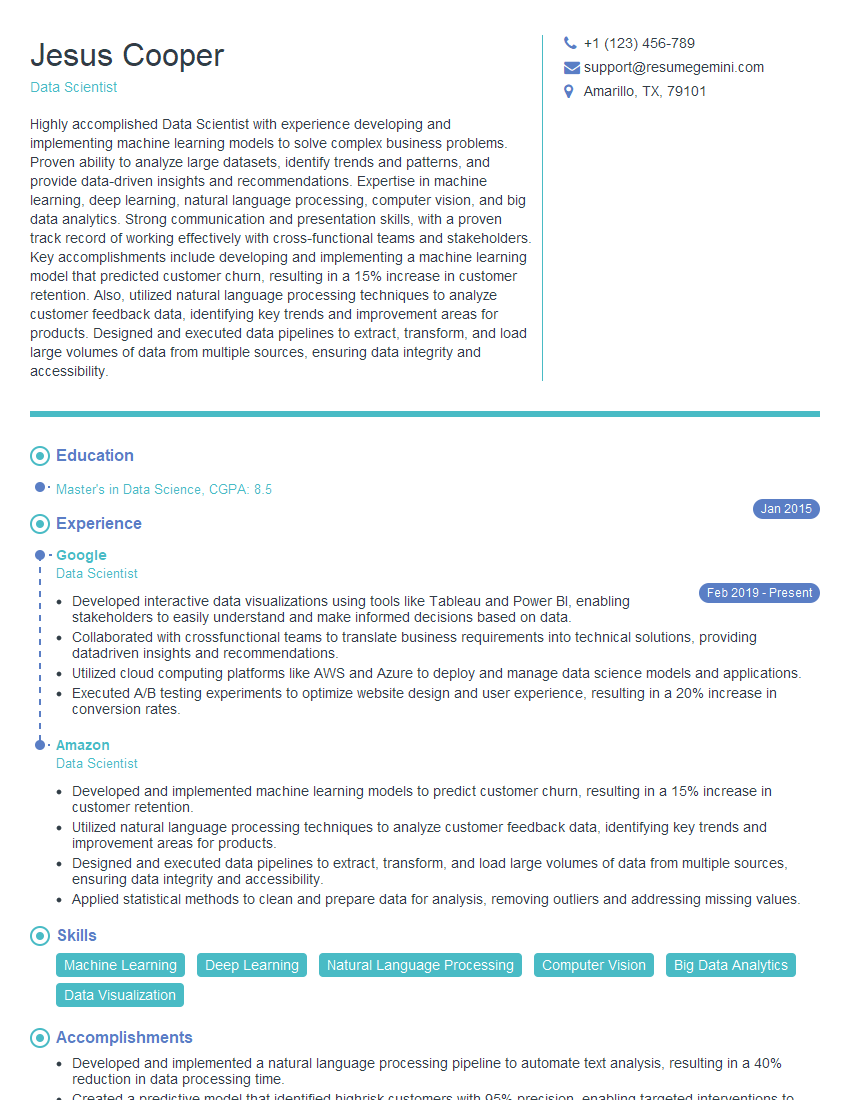
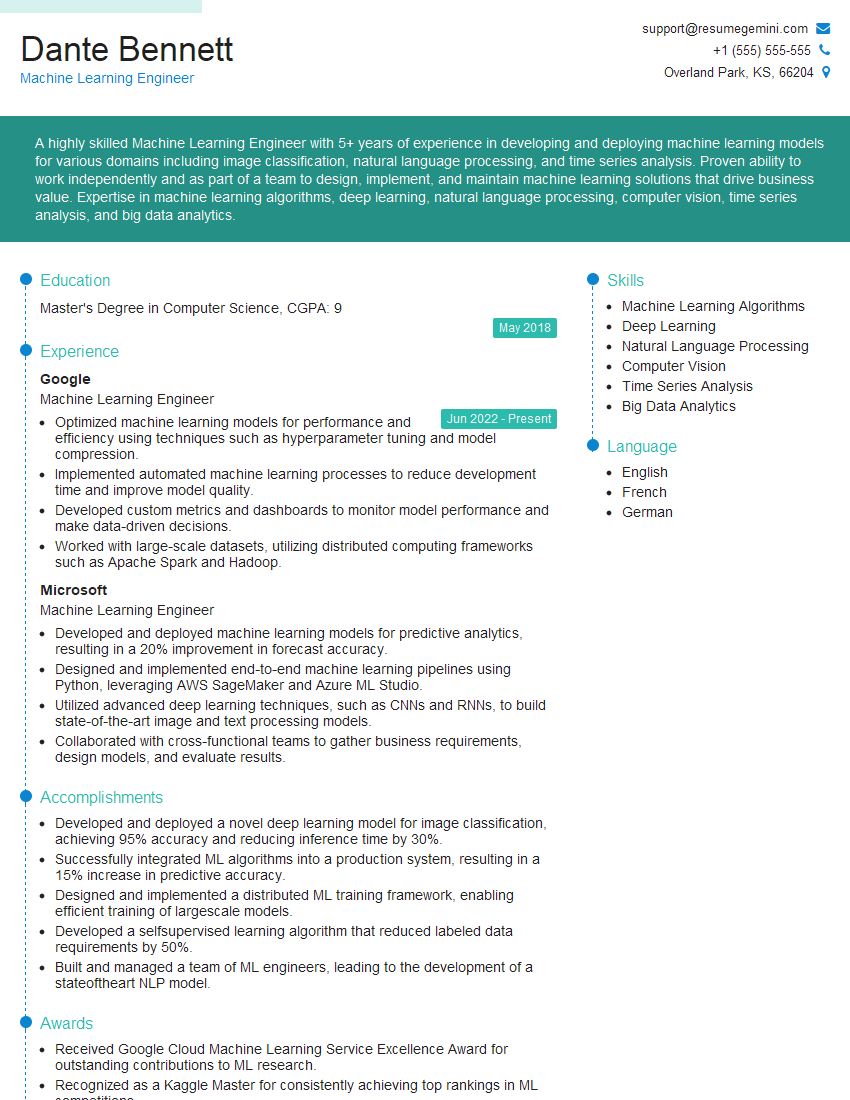
Mastering the deployment and maintenance of AI/ML systems is crucial for career advancement in this rapidly evolving field. Demonstrating this expertise through a strong resume is key to unlocking exciting opportunities. Creating an ATS-friendly resume is essential to ensure your application gets noticed. We highly recommend leveraging ResumeGemini to build a professional and impactful resume that highlights your skills and experience. ResumeGemini provides examples of resumes tailored to roles emphasizing experience in deploying and maintaining AI and Machine Learning systems, helping you present your qualifications effectively.
Explore more articles
Users Rating of Our Blogs
Share Your Experience
We value your feedback! Please rate our content and share your thoughts (optional).
What Readers Say About Our Blog
Very informative content, great job.
good