Are you ready to stand out in your next interview? Understanding and preparing for Drywall Finishing interview questions is a game-changer. In this blog, we’ve compiled key questions and expert advice to help you showcase your skills with confidence and precision. Let’s get started on your journey to acing the interview.
Questions Asked in Drywall Finishing Interview
Q 1. What types of drywall compound do you prefer and why?
My preference in drywall compound hinges on the specific task. For taping and bedding, I favor a lightweight all-purpose compound. Its smooth, easy-to-sand consistency makes for a quick and efficient base coat. For topping coats, where a flawless finish is paramount, I often opt for a lightweight, all-purpose compound designed for smooth finishes, which allows for excellent sanding and minimal dust. A heavier compound might be useful in certain situations like filling deep holes, but for most applications, lightweight is key. It reduces the overall weight on the wall and dries faster, which speeds up the process considerably. Using the right compound for the right job is crucial in achieving a professional, high-quality finish.
Q 2. Describe your experience with different drywall taping methods.
Over the years, I’ve become proficient in various drywall taping methods. I’m comfortable with both hand-taping and using a taping knife. Hand-taping, while slower, allows for more precise control, especially in intricate areas. Using a taping knife significantly increases speed and efficiency, ideal for large, flat surfaces. I’ve found that the key to success with either method is using even pressure to embed the tape properly within the compound, ensuring a seamless transition to the wall surface. The finishing process involves multiple coats of compound applied with increasing widths of knives, progressively smoothing the surface for a pristine finish. I also understand the benefits of using a spray-on compound for speed and efficiency on large commercial projects. Every method has its niche, and choosing the right one depends greatly on the project scope and personal preference.
Q 3. How do you ensure smooth, consistent drywall finishes?
Achieving smooth, consistent drywall finishes is a matter of meticulous attention to detail. It begins with the preparation – ensuring the drywall is properly installed, seams are cleanly taped, and the surface is free of imperfections. Then, applying thin, even coats of compound, allowing adequate drying time between coats. Overloading the compound will result in cracking and uneven surfaces. I always use high-quality sanding tools, beginning with coarser grits to remove imperfections then gradually moving to finer grits for a flawless finish. This careful multi-step process ensures a consistent, smooth surface. Remember, patience is key! Rushing the process often leads to mistakes that are difficult and time-consuming to correct.
Q 4. Explain your process for repairing damaged drywall.
Repairing damaged drywall involves several steps, beginning with a thorough assessment of the damage. Small holes can be easily patched with pre-mixed spackling compound, while larger holes require cutting out the damaged section and installing a new drywall patch. The patch should be securely fastened and the edges should be flush with the surrounding drywall. Then apply layers of drywall compound, feathering the edges to create a seamless blend with the existing wall. Sanding each coat to ensure a smooth finish. The process mirrors the initial drywall finishing, ensuring consistency in texture and appearance. Careful attention to detail and proper selection of materials will ensure a durable and invisible repair.
Q 5. What are the common causes of drywall cracks and how do you repair them?
Drywall cracks often stem from structural movement within the house. Settlement of the foundation, shifting framing, or even changes in humidity can cause stress on the drywall, leading to cracks. Another common cause is improper installation of the drywall. The most effective repair involves finding the root cause – is it a simple surface crack or a sign of underlying structural issues? For minor cracks, filling and sanding is sufficient. However, for larger or recurring cracks, addressing the structural issues may be necessary to avoid future problems. Sometimes, simply reinforcing the area behind the drywall with additional framing can prevent further cracking. The best repair addresses both the symptom and the cause.
Q 6. How do you achieve different types of drywall textures (e.g., knockdown, orange peel)?
Creating different drywall textures involves using specific techniques when applying the final coat of compound. For a knockdown texture, a thick coat is applied and then ‘knocked down’ using a special tool to create a rough, textured surface. The texture and depth depend on the tool used and how forcefully it’s applied. Orange peel, on the other hand, is achieved by using a hopper gun or a spray texture gun and adjusting the spray pattern and pressure to achieve the desired level of texture. This approach requires practice and an understanding of the spray equipment. Other textures are created through different techniques like using rollers with different nap lengths. In this case, careful planning and understanding of the tools and materials is crucial for creating a consistent and aesthetically pleasing finish.
Q 7. Describe your experience with different types of drywall.
My experience encompasses various types of drywall, including standard drywall, moisture-resistant drywall (often used in bathrooms and kitchens), and fire-resistant drywall (used in high-traffic areas). Standard drywall is the most common type, suitable for most interior applications. Moisture-resistant drywall is essential in high-humidity areas to prevent mold and mildew growth. Fire-resistant drywall provides enhanced fire protection, which increases the overall safety of the building. Understanding the properties of each type is crucial for selecting the right material for each project. The thickness and density of the drywall can also influence the application process and the tools and techniques required for proper finishing.
Q 8. What safety precautions do you take while working with drywall?
Safety is paramount in drywall finishing. My approach is proactive, encompassing several key measures. First, I always wear appropriate Personal Protective Equipment (PPE), including safety glasses to protect my eyes from dust and debris, a dust mask (ideally an N95 respirator) to prevent inhaling harmful particles, and work gloves to protect my hands from cuts and irritants.
Second, I ensure the work area is well-lit and free of clutter to minimize tripping hazards. This includes properly securing any loose wires or objects. Third, I utilize proper lifting techniques when handling drywall sheets, to avoid strains and injuries. If the sheet is too heavy for one person, I always get assistance. Finally, I’m meticulous about proper cleanup, ensuring all dust and debris are removed at the end of each workday, minimizing the risk of slipping and respiratory problems.
For example, on a recent job, we were working in a confined attic space. Before starting, I ensured we had adequate ventilation to minimize dust buildup, and we used harnesses and safety lines to prevent falls.
Q 9. How do you manage your time and prioritize tasks on a drywall finishing project?
Effective time management on a drywall finishing project hinges on careful planning and prioritization. I begin by thoroughly reviewing the blueprints and specifications, identifying the scope of work and potential challenges. This allows me to break down the project into manageable tasks.
I prioritize tasks based on their dependencies and urgency. For instance, taping and mudding must be completed before sanding and priming. I create a realistic schedule, allowing for unforeseen delays or complexities. This schedule becomes a roadmap that I monitor and adjust as needed. I also regularly assess progress, ensuring we stay on track and address any potential bottlenecks promptly.
For example, on a large commercial project, we had a tight deadline. By carefully planning each stage – from installing the drywall to finishing the final coats – and by prioritizing critical path tasks, we delivered the project on time and within budget.
Q 10. Describe your experience with mudding and taping techniques.
Mudding and taping are the heart of drywall finishing, and my experience encompasses a wide range of techniques. I’m proficient in both hand-taping and using taping tools. Hand-taping offers precision for intricate details, while taping tools increase efficiency on larger projects. My approach to mudding involves applying thin coats to ensure even coverage and prevent cracking. I’m adept at various mudding techniques, such as using all-purpose joint compound for general application and lightweight all-purpose compound for ease of sanding.
I understand the importance of proper feathering, creating a seamless transition between the tape and the drywall surface to achieve a flawless finish. I am experienced with different types of tape, including paper tape and fiberglass mesh tape, selecting the most suitable type depending on the project requirements. My expertise extends to dealing with various joint types, including inside corners, outside corners and butt joints, employing specific techniques for each.
For example, when working on a project with many inside corners, I use a corner tool to create a clean, consistent finish. For wide butt joints, I use a wider knife and apply multiple coats to create a gradual feathering effect.
Q 11. What tools and equipment are essential for efficient drywall finishing?
Efficient drywall finishing relies heavily on the right tools and equipment. The essentials include various sizes of putty knives (6”, 8”, 10”, and 12”), for applying different coats of mud and achieving various levels of feathering. A taping knife is crucial for embedding the tape neatly and evenly. A hawk (a flat, raised platform) makes mud application smoother and more efficient. A sturdy drywall sander, either manual or electric, is needed for smoothing the mud coats.
Other important tools include a utility knife for cutting tape, a level for checking surface flatness, a measuring tape, and a sponge or damp cloth for cleaning tools. A powerful shop vacuum is essential for efficient dust removal. For larger projects, a pump sprayer for wetting the drywall before sanding can significantly reduce dust. Finally, having a variety of joint compounds on hand, suited to different applications, is crucial.
Q 12. How do you troubleshoot common problems encountered during drywall finishing?
Troubleshooting is a critical skill in drywall finishing. Common problems include cracking, nail pops, and uneven surfaces. Cracking often indicates insufficient feathering or improper drying time of the joint compound. My solution involves carefully removing the cracked section, reapplying mud with proper feathering, and allowing sufficient drying time before sanding.
Nail pops are addressed by carefully tapping the nail head back into the drywall surface using a hammer and then carefully mudding and sanding the area. Uneven surfaces are tackled through careful multiple coats of mud, each coat sanded smooth, until the desired flatness is achieved. Knowing how to identify the root cause of the problem—whether it’s material selection, application technique, or environmental factors—is key to finding the best solution.
For instance, I once encountered excessive cracking in a newly finished room. By investigating, I realized the issue stemmed from too-rapid drying due to inadequate climate control. Adjusting the temperature and humidity, and applying thinner coats of mud, resolved the problem.
Q 13. Explain your understanding of joint compound application and drying times.
Joint compound (also called drywall mud) is the glue that holds the drywall together and creates a smooth surface. Understanding its application and drying times is critical for a successful finish. Different types of joint compound exist, each with different characteristics and drying times: All-purpose compound is versatile, all-purpose lightweight is easier to sand, and setting-type compound dries faster and is useful for multiple coats in a short time.
Application involves applying thin, even coats, carefully feathering each coat to avoid build-up and cracking. Drying times depend on the type of compound, humidity, and temperature. All-purpose compounds typically require several hours to dry between coats, while setting-type compounds dry much faster. I always allow sufficient drying time before sanding to prevent tearing or damage to the compound.
For instance, in humid climates, I will choose a faster-drying compound and/or apply thinner coats to avoid excessive drying time, and potential for mold growth.
Q 14. How do you prepare the surface before applying joint compound?
Surface preparation before applying joint compound is crucial for a professional finish. This involves several steps: First, I ensure the drywall is firmly attached to the framing and free from any loose debris. Then, I thoroughly clean the surface to remove any dust or dirt, using a brush or vacuum. This ensures the mud adheres properly and prevents weak points.
Next, I prime any areas that have been repaired or patched using a drywall primer designed to improve adhesion and prevent the mud from being sucked into the drywall. Finally, I carefully tape all joints using appropriate paper or fiberglass tape, ensuring the tape is fully embedded and smooth to prepare for the mud application. This thorough prep work prevents common problems such as cracking and poor adhesion.
Q 15. What is your experience with priming and painting drywall?
Priming and painting drywall are crucial final steps that protect the surface and enhance the overall aesthetic. Priming seals the drywall, preventing the absorption of paint and ensuring a uniform finish. A good primer also helps the paint adhere better, leading to a longer-lasting, more vibrant result. I always use a high-quality primer specifically formulated for drywall, applying it with a roller for even coverage and a brush for edges and corners. After the primer dries completely (usually a few hours, depending on the product and environmental conditions), I apply two coats of paint, allowing each coat to dry fully before applying the next. The first coat is usually a slightly thinner coat to soak into the surface, while the second coat provides the full color and coverage. I carefully select paint colors based on client preferences and the lighting conditions of the space, ensuring the final look aligns perfectly with their vision. On one project, we used a specialized primer to cover stubborn water stains before painting, a detail that significantly improved the final product.
Career Expert Tips:
- Ace those interviews! Prepare effectively by reviewing the Top 50 Most Common Interview Questions on ResumeGemini.
- Navigate your job search with confidence! Explore a wide range of Career Tips on ResumeGemini. Learn about common challenges and recommendations to overcome them.
- Craft the perfect resume! Master the Art of Resume Writing with ResumeGemini’s guide. Showcase your unique qualifications and achievements effectively.
- Don’t miss out on holiday savings! Build your dream resume with ResumeGemini’s ATS optimized templates.
Q 16. How do you handle challenging angles and curves when finishing drywall?
Handling angles and curves requires precision and the right tools. For sharp angles, I use a flexible putty knife to carefully apply joint compound, feathering the edges to create a seamless transition. For curves, I utilize a variety of techniques, including using a flexible taping knife or even a slightly damp sponge to smooth out the compound. Often, multiple thin coats are better than one thick coat when working with curves to avoid cracking. One particularly challenging project involved a curved wall in a high-end home. To achieve the desired smooth, even finish, I used a combination of flexible knives and a considerable amount of patience and attention to detail. The result was a perfectly smooth, flawless curve that impressed the client immensely.
Q 17. What is your experience with working at heights?
Safety is paramount when working at heights. I have extensive experience working on scaffolding, ladders, and lifts, always adhering to strict safety protocols. This includes using appropriate fall protection equipment like harnesses and safety lines, ensuring the stability of the scaffolding, and regularly inspecting all equipment before use. I also understand the limitations of each piece of equipment and always choose the most appropriate method for the specific task at hand. For instance, when working on high ceilings, I prefer using a rolling scaffold for its stability and maneuverability, rather than a ladder which can be unstable for extended periods of work at a significant height. I’ve trained extensively in proper fall prevention and rescue techniques. Proper planning, adherence to regulations, and constant self-assessment are key to ensuring a safe working environment at height.
Q 18. What are the different types of drywall screws and how do you choose the right ones?
Drywall screws come in various types, lengths, and materials. Common types include self-tapping, bugle-head, and drywall screws with different coatings. The choice depends on several factors including the type of drywall, the thickness of the drywall, and the application. For example, longer screws are needed for thicker drywall, and self-tapping screws are generally preferred for their ease of use. Bungle-head screws are often favored for their aesthetic appeal, as the slight recess helps the joint compound to blend seamlessly into the surface. I always use corrosion-resistant screws in areas prone to moisture, such as bathrooms or kitchens. Choosing the incorrect screw can lead to issues such as popping nails, uneven surfaces and an ultimately poor finish. I meticulously select the right screw for each job, taking into consideration the specific requirements of the project.
Q 19. How do you ensure a consistent coat thickness when applying joint compound?
Maintaining consistent coat thickness is crucial for a flawless finish. I achieve this by using a consistent technique and the right tools. I typically apply thin coats using a broad knife, working in small sections and ensuring even distribution of the compound. I use a combination of techniques such as back-rolling (applying pressure to the back of the knife while applying the compound) and feathering (tapering off the compound towards the edge) to maintain consistency. Over application leads to cracking and uneven surfaces, while under application doesn’t provide sufficient protection to the seams. Applying multiple thin coats instead of one thick coat is always my preference to allow drying properly and avoids cracking. Regular checks using a consistent lighting source help ensure even thickness throughout the project.
Q 20. How do you clean up after completing a drywall finishing job?
Cleaning up after a drywall finishing job is vital for maintaining a professional image and ensuring safety. I meticulously remove all tools, equipment, and debris, disposing of waste responsibly. All surfaces, including floors and work areas, are thoroughly cleaned using a shop-vac to remove dust and compound residue. I wash all tools and equipment carefully to prevent corrosion and maintain their lifespan. Any leftover joint compound is properly stored, and the work area is left clean and tidy. A clean job site speaks volumes about professionalism and commitment to quality. Respecting the client’s property is paramount, and leaving the space immaculate is always my highest priority.
Q 21. What is your experience with using power tools for drywall finishing?
I am proficient in using a variety of power tools for drywall finishing, including automatic taping tools, mud mixers, and sanders. Automatic taping tools significantly increase efficiency and consistency when applying tape, while mud mixers save time and effort when preparing large quantities of joint compound. Using power sanders is crucial for quickly smoothing out surfaces and achieving a perfectly even finish, though careful technique is needed to avoid sanding too deeply. Always using the appropriate safety equipment like dust masks and eye protection with these tools is paramount. I carefully maintain all my power tools, regularly cleaning and lubricating them to ensure optimal performance and longevity. Proper tool maintenance increases efficiency and allows me to complete jobs with the highest quality possible.
Q 22. Describe a time you had to troubleshoot a drywall finishing problem on a job site.
One time, I was finishing a large commercial project, and we encountered excessive cracking in the mud between several 12-foot-long drywall sheets. The initial application seemed fine, but after drying, significant hairline fractures appeared. Troubleshooting began with examining the installation process itself. We determined the root cause was improper taping technique – specifically, insufficient embedding of the tape into the initial coat of joint compound. The lack of proper adhesion caused the tape to shrink and pull away from the drywall as the compound dried and cured, creating the cracks. We had to carefully remove the cracked sections, reapply a generous layer of compound, re-embed the tape thoroughly, feather it out smoothly, and re-sand. To prevent recurrence, we implemented a more rigorous quality-control procedure where we inspected each sheet’s taping before the next coat was applied. This involved training other team members to reinforce proper tape-embedding techniques and to ensure consistent, thin compound coats.
Q 23. How do you maintain the quality of your work under pressure?
Maintaining quality under pressure requires a systematic approach. First, I prioritize thorough planning: carefully assessing the project scope, creating a realistic timeline with buffer time, and gathering all necessary tools and materials beforehand. This minimizes on-site scrambling and reduces stress. Second, I focus on meticulous execution – taking my time, particularly on critical aspects like taping and initial coats, instead of rushing. Lastly, I employ self-checks throughout the process. This includes regularly reviewing my work for imperfections like inconsistencies in compound thickness or sanding marks, addressing them immediately rather than letting them accumulate. Think of it like a skilled surgeon: precision and careful attention to detail, even under pressure, are paramount to achieving the best results.
Q 24. What are some common mistakes to avoid in drywall finishing?
Common drywall finishing mistakes often stem from rushing or neglecting fundamental techniques.
- Overloading the blade: Too much joint compound on the knife leads to uneven coats, sagging, and increased sanding time. Think of it like trying to paint a wall with a bucket of paint instead of a brush – you’ll end up with a mess!
- Insufficient sanding: Failing to adequately sand between coats creates noticeable texture imperfections in the finished wall. This results in a less-smooth and less-professional appearance.
- Ignoring feathering: Properly feathering the edges of each compound coat ensures a seamless transition between the compound and the drywall. Improper feathering leads to visible ridges and unevenness.
- Using the wrong tools: Selecting the wrong type or size of knife or sanding tool drastically affects the outcome. Using a too-large knife for corners, for instance, will lead to imperfections.
- Applying too many coats: Trying to compensate for previous errors with excessive coats results in longer drying times, increased cracking potential, and wasted material.
Q 25. How do you determine the appropriate amount of joint compound needed for a project?
Determining the appropriate amount of joint compound involves careful consideration of several factors. The surface area to be covered is the most obvious factor; larger areas necessitate more compound. The type of drywall also plays a crucial role: thicker drywall sheets require more compound to fill seams. The number of coats needed depends on the desired finish; a high-end finish might necessitate more coats than a basic one. My approach typically involves accurately measuring the total surface area requiring compound, then adding a buffer of about 10-15% to account for waste and potential re-work. I also take into account the depth of the seams and any significant repairs that need to be made, adding compound to fill these in. This approach avoids running short on materials mid-project, leading to delays and potential compromise on the finish quality.
Q 26. What is your experience with different types of sanding equipment?
My experience encompasses various sanding tools, from hand sanding blocks for detail work and smaller repairs to electric rotary sanders for larger surface areas. I’m proficient with both long-board electric sanders for wall coverage and smaller, more maneuverable hand sanders for corners and tight spots. I understand the importance of choosing the right tool for the specific job. For instance, aggressive sanding with a high-powered tool on thin coats can easily damage the underlying drywall. In contrast, using a hand block for large areas is time-consuming and inefficient. This involves understanding the grits needed for the different stages of sanding, from coarser grits for initial smoothing to finer grits for achieving a perfectly smooth finish. Selecting appropriate dust collection systems is another critical aspect of my approach to ensure a clean and safe work environment.
Q 27. Describe your experience working with a team on a drywall finishing project.
Teamwork is essential in drywall finishing. On a recent project, we had a large, complex renovation. Effective teamwork meant clear communication and task delegation. We divided the work into specific sections, assigning tasks based on team members’ skill sets. Each team member was responsible for a section, ensuring efficient progress and maintaining consistency in quality. Regular check-ins, clear communication about potential issues, and mutual support enabled seamless transitions between tasks. For example, one team member might focus on taping while another focused on initial coats. This collaborative approach ensured efficient completion without compromising on quality. I believe in fostering a collaborative environment where each member feels valued and can contribute their skills effectively.
Q 28. How do you stay updated on the latest techniques and materials in drywall finishing?
Staying updated is crucial in this ever-evolving field. I regularly attend industry workshops and seminars, where I learn about new techniques, materials, and best practices. I also subscribe to trade publications and online forums, constantly engaging with new information. Keeping up-to-date not only ensures the highest quality work but also helps me anticipate and overcome emerging challenges. Furthermore, I actively network with other professionals, exchanging insights and experiences. This continuous learning keeps my skills sharpened, allowing me to deliver exceptional results on every project. This is not just about staying abreast of trends, it’s about continuous improvement—a commitment to my craft and commitment to delivering the highest level of quality.
Key Topics to Learn for Your Drywall Finishing Interview
- Surface Preparation: Understanding different wall types, repairing imperfections (holes, cracks), and applying appropriate primers for optimal adhesion.
- Joint Compound Application: Mastering techniques like taping, bedding, and coating for seamless finishes. This includes understanding the different types of joint compound and their applications (e.g., all-purpose, lightweight).
- Sanding Techniques: Proper sanding methods to achieve smooth, even surfaces, minimizing dust, and understanding the importance of different grit levels.
- Finishing Techniques: Achieving various finishes (e.g., smooth, textured) and understanding the tools and techniques involved, including the use of different tools for different effects.
- Troubleshooting Common Issues: Identifying and resolving problems such as cracking, discoloration, and uneven surfaces. This includes understanding the causes of these issues and preventative measures.
- Safety Procedures: Demonstrating knowledge of safety regulations and procedures related to drywall finishing, including proper use of personal protective equipment (PPE).
- Tools and Equipment: Familiarity with various tools used in drywall finishing (knives, trowels, sanding tools, etc.) and their proper usage and maintenance.
- Understanding Specifications: Interpreting blueprints and specifications to ensure the finished product meets the required standards.
- Time Management and Efficiency: Demonstrating an understanding of how to efficiently complete projects within given timeframes and budgets.
Next Steps
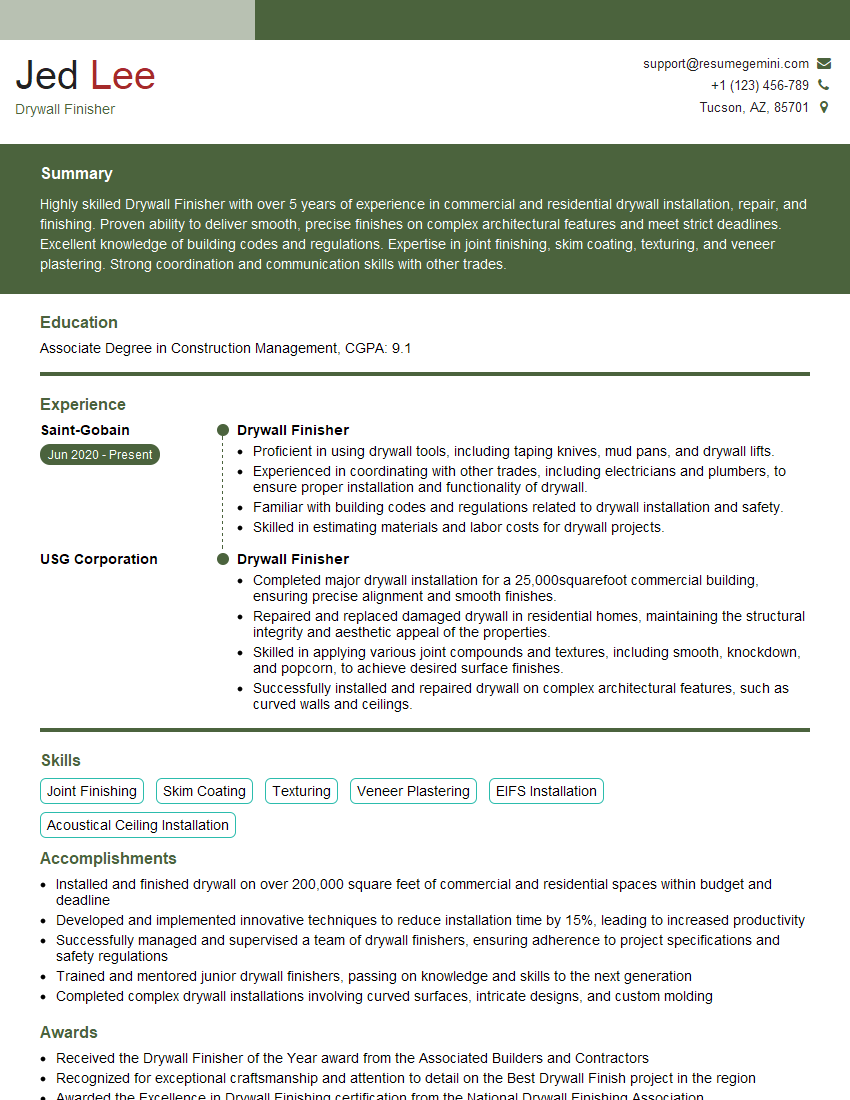
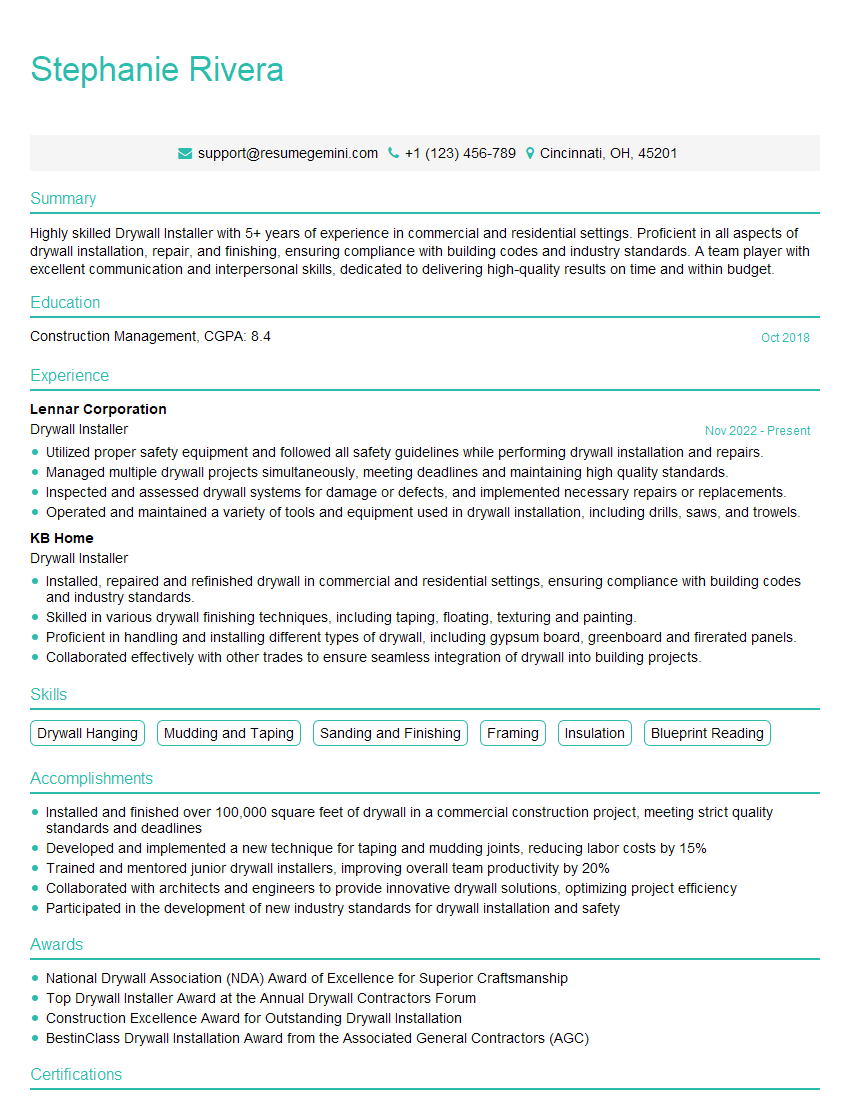
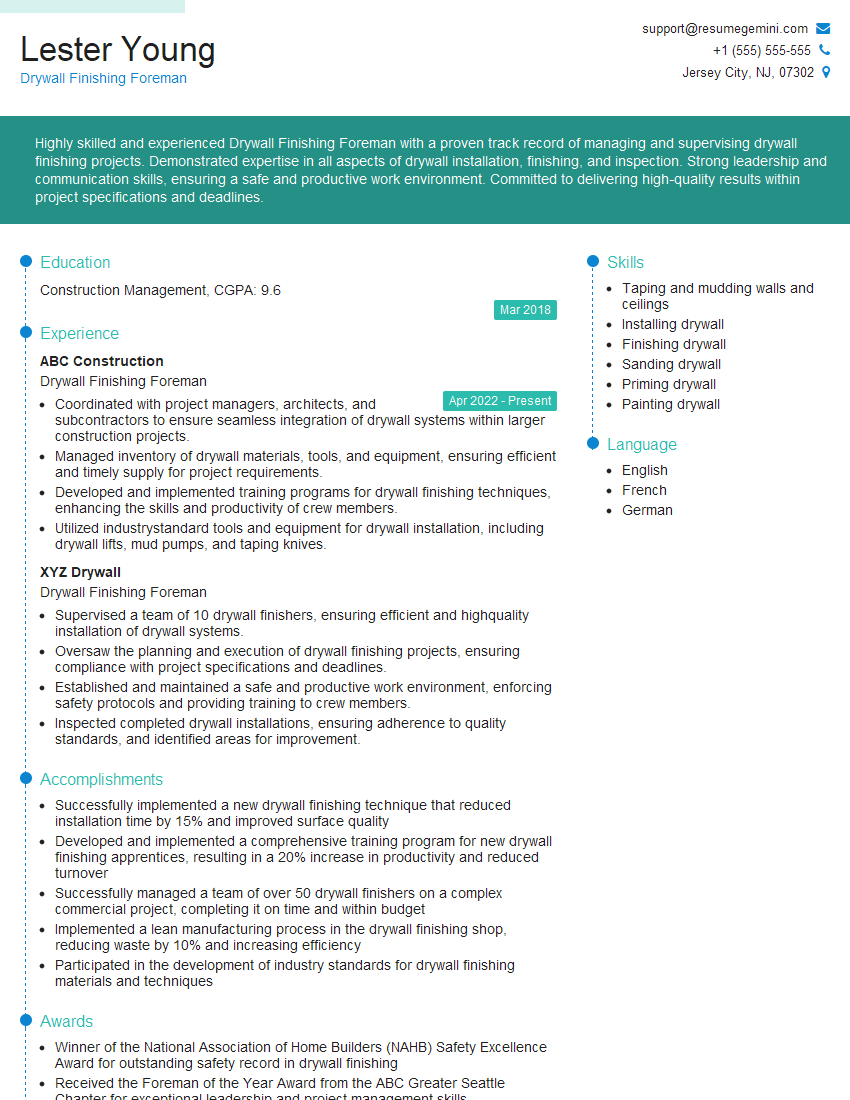
Mastering drywall finishing opens doors to a rewarding career with excellent earning potential and opportunities for advancement. To increase your chances of landing your dream job, a well-crafted resume is essential. An ATS-friendly resume ensures your application gets noticed by recruiters and hiring managers. We highly recommend using ResumeGemini to build a professional, impactful resume that highlights your skills and experience effectively. ResumeGemini provides examples of resumes tailored specifically for Drywall Finishing professionals, helping you showcase your qualifications in the best possible light. Take the next step in your career journey and build a resume that makes a difference!

Explore more articles
Users Rating of Our Blogs
Share Your Experience
We value your feedback! Please rate our content and share your thoughts (optional).
What Readers Say About Our Blog
Very informative content, great job.
good