Feeling uncertain about what to expect in your upcoming interview? We’ve got you covered! This blog highlights the most important Electrical and Wiring interview questions and provides actionable advice to help you stand out as the ideal candidate. Let’s pave the way for your success.
Questions Asked in Electrical and Wiring Interview
Q 1. Explain the difference between AC and DC current.
The main difference between AC (Alternating Current) and DC (Direct Current) lies in the direction of electron flow. In DC, electrons flow consistently in one direction, like a river flowing downstream. This is the type of current produced by batteries. AC, on the other hand, periodically reverses its direction, oscillating back and forth like a pendulum. This is the type of electricity supplied to our homes and businesses from power plants.
Think of it like this: DC is like a steady stream of water, while AC is like a wave constantly moving back and forth. This oscillating nature of AC makes it easier to transmit over long distances with less energy loss, which is why it’s the standard for power grids. DC is more commonly used in smaller electronics and devices where a consistent current is needed.
Q 2. Describe Ohm’s Law and its applications.
Ohm’s Law is a fundamental principle in electrical engineering that describes the relationship between voltage (V), current (I), and resistance (R) in a circuit. It’s expressed mathematically as: V = I * R
This means that the voltage across a conductor is directly proportional to the current flowing through it, and directly proportional to its resistance. A higher voltage will result in a higher current, given constant resistance. Conversely, a higher resistance will result in a lower current, given constant voltage.
Applications are ubiquitous. For example, it allows us to calculate the current draw of a device, given its voltage rating and resistance. It helps in designing circuits, sizing wires, and ensuring components don’t overheat or fail due to excessive current. In everyday life, a simple example is a light bulb: a higher voltage (higher current) leads to a brighter light (until the filament burns out!).
Q 3. What are the different types of electrical wiring?
There are several types of electrical wiring, each suited for different applications and environments. Some common types include:
- Romex (NM-B): A non-metallic sheathed cable commonly used in residential wiring. It’s relatively easy to install and cost-effective.
- BX (AC): Armored cable, featuring conductors encased in a flexible metal sheath, providing extra protection against physical damage. Often used in areas where physical protection is important.
- MC Cable (Metal Clad): Similar to BX, offering good protection but is typically easier to work with.
- Conduit Wiring: Individual conductors run inside a rigid metal or plastic pipe, providing superior protection and flexibility in routing. Often seen in industrial or commercial settings.
- Aluminum Wiring: While less common now due to its susceptibility to corrosion and overheating issues compared to copper, it’s still found in older buildings.
The choice of wiring depends heavily on factors like the application, building codes, safety requirements, and environmental conditions.
Q 4. Explain the National Electrical Code (NEC) and its importance.
The National Electrical Code (NEC) is a set of widely adopted standards for electrical wiring and installation in the United States. It’s a comprehensive document outlining safe practices to prevent electrical hazards, fires, and injuries. The NEC is not a law, but it’s legally mandated by most jurisdictions, forming the basis for local electrical codes. Inspectors use the NEC to ensure installations meet safety standards.
Its importance is paramount. It safeguards lives and property by mandating safe installation techniques, specifying appropriate materials, and defining requirements for various electrical systems. Following the NEC is essential for ensuring the safety and reliability of any electrical installation. Failure to comply can lead to fines, legal repercussions, and potentially catastrophic consequences.
Q 5. How do you troubleshoot a faulty circuit?
Troubleshooting a faulty circuit requires a systematic approach. First, I would ensure my own safety by de-energizing the circuit at the breaker panel. Then, I’d use a voltage tester to verify that power is indeed off. Next, I’d visually inspect the circuit for any obvious problems such as loose connections, damaged wires, or tripped circuit breakers/GFCIs.
If a visual inspection doesn’t reveal the issue, I’d use a multimeter to check for continuity in the wiring, checking for any breaks or shorts in the circuit. I would also measure the voltage at different points in the circuit to pinpoint the location of the fault. For instance, if I find voltage at one end of a circuit but not at the other, I know the break is somewhere between those two points.
Once the faulty component is identified (a broken wire, a bad switch, etc.), I’d replace or repair it, ensuring all connections are secure and the circuit is properly grounded. After the repair, I’d thoroughly test the circuit to ensure it’s functioning correctly before restoring power.
Q 6. What safety precautions do you take when working with electricity?
Safety is paramount when working with electricity. My primary precaution is always to de-energize the circuit before working on it. I never assume a circuit is dead; I always double-check with a non-contact voltage tester. I use appropriate personal protective equipment (PPE), including insulated tools, safety glasses, and rubber gloves. I work with a partner whenever possible, to ensure someone is available to assist in case of an emergency.
I adhere strictly to the NEC and all relevant local codes. I ensure the work area is well-lit and free of obstructions. I avoid working in wet or damp conditions, and I am mindful of potential hazards like overhead power lines. Finally, I never work on energized circuits unless absolutely necessary and with appropriate safety measures in place, such as using insulated tools and employing lockout/tagout procedures.
Q 7. Explain the purpose of grounding and bonding.
Grounding and bonding are crucial safety measures in electrical systems, designed to protect against electrical shocks and prevent fires. Grounding connects a non-current-carrying metal part of an electrical system to the earth. This provides a path for fault currents to flow directly to the ground, rather than through a person or equipment, preventing electrical shock.
Bonding, on the other hand, connects multiple metal parts within an electrical system to each other. This ensures that these parts are at the same electrical potential, preventing voltage differences that could cause hazardous arcing or sparking. Think of grounding as connecting to the earth, and bonding as connecting things within the system together. Together, they form a comprehensive safety net, providing multiple pathways for fault currents, minimizing the risk of electrical hazards.
Imagine a faulty appliance: If it’s grounded, a fault current will flow directly to earth, tripping a circuit breaker. If it’s also bonded, any metallic parts of the appliance will be at the same potential, preventing shocks if you touch them. This dual protection system significantly enhances safety.
Q 8. What are the different types of electrical outlets and their uses?
Electrical outlets come in various types, each designed for specific purposes and voltage requirements. The most common types are:
- 120V NEMA 5-15R (Standard Duplex Outlet): The ubiquitous outlet found in most homes in North America. It’s designed for standard appliances and electronics.
- 120V NEMA 5-20R (20 Amp Duplex Outlet): This outlet provides a higher amperage capacity, suitable for power-hungry appliances like dryers or microwaves. It’s easily identifiable by its T-shaped neutral slot.
- 240V Outlets (NEMA 6-15R, 6-20R, etc.): These outlets supply higher voltage, necessary for appliances like electric ranges, ovens, and clothes dryers. They are typically found in the kitchen or laundry room.
- GFCI Outlets (Ground Fault Circuit Interrupters): Designed for safety in areas prone to moisture, like bathrooms and kitchens. They detect ground faults and immediately cut power to prevent electric shock.
- AFCI Outlets (Arc Fault Circuit Interrupters): These outlets detect potentially dangerous arcing in wiring and shut off power, helping to prevent electrical fires.
- USB Outlets: These outlets integrate USB charging ports, offering convenient charging for smartphones and other devices.
Understanding the different outlet types is crucial for safe and efficient electrical installations. Choosing the wrong outlet can lead to appliance malfunction, overloading circuits, or even fire hazards.
Q 9. Describe your experience with different types of electrical testing equipment.
Throughout my career, I’ve extensively used a variety of electrical testing equipment. My experience encompasses:
- Multimeters: Essential for measuring voltage, current, and resistance. I’ve used both analog and digital multimeters, appreciating the precision of digital models for complex troubleshooting.
- Clamp Meters: These are invaluable for measuring current without interrupting the circuit. I’ve utilized them extensively for diagnosing overloaded circuits and verifying correct current flow in various applications.
- Megohmmeters (Meggers): Used to test insulation resistance in wiring and equipment. This is critical for ensuring safety and identifying potential hazards before they become problems. I’ve used them in preventative maintenance programs and during inspections.
- Loop Testers: These testers measure the impedance of a circuit to identify potential faults and verify proper grounding. This tool is critical for fault finding in earth leakage protection circuits.
- Ground Resistance Testers: These measure the resistance of the grounding system. Ensuring proper grounding is crucial for safety and this is what this tool provides. Low resistance indicates a well-grounded system, while high resistance indicates a potential safety hazard.
My proficiency with these instruments allows me to accurately diagnose electrical problems, ensuring the safety and efficiency of electrical systems.
Q 10. How do you calculate voltage drop?
Voltage drop is the reduction in voltage along a conductor caused by its resistance to current flow. It’s crucial to calculate voltage drop to ensure that sufficient voltage reaches the load (appliance or device).
The formula for calculating voltage drop is:
Vd = 2 * I * L * R / 1000Where:
Vd= Voltage drop (in Volts)I= Current (in Amps)L= Length of the conductor (in feet)R= Resistance of the conductor (in ohms per 1000 feet)
Example: Let’s say you have a 100-foot long 12-gauge copper wire carrying 15 amps. The resistance of 12-gauge copper wire is approximately 1.6 ohms per 1000 feet. The voltage drop would be:
Vd = 2 * 15 A * 100 ft * 1.6 ohms/1000 ft / 1000 = 0.48 VoltsThis is a relatively small voltage drop, but exceeding a certain percentage (typically 3-5%) can affect the performance of equipment and requires larger gauge wiring to compensate.
Q 11. Explain the concept of impedance and its impact on circuits.
Impedance is the total opposition to the flow of alternating current (AC) in a circuit. Unlike resistance, which only considers the opposition to direct current (DC), impedance incorporates both resistance and reactance (opposition due to capacitance and inductance).
Impedance affects circuits in several ways:
- Power Factor: Impedance influences the power factor, which is the ratio of real power (used by the load) to apparent power (total power supplied). A low power factor can lead to increased energy costs and inefficient operation.
- Current Flow: Higher impedance reduces current flow for a given voltage. This can affect the performance of devices designed for specific current levels.
- Resonance: In circuits with both capacitance and inductance, impedance can reach a minimum at a specific frequency, known as resonance. This can cause a significant increase in current flow and potentially damage components.
Understanding impedance is crucial in AC circuit analysis and design. For instance, in audio systems, impedance matching between components is critical for optimal power transfer and sound quality.
Q 12. What are the different types of circuit breakers and their functions?
Circuit breakers are safety devices designed to protect electrical circuits from overcurrent. Several types exist:
- Thermal Circuit Breakers: These breakers use a bimetallic strip that bends and trips the breaker when excessive heat is generated due to overcurrent.
- Magnetic Circuit Breakers: These breakers use an electromagnet that trips the breaker when a high current flows through the circuit. They are faster acting than thermal breakers for large current surges.
- Thermal-Magnetic Circuit Breakers: The most common type, combining both thermal and magnetic tripping mechanisms. This provides protection against both slow overloads and fast short circuits.
- Ground Fault Circuit Interrupters (GFCIs): These detect imbalances in current between the hot and neutral wires, indicating a ground fault. They quickly trip to protect against electric shock.
- Arc Fault Circuit Interrupters (AFCIs): These detect the characteristic arcing that occurs during electrical faults and trip the circuit to help prevent electrical fires.
Each circuit breaker type serves a specific purpose in protecting electrical systems. The selection of the appropriate breaker depends on the specific application and the type of protection required.
Q 13. Describe your experience with electrical drawings and schematics.
I have extensive experience interpreting and working with electrical drawings and schematics. This involves understanding single-line diagrams, wiring diagrams, and detailed panel schedules. I’m proficient in reading symbols, understanding circuit configurations, and tracing current pathways.
My experience includes:
- Interpreting symbols and notations: I can accurately decipher the various symbols and notations commonly used in electrical drawings, including those specific to various building codes.
- Identifying components and their interconnections: I understand how different components interact within a system and can trace the flow of electricity from the source to the load.
- Analyzing circuit configurations: I can evaluate the design of a circuit, identifying potential issues and making recommendations for improvement.
- Working with CAD software: I’m familiar with CAD software used for electrical design and documentation.
Accurate interpretation of electrical drawings is paramount for safe and efficient installation and maintenance. A misunderstanding of a drawing can lead to significant errors and safety hazards.
Q 14. How do you determine the appropriate wire gauge for a given application?
Selecting the appropriate wire gauge depends on several factors, primarily the current carrying capacity and the allowable voltage drop. The higher the current, the larger the gauge (smaller number) needs to be. Larger gauges offer less resistance.
To determine the appropriate gauge, you need to consider:
- Amperage (Current): The amount of current the wire will carry (in Amps).
- Voltage: The voltage of the circuit (in Volts).
- Length of the wire: The total distance the wire runs (in feet).
- Type of wire: Different types of wire (copper, aluminum) have different resistance characteristics.
- Ambient temperature: Higher temperatures reduce the current carrying capacity of the wire.
- National Electrical Code (NEC): The NEC provides detailed tables specifying the allowable ampacity for various wire types and installation methods.
Using the NEC tables and considering voltage drop calculations (as discussed earlier), you can choose the correct wire gauge to ensure a safe and efficient installation. Undersizing the wire can lead to overheating, while oversizing increases costs unnecessarily. Consulting the NEC tables is essential for compliance and safety.
Q 15. Explain the principles of parallel and series circuits.
Series and parallel circuits are fundamental concepts in electricity, determining how components are connected and how current flows. In a series circuit, components are connected end-to-end, forming a single path for current. This means the current is the same through each component. Think of it like a single lane road – all traffic must travel the same path. The total resistance is the sum of individual resistances (Rtotal = R1 + R2 + R3…). If one component fails, the entire circuit breaks. A simple example is a string of Christmas lights where one bulb burning out causes the entire string to go dark.
In a parallel circuit, components are connected across each other, providing multiple paths for current flow. The voltage across each component is the same, but the current through each branch can differ depending on the resistance of that branch. Think of it like a multi-lane highway – traffic can distribute across multiple paths. The total resistance is less than the smallest individual resistance (1/Rtotal = 1/R1 + 1/R2 + 1/R3…). If one component fails, the others continue to function. Household wiring is a classic example of a parallel circuit; if one appliance malfunctions, the others remain operational.
Career Expert Tips:
- Ace those interviews! Prepare effectively by reviewing the Top 50 Most Common Interview Questions on ResumeGemini.
- Navigate your job search with confidence! Explore a wide range of Career Tips on ResumeGemini. Learn about common challenges and recommendations to overcome them.
- Craft the perfect resume! Master the Art of Resume Writing with ResumeGemini’s guide. Showcase your unique qualifications and achievements effectively.
- Don’t miss out on holiday savings! Build your dream resume with ResumeGemini’s ATS optimized templates.
Q 16. What is the difference between a fuse and a circuit breaker?
Both fuses and circuit breakers are safety devices designed to protect circuits from overcurrent, but they operate differently. A fuse is a one-time use device containing a thin wire that melts and breaks the circuit when excessive current flows. Once blown, it needs to be replaced. Imagine it as a sacrificial element, protecting the circuit by burning out itself. Fuses are relatively inexpensive and simple but require manual replacement.
A circuit breaker is a reusable device that automatically interrupts the circuit when an overcurrent is detected. It uses a bimetallic strip or an electromagnet to trigger a mechanism that switches the circuit off. Once the fault is cleared, the circuit breaker can be reset, restoring power. They are more expensive than fuses but offer the convenience of resettability and are generally preferred for modern applications. Think of a circuit breaker like a sophisticated switch that automatically shuts off when it senses danger and can be turned back on once the danger has passed.
Q 17. How do you identify and handle different types of electrical hazards?
Identifying and handling electrical hazards requires a methodical approach and strict adherence to safety protocols. Common hazards include exposed wires, damaged insulation, overloaded circuits, damp or wet conditions, and improper grounding. Identifying these hazards often involves visual inspection, using multimeters to test voltage and continuity, and understanding the wiring schematic.
Handling these hazards involves several key steps: de-energizing the circuit before any work is done (locking out/tagging out procedures are crucial), using appropriate personal protective equipment (PPE) such as insulated gloves, safety glasses, and non-conductive footwear, using proper tools designed for electrical work, and adhering to safe working practices, always treating any circuit as potentially live until verified otherwise. If you are uncertain about a situation, seek expert help immediately. Never compromise safety. Safety is paramount in any electrical situation.
Q 18. Explain your experience with various wiring methods (e.g., conduit, raceway).
Throughout my career, I have extensive experience with various wiring methods, including conduit, raceway, and surface mounting. Conduit wiring uses metal or plastic pipes to protect and route wires, offering excellent protection against physical damage and environmental factors. I’m proficient in bending and installing various types of conduit, selecting the appropriate size and type based on the application and local codes. I have experience with different fittings, such as couplings, elbows, and boxes.
Raceway systems offer similar protection but can include different types of channels and trays for wire routing, offering greater flexibility in installations. I am skilled in using various raceway systems and selecting the most appropriate method for specific requirements. Finally, surface mounting involves running wires directly on surfaces and securing them with appropriate clips and staples. This method is simpler and quicker for less demanding applications, but it generally offers less protection compared to conduit or raceway. I always ensure that all wiring methods comply with the relevant electrical codes and regulations.
Q 19. Describe your proficiency in using electrical tools and equipment.
My proficiency in using electrical tools and equipment encompasses a wide range of tools, including multimeters, wire strippers, crimpers, voltage testers, fish tapes, cable pullers, and various hand and power tools for conduit bending and installation. I am adept at using multimeters to troubleshoot circuits, identify shorts, measure voltage and current, and verify proper grounding. I am also familiar with operating specialized tools such as cable locators and thermal imaging cameras for identifying potential problems.
I understand the importance of selecting the right tool for each task and maintaining all tools in good working condition. Safety is always my top priority, and I always use tools correctly, following manufacturer’s instructions and safety protocols to ensure my personal safety and the safety of others on the job. I regularly undergo training to ensure my skills remain updated and compliant with the latest safety standards.
Q 20. How do you ensure compliance with local electrical codes and regulations?
Ensuring compliance with local electrical codes and regulations is non-negotiable. I meticulously review and follow all relevant codes, such as the National Electrical Code (NEC) in the US or equivalent standards in other regions. Before any project, I thoroughly investigate applicable codes to ensure all work meets the required standards. This involves checking for permit requirements, proper sizing of conductors, grounding practices, installation methods, and safety regulations.
I maintain detailed records of all work performed, including materials used and inspections conducted. I also collaborate with inspectors to ensure all work conforms to codes. Staying current with code updates and changes is crucial; I regularly review updates and attend training sessions to remain informed about any changes to codes and best practices. By adhering to these procedures, I help ensure all electrical systems are safe, reliable, and compliant.
Q 21. Explain your understanding of electrical power distribution systems.
Electrical power distribution systems involve the generation, transmission, and distribution of electricity from power plants to consumers. My understanding encompasses the various stages, starting with high-voltage transmission lines that carry electricity over long distances. These lines typically use transformers to step down the voltage for distribution to substations.
From substations, the power is further stepped down and distributed via lower-voltage lines to consumers. I understand the role of transformers, switchgear, circuit breakers, protective relays, and other equipment in managing the flow and safety of power. I’m familiar with different distribution systems, including radial, ring, and interconnected networks. This includes an understanding of single-phase and three-phase systems and their applications in residential, commercial, and industrial settings. I also understand the importance of grid stability and the challenges of integrating renewable energy sources into existing distribution systems.
Q 22. Describe your experience with troubleshooting industrial control systems.
Troubleshooting industrial control systems requires a systematic approach combining electrical knowledge with a deep understanding of the process being controlled. My experience spans various industries, including manufacturing and power generation. I typically begin by thoroughly assessing the system’s documentation, including schematics and PLC program code, to understand its normal operating parameters. Then, I use diagnostic tools like multimeters, oscilloscopes, and logic analyzers to pinpoint faulty components. For example, in one instance, a production line experienced intermittent stoppages. By analyzing the PLC’s alarm logs and monitoring sensor signals with an oscilloscope, I identified a faulty proximity sensor causing erratic readings and triggering the emergency stop. Replacing the sensor resolved the issue immediately. Another case involved a complex system with multiple PLCs and HMIs (Human Machine Interfaces). A systematic approach involving isolating sections of the system and checking communication links, ultimately revealed a corrupted communication module that needed replacement. This experience highlights the importance of meticulous documentation and the ability to trace signals through complex control systems.
- Systematic approach: Documentation review, diagnostic tool usage.
- Example 1: Faulty proximity sensor causing production line stoppages.
- Example 2: Corrupted communication module causing system failures.
Q 23. How do you handle emergency situations involving electrical equipment?
Emergency situations with electrical equipment demand immediate and safe action. My priority is always to ensure the safety of personnel and prevent further damage. The first step is to isolate the power source immediately by switching off the main breaker or using an emergency stop button. This is crucial to prevent electric shock or fire hazards. Next, I assess the situation, determining the extent of the problem and the potential hazards. If there’s a fire, I will initiate the appropriate fire suppression procedures while ensuring everyone is evacuated safely. After the immediate danger is neutralized, I carefully investigate the cause of the incident, taking appropriate safety precautions, using insulated tools and lockout/tagout procedures. Thorough documentation of the incident and corrective actions is crucial for preventing future occurrences. For example, I once responded to a short circuit resulting in smoke and sparking. I immediately shut down the system, reported the incident, and after ensuring the area was safe, investigated the root cause, eventually finding a damaged wire causing the short.
- Priority: Personnel safety.
- Step 1: Power isolation.
- Step 2: Situation assessment and hazard mitigation.
- Step 3: Investigation and documentation.
Q 24. Explain your experience with different types of motors and motor controls.
My experience with motors and motor controls encompasses a broad range of AC and DC motors, including induction motors, synchronous motors, servo motors, and stepper motors. I’m proficient in selecting appropriate motors for various applications based on factors such as load requirements, speed control needs, and power efficiency. I’ve worked extensively with different control methods, such as Variable Frequency Drives (VFDs), soft starters, and motor starters. For instance, I’ve designed systems using VFDs for precise speed control of conveyor belts in a manufacturing plant, resulting in improved efficiency and reduced energy consumption. In another project, I implemented a regenerative braking system for a large crane, minimizing wear and tear on the braking components and enhancing safety. Understanding motor characteristics, including torque-speed curves and thermal limits, is critical for selecting the right motor and control scheme for the application.
- Motor types: AC induction, synchronous, servo, stepper motors.
- Control methods: VFDs, soft starters, motor starters.
- Example 1: VFD application for conveyor belt speed control.
- Example 2: Regenerative braking system for a crane.
Q 25. Describe your experience with electrical system design and installation.
My experience with electrical system design and installation includes working on projects ranging from small-scale renovations to large-scale industrial installations. The design process starts with a thorough understanding of the client’s needs, which informs the selection of appropriate equipment, such as transformers, circuit breakers, and wiring. I use CAD software to create detailed electrical schematics and drawings, ensuring compliance with relevant safety standards and building codes. The installation process involves careful planning and execution, paying close attention to safety procedures and proper grounding and bonding techniques. For example, I led a team in designing and installing a complete electrical system for a new manufacturing facility. This involved coordinating with other trades, ensuring proper grounding and bonding, and rigorous testing to confirm system integrity. In another project, I oversaw the upgrade of an existing electrical system in an older building, ensuring compliance with modern safety codes and improving the efficiency of the system.
- Design process: Needs assessment, equipment selection, schematic creation.
- Installation process: Planning, safety procedures, testing.
- Example 1: Design and installation of a complete electrical system for a new facility.
- Example 2: Upgrade of an existing electrical system.
Q 26. What is your experience with programmable logic controllers (PLCs)?
I have extensive experience with Programmable Logic Controllers (PLCs) across various brands and models. My expertise encompasses PLC programming using ladder logic, structured text, and function block diagrams. I’m proficient in designing, implementing, and troubleshooting PLC-based control systems. I’ve worked with various communication protocols, including Ethernet/IP, Modbus, and Profibus, to integrate PLCs with other devices and systems. For instance, I developed a PLC program for controlling a robotic arm in an automated assembly line, optimizing its movement and improving production efficiency. In another project, I integrated several PLCs through a network to create a distributed control system for a large industrial process. My experience includes using PLC simulation software to test and debug programs before deployment, reducing the risk of errors during installation and commissioning.
- Programming languages: Ladder logic, structured text, function block diagrams.
- Communication protocols: Ethernet/IP, Modbus, Profibus.
- Example 1: PLC program for robotic arm control in an assembly line.
- Example 2: Distributed control system using multiple PLCs.
Q 27. How do you stay updated on the latest advancements in electrical technology?
Staying current with advancements in electrical technology is crucial for maintaining my expertise. I actively participate in professional development activities, including attending industry conferences, workshops, and webinars. I also subscribe to relevant industry publications and online resources, keeping myself informed about the latest technologies and best practices. I regularly review new product information from manufacturers and explore emerging technologies, such as smart grid technologies and the Internet of Things (IoT) applications in industrial automation. Furthermore, I actively engage with online communities and forums, exchanging knowledge and insights with other professionals in the field. This continuous learning ensures I remain at the forefront of the industry and can apply the latest techniques and technologies to my work.
- Methods: Conferences, workshops, webinars, publications, online resources.
- Focus areas: Smart grid technologies, IoT in industrial automation.
Q 28. Describe a time you had to solve a complex electrical problem.
One particularly challenging project involved troubleshooting a complex power distribution system in a large factory. The system was experiencing frequent power outages and voltage fluctuations, causing significant production downtime and damage to sensitive equipment. The initial diagnostics pointed to several potential issues, including faulty transformers, overloaded circuits, and problems with the grounding system. To systematically address the problem, I divided the system into smaller, manageable sections and conducted thorough tests on each component. Using specialized test equipment, I identified a combination of issues: several overloaded circuits, a faulty transformer, and inadequate grounding in a specific part of the factory. The solution involved upgrading the transformer, rerouting some circuits to balance the load, and improving the grounding system. This multi-faceted approach successfully resolved the power problems, restoring stability and preventing future incidents. The problem-solving process highlighted the importance of a thorough understanding of power systems, systematic troubleshooting methodologies, and the ability to integrate multiple diagnostic techniques to identify and resolve complex issues.
- Problem: Frequent power outages and voltage fluctuations.
- Approach: System division, thorough component testing, multi-faceted solutions.
- Solution: Transformer upgrade, circuit rerouting, grounding system improvement.
Key Topics to Learn for Electrical and Wiring Interview
- Electrical Safety Regulations and Codes: Understand and apply relevant safety standards (e.g., NEC) to ensure safe installations and practices. This includes working knowledge of lockout/tagout procedures and personal protective equipment (PPE).
- Circuit Analysis and Design: Master the fundamentals of Ohm’s Law, Kirchhoff’s Laws, and series/parallel circuits. Be prepared to discuss circuit design considerations for various applications, including residential, commercial, and industrial settings.
- Wiring Methods and Techniques: Demonstrate proficiency in different wiring methods (e.g., conduit bending, cable termination, splicing techniques). Understand the advantages and disadvantages of various wiring types (e.g., Romex, BX cable, armored cable).
- Electrical Components and Devices: Familiarize yourself with the function and application of common electrical components such as circuit breakers, fuses, switches, receptacles, and motors. Be prepared to discuss their selection criteria based on specific project needs.
- Troubleshooting and Diagnostics: Develop strong troubleshooting skills. Practice identifying and resolving common electrical problems using appropriate testing equipment (e.g., multimeters, voltage testers). Be ready to discuss systematic approaches to fault finding.
- Blueprint Reading and Interpretation: Practice interpreting electrical schematics, blueprints, and wiring diagrams to understand project requirements and execute installations accurately.
- Motor Controls and Automation: For more advanced roles, understanding motor control circuits, PLCs (Programmable Logic Controllers), and basic industrial automation principles is crucial.
Next Steps
Mastering Electrical and Wiring principles is key to unlocking exciting career opportunities with excellent growth potential in diverse industries. A strong foundation in these areas allows you to contribute significantly to projects, ensuring safety and efficiency. To maximize your job prospects, creating a compelling and ATS-friendly resume is essential. ResumeGemini is a trusted resource that can help you craft a professional resume that highlights your skills and experience effectively. We provide examples of resumes tailored to the Electrical and Wiring field to help you get started.
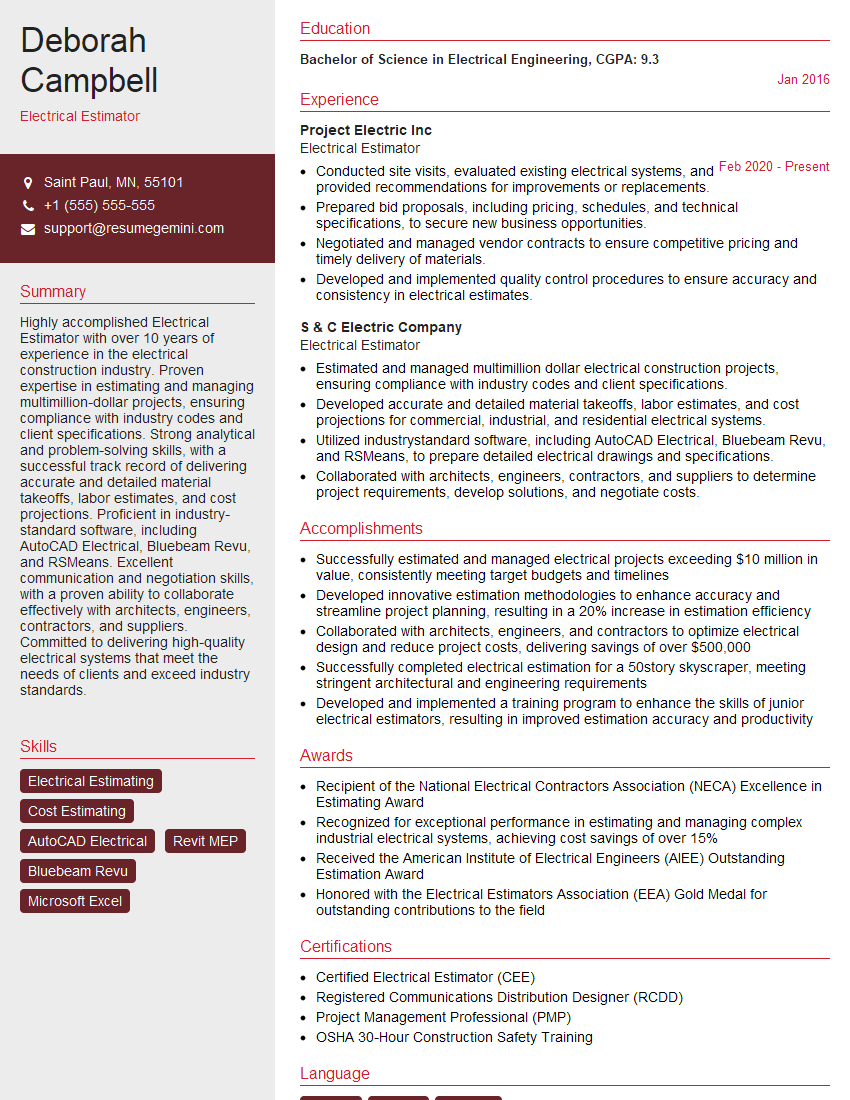
Electrical Estimator Resume Sample
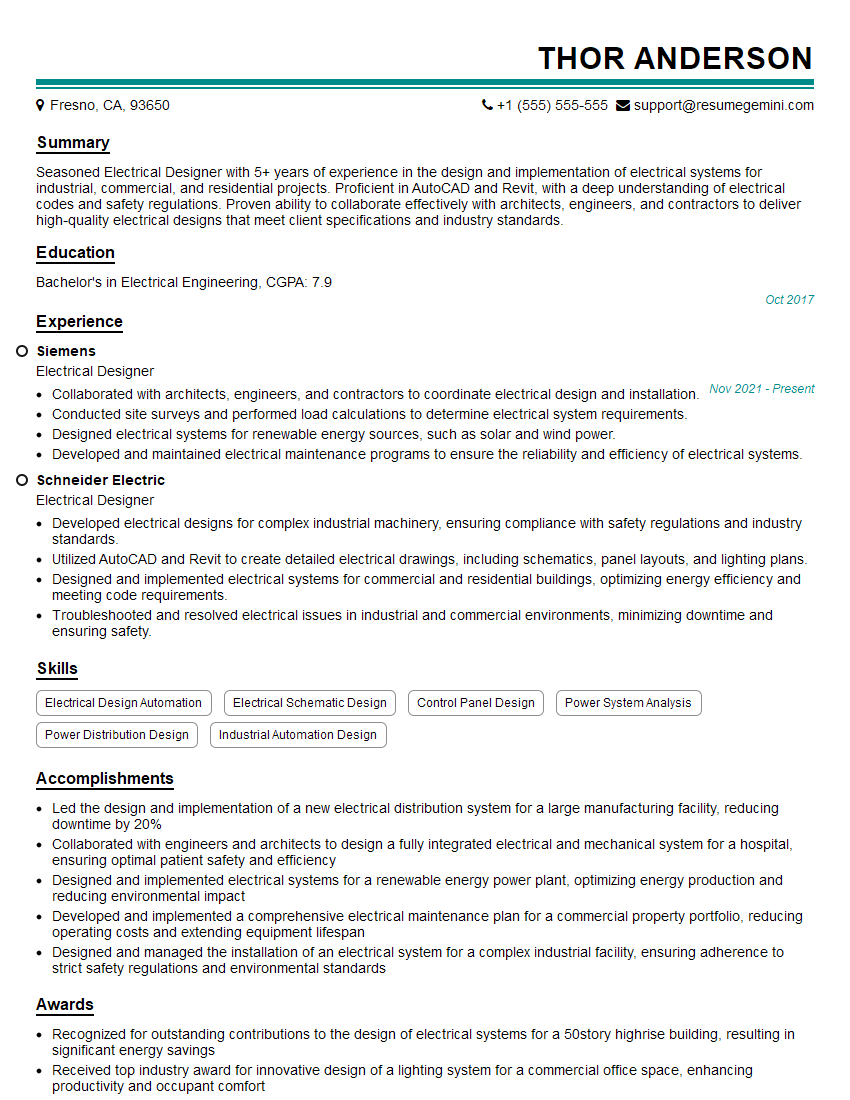
Electrical Designer Resume Sample
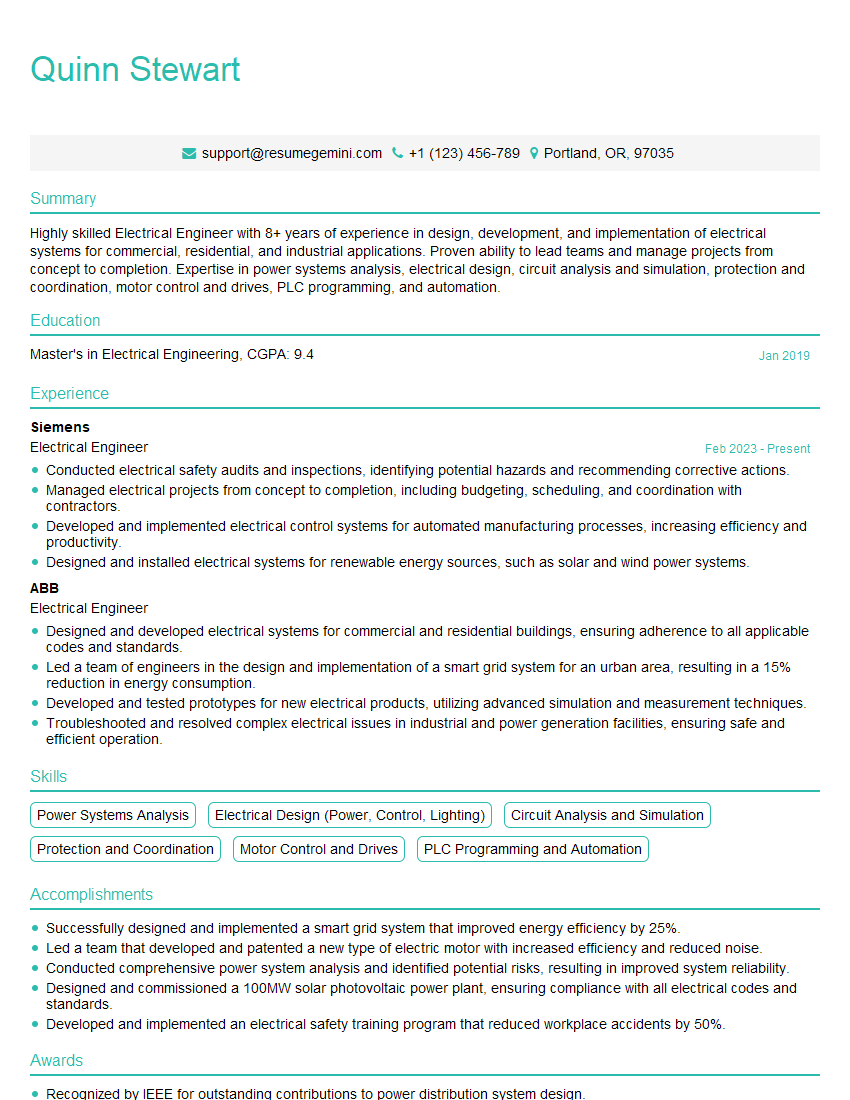
Electrical Engineer Resume Sample
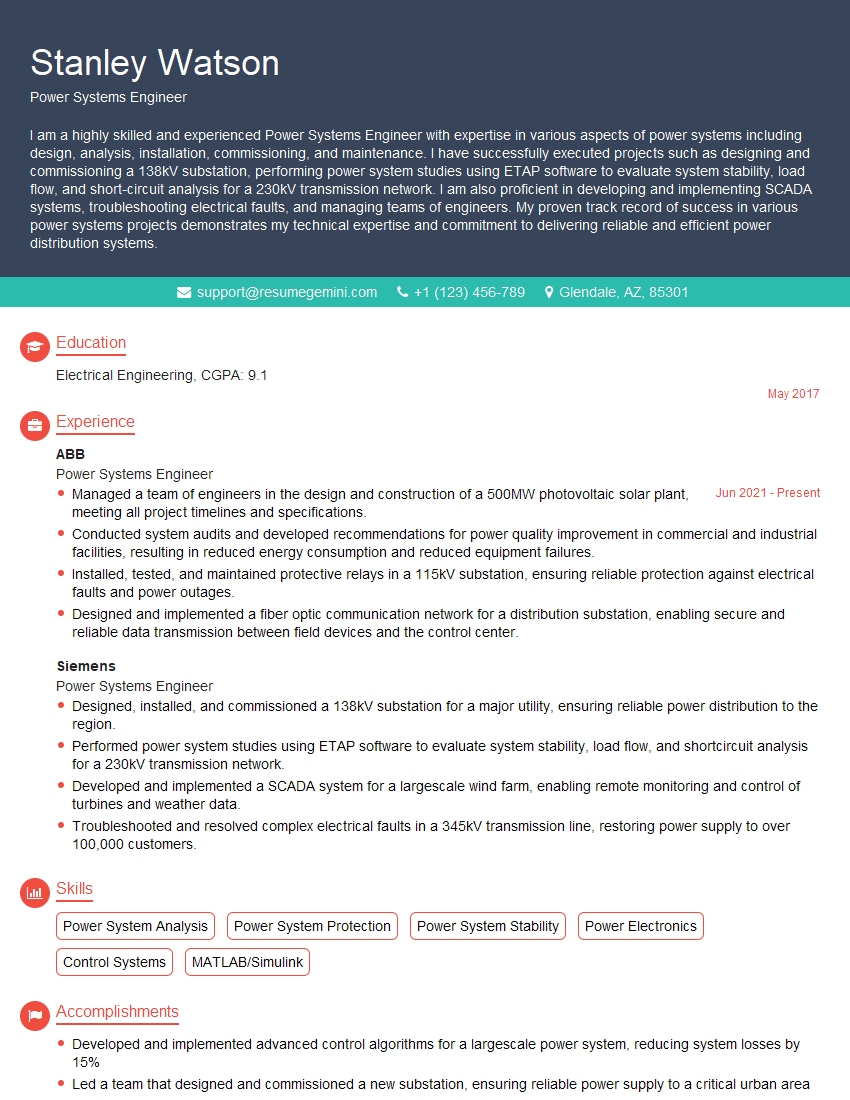
Power Systems Engineer Resume Sample
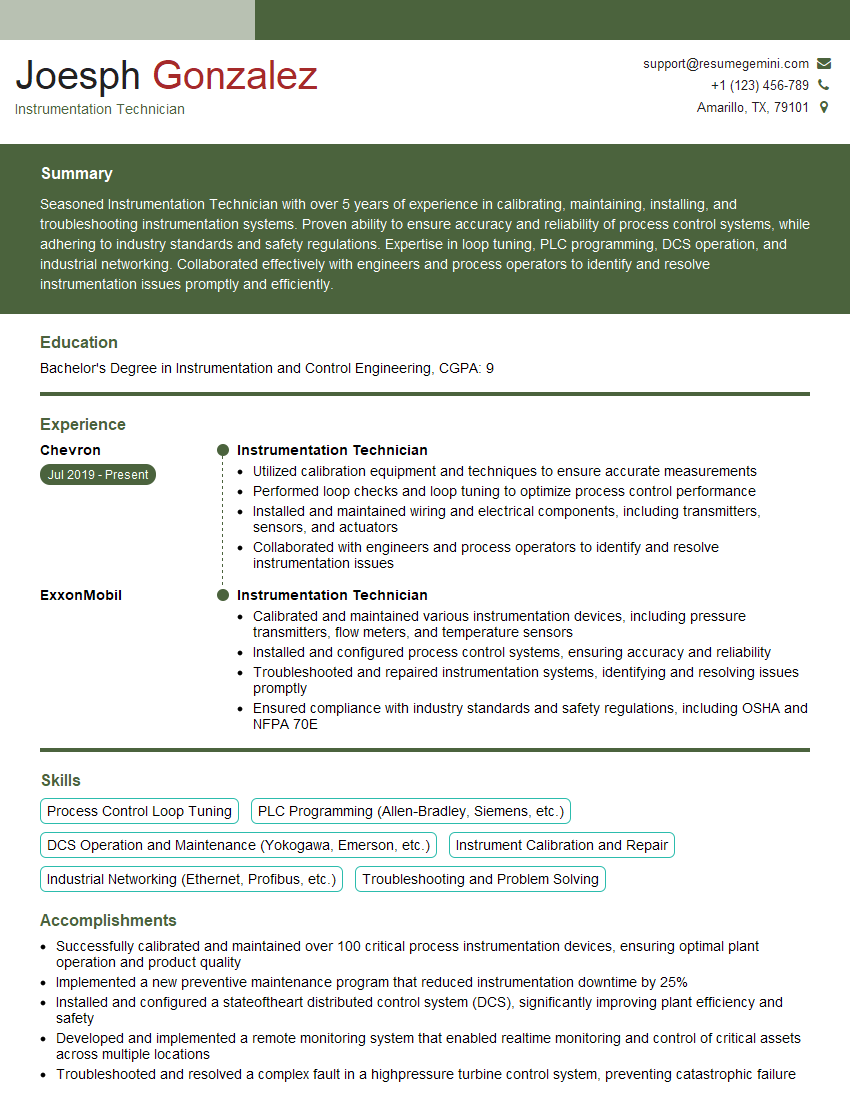
Instrumentation Technician Resume Sample
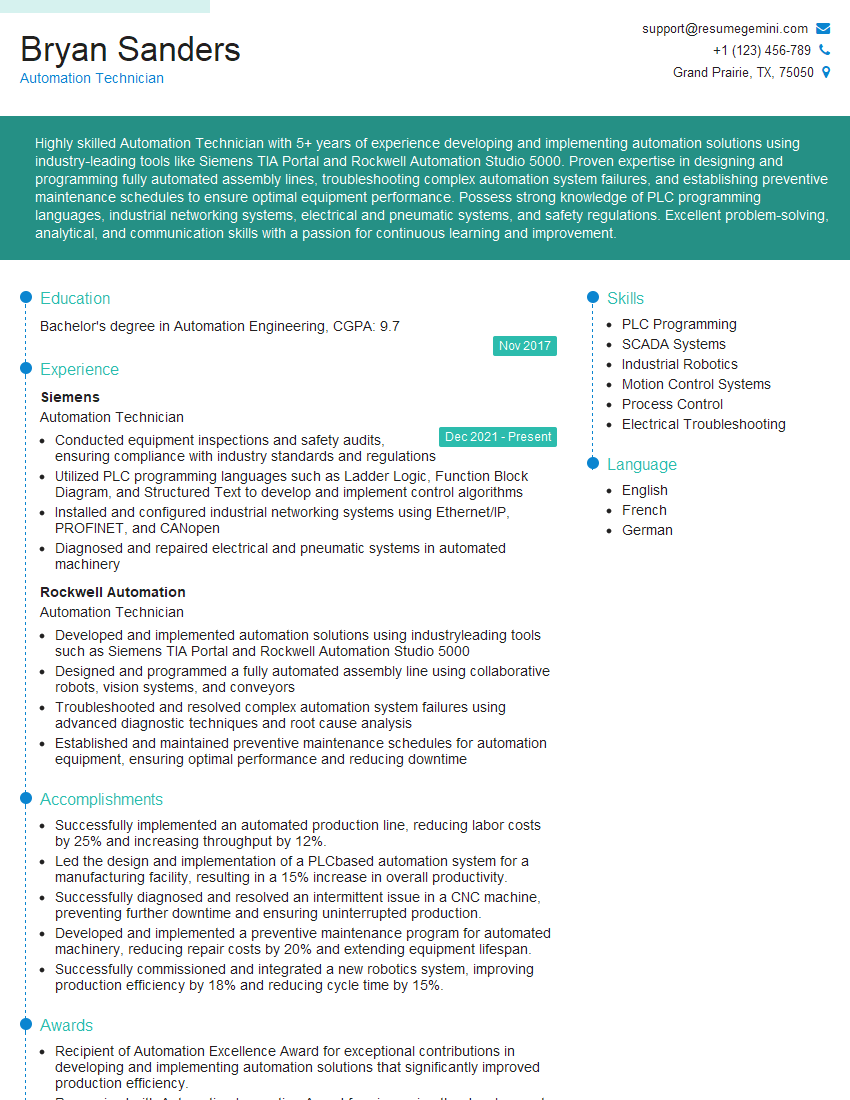
Automation Technician Resume Sample
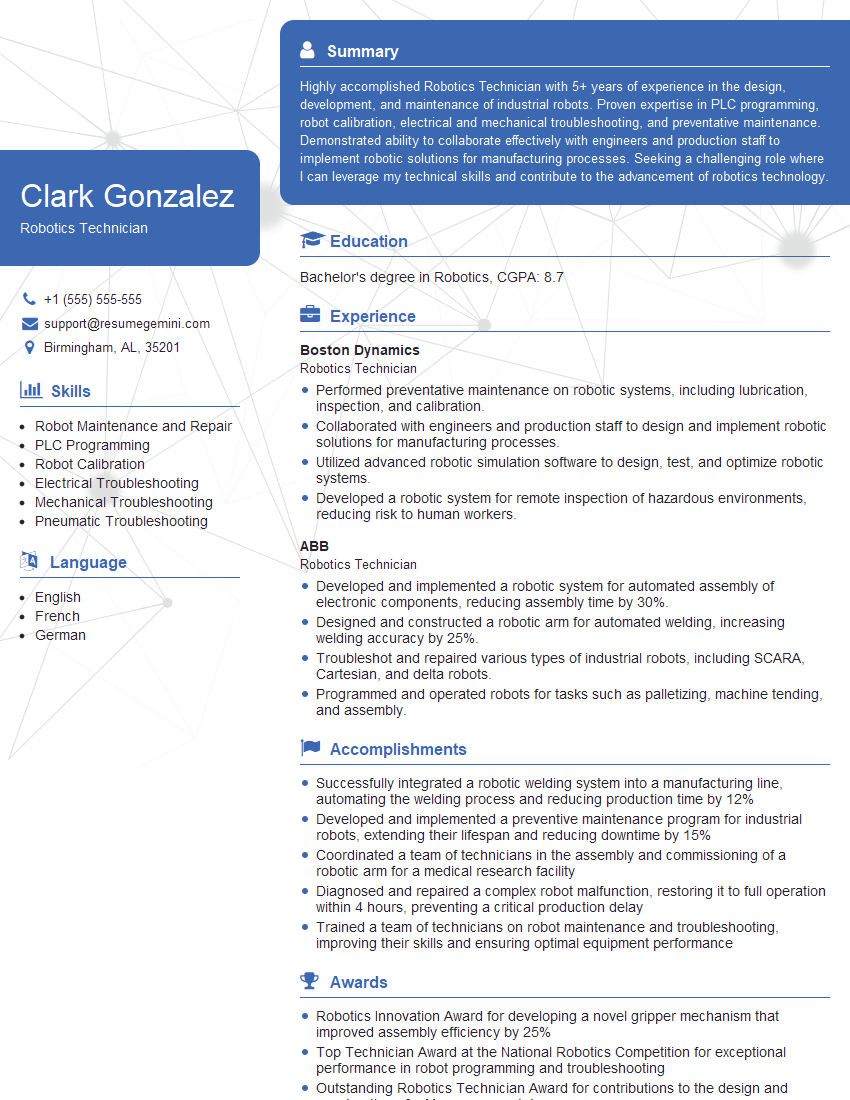
Robotics Technician Resume Sample
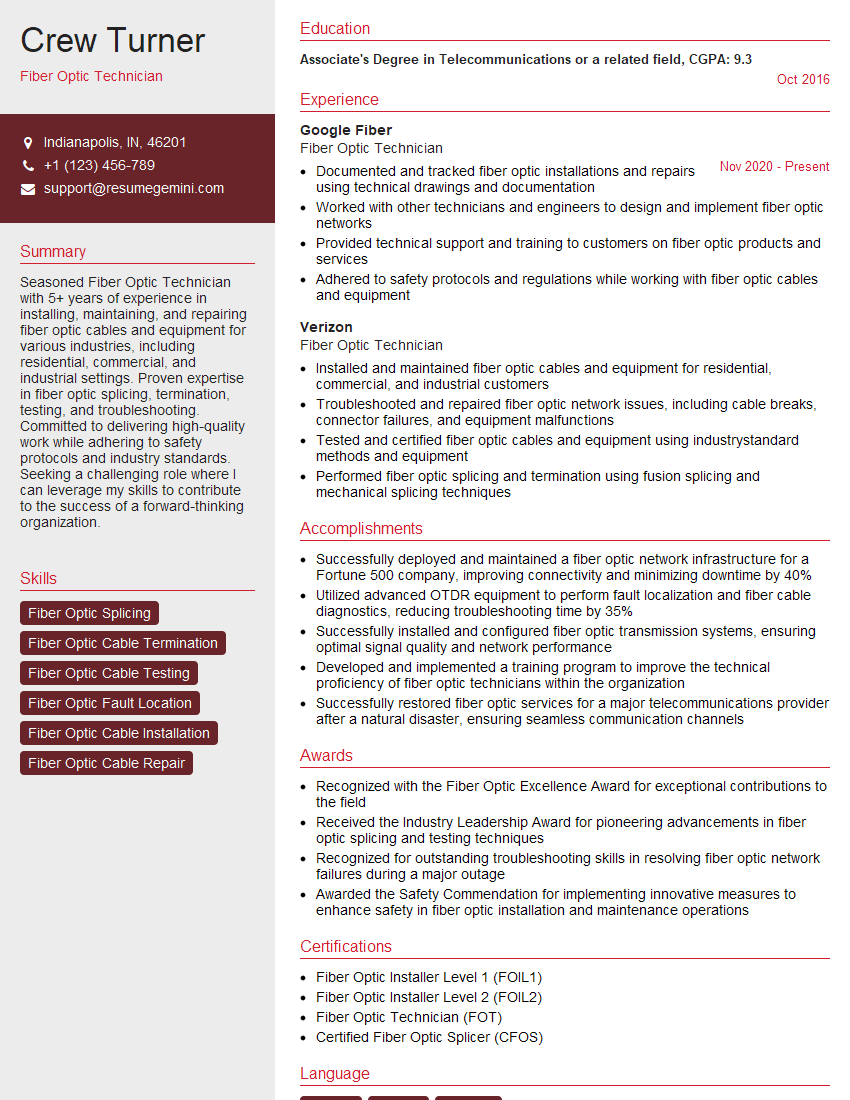
Fiber Optic Technician Resume Sample
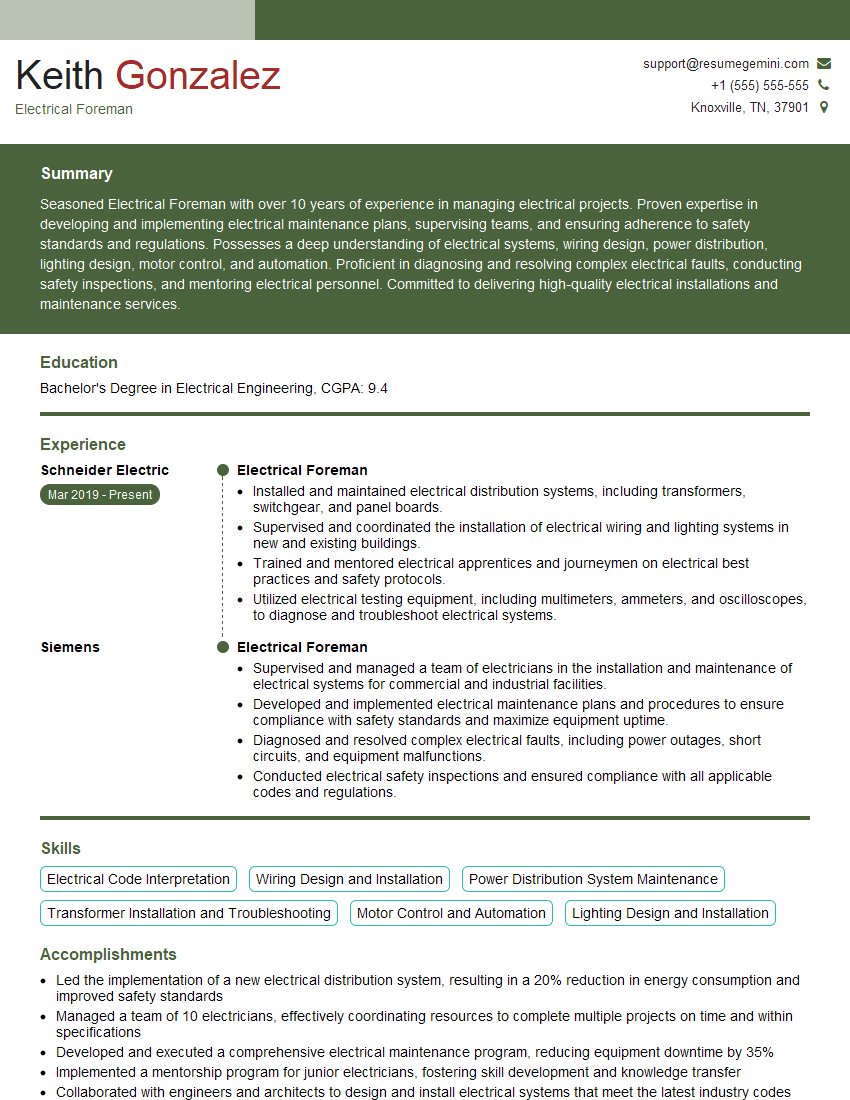
Electrical Foreman Resume Sample
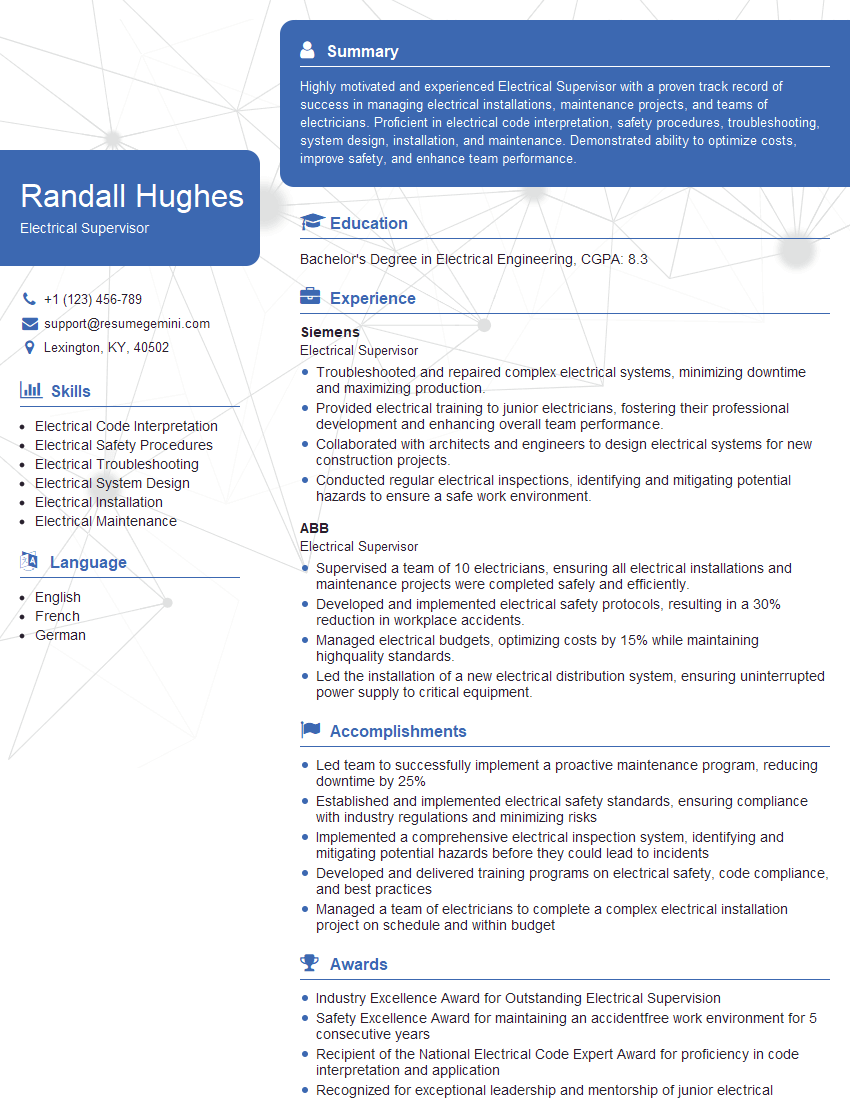
Electrical Supervisor Resume Sample
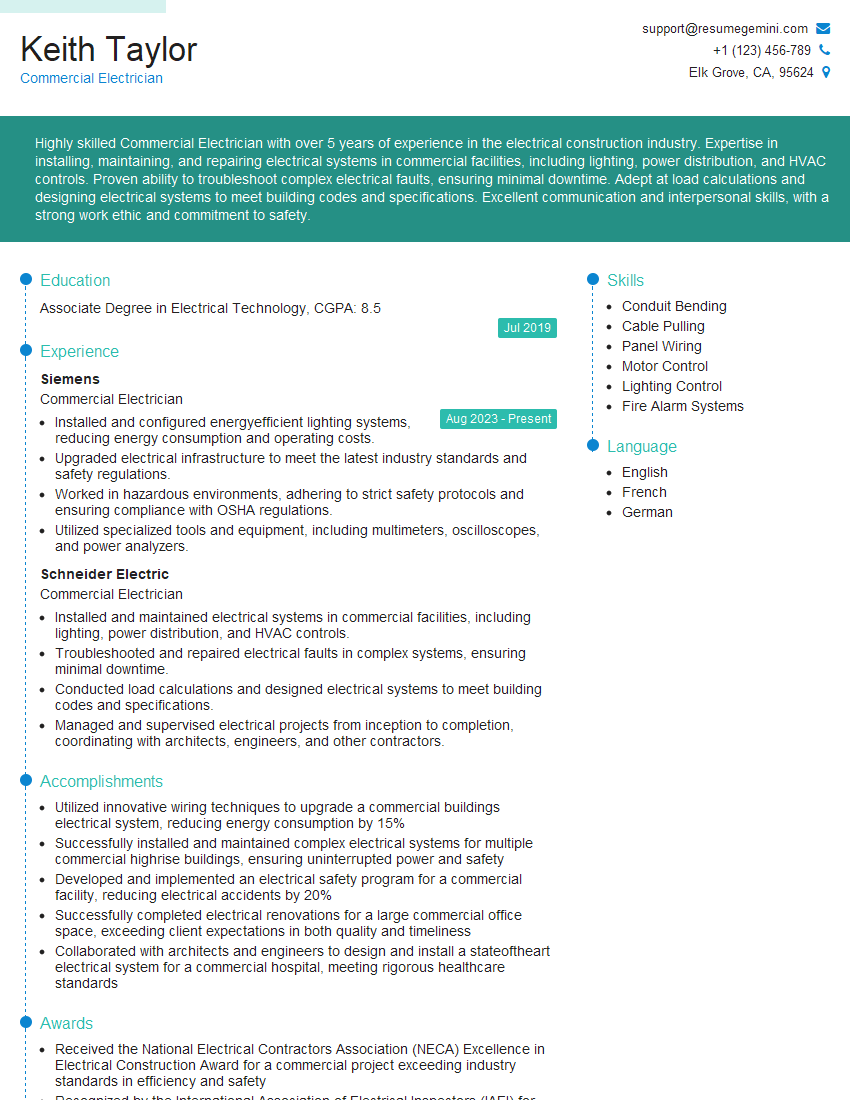
Commercial Electrician Resume Sample
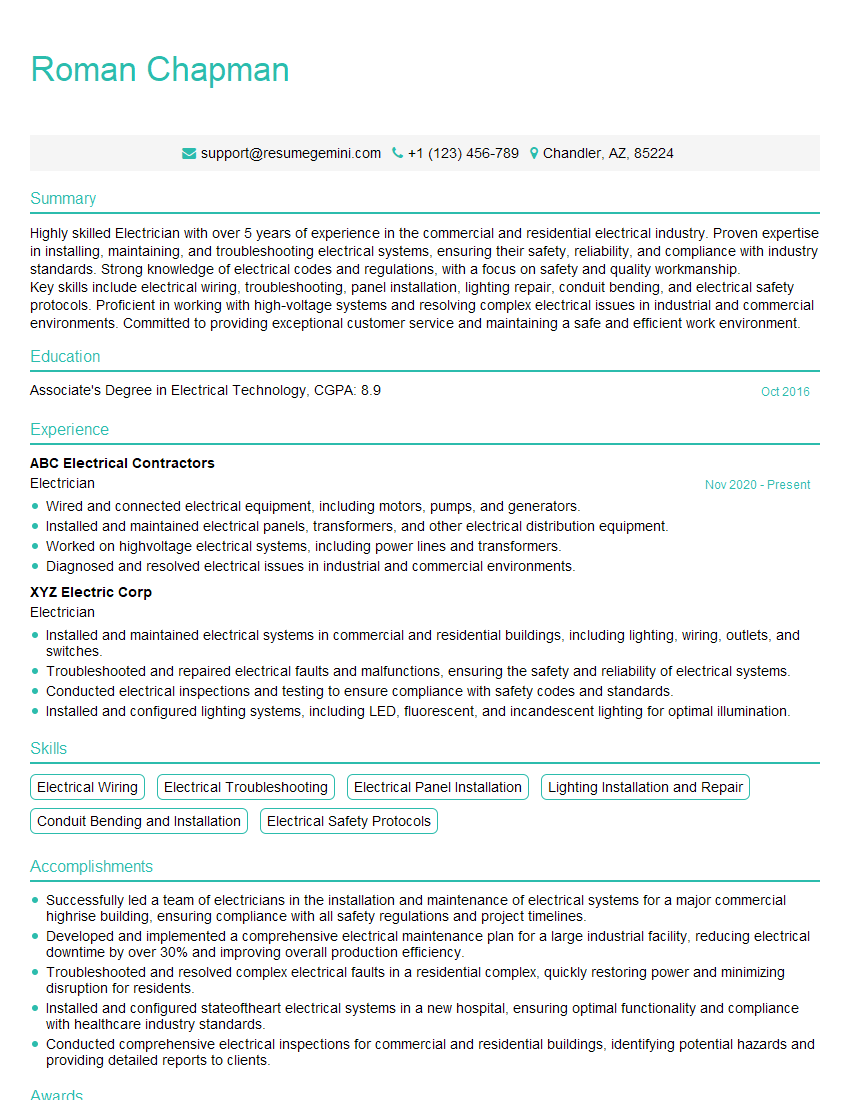
Electrician Resume Sample
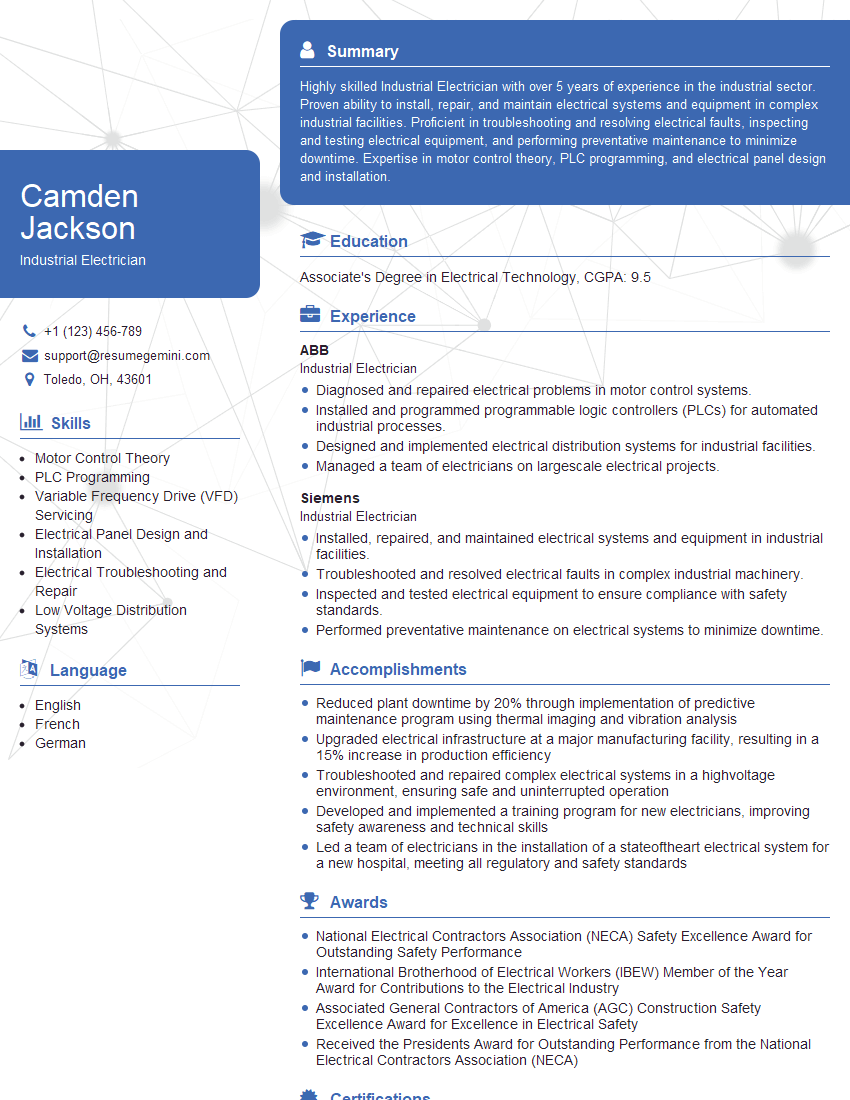
Industrial Electrician Resume Sample
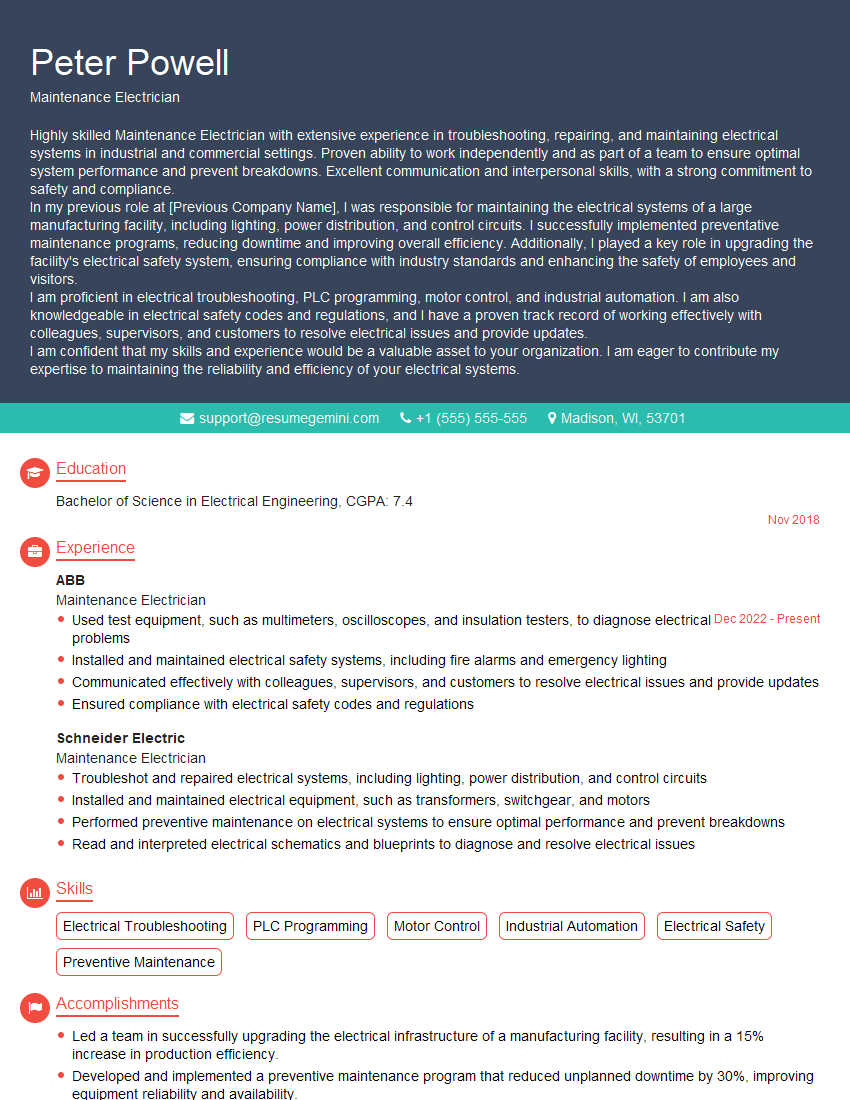
Maintenance Electrician Resume Sample
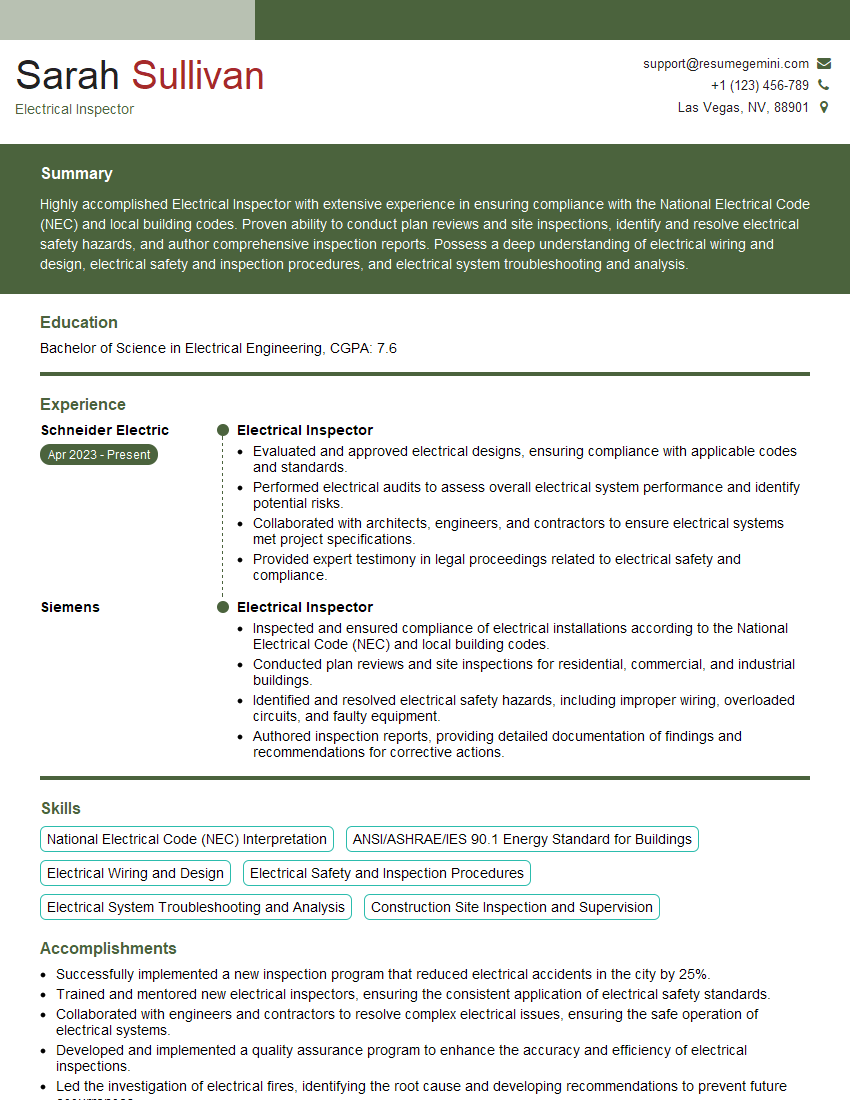
Electrical Inspector Resume Sample
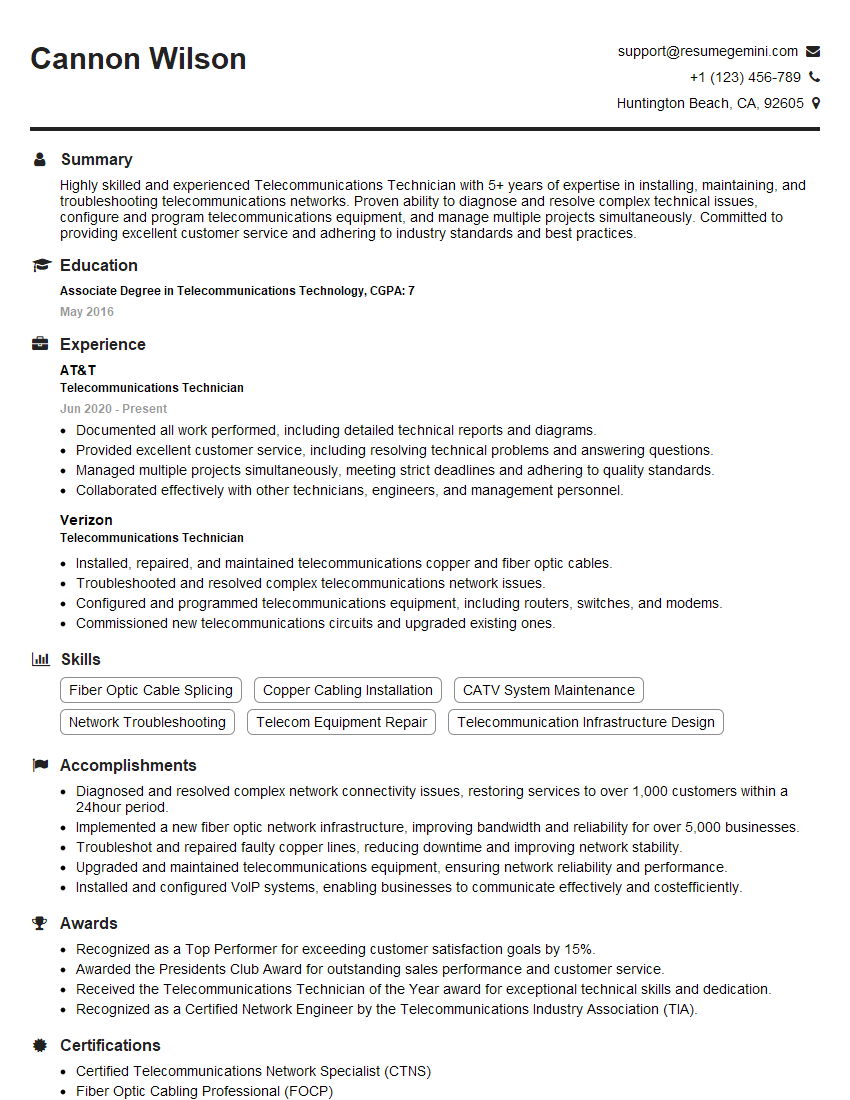
Telecommunications Technician Resume Sample
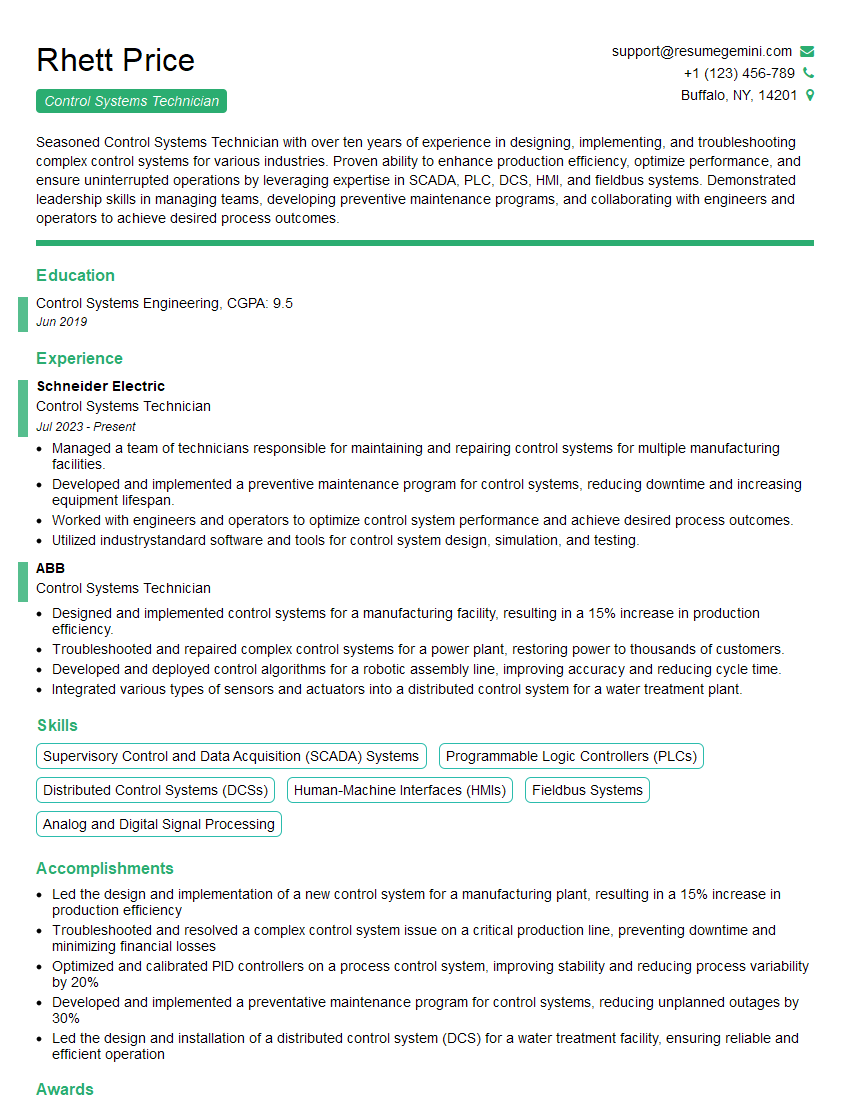
Control Systems Technician Resume Sample
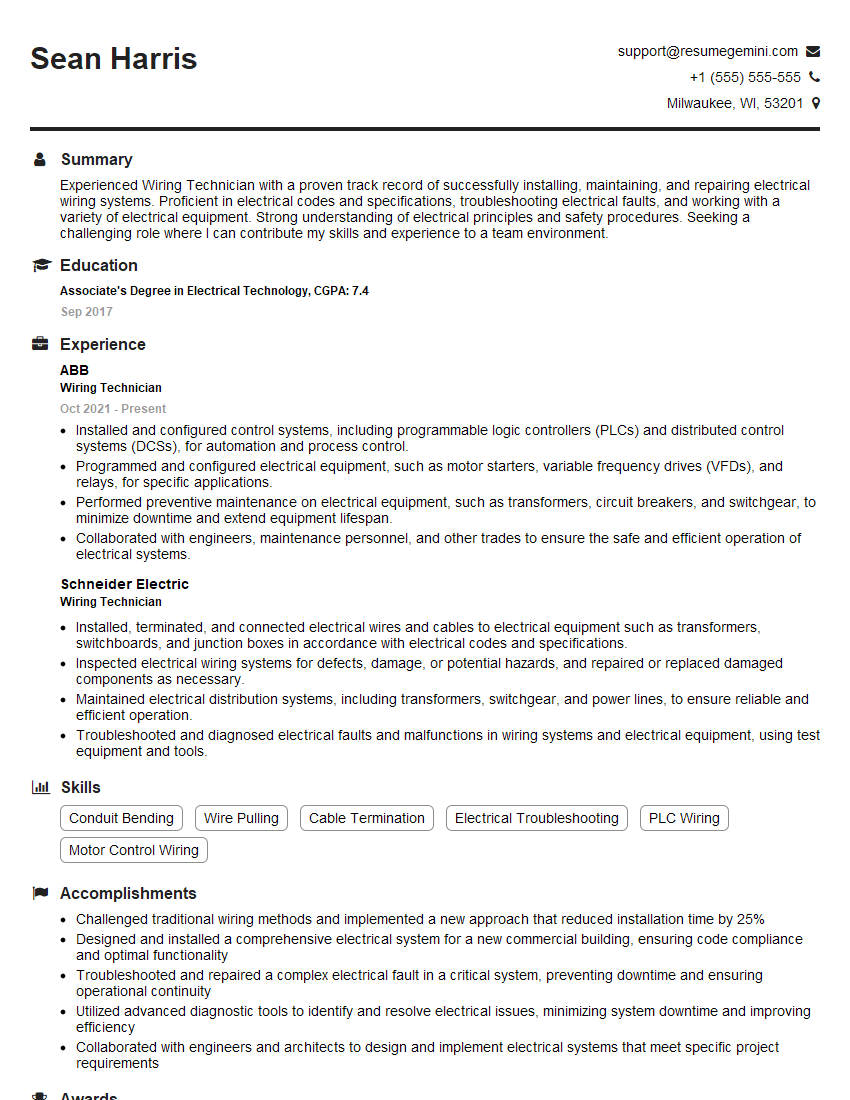
Wiring Technician Resume Sample
- Electrical Estimator
- Electrical Designer
- Electrical Engineer
- Power Systems Engineer
- Instrumentation Technician
- Automation Technician
- Robotics Technician
- Fiber Optic Technician
- Electrical Foreman
- Electrical Supervisor
- Commercial Electrician
- Electrician
- Industrial Electrician
- Maintenance Electrician
- Electrical Inspector
- Telecommunications Technician
- Control Systems Technician
- Wiring Technician
Explore more articles
Users Rating of Our Blogs
Share Your Experience
We value your feedback! Please rate our content and share your thoughts (optional).
What Readers Say About Our Blog
Very informative content, great job.
good