Cracking a skill-specific interview, like one for Hostage Negotiator, requires understanding the nuances of the role. In this blog, we present the questions you’re most likely to encounter, along with insights into how to answer them effectively. Let’s ensure you’re ready to make a strong impression.
Questions Asked in Hostage Negotiator Interview
Q 1. Describe the phases of a typical hostage negotiation.
Hostage negotiation isn’t a rigid, linear process, but it generally unfolds in distinct phases. These phases often overlap and their order might shift depending on the specific situation.
- Phase 1: Pre-Incident Planning and Preparation: This involves understanding the environment, potential threats, and developing a negotiation strategy based on available intel. This phase might include reviewing past incidents and preparing tactical options.
- Phase 2: Initial Contact and Assessment: This is about establishing communication with the hostage-taker. The priority is to ensure the safety of the hostages and to assess the emotional state and demands of the perpetrator. The negotiator aims to build a rapport and buy time.
- Phase 3: Building Rapport and Establishing Trust: This is crucial. The negotiator actively listens, empathizes (without condoning the actions), and attempts to find common ground to humanize the situation and build a relationship. This stage is about de-escalation.
- Phase 4: Negotiation and Crisis Resolution: This is the core of the process, where demands are discussed, concessions are considered (carefully!), and strategies to achieve a peaceful resolution are implemented. It involves creative problem-solving and strategic communication.
- Phase 5: Hostage Release and Post-Incident Analysis: This involves the safe release of hostages, the apprehension (if appropriate) of the hostage-taker, and a critical review of the entire operation. This analysis feeds back into future training and preparations.
Each phase requires specialized skills, careful planning, and a deep understanding of human psychology. It’s a high-pressure environment requiring cool-headedness and expertise.
Q 2. Explain the concept of ‘active listening’ in hostage negotiations.
Active listening in hostage negotiation is far more than simply hearing words; it’s about understanding the emotions and motivations behind them. It’s about conveying empathy and genuine concern.
Imagine a hostage-taker ranting about feeling wronged. Active listening means not interrupting, but carefully observing their body language, tone of voice, and the underlying emotions they express. It involves paraphrasing their statements to confirm understanding (‘So, if I understand correctly, you feel deeply betrayed and believe this is the only way to get your message heard?’) and reflecting their emotions (‘It sounds like you’re feeling a lot of anger and frustration right now.’).
The goal is not to agree with the hostage-taker but to show them that you understand their perspective. This builds trust and opens the door to de-escalation and negotiation.
Q 3. What are some common psychological tactics used by hostage-takers?
Hostage-takers employ various psychological tactics, often driven by desperation, mental illness, or a desire for control. Some common tactics include:
- Creating a sense of urgency: Setting deadlines or threatening immediate violence to increase pressure.
- Playing on emotions: Manipulating negotiators’ empathy or exploiting the hostages’ fears.
- Making unrealistic demands: Negotiating for seemingly impossible things to test the negotiators’ resolve.
- Using the hostages as shields: Threatening to harm or kill hostages to prevent intervention.
- Creating confusion: Switching between calm and aggressive behaviors to keep negotiators off balance.
- Disinformation: Providing false information to mislead negotiators or law enforcement.
Understanding these tactics is critical for negotiators to maintain control, not succumb to manipulation, and develop effective counter-strategies.
Q 4. How do you establish rapport with a hostage-taker?
Establishing rapport is foundational in hostage negotiation. It’s about building a connection based on trust and understanding, despite the adversarial nature of the situation.
Key strategies include:
- Validating their feelings: Acknowledging their emotions without condoning their actions. Saying things like, ‘I understand you’re feeling angry,’ goes a long way.
- Finding common ground: Looking for shared experiences, interests, or values to establish a connection. Even small points of commonality can help.
- Using mirroring and matching techniques: Subtly mirroring their body language or tone to build rapport, but avoid overt imitation.
- Active listening (as described above): Showing genuine interest in what they’re saying.
- Offering choices: Providing options within the framework of the negotiation to give the hostage-taker a sense of control.
The goal is to transform the relationship from adversarial to collaborative, making the hostage-taker more receptive to negotiation.
Q 5. Describe your understanding of the Stockholm Syndrome.
Stockholm Syndrome is a psychological phenomenon where hostages develop positive feelings towards their captors. This seemingly paradoxical behavior is a coping mechanism in traumatic situations. It’s not a universal response and is often linked to survival instincts and a desire for safety.
Hostages might develop empathy for their captors, identifying with them against authorities. They may start to believe their captors’ justifications for their actions, and even defend them. This is because the captors become the source of their immediate security and even survival.
Understanding Stockholm Syndrome helps negotiators appreciate the complexities of hostage situations. While the syndrome shouldn’t be taken as a justification for the hostage-taker’s actions, it provides valuable insight into the hostages’ emotional state during and after the event and informs post-incident care.
Q 6. What communication techniques are most effective in high-stress situations?
Effective communication in high-stress situations hinges on clarity, empathy, and control. The following techniques are crucial:
- Clear and concise language: Avoid jargon and complex sentences. Use simple, direct language.
- Calm and controlled tone: Speak slowly and deliberately, using a calm, reassuring voice. Match the intensity level of the hostage-taker, but aim to slightly lower it.
- Active listening (as emphasized earlier): Demonstrate genuine understanding and empathy.
- Repeating key information: To ensure understanding, especially in stressful situations.
- Validation and empathy: Showing understanding of their emotions, even if you disagree with their actions.
- Positive framing: Focusing on solutions and positive outcomes rather than dwelling on the negatives.
The goal is to create a safe communication space, to foster a sense of security, and to provide a sense of control for both the negotiator and the hostage-taker.
Q 7. How would you handle a situation where the hostage-taker is armed and threatening violence?
Handling an armed and violent hostage-taker requires a multi-faceted approach prioritizing the safety of the hostages above all else.
The immediate response would involve a coordinated effort between negotiators and tactical teams. While the negotiators attempt to communicate and de-escalate the situation through the strategies already discussed, the tactical team establishes a secure perimeter, assesses the environment, and develops a plan for potential intervention should negotiations fail.
The negotiator’s role involves buying time, gathering information, and trying to identify triggers and reduce tension. Concessions might be made, but they’ll be carefully calibrated to increase the chances of a peaceful resolution without endangering lives. The primary goal remains a safe resolution, and tactical options are only employed as a last resort, after all other avenues have been exhausted.
Such a situation necessitates exceptional teamwork, clear communication channels, and a thorough understanding of the risk assessment.
Q 8. Explain your understanding of BATNA in the context of hostage negotiation.
BATNA, or Best Alternative To a Negotiated Agreement, is crucial in hostage negotiation. It represents the most advantageous alternative course of action a negotiator can take if negotiations fail. For the hostage-taker, their BATNA might be suicide, escape, or continuing the standoff with the hope of a better outcome. For the negotiators and law enforcement, it might be a planned assault or a strategic withdrawal to regroup and reassess. Understanding the hostage-taker’s BATNA helps negotiators anticipate their actions and tailor their strategies accordingly. A strong understanding of both sides’ BATNAs allows for a more calculated approach, maximizing the chances of a peaceful resolution. For example, if the hostage-taker’s BATNA is weak (e.g., limited escape routes, few resources), the negotiators can use this to their advantage, offering a more lenient outcome that surpasses the hostage-taker’s BATNA.
Q 9. How do you assess the mental state of a hostage-taker?
Assessing a hostage-taker’s mental state is paramount. We use a multi-faceted approach. Firstly, we analyze their communication – the content, tone, and speed of their speech provide crucial insights. A rambling, incoherent speech might suggest a mental health crisis, whereas a calm, controlled voice could indicate planning and a degree of rational thought. Secondly, we observe their behaviour through video feeds and any eyewitness accounts. Are they agitated, exhibiting signs of paranoia, or showing signs of exhaustion? Thirdly, we gather background information: their criminal history, known mental health issues, and any recent stressors in their life can all inform our understanding. We employ psychological profiling techniques, but remember no single factor definitively defines their state. It’s a holistic assessment, often involving collaboration with psychologists and psychiatrists. For instance, a hostage-taker demanding specific items might suggest a focus on tangible goals rather than a purely psychological crisis. Conversely, irrational demands and violent pronouncements may signal a deeper underlying mental instability requiring specialized intervention.
Q 10. What are the ethical considerations in hostage negotiations?
Ethical considerations are paramount. Our primary goal is to save lives – both hostages and the hostage-taker. This means we constantly grapple with the potential for harm. We must consider the principle of proportionality – the use of force should be proportionate to the threat. Deception is sometimes employed, but it must be carefully calibrated and justifiable within the circumstances. We’re obligated to respect the rights of the individuals involved, even the hostage-taker, ensuring due process. The use of force, however, is subject to strict legal and ethical scrutiny. We must always document our actions thoroughly, justifying every decision. A particularly thorny issue is the potential for making concessions that might embolden future hostage-takers. This requires careful balancing of immediate needs with long-term implications. Every situation is carefully reviewed post-incident to learn from experiences and refine our approaches to ethical challenges.
Q 11. How would you manage the media during a hostage situation?
Media management is critical. Our strategy aims to control the narrative and avoid escalating the situation. We designate a single spokesperson to communicate with the media, providing carefully worded statements to avoid jeopardizing negotiations. We prioritize accuracy and transparency, while ensuring we don’t release information that could assist the hostage-taker. We understand the media’s desire for information, but our primary focus remains on resolving the crisis safely. We work to establish a clear channel of communication with media outlets to ensure updates are consistent. For instance, we might issue press releases with general updates on the situation, while refraining from sharing detailed operational specifics that could compromise the safety of the hostages or the negotiators.
Q 12. Describe your experience with non-verbal communication in negotiations.
Non-verbal communication is just as important as verbal communication. We meticulously observe the hostage-taker’s body language: posture, eye contact, facial expressions. A tense posture, fidgeting, or avoiding eye contact can indicate stress, anger, or fear. Conversely, relaxed posture and calm demeanor may suggest a more cooperative attitude. We also mirror their body language to build rapport, creating a sense of connection and trust. But this mirroring is subtle and strategic; it must not feel forced or disingenuous. For example, if the hostage-taker shows signs of exhaustion, we might subtly adopt a more relaxed posture ourselves to reflect empathy and subtly signal a need for a pause in the negotiations. We use this observation to subtly manage the emotional tone of the negotiation; however, this technique requires significant experience and a deep understanding of both verbal and nonverbal cues.
Q 13. How do you handle a situation where negotiations stall?
Negotiation stalls happen. We analyze why. Is it a misunderstanding? A change in the hostage-taker’s demands? A shift in their mental state? We try to re-establish communication, using active listening and empathy. We might offer small concessions to demonstrate our willingness to cooperate, but we never make significant concessions under pressure. We reassess our strategies, seeking alternative approaches. We also consider the time factor. A prolonged standoff increases risks to everyone involved. We carefully consider whether the stall is a calculated tactic by the hostage-taker, or genuinely a sign of a breakdown in communication. We might change negotiators if a fresh perspective is needed. Ultimately, we might need to reassess the BATNAs of all parties and prepare for alternative courses of action if negotiations remain unproductive.
Q 14. What are the potential risks and challenges in hostage negotiations?
Hostage negotiations are inherently risky. The potential for violence is always present. The hostage-taker may be unpredictable, mentally unstable, or under the influence of substances. There’s also the risk of injury or death to hostages, negotiators, and law enforcement personnel. The environment itself can pose dangers – from hazardous locations to complex building layouts. Time pressure is another major challenge. Each passing hour increases the risk, while also limiting the opportunities for a successful resolution. Furthermore, the stakes are incredibly high; the consequences of failure can be devastating and long-lasting. We mitigate these risks through meticulous planning, thorough risk assessments, trained negotiators, and close coordination with other agencies. We also continually analyze our successes and failures to improve our practices and safeguard the lives of those involved. Detailed debriefings after every incident are essential in learning from our experiences and refining our procedures to enhance safety and efficacy.
Q 15. Explain your crisis management strategy.
My crisis management strategy hinges on a four-stage approach: Assessment, Planning, Action, and Review.
Assessment: This crucial first phase involves rapidly gathering information about the situation. Who are the hostage-takers? How many hostages are there? What are their demands? What is the location like? Are there any immediate threats?
Planning: Based on the assessment, we formulate a detailed strategy. This includes identifying resources needed (SWAT, medical personnel, etc.), developing communication protocols, and assigning roles within the negotiation team. We carefully consider different negotiation tactics depending on the hostage-taker’s profile and the overall situation.
Action: This involves implementing the planned strategy, which often involves establishing contact with the hostage-taker, building rapport, managing the situation, and actively seeking a peaceful resolution. This stage requires constant reassessment and adaptability.
Review: After the successful resolution (or even if the outcome wasn’t ideal), a thorough review is conducted. This helps us identify what worked well, what could be improved, and allows for valuable learning and team development. This process contributes significantly to our collective expertise and enhances our readiness for future crises.
For example, in a case involving a barricaded suspect threatening self-harm, the assessment phase might reveal a history of mental health issues, leading to a planning phase that emphasizes empathy and building trust rather than forceful tactics.
Career Expert Tips:
- Ace those interviews! Prepare effectively by reviewing the Top 50 Most Common Interview Questions on ResumeGemini.
- Navigate your job search with confidence! Explore a wide range of Career Tips on ResumeGemini. Learn about common challenges and recommendations to overcome them.
- Craft the perfect resume! Master the Art of Resume Writing with ResumeGemini’s guide. Showcase your unique qualifications and achievements effectively.
- Don’t miss out on holiday savings! Build your dream resume with ResumeGemini’s ATS optimized templates.
Q 16. How do you deal with a hostage-taker who demands impossible conditions?
Dealing with impossible demands requires a delicate balance of empathy and firmness. We never promise what we can’t deliver, but we actively listen to understand the root causes of the demands. Often, seemingly impossible demands mask underlying needs and emotions. Our goal is to find common ground, even if the initial demands are unrealistic. We might offer compromises, explore alternative solutions, and use active listening to identify the hostage-taker’s underlying motivations. For instance, a demand for a large sum of money might stem from a desperate financial situation, opening the door for exploring alternative solutions like offering financial aid or connecting them with social services.
The key is to shift the focus from the impossible demand to the underlying need or emotion. We might say something like, “I understand you’re feeling desperate, and that’s why you’re making these demands. Let’s talk about what’s causing you this level of distress, and see if we can find a way to help.”
Q 17. Describe your experience working under pressure.
Working under pressure is an intrinsic part of being a hostage negotiator. Years of training and experience have equipped me to handle the high-stakes environment. I remain calm under intense pressure by focusing on the core principles of negotiation: active listening, empathy, and strategic communication. My breathing techniques and mental exercises help me manage stress and maintain clear thinking, even in life-threatening situations. I’ve learned to break down complex problems into smaller, manageable steps, focusing on one element at a time, and I use the support of my team to stay grounded and focused.
One instance involved a situation where a suicidal individual held their family hostage. The pressure to prevent potential loss of life was immense. By utilizing active listening and demonstrating genuine empathy, I managed to build rapport, and ultimately, the situation resolved peacefully. The experience highlighted the crucial importance of patience, understanding, and the effective use of communication strategies under pressure.
Q 18. How do you de-escalate a potentially violent situation?
De-escalation requires a multi-pronged approach, focusing on building rapport, understanding the hostage-taker’s perspective, and creating a safe environment. This involves:
Active Listening: Patiently listening to the hostage-taker’s concerns without interruption shows respect and builds trust. It helps in understanding their motivations and anxieties.
Empathy: Demonstrating understanding and acknowledging the hostage-taker’s emotions, even if you don’t agree with their actions, is crucial for fostering cooperation.
Controlled Communication: Using calm and reassuring language, speaking slowly and clearly, avoiding inflammatory words or accusatory tones is paramount. Offering choices empowers the hostage-taker, granting a sense of control.
Building Rapport: Finding common ground or shared experiences helps in establishing a connection and fostering trust.
Strategic Concessions: Making small, calculated concessions to build trust and show willingness to cooperate.
Imagine a situation with an armed individual threatening to harm others due to perceived injustice. By actively listening to their grievances and acknowledging their feelings of frustration, we can gradually diffuse the tension and find a path towards a peaceful resolution.
Q 19. What are the legal limits of a negotiator’s authority?
A negotiator’s authority is strictly defined by law and agency policy. We cannot promise amnesty, make deals that contradict legal statutes, or compromise the safety of others. We must work within the boundaries of the law, coordinating closely with law enforcement and legal counsel. While we can offer concessions, these must align with legal and operational constraints. For instance, we might negotiate a safe surrender, but we cannot guarantee immunity from prosecution. The decision of offering any concessions is taken based on careful risk assessment and in consultation with the legal and command teams.
Our primary goal is to secure the safe release of hostages. While we strive to understand the hostage-taker’s perspectives and motivations, our actions are always guided by legal and ethical principles, ensuring our actions are legally sound and ethically justifiable.
Q 20. How do you handle the emotional toll of hostage negotiation work?
The emotional toll of hostage negotiation is significant. We are constantly exposed to high-stress situations, witnessing human suffering and facing the possibility of life-or-death outcomes. To cope with this, we have robust support systems in place, including access to mental health professionals, peer support groups, and debriefing sessions after critical incidents. These sessions are vital for processing the emotional aftermath of a negotiation, sharing experiences, and learning from successes and challenges.
Self-care is also a critical component. Maintaining a healthy work-life balance, engaging in stress-reducing activities, and seeking help when needed are essential for our well-being and professional longevity. We recognize the importance of mental resilience and actively work on strategies for managing the emotional demands of this demanding profession.
Q 21. Describe your experience with team-based negotiations.
Team-based negotiations are essential for effective crisis management. Different team members bring diverse skill sets—psychological expertise, communication skills, tactical awareness, legal expertise—to the table. Our team operates with clearly defined roles and responsibilities to ensure coordinated action. We use a structured approach where one member acts as the primary negotiator, communicating directly with the hostage-taker, while others support through intelligence gathering, tactical planning, and communication monitoring. This collaborative approach ensures effective information flow, decision-making, and a better chance of a successful outcome. For example, a psychologist might assess the hostage-taker’s psychological state, informing the lead negotiator’s approach, while a tactical team prepares alternative courses of action should negotiations fail.
Effective communication and trust among team members are crucial. Regular training and debriefing sessions ensure our team operates seamlessly, fostering a culture of mutual respect and understanding. The synergy of a well-coordinated team far surpasses the effectiveness of individual effort.
Q 22. What communication equipment and technology are essential in hostage situations?
Effective communication is paramount in hostage situations, and the right equipment is crucial. We rely on a suite of technologies, prioritizing reliability and security. This typically includes:
- Secure radio systems: Encrypted channels are essential to prevent the hostage-taker from listening in and to ensure clear communication between negotiators, the command center, and tactical teams. We often use multiple frequencies for redundancy and to avoid interference.
- Telephone lines: A direct line to the hostage-taker is frequently established, providing a more private and less easily monitored communication channel than radios. This is important for building rapport.
- Audio and video recording equipment: Every negotiation is meticulously recorded. This serves as a critical record for debriefing, analysis, and potential legal proceedings. It also helps monitor the situation’s progress and the emotional state of all parties.
- Surveillance systems: Real-time video feeds from cameras placed strategically around the scene provide invaluable situational awareness, enabling us to observe the hostage-taker’s actions and the hostages’ well-being. This includes thermal imaging for low-light conditions.
- Intercom systems: In some cases, we use intercom systems to communicate directly with the hostages without the hostage-taker necessarily knowing. This can help gain intel or provide reassurance.
The choice of technology depends on the specific circumstances of each incident. For example, in a high-tech environment, the use of encrypted internet-based communication might be necessary.
Q 23. How do you maintain situational awareness during a negotiation?
Maintaining situational awareness is arguably the most critical aspect of a hostage negotiation. It’s a constant, dynamic process that involves:
- Collaboration with intelligence and tactical teams: I rely heavily on input from police, SWAT, and other specialized units. Understanding the hostage-taker’s history, motivations, and potential access to weapons is essential.
- Continuous monitoring of communication: I actively listen not just to what the hostage-taker says, but also to how they say it. Tone, inflections, and pauses can reveal crucial emotional states and changes in their plans.
- Analysis of the physical environment: Understanding the layout of the building, potential escape routes, and the location of hostages is vital. This information often comes from visual surveillance and tactical teams’ reports.
- Tracking time and resources: Knowing the resources available and how much time we have is crucial for decision-making. Time constraints often exert considerable pressure on negotiations.
- Deciphering the emotional state of all involved parties: We analyze the emotions expressed verbally and nonverbally, from the hostage-taker to the hostages and support teams, to predict future actions.
For example, a sudden shift in the hostage-taker’s tone from angry to calm might indicate a change in strategy requiring a shift in our approach. Maintaining constant situational awareness is what separates success from failure.
Q 24. How do you prioritize the safety of hostages during negotiations?
Hostage safety is our absolute top priority. Every decision we make is filtered through this lens. We achieve this through:
- Building rapport and trust: Our primary aim is to de-escalate the situation. We listen empathetically, acknowledge their feelings, and try to create a connection, even with the perpetrator. This creates an opportunity for a peaceful resolution.
- Providing reassurance and hope: We regularly reassure the hostages that we are working hard for their release and offer hope for a positive outcome. This prevents them from losing hope and acting in desperation.
- Negotiating for immediate needs: We address immediate concerns like food, water, and medical attention for the hostages, showing we care about their wellbeing. These small victories build trust and can create an opening.
- Avoiding actions that could provoke the hostage-taker: We avoid any action that could trigger violence. A sudden move or perceived threat might escalate the situation rapidly. Patience is paramount.
- Coordinated strategy with tactical teams: We work in close coordination with tactical teams to ensure the safety of hostages during any potential intervention. The timing of such intervention depends on the dynamics of the situation.
For instance, in one case, we secured the release of a hostage by negotiating for a specific medical treatment they needed, showing the perpetrator we understood their concerns and cared about the hostage’s well-being.
Q 25. Explain your experience managing multiple stakeholders during a crisis.
Managing multiple stakeholders during a crisis is like conducting an orchestra. Each section – law enforcement, family members of hostages, media, and even onlookers – has its own concerns and agendas. My experience includes:
- Establishing clear communication channels: A central command center is essential. We use designated spokespersons to maintain consistent messaging.
- Managing expectations: Transparency, to the extent possible, is key. While avoiding revealing sensitive information, we strive to keep stakeholders informed.
- Addressing conflicting interests: Negotiations often involve conflicting interests. For example, law enforcement’s focus might be on the apprehension of the perpetrator, while the family’s is focused solely on their loved one’s safe return. I act as a mediator, carefully balancing these interests.
- Prioritizing information flow: Information is power and a critical resource that needs strict control. We must prevent misinformation from spreading.
- Delegating tasks effectively: I rely on a highly skilled and specialized team, each responsible for handling specific tasks within the negotiation.
In one high-profile case, I had to simultaneously manage communication with the volatile hostage-taker, the anxious families, a highly publicized media presence, and a team of law enforcement officers. Effective communication and clear delegation were crucial in reaching a peaceful resolution.
Q 26. How do you adapt your negotiation style to different personality types?
Adaptability is crucial in hostage negotiation. Each hostage-taker is an individual with unique motivations, fears, and communication styles. My approach is based on active listening and employing different strategies:
- Empathetic listening: I try to understand their perspective, even if I disagree with it. This allows me to build rapport and establish a foundation for trust.
- Building rapport through shared values: I identify common ground, even small shared values, to create a sense of connection. This can be family, religious beliefs, or shared experiences.
- Adjusting communication style: My approach varies widely depending on whether the hostage-taker is angry, anxious, depressed, or manipulative. I try to match my communication style to theirs, ensuring they feel understood.
- Using different verbal and non-verbal cues: In some situations, a firm but calm tone might be necessary, while in others, empathy and understanding are paramount. I use body language strategically, mirroring or mirroring-opposing to build rapport.
- Utilizing specialized techniques for different personality types: Certain techniques, like cognitive reframing, are better suited to certain personality types than others. I adapt my approach accordingly.
For example, with a narcissistic hostage-taker, I might focus on their self-image and ego to gain their cooperation, whereas with a severely depressed hostage-taker, building trust and providing empathetic support would be paramount.
Q 27. What are some common mistakes to avoid in hostage negotiations?
Many pitfalls can derail a hostage negotiation. Some common mistakes to avoid include:
- Making promises you can’t keep: This erodes trust and can lead to further escalation. Only make promises you are certain can be fulfilled.
- Losing your composure: Remaining calm and professional is vital, even under extreme pressure. Showing panic or frustration can trigger violence.
- Underestimating the hostage-taker: Treat each situation as unique and avoid making assumptions about their motivations or capabilities. They may be far more intelligent or capable than initially perceived.
- Ignoring the hostage-taker’s demands: While not always feasible, addressing and negotiating around demands (even seemingly irrational ones) is usually better than outright rejection. This can be a way to build trust and gain concessions.
- Focusing solely on the perpetrator and neglecting the hostages: We must constantly balance our focus on both perpetrator and hostages. The goal is not just to resolve the immediate crisis but also to minimize long-term trauma for the hostages.
- Rushing the process: Patience and skillful timing are essential for a successful outcome. A hasty resolution may lead to unwanted consequences.
Avoiding these common mistakes is not just about technique, but about having the emotional intelligence, patience, and training to handle the extreme pressures of a hostage situation. Preparation is key.
Key Topics to Learn for Hostage Negotiator Interview
- Crisis Communication & Active Listening: Understanding verbal and nonverbal cues, employing empathy and rapport-building techniques to de-escalate tense situations. Practical application: Analyzing case studies of successful and unsuccessful negotiations to identify key communication strategies.
- Negotiation Tactics & Strategies: Mastering various negotiation approaches (e.g., collaborative, competitive, principled), understanding the psychology of hostage-takers, and developing effective problem-solving frameworks. Practical application: Role-playing scenarios to practice applying different negotiation techniques and adapting to changing circumstances.
- Risk Assessment & Threat Analysis: Evaluating potential threats, identifying vulnerabilities, and developing safe and effective strategies to ensure the safety of hostages and negotiators. Practical application: Analyzing real-world scenarios to assess risk levels and strategize appropriate responses.
- Ethical Considerations & Legal Frameworks: Understanding the legal and ethical implications of hostage negotiation, including the use of force, and maintaining professional integrity under pressure. Practical application: Researching relevant laws and regulations governing hostage situations and their application in diverse scenarios.
- Teamwork & Collaboration: Understanding the importance of effective teamwork and coordination with other law enforcement agencies and support personnel. Practical application: Developing strategies for effective communication and collaboration within a multidisciplinary team.
- Post-Incident Debriefing & Psychological Support: Recognizing the psychological impact of high-stress situations and utilizing appropriate debriefing and support mechanisms for both negotiators and hostages. Practical application: Researching best practices for psychological first aid and post-incident support.
Next Steps
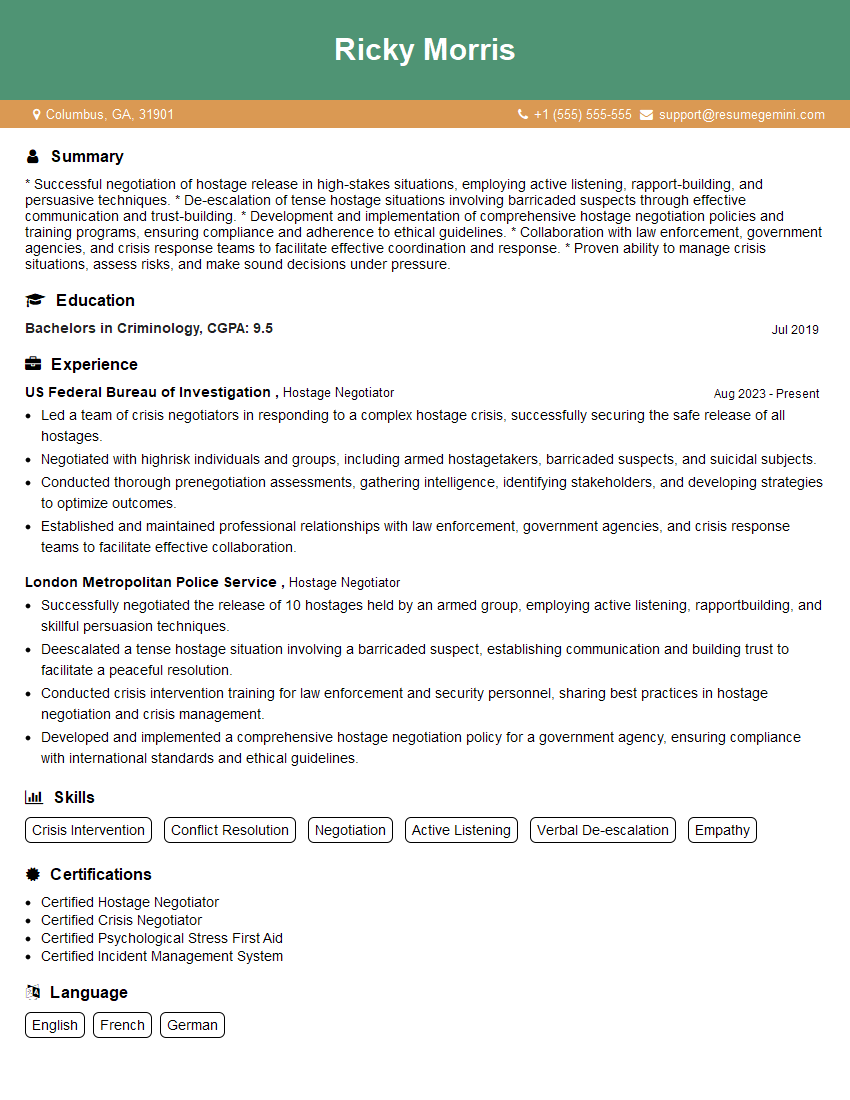
Mastering the art of hostage negotiation is a significant career advancement, demonstrating exceptional communication, critical thinking, and problem-solving skills highly valued across many fields. To maximize your job prospects, focus on building an ATS-friendly resume that highlights your relevant skills and experiences. ResumeGemini is a trusted resource that can help you create a powerful and impactful resume tailored to the Hostage Negotiator role. Examples of resumes specifically designed for this field are available to help guide you. Take the next step towards your dream career today!

Explore more articles
Users Rating of Our Blogs
Share Your Experience
We value your feedback! Please rate our content and share your thoughts (optional).
What Readers Say About Our Blog
Very informative content, great job.
good