The right preparation can turn an interview into an opportunity to showcase your expertise. This guide to Electrical Control Panel Repair interview questions is your ultimate resource, providing key insights and tips to help you ace your responses and stand out as a top candidate.
Questions Asked in Electrical Control Panel Repair Interview
Q 1. Explain the process of troubleshooting a faulty control panel.
Troubleshooting a faulty control panel is a systematic process that requires a methodical approach. It’s like detective work, where you gather clues to identify the culprit. First, I would always ensure the panel is safely de-energized before starting any work. Then, I begin with a visual inspection, looking for obvious signs of damage such as burnt components, loose wires, or tripped breakers. Next, I’d check the input power and verify that it’s reaching the panel correctly using a multimeter. If the power is good, I’d move on to checking individual components, starting with the simplest elements and working my way up to more complex ones like PLCs.
For example, if the problem is a motor that won’t start, I might check the motor starter’s relay coil for voltage, then examine the contactor’s auxiliary contacts to see if they’re closing properly. If all the basic components appear fine, I’d then move onto checking the logic within the PLC program itself. Using the PLC’s programming software, I’d observe the input and output status during operation, searching for any inconsistencies or errors. Each step involves careful documentation and testing to isolate the fault.
Finally, once the faulty component is identified, I’d replace it with a new component, making sure to meticulously follow the wiring diagrams. After the repair, a comprehensive test of the entire panel is essential to ensure everything is functioning correctly and safely.
Q 2. Describe your experience with different types of control panel components (e.g., relays, contactors, PLCs).
My experience spans a wide range of control panel components. I’m proficient with various types of relays, from simple electromechanical relays to solid-state relays, each with its own applications and limitations. For instance, electromechanical relays are suitable for high current switching, while solid-state relays are ideal for applications requiring faster switching speeds and better isolation. I’ve also extensively worked with contactors, both AC and DC, understanding the nuances of their operation, including understanding the role of auxiliary contacts and the importance of proper sizing for the load.
My experience with PLCs is particularly strong. I’ve worked with PLCs from various manufacturers, including Allen-Bradley, Siemens, and Schneider Electric, and am familiar with their programming languages and communication protocols. Understanding the PLC’s role as the ‘brain’ of the control system is critical, and I’ve applied this knowledge to various projects involving complex automation systems. I am equally comfortable working with other components such as timers, counters, proximity sensors, limit switches, and push buttons, understanding their application and troubleshooting techniques.
Q 3. How do you diagnose and resolve issues related to wiring and connections in control panels?
Diagnosing wiring and connection issues requires a combination of visual inspection and precise testing. I begin by meticulously examining all wires and connections for any signs of damage, loose connections, or incorrect wiring. A visual inspection often reveals obvious problems, such as broken or frayed wires. For more subtle problems, I use a multimeter to check for continuity, voltage drops, and short circuits. A continuity test helps identify broken wires, while voltage drop measurements reveal potential problems with high-resistance connections.
For example, if a motor isn’t receiving power, I’d first check the voltage at the motor terminals using a multimeter. If the voltage is low, I’d systematically check the wiring from the power source to the motor, measuring the voltage at each point along the way to pinpoint the location of the voltage drop. This methodical approach allows for efficient identification and rectification of wiring issues. Accurate wiring diagrams are crucial throughout the process, allowing a clear understanding of the intended circuit. I always ensure that connections are properly tightened and that appropriate wire gauges are used for the specific load.
Q 4. What safety precautions do you take when working with electrical control panels?
Safety is paramount when working with electrical control panels. I always adhere to strict safety protocols, including:
- Lockout/Tagout (LOTO): Before any work begins, the panel must be completely de-energized using a LOTO procedure to prevent accidental energization.
- Personal Protective Equipment (PPE): I always wear appropriate PPE, including safety glasses, insulated gloves, and safety shoes.
- Voltage Testing: Before touching any components, I use a non-contact voltage tester to verify that the circuit is indeed de-energized.
- Grounding: I ensure that the panel is properly grounded to prevent electrical shocks.
- Working Alone: I always ensure that at least another qualified colleague is present, or I am under direct supervision from someone qualified to monitor my work.
These precautions are not just guidelines; they’re non-negotiable steps to ensure my safety and the safety of those around me. Ignoring these safety protocols could lead to serious injury or even death.
Q 5. Explain your experience with Programmable Logic Controllers (PLCs) in control panel applications.
My experience with PLCs in control panel applications is extensive. I’ve programmed PLCs using various programming languages, primarily ladder logic, but also including structured text and function block diagrams. I’m proficient in troubleshooting PLC programs, identifying and resolving issues related to logic errors, communication problems, and hardware failures. I also have experience with configuring various communication modules, enabling PLCs to communicate with other devices on a network, such as HMIs and SCADA systems.
For example, I once worked on a project where a conveyor system was malfunctioning. Using the PLC’s programming software, I identified a timing error in the ladder logic program which caused the conveyor belt to stop prematurely. By correcting the timing parameters in the program, I was able to restore the conveyor system to full functionality. This involved understanding the PLC’s internal timers, counters, and inputs/outputs. My experience also includes PLC hardware configuration, including module replacement and expansion, ensuring seamless integration into the control system.
Q 6. How familiar are you with different types of control panel enclosures and their purpose?
I am familiar with various types of control panel enclosures, each designed for specific applications and environmental conditions. These include NEMA-rated enclosures, which offer varying degrees of protection against dust, moisture, and other environmental hazards. For example, a NEMA 1 enclosure provides basic protection in an indoor environment, while a NEMA 4X enclosure offers a higher degree of protection against water and dust, making it suitable for outdoor or harsh industrial settings. The choice of enclosure depends on the application’s environmental requirements and the level of protection needed for the equipment inside.
Beyond NEMA ratings, I’m also familiar with explosion-proof enclosures designed for hazardous locations where flammable gases or vapors may be present. These enclosures are specifically designed to prevent ignition sources from causing explosions. Furthermore, I consider factors like enclosure size, material (steel, stainless steel, or other materials), and ease of access for maintenance when selecting an appropriate enclosure for a given application. The selection process often involves careful consideration of the application’s specific requirements.
Q 7. Describe your experience with ladder logic programming.
Ladder logic programming is my primary method for PLC programming. I’m proficient in designing, implementing, and troubleshooting ladder logic programs for various industrial applications. I understand the fundamental elements of ladder logic, including inputs, outputs, timers, counters, and mathematical functions. My experience includes designing ladder logic programs for complex control systems with multiple inputs and outputs, employing techniques to optimize the program’s efficiency and readability.
For instance, I can write ladder logic to control a process where multiple sensors provide input, and the PLC needs to make decisions based on these inputs to control actuators. I understand the importance of using structured programming techniques to improve code readability and maintainability. I also understand the use of various programming techniques to ensure proper functionality and error handling within the PLC program. My experience encompasses the debugging and troubleshooting of existing ladder logic programs, allowing me to effectively identify and correct logic errors that lead to unexpected system behavior.
Example: //Simple Ladder Logic for a Motor Starter //Input: Start Button (I:1/0) //Output: Motor Contactor (O:1/0) --|---|I:1/0---|---( )---|---O:1/0---|--
Q 8. How do you interpret electrical schematics and wiring diagrams for control panels?
Interpreting electrical schematics and wiring diagrams is fundamental to control panel repair. Think of them as the panel’s blueprint. They detail the components, their connections, and the flow of power and signals. I begin by identifying the main power source and tracing the path to each component. I look for symbols representing motors, sensors, PLCs (Programmable Logic Controllers), relays, and other devices. Understanding the logic behind the connections is crucial. For instance, a ladder diagram (a common type of schematic) shows the control logic using symbols representing contacts, coils, and timers. By carefully following the diagram, I can understand how each component interacts with the others. If I’m faced with a complex diagram for a large industrial panel, I might break it down into smaller sections to manage the complexity. For example, I’ll first look at the power distribution, then focus on individual circuits handling specific functions like motor control or safety interlocks.
I always cross-reference the schematic with the physical panel layout. This is where I verify component placement and ensure the wiring matches the diagram. I often use a highlighter or color-coding to trace specific circuits and identify potential issues quicker. If there are discrepancies, I document them carefully before proceeding with any repairs.
Q 9. How do you test and verify the functionality of a repaired control panel?
Testing a repaired control panel is a critical step, ensuring safety and functionality. My approach involves a phased verification process. Initially, I perform visual inspections for any loose connections, damaged components, or obvious wiring faults. Then, I start with low-voltage tests using a multimeter to check continuity and voltage levels at key points in the circuit, always ensuring I’ve de-energized the panel properly before performing these checks. I will refer back to the schematic to make sure values are correct.
Next, I conduct functional tests, simulating real-world operations. This often involves activating the control panel’s switches, buttons, and sensors while monitoring the output devices such as motors, lights, or valves. For example, If the panel is for a conveyor belt, I’d activate the start and stop buttons, monitoring the motor’s response and confirming safe operation. I use specialized diagnostic tools, such as PLC programming software and logic analyzers to evaluate the programming and identify any lingering problems. Documentation is key at this stage – I record all test results and any anomalies observed.
Finally, if applicable, I’ll perform a load test using the proper equipment, ensuring that the panel can safely handle the full operational load. This might involve simulating peak demand for power. Throughout the testing phase, safety is paramount. I always follow lockout/tagout procedures and use appropriate personal protective equipment (PPE).
Q 10. What are the common causes of control panel failures?
Control panel failures stem from a range of causes, often interconnected. Loose connections are a surprisingly common culprit, often due to vibration or inadequate initial installation. These can lead to intermittent faults or complete outages. Overheating of components, often due to insufficient ventilation or overloading, can cause premature failure. This is especially important in panels operating in harsh environments. Worn-out components, such as relays, contactors, or circuit breakers, reach the end of their operational lifespan and simply stop functioning reliably. This is why preventative maintenance is vital.
Environmental factors can heavily influence panel lifespan. Excessive dust, moisture, or corrosive elements can damage components and lead to short circuits or insulation breakdown. Power surges can also cause significant damage, potentially leading to catastrophic failure. Improper installation or modification of the panel can also introduce problems down the line. Finally, programming errors in PLCs or other programmable devices can result in unexpected behaviors and malfunctions. A thorough understanding of these potential failure points allows for better preventative maintenance and faster diagnosis.
Q 11. Explain your experience with various diagnostic tools used for control panel repair.
My experience spans a wide array of diagnostic tools. The trusty multimeter is my everyday companion, essential for checking voltage, current, resistance, and continuity. I also frequently use clamp meters to measure current without breaking the circuit. For more advanced troubleshooting, I rely on specialized instruments like oscilloscopes, which allow me to visualize waveforms and identify signal integrity issues. These are especially useful when investigating timing-sensitive circuits.
When working with PLCs, I use dedicated programming software to access the control logic, monitor process variables, and identify any errors or malfunctions within the program itself. Logic analyzers aid in tracking digital signals within complex circuits, helping to isolate faulty components or wiring issues. Thermal imaging cameras help detect overheating components before they fail, allowing for preventative maintenance and avoiding costly downtime. The choice of tool depends heavily on the nature of the problem and the specific control system involved. Proper training and understanding of these tools are crucial for accurate and safe diagnostics.
Q 12. Describe your process for documenting repairs and maintenance performed on control panels.
Comprehensive documentation is critical for traceability, maintenance, and future repairs. My process begins with a detailed description of the initial problem presented. I always include photographs of the panel’s condition before and after repairs. All replaced components are meticulously listed, along with their part numbers and manufacturers. I also document all testing procedures performed, including test points, readings, and observations.
For PLC-based systems, I back up the original PLC program and document all changes made during the repair process. Any modification to the wiring is also carefully documented, with updated schematics or drawings where necessary. All work is completed on a formal work order to track labor costs and time accurately. Finally, I provide clear instructions for future maintenance and troubleshooting, if needed. This ensures consistency and clarity for other technicians who might work on the panel in the future.
Q 13. How do you ensure compliance with relevant safety standards and regulations?
Safety and compliance are paramount. I strictly adhere to all relevant safety standards, including those set by OSHA (Occupational Safety and Health Administration), NFPA (National Fire Protection Association), and IEC (International Electrotechnical Commission). Before beginning any work, I always ensure the panel is properly de-energized using lockout/tagout procedures to prevent accidental energization. I utilize appropriate personal protective equipment (PPE), including safety glasses, gloves, and insulated tools, at all times. Every repair must adhere to the manufacturer’s specifications and industry best practices.
Regular calibration of my diagnostic equipment is crucial to ensure the accuracy of readings. I stay updated on the latest safety regulations and code changes through professional development and industry publications. My work is geared toward preventing electrical hazards and ensuring the panel’s safe and reliable operation. Detailed documentation also demonstrates compliance and allows for easy review during audits.
Q 14. How do you handle emergency situations during control panel repair?
Emergency situations require swift, decisive action prioritizing safety. If I encounter a hazardous situation, such as an electrical shock, fire, or equipment malfunction, I immediately de-energize the panel (if safe to do so) and evacuate the area. I then alert emergency services and follow company emergency protocols. I must prioritize my personal safety and the safety of others. Depending on the nature of the emergency, I might use fire extinguishers, first aid kits, or other emergency equipment, always exercising caution and following established procedures.
Proper training and experience are vital in handling such scenarios. Understanding potential hazards and having a clear emergency response plan are crucial in mitigating risks and ensuring a safe outcome. Post-emergency, a thorough investigation into the root cause of the situation is conducted, followed by detailed reporting and implementation of corrective actions to prevent future incidents. This might include modifying safety protocols, upgrading equipment, or enhancing preventative maintenance strategies.
Q 15. What is your experience with different types of sensors and actuators used in control panel systems?
My experience with sensors and actuators in control panels is extensive. I’ve worked with a wide variety of them, ranging from simple limit switches and pressure switches to more sophisticated devices like proximity sensors, photoelectric sensors, load cells, and various types of actuators including pneumatic cylinders, hydraulic rams, and servo motors. Understanding their operational principles, wiring diagrams, and potential failure points is critical for effective troubleshooting and repair.
- Proximity Sensors: I’ve extensively used inductive and capacitive proximity sensors for detecting the presence of metallic or non-metallic objects, respectively. Troubleshooting often involves checking for correct voltage, proper grounding, and ensuring the sensing range is appropriately set. For example, I once diagnosed a faulty bottling line by identifying a misaligned proximity sensor that was preventing bottles from being detected correctly.
- Pressure Sensors: These are crucial in many process control applications. I’m familiar with both analog and digital pressure sensors and their associated signal conditioning circuitry. A recent example involved replacing a faulty pressure sensor on a hydraulic press, requiring careful calibration to ensure accurate operation.
- Actuators: My experience encompasses the repair and maintenance of diverse actuators. Diagnosing problems can involve checking for air leaks (pneumatics), hydraulic fluid levels (hydraulics), and motor functionality (electric). I once repaired a malfunctioning pneumatic cylinder on a robotic arm by identifying a small leak in the pneumatic line and replacing a worn-out seal.
Career Expert Tips:
- Ace those interviews! Prepare effectively by reviewing the Top 50 Most Common Interview Questions on ResumeGemini.
- Navigate your job search with confidence! Explore a wide range of Career Tips on ResumeGemini. Learn about common challenges and recommendations to overcome them.
- Craft the perfect resume! Master the Art of Resume Writing with ResumeGemini’s guide. Showcase your unique qualifications and achievements effectively.
- Don’t miss out on holiday savings! Build your dream resume with ResumeGemini’s ATS optimized templates.
Q 16. Describe your proficiency in using hand tools and power tools for control panel repair.
Proficiency with hand and power tools is fundamental to control panel repair. Safety is paramount; I always follow proper safety procedures and use appropriate personal protective equipment (PPE) such as safety glasses, gloves, and insulated tools. My experience encompasses a wide range of hand tools – screwdrivers (various types and sizes), pliers, wire strippers, crimpers, and multimeters. For power tools, I’m proficient in using drills, die grinders, and saws, always ensuring they are in good working order and used correctly.
A recent project involved replacing a section of damaged conduit within a control panel. This required precise cutting of the conduit using a tubing cutter, careful bending to maintain proper routing, and secure fastening using appropriate connectors. My experience allows me to select the right tool for the job and perform the work safely and efficiently.
Q 17. Explain your understanding of grounding and bonding techniques in control panels.
Grounding and bonding are crucial for safety and preventing electrical hazards within a control panel. Proper grounding provides a low-impedance path for fault currents, protecting personnel and equipment from electrical shocks and damage. Bonding connects metal parts to ensure they are at the same electrical potential, preventing voltage differences that could lead to sparking or arcing. I’m well-versed in the relevant electrical codes (such as NEC in the US) and follow best practices for grounding and bonding to ensure compliance and safety.
My approach involves verifying the integrity of the grounding system, checking for loose connections, and ensuring the use of appropriate grounding conductors. For bonding, I ensure all metallic enclosures and components are properly connected to the main grounding busbar using appropriate connectors and bonding straps. Failure to properly ground and bond can lead to dangerous situations and equipment malfunctions. For example, a poorly grounded control panel can cause significant electrical shock hazards, while inadequate bonding can lead to unexpected voltage differences, potentially causing equipment failure or even fire hazards.
Q 18. How do you handle situations where parts are unavailable during a repair?
When parts are unavailable, I employ several strategies to ensure minimal downtime. My first step involves thorough investigation to ensure the component is indeed faulty and cannot be repaired. Then I try to find suitable substitutes or equivalents. This might involve cross-referencing part numbers, researching similar components with compatible specifications, or consulting with suppliers to explore alternatives.
If a direct replacement is impossible, I may need to employ creative solutions. This could involve modifying an existing component (only if safe and technically sound), temporarily using a workaround, or designing a custom solution if the time and resources allow. Effective communication with the client is critical, keeping them informed of the situation and potential solutions, and working collaboratively to find the best course of action. In one instance, we were dealing with an obsolete relay, we utilized a more modern one, carefully modifying the wiring to ensure functionality and compatibility.
Q 19. What is your experience with HMI (Human Machine Interface) programming and troubleshooting?
I have extensive experience with HMI programming and troubleshooting, primarily using Allen-Bradley FactoryTalk View and Siemens WinCC. My skills encompass designing user interfaces, configuring alarms and historical data logging, creating custom screens, and integrating with PLCs. Troubleshooting often involves checking communication links, verifying configuration settings, and debugging scripts.
A common issue I encounter is miscommunication between the HMI and the PLC. To solve this, I systematically check the communication settings on both ends, the cable connections, and the network configuration. I also utilize diagnostic tools provided by the HMI software to identify and resolve communication errors or data inconsistencies. For example, I resolved a critical issue on a packaging machine by pinpointing a faulty communication cable causing inconsistencies in the HMI display, resulting in production delays.
Q 20. Explain your knowledge of different communication protocols used in control panels (e.g., Ethernet/IP, Modbus).
I’m familiar with various communication protocols used in control panels, including Ethernet/IP, Modbus TCP/IP, Profibus, and others. Understanding these protocols is essential for configuring network communications, troubleshooting connectivity problems, and integrating various devices within the control system. Each protocol has its own strengths and weaknesses and is selected based on the specific application requirements.
Ethernet/IP is a common industrial Ethernet protocol known for its high speed and robust capabilities. Modbus is a widely adopted protocol characterized by its simplicity and versatility. I’ve worked with situations where multiple protocols are used, requiring me to understand the data structures and communication methods of each to ensure seamless integration. In one project, I integrated an older Modbus RTU device with a newer Ethernet/IP based system using a gateway, demonstrating my ability to work with heterogeneous networks.
Q 21. How do you prioritize multiple repair tasks or requests?
Prioritizing repair tasks involves considering several factors: urgency, criticality, potential impact on operations, and resource availability. I typically utilize a system combining urgency and impact, assigning priorities based on a matrix that categorizes tasks based on the level of urgency and potential impact on the overall operation.
High-urgency, high-impact tasks (e.g., a critical system failure causing complete production shutdown) receive immediate attention. Lower-urgency, low-impact tasks (e.g., minor cosmetic repairs) are scheduled for later. Clear communication with clients and team members is key. I maintain open lines of communication to keep everyone informed of the progress, potential delays, and any changes in priorities. This collaborative approach helps to ensure smooth operations and minimizes disruption. This systematic approach allows me to manage multiple tasks effectively, ensuring that the most critical issues are addressed promptly.
Q 22. Describe your experience working with different types of motor starters (e.g., across-the-line, soft starters).
My experience encompasses a wide range of motor starters, crucial components in controlling electric motors. I’ve extensively worked with across-the-line starters, the simplest type, which directly connect the motor to the power supply, providing full voltage instantly. These are suitable for smaller motors and applications where inrush current isn’t a major concern. However, for larger motors, the high inrush current can damage components. That’s where soft starters come in. I have significant experience troubleshooting and repairing these; they gradually increase the voltage applied to the motor, reducing the stress on the power system and the motor itself, extending its lifespan. I’ve also worked with reduced-voltage autotransformers (RVATs) and star-delta starters, each having specific applications depending on the motor size, load characteristics, and budget.
For example, I recently repaired a control panel where a large AC induction motor was repeatedly tripping its across-the-line starter due to high inrush current. By replacing the starter with a soft starter, we not only resolved the tripping issue but also significantly reduced the wear and tear on both the motor and the electrical system. Another project involved a food processing plant where consistent starting torque was crucial. We opted for a soft starter with adjustable ramp-up times to ensure smooth motor operation and reduce product damage during the startup.
Q 23. What is your experience with different types of control panel power supplies?
My expertise includes various control panel power supplies, each with its own set of advantages and disadvantages. I’m familiar with transformer-rectifier units, which convert AC power to DC, commonly used for PLC (Programmable Logic Controller) and other low-voltage DC components within the panel. I’ve also worked extensively with switch-mode power supplies (SMPS), known for their efficiency and compact size. These are ideal for applications requiring high-efficiency power conversion. Further, I have experience with uninterruptible power supplies (UPS) systems, critical in ensuring continuous operation of critical control systems during power outages. Each type demands a unique approach to troubleshooting, encompassing issues such as voltage regulation, efficiency, and potential failure points.
For instance, in one project, a faulty SMPS in a process control system was causing intermittent shutdowns. Through systematic diagnosis, I identified a failing capacitor in the SMPS. Replacing the capacitor resolved the issue, restoring continuous operation. Another example involves installing a UPS system for a critical manufacturing process where any power disruption could result in significant financial losses.
Q 24. Explain your understanding of National Electrical Code (NEC) requirements related to control panels.
A deep understanding of the NEC is paramount in control panel repair and installation. I’m well-versed in articles relevant to control panels, including those addressing grounding, short-circuit protection, overcurrent protection, wiring methods, and enclosure requirements. Understanding Article 409 (Industrial Control Panels) is crucial. This includes adherence to proper wire sizing, using appropriate conduits and raceways, and ensuring correct labeling and identification of all components. Safety is paramount, and I ensure all work adheres strictly to the NEC to mitigate risks of electrical shock, fire hazards, and equipment damage. Proper grounding is especially crucial to prevent stray currents and ensure personnel safety.
For example, I recently encountered a control panel that lacked proper grounding, violating NEC Article 250. This could have resulted in serious safety hazards. I corrected the issue by installing a proper grounding conductor, connecting it to the panel’s grounding busbar, and verifying the connection’s integrity with a ground resistance tester. The corrected grounding ensured the panel operates safely and complies with the NEC.
Q 25. How do you stay updated on the latest technologies and trends in electrical control panel repair?
Keeping up-to-date with the latest advancements in electrical control panel repair is a continuous process. I actively participate in professional development activities, including attending industry conferences and workshops. Trade publications, online forums, and manufacturer training programs provide invaluable insights into new technologies, components, and best practices. I also maintain memberships in relevant professional organizations, which offer access to technical resources and networking opportunities with other experts in the field.
For instance, I recently attended a seminar on the use of advanced diagnostics tools for troubleshooting control panel failures. The information I gained helped me diagnose and resolve a particularly complex issue involving a failing programmable automation controller (PAC) more efficiently.
Q 26. Describe a challenging control panel repair you encountered and how you resolved it.
One challenging repair involved a control panel for a large industrial oven that was experiencing intermittent shutdowns and erratic temperature control. Initial inspection revealed no obvious problems. After systematically checking each component—sensors, relays, PLC—I discovered a hairline fracture in a printed circuit board (PCB) inside the PLC. This fracture was causing intermittent opens in the circuit, leading to unpredictable operation. Simply replacing the PLC wouldn’t have been cost-effective. Instead, I painstakingly repaired the PCB using specialized soldering techniques and microsoldering equipment. This involved carefully cleaning the fractured area, applying a conductive epoxy, and verifying the repair with a multimeter. The repaired PCB restored the control panel’s functionality without requiring a complete PLC replacement, saving the client significant costs.
Q 27. How do you ensure the quality and reliability of your control panel repairs?
Ensuring quality and reliability is a top priority. My approach incorporates several key elements: meticulous troubleshooting, using only high-quality replacement components from reputable manufacturers, adherence to strict wiring standards, and comprehensive testing. After every repair, I conduct thorough testing, including voltage and current measurements, continuity checks, and functionality verification. Documentation is critical; I maintain detailed records of all repairs, including parts replaced and test results. This allows for efficient tracking, analysis, and future troubleshooting if issues re-emerge.
For example, after replacing components, I always perform a functional test to ensure the repaired system operates as intended. I also conduct insulation resistance tests to prevent future issues. This rigorous approach prevents potential failures and ensures long-term system reliability.
Q 28. Describe your experience with preventative maintenance on control panels.
Preventative maintenance is crucial for extending the lifespan of control panels and preventing unexpected downtime. My approach involves regular inspections, focusing on key areas such as connections, components, and wiring. I visually inspect for loose connections, corrosion, or signs of overheating. I check the functionality of safety devices, such as emergency stop buttons and safety relays. I also perform thermal imaging scans to identify potential overheating issues before they escalate into major problems. Cleaning and tightening connections and replacing worn-out components before failure prevents larger, more costly problems down the line. Developing a tailored maintenance schedule, specific to the control panel’s application and environmental conditions, is crucial.
A recent example involved a client whose control panel was prone to overheating during peak operation. Through thermal imaging, we detected a loose connection causing a significant increase in resistance, which was generating heat. Tightening the connection eliminated the overheating risk, preventing potential damage to other components and avoiding costly downtime.
Key Topics to Learn for Electrical Control Panel Repair Interview
- Understanding Control System Schematics: Interpreting wiring diagrams, ladder logic, and PLC programming to diagnose faults effectively.
- Troubleshooting Techniques: Applying systematic approaches like the “5 Whys” to identify root causes of malfunctions in control panels.
- Component Identification and Testing: Familiarization with various components (relays, contactors, sensors, PLCs) and proficiency in using multimeters and other diagnostic tools.
- Safety Procedures and Regulations: Demonstrating a thorough understanding of lockout/tagout procedures and relevant electrical safety standards (e.g., NEC).
- PLC Programming and Logic: Knowledge of ladder logic, function blocks, and troubleshooting PLC programs for efficient repair and maintenance.
- Preventive Maintenance Strategies: Understanding the importance of routine inspections, cleaning, and component replacement to prevent costly failures.
- Electrical Power Distribution Systems: Understanding how power is distributed within a control panel and the implications for troubleshooting.
- Motor Control Circuits: Experience in diagnosing and repairing motor starter circuits, including understanding different motor types and their control requirements.
- Human-Machine Interface (HMI) Systems: Familiarity with HMI operation, troubleshooting, and programming for efficient operator interaction.
- Documentation and Reporting: Ability to accurately document repair procedures, findings, and recommendations for future reference.
Next Steps
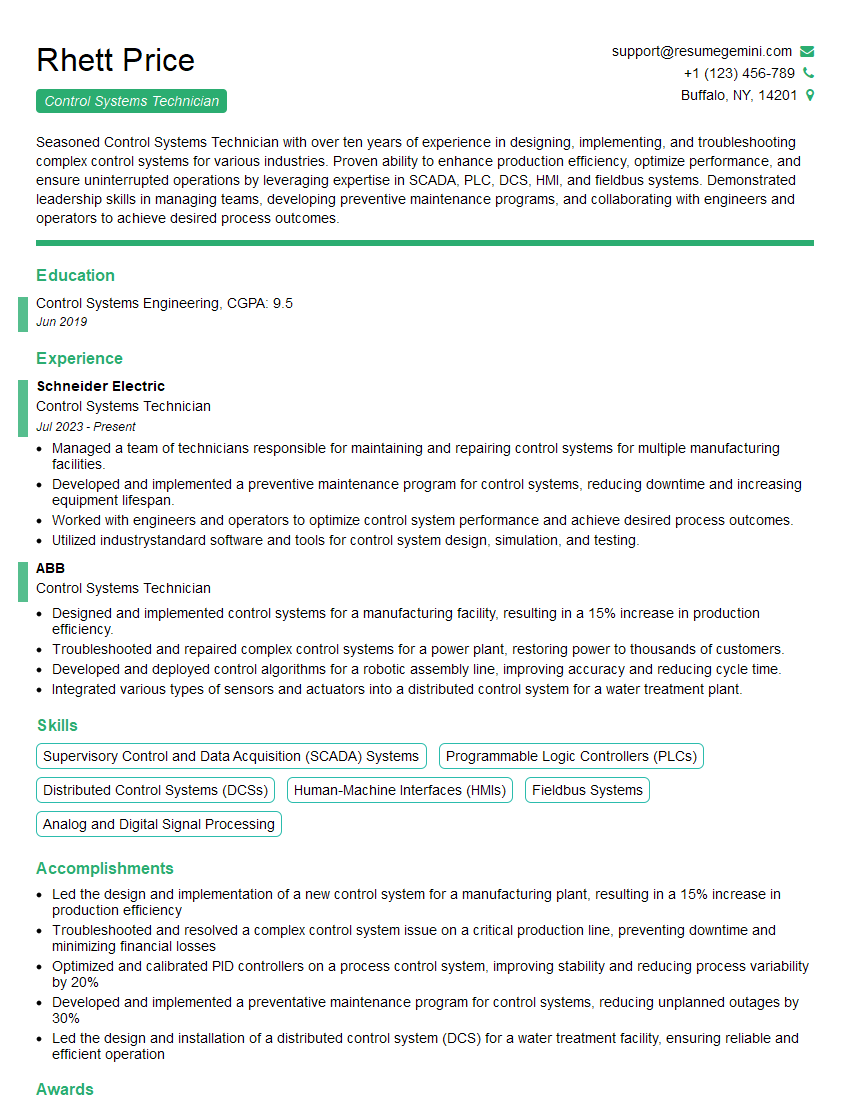
Mastering Electrical Control Panel Repair opens doors to a rewarding career with excellent growth potential, offering opportunities for specialization and advancement within industrial maintenance and automation. To maximize your job prospects, crafting a strong, ATS-friendly resume is crucial. ResumeGemini is a trusted resource that can help you build a professional resume that highlights your skills and experience effectively. ResumeGemini provides examples of resumes tailored to Electrical Control Panel Repair, helping you showcase your qualifications to potential employers. Take the next step in your career journey and create a resume that stands out.
Explore more articles
Users Rating of Our Blogs
Share Your Experience
We value your feedback! Please rate our content and share your thoughts (optional).
What Readers Say About Our Blog
Very informative content, great job.
good