Every successful interview starts with knowing what to expect. In this blog, we’ll take you through the top Electrical Inspection and Code Compliance interview questions, breaking them down with expert tips to help you deliver impactful answers. Step into your next interview fully prepared and ready to succeed.
Questions Asked in Electrical Inspection and Code Compliance Interview
Q 1. Explain the National Electrical Code (NEC) and its significance.
The National Electrical Code (NEC) is a widely adopted standard for the safe installation of electrical wiring and equipment in the United States. It’s not a law itself, but it’s incorporated by reference into many local, state, and municipal building codes, making adherence essentially mandatory. Think of it as the rulebook for safe electrical work. Its significance lies in its ability to minimize electrical hazards, preventing fires, injuries, and fatalities. It provides clear guidelines on everything from wire sizing and grounding to the installation of specific appliances and equipment. Regular updates ensure the NEC stays current with technological advancements and emerging safety concerns.
For example, the NEC dictates the minimum wire gauge required for a specific amperage, ensuring the wiring doesn’t overheat and cause a fire. It also outlines safety measures for arc-fault circuit interrupters (AFCIs) and ground-fault circuit interrupters (GFCIs) in areas prone to water exposure, like bathrooms and kitchens, minimizing the risk of electric shock.
Q 2. Describe the process of inspecting a residential electrical panel.
Inspecting a residential electrical panel is a methodical process requiring careful observation and testing. First, I visually assess the panel for any signs of damage, loose connections, overheating, or corrosion. I’ll check for proper labeling of breakers and ensure all wires are neatly secured. Next, I’ll verify that the main breaker is properly sized for the service and that the panel is adequately grounded. This often involves checking the grounding wire connection and measuring the ground resistance. I’ll then inspect each individual breaker, checking for signs of tripping or damage. Finally, I’ll use specialized testing equipment, such as a clamp meter, to measure the current draw on different circuits to identify any overloading or unusual activity. Throughout the inspection, I maintain detailed records documenting any findings or violations.
Imagine it like a car mechanic checking your engine – I’m systematically checking each component for potential problems before they cause larger issues.
Q 3. What are the common violations you encounter during electrical inspections?
During electrical inspections, I commonly find violations related to grounding and bonding, improper wiring methods (such as using the wrong gauge wire or insufficient wire supports), overloaded circuits, missing or improperly installed GFCIs/AFCIs, and damaged or outdated equipment. Improperly installed or maintained electrical panels are also a recurring issue. Another common problem is the absence of proper labeling, which makes troubleshooting and maintenance difficult and potentially dangerous. I’ve also seen cases where electrical work was done without permits or by unqualified individuals.
For instance, I recently found a situation where a homeowner had added several high-power appliances to a circuit that was already nearing its capacity, creating an overload risk and a potential fire hazard. This highlights the importance of regular inspections to ensure safety and compliance.
Q 4. How do you determine the ampacity of a conductor?
Determining the ampacity of a conductor involves considering several factors. Ampacity, simply put, is the maximum current a conductor can carry continuously under specific conditions without exceeding its temperature rating. This is crucial to prevent overheating and potential fire hazards. The NEC tables provide ampacity ratings for various types of conductors (copper, aluminum) based on their size (gauge), insulation type, and installation method (e.g., in conduit, in free air). Other factors, such as ambient temperature, installation location (e.g., inside walls versus in direct sunlight), and the number of conductors in a raceway, can also affect the allowable ampacity and need to be taken into consideration. I frequently use the NEC tables and relevant calculation methods to determine the proper ampacity for each circuit in a given installation.
For example, a 12-gauge copper conductor in free air might have a higher ampacity rating than the same conductor installed in a conduit with other conductors. This is because the conduit can impede heat dissipation.
Q 5. What are the safety precautions you take during an electrical inspection?
Safety is paramount during an electrical inspection. Before beginning, I always de-energize the circuit if possible. This is the most important step. I use appropriate personal protective equipment (PPE), including insulated gloves, safety glasses, and insulated footwear to protect myself from electric shock. I follow lock-out/tag-out procedures to prevent accidental energization during the inspection. I also use non-contact voltage testers to verify that circuits are indeed de-energized before working directly on them. If a circuit must remain energized, I use insulated tools and maintain a safe distance to avoid contact. I always work methodically and carefully, being mindful of the potential hazards of working with electricity.
Think of it like working with fire – I treat electrical circuits with the same respect and caution.
Q 6. Explain the differences between grounding and bonding.
Grounding and bonding are distinct but related concepts crucial for electrical safety. Grounding connects a non-current-carrying metal part of an electrical system to the earth, providing a low-resistance path for fault currents to flow to the ground. This protects against electric shock and prevents equipment from becoming energized. Bonding, on the other hand, connects non-current-carrying metal parts of an electrical system to each other, equalizing their electrical potential. This prevents voltage differences between metal parts that could cause dangerous electrical shock. In essence, grounding connects to the earth, while bonding connects to each other.
Imagine a house during a thunderstorm. Grounding is like the lightning rod, safely diverting electrical current to the earth. Bonding is like connecting all the metal plumbing in the house to prevent voltage differences that could cause shocks.
Q 7. Describe the proper methods for testing ground continuity.
Testing ground continuity involves measuring the resistance of the grounding path to ensure it’s sufficiently low to effectively conduct fault currents to the earth. I use a clamp-on ammeter and a low-resistance ohmmeter to measure the resistance between the ground electrode and other grounded points in the system. This test helps ensure the earth’s potential is rapidly transferred to ground and reduces the risk of electrical shock. A low resistance reading (typically less than 5 ohms is generally acceptable, though the specific value depends on local codes) indicates a good ground connection, while a high resistance reading may signify a fault in the grounding system. Proper testing methods also include ensuring all circuits are de-energized to avoid damaging the equipment or harming personnel.
It’s similar to checking the flow of water in a pipe – a low resistance reading suggests clear and effective flow of electricity to ground.
Q 8. How do you interpret electrical blueprints and schematics?
Interpreting electrical blueprints and schematics requires a systematic approach. Think of them as a detailed map of the electrical system. First, I identify the legend, which explains symbols representing various components like switches, outlets, lights, and circuits. Then, I trace the paths of wiring from the power source (usually the electrical panel) to the various loads (devices that use electricity). I pay close attention to wire sizes (indicated by numbers like 12 AWG or 14 AWG), circuit breakers ratings, and the type of wiring used. For example, a thicker wire (e.g., 8 AWG) usually indicates a higher amperage circuit, suggesting it’s powering high-demand appliances. I also look for notes and annotations that might highlight specific installation requirements or safety precautions. Understanding the schematic allows me to foresee potential issues, such as overloaded circuits or improper grounding, before they even occur. It’s crucial to be able to visualize the three-dimensional layout from a two-dimensional drawing, ensuring the plan meets code and safety standards.
For instance, I recently worked on a project where the blueprint indicated a 20-amp circuit powering both an oven and a microwave. A quick calculation based on the expected amperage draw of each appliance revealed a potential overload, and this issue was addressed during the design phase by specifying a separate circuit for each appliance.
Q 9. What are the requirements for installing GFCI receptacles?
Ground Fault Circuit Interrupters (GFCIs) are crucial safety devices designed to protect people from electrical shock. They are required in many locations due to the risk of electrical current escaping and creating a shock hazard. The NEC (National Electrical Code) mandates GFCIs for outlets in bathrooms, kitchens, garages, outdoors, and anywhere near water sources. Also, any receptacles within 6 feet of a sink or other water source in areas like basements or laundry rooms require GFCI protection. These locations are considered high-risk due to the potential for accidental contact with water and electricity. GFCIs work by continuously monitoring the current flowing through the circuit. If there’s an imbalance – meaning current isn’t returning to the source via the neutral wire – indicating a ground fault, the GFCI quickly interrupts the circuit to prevent shock. They are typically easy to identify by their ‘Test’ and ‘Reset’ buttons. Regular testing ensures functionality.
For example, if someone accidentally drops a hair dryer into a bathtub with a non-GFCI outlet, the result could be fatal. However, a GFCI outlet would immediately shut off the power, preventing the potentially deadly shock.
Q 10. Explain the requirements for arc-fault circuit interrupters (AFCIs).
Arc-Fault Circuit Interrupters (AFCIs) are designed to detect and interrupt potentially dangerous electrical arcs that can cause fires. Unlike GFCIs, which detect ground faults, AFCIs focus on the dangerous arc that occurs when there is a break in a wire or a loose connection. These arcs can generate intense heat and ignite nearby flammable materials. The NEC mandates AFCIs in many bedroom circuits and hallways, recognising these areas often have bedding and other combustible materials. AFCIs employ sophisticated sensors to detect these arcing faults, quickly interrupting power before they become a fire hazard. There are two types of AFCIs: those that detect only series arcs (those from a break in the wire) and those that detect both series and parallel arcs (those caused by loose connections or damaged insulation).
Imagine a loose connection in a wall behind a bed. A small arc may start, not significant enough to trip a typical circuit breaker, but intense enough to eventually ignite the nearby mattress. An AFCI would detect this potentially dangerous condition and instantly shut off the power, preventing a devastating fire.
Q 11. What are the regulations for installing electrical wiring in wet locations?
Installing electrical wiring in wet locations demands extra caution to ensure safety and longevity. The NEC specifies requirements for using weatherproof boxes, fittings, and cables rated for wet locations. Common examples of wet locations include bathrooms, outdoor areas, and areas near pools. The wiring must be protected from moisture to prevent corrosion and potential short circuits. This means using conduit (typically PVC or metal) to protect the wires, sealing all connections and boxes meticulously, and using properly rated equipment. In addition to conduit, watertight connectors and sealants are essential, ensuring the integrity of the wiring against moisture ingress. The type of conduit used must be suitable for the location; for instance, PVC conduit is commonly used in dry locations, but metal conduit provides better protection against corrosion in consistently wet environments.
For instance, outdoor lighting installations require special care. The wires must be housed in weatherproof conduit, and all connections must be sealed tightly to prevent water intrusion. Failure to follow these guidelines can result in electrical shock or fires, posing significant safety risks.
Q 12. How do you determine the proper size of conduits for different wire types?
Determining the proper conduit size for different wire types is critical for ensuring sufficient space for the wires and proper heat dissipation. The NEC provides detailed tables that specify the minimum conduit size based on the number of wires, their size (AWG), and the type of insulation. The number of wires in the conduit affects the fill ratio, influencing the necessary conduit size to avoid overheating. I use a conduit fill calculator, either a physical one or a software application, to ensure compliance with code. This calculator considers the wire’s cross-sectional area, insulation type, and the number of conductors to determine the minimum size of conduit allowed. Incorrect sizing can lead to overheating, which is a potential fire hazard.
For example, installing a conduit with three 12 AWG wires needs a different size conduit than one with two 10 AWG wires, even if both have the same total ampacity. The differences in physical wire sizes require different sized conduits.
Q 13. Explain the requirements for installing lighting fixtures in various locations.
Installing lighting fixtures involves various considerations, depending on the location and type of fixture. The NEC specifies requirements for different locations like damp locations (bathrooms), wet locations (outdoor areas), and hazardous locations (areas with flammable materials). Each location requires a fixture rated for the specific conditions. For instance, damp locations require fixtures marked ‘damp-location rated’, which have enhanced sealing to protect against moisture. Wet location fixtures have even stricter requirements, ensuring complete protection against water intrusion. Fixtures in hazardous locations require special ratings to prevent ignition of flammable gases or vapours. Furthermore, proper grounding and appropriate mounting methods are essential to ensure safety and compliance. Fixtures should be securely mounted using appropriate hardware and grounded to the electrical system to prevent shocks.
For example, a bathroom ceiling fixture needs to be damp-location rated, with gaskets and seals to prevent moisture from entering the fixture. A poorly installed or incorrectly rated fixture could lead to short circuits and potential shocks.
Q 14. Describe the process of inspecting a commercial electrical system.
Inspecting a commercial electrical system is a comprehensive process that ensures compliance with the NEC and promotes safety. It involves several key steps: First, I review the blueprints and schematics to understand the system’s design. Next, I visually inspect the electrical panel, checking for proper labeling, correct breaker sizes, and signs of overheating or damage. Then, I examine all wiring, looking for loose connections, damaged insulation, and improper routing. I test the grounding system to ensure proper functionality and safety. I use specialized test equipment like a multimeter to check voltage, amperage, and ground continuity. I carefully check all receptacles and lighting fixtures, verifying proper installation and functionality. I pay particular attention to areas with higher risk such as wet locations or areas with heavy equipment. Detailed documentation of the inspection, including any identified violations or safety concerns, is crucial.
During a recent inspection of a commercial kitchen, I found a significant number of overloaded circuits, poorly installed conduit, and inadequate grounding in several areas. This inspection revealed critical safety hazards requiring immediate attention and remedial actions.
Q 15. How do you handle discrepancies between the plans and the actual installation?
Discrepancies between plans and actual installations are a common challenge in electrical inspections. My approach involves a systematic process to ensure safety and code compliance. First, I carefully review the approved electrical plans to fully understand the intended design. Then, I conduct a thorough on-site inspection, meticulously comparing the existing installation with the plans. Any discrepancies are meticulously documented, with photographs and detailed descriptions. This documentation includes the location of the discrepancy, a description of the difference between the plans and the actual installation (e.g., incorrect wire gauge, missing grounding, unauthorized modifications), and the potential safety implications.
Next, I categorize discrepancies into severity levels: minor (easily rectified, no immediate safety concern), major (requires correction before energization, potential safety risk), and critical (immediate safety hazard, requires immediate shutdown). For minor discrepancies, I might offer recommendations for correction. For major discrepancies, I’ll clearly state the required corrections in my report and request a follow-up inspection after the corrections are made. Critical discrepancies necessitate immediate action, often involving notifying the relevant authorities and potentially issuing a stop-work order until the hazard is mitigated. For example, if the plans show a 20-amp circuit breaker but a 15-amp breaker is installed, that’s a major discrepancy requiring correction to prevent overheating and potential fire hazards. Similarly, missing grounding is a critical discrepancy and will result in immediate action.
Career Expert Tips:
- Ace those interviews! Prepare effectively by reviewing the Top 50 Most Common Interview Questions on ResumeGemini.
- Navigate your job search with confidence! Explore a wide range of Career Tips on ResumeGemini. Learn about common challenges and recommendations to overcome them.
- Craft the perfect resume! Master the Art of Resume Writing with ResumeGemini’s guide. Showcase your unique qualifications and achievements effectively.
- Don’t miss out on holiday savings! Build your dream resume with ResumeGemini’s ATS optimized templates.
Q 16. What are the common causes of electrical fires?
Electrical fires are a significant safety concern, and understanding their causes is crucial for prevention. Common culprits include:
- Overloaded Circuits: This occurs when too many appliances or devices draw power from a single circuit, exceeding its amperage rating. Think of it like trying to fit too much water into a small cup – it overflows and potentially causes damage.
- Faulty Wiring: Damaged, frayed, or improperly installed wiring can create sparks and generate heat, leading to ignition. This is especially risky in older homes with outdated wiring.
- Overheating Appliances: Appliances with faulty heating elements, such as malfunctioning space heaters or ovens, can become extremely hot and ignite nearby flammable materials.
- Loose Connections: Loose wiring connections create resistance and generate heat, potentially leading to fires. Think of it like repeatedly plugging and unplugging a phone charger – friction can eventually damage it.
- Arcing Faults: An electric arc occurs when electricity jumps between two conductive surfaces, causing intense heat and potentially starting a fire. This is often caused by worn insulation or faulty switches.
- Improper Grounding: Lack of proper grounding creates a path for stray currents to flow, causing overheating and increasing the risk of shock and fire.
Addressing these causes through regular inspections, proper maintenance, and adherence to electrical codes significantly reduces the risk of electrical fires.
Q 17. How do you identify and address potential electrical hazards?
Identifying and addressing potential electrical hazards is paramount in ensuring safety. My process begins with a visual inspection, looking for signs of damage, wear, and tear on wiring, outlets, switches, and other components. I check for things like frayed insulation, loose connections, scorch marks, and signs of overheating. I also use specialized testing equipment to verify proper grounding, voltage levels, and circuit integrity. This might include a multimeter to test voltage and continuity, a ground tester to check for proper grounding, and a clamp meter to measure current draw.
Beyond visual inspection and testing, I look for potential hazards based on occupancy and usage. A high-traffic area might require more robust wiring or additional circuits compared to a low-traffic area. I pay particular attention to areas where water is present, such as bathrooms and kitchens, and I carefully assess the suitability of electrical equipment in those locations. Any identified hazards are documented in detail, including photographs and specific location, along with clear recommendations for remediation. This documentation ensures clear communication with clients and allows for proper follow-up.
Q 18. Explain the importance of proper labeling and identification of electrical components.
Proper labeling and identification of electrical components are crucial for safety, maintenance, and troubleshooting. Clear labeling makes it easy to identify circuits, wires, and equipment, facilitating repairs and reducing the risk of accidental damage or injury. Imagine trying to fix a complex piece of equipment without a manual or diagram – it would be extremely challenging and potentially dangerous. Similarly, unclear labeling in an electrical system can lead to confusion and potentially hazardous situations.
Labels should be permanent, legible, and clearly indicate the function and rating of each component (e.g., voltage, amperage, phase). They should also comply with relevant industry standards and codes. For example, circuit breakers should be clearly labeled to indicate the circuits they protect, and wires should be color-coded according to the National Electrical Code. This information not only aids in maintenance and troubleshooting but also assists emergency responders in quickly understanding the electrical system layout and identifying potential hazards during an emergency.
Q 19. What is your experience with different types of electrical testing equipment?
Throughout my career, I’ve gained extensive experience using a variety of electrical testing equipment, including multimeters (for voltage, current, and resistance measurements), clamp meters (for measuring current without breaking the circuit), insulation resistance testers (for checking the integrity of insulation), ground testers (for ensuring proper grounding), and circuit breakers testers (for verifying their functionality). I’m also proficient in using specialized equipment such as thermal imaging cameras to detect overheating, and power quality analyzers for identifying voltage fluctuations and harmonics.
My experience extends to understanding the limitations of each device and applying the appropriate test methods for different situations. For example, using a multimeter to check for continuity before working on a circuit to ensure it’s not energized is a standard safety procedure I always follow. Understanding the capabilities and limitations of each tool is critical to ensure accurate and safe testing.
Q 20. Describe your experience with report writing and documentation for electrical inspections.
Detailed and accurate report writing is a cornerstone of my work. My reports clearly outline the scope of the inspection, the methodology used, the findings (including photographs and diagrams), and any identified discrepancies or hazards. The format adheres to industry standards, ensuring clarity and consistency. Critically, my reports clearly articulate the severity of each finding and recommend appropriate corrective actions. I utilize clear, concise language, avoiding technical jargon where possible, to ensure that the information is easily understood by clients, even those without extensive electrical knowledge.
I maintain a digital record of all inspection reports, ensuring easy accessibility and traceability. This digital archive allows for efficient retrieval of past inspection data, facilitating ongoing maintenance and system improvements. In addition to formal reports, I’m skilled at preparing concise summaries highlighting key findings and recommendations for clients who require quick overviews.
Q 21. How do you stay updated on the latest electrical codes and regulations?
Staying current with the latest electrical codes and regulations is paramount in ensuring compliance and safety. I actively participate in professional development programs and workshops offered by organizations such as the IEEE (Institute of Electrical and Electronics Engineers) and NFPA (National Fire Protection Association). I regularly review updates to the National Electrical Code (NEC) and other relevant local, state, and federal regulations. Subscriptions to industry journals and online resources keep me informed about new technologies, best practices, and emerging safety concerns.
I also network with other electrical professionals through industry associations, attending conferences and participating in online forums to share knowledge and stay abreast of the latest developments. This multi-faceted approach ensures that my practices and recommendations always reflect the most current and best practices in electrical safety and code compliance.
Q 22. Explain your understanding of the different types of electrical permits.
Electrical permits are crucial for ensuring safety and compliance with electrical codes. They signify that the planned electrical work has been reviewed and approved by the relevant authority having jurisdiction (AHJ), typically a local building department. The types of permits vary depending on the scope of the work, but generally include:
- New Construction Permits: These are required for all new electrical installations in buildings, from residential homes to large commercial complexes. They cover the entire electrical system, including service panels, wiring, outlets, and lighting.
- Alteration or Repair Permits: These are necessary for any modifications or repairs to existing electrical systems. This could range from replacing a faulty outlet to a significant renovation that affects the electrical infrastructure.
- Temporary Permits: These are issued for short-term electrical installations, such as for construction sites or special events. They usually have a limited duration and specific conditions.
- Demolition Permits: While less directly related to new installations, these ensure that the demolition process doesn’t create electrical hazards and addresses proper decommissioning of the system.
Each permit application requires detailed information about the project, including plans, specifications, and the qualifications of the electrician. The AHJ reviews this information to ensure compliance with the National Electrical Code (NEC) and local ordinances. Failure to obtain the correct permits can result in fines, delays, and safety risks.
Q 23. How do you handle difficult or confrontational situations with contractors or homeowners?
Handling confrontational situations requires a calm and professional approach. My strategy focuses on active listening, clear communication, and de-escalation. I start by acknowledging the contractor or homeowner’s concerns, explaining the code violations in a non-accusatory manner, using clear and simple language avoiding technical jargon whenever possible. I use visuals like diagrams or photos to illustrate the issue.
For example, if a homeowner is upset about required changes, I’ll explain the safety implications of their current setup, emphasizing how the changes protect their family and property. If a contractor disagrees with my assessment, I’ll show them the relevant code sections and explain my reasoning. If the disagreement persists, I offer to consult with their supervisor or a qualified third party to resolve the conflict. The goal is to find a solution that meets both safety standards and their needs, always prioritizing safety. Maintaining a respectful and professional demeanor throughout the process is paramount.
Q 24. Describe a time you had to make a critical decision during an inspection.
During an inspection of a newly constructed daycare center, I discovered a significant grounding issue. The grounding wire was improperly connected, posing a severe electrocution risk to the children.
My immediate decision was to halt the inspection and issue a stop-work order. This meant delaying the opening of the daycare and causing inconvenience, but prioritizing safety was non-negotiable. I clearly documented the violation with detailed photos and a comprehensive report. I then contacted the building inspector and the electrical contractor immediately, outlining the problem and the immediate need for correction. We coordinated a follow-up inspection to confirm the repairs, preventing potential serious harm. This situation highlighted the critical importance of thorough inspections and the immediate action required when major safety issues are identified.
Q 25. How familiar are you with OSHA regulations pertaining to electrical safety?
I am very familiar with OSHA regulations, specifically Subpart S – Electrical, which outlines the safety standards for electrical work. I understand the requirements for lockout/tagout procedures, arc flash hazard mitigation, personal protective equipment (PPE), and training requirements for qualified electrical workers.
For instance, I’m aware of the necessity of using proper PPE, like insulated gloves, safety glasses, and arc flash suits when working near energized equipment. I am also familiar with OSHA’s requirements for electrical safety training, which ensures workers understand the hazards and have the knowledge to perform their jobs safely. Regular training updates are crucial due to evolving standards and technology. Compliance with OSHA ensures worker safety and reduces the likelihood of accidents on the job site.
Q 26. What is your experience working with different types of electrical systems (e.g., low voltage, high voltage)?
My experience encompasses a wide range of electrical systems. I’ve worked with both low-voltage systems, like those found in residential buildings, including fire alarm circuits and security systems, and high-voltage systems, such as those in industrial settings and commercial power distribution systems.
In low-voltage systems, my focus is on ensuring proper wiring, grounding, and overcurrent protection. High-voltage systems require a deeper understanding of power distribution, transformer operation, and safety procedures to mitigate the increased risks associated with higher voltages. Understanding the specific codes and regulations for each voltage class is essential for safe and compliant installations. My experience includes working with different wiring methods, such as conduit, cable tray, and raceway systems, adapting my approach based on the specific application and voltage levels.
Q 27. Describe your experience with electrical inspections of specific building types (e.g., residential, commercial, industrial).
My experience spans various building types. In residential inspections, I focus on identifying common issues like faulty wiring, inadequate grounding, and overloaded circuits. Commercial inspections often involve more complex systems, including larger electrical panels, extensive lighting systems, and specialized equipment. I’ve inspected everything from small retail spaces to large office buildings. Industrial inspections require a high level of expertise due to the presence of heavy machinery and specialized electrical systems.
Each building type presents unique challenges. For example, in industrial settings, I pay close attention to the safety of heavy machinery, ensuring proper grounding, isolation, and lockout/tagout procedures are in place. My inspections always prioritize safety and compliance with the relevant codes and standards, regardless of the building type. Detailed documentation and photographic evidence are critical for all types of inspections.
Key Topics to Learn for Electrical Inspection and Code Compliance Interview
- National Electrical Code (NEC) Knowledge: Demonstrate a thorough understanding of the NEC, including its organization, key articles, and common amendments. Be prepared to discuss specific code sections relevant to various electrical systems.
- Wiring Methods and Techniques: Explain different wiring methods (e.g., conduit, cable trays, raceways), their applications, and how to ensure compliance with code requirements. Be ready to discuss proper grounding and bonding techniques.
- Electrical Calculations and Load Calculations: Show your ability to perform load calculations, determine appropriate overcurrent protection, and apply relevant formulas to ensure safe and compliant electrical installations. Understand voltage drop calculations and their implications.
- Electrical System Components: Display familiarity with various electrical components (e.g., circuit breakers, fuses, transformers, motors, panels) and their functions. Be able to identify potential hazards and code violations related to these components.
- Safety Procedures and Regulations: Highlight your understanding of safety regulations, lockout/tagout procedures, and personal protective equipment (PPE) necessary for electrical inspections. Demonstrate awareness of OSHA standards.
- Plan Review and Inspections: Discuss your experience (or theoretical understanding) of reviewing electrical plans for compliance and conducting thorough on-site inspections. Describe common issues found during inspections and how to address them.
- Troubleshooting and Problem-Solving: Showcase your ability to identify and troubleshoot electrical problems, applying your knowledge of the NEC and electrical principles. Be prepared to discuss your approach to diagnosing and resolving code violations.
- Report Writing and Documentation: Explain your ability to create clear, concise, and accurate inspection reports, documenting findings, violations, and recommendations for corrective actions.
Next Steps
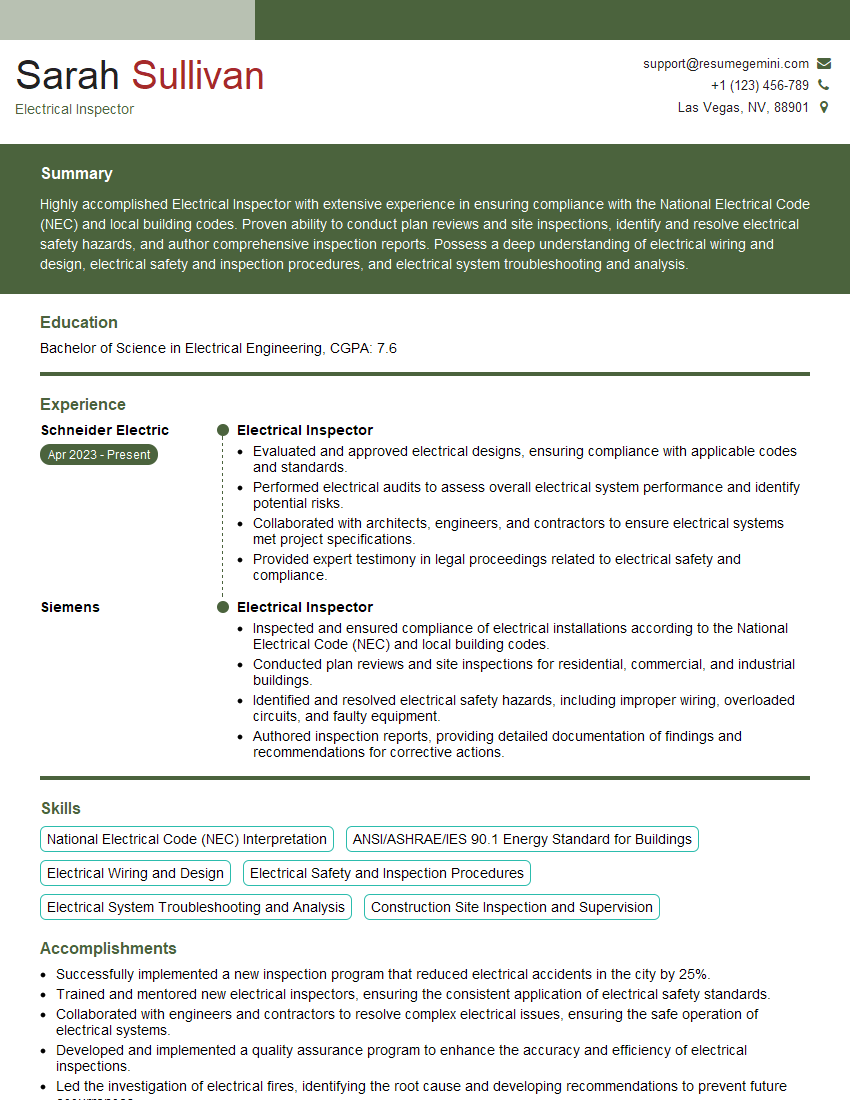
Mastering Electrical Inspection and Code Compliance opens doors to exciting career opportunities with excellent growth potential. A strong understanding of these principles is highly valued by employers and significantly enhances your professional credibility. To maximize your job prospects, creating a compelling and ATS-friendly resume is crucial. ResumeGemini is a trusted resource that can help you craft a professional resume that highlights your skills and experience effectively. ResumeGemini provides examples of resumes tailored to Electrical Inspection and Code Compliance roles to help you get started. Take the next step in your career journey by building a stand-out resume today!
Explore more articles
Users Rating of Our Blogs
Share Your Experience
We value your feedback! Please rate our content and share your thoughts (optional).
What Readers Say About Our Blog
Very informative content, great job.
good