The right preparation can turn an interview into an opportunity to showcase your expertise. This guide to Electronic Intelligence interview questions is your ultimate resource, providing key insights and tips to help you ace your responses and stand out as a top candidate.
Questions Asked in Electronic Intelligence Interview
Q 1. Explain the difference between SIGINT, COMINT, and ELINT.
SIGINT, COMINT, and ELINT are all sub-fields of Signals Intelligence (SIGINT), representing different types of intercepted signals. Think of SIGINT as the umbrella term encompassing all forms of intelligence gathered from intercepted signals.
SIGINT (Signals Intelligence): This is the broadest category, encompassing all intelligence derived from intercepted signals. It’s the overall field of study and practice.
COMINT (Communications Intelligence): This focuses on the interception and analysis of communications, such as telephone calls, radio transmissions, and internet traffic. Imagine intercepting a radio conversation between two individuals – that’s COMINT.
ELINT (Electronic Intelligence): This focuses on the interception and analysis of non-communication electronic signals. This includes radar emissions, electronic warfare signals, and other signals produced by electronic systems. Think of detecting the radar signal from an enemy aircraft – that falls under ELINT.
The key difference lies in the purpose of the electronic signals being intercepted. COMINT targets communications intended for someone else, while ELINT focuses on signals that aren’t necessarily intended as communication but reveal operational details.
Q 2. Describe the signal processing techniques used in Electronic Intelligence.
Signal processing in Electronic Intelligence involves a complex series of techniques to extract meaningful information from raw signals. This often starts with signal acquisition, followed by sophisticated filtering, modulation recognition, and feature extraction.
Filtering: This removes unwanted noise and interference to isolate the signal of interest. Imagine separating the sound of a specific instrument from an orchestra – that’s similar to filtering in signal processing.
Modulation Recognition: This identifies the type of modulation used (e.g., AM, FM, digital), crucial for decoding the signal’s content if it is a communication signal (COMINT). Different modulation schemes contain unique characteristics that provide clues.
Feature Extraction: This involves identifying key characteristics of the signal, like frequency, pulse repetition interval (PRI), and bandwidth. These features are then used for signal identification and classification.
Direction Finding: Determining the origin of a signal using multiple receiving antennas. This is akin to using triangulation to pinpoint a location based on multiple signal sources.
Signal parameter estimation: This involves using statistical methods to estimate unknown parameters of the signal, such as signal power or arrival time.
Advanced techniques such as machine learning algorithms are increasingly used for automated signal analysis, classification, and anomaly detection, dramatically improving efficiency and accuracy. For example, deep learning models can be trained to identify and classify radar pulses with a high degree of accuracy.
Q 3. How do you identify and classify different types of electronic signals?
Identifying and classifying electronic signals involves a multi-step process combining signal analysis techniques with databases and expert knowledge. We analyze signal characteristics such as:
Frequency: The frequency of the signal (e.g., 10 GHz for a specific type of radar)
Bandwidth: The range of frequencies occupied by the signal
Modulation type: How the information is encoded on the carrier wave
Pulse characteristics (for pulsed signals): Pulse width, pulse repetition frequency (PRF), and pulse repetition interval (PRI)
Emission patterns: The way the signal is transmitted over time, including how long it transmits, and how often
This information is then compared against known signal signatures in databases and expert knowledge, allowing for identification and classification. For example, recognizing a specific radar PRF could allow us to identify the type of radar system being used. Further analysis might include geolocation techniques to identify the transmitter’s location.
Q 4. What are the common challenges in intercepting and analyzing electronic signals?
Intercepting and analyzing electronic signals present many challenges:
Signal strength and attenuation: Signals weaken with distance, making long-range interception difficult.
Noise and interference: Other signals can mask or obscure the target signal, requiring sophisticated filtering techniques.
Signal jamming and spoofing: Adversaries may intentionally jam or spoof signals to confuse or mislead.
Spread spectrum techniques: These techniques spread the signal across a wide bandwidth to make interception and decoding more challenging.
Data volume: The sheer volume of signals can make processing and analysis a significant undertaking, demanding automated systems.
Signal security: Encryption and other security measures protect sensitive information.
Overcoming these challenges often requires advanced signal processing techniques, large antenna arrays, specialized equipment, and expert analysis. For example, using advanced direction-finding techniques can mitigate the issue of identifying the emitter location amidst several signals with similar frequency.
Q 5. Explain the concept of electronic countermeasures (ECM).
Electronic countermeasures (ECM) are techniques and technologies used to disrupt or deceive enemy electronic systems. They are essentially the offensive counterpart to Electronic Intelligence (ELINT).
Jamming: This involves transmitting a signal that overpowers or interferes with the target system, preventing it from functioning correctly. This is like shouting over someone to make them unable to hear what they were trying to say.
Deception: This involves transmitting false or misleading signals to confuse or mislead the enemy, making them believe that something is happening when it isn’t. This is similar to spreading misinformation during a war.
Spoofing: This involves imitating the signals of a legitimate system to trick the enemy into reacting to a false target or data.
ECM techniques are crucial for protecting friendly forces and assets from enemy surveillance and attack. The development of new ECM technologies is an ongoing process, as are counter-countermeasures by the receiving side. This creates an arms race in developing and countering ECM technologies.
Q 6. Describe your experience with signal analysis software and tools.
Throughout my career, I’ve extensively utilized various signal analysis software and tools, including:
MATLAB: This is a widely used platform for signal processing, with toolboxes specifically designed for tasks such as filtering, spectral analysis, and modulation recognition. I frequently use its signal processing toolbox to process raw signals acquired from different receiver systems.
Specialized SIGINT analysis software: These software packages often offer advanced algorithms for signal detection, classification, and geolocation. Examples include specific programs designed for demodulating encrypted signals or identifying specific radar systems.
Software Defined Radios (SDRs): I have experience working with SDRs, which allow for flexible and adaptable signal processing by controlling radio frequencies and other parameters in software.
My experience also encompasses the use of dedicated hardware, such as spectrum analyzers and digital receivers, which are integrated with the software for real-time analysis of signals.
Q 7. How do you prioritize and manage multiple signals intelligence tasks?
Prioritizing and managing multiple signals intelligence tasks requires a structured approach. We use a combination of factors to determine task importance:
Time sensitivity: Some tasks require immediate attention due to their time-critical nature. For example, intercepting a communication signal related to an imminent attack is far more important than analyzing a long-term communication pattern.
Intelligence value: Tasks are prioritized based on their potential to provide valuable intelligence. The signal’s potential to reveal sensitive information determines how urgently it’s processed.
Resource availability: The availability of personnel, equipment, and processing power influences task prioritization. We cannot pursue every single signal, so we focus on signals we can properly analyze.
Strategic alignment: Tasks are aligned with overall intelligence objectives. This ensures efforts focus on the most relevant information to specific goals.
We often utilize task management software and established protocols for coordinating multiple tasks and reporting progress. The use of agile methodologies allows for flexibility and adapting to changing priorities and new intelligence.
Q 8. What are the ethical considerations involved in Electronic Intelligence?
Electronic Intelligence (ELINT) presents significant ethical challenges, primarily revolving around privacy and the potential for misuse. Gathering intelligence often involves intercepting communications and monitoring activities without the knowledge or consent of the individuals involved. This raises concerns about the right to privacy, particularly in democratic societies where individual liberties are highly valued.
- Privacy Violation: The very nature of ELINT involves collecting personal data, which can include sensitive information like conversations, financial transactions, and location data. Balancing national security needs with the fundamental right to privacy is a constant ethical tightrope walk.
- Potential for Abuse: ELINT capabilities can be misused for purposes beyond national security, such as political espionage, corporate espionage, or even targeting individuals for harassment or blackmail. Strong oversight and strict regulations are crucial to prevent such abuses.
- Transparency and Accountability: There’s a constant need for transparency and accountability within ELINT operations. Clear guidelines and oversight mechanisms are essential to ensure ethical conduct and prevent unlawful actions.
- International Law: The collection and use of ELINT data must comply with international laws and treaties, such as the Universal Declaration of Human Rights. Violation of these laws can have severe legal and diplomatic consequences.
For instance, consider a scenario where ELINT is used to monitor communications within a country suspected of developing weapons of mass destruction. While this may serve a legitimate national security interest, the collection of data might also inadvertently capture the private communications of innocent citizens. Careful planning, strict targeting parameters, and robust data minimization procedures are essential to mitigate such risks.
Q 9. How do you ensure the accuracy and reliability of intelligence reports?
Ensuring the accuracy and reliability of intelligence reports in ELINT is paramount. It’s a multi-faceted process involving rigorous procedures and technologies.
- Source Verification: The credibility of each intelligence source must be carefully assessed. This involves analyzing the source’s history, motivation, and potential biases. Multiple independent sources corroborating the same information significantly increase the report’s reliability.
- Data Validation: Raw data from various sensors and intercepts needs to be validated. This includes checking for signal anomalies, interference, and potential manipulation. Sophisticated signal processing techniques are essential for this step.
- Technical Analysis: Thorough analysis of intercepted signals is crucial to determine their origin, content, and intended purpose. Expert knowledge of modulation techniques, encryption algorithms, and communication protocols is necessary.
- Human Intelligence (HUMINT) Integration: Combining ELINT data with HUMINT can provide valuable context and cross-validation. Ground truth obtained from human sources can confirm or refute ELINT findings.
- Peer Review and Quality Control: Intelligence reports should undergo rigorous peer review before dissemination. Experienced analysts review the findings, methodology, and conclusions to identify potential errors or biases.
Think of it like a detective investigation. A single piece of evidence might be suggestive, but multiple pieces of evidence, each rigorously examined and cross-referenced, paint a more complete and reliable picture.
Q 10. Describe your experience with data analysis and visualization techniques in relation to SIGINT.
My experience with data analysis and visualization in SIGINT (Signals Intelligence) is extensive. I’ve used a variety of techniques to process and interpret vast quantities of data from various sources, including radar, communications, and electronic emissions.
- Statistical Analysis: I’ve used statistical methods like regression analysis and time series analysis to identify patterns and trends in signal data. This helps in recognizing anomalies and predicting future activity.
- Machine Learning (ML): I’ve applied ML algorithms, such as clustering and classification, to automate the analysis of large datasets, identifying patterns that might be missed by human analysts. This significantly improves efficiency and allows for the handling of increasingly large datasets.
- Data Visualization: Visualizing data is crucial for effective communication and analysis. I frequently use tools like Tableau and custom-built dashboards to represent complex data in easily understandable formats, such as charts, graphs, and maps. This helps in identifying correlations and drawing meaningful conclusions.
- Network Analysis: For analyzing communication networks, I’ve used network graph visualization to display relationships between different communication nodes and identify key players or vulnerabilities.
For example, in one project, I used a combination of machine learning and data visualization to identify and map the communication patterns of a hostile network. By visualizing the data on an interactive map, we were able to pinpoint key locations and actors, ultimately leading to the disruption of their operations.
Q 11. Explain your understanding of different modulation techniques used in electronic signals.
Understanding modulation techniques is fundamental to ELINT. Modulation is the process of encoding information onto a carrier wave, which is a high-frequency signal suitable for transmission. Different modulation techniques have different characteristics in terms of bandwidth, power efficiency, and robustness to noise.
- Amplitude Modulation (AM): The amplitude of the carrier wave is varied to represent the information signal. It’s relatively simple to implement but susceptible to noise and interference.
- Frequency Modulation (FM): The frequency of the carrier wave is varied to represent the information signal. It’s more robust to noise than AM but requires a wider bandwidth.
- Phase Modulation (PM): The phase of the carrier wave is varied to represent the information signal. It’s similar to FM in its robustness to noise but offers different spectral characteristics.
- Digital Modulation Techniques: These include techniques like Phase Shift Keying (PSK), Frequency Shift Keying (FSK), and Quadrature Amplitude Modulation (QAM), used for digital data transmission. They offer higher bandwidth efficiency and are used extensively in modern communication systems.
Recognizing the specific modulation technique used in an intercepted signal allows analysts to determine the type of communication system, its bandwidth requirements, and even infer aspects of the transmitted data. This is a critical skill for ELINT analysts.
Q 12. How do you handle classified information and maintain security protocols?
Handling classified information requires adherence to strict security protocols and procedures. My experience includes working under various security clearances, and I have a thorough understanding of the relevant regulations and best practices.
- Need-to-Know Basis: Access to classified information is granted on a strict need-to-know basis. I only access information directly relevant to my assigned tasks.
- Data Encryption: Sensitive data is encrypted both in transit and at rest using robust encryption algorithms to protect it from unauthorized access.
- Secure Communication Channels: I utilize secure communication channels for transmitting classified information, such as encrypted email and secure voice communication systems.
- Physical Security: I’m familiar with procedures for maintaining the physical security of classified materials, including secure storage, handling, and disposal procedures.
- Security Awareness Training: I participate regularly in security awareness training to stay updated on the latest threats and best practices.
Breaches in security can have catastrophic consequences. Therefore, maintaining the highest level of vigilance and adhering to all established security protocols is non-negotiable. I treat security not merely as a set of rules, but as a professional responsibility of paramount importance.
Q 13. Describe your experience with geolocation techniques used in Electronic Intelligence.
Geolocation techniques are critical in ELINT for determining the geographical location of signal emitters. This information is crucial for understanding the context of intercepted communications and planning further actions.
- Triangulation: This classic technique uses the signals received by multiple geographically separated receivers to determine the emitter’s location using geometric principles. The accuracy depends on the number and spacing of the receivers.
- Time Difference of Arrival (TDOA): This technique measures the difference in arrival time of a signal at multiple receivers. By analyzing these differences, the emitter’s location can be determined.
- Angle of Arrival (AOA): This technique uses directional antennas to measure the direction of arrival of the signal. Combining measurements from multiple antennas allows for location estimation.
- Satellite-Based Geolocation: Using satellite constellations, signal emitters can be located with high accuracy. This requires knowledge of the satellite orbits and signal propagation characteristics.
- Signal Fingerprinting: Analyzing unique characteristics of a signal, like frequency hopping patterns, can be used to identify specific devices and their known locations.
Imagine tracking a clandestine communication network. Geolocating the emitters reveals the network’s physical infrastructure, providing insights into its organization, capabilities, and potential vulnerabilities. Combining these geolocation techniques with other intelligence sources provides a more comprehensive picture.
Q 14. Explain the role of Electronic Intelligence in national security.
Electronic Intelligence plays a crucial role in national security by providing critical information about potential threats and adversaries. It is an essential component of a nation’s overall intelligence gathering capabilities.
- Early Warning of Threats: ELINT can detect the deployment or testing of hostile weapons systems, providing valuable early warning of potential attacks.
- Situational Awareness: It provides real-time situational awareness of adversary activities, including military movements, communication patterns, and infrastructure development.
- Intelligence Support for Military Operations: ELINT provides critical information to support military operations, such as targeting, reconnaissance, and battle damage assessment.
- Counter-Intelligence: ELINT plays a key role in countering intelligence efforts from foreign adversaries by identifying and disrupting their communication and surveillance systems.
- Cybersecurity: ELINT can be used to detect and analyze cyber threats, providing critical information for network defense and cyber warfare.
In essence, ELINT provides the ‘eyes and ears’ of a nation’s intelligence services, enabling timely and informed decision-making in the face of evolving security challenges. It’s a critical element in maintaining national security and protecting a nation’s interests.
Q 15. How do you interpret and analyze complex datasets from various electronic sources?
Interpreting complex datasets from various electronic sources in Electronic Intelligence (ELINT) involves a multi-stage process. First, we need to understand the data’s origin and format. This often involves deciphering metadata, identifying signal characteristics (frequency, modulation, power), and correlating it with known emitter databases. Next, we apply signal processing techniques like filtering, demodulation, and spectral analysis to extract meaningful information. This might involve identifying specific communication protocols or extracting intelligence from encrypted signals, which requires advanced cryptographic knowledge. Finally, we use data mining and machine learning algorithms to identify patterns, anomalies, and correlations within the massive datasets. Think of it like piecing together a complex puzzle – each data point is a piece, and our tools and expertise allow us to assemble the complete picture, revealing valuable insights.
For example, we might receive data from multiple sources – satellite imagery showing potential emitter locations, radio frequency (RF) signals intercepted by various sensors, and intelligence reports from human sources. By combining this data and applying our analytical skills, we can build a comprehensive understanding of an adversary’s communication network or identify potential threats.
Career Expert Tips:
- Ace those interviews! Prepare effectively by reviewing the Top 50 Most Common Interview Questions on ResumeGemini.
- Navigate your job search with confidence! Explore a wide range of Career Tips on ResumeGemini. Learn about common challenges and recommendations to overcome them.
- Craft the perfect resume! Master the Art of Resume Writing with ResumeGemini’s guide. Showcase your unique qualifications and achievements effectively.
- Don’t miss out on holiday savings! Build your dream resume with ResumeGemini’s ATS optimized templates.
Q 16. Describe your experience working with different types of antennas and receivers.
My experience encompasses a wide range of antennas and receivers, from simple dipole antennas used for wideband surveillance to sophisticated phased array systems capable of precise direction-finding. I’m proficient in using various receiver types, including software-defined radios (SDRs), which offer exceptional flexibility and adaptability. I’ve worked with antennas optimized for different frequency bands, such as VHF, UHF, and microwave, and understand the trade-offs between gain, bandwidth, and size. Moreover, I’m familiar with various receiver architectures, including heterodyne and direct conversion receivers, and their respective strengths and weaknesses.
For instance, in one project, we used a large aperture phased array antenna to pinpoint the location of a clandestine communication transmitter with high accuracy. In another project, we deployed a network of SDRs to monitor a broad frequency spectrum for unusual signals, which required careful calibration and synchronization of the receivers. This expertise is critical in ensuring the accuracy and reliability of our ELINT operations.
Q 17. How do you stay updated on the latest advancements in electronic signal technology?
Staying current in the rapidly evolving field of electronic signal technology is crucial. I achieve this through several methods. Regularly attending industry conferences and workshops allows me to network with experts and learn about the latest advancements. I also actively participate in online communities and forums, reading peer-reviewed journals and publications. This keeps me abreast of new signal processing techniques, advanced antenna designs, and novel cryptographic methods. Furthermore, I dedicate time to self-study, exploring new software and hardware tools relevant to signal intelligence. A focus on continuous learning is crucial in this domain; it’s not simply about keeping up, it’s about anticipating the next wave of technological developments.
Q 18. What are the limitations and vulnerabilities of Electronic Intelligence systems?
Electronic Intelligence systems, while powerful, have limitations and vulnerabilities. One key limitation is the range and sensitivity of the receivers. Weak signals, distance from the emitter, and environmental interference can significantly impact the effectiveness of the system. Furthermore, sophisticated signal processing is often required to extract useful intelligence, which can be computationally intensive and time-consuming. Finally, adversaries can employ techniques to mask or jam their signals, making detection and analysis extremely challenging. These jamming techniques range from simple noise generators to complex, adaptive jamming systems designed to overwhelm our systems.
Vulnerabilities also exist. Systems can be compromised through cyberattacks, physical attacks targeting the sensors or data processing centers, or through insider threats. Understanding these limitations and proactively mitigating vulnerabilities is essential for maintaining the integrity and effectiveness of our intelligence gathering efforts.
Q 19. How do you collaborate effectively with other intelligence analysts and stakeholders?
Effective collaboration is paramount in ELINT. I foster collaboration by actively participating in intelligence briefings and sharing data and analysis with other analysts. Using collaborative tools like secure data sharing platforms and communication systems ensures seamless information flow. Moreover, I believe in clearly articulating my findings, presenting them in a concise and understandable manner, and actively listening to and incorporating feedback from other stakeholders. This collaborative approach is essential for generating accurate and comprehensive intelligence assessments. Clear communication bridges the gap between technical expertise and strategic decision-making.
For instance, in a recent project involving the analysis of complex encrypted communications, collaboration with cryptographers and linguists was crucial. Their unique skills and perspectives contributed to a much more complete understanding of the intercepted data, resulting in a significant intelligence breakthrough.
Q 20. Describe a situation where you had to troubleshoot a problem with electronic signals.
During a large-scale surveillance operation, we encountered significant interference on a specific frequency band. Initial analysis suggested a strong, localized jammer disrupting our ability to intercept the target signals. The problem was not merely the presence of noise but identifying its source and mitigating its effect. We systematically investigated multiple possible causes: atmospheric interference, unintended transmissions from nearby sources, and deliberate jamming. We first analyzed the interference’s spectral characteristics, noting its unusual pulse shape and high power levels, strongly suggesting intentional jamming. Then, we employed direction-finding techniques using multiple antennas, triangulating the interference’s source to a nearby building. Further investigation, corroborated by open-source intelligence, revealed that the building housed a competitor who might have attempted to disrupt our operations. We implemented adaptive filtering techniques to minimize the interference’s impact, allowing us to recover the target signals.
Q 21. Explain your understanding of frequency hopping spread spectrum (FHSS).
Frequency Hopping Spread Spectrum (FHSS) is a digital modulation technique used to enhance communication security and resilience against interference. It involves rapidly switching the carrier frequency of a radio signal among a set of pre-defined frequencies according to a pseudo-random sequence. This hopping pattern is known only to the transmitter and receiver. The rapid frequency changes make it difficult for unintended receivers to intercept the signal, as they would only capture brief snippets of the transmission before the frequency changes again. This makes eavesdropping extremely difficult.
Think of it like a conversation in a crowded room where you and your partner use a secret code to change topics every few seconds. Anyone listening in will only hear fragmented parts of the conversation, making it nearly impossible to understand the overall message. The pseudo-random sequence ensures unpredictability, making it harder to predict the next frequency hop.
FHSS is widely used in military and commercial applications for secure communication, especially where interference is a concern. Its effectiveness depends on factors such as the hopping rate, the number of frequencies used, and the complexity of the pseudo-random sequence. Higher hopping rates and a larger frequency set improve security but also increase system complexity.
Q 22. How do you conduct effective research and analysis to support intelligence operations?
Effective research and analysis in Electronic Intelligence (ELINT) are crucial for supporting intelligence operations. It’s a multi-faceted process involving data collection, processing, analysis, and ultimately, the creation of actionable intelligence. Think of it like piecing together a complex puzzle; each piece of data is a fragment of information, and the goal is to create a coherent picture.
- Data Collection: This begins with identifying relevant signals and their sources. This might involve using various ELINT sensors to passively intercept radio frequency (RF) emissions, such as radar signals, communications transmissions, and electronic warfare signals. The sensors need to be strategically deployed to maximize coverage and minimize interference.
- Data Processing: Once collected, the raw data—often huge volumes—needs processing. This involves filtering out noise, organizing data by signal type, and converting it into a more manageable format for analysis. Specialized software and signal processing techniques are essential here.
- Data Analysis: This involves interpreting the processed data to extract meaningful intelligence. Analysts need expertise in signal types, communication protocols, and the technical capabilities of potential adversaries. Techniques include frequency analysis, time-domain analysis, and modulation recognition to identify signal parameters and patterns. Open-source intelligence (OSINT) and human intelligence (HUMINT) can greatly enhance ELINT analysis by adding context to technical findings.
- Intelligence Reporting: The final step is presenting the findings clearly and concisely in intelligence reports. These reports must be accurate, timely, and actionable, providing decision-makers with information needed to effectively address security threats.
For instance, analyzing intercepted radar signals could reveal the type, location, and capabilities of an adversary’s military equipment, providing vital information for strategic planning.
Q 23. Describe your experience with signal interception and recording techniques.
My experience with signal interception and recording involves a range of techniques, from using simple direction-finding antennas to sophisticated, computer-controlled systems. Signal interception depends heavily on the target and the environment. We aim for both wideband and narrowband capabilities.
- Antenna Selection: The choice of antenna depends on the frequency range of interest. For example, a high-gain directional antenna is used for narrowband signals from a known location while a wideband antenna is used for general surveillance. Different antenna types offer various directional properties and sensitivity levels.
- Receiver Technology: Sophisticated receivers are essential for capturing weak signals. Digital receivers offer advantages in flexibility and signal processing capabilities. These are commonly equipped with multiple channels, allowing for simultaneous capture of many signals.
- Recording and Storage: Intercepted signals are recorded digitally, with the data stored securely and with robust metadata. This metadata includes date, time, frequency, antenna position, and other relevant information, crucial for analysis.
- Signal Strength and Location: Triangulation techniques using multiple receivers can pinpoint the location of a transmitting source. Careful analysis of signal strength can determine the distance to the source.
In one project, we used a phased array antenna system to intercept and record multiple communication signals simultaneously, improving our ability to monitor a wide geographic area. This allowed us to track multiple targets and correlate their activity.
Q 24. Explain the importance of maintaining the integrity of the intelligence chain.
Maintaining the integrity of the intelligence chain is paramount. It ensures the accuracy, reliability, and timeliness of the intelligence provided to decision-makers. Think of it as a delicate ecosystem; if one part is compromised, the whole system suffers.
- Secure Handling of Data: Data security at every stage is critical. This includes protecting the intercepted signals from unauthorized access, tampering, or modification, often employing encryption and secure storage protocols.
- Chain of Custody: Maintaining a clear chain of custody is essential. This means documenting every step of the process, from interception to analysis and reporting, to ensure the accountability and traceability of intelligence products.
- Data Validation and Verification: Cross-checking data from multiple sources is vital. Triangulating information from different sources strengthens the reliability and credibility of the intelligence.
- Analytical Rigor: Analysts must use sound analytical methods and techniques, applying critical thinking to avoid biases and drawing only justifiable conclusions.
- Communication Protocols: Secure and reliable communication channels are vital to ensure that intelligence reaches its intended recipients safely and swiftly.
A breach in the chain’s integrity can have severe consequences. Inaccurate or compromised intelligence can lead to flawed decisions and potentially disastrous outcomes.
Q 25. How do you contribute to the development of new signals intelligence capabilities?
Contributing to the development of new signals intelligence capabilities is an ongoing process requiring a blend of theoretical understanding and practical application. This often involves collaborations with engineers and other specialists.
- Algorithm Development: Improving signal processing algorithms is a key area. This involves creating better methods for noise reduction, signal detection, and modulation recognition. Advanced machine learning techniques, particularly deep learning, are being increasingly applied to automate these tasks and enhance accuracy.
- Sensor Technology Advancements: Developing new sensors with enhanced sensitivity, wider bandwidths, and improved direction-finding capabilities is critical. This also includes miniaturization and improvements in energy efficiency for deployment in various environments.
- Data Analytics Tools: Creating better tools and software for processing and analyzing vast amounts of ELINT data is crucial. This includes developing advanced visualization tools that allow analysts to effectively explore complex datasets.
- Cybersecurity Integration: Integrating ELINT capabilities into cybersecurity systems is becoming increasingly important. This allows for proactive detection and response to cyber threats.
For instance, I’ve worked on a project to develop a new algorithm for identifying and classifying advanced radar systems by analyzing their signal characteristics. This enhanced our ability to distinguish between different types of radar, providing more precise intelligence.
Q 26. Describe your experience with signal demodulation and decoding techniques.
Signal demodulation and decoding are crucial steps in extracting meaningful information from intercepted signals. Demodulation is the process of recovering the original information-bearing signal from a modulated carrier wave, while decoding involves interpreting the extracted information based on the type of coding or encryption used.
- Demodulation Techniques: Various techniques exist depending on the modulation type used (e.g., Amplitude Modulation (AM), Frequency Modulation (FM), Phase Shift Keying (PSK), etc.). Software-defined radios (SDRs) are frequently used because they offer flexibility in adapting to different modulation schemes.
- Decoding Techniques: Once demodulated, the signal needs decoding. This involves identifying the coding scheme and using appropriate algorithms to recover the original message. This might involve breaking encryption or using known communication protocols to interpret data streams.
- Cryptoanalysis: For encrypted signals, cryptoanalysis techniques might be required to break the encryption. This could involve applying known vulnerabilities or developing new methods for breaking ciphers.
- Protocol Analysis: Analyzing communication protocols helps identify the type of communication and the information exchanged. For example, understanding the TCP/IP protocol assists in decoding network traffic.
In one project, I successfully demodulated and decoded a complex digitally modulated signal using a combination of software-defined radio and custom-developed algorithms, revealing a clandestine communication network.
Q 27. What are your strategies for overcoming challenges related to signal interference and noise?
Signal interference and noise are constant challenges in ELINT. Various techniques are used to mitigate these issues and improve signal quality.
- Filtering Techniques: Digital filters are extensively used to remove unwanted noise and interference. Different filter types are chosen based on the nature of the noise and the signal of interest. Notch filters are effective at removing specific frequencies.
- Adaptive Filtering: These techniques automatically adjust to changing noise conditions, providing robust performance even in dynamic environments.
- Signal Averaging: Repeating the signal capture and averaging the results can significantly reduce the impact of random noise.
- Spread Spectrum Techniques: These techniques spread the signal over a wide bandwidth, making it less susceptible to narrowband interference.
- Antenna Placement and Directivity: Careful antenna placement and use of high-gain directional antennas can minimize interference from unwanted sources.
For example, in a highly congested radio frequency environment, I employed adaptive filtering to isolate a weak signal of interest from various sources of interference and jammers, allowing for successful data extraction.
Q 28. Explain the role of Electronic Intelligence in cybersecurity.
Electronic Intelligence plays a crucial role in cybersecurity by providing proactive threat detection and situational awareness. ELINT’s passive nature allows for monitoring network traffic without directly interacting with it, minimizing the risk of triggering malicious responses.
- Network Traffic Analysis: ELINT can monitor network traffic for malicious activity, including data exfiltration, command-and-control communications, and other suspicious patterns. This allows for early detection of cyberattacks.
- Identifying Malware: Analyzing network communications can reveal the presence of malware and other malicious software by identifying unusual communication patterns or data transfers.
- Threat Intelligence: ELINT data can provide valuable threat intelligence, helping organizations understand the tactics, techniques, and procedures (TTPs) used by cyber attackers.
- Vulnerability Assessment: By monitoring network emissions, ELINT can help identify vulnerabilities in network security protocols, helping organizations patch weaknesses.
For example, ELINT can detect unusual RF emissions from a compromised device, indicating a possible data breach or malware infection, enabling a swift response to contain the threat.
Key Topics to Learn for Electronic Intelligence Interview
- Signal Processing Fundamentals: Understanding concepts like Fourier transforms, filtering, and modulation techniques is crucial for analyzing intercepted signals.
- Data Acquisition and Analysis: Familiarize yourself with various data acquisition methods and the practical application of statistical analysis and machine learning algorithms to interpret large datasets.
- Cybersecurity in the Context of ELINT: Explore the security implications of electronic intelligence gathering and the measures needed to protect sensitive information.
- Radio Frequency (RF) Engineering: Grasp the principles of RF propagation, antenna theory, and receiver design to understand how signals are transmitted and received.
- Electronic Warfare (EW) Principles: Develop a foundational understanding of electronic warfare techniques, including jamming, deception, and electronic protection.
- Intelligence Analysis and Reporting: Learn how to effectively analyze raw intelligence data, draw conclusions, and present findings in clear and concise reports.
- Ethical Considerations in Electronic Intelligence: Understand the legal and ethical implications of collecting and analyzing electronic intelligence.
- Specific ELINT Systems and Technologies: Research common technologies and systems used in electronic intelligence gathering. Focus on their capabilities and limitations.
- Problem-solving and Critical Thinking: Practice applying your knowledge to solve complex problems related to signal analysis, data interpretation, and threat assessment.
Next Steps
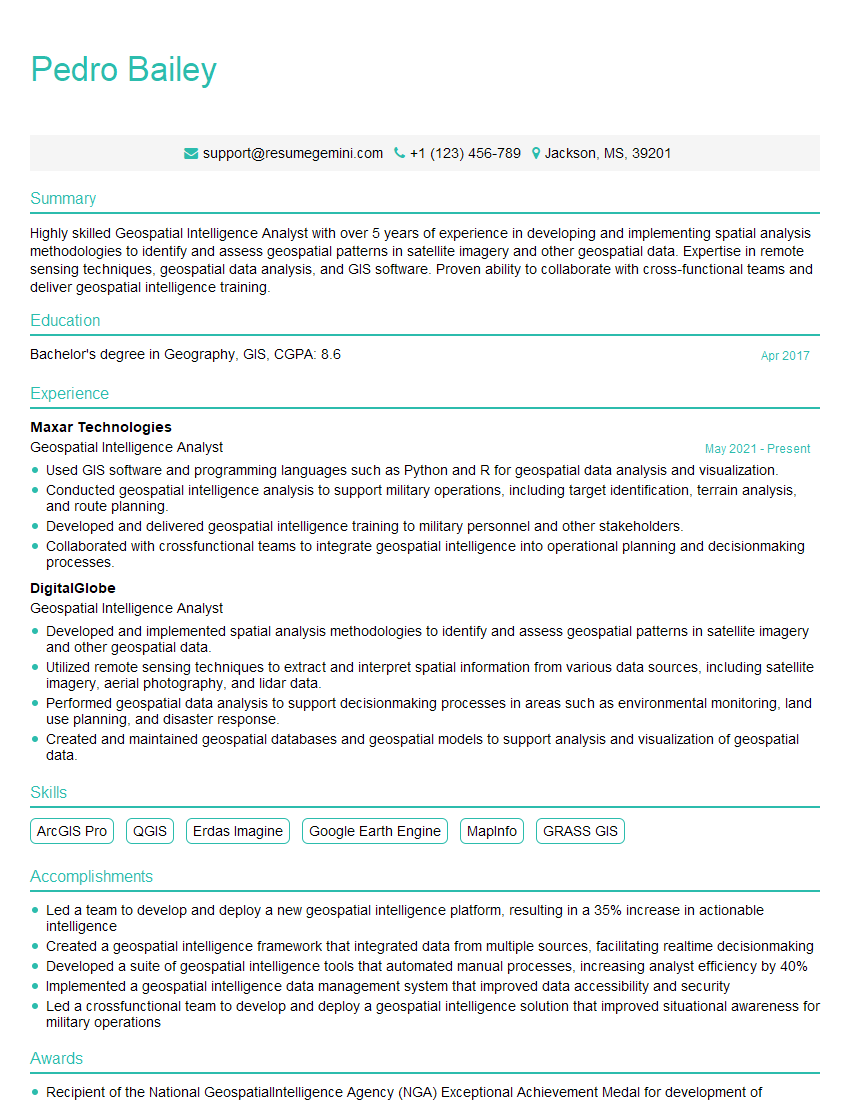
Mastering Electronic Intelligence opens doors to a dynamic and rewarding career, offering opportunities for innovation and significant impact. To maximize your job prospects, crafting a strong, ATS-friendly resume is essential. ResumeGemini can significantly enhance your resume-building experience, helping you create a professional document that showcases your skills and experience effectively. We offer examples of resumes tailored to Electronic Intelligence to help you get started. Invest the time to create a compelling resume – it’s your first impression on potential employers.

Explore more articles
Users Rating of Our Blogs
Share Your Experience
We value your feedback! Please rate our content and share your thoughts (optional).
What Readers Say About Our Blog
Very informative content, great job.
good