Interviews are more than just a Q&A session—they’re a chance to prove your worth. This blog dives into essential ElectroOptical and Infrared Systems interview questions and expert tips to help you align your answers with what hiring managers are looking for. Start preparing to shine!
Questions Asked in ElectroOptical and Infrared Systems Interview
Q 1. Explain the difference between thermal and photonics imaging.
Thermal imaging and photonics imaging are both subsets of electro-optical (EO) systems, but they detect different types of electromagnetic radiation. Thermal imaging, also known as infrared (IR) imaging, detects the infrared radiation emitted by objects due to their temperature. Think of it like feeling the heat radiating from a hot stove – that’s infrared radiation. Photonics imaging, on the other hand, detects reflected or emitted light in the visible and near-infrared spectrum. This is the kind of imaging our eyes perform, and it’s also used in many cameras and sensors. The key difference lies in the source of the detected radiation: thermal imaging detects emitted heat, while photonics imaging primarily detects reflected or emitted light within the visible and near-infrared wavelengths.
Imagine you’re trying to spot a person hiding in the bushes at night. A thermal imager would easily detect the person’s body heat as a bright spot against the cooler background, even in complete darkness. A traditional photonics camera, however, would struggle unless there was some ambient light for the person and the bushes to reflect.
Q 2. Describe the principles of operation of a bolometer.
A bolometer is a type of thermal detector that measures infrared radiation by sensing the change in its own electrical resistance as it absorbs heat. It works on the principle that the electrical resistance of certain materials changes predictably with temperature. When infrared radiation strikes the bolometer’s sensitive element, it absorbs the energy and heats up, causing a change in its resistance. This resistance change is then measured and converted into a signal proportional to the incident infrared radiation. Bolometers are relatively simple and inexpensive to manufacture, which makes them popular in various applications.
Think of it like a very sensitive thermometer. When the thermometer absorbs heat, its temperature (and resistance) rises, allowing you to measure the intensity of the heat source. Different materials are used for the sensitive element depending on the required sensitivity and spectral range. Microbolometers are a modern variation that miniaturizes the sensor for applications in compact thermal cameras.
Q 3. What are the key performance indicators (KPIs) for an infrared camera system?
Key Performance Indicators (KPIs) for an infrared camera system are numerous and depend heavily on the specific application. However, some crucial KPIs include:
- Noise Equivalent Temperature Difference (NETD): This measures the smallest temperature difference the camera can detect. A lower NETD is better, indicating higher sensitivity.
- Spatial Resolution: This refers to the smallest detail the camera can resolve, often expressed in pixels or milliradians (mrad). Higher resolution means more detail.
- Spectral Range: This defines the wavelengths of infrared radiation the camera can detect (e.g., 3-5 µm, 8-12 µm). Different spectral ranges are best for different applications.
- Field of View (FOV): This determines the area the camera can see. A wider FOV covers a larger area, while a narrower FOV provides more detail at closer ranges.
- Frame Rate: The number of images captured per second. Higher frame rates are crucial for tracking fast-moving objects.
- Operating Temperature Range: This describes the temperature range over which the camera can function reliably.
- Minimum Detectable Temperature Difference (MDTD): This is the minimum temperature difference that can be distinguished from the noise, often used for qualitative assessment of signal-to-noise ratio.
The relative importance of these KPIs depends heavily on the specific use case. A surveillance camera might prioritize a wider FOV and higher frame rate, while a scientific instrument might prioritize low NETD and high spatial resolution.
Q 4. Explain the concept of spectral radiance.
Spectral radiance is the radiant flux emitted, reflected, transmitted, or received by a surface, per unit solid angle per unit projected area per unit wavelength (or frequency). It essentially describes how much electromagnetic radiation is emitted or reflected from a surface at a specific wavelength, within a specific direction, and from a specific area. It’s measured in Watts per steradian per square meter per meter (W·sr-1·m-2·m-1).
Imagine a light bulb. Its spectral radiance would vary depending on the wavelength. It emits more strongly in the visible range than in the far infrared. Understanding spectral radiance is critical for designing and calibrating EO/IR systems, particularly for understanding how the target’s spectral signature interacts with the atmospheric transmission and detector sensitivity.
Q 5. Describe different types of optical filters and their applications in EO/IR systems.
Optical filters are crucial components in EO/IR systems, selectively transmitting or blocking specific wavelengths of light. Several types exist:
- Bandpass filters: Transmit a specific range of wavelengths while blocking others. Used to isolate a specific spectral band of interest, for example, isolating the 3-5 µm band in an IR system.
- Longpass filters: Transmit wavelengths longer than a specified cutoff wavelength. Useful for blocking visible light in an IR system.
- Shortpass filters: Transmit wavelengths shorter than a specified cutoff wavelength. Can be used to block unwanted long-wavelength radiation.
- Notch filters: Block a narrow range of wavelengths while transmitting others. Often used to remove unwanted spectral lines or noise.
- Interference filters: Use interference phenomena to achieve high spectral selectivity. Provide very narrow bandpass characteristics.
For instance, a bandpass filter might be used in a thermal camera to isolate the 8-12 µm atmospheric window for better atmospheric transmission. A shortpass filter would be crucial to block sunlight in a night vision system.
Q 6. What are the advantages and disadvantages of different types of IR detectors (e.g., MCT, InSb, microbolometer)?
Several types of infrared detectors exist, each with its own set of advantages and disadvantages:
- Mercury Cadmium Telluride (MCT): Offers high sensitivity and speed, making it suitable for high-performance applications. However, it requires cryogenic cooling, increasing its complexity and cost.
- Indium Antimonide (InSb): Another high-performance detector, particularly sensitive in the shorter-wavelength IR (3-5 µm). It also requires cooling, but sometimes less stringent than MCT.
- Microbolometers: Uncooled detectors based on the bolometer principle, offering lower cost and simpler operation. They have lower sensitivity and slower response times compared to cooled detectors but are very popular due to their ease of use and lower cost.
Choosing the right detector depends on the application requirements. If sensitivity and speed are paramount, a cooled detector like MCT or InSb might be chosen. If cost and simplicity are prioritized, a microbolometer would be a good option. The trade-off is always between performance, cost, and complexity.
Q 7. Explain the concept of atmospheric transmission and its impact on EO/IR system performance.
Atmospheric transmission refers to the fraction of electromagnetic radiation that passes through the atmosphere without being absorbed or scattered. Different wavelengths of light interact differently with atmospheric components like water vapor, carbon dioxide, and aerosols. This causes certain wavelength bands to have higher transmission than others – these are known as atmospheric windows.
The impact on EO/IR system performance is significant. Low atmospheric transmission can severely limit the range and performance of a system. For instance, in the infrared spectrum, the 3-5 µm and 8-12 µm atmospheric windows are commonly exploited due to their relatively high transmission compared to other wavelengths. System designers need to carefully consider the atmospheric conditions (temperature, humidity, pressure) and select appropriate wavelengths and detectors to optimize performance.
Imagine trying to use a flashlight to signal someone at night. If there’s heavy fog (scattering), the light will be significantly attenuated. Similarly, water vapor in the atmosphere can absorb certain IR wavelengths reducing their effectiveness in long-range detection.
Q 8. How do you characterize the performance of an EO/IR system?
Characterizing the performance of an EO/IR system involves assessing several key metrics. Think of it like grading a student; you need to look at different aspects to get a complete picture. We evaluate factors such as:
- Spatial Resolution: This refers to the smallest discernible detail the system can resolve. A higher resolution means sharper images, like the difference between a low-resolution pixelated image and a high-resolution photograph. We often express this in terms of line pairs per millimeter (lp/mm).
- Thermal Sensitivity (for IR): Measures how well the system can detect small temperature differences. A more sensitive system can detect fainter heat signatures, which is crucial for applications like thermal imaging in security or medical diagnostics. This is often expressed in milliKelvin (mK).
- Spectral Response (for both EO and IR): Indicates the range of wavelengths the system can detect. Different wavelengths provide different information; for example, certain wavelengths might be better for penetrating fog or for detecting specific materials. This is often represented graphically as a spectral sensitivity curve.
- Noise Equivalent Temperature Difference (NETD) (for IR): This metric quantifies the system’s ability to distinguish a small temperature difference from background noise. A lower NETD indicates better performance, similar to having a less noisy camera sensor.
- Signal-to-Noise Ratio (SNR): This ratio compares the strength of the desired signal (the image) to the noise level. A higher SNR means a clearer, less noisy image. It’s a crucial indicator of image quality for both EO and IR systems.
- Minimum Resolvable Temperature Difference (MRTD): Measures the smallest temperature difference that can be resolved between two adjacent objects under specific conditions. It’s a more practical measure of thermal resolution than NETD, as it takes into account the observer and the display.
By analyzing these parameters, we can determine the overall performance and suitability of an EO/IR system for a particular application.
Q 9. What are the common noise sources in EO/IR systems?
Noise in EO/IR systems degrades image quality and reduces performance. Think of noise as unwanted interference that obscures the signal. Common noise sources include:
- Detector Noise: This arises from the inherent limitations of the detector itself. It can be caused by thermal fluctuations (Johnson-Nyquist noise), shot noise (due to the discrete nature of photons), or dark current (electrons generated in the detector even without light). For example, a cooled detector greatly reduces thermal noise.
- Readout Noise: This is introduced by the electronics that read out the signal from the detector array. It’s analogous to static in an audio signal.
- Background Noise: This is the radiation from the environment that falls onto the detector. In IR systems, this can be significant, coming from atmospheric emission or reflections.
- Optical Noise: Scratches, imperfections or scattering in the optical components can create noise. This is analogous to dust on a camera lens.
- System Noise: This encompasses noise from various sources within the system, such as vibrations or electromagnetic interference. For example, electrical interference from nearby equipment.
Understanding and mitigating these noise sources is essential for designing high-performance EO/IR systems. Techniques like cooling, signal processing, and careful system design are used to minimize their impact.
Q 10. Describe various image processing techniques used in EO/IR applications.
Image processing is crucial for enhancing the quality and extracting useful information from EO/IR imagery. Think of it as post-production for a film; it enhances the final product. Common techniques include:
- Noise Reduction: Techniques like averaging, median filtering, and wavelet transforms are employed to suppress noise and improve image clarity. These are digital filtering techniques that are analogous to using noise-reduction software on a photograph.
- Image Enhancement: Techniques like histogram equalization, contrast stretching, and sharpening improve the visual appearance of the image, making details more visible. For example, increasing contrast can make a dimly lit scene clearer.
- Target Detection and Recognition: Algorithms are used to automatically detect objects of interest within the image, like people, vehicles, or specific types of thermal signatures. This often involves pattern recognition and machine learning techniques. This is similar to facial recognition software.
- Image Registration: This aligns multiple images taken at different times or from different viewpoints, which is essential for creating 3D models or tracking moving objects. Think of the process of combining multiple satellite images to form a seamless map.
- Image Fusion: Combining EO and IR images to create a composite image that leverages the strengths of both modalities. For instance, combining visible imagery with thermal imagery can yield a more informative image, showcasing both details and heat signatures.
These techniques are implemented using specialized software and hardware, and their effectiveness depends on the specific application and the characteristics of the EO/IR system.
Q 11. Explain the concept of focal plane arrays (FPAs).
A Focal Plane Array (FPA) is a critical component in EO/IR systems. Imagine it as the ‘film’ or ‘sensor’ in a traditional camera, but instead of a single sensor, it has thousands or millions of individual detectors arranged in a grid. Each detector measures the light (or infrared radiation) intensity at a specific location in the scene. This grid of detectors is what captures the two-dimensional image.
FPAs can be:
- Charge-Coupled Devices (CCDs) for EO applications
- Complementary Metal-Oxide-Semiconductor (CMOS) for both EO and IR applications
- Microbolometer for thermal infrared applications
The FPA’s size, pixel pitch (distance between pixels), and the number of pixels determine the image’s resolution and field of view. FPAs are often cooled (especially in IR applications) to reduce noise and increase sensitivity. They are a key element enabling high-performance imaging in modern EO/IR systems.
Q 12. What is Modulation Transfer Function (MTF) and how is it measured?
The Modulation Transfer Function (MTF) is a measure of how well an optical system can transmit different spatial frequencies. Imagine it as a measure of how sharply the system can reproduce details at various levels of fineness. A higher MTF at a specific frequency indicates better resolution at that level of detail. It’s usually expressed as a percentage or a ratio from 0 to 1.
MTF is typically measured using a variety of techniques, including:
- Slit method: A narrow slit is used as the test target, and the image of the slit is analyzed to determine the MTF.
- Square wave method: A square-wave target is used; its blurred image is analyzed to derive the MTF.
- Line pair target: A target consisting of alternating black and white lines of varying spatial frequencies is used. The contrast of the imaged lines is used to determine the MTF at those frequencies.
The MTF is a crucial specification when designing optical systems for EO/IR applications. It allows us to predict the system’s image quality and choose appropriate optical components. For example, a high MTF is crucial for medical imaging where fine detail is necessary.
Q 13. How do you design an optical system for a specific application?
Designing an optical system is an iterative process that involves careful consideration of numerous factors. Think of it as designing a custom-made suit; every detail matters. The design process generally involves:
- Defining Requirements: This includes specifying the system’s field of view, resolution, spectral range, operating conditions, size and weight constraints, and overall cost targets.
- Choosing Optical Components: Based on the requirements, selecting the appropriate lenses, mirrors, filters, and detectors.
- Optical Design Software: Using specialized software (like Zemax or Code V) to model and optimize the optical system. This involves balancing parameters like aberration correction, image quality, and overall system performance.
- Tolerance Analysis: Determining the acceptable variations in component manufacturing and assembly that will still result in acceptable system performance.
- Prototyping and Testing: Building a prototype and testing it under various conditions to verify the design meets the specifications and performance goals.
- Iteration and Refinement: Modifying the design based on test results and refining the system until the performance meets the requirements.
The design process requires expertise in optical engineering, physics, and often, programming skills to use optical design software effectively. The final design must be robust and reliable and meet all operational specifications.
Q 14. What are different types of optical lenses and their characteristics?
Numerous types of optical lenses are available, each with specific properties suited for different applications. Think of them as different tools in a toolbox; each is best suited for a particular job.
- Single Lenses: Simple lenses like bi-convex (converging) or bi-concave (diverging) lenses. While simple, they have significant aberrations.
- Doublet Lenses: Combine two lenses of different materials and curvatures to correct for aberrations, improving image quality compared to single lenses. This is like using multiple layers of paint to create depth in an artwork.
- Achromatic Lenses: Designed to minimize chromatic aberration (color fringing), often using two lenses of different glasses with different refractive indices. Crucial for applications needing high color fidelity.
- Aspheric Lenses: Have non-spherical surfaces, allowing for better aberration correction and improved image quality compared to spherical lenses. They are often used where weight and size constraints exist.
- Diffractive Lenses: Use diffraction gratings to focus light. They offer superior aberration correction and can be more compact than traditional lenses, often used in applications needing a high degree of aberration correction in a compact form.
The choice of lens type depends heavily on the application’s requirements. For instance, a high-resolution camera might use aspheric lenses, while a simple magnifier might use a single convex lens. The material of the lens is also a significant consideration and often determines the lens’ spectral range, transmission, and environmental tolerance.
Q 15. Explain the concept of radiometric calibration.
Radiometric calibration is the process of relating the digital output of an electro-optical (EO) or infrared (IR) sensor to absolute radiance or irradiance values. Essentially, it’s like creating a conversion chart: we figure out how many digital counts correspond to a specific amount of energy received by the sensor. This is crucial because raw sensor data is just a series of numbers; radiometric calibration transforms these numbers into meaningful physical units (e.g., watts per square meter per steradian for radiance), allowing for quantitative analysis of the scene being imaged.
The process often involves using calibrated sources with known radiance or irradiance values. These sources are presented to the sensor, and the resulting digital output is recorded. This data is then used to create a calibration curve or look-up table (LUT) which mathematically translates digital counts into absolute physical units. Without this calibration, you’re only seeing relative differences in brightness, not actual energy levels.
For example, imagine an IR camera looking at a hot engine. Without calibration, you’d see the engine brighter than its surroundings, but you couldn’t quantify how much hotter it is. Radiometric calibration allows you to determine the actual temperature difference.
Career Expert Tips:
- Ace those interviews! Prepare effectively by reviewing the Top 50 Most Common Interview Questions on ResumeGemini.
- Navigate your job search with confidence! Explore a wide range of Career Tips on ResumeGemini. Learn about common challenges and recommendations to overcome them.
- Craft the perfect resume! Master the Art of Resume Writing with ResumeGemini’s guide. Showcase your unique qualifications and achievements effectively.
- Don’t miss out on holiday savings! Build your dream resume with ResumeGemini’s ATS optimized templates.
Q 16. Discuss different types of cooling methods for IR detectors.
IR detectors often require cooling to minimize thermal noise, which interferes with the detection of weak infrared signals. The choice of cooling method depends on the application’s requirements, cost constraints, and size/weight limitations.
- Thermoelectric Cooling (TEC): This is the most common method for moderately sensitive applications. TECs use the Peltier effect to create a temperature difference, cooling the detector down to perhaps -40°C. They are relatively inexpensive, compact, and require no cryogens, but have limitations in the ultimate achievable temperature.
- Mechanical Refrigeration: For more demanding applications requiring lower detector operating temperatures, miniature mechanical refrigerators based on the Stirling or pulse-tube cycle are used. These are more complex and expensive but can achieve temperatures far below those possible with TECs.
- Cryogenic Cooling (Liquid Nitrogen, Liquid Helium): These methods provide the lowest temperatures, enabling the best possible performance in extremely sensitive applications such as astronomy or deep-space observations. However, they are bulky, complex, expensive, and require frequent replenishment of the cryogen.
- Radiation Cooling: For space-based applications, where the background temperature is extremely low, radiation cooling can be employed. This relies on the detector radiating heat into space to achieve cooling.
Q 17. What are the challenges in designing a long-range EO/IR system?
Designing a long-range EO/IR system presents several significant challenges:
- Atmospheric Effects: The atmosphere significantly attenuates and distorts light and infrared radiation. Factors like scattering, absorption, and turbulence degrade image quality and range. Atmospheric modeling and compensation techniques are crucial.
- Target Acquisition and Tracking: At long ranges, targets become very small and faint, making acquisition and tracking challenging. High-resolution sensors, sophisticated image processing algorithms, and potentially active illumination are needed.
- Background Clutter: Clutter from background sources (e.g., trees, buildings, clouds) can mask the target, requiring advanced signal processing to isolate the target from the background.
- System Size, Weight, and Power: Long-range systems often require large optics, sensitive detectors, and powerful signal processing units, leading to increased size, weight, and power consumption, which can pose design challenges.
- Cost: High-performance components and advanced algorithms contribute to the high overall cost of long-range EO/IR systems.
Q 18. How does temperature affect the performance of an infrared camera?
Temperature significantly impacts the performance of an infrared camera. This is because:
- Detector Sensitivity: The responsivity (output signal for a given input radiation) of an IR detector changes with temperature. Usually, sensitivity decreases with increasing temperature.
- Noise: Higher temperatures increase thermal noise within the detector and electronics, reducing the signal-to-noise ratio (SNR) and degrading image quality. This is especially significant in uncooled systems.
- Dark Current: Dark current, the current generated by the detector in the absence of radiation, increases exponentially with temperature. This adds noise to the signal and reduces the camera’s ability to detect faint objects.
- Calibration Shift: Temperature changes can shift the camera’s calibration, leading to inaccurate temperature measurements in radiometric applications.
To mitigate these effects, many IR cameras employ temperature compensation techniques through software algorithms or thermoelectric coolers (TECs) to regulate detector temperature. Proper thermal management is essential for optimal IR camera performance.
Q 19. Explain the concept of signal-to-noise ratio (SNR) in EO/IR systems.
The signal-to-noise ratio (SNR) in EO/IR systems is a measure of the strength of the desired signal relative to the level of background noise. A high SNR indicates a strong signal and low noise, resulting in a clear and accurate image. Conversely, a low SNR means the signal is weak and obscured by noise, leading to poor image quality.
SNR is typically expressed as a ratio (or in decibels):
SNR = Signal Power / Noise Power
In EO/IR systems, the signal is the radiation emanating from the target, while the noise comprises various sources such as thermal noise, shot noise, read noise, and atmospheric noise. Improving SNR can be achieved by improving detector sensitivity, reducing noise sources (e.g., through cooling), using advanced signal processing techniques (such as noise filtering), and employing longer integration times (where possible).
A higher SNR is essential for accurate target detection, recognition, and identification, especially in challenging conditions such as low-light or long-range scenarios.
Q 20. What are the safety considerations when working with lasers?
Lasers, especially high-powered ones, present significant safety hazards if not handled properly. Safety considerations include:
- Eye Safety: Laser radiation can cause severe eye damage, from temporary vision impairment to permanent blindness. Eye protection appropriate for the laser’s wavelength and power level is mandatory.
- Skin Burns: High-power lasers can cause skin burns. Protective clothing may be necessary.
- Fire Hazard: Laser beams can ignite flammable materials. Surroundings should be free of flammable substances.
- Class Designation and Controls: Lasers are classified according to their potential hazard levels (Class 1 to 4). Appropriate safety controls and procedures, including safety interlocks, warning signs, and controlled access areas, should be implemented based on the laser’s class.
- Beam Containment and Reflection: Laser beams should be properly contained and directed to prevent accidental exposure. Reflection from shiny surfaces needs to be considered and mitigated.
- Training and Procedures: Personnel working with lasers should receive adequate training on safe operating procedures and emergency response.
Q 21. Describe different types of optical mounts and their applications.
Optical mounts are crucial for precisely positioning and stabilizing optical components within EO/IR systems. Different types of mounts are used depending on the application’s requirements regarding precision, adjustment range, and environmental conditions.
- Kinematic Mounts: These mounts use three points of contact to define the position and orientation of the optical component. They are highly stable and provide excellent repeatability. They’re commonly used in high-precision applications such as telescopes or laser systems.
- Flexure Mounts: These mounts use flexible elements to support the optical component, minimizing vibration and thermal effects. They are excellent for applications demanding high stability.
- Adjustment Mounts: These mounts provide a mechanism to fine-tune the position and orientation of the optical component. They may include screws or other adjustment mechanisms for precise alignment. These are commonly used during alignment and calibration.
- Vibration-Isolation Mounts: These mounts are designed to minimize the transmission of vibrations from the environment to the optical component, maintaining image stability. They are often used in applications where vibrations are a major concern, like airborne or mobile platforms.
- Compensated Mounts: These mounts actively compensate for thermal expansion or other environmental factors that can affect the alignment of the optical components. They are essential for high-stability applications in varying temperatures.
Q 22. What are the limitations of EO/IR technology?
Electro-Optical (EO) and Infrared (IR) systems, while incredibly powerful, have several limitations. Think of them like a high-powered camera with specific strengths and weaknesses. Firstly, atmospheric effects like fog, rain, and dust significantly reduce visibility. Imagine trying to take a clear picture through a thick fog – the image quality suffers greatly. Similarly, EO/IR systems struggle in these conditions. Secondly, target signature limitations mean that not all objects emit or reflect enough radiation to be detected. A small, dark object might be completely invisible to an IR system, even if it’s close by. Thirdly, range limitations exist due to signal attenuation with distance. The further away the target, the weaker the signal becomes, making detection challenging. Finally, countermeasures like camouflage, decoys, and jamming can hinder EO/IR system performance. These are designed to deliberately confuse or blind the system, akin to someone shining a bright light into your camera lens.
Another key limitation is the spectral sensitivity of the sensors. Different sensors are sensitive to different wavelengths, and objects might be detectable in one band but invisible in another. Finally, the cost and complexity of EO/IR systems can be substantial, including the development, maintenance, and operation of the systems, especially high-end systems with advanced capabilities.
Q 23. How would you troubleshoot a malfunctioning EO/IR system?
Troubleshooting a malfunctioning EO/IR system requires a systematic approach. I would follow these steps: First, I’d start with a visual inspection, checking for obvious physical damage like loose connections, broken components, or signs of overheating. Next, I’d check the power supply and ensure all power sources are functioning correctly and the voltage and current levels are within the system’s specifications. Then, I’d move to functional testing, verifying the performance of individual components such as the sensor, optics, and processing unit. This would likely involve checking for proper signal levels, image quality, and system responsiveness using built-in diagnostic tools or specialized test equipment.
If these initial checks don’t reveal the problem, I’d analyze the system logs and error messages to identify any software or firmware issues. If necessary, I’d use specialized calibration equipment to test the accuracy and stability of the system’s components. For example, a blackbody source would be useful to verify the thermal camera’s calibration and sensitivity. Throughout the process, I’d refer to the system’s technical manuals and documentation, and if needed, engage with the system’s manufacturer for technical support. Remember, safety is paramount – always follow proper safety procedures when working with electrical and optical equipment.
Q 24. Explain the concept of image registration in multi-spectral imaging.
Image registration in multi-spectral imaging is the process of aligning images acquired from different spectral bands (e.g., visible, near-infrared, shortwave infrared) to a common coordinate system. Imagine trying to overlay several maps – each showing different features – onto a single base map. You need to carefully align them to make sure the features match up correctly. Similarly, in multi-spectral imaging, it’s crucial to align the images to accurately interpret the combined information.
This is achieved using various techniques, including feature-based methods (identifying and matching distinctive features across the images) and intensity-based methods (using correlation of pixel intensities). Accurate registration is critical for tasks like target identification, classification, and change detection. For example, in precision agriculture, multispectral images are used to assess the health of crops. Accurate registration allows us to combine information from different bands, providing a more comprehensive understanding of the crop’s condition than any single band alone.
Q 25. Discuss your experience with different EO/IR software packages.
My experience encompasses several popular EO/IR software packages. I’m proficient in ENVI (for image processing, analysis, and visualization of multispectral and hyperspectral data), MATLAB (extensively used for image processing algorithms, modeling and simulation, and data analysis), and IDL (powerful scripting language frequently employed in scientific data analysis and visualization). I’ve also worked with specialized software for processing data from specific sensor platforms. In one project, I used a manufacturer’s proprietary software to analyze data from an airborne hyperspectral imager and developed custom algorithms for anomaly detection. In another project, I used MATLAB to develop image processing pipelines for automated target recognition using data from a thermal imaging system. The choice of software often depends on the project’s specific needs and the type of data being analyzed.
Q 26. Describe your experience with optical alignment and testing techniques.
Optical alignment and testing are fundamental to the performance of any EO/IR system. My experience includes aligning various optical components, including lenses, mirrors, and detectors, using techniques like autocollimation and knife-edge scanning. Autocollimation employs a reflective target to precisely align optical axes, ensuring accurate beam paths. Knife-edge scanning uses a sharp edge to measure the beam profile, helping in adjusting and optimizing focusing and collimation. I’m also experienced in testing the system’s modulation transfer function (MTF), which measures its ability to resolve fine details, and spot diagrams which show the distribution of light in the image plane. This involves using specialized equipment like MTF testing systems and beam profiling cameras. For example, in a recent project involving the assembly of a high-resolution thermal imaging system, I carefully aligned the telescope using autocollimation and verified the MTF using a dedicated testing system, ensuring the system met the specified performance requirements.
Q 27. Explain your understanding of system integration in the context of EO/IR systems.
System integration in EO/IR systems refers to the process of combining different subsystems (sensors, optics, electronics, software) into a fully functional and integrated system. This isn’t just assembling components; it’s about ensuring they work seamlessly together. Think of it like building a complex machine – each part needs to fit perfectly and perform its intended function for the machine to work optimally. In EO/IR, this includes careful consideration of factors like data flow, timing and synchronization, thermal management, and environmental control.
My experience in system integration includes working on both ground-based and airborne EO/IR platforms. One project involved integrating a new thermal camera onto an existing surveillance system, requiring careful consideration of power requirements, data transfer protocols, and the integration of the new sensor’s software into the existing control architecture. I’ve had to deal with challenges like interfacing different communication protocols (e.g., Ethernet, RS-232) and managing the thermal environment to ensure that the system operates reliably under varied conditions. Effective system integration requires meticulous planning, collaboration, and rigorous testing to ensure flawless operation.
Q 28. How do you handle conflicting priorities in an EO/IR project?
Conflicting priorities are common in EO/IR projects, often involving trade-offs between cost, performance, and schedule. My approach is to first clearly define and document all the project requirements and constraints. Next, I’d prioritize them using a structured approach, possibly using a weighted scoring system to determine the relative importance of each requirement. This involves open communication with stakeholders to ensure everyone understands the trade-offs and to reach a consensus on the optimal approach. For instance, if a tight budget conflicts with the desired performance, we might consider using a less expensive sensor with slightly reduced performance but still meets the core project goals.
Furthermore, I frequently use risk management techniques to identify and mitigate potential problems. This includes proactively assessing the risks associated with different choices and developing contingency plans. Regular progress monitoring and adjustments are crucial to ensure the project stays on track even when facing unexpected challenges. Finally, transparent and consistent communication with the project team and stakeholders is vital throughout the process, allowing for quick responses to changing priorities and ensuring the project’s success despite challenges.
Key Topics to Learn for ElectroOptical and Infrared Systems Interview
- Optical Principles: Understanding fundamental concepts like reflection, refraction, diffraction, and polarization is crucial. Consider how these principles apply within EO/IR systems.
- Infrared Physics and Detectors: Familiarize yourself with blackbody radiation, thermal imaging, and various detector technologies (e.g., photoconductive, photovoltaic). Be prepared to discuss their strengths and weaknesses.
- Optical Components and Systems: Gain a solid understanding of lenses, mirrors, prisms, filters, and their role in shaping and manipulating light in EO/IR systems. Explore different system architectures (e.g., afocal, telecentric).
- Image Processing and Analysis: Learn about image formation, noise reduction techniques, and image enhancement algorithms specific to EO/IR imagery. Understanding signal-to-noise ratio is essential.
- Electro-Optical System Design: Develop your ability to analyze system performance, considering factors like sensitivity, resolution, range, and field of view. Be ready to discuss trade-offs in system design.
- Practical Applications: Explore the diverse applications of EO/IR technology, such as surveillance, target acquisition, medical imaging, and industrial inspection. Having examples readily available to discuss your understanding will be beneficial.
- Calibration and Testing: Understand the methods and procedures involved in ensuring the accuracy and reliability of EO/IR systems. This includes understanding various testing parameters and their significance.
- Signal Processing and Data Acquisition: Understand how signals are processed and acquired from EO/IR sensors. Familiarize yourself with relevant algorithms and techniques.
Next Steps
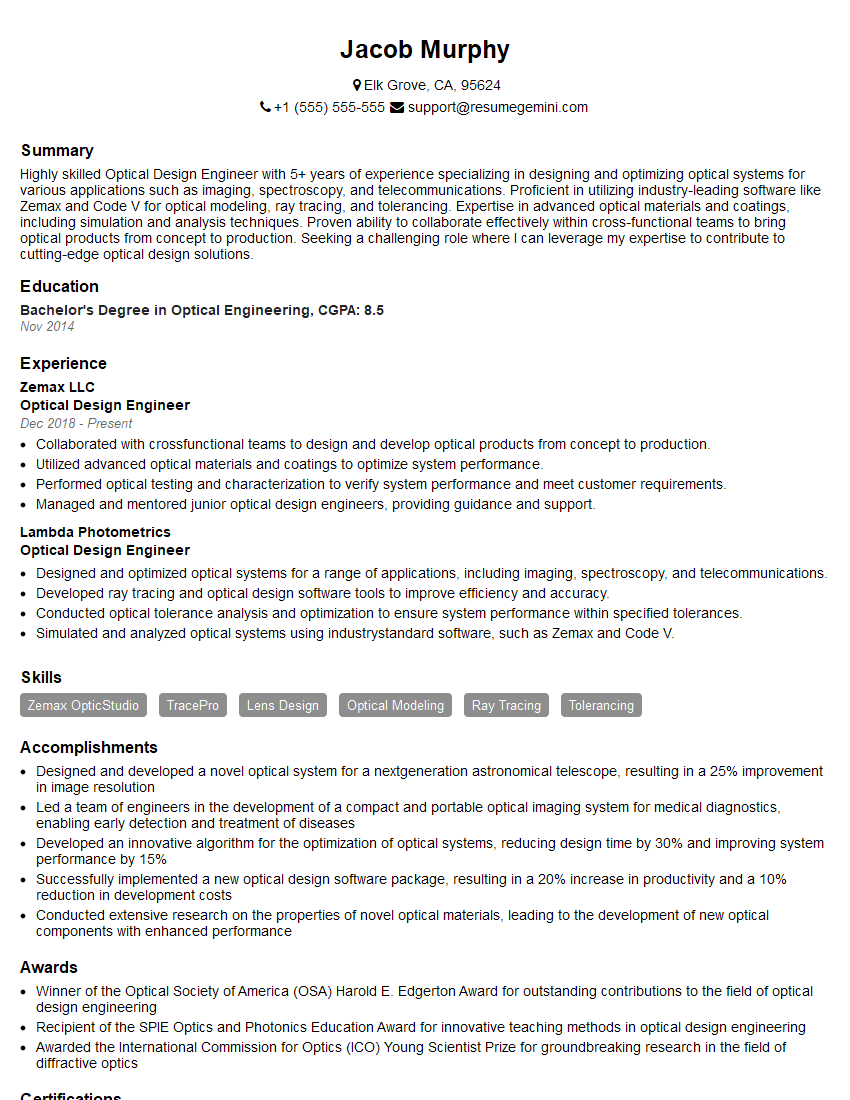
Mastering ElectroOptical and Infrared Systems opens doors to exciting and rewarding careers in various high-tech industries. A strong understanding of these systems is highly sought after, making you a valuable asset to any team. To maximize your job prospects, create a compelling and ATS-friendly resume that highlights your skills and experience. ResumeGemini is a trusted resource that can help you build a professional and impactful resume tailored to the specific requirements of the ElectroOptical and Infrared Systems field. Examples of resumes specifically designed for this area are available to guide you. Invest time in crafting a strong resume – it’s your first impression and a key step in securing your dream job.



Explore more articles
Users Rating of Our Blogs
Share Your Experience
We value your feedback! Please rate our content and share your thoughts (optional).
What Readers Say About Our Blog
Very informative content, great job.
good