Are you ready to stand out in your next interview? Understanding and preparing for Elevator Maintenance Logs interview questions is a game-changer. In this blog, we’ve compiled key questions and expert advice to help you showcase your skills with confidence and precision. Let’s get started on your journey to acing the interview.
Questions Asked in Elevator Maintenance Logs Interview
Q 1. Describe the standard format of an elevator maintenance log.
A standard elevator maintenance log typically follows a structured format to ensure consistency and ease of access. Think of it like a meticulously kept patient chart for your building’s vertical transportation system. While the exact format might vary slightly depending on the company or building management, most logs incorporate key elements like a unique identification number for each entry, date and time of the maintenance activity, and a clear description of the work performed. Many use a tabular format for easy readability and data entry.
A common structure might include columns for: Date, Time, Elevator Unit Number (e.g., Elevator A, B, etc.), Technician Name/ID, Description of Work Performed, Parts Replaced (if any), and Next Scheduled Maintenance. Some logs also include sections for documenting observations, issues detected but not immediately resolved, and signatures or electronic confirmation.
Q 2. What information is crucial to include in each log entry?
Each log entry needs to be detailed and accurate for effective maintenance and troubleshooting. Imagine trying to diagnose a car problem with incomplete repair records – it would be a nightmare! Crucial information includes:
- Date and Time: Precise timestamps are essential for tracking issues and scheduling maintenance.
- Elevator Unit Number: Clearly identifies which elevator was serviced.
- Technician Name/ID: Allows for accountability and tracking of individual performance.
- Detailed Description of Work Performed: Specifics like ‘lubricated guide rails,’ ‘replaced worn cable,’ or ‘calibrated door sensors’ are far more useful than vague entries.
- Parts Replaced (with serial numbers if applicable): Crucial for warranty claims and parts tracking.
- Observations: Note any unusual sounds, vibrations, or other observations even if they don’t require immediate action. These might indicate developing problems.
- Next Scheduled Maintenance: Indicates when the next preventative maintenance is due based on the manufacturer’s recommendations and the specific work performed.
Q 3. How often should elevator maintenance logs be updated?
The frequency of log updates depends heavily on the elevator’s usage, age, and the maintenance contract. However, a general guideline is to update the log after every maintenance activity, whether it’s a routine inspection, a corrective repair, or a scheduled preventative maintenance visit. This includes both major repairs and minor adjustments. Think of it like diligently recording your health vitals; regular updates provide a comprehensive picture of the elevator’s condition.
Many organizations follow a preventative maintenance schedule, often performing monthly or quarterly inspections, with more extensive annual overhauls. Every activity during these schedules should be documented. Detailed logs allow for the identification of trends in repairs, helping predict future needs.
Q 4. What are the consequences of incomplete or inaccurate log entries?
Incomplete or inaccurate log entries can lead to serious consequences, including:
- Safety Hazards: Missed repairs or poorly documented issues might result in equipment failure, causing injuries or even fatalities.
- Increased Downtime: Inaccurate records can hinder efficient troubleshooting, prolonging repairs and causing inconvenience to building occupants.
- Higher Maintenance Costs: Failure to track issues can lead to more extensive and expensive repairs in the future.
- Liability Issues: Poorly maintained logs could be used against building owners or management in case of accidents or legal disputes.
- Compliance Issues: Many jurisdictions have regulations regarding elevator maintenance and record-keeping. Failure to comply can result in fines or other penalties.
In essence, thorough and accurate logging is crucial for both safety and legal compliance.
Q 5. Explain the importance of using a standardized system for maintenance logs.
A standardized system for maintenance logs is vital for efficiency and data analysis. Using a standardized system ensures clarity and consistency across all entries, regardless of which technician performed the work or when the entry was made. This uniformity simplifies data analysis, allowing for easy identification of trends, prediction of future maintenance needs, and improved resource allocation. It’s like using a standardized recipe in a kitchen – the results are always consistent and reliable.
Standardization might involve using a specific software, a pre-printed logbook with defined fields, or a shared digital database accessible to all maintenance personnel. It improves communication and reduces the risk of misinterpretations.
Q 6. How do you ensure all relevant personnel have access to the logs?
Ensuring access to the maintenance logs depends on the chosen system and the organization’s security protocols. For paper-based logs, a designated secure location with controlled access is crucial. Digital systems provide more flexibility. Cloud-based solutions offer secure access control with user permissions, allowing different personnel to view or edit based on their roles. For instance, maintenance technicians might have full editing access, while building managers could have read-only access. A well-defined access control system is essential for data security and compliance.
Using a secure, password-protected system limits access to authorized personnel, safeguarding sensitive information and preventing unauthorized changes.
Q 7. Describe how you would handle a discrepancy in the maintenance log.
Handling a discrepancy in the maintenance log requires a systematic approach. The first step is to identify the nature of the discrepancy. Is it a missing entry, conflicting information, or an apparent error? Once identified, investigate the potential causes. This might involve reviewing other documentation, interviewing relevant personnel, or even inspecting the elevator itself. Document all steps taken during the investigation.
Once the cause is determined, correct the discrepancy by making a note explaining the situation and the actions taken to rectify the error. If significant changes are needed, it’s good practice to add an addendum or a new entry clarifying the situation. Transparency is key. The goal is to establish an accurate record reflecting the elevator’s maintenance history.
Q 8. How do you use elevator maintenance logs for preventative maintenance scheduling?
Preventative maintenance scheduling relies heavily on elevator maintenance logs. We analyze past service records to identify recurring issues, component lifespans, and potential failure points. This data allows us to create a proactive maintenance schedule, rather than reacting to breakdowns. For example, if the logs consistently show a specific type of motor brush wearing out every 6 months in a particular elevator model, we schedule its replacement proactively around the 5-month mark. This minimizes downtime and ensures optimal elevator performance.
The process involves:
- Data Aggregation: Gathering data from all relevant logs for each elevator.
- Trend Analysis: Identifying recurring problems or patterns.
- Predictive Modeling (if applicable): Using software to predict when components are likely to fail.
- Schedule Creation: Developing a customized maintenance schedule based on identified risks and component lifecycles. This schedule incorporates both routine inspections and preventative replacements.
This approach moves maintenance from a reactive to a proactive model, drastically improving reliability and reducing operational costs.
Q 9. How do elevator maintenance logs contribute to regulatory compliance?
Elevator maintenance logs are crucial for regulatory compliance. They provide verifiable proof that mandated inspections, repairs, and safety checks have been performed as required by local and national codes (such as ASME A17.1 in the US). Inspectors often request these logs during audits to verify adherence to regulations. Incomplete or inaccurate logs can result in fines or even operational shutdowns.
The logs serve as a record of:
- Regular Inspections: Documentation of routine checks, showing compliance with the frequency required by codes.
- Repair and Maintenance Activities: Detailed records of repairs performed, including the nature of the problem, parts replaced, and the technician’s certification.
- Safety Checks: Evidence of safety device testing and compliance.
Maintaining meticulous logs is not just about avoiding penalties; it’s about ensuring the safety of building occupants. A comprehensive log demonstrates a commitment to safety and responsible operation.
Q 10. How do you utilize maintenance logs to track parts and repairs?
Maintenance logs are indispensable for tracking parts and repairs. Each entry should clearly document the parts used, their serial numbers (if applicable), and the cost. This data helps manage inventory, analyze repair costs, and identify potential issues with specific parts. For instance, if a particular type of cable is failing frequently, the log data can highlight this trend, leading to investigation of the root cause or a switch to a more reliable supplier.
Effective tracking requires:
- Detailed Part Descriptions: Include manufacturer, model number, and any other relevant identifiers.
- Serial Number Tracking: Useful for warranty claims and tracing the history of components.
- Cost Recording: Accurately tracking labor and parts costs for budgeting and analysis.
- Vendor Information: Recording the supplier for easier reordering and warranty claims.
Imagine a scenario where a specific elevator has experienced multiple failures of a particular hydraulic component. By reviewing the logs, we can quickly determine the frequency of replacements, the cost involved, and potentially identify a pattern that points toward a deeper, unresolved problem like a faulty pressure regulator.
Q 11. Explain your experience with different types of elevator maintenance log software.
My experience encompasses various elevator maintenance log software, from simple spreadsheet programs to sophisticated cloud-based systems. I’ve worked with:
- Spreadsheet Software (e.g., Excel, Google Sheets): While basic, these are useful for smaller operations. However, they lack the advanced features of dedicated software and can be prone to errors with larger datasets.
- Standalone Database Software: These offer more robust data management capabilities than spreadsheets, allowing for better reporting and analysis. However, they might require more technical expertise to set up and maintain.
- Cloud-Based Maintenance Management Systems (CMMS): These are typically the most advanced, offering features like mobile accessibility, automated reporting, real-time data updates, and integration with other building management systems. Examples include UpKeep, Fiix, and many others specialized for elevator maintenance.
The choice of software depends on the size and complexity of the operation, budget, and technical expertise available. Cloud-based systems are generally preferred for larger organizations due to their scalability and advanced features.
Q 12. Describe a time you had to troubleshoot a problem using maintenance logs.
I once encountered an elevator repeatedly experiencing erratic braking. Initial inspections yielded no obvious mechanical problems. By meticulously reviewing the maintenance logs, I discovered a pattern: the incidents correlated with periods of high humidity. While not immediately apparent, the logs revealed past instances of minor electrical issues resolved in damp conditions. This led to a thorough investigation of the electrical components and ultimately revealed a failing capacitor that malfunctioned under humid conditions. Replacing the capacitor solved the problem permanently.
This highlights the importance of not only documenting repairs but also noting environmental factors and any unusual circumstances that might be contributing to recurring issues. The logs provided the crucial clues to solving a complex problem that could have been attributed initially to multiple unrelated causes.
Q 13. How do you ensure the integrity and security of elevator maintenance logs?
Ensuring the integrity and security of elevator maintenance logs is critical. This involves a multi-pronged approach:
- Data Backup and Redundancy: Regular backups to prevent data loss from hardware failure or accidental deletion. Cloud-based systems often have built-in backup and disaster recovery features.
- Access Control: Limiting access to the logs to authorized personnel only, using password protection and user roles. This prevents unauthorized modification or deletion.
- Data Validation: Implementing checks to ensure data accuracy and completeness. This may involve data entry validation rules and regular audits.
- Version Control: Tracking changes made to the logs, showing who made the changes and when. This provides an audit trail and helps resolve discrepancies.
- Encryption (for sensitive data): Encrypting sensitive information like part serial numbers or repair details, particularly if the logs are stored electronically.
A robust system for maintaining the integrity and security of elevator maintenance logs is essential for compliance, liability protection, and efficient troubleshooting.
Q 14. How do you identify trends or patterns in maintenance logs?
Identifying trends and patterns in maintenance logs involves analyzing the data for recurring issues or anomalies. This can be done manually for smaller datasets, or using data analysis software for larger ones. Methods include:
- Frequency Analysis: Determining how often specific repairs or replacements are needed.
- Time-Series Analysis: Plotting repair data over time to identify seasonal trends or patterns.
- Correlation Analysis: Identifying relationships between different factors, such as environmental conditions and equipment failures.
- Data Visualization: Using charts and graphs to visualize data and identify patterns more easily.
For instance, if a graph shows a spike in brake pad replacements during winter months, it suggests a potential correlation with increased usage due to weather conditions. This type of analysis allows for preventative measures and optimization of maintenance schedules.
Q 15. What key performance indicators (KPIs) do you track using maintenance logs?
Key Performance Indicators (KPIs) derived from elevator maintenance logs are crucial for assessing the efficiency and effectiveness of our maintenance program. We track several key metrics, focusing on both preventative and corrective maintenance.
- Mean Time Between Failures (MTBF): This KPI tells us the average time between elevator malfunctions. A high MTBF indicates reliable elevators and effective preventative maintenance. For example, an MTBF of 18 months suggests infrequent breakdowns.
- Mean Time To Repair (MTTR): This measures the average time it takes to restore an elevator to operational status after a failure. A low MTTR reflects efficient repair processes and readily available parts. A target MTTR might be under 4 hours.
- Maintenance Cost per Elevator: This KPI helps us assess the cost-effectiveness of our maintenance strategy. We track this per elevator to identify potential areas for optimization. We regularly compare this metric across different building types and elevator models.
- Number of Service Calls: Tracking the number of service calls per elevator reveals potential issues with specific units or operational patterns. A high number of calls might point to a failing component or the need for more frequent preventative maintenance.
- Percentage of Preventative Maintenance Completed on Schedule: This ensures we’re staying on top of scheduled maintenance and proactively addressing potential problems before they escalate.
By monitoring these KPIs, we can identify trends, pinpoint areas needing improvement, and justify maintenance budget requests.
Career Expert Tips:
- Ace those interviews! Prepare effectively by reviewing the Top 50 Most Common Interview Questions on ResumeGemini.
- Navigate your job search with confidence! Explore a wide range of Career Tips on ResumeGemini. Learn about common challenges and recommendations to overcome them.
- Craft the perfect resume! Master the Art of Resume Writing with ResumeGemini’s guide. Showcase your unique qualifications and achievements effectively.
- Don’t miss out on holiday savings! Build your dream resume with ResumeGemini’s ATS optimized templates.
Q 16. How do you utilize maintenance logs to optimize maintenance schedules?
Maintenance logs are the backbone of our optimized maintenance scheduling. We use historical data from the logs to identify patterns and predict future maintenance needs.
Think of it like this: if an elevator consistently requires specific maintenance after a certain number of operating hours or cycles, we can schedule that preventative work proactively, minimizing the risk of unexpected breakdowns. For instance, if lubrication is needed every 6 months based on past records for a particular model, we schedule it into our system.
We also analyze the types and frequency of repairs. Frequent repairs on a particular component might indicate a systemic issue needing attention beyond typical scheduled maintenance. This might involve a replacement rather than continual repair, as determined by the data in the logs.
Our process uses data analysis to predict maintenance needs, allowing for the proactive scheduling of tasks instead of reacting to failures only. The aim is to shift from reactive to proactive maintenance—reducing downtime and costs.
Q 17. What are the common errors found in poorly maintained elevator maintenance logs?
Poorly maintained elevator maintenance logs are a common source of problems. The most frequent errors include:
- Incomplete or Missing Information: This is the most significant issue. Missing details about the repair, date, technician, or parts used make it nearly impossible to track trends or optimize maintenance.
- Inconsistent Formatting: Lack of a standardized format makes data analysis extremely difficult. If one technician uses abbreviations while another writes complete sentences, compiling accurate information is laborious.
- Lack of Clarity and Detail: Vague descriptions of the problem or solution hinder troubleshooting future similar issues. Instead of stating “Elevator malfunctioned,” a detailed description of the malfunction is essential.
- Illegible Handwriting (in paper logs): This makes it impossible to access the data reliably.
- Failure to Document Preventative Maintenance: This is crucial for tracking MTBF and ensuring compliance. Omitting this data gives a false sense of security.
- Lack of Serial Numbers or Component Identification: This makes it hard to track specific components’ lifespan and to order the right parts for repair.
These errors contribute to inaccurate predictions, inefficient maintenance scheduling, and higher overall costs.
Q 18. How do you reconcile discrepancies between scheduled and actual maintenance?
Reconciling discrepancies between scheduled and actual maintenance requires a thorough investigation. First, we identify the difference between the planned schedule and the actual work performed.
For example, if a scheduled lubrication was missed, we investigate why. Was it a scheduling conflict? Was the technician unavailable? Was there a parts shortage? The maintenance log should document the reason for the deviation. This allows for process improvement and preventing similar issues in the future.
If an unscheduled repair occurred, the log should clearly detail the reason. This might reveal an underlying problem needing additional preventative measures in future schedules. This feedback loop allows for continuous improvement and more accurate predictive maintenance.
We also use reporting tools to analyze these discrepancies regularly. This highlights patterns of missed maintenance or unexpected repairs, allowing for proactive adjustments to our scheduling and resource allocation.
Q 19. Describe your experience using digital vs. paper-based maintenance logs.
My experience encompasses both paper-based and digital elevator maintenance logs, and the transition to digital has been transformative. Paper logs were cumbersome and prone to errors, including illegible handwriting and difficulty in searching information. Data analysis was practically impossible without manually entering data into spreadsheets, which was time-consuming and error-prone.
Digital logs, however, have streamlined the entire process. We use a specialized software system which allows for real-time data entry, automated reporting, and easy searchability. The software generates reports on KPIs and helps us schedule maintenance proactively. We can also easily track parts inventory and technician availability directly within the system. The digital system ensures a much higher level of accuracy and efficiency compared to the manual paper-based system.
The move to digital has also improved communication and collaboration between technicians and management, as everyone can access the same up-to-date information.
Q 20. How do you ensure the logs are easily searchable and auditable?
Ensuring searchability and auditability is paramount in elevator maintenance logs. Our digital system includes robust search functions allowing us to easily retrieve information based on various criteria: date, elevator ID, technician, type of maintenance, or specific component.
For auditability, we implement a version control system, so we maintain a complete history of every entry and modification. This is invaluable for regulatory compliance and internal reviews. The system also automatically records user logins and actions, creating an auditable trail of all maintenance activities.
Even with a digital system, we have established a clear and standardized format for data entry to ensure data consistency and integrity. Every data field is meticulously defined to eliminate ambiguity.
Q 21. Explain how you prioritize maintenance tasks based on information in the logs.
Prioritizing maintenance tasks relies heavily on the information within the logs. We use a risk-based prioritization approach combining several factors from the log data:
- Criticality of the system: Elevators in high-traffic areas or those serving critical functions (hospitals, emergency exits) receive higher priority.
- Severity of the reported issue: A complete elevator shutdown is obviously prioritized over a minor cosmetic issue.
- Frequency and history of similar issues: A recurring problem, even a minor one, might signal an underlying problem and thus receives higher priority to prevent future issues.
- Potential safety risk: Safety hazards receive top priority, regardless of other factors.
- Impact on building operations: Issues causing significant downtime or inconvenience get priority.
We often utilize a scoring system to weigh these factors objectively and ensure a consistent approach to task prioritization. This helps ensure that the most urgent and impactful issues are addressed first, minimizing downtime and maintaining safety.
Q 22. What is your process for escalating critical maintenance issues identified in the logs?
My process for escalating critical maintenance issues begins with immediate action. If a log entry indicates a critical safety concern, such as a malfunctioning emergency brake or a significant structural defect, I immediately notify the building management and the relevant authorities. This notification happens through a clear and concise report detailing the issue, its severity, and potential consequences. This report will reference the specific log entry for traceability and immediate verification.
Next, I follow a pre-defined escalation protocol. This might involve contacting a designated emergency maintenance contractor or directly notifying the elevator manufacturer’s service department, depending on the severity and the specifics of the issue. The protocol ensures that all stakeholders are informed, and the issue is addressed swiftly and appropriately. After the initial notification, I work with the relevant parties to monitor the resolution process and document all actions taken until the issue is completely resolved and the elevator is deemed safe for operation again. Regular follow-up updates to the log are critical for maintaining a complete record of the event. For instance, a recent incident involving a trapped passenger resulted in an immediate call to emergency services, followed by a detailed log entry, a notification to the building manager, and subsequent repairs documented through updated log entries.
Q 23. Describe your experience with different elevator manufacturers and their log requirements.
My experience spans various elevator manufacturers, including Otis, Schindler, and Kone. Each has its own logging system and requirements. Otis, for example, often utilizes proprietary software for their log management, which necessitates specific training and understanding of their interface. Schindler, on the other hand, may favor a more standardized approach, while Kone might lean toward cloud-based solutions. The differences aren’t just in the software; they also extend to the types of data recorded. Some manufacturers emphasize preventative maintenance data, while others prioritize reactive maintenance logs. Regardless of the manufacturer, I ensure consistent adherence to industry best practices, ensuring all relevant data – including date, time, issue description, actions taken, and the technician’s identification – is meticulously documented. I’ve found that understanding each manufacturer’s specific requirements significantly impacts the effectiveness of preventive maintenance and streamlined troubleshooting.
Q 24. How do you use data from maintenance logs to support budget requests?
Maintenance logs are invaluable in justifying budget requests. By analyzing historical data, I can identify recurring issues, predict potential future failures, and demonstrate the need for preventative maintenance or major overhauls. For example, if the logs consistently show frequent occurrences of a specific component failure, I can present this data to support a request for budget allocation to replace that component across all elevators. The analysis could reveal a pattern of failures within a specific age range of elevators, suggesting the need for more frequent inspections or preventative maintenance. This data-driven approach allows for the creation of a comprehensive budget proposal that prioritizes critical maintenance needs and demonstrates a clear return on investment. I also include cost projections for potential failures if maintenance is deferred, making a strong case for proactive spending.
Q 25. How do you ensure that the maintenance log information is accurate and reliable?
Accuracy and reliability in maintenance log information are paramount. I implement several strategies to ensure this. First, I utilize digital logging systems whenever possible, minimizing the risk of human error associated with handwritten records. These systems often incorporate automated data entry features and real-time updates. Second, all entries must follow a standardized format, including detailed descriptions of the problem, actions taken, and parts used. Third, each entry requires the technician’s signature or digital equivalent, promoting accountability. Fourth, regular audits of the logs ensure completeness and consistency. Finally, I conduct periodic cross-checks with other building management systems to ensure data integrity. A recent audit revealed a discrepancy in the reported downtime of one elevator. Through investigation and comparison with security footage, the discrepancy was resolved, demonstrating the importance of these checks in maintaining accuracy.
Q 26. What are the legal and safety implications of improperly maintained elevator maintenance logs?
Improperly maintained elevator maintenance logs have significant legal and safety implications. From a safety perspective, incomplete or inaccurate logs can mask critical issues, leading to potential accidents and injuries. Failure to document necessary maintenance can result in catastrophic failures, putting lives at risk. Legally, inadequate record-keeping can expose building owners and maintenance providers to substantial liability in the event of accidents or malfunctions. Failure to comply with safety regulations and proper documentation can result in hefty fines and legal action. For instance, if an accident occurs and investigations reveal a lack of proper documentation of a previously reported malfunction, the building owners and maintenance company could face serious legal repercussions. Maintaining detailed and accurate logs is not just a best practice, it’s a legal and ethical obligation.
Q 27. Describe your experience with using maintenance logs to track warranty information.
Maintenance logs are crucial for tracking warranty information. I ensure that all warranty-related repairs and maintenance are meticulously documented in the logs. This includes the date of service, the specific parts covered under warranty, and the manufacturer’s authorization for the repair. This detailed record is essential in processing warranty claims efficiently. Clear and precise documentation strengthens our position when making a claim and minimizes any potential disputes with the manufacturer. For example, if a specific component fails within the warranty period, the detailed log entry serves as concrete proof for a timely and successful claim. Maintaining these detailed records simplifies the warranty process and protects the building’s financial interests.
Q 28. How do you integrate elevator maintenance log data with other building management systems?
Integrating elevator maintenance log data with other building management systems (BMS) streamlines operations and improves efficiency. This integration can take various forms, from simple data transfers to complex real-time monitoring systems. In many cases, we utilize APIs to transfer relevant data from our maintenance logging system to the BMS. This allows for a centralized view of all building operations, including elevator status, maintenance history, and potential issues. This integration can facilitate proactive maintenance scheduling, optimized resource allocation, and improved overall building management. For example, real-time data on elevator downtime can automatically trigger alerts to building management, allowing for faster response times and minimizing disruption to building occupants. This level of integration is essential for modern, efficient building management.
Key Topics to Learn for Elevator Maintenance Logs Interview
- Log Structure and Organization: Understanding the different formats of elevator maintenance logs, including digital and paper-based systems, and how to efficiently navigate and interpret them.
- Data Interpretation and Analysis: Analyzing log entries to identify recurring issues, potential malfunctions, and trends in elevator performance. This includes understanding key performance indicators (KPIs) related to elevator maintenance.
- Preventive Maintenance Scheduling: Learning how maintenance logs are used to plan and schedule preventive maintenance tasks, ensuring optimal elevator uptime and minimizing costly breakdowns.
- Troubleshooting and Diagnostics: Utilizing maintenance logs to trace the history of elevator problems and support efficient troubleshooting and repair strategies.
- Regulatory Compliance: Understanding how maintenance logs are essential for demonstrating compliance with industry safety regulations and standards.
- Reporting and Documentation: Knowing how to accurately document maintenance activities, repairs, and parts replacements within the log system, ensuring clear and concise records.
- Safety Procedures and Protocols: How maintenance logs are integral to tracking safety checks, inspections, and adherence to safety procedures for elevator operations.
- Digital Log Systems and Software: Familiarity with various digital log management systems, including their functionalities and data management capabilities.
- Data Entry and Accuracy: Understanding the importance of accurate and timely data entry in maintenance logs and the consequences of errors.
Next Steps
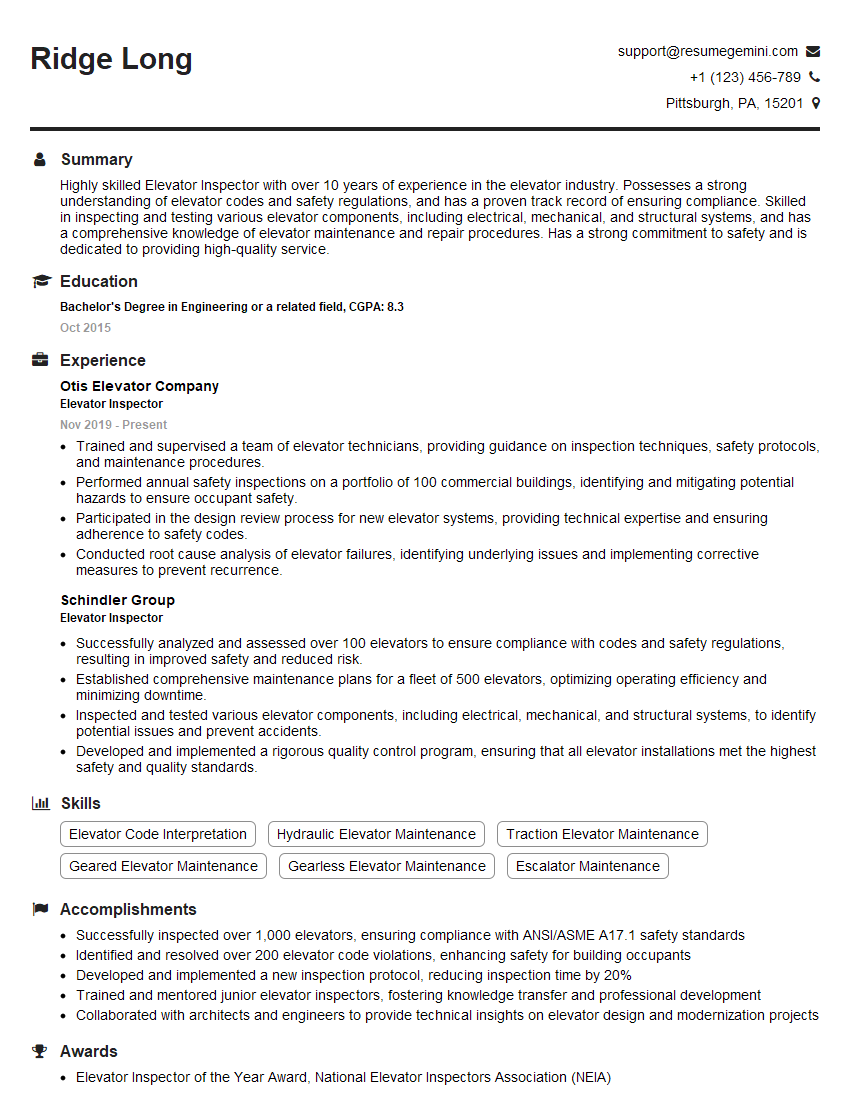
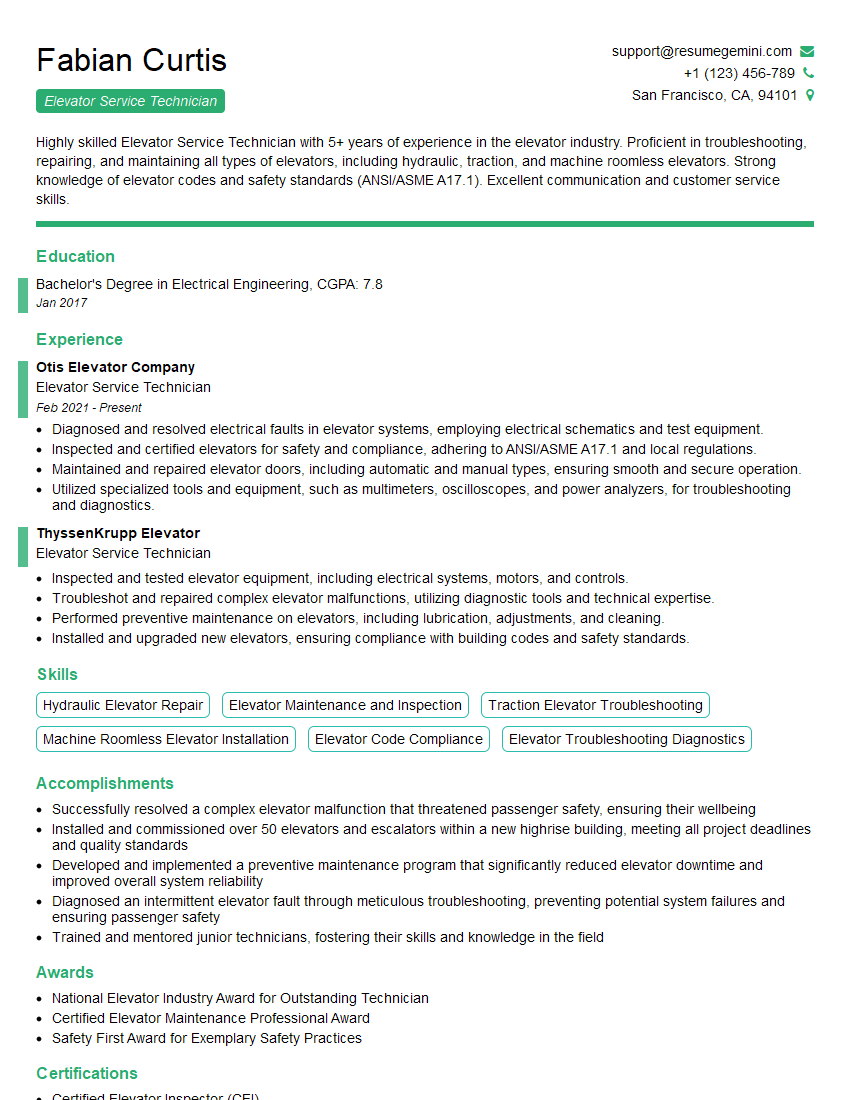
Mastering the intricacies of Elevator Maintenance Logs is crucial for career advancement in the elevator industry. A strong understanding of log management demonstrates technical proficiency and a commitment to safety and efficiency. To increase your job prospects, it’s vital to create an ATS-friendly resume that highlights your skills and experience effectively. ResumeGemini can be a trusted resource to help you build a professional and impactful resume. Examples of resumes tailored to Elevator Maintenance Logs expertise are available within ResumeGemini to guide you.


Explore more articles
Users Rating of Our Blogs
Share Your Experience
We value your feedback! Please rate our content and share your thoughts (optional).
What Readers Say About Our Blog
Very informative content, great job.
good