Are you ready to stand out in your next interview? Understanding and preparing for Elevator Repair Records interview questions is a game-changer. In this blog, we’ve compiled key questions and expert advice to help you showcase your skills with confidence and precision. Let’s get started on your journey to acing the interview.
Questions Asked in Elevator Repair Records Interview
Q 1. Explain the importance of accurate and up-to-date elevator repair records.
Accurate and up-to-date elevator repair records are paramount for ensuring safety, compliance, and efficient maintenance. Think of them as a vital medical chart for your building’s vertical transportation system. They provide a complete history of the elevator’s performance, maintenance activities, and any repairs undertaken. This information is crucial for predicting potential issues, preventing breakdowns, and ensuring the elevator operates safely and reliably. Without accurate records, you risk costly downtime, potential safety hazards, and difficulty in meeting regulatory requirements.
For example, if an elevator experiences repeated malfunctions related to a specific component, analyzing repair records can identify a pattern, prompting proactive maintenance or even a component replacement to prevent future failures. This proactive approach minimizes downtime and enhances the overall safety and lifespan of the elevator.
Q 2. Describe different methods for maintaining elevator repair records (paper, digital, etc.).
Maintaining elevator repair records can be done through various methods, each with its own advantages and disadvantages. Traditionally, paper-based systems were common, using physical logbooks and maintenance folders. However, digital methods are becoming increasingly prevalent.
- Paper-based systems: These involve manually filling out forms, creating physical files, and storing them in a designated location. While simple, they are prone to damage, loss, and difficulty in searching for specific information.
- Digital systems: These utilize software and databases to record and manage elevator repair information electronically. This offers advantages such as ease of access, searchability, data backup, and the ability to generate reports.
- Hybrid systems: A combination of paper and digital systems can provide a practical approach. For example, initial repair documentation might be done on paper, then scanned and stored digitally for easier long-term management.
Q 3. What software or systems are you familiar with for managing elevator repair records?
I’m familiar with several software and systems for managing elevator repair records. These range from simple spreadsheet programs like Microsoft Excel, which can be effective for small operations, to dedicated Computerized Maintenance Management Systems (CMMS). Examples of CMMS software include Fiix, UpKeep, and ManageEngine ServiceDesk Plus. These systems often include features such as work order management, inventory tracking, preventive maintenance scheduling, and reporting capabilities. More specialized elevator-specific software also exists, offering features tailored to the unique requirements of elevator maintenance and repair.
The choice of software depends heavily on the size and complexity of the elevator portfolio being managed. For a single elevator in a small building, a simple spreadsheet might suffice. However, for a large building complex or a company managing multiple elevators, a robust CMMS or specialized elevator management software becomes essential for efficiency and data organization.
Q 4. How do you ensure the confidentiality and security of elevator repair records?
Confidentiality and security of elevator repair records are critical. This is particularly true given that the records often contain sensitive information about the building’s infrastructure and potential vulnerabilities. Security measures depend on the chosen record-keeping method.
- Paper-based systems: Require secure storage in locked cabinets or restricted-access areas. Access should be limited to authorized personnel only.
- Digital systems: Employ strong passwords, access control, data encryption, and regular software updates to safeguard against unauthorized access and cyber threats. Data backups should be routinely performed and stored securely, ideally off-site.
- Compliance with regulations: Adherence to relevant data protection laws and regulations such as GDPR (General Data Protection Regulation) or CCPA (California Consumer Privacy Act), when applicable, is essential.
Regular audits of security practices should be conducted to ensure ongoing protection of sensitive information.
Q 5. How do you handle discrepancies or inconsistencies in elevator repair records?
Discrepancies or inconsistencies in elevator repair records can significantly impact maintenance effectiveness and safety. A systematic approach is crucial to resolve such issues. First, the discrepancy should be identified and documented. Then, a thorough investigation is necessary to determine the cause. This might involve comparing the records with actual maintenance performed, interviewing technicians, and reviewing relevant documentation such as parts orders or invoices.
Once the source of the inconsistency is identified, corrective actions should be implemented. This may involve updating the records to reflect the actual maintenance performed, investigating why the discrepancy occurred, and implementing measures to prevent similar issues in the future. For example, improved record-keeping protocols or additional technician training may be necessary. A well-documented process of resolving discrepancies helps maintain data integrity and enhances the reliability of future maintenance decisions.
Q 6. What are the legal and regulatory requirements for maintaining elevator repair records?
Legal and regulatory requirements for maintaining elevator repair records vary depending on location. However, common requirements include:
- Detailed record-keeping: Maintaining comprehensive records of all inspections, maintenance, and repair activities, including dates, descriptions, parts used, and technicians involved.
- Retention periods: Specific timeframes for retaining these records are often mandated. These retention periods can vary depending on the jurisdiction and the type of record.
- Accessibility: Records must be readily available for inspection by regulatory authorities upon request. This could mean both physical and digital accessibility.
- Specific formats: Some jurisdictions might prescribe specific formats for documenting repairs or inspections.
Failure to comply with these regulations can result in significant penalties, including fines and operational shutdowns. Staying informed about local regulations and best practices is crucial for responsible elevator management.
Q 7. How do you prioritize repairs based on the information in elevator repair records?
Prioritizing repairs using elevator repair records involves analyzing the recorded information to assess the urgency and potential safety risks of each issue. A common approach uses a risk-based prioritization system.
- Safety critical repairs: Issues posing immediate safety hazards, such as malfunctioning emergency brakes or door sensors, are given top priority.
- Operational critical repairs: Problems significantly impacting elevator usability, like frequent stoppages or slow operation, receive high priority.
- Preventive maintenance: Regularly scheduled maintenance tasks based on manufacturer recommendations and historical data prevent future problems and extend the elevator’s lifespan.
- Minor repairs: Issues that don’t affect safety or operational efficiency can be scheduled for less urgent attention.
Using a CMMS or similar system allows for automated prioritization based on predefined rules and risk assessment, ensuring efficient scheduling and resource allocation.
Q 8. Describe your experience with using elevator repair records for preventative maintenance scheduling.
Preventative maintenance scheduling relies heavily on a thorough analysis of past repair records. Think of it like a doctor’s appointment – regular checkups are crucial to catch potential problems before they become major issues. By reviewing repair records, we identify components with a history of failures or those nearing the end of their lifespan. For example, if a specific elevator model consistently experiences issues with its control system after five years, we schedule preventative maintenance – a thorough inspection and potential component replacement – around the four-year mark. This proactive approach minimizes downtime and costly emergency repairs.
- Data Analysis: We analyze historical data to determine the frequency and type of repairs needed for each elevator.
- Component Lifespan: We note the lifespan of various components to predict when replacement or servicing might be necessary.
- Predictive Maintenance: This data informs our predictive maintenance strategies, allowing us to address potential problems *before* they escalate.
Q 9. How do you use elevator repair records to identify recurring issues or trends?
Identifying recurring issues involves a systematic approach to data analysis. We use various techniques to spot trends: Imagine sifting through a pile of puzzle pieces to find repeating patterns. First, we organize the records chronologically and by elevator. Then, we use data visualization tools – spreadsheets, databases, or specialized software – to visually represent the repair data. Looking at charts and graphs helps us quickly identify repeated problems. For instance, if we see a spike in calls related to a specific door sensor on a particular elevator model, we know we’ve got a potential design flaw or maintenance issue to address. This might involve contacting the manufacturer, adjusting our maintenance procedures, or even implementing a preventative replacement schedule for those sensors.
- Data Aggregation: We group similar repair issues to understand recurring problems.
- Data Visualization: Charts and graphs help identify patterns and trends more easily.
- Root Cause Analysis: Once a trend is identified, we conduct a thorough investigation to understand the underlying cause.
Q 10. How do you extract and analyze data from elevator repair records to improve efficiency?
Extracting and analyzing data from elevator repair records is key to optimizing efficiency. We use a combination of manual and automated methods. Manual review involves carefully examining records to pinpoint recurring problems or inefficient repair processes. Automation is where we leverage software or databases to quickly query repair history, identify trends, and generate reports. For instance, we might run a query to identify all repairs on a specific elevator model in the past year, allowing us to spot patterns, assess the cost of repairs, and make informed decisions about preventative measures. This might mean investing in training for technicians, changing parts suppliers, or revising our maintenance schedules.
- Data Mining: We use data mining techniques to uncover hidden relationships within the data.
- Report Generation: Automated reports provide quick summaries of repair history and trends.
- Performance Metrics: We track key performance indicators (KPIs) such as mean time to repair (MTTR) to identify areas for improvement.
Q 11. How do you ensure that all necessary information is included in elevator repair records?
Ensuring comprehensive elevator repair records is crucial for liability and efficient maintenance. Every record needs to include specific details. Imagine a detective’s case file – every detail matters. We use standardized forms that capture: the date and time of the repair, the elevator’s location and identification number, a detailed description of the malfunction, the parts used, the technician’s name and certification, the labor hours, the total cost, and importantly, a clear description of the problem’s resolution and any preventative measures taken. Digital record keeping is increasingly utilized and aids in accurate data capture, analysis, and reporting. Digital systems also offer improved search capabilities allowing quicker access to information.
- Standardized Forms: Use of consistent forms ensures all vital information is collected.
- Digital Record Keeping: Implementing digital systems enhances data accuracy, accessibility, and analysis.
- Regular Audits: Periodically reviewing records to ensure completeness and consistency.
Q 12. How do you handle emergency repairs and their documentation in the records?
Emergency repairs require immediate action and meticulous documentation. Think of it as a fire drill – quick response is key, but accurate record-keeping is crucial afterward. We prioritize immediate resolution of the issue, but simultaneously initiate documentation. This involves clearly stating the nature of the emergency, the time of the initial report, the response time, the actions taken, the parts used, and the overall resolution of the problem. Special attention is paid to ensuring safety and compliance aspects of emergency repair work, and all such actions are meticulously recorded. A detailed report, possibly with photographic evidence, is usually compiled within 24 hours after the repair is completed. These records are crucial for insurance claims, regulatory compliance, and continuous improvement initiatives.
- Immediate Action: Prioritize resolving the emergency first.
- Detailed Documentation: Capture all relevant details immediately after the event.
- Safety Measures: Record all safety precautions undertaken.
Q 13. What is your experience with different types of elevator repair record formats?
My experience spans various elevator repair record formats, from simple paper-based systems to sophisticated computerized maintenance management systems (CMMS). Paper-based systems, while straightforward, can be cumbersome, inefficient, and prone to errors. Spreadsheet-based systems offer an improvement, offering better organization and the capacity for basic analysis. However, CMMS offer the greatest advantages, providing integrated features like work order management, inventory tracking, and comprehensive reporting. Each system has its strengths and weaknesses. The choice depends heavily on factors like the size of the operation, budget, and technological capabilities. A larger company with numerous elevators would likely benefit from a CMMS, while a smaller business might find a spreadsheet approach sufficient. The key is to maintain a consistent and well-organized system, regardless of the format.
- Paper-based: Simplest format but prone to loss and difficult to analyze.
- Spreadsheet-based: Offer better organization and basic analytical capabilities.
- CMMS (Computerized Maintenance Management Systems): Integrated systems offering comprehensive features.
Q 14. How do you ensure compliance with OSHA regulations regarding elevator repair records?
OSHA compliance for elevator repair records is non-negotiable; it’s paramount for worker safety and legal adherence. We ensure compliance through several key practices. First, all records are meticulously maintained, accurately reflecting every repair, inspection, and maintenance activity. Secondly, we strictly adhere to OSHA’s guidelines on record-keeping formats and retention periods. Third, our technicians receive regular training on OSHA regulations pertaining to elevator maintenance and repair, emphasizing safe work practices and proper documentation. Finally, we conduct periodic internal audits to verify our adherence to OSHA standards and identify areas for improvement. Non-compliance can result in hefty fines and even facility closures, making compliance a top priority.
- Meticulous Record Keeping: Maintain accurate and complete records of all elevator maintenance and repair activities.
- OSHA Training: Provide regular training to technicians on relevant OSHA regulations.
- Regular Audits: Conduct periodic internal audits to ensure compliance.
Q 15. Describe your experience with using elevator repair records to track parts inventory.
Tracking parts inventory using elevator repair records is crucial for efficient maintenance and cost control. It involves meticulously recording every part used during a repair, including the part number, quantity, and the date of use. This data is then aggregated to provide an accurate overview of parts consumption. For example, if we consistently see high usage of a specific type of cable, we can anticipate future needs and proactively order replacements, avoiding potential downtime due to stockouts.
I typically use a computerized maintenance management system (CMMS) to manage this. The CMMS allows for automated tracking, generating reports showing the consumption rate of each part. This helps us determine optimal reorder points and quantities, minimizing storage costs while ensuring parts are available when needed. For instance, if a report shows we’ve used 100 units of a specific bearing in the last quarter, I can use this data to estimate future demand and adjust our inventory accordingly.
Career Expert Tips:
- Ace those interviews! Prepare effectively by reviewing the Top 50 Most Common Interview Questions on ResumeGemini.
- Navigate your job search with confidence! Explore a wide range of Career Tips on ResumeGemini. Learn about common challenges and recommendations to overcome them.
- Craft the perfect resume! Master the Art of Resume Writing with ResumeGemini’s guide. Showcase your unique qualifications and achievements effectively.
- Don’t miss out on holiday savings! Build your dream resume with ResumeGemini’s ATS optimized templates.
Q 16. How do you communicate information from elevator repair records to other stakeholders?
Communicating information from elevator repair records involves various stakeholders, including mechanics, management, clients, and potentially regulatory bodies. I utilize a multi-pronged approach. For mechanics, concise daily reports summarizing completed repairs and any outstanding issues are essential. For management, I provide regular reports summarizing costs, identifying recurring problems, and suggesting preventive maintenance strategies. Clients receive updates on repair progress and any planned downtime, ensuring transparency. Finally, regulatory reports, if required, will be meticulously compiled from the records to meet compliance standards.
Effective communication relies heavily on clear, concise reporting. I use a combination of written reports, email updates, and even visual aids like graphs illustrating trends in repair frequency or costs. For example, a graph showing a spike in calls related to a specific elevator component can help to initiate a preventive maintenance plan.
Q 17. What is your process for archiving and retrieving old elevator repair records?
Archiving and retrieving old elevator repair records is vital for long-term analysis, warranty claims, and historical data. We employ a digital archiving system, using a secure cloud-based platform that allows for easy searching and retrieval. Each record includes the date of service, the elevator’s identification number, a detailed description of the repair, parts used, and the technician’s notes. Files are organized by elevator ID and date, allowing for quick retrieval of specific information.
For additional security, we maintain regular backups and adhere to strict data security protocols. We also keep a limited number of physical copies of critical records in a secure, off-site location, as a further precaution against data loss. Retrieving a record is as simple as searching by date, elevator ID, or even keywords within the technician’s notes – the system is designed for quick and efficient access.
Q 18. How do you handle situations where elevator repair records are incomplete or missing?
Incomplete or missing elevator repair records pose a significant challenge. My approach involves a systematic investigation to reconstruct the missing information. This starts with interviewing technicians who may have worked on the elevator in question. We also check for any related documentation, such as purchase orders for parts or communication with clients. If no information can be found, we acknowledge the gap in the records and document this explicitly, noting the limitations this places on any subsequent analysis.
For example, if a repair record is missing the part numbers used, I might try to deduce them based on the description of the repair and the technician’s general work habits. However, I always clearly indicate that this information is inferred and not directly from the original record. The goal is transparency and minimizing inaccuracies.
Q 19. What is your proficiency with data entry and record-keeping software?
I am highly proficient in using various data entry and record-keeping software. My experience includes using CMMS software (Computerized Maintenance Management Systems) such as Fiix, UpKeep, and similar platforms. I’m also comfortable using spreadsheet software (Excel, Google Sheets) to manage and analyze data. I’m proficient in data input, data validation, and report generation, ensuring accuracy and consistency in all my work. I can easily navigate complex software interfaces and learn new programs quickly.
My skills extend beyond simple data entry; I’m adept at creating customized reports and dashboards, visualizing key performance indicators (KPIs) relevant to maintenance costs, repair frequency, and part usage. This helps in effective decision-making regarding maintenance strategies and inventory management.
Q 20. Describe your experience with using elevator repair records for cost analysis and budgeting.
Elevator repair records are essential for cost analysis and budgeting. By analyzing historical repair data, we can identify trends in repair costs, predict future expenses, and develop more effective maintenance strategies. For example, consistently high repair costs for a specific component might indicate a need for preventative maintenance or replacement of the component before it fails.
I use the data to create detailed cost breakdowns for each repair, categorizing expenses into labor, parts, and other associated costs. This information feeds into our annual budget, helping to accurately estimate future maintenance expenses. For example, if the average cost of repairing a particular issue is $500, and we expect 10 such repairs annually, we can budget $5000 for this specific issue. Tracking such data enables proactive budgeting and accurate cost forecasting.
Q 21. How do you train others on proper elevator repair record-keeping procedures?
Training others on proper elevator repair record-keeping procedures involves a combination of hands-on instruction and ongoing support. I start by explaining the importance of accurate and complete record-keeping, emphasizing its role in efficient maintenance, cost control, and legal compliance. I then provide detailed instruction on the specific software we use, including how to correctly input data, generate reports, and manage the digital archive. I emphasize the criticality of using correct part numbers, accurate descriptions, and detailed notes on the work performed.
Practical exercises are an integral part of the training. I guide new technicians through the process of creating sample repair records, providing feedback and answering their questions. Ongoing support is equally important. I encourage technicians to reach out with any questions, providing guidance and clarification as needed. Regular reviews of their work help to identify areas for improvement and maintain a high standard of record-keeping.
Q 22. Explain the importance of using consistent terminology and coding in elevator repair records.
Consistent terminology and coding in elevator repair records are paramount for efficient troubleshooting, data analysis, and regulatory compliance. Think of it like a well-organized toolbox – if every tool is labeled clearly and consistently, you can find what you need quickly and avoid confusion. Inconsistent terminology leads to ambiguity and errors, hindering effective communication between technicians and potentially delaying repairs.
For instance, instead of using vague terms like “motor problem,” we use specific codes like “MTR_BRUSH_WEAR” or “MTR_OVERHEAT.” This standardized approach ensures everyone understands the exact nature of the issue. We also maintain a comprehensive glossary that defines all codes and terms, ensuring everyone is on the same page.
- Improved Communication: Clear, consistent language ensures seamless communication between technicians, supervisors, and other stakeholders.
- Faster Troubleshooting: Standardized codes allow for quick identification of recurring issues and facilitate faster repairs.
- Data Analysis: Consistent data allows for effective trend analysis, helping identify common problems and improve preventative maintenance.
- Regulatory Compliance: Consistent record-keeping meets industry standards and regulatory requirements.
Q 23. How do you ensure that elevator repair records are easily accessible to authorized personnel?
Accessibility to authorized personnel is crucial for efficient operations and safety. We utilize a secure, cloud-based system with role-based access control. This means different users have different levels of permission. For instance, a technician might only have access to records related to their assigned elevators, while supervisors can view all records within their area of responsibility.
This system offers several advantages:
- Centralized Database: All records are stored in a single, easily searchable location.
- Role-Based Access: Access is restricted based on job roles and responsibilities, ensuring data security.
- Version Control: The system tracks all changes made to a record, providing a complete audit trail.
- Mobile Access: Technicians can access the system from their smartphones or tablets in the field.
We also conduct regular training sessions to ensure all personnel understand how to navigate and utilize the system effectively.
Q 24. Describe a time you had to troubleshoot a problem using elevator repair records.
Recently, we experienced intermittent power failures in a high-rise building’s elevator bank. Initial troubleshooting pointed towards a faulty motor controller, but the problem persisted even after replacement. By meticulously reviewing the historical repair records, we noticed a pattern: similar power fluctuations had occurred in the past, always during peak hours, and always affecting the same bank of elevators. This suggested a problem with the building’s main electrical supply, rather than a localized issue with the elevator system.
The repair records revealed previous instances where electricians had been called in to address similar issues. By cross-referencing these entries with building maintenance reports, we were able to identify a failing circuit breaker in the main power distribution panel. Replacing the breaker solved the issue completely. This highlights the critical role detailed records play in effective problem-solving. The information was not just about past repairs but revealed a pattern leading to a quicker resolution.
Q 25. How do you ensure data integrity in elevator repair records?
Data integrity is maintained through a multi-pronged approach. First, we use a structured database system, ensuring all data points are standardized and entered correctly. Second, we employ a system of checks and balances, where repairs are verified by supervisors, and each entry is timestamped to track responsibility. Third, we regularly perform data audits to identify and correct any inconsistencies.
Specific strategies include:
- Data Validation: The system prevents incorrect data entry by using data validation rules.
- Regular Backups: We conduct daily backups to safeguard against data loss.
- Access Control: Only authorized personnel have access to the system.
- Auditing: Regular audits ensure data accuracy and compliance.
Think of it like a financial ledger – meticulous record-keeping ensures accuracy and transparency.
Q 26. Explain the process of transferring elevator repair records when a technician changes assignments.
When a technician changes assignments, we follow a standardized transfer procedure. All relevant records are electronically transferred to the new technician’s account. The system automatically updates the assignment details. This ensures a seamless handover and minimal disruption to service.
The process involves:
- System Notification: The system automatically notifies both the departing and incoming technicians of the assignment transfer.
- Record Transfer: The system automatically transfers all relevant repair records associated with the assigned elevators.
- Review and Confirmation: The incoming technician reviews the records and confirms the transfer.
- Access Control Update: The system updates access control to reflect the change in assignment.
This process ensures continuity of service and eliminates any ambiguity about who is responsible for which elevators.
Q 27. How do you identify and rectify errors in elevator repair records?
Error identification and rectification are proactive measures. Our system highlights inconsistencies and potential errors. For example, if a technician enters a repair code that doesn’t match the reported problem, the system flags it for review. We also conduct regular data audits to identify any discrepancies.
The rectification process involves:
- Error Identification: The system’s automated alerts and data audits identify errors.
- Verification: The reported error is verified by comparing it with other records and physical inspection if necessary.
- Correction: The error is corrected by authorized personnel.
- Documentation: The correction is documented, including the nature of the error, the correction made, and the person who made the correction.
By combining automated checks with regular manual reviews, we maintain high data integrity. It is similar to a proofreading process for a critical document – multiple checks ensure accuracy.
Q 28. What strategies do you employ to improve the accuracy and efficiency of elevator repair record-keeping?
Improving accuracy and efficiency involves a combination of technological enhancements and procedural improvements. We continuously evaluate our system to identify areas for improvement. This includes leveraging technology for automated data entry, using mobile devices for on-site record-keeping, and regularly updating our training programs.
Specific strategies include:
- Mobile Data Entry: Technicians use mobile devices to enter data directly in the field, reducing transcription errors and saving time.
- Automated Data Entry: Integrating sensors and IoT devices can automate data collection, reducing manual input.
- Regular Training: Ongoing training for technicians on proper record-keeping procedures.
- System Upgrades: Regularly upgrading the software to enhance functionality and incorporate new features.
- Performance Metrics: Tracking key performance indicators (KPIs) such as time spent on repairs and accuracy of record-keeping to identify and address areas needing improvement.
A continuous improvement cycle is vital to optimizing both accuracy and efficiency, ensuring our elevator maintenance is not only effective but also efficient.
Key Topics to Learn for Elevator Repair Records Interview
- Elevator Systems: Understanding the mechanical, electrical, and hydraulic components of various elevator types (hydraulic, traction, etc.). This includes knowledge of their functions, interrelationships, and potential failure points.
- Troubleshooting and Diagnostics: Mastering practical skills in identifying malfunctions through systematic analysis, using diagnostic tools, and interpreting error codes. This includes experience with preventative maintenance procedures.
- Safety Regulations and Codes: A thorough understanding of relevant safety standards and regulations governing elevator maintenance and repair, ensuring compliance and prioritizing safety in all operations.
- Repair and Maintenance Procedures: Practical experience in performing routine maintenance, diagnosing faults, and executing repairs on elevator systems, including component replacement and system calibration.
- Blueprint Reading and Schematics: Ability to interpret technical drawings, schematics, and wiring diagrams to understand the elevator system’s layout and component interactions.
- Record Keeping and Documentation: Understanding the importance of accurate and detailed record keeping for maintenance logs, repair reports, and compliance documentation.
- Customer Service and Communication: Demonstrating excellent communication skills to interact effectively with building managers, tenants, and colleagues, addressing concerns and providing clear explanations.
- Problem-Solving and Analytical Skills: The ability to systematically approach complex problems, analyze symptoms, and identify root causes of malfunctions in elevator systems.
Next Steps
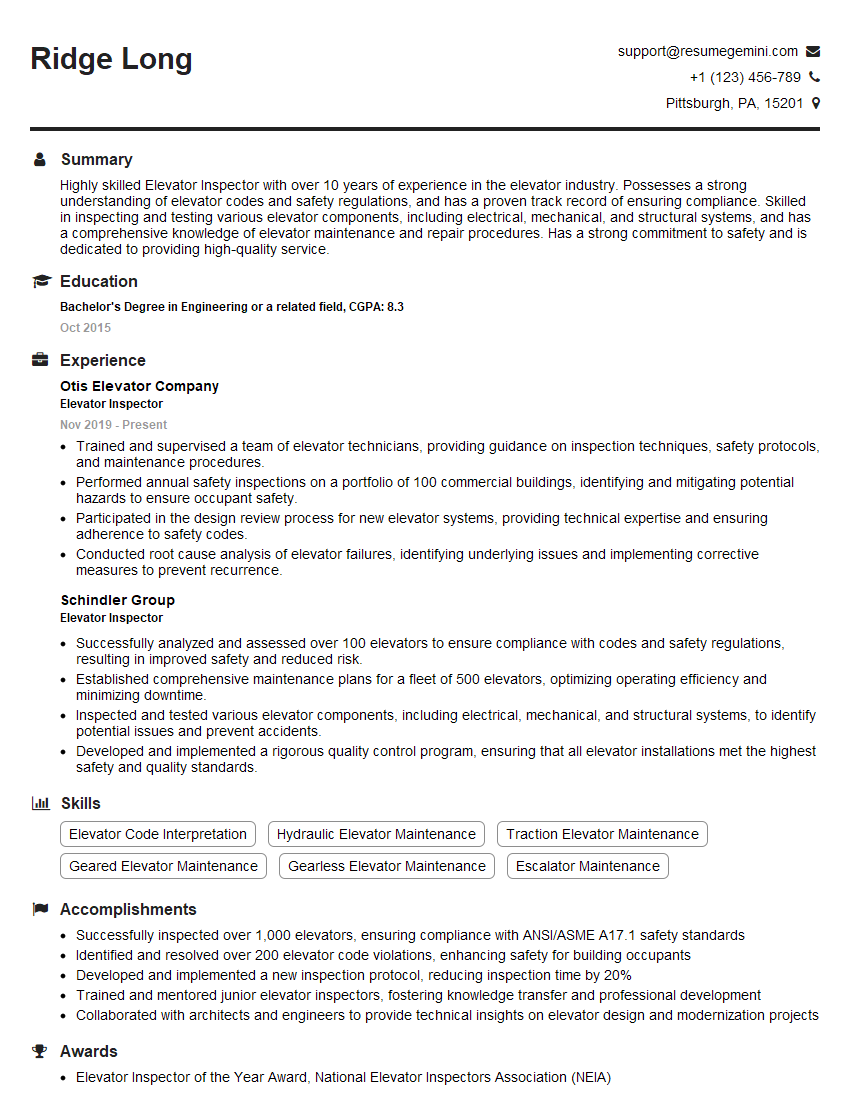
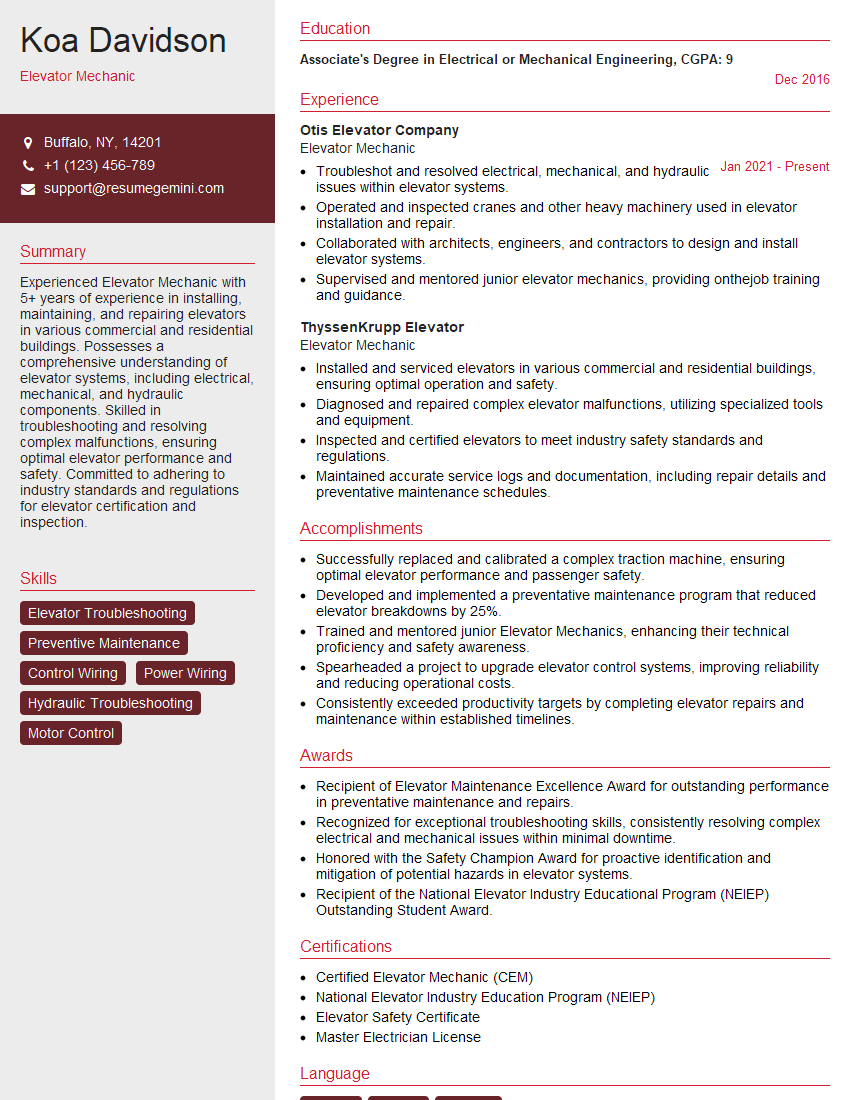
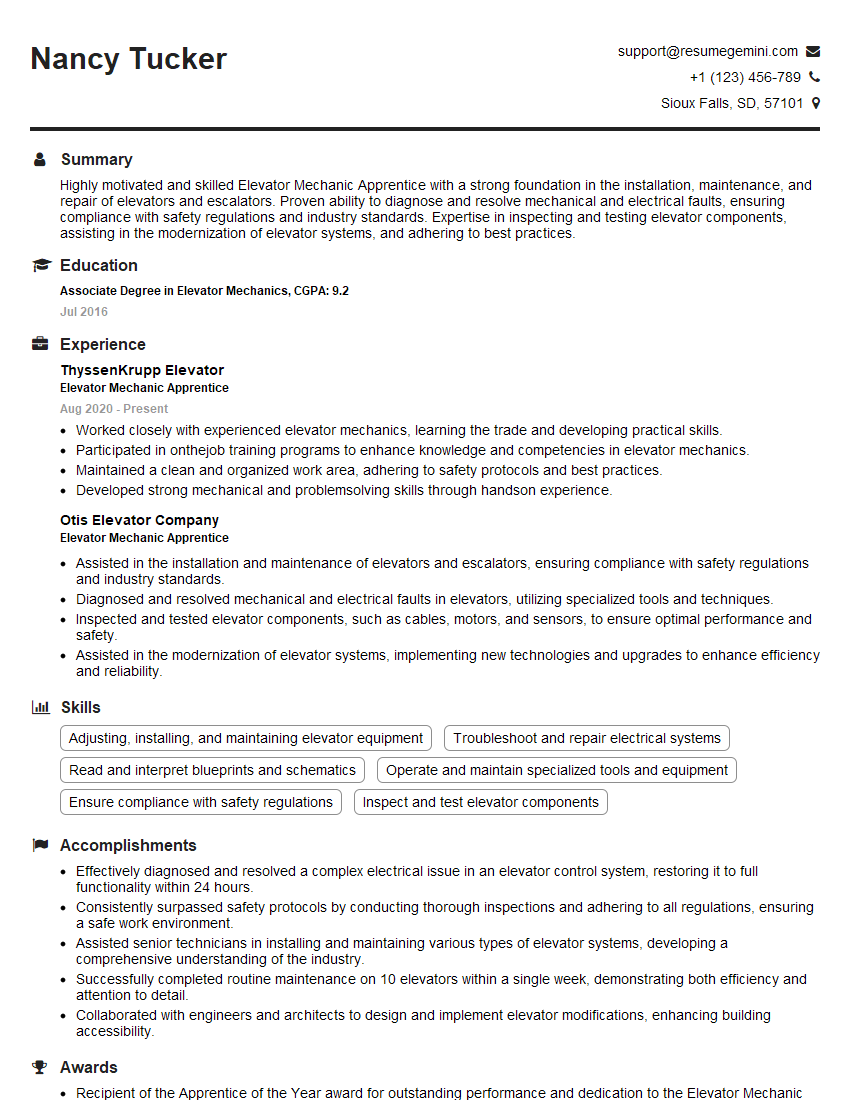
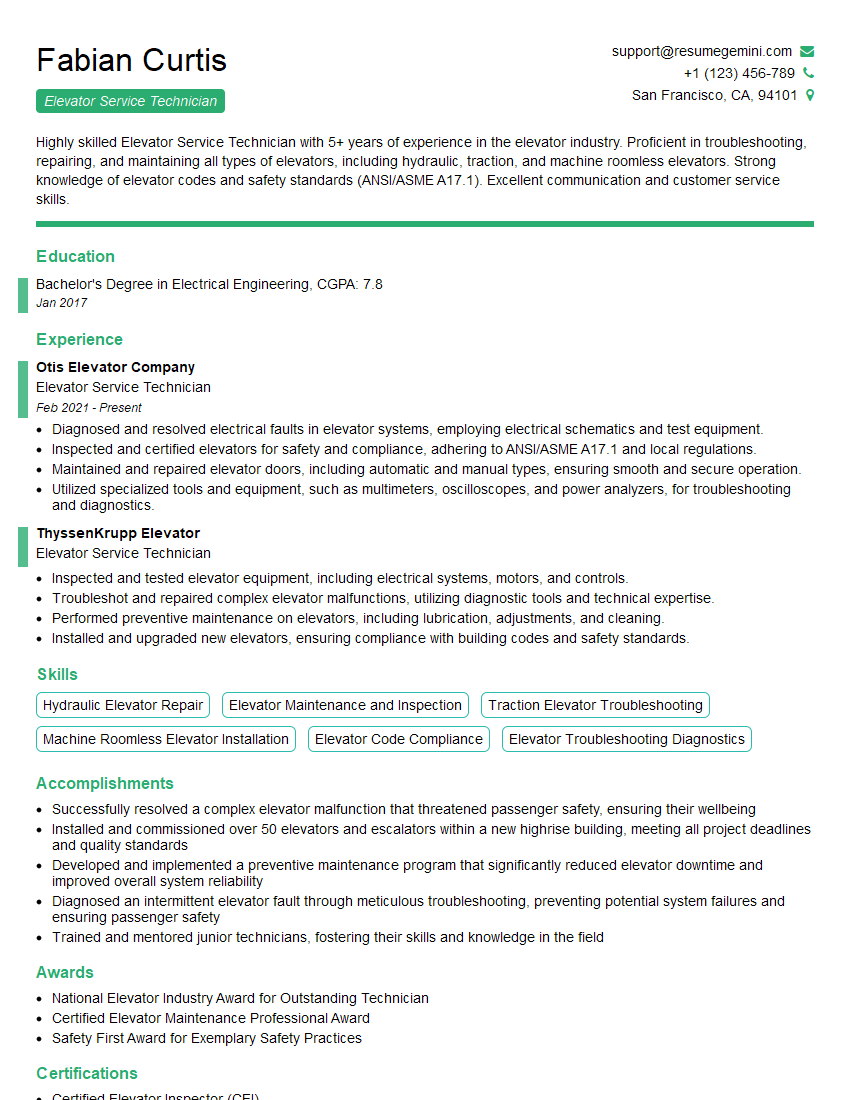
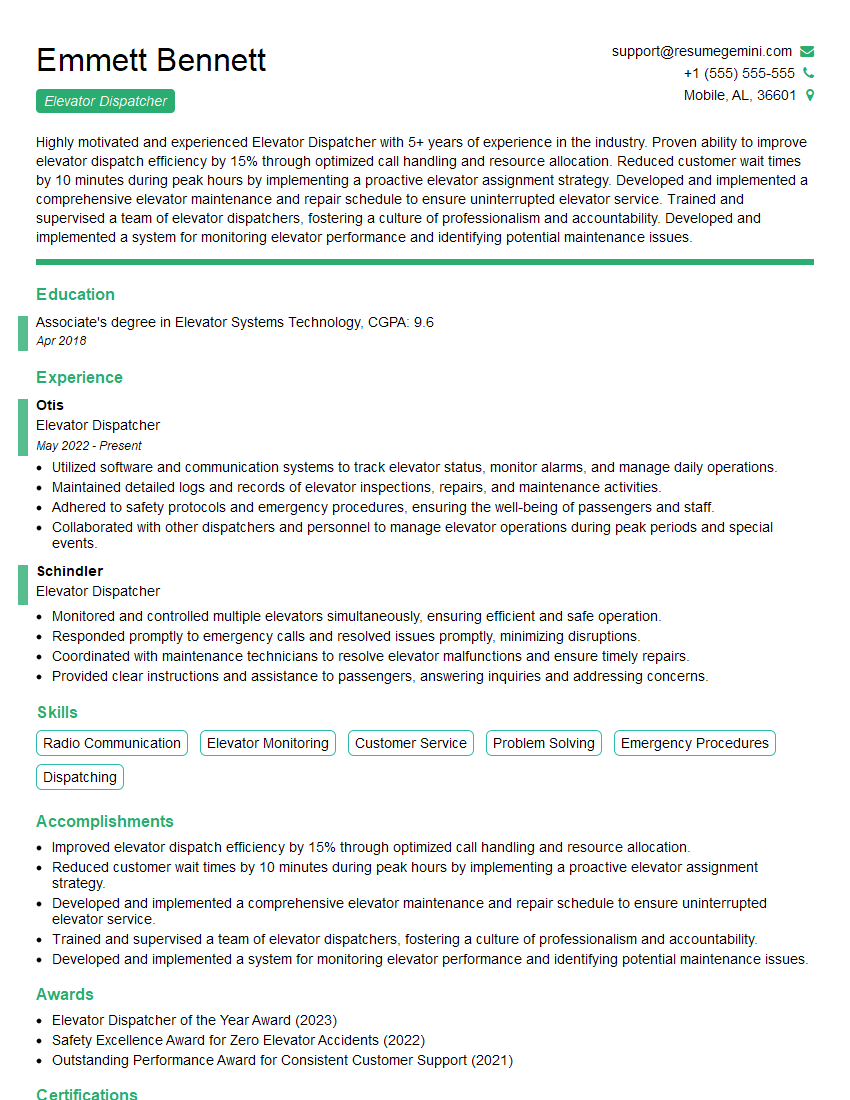
Mastering Elevator Repair Records is crucial for career advancement in a field that’s vital to modern infrastructure. A strong understanding of these concepts significantly improves your job prospects and demonstrates your commitment to safety and efficiency. To maximize your chances, create an ATS-friendly resume that highlights your skills and experience effectively. ResumeGemini is a trusted resource that can help you build a professional and impactful resume, ensuring your application stands out. Examples of resumes tailored to Elevator Repair Records are available to help guide you.

Explore more articles
Users Rating of Our Blogs
Share Your Experience
We value your feedback! Please rate our content and share your thoughts (optional).
What Readers Say About Our Blog
Very informative content, great job.
good