Interviews are opportunities to demonstrate your expertise, and this guide is here to help you shine. Explore the essential Energy management control systems interview questions that employers frequently ask, paired with strategies for crafting responses that set you apart from the competition.
Questions Asked in Energy management control systems Interview
Q 1. Explain the difference between open-loop and closed-loop control systems in energy management.
In energy management, open-loop and closed-loop control systems differ fundamentally in how they respond to changes. Think of it like driving a car. An open-loop system is like setting your cruise control – you input a desired speed, and the car tries to maintain it without continuously checking its actual speed. It doesn’t account for external factors like hills or wind resistance. Similarly, in energy management, an open-loop system might set a heating system to a specific temperature without constantly monitoring if that temperature is actually reached. If the outside temperature drops significantly, the system won’t automatically adjust.
A closed-loop system, on the other hand, is like using your foot on the gas pedal and constantly adjusting based on your speedometer. It involves feedback. The system constantly monitors its output (actual temperature) and compares it to the desired setpoint (target temperature). If there’s a difference, it adjusts its input (heating power) to minimize the error. This ensures the system accurately maintains the desired temperature despite external influences. Closed-loop systems are far more efficient and accurate in energy management, leading to optimized energy use and cost savings.
- Open-loop example: A timer-based system that turns on lights at sunset and off at sunrise regardless of occupancy.
- Closed-loop example: A system that uses occupancy sensors to automatically adjust lighting levels based on the number of people in a room and ambient light levels.
Q 2. Describe your experience with different types of building automation systems (BAS).
I’ve worked extensively with various Building Automation Systems (BAS), including industry-leading platforms like Tridium Niagara, Schneider Electric EcoStruxure, and Siemens Desigo. My experience spans different protocols like BACnet, Modbus, and LonWorks. I’ve been involved in projects ranging from simple HVAC control in small offices to complex integrated systems managing energy consumption across large campuses. For example, in one project, we implemented a Niagara-based BAS to integrate HVAC, lighting, and security systems in a large hospital. This involved configuring the system to optimize energy consumption while ensuring patient comfort and safety. In another project, using Schneider Electric EcoStruxure, we successfully migrated an older BAS to a modern cloud-based platform, resulting in significant improvements in monitoring, control, and remote accessibility. Each system has its strengths and weaknesses, and choosing the right platform depends on the building’s size, complexity, and budget.
Q 3. How do you troubleshoot a malfunctioning energy management control system?
Troubleshooting a malfunctioning energy management control system requires a systematic approach. I typically follow these steps:
- Identify the problem: Pinpoint the specific issue – is it a complete system failure, intermittent malfunction, or inaccurate readings? This usually involves reviewing system logs and alarms.
- Isolate the source: Determine if the issue lies within the sensors, actuators, control hardware (like PLCs), or the software. I often use diagnostic tools provided by the BAS manufacturer to help isolate the problem.
- Verify communication: Check all communication links between different components. Problems can arise from network connectivity issues or faulty communication protocols.
- Check for power issues: Ensure proper power supply to all components. Loose connections or power fluctuations can cause malfunctions.
- Inspect hardware: Visually inspect components like sensors, actuators, and wiring for damage or loose connections.
- Test software: If the problem seems to be software-related, I would check for software bugs, configuration errors, and look for potential updates or patches.
- Use simulation tools: Some BAS allow for simulating scenarios to pinpoint the source of a malfunction without disrupting the real system.
- Document findings: Carefully document all troubleshooting steps and findings to aid future problem-solving and maintenance.
For instance, if a VAV (Variable Air Volume) box isn’t responding correctly, I’d check its power supply, communication with the controller, the damper actuator’s operation, and finally, the control logic within the BAS to make sure the setpoints and control algorithms are correct.
Q 4. What are the key performance indicators (KPIs) you monitor in energy management?
Key Performance Indicators (KPIs) for energy management are crucial for tracking effectiveness and identifying areas for improvement. Some essential KPIs include:
- Energy consumption (kWh): Total energy consumed by the building or system.
- Energy intensity (kWh/m²): Energy consumption per square meter of building space.
- Energy cost ($): Total cost incurred for energy consumption.
- Peak demand (kW): Highest power demand during a specified period, important for demand-based charges.
- Carbon emissions (kg CO₂): Amount of greenhouse gas emissions produced by energy use.
- Return on investment (ROI): Measures the financial benefits of energy efficiency improvements.
- System uptime (%): Measures the reliability and availability of the energy management system.
- Specific energy consumption of equipment (kWh/unit): Tracks energy performance of individual equipment like chillers or HVAC systems.
By regularly monitoring these KPIs, we can identify trends, pinpoint inefficiencies, and justify investments in energy-saving measures.
Q 5. Explain your experience with SCADA systems in energy management applications.
Supervisory Control and Data Acquisition (SCADA) systems are indispensable in energy management, providing centralized monitoring and control of geographically dispersed assets. My experience with SCADA includes using systems like Ignition and Wonderware. I’ve utilized SCADA to monitor and control power generation plants, water treatment facilities, and large industrial complexes. For example, I worked on a project using Ignition SCADA to monitor and control a network of solar farms. The system provided real-time data on power output, environmental conditions (like solar irradiance and temperature), and equipment performance. This allowed for proactive maintenance, optimized energy generation, and enhanced operational efficiency. SCADA systems’ ability to visualize data, generate reports, and provide alerts are essential for effective energy management in large and complex systems.
Q 6. Describe your experience with programming PLCs for energy control systems.
I’m proficient in programming Programmable Logic Controllers (PLCs) for energy control systems, primarily using ladder logic and structured text in platforms like Rockwell Automation (Allen-Bradley) and Siemens TIA Portal. My experience includes developing PLC programs for HVAC control, lighting management, and motor control applications. For instance, I developed a PLC program to optimize the operation of a chiller plant, incorporating logic for load shedding, sequencing, and fault detection. This resulted in improved chiller efficiency and reduced energy consumption. Effective PLC programming requires a strong understanding of control logic, process variables, and safety standards. I always prioritize robust error handling and clear documentation to facilitate troubleshooting and maintenance.
Here’s a simple example of ladder logic for controlling a lighting circuit based on occupancy:
//Input: Occupancy sensor (I:1/0) //Output: Lighting circuit (O:1/0) //Logic: If occupancy sensor is ON, then turn lighting circuit ON. ---[I:1/0]---( )---[O:1/0]---Q 7. How do you ensure the cybersecurity of an energy management control system?
Cybersecurity is paramount in energy management control systems. A breach could lead to significant financial losses, operational disruptions, and even safety hazards. My approach to ensuring cybersecurity involves a multi-layered strategy:
- Network segmentation: Separating the energy management system’s network from other corporate networks to limit the impact of a potential breach.
- Firewall and intrusion detection systems: Implementing robust firewalls and intrusion detection systems to monitor and block unauthorized access attempts.
- Regular software updates and patching: Keeping the system’s software up-to-date with security patches to address known vulnerabilities.
- Strong authentication and access control: Using strong passwords, multi-factor authentication, and role-based access control to restrict access to authorized personnel only.
- Data encryption: Encrypting sensitive data both in transit and at rest to protect it from unauthorized access.
- Regular security audits and penetration testing: Conducting regular security assessments to identify and address vulnerabilities before they can be exploited.
- Employee training: Educating employees about cybersecurity best practices, including phishing awareness and password security.
- Incident response plan: Developing and regularly testing an incident response plan to mitigate the impact of a security breach.
Implementing these measures and regularly reviewing and updating our security protocols are crucial for protecting energy management systems from cyber threats.
Q 8. What are some common energy-saving strategies implemented through control systems?
Energy-saving strategies implemented through control systems aim to reduce energy consumption without compromising operational efficiency. These strategies often involve optimizing equipment operation based on real-time data and predictive models.
Smart Scheduling: This involves adjusting the operation of HVAC systems, lighting, and other equipment based on occupancy schedules and time-of-use energy pricing. For example, a building management system (BMS) could automatically turn off lights in unoccupied rooms or pre-cool/heat a building before occupancy begins.
Optimized Setpoints: Fine-tuning temperature setpoints in HVAC systems, for instance, can significantly impact energy use. Even a small adjustment can lead to considerable savings over time. This often requires careful balancing between occupant comfort and energy efficiency.
Demand-Side Management (DSM): This encompasses various techniques to reduce peak energy demand, such as load shedding during peak hours or utilizing energy storage systems. This can be particularly effective in reducing electricity bills, as charges are often higher during periods of high demand.
Fault Detection and Diagnostics (FDD): Control systems can monitor equipment performance in real-time, identifying and alerting operators to potential issues like equipment malfunctions that lead to energy waste. Early detection allows for timely maintenance and prevents larger problems.
Real-time Data Analysis and Reporting: Continuous monitoring and analysis of energy consumption patterns help identify areas for improvement and track the effectiveness of implemented energy-saving measures. This data-driven approach allows for continuous optimization of energy management strategies.
Q 9. Explain the concept of demand response and its implementation in energy management.
Demand response (DR) is a strategy where energy consumers adjust their energy consumption in response to real-time pricing signals or grid conditions. It’s a crucial tool for managing electricity demand and improving grid stability.
Implementation in energy management often involves:
Price-Based DR: Consumers respond to dynamic pricing signals, reducing their energy use during peak hours when electricity is most expensive. This could involve shifting non-critical loads to off-peak times or utilizing energy storage when prices are low.
Incentive-Based DR: Utility companies offer financial incentives to consumers who reduce their consumption during periods of high demand. This could include payments or rebates for participation.
Time-of-Use (TOU) Pricing: This pricing structure charges different rates for electricity at different times of the day. This encourages consumers to shift their energy consumption to off-peak hours.
Load Control Technologies: Automated systems can remotely control and shed loads (e.g., turning off HVAC systems temporarily) during peak demand periods. This requires advanced communication and control infrastructure.
For example, a data center might participate in a DR program by automatically adjusting server workloads based on real-time pricing information, reducing energy costs while maintaining operational requirements.
Q 10. Describe your experience with energy modeling and simulation software.
I have extensive experience using energy modeling and simulation software, including tools like EnergyPlus, TRNSYS, and IDA ICE. These tools allow for detailed modeling of building energy performance and the impact of various energy-saving measures.
In my previous role, I used EnergyPlus to model the energy consumption of a large commercial building. The model incorporated detailed information about the building’s geometry, HVAC systems, lighting, and occupancy patterns. The simulations allowed us to evaluate different design options and control strategies, ultimately leading to a more energy-efficient design and significant cost savings.
Furthermore, I’m proficient in using these platforms to create virtual test environments for testing and optimizing control algorithms before implementation in real-world systems. This minimizes risk and speeds up the process significantly.
Q 11. How do you handle data from multiple energy sources in a centralized management system?
Handling data from multiple energy sources in a centralized management system requires a robust data acquisition and integration strategy. This typically involves using a system architecture that employs:
Data Acquisition Units (DAUs): These devices collect data from various sources, such as meters for electricity, gas, water, and even renewable energy systems.
Communication Protocols: DAUs typically communicate with the central management system using protocols like Modbus, BACnet, or OPC UA. The choice depends on the specific equipment and communication requirements.
Data Aggregation and Normalization: The central system aggregates the data from different sources, converting it into a consistent format before storage and analysis.
Database Management System (DBMS): A relational database (like SQL) or a NoSQL database is used to store the large volume of energy data from various sources. This database needs to be designed for efficient data retrieval and analysis.
Data Visualization and Reporting Tools: User-friendly dashboards and reporting tools are essential for displaying the aggregated data in an easily understandable format, allowing operators to monitor energy usage, identify patterns, and make informed decisions.
Think of it like a conductor orchestrating an orchestra—each instrument (energy source) plays its part, but the conductor (central system) ensures harmony and synchronizes their performance.
Q 12. What are the different communication protocols used in energy management systems?
Energy management systems employ a variety of communication protocols to connect different devices and systems. The choice of protocol depends on factors such as distance, speed, reliability, and cost.
Modbus: A widely used serial communication protocol, typically for industrial control systems. It’s relatively simple and robust.
BACnet: A standardized protocol specifically designed for building automation systems, enabling interoperability between different vendor’s equipment.
OPC UA (Unified Architecture): A platform-independent protocol that provides a standard way for different devices and systems to exchange data. It’s becoming increasingly popular due to its interoperability and security features.
Ethernet/IP: A common industrial Ethernet protocol, offering high bandwidth and speed.
Wireless Protocols (e.g., Zigbee, Z-Wave, WiFi): Used for connecting remote sensors and actuators, offering flexibility but potentially lower reliability and security.
In a large-scale energy management system, often a combination of these protocols is used to ensure comprehensive connectivity.
Q 13. Explain your experience with integrating renewable energy sources into an existing energy management system.
Integrating renewable energy sources (RES) into an existing energy management system requires careful planning and execution. The process typically involves:
Assessment of Existing Infrastructure: Analyzing the capacity of the current system to handle additional data and power from RES, including assessing the capabilities of the control system, communication network, and electrical infrastructure.
Selection of Appropriate RES Integration Technologies: Choosing suitable inverters, power optimizers, and other equipment for connecting RES (e.g., solar PV, wind turbines) to the grid.
Data Acquisition and Integration: Adding RES data acquisition capabilities to the existing energy management system, potentially by incorporating new sensors and communication protocols.
Control Algorithm Development or Modification: Adjusting or developing control algorithms to optimize the use of both conventional and renewable energy sources. This might involve prioritizing renewable energy usage, managing energy storage, and minimizing grid reliance.
Testing and Commissioning: Thoroughly testing the integrated system to ensure optimal performance, reliability, and safety.
In a project I worked on, we integrated a large-scale solar PV array into a university campus’s energy management system. This required upgrading the system’s communication network, implementing advanced control algorithms to manage energy storage, and modifying the energy monitoring dashboards to include solar energy production data.
Q 14. How do you optimize energy consumption based on occupancy patterns?
Optimizing energy consumption based on occupancy patterns is a key strategy for improving energy efficiency in buildings. This typically involves using occupancy sensors and scheduling algorithms in the energy management system.
The process involves:
Occupancy Sensing: Employing various sensors (PIR sensors, ultrasonic sensors, etc.) to detect the presence or absence of occupants in different zones of a building. These sensors provide real-time occupancy data to the control system.
Space-Based Control: Implementing control logic that automatically adjusts lighting, HVAC, and other equipment based on real-time occupancy data. For example, lights and HVAC systems in unoccupied spaces can be automatically turned off or set to a lower energy consumption mode.
Scheduling Algorithms: Utilizing pre-programmed schedules based on typical occupancy patterns for optimizing energy consumption when occupancy data isn’t available (e.g., outside of regular working hours).
Adaptive Control Strategies: Implementing more sophisticated control algorithms that can learn and adapt to changing occupancy patterns, further improving energy efficiency over time.
For instance, in an office building, occupancy sensors could be used to dim or turn off lights in unoccupied areas, or reduce cooling/heating in empty zones. The system would adjust based on data rather than fixed schedules, leading to substantial energy savings.
Q 15. What are the challenges of implementing an energy management control system in a large building?
Implementing an energy management control system (EMCS) in a large building presents numerous challenges. It’s akin to orchestrating a complex symphony of interconnected systems – heating, ventilation, air conditioning (HVAC), lighting, and more. The complexity arises from several key factors:
System Integration: Integrating various existing systems (often from different vendors with incompatible protocols) into a unified EMCS is a major hurdle. This requires careful planning, specialized expertise, and potentially costly upgrades.
Data Management: Large buildings generate massive amounts of data. Efficiently collecting, processing, and analyzing this data to derive actionable insights requires robust infrastructure and sophisticated software.
Occupancy Patterns: Predicting and responding to fluctuating occupancy patterns is crucial for optimizing energy usage. This necessitates smart sensors and algorithms that can adapt to dynamic conditions.
Cost and ROI: Implementing an EMCS involves significant upfront investment. Justifying this expense requires careful analysis of potential energy savings and a clear demonstration of return on investment (ROI).
Human Factors: Successfully implementing an EMCS often requires retraining building staff to effectively utilize the new system. Resistance to change and lack of user adoption can significantly hamper its effectiveness.
Cybersecurity: EMCSs are increasingly vulnerable to cyberattacks. Protecting sensitive data and ensuring system integrity requires robust cybersecurity measures.
For example, I once worked on a project where integrating legacy HVAC controllers with a new EMCS platform proved exceptionally challenging due to outdated communication protocols. We overcame this by deploying specialized gateways and developing custom integration scripts. This highlights the need for thorough upfront planning and a robust integration strategy.
Career Expert Tips:
- Ace those interviews! Prepare effectively by reviewing the Top 50 Most Common Interview Questions on ResumeGemini.
- Navigate your job search with confidence! Explore a wide range of Career Tips on ResumeGemini. Learn about common challenges and recommendations to overcome them.
- Craft the perfect resume! Master the Art of Resume Writing with ResumeGemini’s guide. Showcase your unique qualifications and achievements effectively.
- Don’t miss out on holiday savings! Build your dream resume with ResumeGemini’s ATS optimized templates.
Q 16. Describe your experience with energy audits and their role in improving control system effectiveness.
Energy audits are the cornerstone of effective EMCS implementation. They provide a comprehensive assessment of a building’s energy consumption patterns, identifying areas for improvement and informing the design of the control system. My experience involves conducting thorough energy audits using a combination of on-site inspections, data analysis from existing utility bills, and advanced metering equipment.
For example, during an audit of a large office building, we identified significant energy waste due to inefficient lighting schedules and inadequate HVAC zoning. This information guided the EMCS design, enabling us to implement occupancy-based lighting controls and optimize HVAC zoning for better efficiency. The post-implementation energy audit revealed a 20% reduction in energy consumption.
The role of energy audits in improving control system effectiveness is multifaceted:
Baseline Data: Audits establish a baseline for energy consumption, providing a benchmark against which to measure the system’s impact.
Problem Identification: They pinpoint specific areas of energy inefficiency that require targeted solutions.
System Optimization: Audit findings inform the design and configuration of the EMCS, ensuring it addresses the building’s specific needs.
Verification and Validation: Post-implementation audits verify the effectiveness of the EMCS and identify any further optimization opportunities.
Q 17. How do you ensure the accuracy and reliability of data collected by energy management systems?
Ensuring data accuracy and reliability is paramount for any EMCS. We employ a multi-pronged approach:
Sensor Calibration and Maintenance: Regular calibration and preventative maintenance of sensors are essential. We establish a rigorous schedule for checking and recalibrating all sensors, ensuring they provide accurate readings.
Data Validation and Quality Control: We implement data validation checks and quality control procedures to identify and correct errors or outliers. This might involve comparing sensor readings with other data sources or using statistical analysis to detect anomalies.
Redundancy and Backup Systems: We employ redundant sensors and data acquisition systems to minimize the impact of sensor failures. This ensures continuous data availability even if one sensor malfunctions.
Data Logging and Archiving: All data is logged and archived securely, enabling thorough analysis and troubleshooting if needed. This also provides a historical record for auditing and reporting purposes.
Data Security: Robust cybersecurity protocols are implemented to protect data from unauthorized access, modification, or deletion.
For example, in one project, we used a combination of temperature sensors and occupancy detectors to monitor HVAC performance. By cross-referencing data from both sources, we were able to detect and correct a faulty temperature sensor that was providing inaccurate readings, thus preventing incorrect control actions and energy waste.
Q 18. What are the different types of sensors used in energy management control systems?
A wide range of sensors are utilized in EMCS, each playing a specific role in monitoring and controlling energy consumption:
Temperature Sensors: These measure air and surface temperatures to optimize HVAC operations. Types include thermocouples, thermistors, and resistance temperature detectors (RTDs).
Humidity Sensors: Monitor humidity levels to regulate HVAC systems and prevent condensation.
Light Sensors: Detect ambient light levels to optimize lighting schedules and reduce energy waste.
Occupancy Sensors: Detect the presence of people in a space to control lighting, HVAC, and other systems based on occupancy. These can be infrared, ultrasonic, or acoustic sensors.
Power Meters: Measure electrical energy consumption at different points in the building. These range from simple kilowatt-hour (kWh) meters to more sophisticated meters that provide detailed power quality data.
Water Flow Meters: Measure water consumption for domestic hot water and other applications.
Air Flow Meters: Measure air flow in HVAC systems to ensure optimal performance and efficiency.
The choice of sensor depends on the specific application and the accuracy and resolution required. For instance, high-precision temperature sensors might be employed in critical areas like data centers, while less precise sensors may suffice for general-purpose lighting control.
Q 19. How do you validate the effectiveness of an energy management control system implementation?
Validating the effectiveness of an EMCS implementation involves comparing pre- and post-implementation energy consumption data. This is often done through a combination of:
Key Performance Indicators (KPIs): We define relevant KPIs such as energy consumption per square foot, peak demand reduction, and operational cost savings. Tracking these KPIs over time provides a clear indication of the system’s impact.
Data Analysis: Detailed analysis of energy consumption data before and after EMCS implementation reveals trends and patterns, highlighting areas of success and areas needing further optimization.
Energy Audits: Post-implementation audits are crucial for verifying the achieved savings and identifying any remaining inefficiencies. These audits often involve a detailed review of the EMCS’s performance and configuration.
User Feedback: Gathering feedback from building occupants and staff can provide valuable insights into the system’s usability and effectiveness.
For instance, in one project, we demonstrated a 15% reduction in energy consumption within the first year post-implementation, exceeding our initial projections. This success was validated through a comprehensive post-implementation audit and positive feedback from the building’s management team.
Q 20. Explain the role of predictive analytics in optimizing energy consumption.
Predictive analytics plays a vital role in optimizing energy consumption by leveraging historical data and machine learning algorithms to anticipate future energy needs. This allows for proactive adjustments to system settings, reducing energy waste and improving efficiency. It’s like having a weather forecaster for your building’s energy usage.
For example, a predictive analytics model might analyze historical weather data, occupancy patterns, and energy consumption to forecast future energy demand. This forecast can then be used to pre-cool or pre-heat the building, optimize HVAC schedules, and shift energy loads to off-peak hours. The model learns and adapts over time, improving its accuracy and effectiveness.
Key benefits of predictive analytics include:
Reduced Energy Waste: By anticipating energy needs, predictive analytics allows for more efficient operation of building systems, reducing energy waste.
Improved Comfort: Predictive models can anticipate occupant needs, ensuring comfortable indoor conditions while optimizing energy use.
Peak Demand Reduction: By shifting energy loads, predictive analytics can reduce peak demand, lowering energy costs and improving grid stability.
Proactive Maintenance: Predictive analytics can identify potential equipment failures before they occur, allowing for preventative maintenance and avoiding costly downtime.
Q 21. Describe your experience with different types of energy meters and their applications.
My experience encompasses various energy meters, each with its unique capabilities and applications:
Simple kWh Meters: These are basic meters that measure total energy consumption in kilowatt-hours (kWh). They are relatively inexpensive but provide limited data.
Advanced Metering Infrastructure (AMI) Meters: These provide more detailed data, including real-time energy consumption, voltage, current, and power factor. They often communicate wirelessly, enabling remote monitoring and control.
Sub-metering Systems: These meters measure energy consumption at individual circuits or zones within a building, enabling granular analysis of energy use and identifying areas for improvement. This is like having a detailed energy budget for each room or area.
Smart Meters: These meters combine the features of AMI meters with advanced capabilities such as time-of-use billing, demand response, and remote disconnection.
The choice of meter depends on factors such as budget, required data resolution, and the overall goals of the energy management strategy. For example, in a large commercial building, a sub-metering system combined with AMI meters would provide detailed data for effective energy management. In a smaller building, simple kWh meters might suffice. I’ve implemented all of these meter types in various projects and tailored the metering strategy to each building’s specific needs.
Q 22. How do you ensure the proper calibration and maintenance of energy management system components?
Proper calibration and maintenance of an Energy Management System (EMS) are crucial for optimal performance and accurate data. Think of it like a finely tuned engine – regular check-ups are essential for peak efficiency. My approach involves a multi-pronged strategy:
- Regular Inspections: Scheduled inspections of all sensors, actuators, and controllers are paramount. This includes verifying proper signal readings (temperature, humidity, power consumption), checking for loose connections, and ensuring the physical integrity of the equipment. For instance, I’d routinely check the accuracy of temperature sensors against calibrated thermometers.
- Calibration Procedures: Each component, such as flow meters or power meters, has specific calibration procedures. These procedures usually involve comparing the readings against known standards, adjusting settings as needed, and documenting the calibration process. We use certified calibration equipment and follow manufacturer’s recommendations.
- Preventive Maintenance: This involves proactive measures to prevent failures. This might include cleaning air filters on HVAC equipment, lubricating moving parts, or replacing worn components before they cause issues. A preventative maintenance schedule tailored to the specific equipment is vital.
- Data Analysis: Regular analysis of the data collected by the EMS is crucial. Inconsistencies or anomalies in the data might indicate a problem with a component that requires attention. This data-driven approach allows for early detection and prevention of more serious problems.
- Documentation: Maintaining meticulous records of all calibrations, maintenance activities, and repairs is essential for compliance and troubleshooting. This documentation acts as a history of the system’s performance and aids in predicting future maintenance needs.
By combining these elements, we ensure the EMS operates at peak performance, provides reliable data, and extends the lifespan of its components.
Q 23. Explain your experience with energy management software and its features.
My experience with energy management software spans several platforms, from building automation systems (BAS) to specialized energy information systems (EIS). I’m proficient in using software that provides real-time monitoring of energy consumption, advanced analytics for identifying energy waste, and automated control strategies to optimize energy use. Key features I regularly utilize include:
- Data Acquisition and Visualization: The ability to gather data from various sources (meters, sensors) and present it in clear, easily understandable dashboards is crucial. I’ve worked with systems that provide historical trend analysis, allowing for the identification of seasonal energy use patterns.
- Energy Modeling and Simulation: Software that can model building energy performance helps predict the impact of various energy efficiency measures. This allows for informed decision-making before implementing costly retrofits. For example, we used software to simulate the impact of installing new HVAC equipment before committing to the investment.
- Automated Control Strategies: Advanced software allows for the implementation of sophisticated control strategies like predictive control or optimization algorithms. This goes beyond simple on/off switching, dynamically adjusting systems based on real-time conditions and occupancy patterns.
- Reporting and Alerting: The ability to generate detailed reports on energy consumption, identify areas for improvement, and receive alerts for equipment malfunctions is essential for proactive management. I use this data to inform clients and make recommendations for energy savings.
- Integration Capabilities: A critical feature is seamless integration with other building systems like lighting control, security, and fire alarm systems. This integrated approach allows for a more holistic and efficient management of the building’s resources.
My experience ensures I can select, implement, and optimize the best software solution for any project’s unique needs.
Q 24. What are the key considerations for selecting an energy management system for a specific building type?
Selecting an EMS for a specific building type requires careful consideration of several factors. The optimal system for a hospital will differ significantly from that of an office building, for example. Key considerations include:
- Building Size and Complexity: A large, complex building will require a more sophisticated EMS than a smaller, simpler one. The number of systems to be monitored and controlled (HVAC, lighting, etc.) directly impacts system complexity.
- Occupancy Patterns: Understanding how the building is used throughout the day and year is vital. An EMS should be able to adapt to different occupancy schedules and optimize energy use accordingly. For example, a school will have drastically different occupancy patterns compared to a 24/7 data center.
- Energy Consumption Profile: Analyzing the building’s historical energy consumption data can reveal its energy-intensive areas and identify opportunities for improvement. This data informs the selection of appropriate sensors and control strategies.
- Budgetary Constraints: The cost of the EMS, including hardware, software, installation, and ongoing maintenance, must be carefully considered. A cost-benefit analysis will help determine the appropriate level of investment.
- Scalability and Future Needs: The system should be scalable to accommodate future expansion or changes in the building’s use. Consider whether it can easily integrate new technologies or accommodate future energy efficiency upgrades.
- Integration with Existing Systems: The EMS should integrate seamlessly with existing building management systems (BMS) to avoid conflicts and ensure a holistic approach to building management. Compatibility with existing infrastructure is crucial to avoid expensive retrofits.
By carefully considering these factors, we can select an EMS that effectively meets the building’s specific needs and maximizes its energy efficiency.
Q 25. Describe your experience with integrating energy management systems with other building management systems.
Integrating EMS with other BMS is a core aspect of my work. It’s not just about connecting systems; it’s about creating a synergistic relationship where they enhance each other’s capabilities. My approach focuses on:
- Open Protocols: Utilizing open communication protocols like BACnet, Modbus, or LonWorks ensures interoperability between different systems from various manufacturers. This prevents vendor lock-in and allows for a more flexible and adaptable system.
- Data Mapping and Sharing: A critical step is establishing a clear mapping of data points between the EMS and other BMS. This ensures that the relevant information is shared and used effectively by both systems. For example, occupancy data from an access control system can be used by the EMS to optimize HVAC schedules.
- Security Considerations: Robust security measures are crucial to protect the integrated system from unauthorized access and cyber threats. This includes implementing firewalls, encryption, and access control protocols.
- Testing and Validation: Thorough testing of the integration is crucial to ensure that the systems work together seamlessly and without conflicts. This includes functional testing, performance testing, and security testing.
- Data Redundancy and Failover Mechanisms: Implementing redundancy and failover mechanisms ensures system stability and resilience in case of failures. This is particularly important for critical systems like HVAC and power distribution.
Successful integration streamlines building operations, improves energy efficiency, and enhances overall building performance. I’ve successfully integrated EMS with fire alarm systems, security systems, and lighting control systems in numerous projects, resulting in significant energy savings and improved building management.
Q 26. How do you address potential conflicts between energy efficiency and occupant comfort?
Balancing energy efficiency and occupant comfort is a constant challenge. It’s a delicate dance, not a zero-sum game. My approach involves:
- Zoning and Personalized Control: Dividing the building into zones allows for customized temperature control based on occupancy and usage. Providing occupants with some control over their local environment, within predefined limits, can significantly improve their satisfaction.
- Smart Sensors and Occupancy Detection: Utilizing sensors to detect occupancy allows for automatic adjustment of lighting and HVAC systems based on actual needs. This prevents energy waste in unoccupied spaces while maintaining comfort in occupied ones.
- Predictive Control Strategies: Advanced algorithms can predict future occupancy and energy demand, enabling proactive adjustments to HVAC systems before occupants even arrive or leave. This anticipates needs rather than reacting to them.
- Feedback Mechanisms: Providing occupants with feedback on their energy consumption (e.g., through displays or mobile apps) can encourage responsible energy use and promote a sense of ownership.
- Data-Driven Optimization: Analyzing the data collected by the EMS allows for fine-tuning of control strategies to achieve the optimal balance between energy efficiency and occupant comfort. This is an iterative process of adjustment and refinement.
It’s about finding that sweet spot where energy is conserved without compromising the well-being of the building’s occupants. The key is utilizing technology to personalize the experience while still promoting responsible energy use.
Q 27. How do you stay up-to-date on the latest advancements in energy management control systems?
Staying current in the rapidly evolving field of energy management requires a multi-faceted approach:
- Professional Organizations: Active participation in organizations like ASHRAE (American Society of Heating, Refrigerating and Air-Conditioning Engineers) provides access to the latest research, industry best practices, and networking opportunities.
- Industry Publications and Journals: Regularly reading industry publications and journals keeps me abreast of the latest technologies, trends, and innovations in the field. This includes both peer-reviewed articles and trade publications.
- Conferences and Workshops: Attending industry conferences and workshops allows for direct engagement with leading experts and provides opportunities to learn about new developments firsthand.
- Online Courses and Webinars: Numerous online resources offer valuable training and continuing education opportunities to enhance my knowledge and skills. I frequently participate in online webinars and courses on emerging technologies.
- Manufacturer Training Programs: Participating in training programs offered by EMS manufacturers provides in-depth knowledge of their specific products and technologies. This allows for efficient implementation and troubleshooting.
Continuous learning is essential in this dynamic field to ensure I remain at the forefront of innovation and provide the best possible solutions for my clients.
Q 28. Describe a challenging energy management project you worked on and how you overcame the obstacles.
One particularly challenging project involved the retrofit of an older hospital building with a new EMS. The building’s aging infrastructure presented significant integration challenges, including outdated protocols, inconsistent sensor data, and limited network bandwidth. The hospital also had strict operational requirements, meaning any downtime or disruption to services was unacceptable.
To overcome these obstacles, we implemented a phased approach:
- Assessment and Planning: We began with a thorough assessment of the existing systems, identifying all components and their communication protocols. This detailed assessment was crucial for planning the integration strategy. We also carefully considered the hospital’s operational constraints.
- Incremental Integration: Instead of a complete system overhaul, we opted for a phased integration, starting with non-critical systems and gradually incorporating more critical ones. This minimized the risk of disruption and allowed for thorough testing at each phase.
- Data Validation and Reconciliation: We discovered significant inconsistencies in sensor data due to the age and condition of the existing sensors. This required extensive data validation and reconciliation to ensure the accuracy of the new system. We calibrated sensors and replaced faulty ones as necessary.
- Advanced Control Strategies: To overcome the limitations of the existing network, we implemented advanced control strategies that minimized the amount of data transmitted. This included using predictive control algorithms to reduce the need for frequent communication.
- Close Collaboration: Maintaining close collaboration with the hospital staff throughout the project was paramount. This ensured that any potential disruptions were minimized, and their concerns were addressed promptly.
Through careful planning, a phased approach, and close collaboration, we successfully completed the project on time and within budget, achieving significant energy savings and improved building management for the hospital. The project highlighted the importance of adaptability, detailed planning, and strong communication in overcoming the challenges of complex EMS retrofits.
Key Topics to Learn for Energy Management Control Systems Interview
- Building Automation Systems (BAS): Understanding the architecture, components (like sensors, controllers, and HMIs), and communication protocols (BACnet, Modbus) used in BAS for energy efficiency.
- Energy Monitoring and Metering: Practical application of data acquisition and analysis techniques to identify energy consumption patterns and pinpoint areas for improvement. This includes experience with various metering technologies and data visualization tools.
- Control Strategies and Algorithms: Explore different control strategies like PID control, predictive control, and model predictive control (MPC) and their application in optimizing energy usage in HVAC systems, lighting, and other building services.
- Energy Efficiency Measures (EEMs): Understanding and applying various EEMs, including HVAC optimization, lighting retrofits, and renewable energy integration, and their impact on overall energy consumption and cost savings.
- Data Analytics and Reporting: Analyzing energy consumption data to identify trends, anomalies, and opportunities for optimization. Creating reports and dashboards to communicate findings to stakeholders.
- Smart Grid Technologies: Familiarity with smart grid concepts, including demand response programs, distributed generation, and microgrids, and their integration with energy management control systems.
- Cybersecurity in Energy Management Systems: Understanding the importance of cybersecurity in protecting energy management systems from cyber threats and vulnerabilities.
- Troubleshooting and Problem Solving: Develop your ability to diagnose and resolve issues in energy management systems, utilizing system diagnostics and analytical skills.
Next Steps
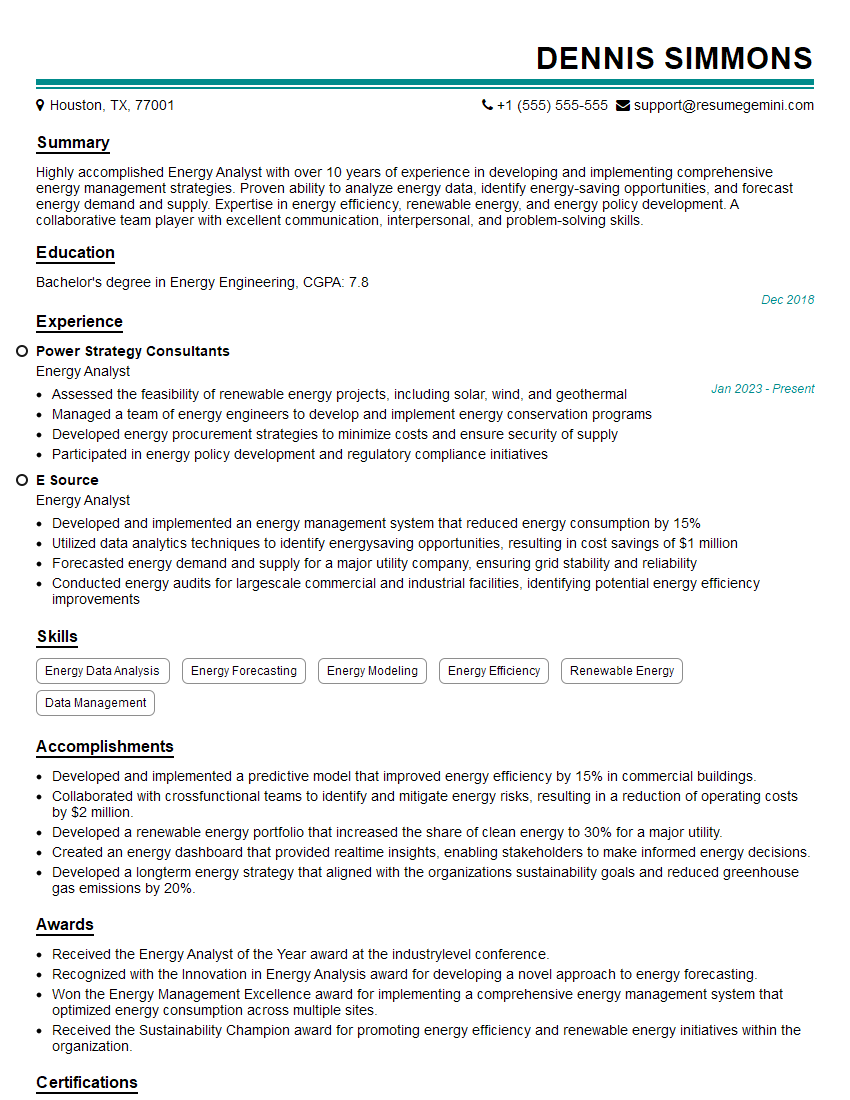
Mastering Energy Management Control Systems opens doors to exciting and impactful careers in a rapidly growing field. Your expertise in optimizing energy efficiency and reducing operational costs is highly valuable to organizations committed to sustainability and cost savings. To make your skills shine, crafting a strong, ATS-friendly resume is crucial for getting your application noticed. ResumeGemini can significantly help you build a compelling resume that highlights your qualifications effectively. We provide examples of resumes tailored to Energy Management Control Systems to guide you in creating a document that showcases your experience and technical abilities. Take the next step towards your dream job – start building your resume with ResumeGemini today!
Explore more articles
Users Rating of Our Blogs
Share Your Experience
We value your feedback! Please rate our content and share your thoughts (optional).
What Readers Say About Our Blog
Very informative content, great job.
good