Feeling uncertain about what to expect in your upcoming interview? We’ve got you covered! This blog highlights the most important Engineering Geophysics interview questions and provides actionable advice to help you stand out as the ideal candidate. Let’s pave the way for your success.
Questions Asked in Engineering Geophysics Interview
Q 1. Explain the difference between reflection and refraction seismic methods.
Both reflection and refraction seismic methods utilize seismic waves generated by controlled sources (like explosions or vibroseis trucks) to image subsurface structures. However, they differ in the type of wave interaction they primarily exploit.
Reflection seismology focuses on the reflected waves that bounce back from subsurface interfaces (boundaries between layers with different acoustic impedance). Think of it like shining a light on a mirror; you see the reflection. Reflection methods are excellent for imaging relatively deep structures and are widely used in oil and gas exploration to locate hydrocarbon reservoirs. The data is processed to create seismic sections showing these reflections.
Refraction seismology, on the other hand, relies on the refracted waves that bend as they pass through different layers of rock. Imagine a straw placed partially in water—the straw appears bent because light bends at the water-air interface. Refraction methods are particularly useful for shallow subsurface investigations, such as determining the depth to bedrock or mapping geological formations. These methods often involve deploying a series of geophones at increasing distances from the source.
In essence, reflection methods look for echoes, while refraction methods analyze the bending of the waves.
Q 2. Describe the principles of electromagnetic surveying.
Electromagnetic (EM) surveying employs the principles of electromagnetism to investigate subsurface properties. It involves transmitting electromagnetic waves into the ground and measuring the response. This response is influenced by the electrical conductivity and permittivity of the subsurface materials.
Different EM methods exist, each using varying frequencies and configurations of transmitting and receiving antennas. For example:
- Ground Penetrating Radar (GPR): Uses high-frequency waves to image shallow features, such as buried pipes, utilities, and archaeological artifacts.
- Magnetotellurics (MT): Employs naturally occurring electromagnetic fields to probe much deeper structures, often used in geothermal exploration and mineral exploration.
- Controlled-Source Electromagnetic (CSEM): Involves transmitting controlled electromagnetic signals, commonly used in offshore hydrocarbon exploration.
The conductivity contrast between subsurface materials (e.g., salty water versus dry rock) causes variations in the received signal. Analyzing these variations allows geophysicists to create images of subsurface conductivity structures.
Q 3. How does gravity surveying work, and what are its limitations?
Gravity surveying measures variations in the Earth’s gravitational field caused by differences in subsurface density. Denser rocks exert a stronger gravitational pull than less dense rocks. A gravity meter measures these minute variations in gravity.
By carefully measuring gravity at numerous locations and correcting for factors like latitude, elevation, and terrain, geophysicists can identify density anomalies. These anomalies can correspond to subsurface geological structures like salt domes (low density), ore bodies (high density), or buried valleys (low density).
Limitations of Gravity Surveying:
- Ambiguity: Gravity anomalies are often ambiguous; multiple subsurface density distributions can produce the same gravity signature. Additional geophysical data is usually needed for unambiguous interpretation.
- Depth of Investigation: Gravity methods are better suited to imaging deeper structures. Shallow, localized density variations might be masked by the overall gravity field.
- Sensitivity to Noise: Gravity measurements are susceptible to noise from various sources, such as terrain variations and nearby moving objects. Careful survey design and data processing are crucial to mitigate these effects.
Q 4. What are the various types of well logs and their applications?
Well logs are measurements taken within a borehole, providing detailed information about the subsurface formations penetrated by the well. Various types of well logs exist, each measuring different physical properties:
- Gamma Ray Log: Measures natural radioactivity, indicating the lithology (rock type) and potential for shale content.
- Resistivity Log: Measures the electrical resistivity of formations, useful for identifying hydrocarbons (which are resistive) and groundwater (which is conductive).
- Sonic Log: Measures the speed of sound waves in the formation, indicating porosity and lithology.
- Density Log: Measures the bulk density of formations, used to estimate porosity and lithology.
- Neutron Log: Measures the hydrogen index, mainly sensitive to porosity and fluid content.
Applications: Well logs are crucial in petroleum engineering, hydrogeology, and geotechnical engineering. They help determine:
- Porosity and permeability of reservoir rocks.
- Hydrocarbon saturation in reservoir rocks.
- Lithology and stratigraphy of formations.
- Location and thickness of aquifers.
- Geotechnical properties of the subsurface for engineering design.
Q 5. Explain the concept of seismic velocity analysis.
Seismic velocity analysis is a crucial step in seismic data processing and interpretation. It involves determining the velocity of seismic waves as they travel through different subsurface layers. This information is essential for accurately imaging subsurface structures.
Several techniques exist for velocity analysis, including:
- Normal Moveout (NMO) velocity analysis: This method involves analyzing the travel times of reflections on a common midpoint (CMP) gather to determine the root-mean-square (RMS) velocity. RMS velocities are then used to create a velocity model.
- Velocity scans: These involve systematically testing different velocity models and assessing their fit to the seismic data. The best-fitting velocity model provides the most accurate image.
- Tomography: This technique uses many seismic rays to reconstruct a 3D velocity model of the subsurface.
Accurate velocity analysis is critical for correcting for the effects of seismic wave travel times and for constructing accurate subsurface images. Incorrect velocities lead to distorted and inaccurate seismic sections.
Q 6. How do you interpret seismic sections?
Interpreting seismic sections requires a multidisciplinary approach, combining geological knowledge with geophysical understanding. Seismic sections are essentially images showing subsurface reflectors, which are boundaries between layers with contrasting acoustic impedance.
The interpretation process involves:
- Identifying key reflectors: Pinpointing major changes in subsurface stratigraphy.
- Mapping faults and folds: Analyzing the geometry of reflectors to identify structural features.
- Correlating seismic events: Tracing reflectors across multiple seismic sections to create a 3D model.
- Integrating well log data: Combining seismic data with well log data to calibrate the interpretation and obtain detailed lithological information.
- Applying geological knowledge: Utilizing regional geology to understand the geological context of the seismic data.
Seismic interpretation software often assists with these tasks, enabling interactive analysis, horizon tracking, and 3D visualization. The goal is to construct a geologically realistic model of the subsurface that explains the observed seismic data.
Q 7. Describe the process of processing seismic data.
Seismic data processing is a complex procedure aimed at enhancing the quality and interpretability of seismic data. It involves several steps:
- Geometry Correction: Correcting for the geometry of the acquisition, accounting for the locations of sources and receivers.
- Demultiplexing: Separating individual traces from the multiplexed seismic data.
- Amplitude and Phase Correction: Compensating for variations in seismic wave amplitudes and phases caused by various factors.
- Noise Reduction: Removing unwanted noise from the data through techniques like filtering and stacking.
- Deconvolution: Removing the effects of the source wavelet to improve the resolution of the data.
- Migration: Correcting for the effects of wave propagation and placing reflectors in their correct spatial positions.
- Stacking: Combining multiple traces to improve the signal-to-noise ratio.
These processing steps improve the signal quality and remove artifacts, resulting in higher-resolution seismic images. Advanced processing techniques may also involve velocity analysis, pre-stack depth migration, and other specialized algorithms.
The choice of processing steps depends on the specific acquisition parameters, geological setting, and the objectives of the seismic survey.
Q 8. What are common noise sources in geophysical data, and how are they mitigated?
Noise in geophysical data is any unwanted signal that obscures the information we’re trying to extract about the subsurface. Think of it like static on a radio – it interferes with the clear signal. These noise sources can be cultural, environmental, or instrumental.
- Cultural Noise: This includes man-made sources like traffic, power lines, and industrial activities. Their effects can be significant, especially in urban environments. Imagine trying to hear a faint whisper amidst a busy city street – that’s the challenge.
- Environmental Noise: Natural sources such as wind, rain, and temperature variations can impact data quality. For example, changes in the ground’s temperature can affect the conductivity of the earth, leading to noisy resistivity measurements.
- Instrumental Noise: This stems from imperfections in the instruments themselves, including electronic noise in the receivers and electromagnetic interference.
Mitigation strategies depend on the noise source. For cultural noise, we can strategically plan our surveys to avoid busy times or locations, or employ noise-reducing techniques during data processing. Environmental noise can be reduced through careful site selection and data acquisition techniques like stacking or averaging multiple measurements. Instrumental noise is often addressed through instrument calibration and proper grounding techniques.
Q 9. Explain the concept of resistivity imaging.
Resistivity imaging is a geophysical method that uses the electrical resistivity of the subsurface to create images of its structure. Resistivity is simply a measure of how well a material resists the flow of electric current. Different materials, like dry rock versus saturated soil, have vastly different resistivities. We inject a current into the ground through electrodes and measure the resulting voltage difference between other electrodes. By systematically changing the electrode positions and performing several measurements, we can build up a 2D or 3D image of the subsurface resistivity variations.
Imagine it like this: if you try to push water through different materials, some will let it flow easily (low resistivity – like clay), while others will resist it strongly (high resistivity – like dry rock). By measuring the flow resistance, we can infer what material is present.
The resulting image allows us to identify features like buried objects, geological layers, contaminant plumes, and fractures. High resistivity often indicates dry rock or dense material, while low resistivity suggests saturated soil or the presence of conductive materials like clay or groundwater.
Q 10. How do you determine subsurface layering using geophysical data?
Determining subsurface layering from geophysical data involves analyzing the variations in the measured physical properties with depth. Different geophysical methods provide different types of information, and we often use a combination of techniques for a more complete picture.
- Seismic Refraction/Reflection: These methods use the travel times of seismic waves to infer the depths and velocities of subsurface layers. The velocity changes reflect variations in material properties.
- Resistivity Imaging: Resistivity variations, as mentioned before, indicate different materials and geological layers. Horizontal changes in resistivity often highlight layer boundaries.
- GPR: GPR provides high-resolution images of the shallow subsurface, revealing the boundaries between layers based on the reflectivity of the radar waves.
The interpretation process often includes visualizing the data through cross-sections or 3D models and correlating the observed variations with geological knowledge of the area. Software packages allow us to invert the measured data to create subsurface models, but careful interpretation and geological understanding are crucial for accurate results. A single technique might not always be enough; often the combined results of several methods are needed for reliable subsurface layering identification.
Q 11. What are the applications of ground-penetrating radar (GPR)?
Ground-penetrating radar (GPR) is a high-resolution geophysical technique that uses electromagnetic pulses to image the shallow subsurface. It’s like having a subsurface X-ray machine, but instead of X-rays, it uses radio waves.
GPR has a wide range of applications, including:
- Utility Mapping: Locating buried utilities such as pipes, cables, and conduits to prevent damage during construction.
- Archaeological Investigations: Detecting buried archaeological features and artifacts.
- Environmental Site Assessments: Identifying buried waste, contaminant plumes, or other subsurface anomalies.
- Civil Engineering: Investigating pavement conditions, detecting voids in foundations, and mapping geological layers.
- Forensic Investigations: Locating buried objects and assessing crime scenes.
Its versatility and relatively high-resolution capabilities make it a valuable tool for various engineering and environmental applications.
Q 12. Describe different types of electromagnetic methods used in engineering geophysics.
Electromagnetic (EM) methods in engineering geophysics measure the response of the subsurface to electromagnetic fields. Several types exist, each with its strengths and limitations:
- Electromagnetic Induction (EMI): This method uses a transmitter coil to generate a primary electromagnetic field, which induces eddy currents in the subsurface. The secondary field generated by these currents is measured by a receiver coil. It’s effective in detecting conductive materials like metallic objects and saline groundwater.
- Ground-Penetrating Radar (GPR): Already discussed above, GPR uses high-frequency electromagnetic pulses to image the shallow subsurface.
- Magnetotellurics (MT): This method utilizes naturally occurring electromagnetic fields to probe the subsurface to greater depths than other EM methods, often used for geological studies and mineral exploration.
- Transient Electromagnetic (TEM): A transmitter sends a current pulse into the ground, and the decaying electromagnetic field is measured afterward. This method is particularly sensitive to variations in conductivity.
The choice of method depends on factors such as the depth of investigation, the target’s conductivity, and the site conditions.
Q 13. How would you design a geophysical survey for a specific subsurface problem?
Designing a geophysical survey involves a systematic approach to address a specific subsurface problem. It’s like creating a detailed recipe to solve a geological puzzle.
- Define the Objective: Clearly state the problem or question you’re trying to answer. For example, locating a buried pipeline, determining the depth to bedrock, or mapping a contaminant plume.
- Site Reconnaissance: Visit the site to assess the surface conditions, identify potential access restrictions, and gather background information (geology, previous studies, etc.).
- Method Selection: Choose the most appropriate geophysical method(s) based on the objective, depth of investigation, and site conditions. Often, a combination of methods is used to achieve a comprehensive understanding.
- Survey Design: Determine the survey layout, electrode spacing (for resistivity), line spacing (for seismic or EM), and the number of measurements required. This depends on the resolution needed and the anticipated scale of the subsurface features.
- Data Acquisition: Perform the field measurements carefully following established procedures and quality control protocols. Accurate data is crucial for reliable interpretation.
- Data Processing and Interpretation: Process the raw data to remove noise and enhance the signal. Then, interpret the processed data using appropriate software and techniques to create a subsurface model that addresses the initial objective.
- Report Writing: Document the entire process, present the findings, and draw conclusions relevant to the original objective. This report acts as a record of the investigation and communicates the results to stakeholders.
Q 14. What software packages are you familiar with for geophysical data processing and interpretation?
I’m proficient in several software packages used for geophysical data processing and interpretation, including:
- Res2DInv/Res3DInv: For processing and inverting resistivity data to create 2D and 3D resistivity models.
- ZondRes: Another powerful software used for resistivity data analysis and interpretation.
- Seismic Unix (SU): A versatile suite for seismic data processing, including reflection and refraction data.
- RadExPro: Dedicated software for processing and interpreting ground-penetrating radar (GPR) data.
- Oasis Montaj: A comprehensive software platform for geophysical data management, processing, and visualization. It can handle data from various geophysical methods.
- Petrel: While often used in the oil and gas industry, Petrel’s powerful 3D modeling capabilities are applicable in engineering geophysics, especially for creating integrated subsurface models.
My familiarity with these packages, along with my understanding of geophysical principles, enables me to effectively process, analyze, and interpret geophysical data to achieve accurate subsurface imaging.
Q 15. Explain the concept of impedance in seismic reflection.
In seismic reflection, impedance is a crucial concept representing the resistance of a subsurface layer to the propagation of seismic waves. It’s calculated as the product of the layer’s density (ρ) and the velocity (Vp) of seismic waves within that layer: Impedance (Z) = ρVp. A higher impedance contrast between two layers means a stronger reflection of seismic waves at the boundary between them. Think of it like throwing a ball at a wall: a hard, dense wall (high impedance) will reflect the ball more strongly than a soft, less dense wall (low impedance). In seismic data processing, we analyze the reflected waves to infer impedance variations, which in turn help us understand the subsurface geological structure – identifying layers, identifying potential hydrocarbon reservoirs, or mapping geological formations.
For example, a high-impedance contrast between a sandstone reservoir saturated with hydrocarbons (high velocity and density) and surrounding shale (lower velocity and density) will generate a strong reflection, which is a key indicator for exploration geophysicists.
Career Expert Tips:
- Ace those interviews! Prepare effectively by reviewing the Top 50 Most Common Interview Questions on ResumeGemini.
- Navigate your job search with confidence! Explore a wide range of Career Tips on ResumeGemini. Learn about common challenges and recommendations to overcome them.
- Craft the perfect resume! Master the Art of Resume Writing with ResumeGemini’s guide. Showcase your unique qualifications and achievements effectively.
- Don’t miss out on holiday savings! Build your dream resume with ResumeGemini’s ATS optimized templates.
Q 16. Describe the limitations of geophysical methods.
Geophysical methods, while powerful, have inherent limitations. One major limitation is the indirect nature of the measurements. We are interpreting subsurface properties from surface measurements, which always involves some degree of ambiguity. For instance, a seismic reflection can be interpreted as a fault or a change in lithology; further investigation may be needed to resolve the ambiguity. Another limitation stems from the resolution of the methods. We can’t resolve infinitely small details; the resolution is limited by the wavelength of the used waves and the acquisition parameters. Furthermore, geological complexities such as steeply dipping layers, complex fault systems, or the presence of strong velocity variations can significantly complicate data interpretation. Finally, geophysical data are often affected by noise from various sources (e.g., cultural noise, weather, instrument limitations), adding uncertainties to the interpretation.
Q 17. How do you handle uncertainties and errors in geophysical data?
Handling uncertainties and errors in geophysical data is a crucial aspect of our work. We employ several strategies. Firstly, we carefully design the survey to minimize errors, ensuring appropriate instrument calibration, proper survey design, and quality control during data acquisition. Secondly, we use robust data processing techniques to mitigate noise and improve signal quality. This might include filtering, deconvolution, and migration processes. Thirdly, we employ statistical analysis to quantify uncertainties and assess the reliability of our interpretations. This includes error propagation analysis and Monte Carlo simulations. Fourthly, we incorporate prior geological information and constraints – geological maps, well logs, etc. – into the interpretation process to reduce ambiguity. Finally, we often use multiple independent geophysical methods (e.g., seismic, gravity, magnetic) to corroborate our findings and reduce uncertainties.
For example, comparing results from seismic reflection and electromagnetic methods can help verify the presence of a conductive mineral deposit, increasing confidence in our interpretations.
Q 18. How do you present and communicate geophysical results to non-technical audiences?
Communicating geophysical results to non-technical audiences requires a clear and concise approach. I avoid jargon and technical terms as much as possible, instead using analogies and visual aids. For instance, I might explain seismic reflection as ‘looking’ into the earth using sound waves, similar to how a doctor uses ultrasound. I use simple diagrams, maps, and cross-sections to illustrate subsurface structures and interpretations. I focus on the key findings and their implications in a straightforward manner. For instance, instead of saying ‘we observed a high-impedance anomaly,’ I might say ‘we found a promising area that could potentially contain oil or gas.’ I use storytelling to make the information memorable and engaging. Finally, I always ensure the presentation is tailored to the specific audience’s knowledge level and interests.
Q 19. Explain the concept of anisotropy in seismic wave propagation.
Anisotropy in seismic wave propagation refers to the dependence of seismic wave velocity on the direction of propagation. In isotropic media, the velocity is the same in all directions. However, in many geological settings, the properties of rocks (e.g., layering, fracturing, mineral alignment) cause the seismic velocity to vary with direction. This variation can significantly affect the travel times of seismic waves and consequently, the accuracy of seismic imaging. For instance, the velocity of a seismic wave traveling parallel to a layered structure will be different from the velocity of a wave traveling perpendicular to it. This phenomenon is particularly important in unconventional reservoir characterization, where the presence of fractures and stress-induced anisotropy can strongly influence the wave propagation and thus the interpretation of the subsurface. Understanding anisotropy is crucial for accurate seismic imaging and interpretation, as it can lead to significant errors if neglected.
Q 20. What are the environmental considerations in geophysical surveys?
Environmental considerations are paramount in geophysical surveys. We must minimize the impact on the environment and comply with all relevant regulations. This includes obtaining necessary permits, carefully selecting survey locations to avoid sensitive habitats, and employing environmentally friendly acquisition techniques. For example, using quieter seismic sources can reduce noise pollution and disruption to wildlife. We should also consider potential impacts on water resources and soil stability, and implement mitigation measures such as restoring sites after surveys are completed. Proper waste management and responsible disposal of materials are also critical. A thorough environmental impact assessment is usually conducted prior to the survey, and ongoing monitoring might be necessary to ensure minimal environmental disruption.
Q 21. Describe your experience with different geophysical acquisition techniques.
Throughout my career, I’ve gained extensive experience with various geophysical acquisition techniques. My expertise includes seismic reflection surveys, using both land and marine acquisition methods, including 2D, 3D, and 4D seismic. I am familiar with different seismic sources (e.g., vibroseis, dynamite, air guns) and receiver types (e.g., geophones, hydrophones). I have hands-on experience with gravity and magnetic surveys, utilizing different types of gravimeters and magnetometers. Furthermore, I’m proficient in electromagnetic methods, including both time-domain and frequency-domain techniques, such as induced polarization and ground-penetrating radar. My experience also encompasses the processing and interpretation of data acquired using these various methods. For each method, I am familiar with appropriate quality control procedures and the interpretation techniques used to extract meaningful geological information from the data.
Q 22. How do you choose the appropriate geophysical method for a given project?
Selecting the right geophysical method is crucial for a successful project. It’s like choosing the right tool for a job – a hammer won’t work for screwing in a screw! The choice depends on several factors, primarily the subsurface target and the geological context. We need to consider the depth of investigation, the required resolution, the physical properties of the target, and the environmental conditions.
- Target properties: Are we looking for something conductive (like metallic ore bodies – ideal for electromagnetic methods), something dense (like buried bedrock – gravity or magnetic methods), or something with contrasting seismic impedance (like different rock layers – seismic methods)?
- Depth of investigation: Shallow targets might be best investigated with ground-penetrating radar (GPR), while deeper targets require methods like seismic reflection.
- Resolution: If high resolution is needed, GPR or high-density electrical resistivity tomography (ERT) might be appropriate. For broader regional surveys, gravity or magnetic methods might suffice.
- Environmental conditions: The terrain, access, and environmental regulations influence the choice. For example, using seismic methods in a densely populated area might require extensive mitigation plans.
For instance, in a site investigation for a building foundation, we might use ERT to map subsurface resistivity, revealing potential weaknesses like buried cavities or highly fractured zones. If we are exploring for groundwater resources, we might combine ERT with seismic refraction to determine the depth and thickness of different geological layers.
Q 23. Explain your understanding of potential field methods.
Potential field methods measure variations in the Earth’s natural fields – gravity and magnetic. These fields are influenced by density and magnetic susceptibility variations within the subsurface. The methods are passive, meaning we don’t inject energy into the ground; we only measure the existing field. This makes them relatively inexpensive and easy to deploy compared to active methods like seismic. However, interpretation can be complex due to the non-uniqueness problem – multiple subsurface models can produce the same observed data.
Gravity methods measure variations in gravitational acceleration caused by density differences. Denser rocks create slightly higher gravity readings. These are frequently used in mineral exploration, groundwater studies, and determining the thickness of sedimentary basins.
Magnetic methods measure variations in the Earth’s magnetic field caused by variations in magnetic susceptibility. Magnetic minerals like magnetite significantly alter the magnetic field. This method is widely used in mapping geological structures, locating ferrous ore deposits, and detecting buried metallic objects.
Both gravity and magnetic data require careful processing and interpretation, often involving advanced techniques like filtering, upward continuation, and 3D inversion to create subsurface models. It’s important to account for regional variations and noise due to instrumental drift and external sources.
Q 24. Describe your experience with data quality control in geophysical surveys.
Data quality control (QC) is paramount in geophysics. Poor quality data leads to inaccurate interpretations and ultimately, flawed engineering decisions. My QC process involves multiple steps, starting from data acquisition and continuing through to final data processing and interpretation.
- Pre-acquisition planning: Careful planning, including selecting appropriate equipment and survey parameters, is crucial. This includes site reconnaissance to identify potential sources of noise.
- Real-time QC during acquisition: Monitoring sensor readings, signal strength, and environmental conditions in real time helps identify and correct errors immediately. For example, ensuring proper instrument calibration and grounding is critical for electrical methods.
- Post-acquisition data processing: This involves removing noise (e.g., spikes, trends), correcting for instrumental drift, and applying appropriate filters. This might involve various software tools and techniques like wavelet denoising or median filtering.
- Data validation: We compare processed data to known geological information and previous surveys. Any inconsistencies need investigation and potential correction. Visual inspection of data plots is an essential step in detecting anomalies.
- Documentation: Meticulous record-keeping is vital. This includes detailed metadata about the survey, equipment, and processing steps.
For example, during a seismic survey, I would carefully check the quality of individual traces for noise and artifacts and might apply techniques like mute zones to eliminate surface waves. In electrical resistivity surveys, electrode spacing and ground contact are carefully monitored to ensure accurate measurements.
Q 25. How do you integrate geophysical data with other geological and engineering data?
Integrating geophysical data with other geological and engineering data is essential for a comprehensive subsurface understanding. It’s like assembling pieces of a puzzle – each dataset provides a different perspective.
This integration typically involves:
- Geological data: This includes geological maps, borehole logs, core samples, and outcrop descriptions. These data provide ground truth and help constrain geophysical interpretations.
- Engineering data: This includes soil properties from laboratory testing, engineering reports, and construction drawings. This helps understand the engineering significance of geophysical findings.
- Geophysical data: The geophysical data itself needs to be integrated through advanced techniques, potentially 3D modeling, to create a comprehensive subsurface model.
The integration process often involves using GIS (Geographic Information Systems) software to visualize and analyze the data in a spatial context. Statistical analysis and inversion techniques can help to reconcile discrepancies between datasets. For instance, we might use borehole data to calibrate geophysical models or use geophysical data to extrapolate information between boreholes. A well-integrated dataset provides a far more robust and reliable basis for engineering design and decision-making than any individual dataset alone.
Q 26. Explain the concept of AVO (amplitude versus offset) analysis.
AVO analysis, or Amplitude Versus Offset analysis, is a seismic technique that studies how seismic reflection amplitudes change with the source-receiver offset (distance). It’s a powerful tool for reservoir characterization because different rock properties and fluid contents affect the reflection amplitude differently depending on the offset. Imagine throwing a ball at a wall – the reflection strength depends on the material the wall is made of (rock properties) and if there’s something behind it like a cushion (fluid content).
AVO analysis exploits the fact that the reflection coefficient (amplitude) varies with the angle of incidence (offset). By analyzing these variations, we can infer information about the elastic properties of subsurface layers, such as the Poisson’s ratio, which is sensitive to the presence of fluids (e.g., hydrocarbons). A high Poisson’s ratio, for example, might suggest a gas reservoir.
AVO analysis involves processing seismic data to extract reflection amplitudes at various offsets and then plotting them to generate AVO curves. Interpretation of these curves usually involves comparing them with theoretical models and using techniques like pre-stack inversion to estimate the elastic parameters.
AVO analysis is crucial in hydrocarbon exploration, where identifying subtle changes in subsurface properties can significantly impact the success of drilling operations. It helps differentiate between gas, oil, and brine reservoirs, thereby reducing exploration risk.
Q 27. Describe your experience with seismic inversion techniques.
Seismic inversion is a crucial technique for transforming seismic data into quantitative estimates of subsurface properties, such as acoustic impedance, density, and shear wave velocity. Instead of just seeing reflections, we attempt to quantify the physical properties of the rocks that create those reflections. It’s like using a blurry picture and sophisticated techniques to create a clear, detailed image.
Several inversion techniques exist, including:
- Post-stack inversion: This uses the stacked seismic data to estimate acoustic impedance. It’s computationally less demanding but has lower resolution.
- Pre-stack inversion: This utilizes the full pre-stack seismic data and allows for the estimation of multiple elastic parameters (P-wave and S-wave velocities, and density), resulting in better resolution and the ability to differentiate rock types more effectively.
- Wavelet-based inversion: This involves deconvolving the seismic wavelet from the data to obtain a better representation of the subsurface reflectivity.
The choice of inversion method depends on the quality of the seismic data, the desired resolution, and the computational resources available. It’s essential to incorporate prior information such as well logs and geological models to improve inversion results. For example, I have used pre-stack inversion techniques in several projects to accurately map reservoir properties, such as porosity and hydrocarbon saturation, to guide the placement of production wells. The resulting models are significantly more accurate and detailed than those from conventional seismic interpretation.
Q 28. What are the challenges and opportunities in modern engineering geophysics?
Modern engineering geophysics faces both challenges and opportunities. The increasing demand for infrastructure projects, coupled with stricter environmental regulations, necessitates sophisticated and sustainable solutions. This drives innovation in both data acquisition and interpretation techniques.
Challenges:
- Urban environments: Conducting geophysical surveys in densely populated areas poses logistical and environmental challenges. Careful planning and mitigation strategies are essential.
- Data interpretation complexity: With ever-increasing datasets and more complex subsurface scenarios, advanced interpretation techniques and powerful computational resources are required.
- Integration of diverse datasets: Successfully integrating geophysical data with other types of geological and engineering data needs robust workflows and advanced software.
- Cost and time constraints: The need for timely and cost-effective solutions puts pressure on the industry to develop more efficient data acquisition and processing methods.
Opportunities:
- Advancements in technology: The development of new sensors, acquisition systems, and processing algorithms is constantly improving the quality, resolution, and efficiency of geophysical surveys.
- Integration with machine learning and artificial intelligence: Machine learning techniques can be applied to automate data processing, enhance interpretation, and discover patterns in complex datasets.
- Development of new geophysical methods: The search for innovative and efficient techniques tailored to specific subsurface challenges is an ongoing process.
- Increased demand for sustainable solutions: The need to minimize environmental impact and use sustainable resources creates opportunities for environmentally friendly geophysical approaches.
In summary, the future of engineering geophysics involves harnessing technology advancements, sophisticated data integration techniques, and innovative solutions to tackle increasingly complex subsurface problems while maintaining sustainability and cost-effectiveness.
Key Topics to Learn for Engineering Geophysics Interview
- Seismic Methods: Understanding reflection, refraction, and surface wave methods; practical applications in hydrocarbon exploration, geological mapping, and earthquake hazard assessment; problem-solving approaches involving data acquisition, processing, and interpretation.
- Gravity and Magnetic Methods: Theoretical concepts of gravity and magnetic fields; applications in mineral exploration, subsurface structure mapping, and environmental studies; tackling interpretation challenges using potential field data analysis techniques.
- Electromagnetic Methods: Principles of electromagnetic induction and their applications in groundwater exploration, mineral exploration, and environmental remediation; solving problems related to data acquisition design and interpretation of induced polarization and magnetotelluric surveys.
- Well Logging: Understanding various well logging techniques (e.g., resistivity, gamma ray, sonic); applications in reservoir characterization, formation evaluation, and well completion design; analyzing well log data to solve formation properties and fluid identification challenges.
- Data Processing and Interpretation: Proficiency in seismic processing workflows, potential field data processing, and electromagnetic data processing; interpretation techniques using advanced software; solving complex geological problems by integrating data from multiple geophysical methods.
- Geophysical Inversion: Understanding the principles of geophysical inversion techniques; applications in creating subsurface models from geophysical data; addressing uncertainties and ambiguities in inversion results.
Next Steps
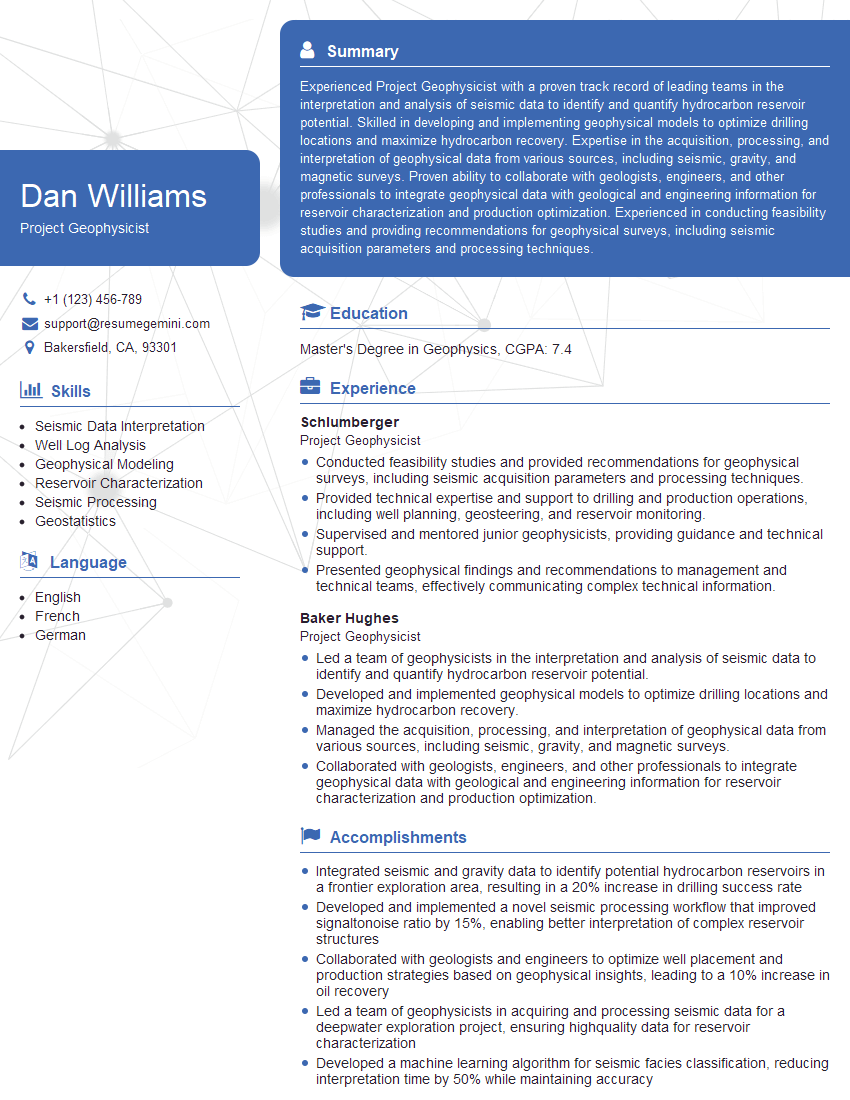
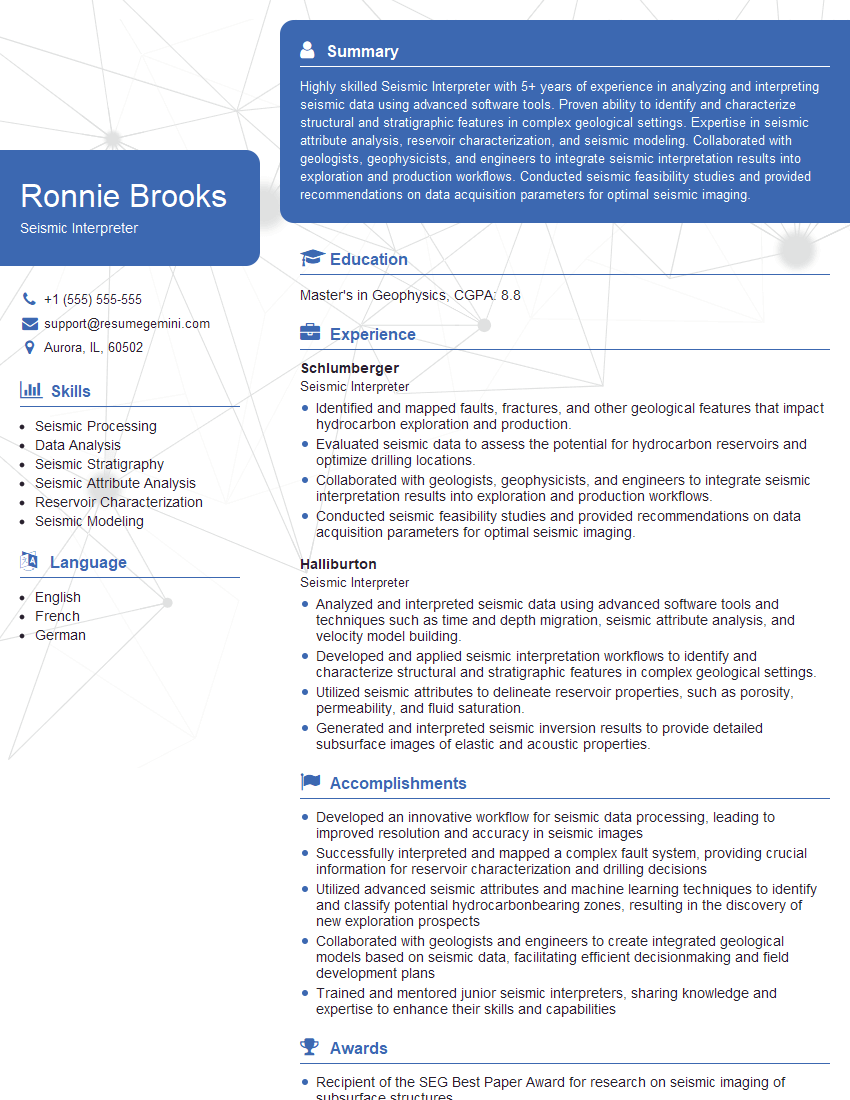
Mastering Engineering Geophysics opens doors to a rewarding career with diverse opportunities in the energy sector, mining industry, environmental consulting, and academia. To significantly boost your job prospects, crafting a strong, ATS-friendly resume is crucial. ResumeGemini can help you build a professional and impactful resume that highlights your skills and experience effectively. We provide examples of resumes tailored specifically to Engineering Geophysics to guide you in creating a winning application. Invest time in building a compelling resume – it’s your first impression on potential employers.

Explore more articles
Users Rating of Our Blogs
Share Your Experience
We value your feedback! Please rate our content and share your thoughts (optional).
What Readers Say About Our Blog
Very informative content, great job.
good