Are you ready to stand out in your next interview? Understanding and preparing for Ensemble Repertoire Selection interview questions is a game-changer. In this blog, we’ve compiled key questions and expert advice to help you showcase your skills with confidence and precision. Let’s get started on your journey to acing the interview.
Questions Asked in Ensemble Repertoire Selection Interview
Q 1. Explain your process for selecting repertoire for a diverse ensemble.
Selecting repertoire for a diverse ensemble requires a multifaceted approach. It’s not simply about choosing pieces; it’s about crafting a program that celebrates the unique skills and backgrounds of each musician while creating a cohesive and engaging whole. My process begins with understanding the ensemble’s strengths and limitations. This includes considering the instrumental balance, individual players’ technical proficiencies, and their stylistic preferences.
- Individual Skill Assessment: I conduct thorough assessments of each musician’s technical capabilities, musicality, and comfort levels with different styles and periods. This information guides the selection of appropriately challenging pieces that will both challenge and inspire.
- Instrumental Balance: I analyze the ensemble’s instrumentation to ensure that each section has an equal opportunity to shine. For example, if the ensemble is heavily weighted towards strings, I would consciously select pieces that highlight the strengths of the brass or woodwind sections.
- Stylistic Diversity: I strive for a program that presents a variety of styles, periods, and composers, showcasing the ensemble’s versatility. This might involve including classical works alongside contemporary compositions or pieces from diverse cultural backgrounds.
- Programmatic Coherence: I create a narrative arc for the program. The pieces are ordered in a way that builds in intensity, contrasts styles effectively, and creates a satisfying overall listening experience. The transition between pieces must also be considered for smooth transitions.
For example, a program might open with a light, playful work, progress through more intense or emotionally charged pieces, and conclude with a triumphant or reflective piece.
Q 2. How do you balance audience appeal with artistic integrity when choosing repertoire?
Balancing audience appeal and artistic integrity is a delicate act, akin to walking a tightrope. While it’s important to engage the audience and offer a program they’ll enjoy, compromising artistic values to chase popularity is detrimental in the long run. My approach focuses on finding that sweet spot where both elements coexist.
- Audience Research: Understanding the typical audience for the ensemble is crucial. This involves analyzing previous concert attendance, audience demographics, and feedback from past performances. This provides insights into their preferences and expectations.
- Programmatic Variety: While some audience engagement can be driven by well-known compositions, I strategically incorporate lesser-known but artistically significant pieces to introduce new perspectives and broaden musical horizons. This expands the audience’s understanding and appreciation of music.
- Contextualization: Providing program notes that offer insight into the historical context, compositional techniques, or composer’s intent can deepen the audience’s understanding and appreciation, even for unfamiliar pieces. This bridges the gap between artistic merit and audience comprehension.
- Accessibility: I ensure that the concert program is accessible to a wider audience by incorporating pieces with diverse stylistic characteristics. This creates an engaging experience without sacrificing artistic standards.
For instance, including a popular, well-known piece alongside a more challenging, contemporary work can attract a broader audience while maintaining artistic integrity. The key is to use the familiar to introduce the unfamiliar.
Q 3. Describe your experience with copyright regulations and licensing for musical works.
Copyright regulations and licensing are paramount in repertoire selection. Ignoring these aspects can lead to legal issues and financial penalties. My experience encompasses meticulous research and adherence to copyright laws. I understand the intricacies of obtaining performance licenses from organizations like ASCAP, BMI, and SESAC for copyrighted works. My process involves:
- Comprehensive Research: I thoroughly research the copyright status of each piece before including it in the program. This includes verifying the copyright holder and the necessary licensing procedures.
- Licensing Acquisition: I ensure all necessary licenses are obtained well in advance of the performance. This involves contacting the appropriate licensing agencies, submitting the required information, and paying the applicable fees. I maintain meticulous records of all licenses acquired.
- Public Domain Works: I actively seek out and include works in the public domain, which eliminates licensing fees. This can significantly reduce performance costs.
- Composer Contact: For works by living composers, I directly contact the composer or their representative to secure performance rights and negotiate any necessary agreements.
I treat copyright compliance as a non-negotiable aspect of my work, viewing it not just as a legal obligation but as a moral one that respects the intellectual property rights of composers.
Q 4. How do you determine the appropriate level of difficulty for a given ensemble?
Determining the appropriate difficulty level is crucial for both the success of the performance and the well-being of the musicians. I use a multi-pronged approach that goes beyond simply looking at technical demands.
- Technical Analysis: I carefully analyze the technical challenges posed by each piece, considering aspects such as range, rhythmic complexity, articulation, and overall difficulty of individual parts.
- Ensemble Dynamics: I consider the collective capabilities of the ensemble. A piece might be technically feasible for individual members but pose challenges when played together. Balance and cohesion are critical.
- Rehearsal Time: I assess the realistic rehearsal time available and select pieces that can be adequately prepared within that timeframe. Overambitious selections lead to stress and compromise performance quality.
- Performance Context: The performance venue, the audience, and the overall program also inform my choice of difficulty. A more challenging piece might be suitable for an experienced audience but inappropriate for a less experienced one.
I often conduct rehearsals or workshops to gauge the ensemble’s progress and adjust the repertoire if needed. The priority is to ensure that the performance is both enjoyable and achievable for the musicians, leading to a positive and rewarding experience.
Q 5. How do you incorporate new and underrepresented composers into your repertoire selection?
Incorporating new and underrepresented composers is a vital part of fostering diversity and inclusivity in music. My approach involves active research and deliberate selection to highlight the contributions of often-overlooked voices.
- Targeted Research: I proactively search for works by women, composers of color, LGBTQ+ composers, and composers from underrepresented geographical regions. I use online databases, scholarly articles, and networks of composers to find promising pieces.
- Direct Engagement with Composers: I reach out to composers whose work I admire and discuss the possibility of including their pieces in our program. This fosters collaboration and helps build relationships with the artistic community.
- Commissioning New Works: When possible, I advocate for commissioning new works from underrepresented composers. This provides them with opportunities to showcase their talent while enriching the ensemble’s repertoire.
- Educational Initiatives: I organize workshops or presentations to educate the ensemble and the wider community about the composers and the historical context of their work. This helps foster a deeper appreciation for the music.
For example, including a work by a female composer from Latin America not only enriches the program musically but also highlights the rich cultural heritage and contributions of women in music.
Q 6. Explain your method for creating a balanced and cohesive concert program.
Creating a balanced and cohesive concert program is an art form in itself. It’s about crafting a narrative that keeps the audience engaged from beginning to end. My method involves careful consideration of several key factors.
- Programmatic Arc: I structure the program with a clear beginning, middle, and end. The order of pieces should create a satisfying flow, often progressing from lighter to more intense works, or alternating between styles to maintain interest.
- Stylistic Variety: I strive for a balance of styles and periods, avoiding monotony. The contrast between pieces should be deliberate, creating dynamic shifts in mood and energy.
- National/Cultural Representation: To showcase diversity, I thoughtfully incorporate pieces that reflect the cultural and national backgrounds of the composers and musicians.
- Tempo and Mood: I consider the tempo and mood of consecutive pieces, ensuring smooth transitions and avoiding jarring juxtapositions. For instance, a fast, energetic piece might be followed by a slower, more reflective work.
- Length and Timing: I carefully manage the overall length of the concert to avoid listener fatigue. The selected pieces should fit comfortably within the allotted time, allowing for appropriate intermissions if necessary.
The goal is to create a journey for the listener, a cohesive narrative that transcends the individual pieces and offers a complete and satisfying musical experience.
Q 7. How do you handle conflicts or disagreements regarding repertoire choices within an ensemble?
Disagreements about repertoire choices are inevitable in any ensemble. My approach to conflict resolution is collaborative and focuses on finding mutually acceptable solutions.
- Open Dialogue: I encourage open and respectful discussions among ensemble members about their preferences and concerns regarding repertoire. This creates a safe space for voicing different perspectives.
- Compromise and Negotiation: I facilitate a process of compromise and negotiation, encouraging members to consider each other’s viewpoints and explore alternative options. The goal is not to impose a decision but to reach a consensus.
- Justification and Rationale: I provide clear justifications for my repertoire choices, explaining the artistic rationale and considering the ensemble’s overall goals. This helps build understanding and acceptance.
- Voting or Ranking: In cases of persistent disagreements, I may suggest a structured voting or ranking system to determine the final selection. This provides a fair and transparent mechanism for decision-making.
- Rotating Repertoire: To mitigate future conflicts, I may implement a system of rotating repertoire, allowing different members to influence the selection process over time. This ensures that everyone has a chance to share their preferences and contribute to the ensemble’s artistic development.
Ultimately, the goal is to maintain a positive and collaborative environment where all members feel heard and respected, fostering a sense of shared ownership and pride in the ensemble’s performance.
Q 8. How do you manage the logistical aspects of acquiring musical scores and parts?
Acquiring scores and parts for an ensemble is a multi-faceted process requiring meticulous organization and attention to detail. It begins with identifying the publisher or source. Many scores are available digitally through online platforms, offering convenience and cost savings, especially for individual parts. However, for large-scale works or when high-quality printed scores are needed, direct purchase from publishers or specialized music retailers is often necessary.
For older, less commonly performed works, locating scores might involve searching archives, contacting libraries specializing in musical scores, or even commissioning transcriptions or restorations. Once the source is identified, I meticulously track each acquisition, using a database or spreadsheet to record the title, composer, publisher, cost, and delivery date. This helps maintain a comprehensive inventory of our repertoire and streamlines future selections.
For example, when preparing a program featuring lesser-known 20th-century chamber works, I had to contact several university libraries to obtain scores on loan and coordinate their timely return. This careful planning and proactive communication are crucial for ensuring a smooth and successful performance process.
Q 9. How do you factor in budgetary constraints when selecting repertoire?
Budgetary constraints significantly influence repertoire selection. It’s not just about the cost of scores; it also encompasses factors like potential rental fees for instruments (if needed), copying costs for parts, licensing fees for copyrighted works, and even travel expenses for guest artists or rental of specialized equipment. I typically create a detailed budget early in the planning process, allocating funds to different categories. This allows me to prioritize pieces that balance artistic merit with financial feasibility.
For instance, if the budget is tight, we might choose to perform works in the public domain, which eliminates licensing fees. Or, we might prioritize pieces requiring fewer instrumentalists to minimize the need to hire additional musicians. I also explore potential sponsorship opportunities or grant applications to help offset costs and expand our repertoire possibilities. Often, creative programming can address budget limitations, for example, pairing less expensive works with a ‘headliner’ piece that attracts a larger audience, thus maximizing revenue.
Q 10. Describe your experience with creating thematic concert programs.
Creating thematic concert programs is one of the most rewarding aspects of my work. It’s about crafting a narrative, a musical journey for the audience. I typically begin by brainstorming potential themes – be it a composer, a historical period, a geographical region, or even a specific emotion or concept. Once a theme is selected, I research pieces that align with the chosen narrative, considering not only their musical style but also their interrelationship and overall flow.
For example, I curated a program themed “The Romantic Spirit in Chamber Music,” which featured works by Schubert, Schumann, and Mendelssohn. The selections were ordered to showcase the evolution of romanticism through a variety of styles and emotional landscapes. Careful sequencing of contrasting yet complementary pieces is key; a powerful or dramatic piece might be followed by a more lyrical or introspective one, maintaining audience engagement throughout the performance. Program notes are also vital, providing context and insights to enhance the audience’s understanding and appreciation of the musical journey.
Q 11. How do you assess the suitability of a piece for a specific venue or performance space?
Assessing the suitability of a piece for a specific venue is critical for a successful performance. Several factors come into play. The acoustic properties of the venue, particularly the size and reverberation time, directly impact the audibility and balance of the music. A large, reverberant hall might be suitable for a full orchestra but less so for a small chamber ensemble. Similarly, a piece with intricate details might get lost in a cavernous space, whereas a smaller venue might be too intimate for a large-scale work.
The venue’s technical capabilities – such as lighting, sound reinforcement, and stage dimensions – are also crucial. Some pieces may require specific lighting setups, and complex works might benefit from amplification. I always visit or thoroughly research the venue before making a selection, considering seating capacity, accessibility, and overall ambiance, ensuring a harmonious match between the music and the performance space. For example, a minimalist composition would be better suited to a small, modern space, rather than a grand, ornate concert hall.
Q 12. How do you utilize technology to support your repertoire selection process?
Technology plays a significant role in modern repertoire selection. I utilize specialized music databases and online catalogs to browse scores, access reviews, and compare editions. Software like Sibelius or Finale can assist in reviewing scores and parts, and also allow for customization. Digital score libraries provide convenient access to a vast repertoire, eliminating the need for physical storage of large quantities of music.
Furthermore, online platforms facilitate communication with publishers, rental agencies, and other musicians, streamlining the acquisition and exchange of scores. I use spreadsheets and databases to track repertoire, budgets, and logistics, improving efficiency and organization. Online tools also help in creating and sharing program notes and promotional materials. For instance, I used a digital score library to find and compare different editions of a Beethoven string quartet, allowing me to choose the best version for our ensemble’s specific needs and skill levels.
Q 13. How familiar are you with various musical periods and styles?
My familiarity with various musical periods and styles is extensive, ranging from the Baroque period to contemporary compositions. My knowledge encompasses diverse genres such as classical, romantic, impressionistic, modern, and contemporary music, extending to various national styles and traditions. This broad understanding allows me to program concerts with diverse and engaging selections.
I am proficient in recognizing the characteristic features of each period and style, enabling me to select works that complement each other thematically and musically while creating a balanced and stimulating program. This ranges from understanding the use of counterpoint in Baroque music to recognizing the harmonic innovations of the Romantic era or the experimental techniques of contemporary composers. A strong foundational understanding of musical history and theory is crucial in making informed and well-rounded repertoire choices.
Q 14. How do you prioritize pieces based on their historical significance or artistic merit?
Prioritizing pieces based on historical significance and artistic merit involves a thoughtful balancing act. Historical significance considers a piece’s impact on musical history, its influence on subsequent composers, and its reflection of the social and cultural context of its time. Artistic merit, on the other hand, focuses on the piece’s intrinsic qualities – its originality, compositional skill, emotional depth, and overall impact on the listener.
I strive to create programs that include a blend of both, incorporating well-known masterpieces that represent important milestones in musical history alongside less-performed but equally compelling works demonstrating exceptional artistic merit. This approach allows for both familiarity and discovery, engaging audiences with a wide range of musical experiences. For example, a concert might feature a seminal work by a renowned composer alongside a contemporary piece that reflects innovative approaches to musical expression, fostering appreciation for both established and emerging artistic voices.
Q 15. How do you engage with the ensemble members to gain input on repertoire choices?
Selecting repertoire is a collaborative process. I believe in fostering open communication and shared ownership from the outset. I typically begin with an initial brainstorming session, inviting each ensemble member to suggest pieces they are passionate about, highlighting their individual strengths and interests. We then discuss the feasibility of each suggestion, considering factors like technical difficulty, stylistic cohesion, and overall program length. This participatory approach not only ensures a more diverse and engaging program but also cultivates a sense of shared responsibility and artistic investment in the final selection.
For example, in a recent project with a string quartet, one violinist suggested a piece by Bartók that showcased their advanced bowing technique, while another cellist proposed a more lyrical piece by Debussy that showcased their expressive capabilities. By incorporating both suggestions, we created a program with both technical brilliance and emotional depth.
Career Expert Tips:
- Ace those interviews! Prepare effectively by reviewing the Top 50 Most Common Interview Questions on ResumeGemini.
- Navigate your job search with confidence! Explore a wide range of Career Tips on ResumeGemini. Learn about common challenges and recommendations to overcome them.
- Craft the perfect resume! Master the Art of Resume Writing with ResumeGemini’s guide. Showcase your unique qualifications and achievements effectively.
- Don’t miss out on holiday savings! Build your dream resume with ResumeGemini’s ATS optimized templates.
Q 16. Describe your experience working with different instrumentation or vocal ranges.
My experience spans a wide range of instrumental and vocal ensembles. I’ve worked with everything from small chamber groups (woodwind quintets, string quartets) to larger ensembles (choruses, orchestras). This experience has taught me the importance of adapting repertoire to suit the specific characteristics of each ensemble. For instance, a piece written for a string quartet might require significant adaptation to be suitable for a string orchestra, or a piece conceived for soprano and piano might need re-orchestration for soprano and string trio.
I am particularly adept at navigating the unique challenges of different vocal ranges. In one project, I curated a program for a mixed chorus with a disproportionately large number of altos. Instead of limiting our choices, I actively sought pieces that showcased the strength of the alto section, cleverly arranging existing pieces or selecting compositions that naturally favored the alto voices while still maintaining a balanced and beautiful overall sound.
Q 17. How do you adapt repertoire selections based on performer availability or skill levels?
Performer availability and skill levels are crucial considerations. I use a flexible, iterative approach. First, I create an initial repertoire wish list. Then, based on performer availability, I check if all musicians are available for the selected pieces’ rehearsals and performance. Next, I assess individual skill levels. If a piece is too challenging for a particular member, I will either explore alternative arrangements, find a substitute piece of a similar style but lesser difficulty, or work with the musician to help them develop the necessary skills within the given timeframe. If a musician is unavailable, I carefully select pieces that allow for suitable substitution.
For instance, if a key violinist is unavailable for a specific concert, I might choose pieces that are less reliant on the first violin’s virtuosity or feature other instruments more prominently. Sometimes, a slightly simpler piece might be a better alternative.
Q 18. How familiar are you with different performance rights organizations?
I am intimately familiar with various performance rights organizations (PROs) such as ASCAP, BMI, and SESAC in the US, and their international equivalents. Understanding their licensing requirements is paramount. Before selecting any piece, I verify its licensing status and ensure we have the necessary permissions for performance and reproduction. This involves consulting the PRO databases, contacting publishers, and obtaining the appropriate licenses to avoid copyright infringement. This is a crucial step to ensure legal compliance and respect for the composers’ and publishers’ rights.
I also stay updated on any changes or additions to their licensing policies. It’s an ongoing process to remain compliant.
Q 19. How do you ensure accessibility for audiences with disabilities in your program choices?
Accessibility is a fundamental principle. I strive to create programs that are inclusive and welcoming to audiences with a wide range of needs. This includes considering: visual aids (program notes in large print or braille), audio descriptions for visually impaired patrons, and designated seating for wheelchair users. When choosing repertoire, I look for pieces that are described in detail to assist audiences with visual or auditory impairments in their understanding and appreciation. I also aim to offer sensory-friendly performances, potentially altering aspects like lighting or sound to make the experience more comfortable for those with sensory sensitivities. It’s a matter of careful planning and collaboration with venue staff to ensure everyone has an equally enjoyable experience.
Q 20. How do you research and select appropriate preludes, intermissions, and encore pieces?
Selecting preludes, intermissions, and encores is about creating a cohesive and engaging overall musical experience. Preludes should set the tone and atmosphere for the main program, while intermissions should provide a refreshing break, maybe showcasing a different style or mood. Encores often serve as a final celebratory moment, typically lighter in nature than the main program’s pieces. My approach involves considering the overall flow and stylistic coherence of the entire concert. I look for pieces that complement the main program, providing a sense of contrast and balance. I might choose short, well-known pieces for encores to ensure broad audience appeal and a satisfying conclusion.
For example, a concert featuring predominantly romantic-era works might use a lighter classical prelude and a lively baroque piece as an encore, adding variety and pacing to the experience.
Q 21. Explain your approach to creating program notes or annotations.
Program notes are more than just a list of pieces; they’re an opportunity to enhance the audience’s understanding and appreciation. My approach is to craft notes that are both informative and engaging, avoiding overly technical jargon while still providing insightful context. I aim to share the historical background of the compositions, highlighting the composer’s intentions and the unique features of each piece. I also include biographical information about the composers to bring the music to life. I strive for a conversational tone, making the information accessible to a diverse audience, including those with little prior knowledge of classical music. The goal is to elevate the listening experience, providing a richer context for appreciating the musical performance.
Q 22. How do you evaluate the potential impact of a particular piece on the audience?
Evaluating a piece’s potential impact on the audience is a multifaceted process. It goes beyond simply judging its musical merit; it involves understanding the target audience’s preferences, the overall artistic vision, and the desired emotional response. I consider several factors:
- Audience demographics and musical tastes: Are we targeting a family audience, seasoned concertgoers, or a younger demographic? This informs the choice of style, complexity, and length of pieces. For example, a family concert might include well-known melodies and shorter pieces, whereas a more experienced audience might appreciate a more challenging or experimental program.
- Programmatic context: How does the piece fit within the overall concert program? Does it create a cohesive narrative or offer a contrasting element? Consider the order of pieces—a powerful, emotional piece might be better placed towards the end to leave a lasting impact.
- Emotional impact and storytelling: What is the piece’s inherent emotional arc? Does it tell a story? Does it evoke specific emotions (joy, sorrow, contemplation)? A good program will offer a blend of different emotional experiences, ensuring a varied and engaging performance.
- Artistic vision: How does the chosen piece contribute to the overarching theme or message of the season or series? Does it align with the artistic director’s vision and the ensemble’s identity?
Ultimately, predicting impact involves a degree of educated guesswork, but careful consideration of these factors dramatically increases the likelihood of a successful and resonant performance.
Q 23. How do you balance familiar pieces with new or less-known works?
Balancing familiar pieces with new or less-known works is crucial for engaging a diverse audience and fostering artistic growth. It’s a delicate dance between satisfying existing expectations and introducing new experiences. My approach involves:
- Strategic placement: Opening with a well-loved piece can draw the audience in, creating a welcoming atmosphere. Subsequently, introducing less-familiar works, perhaps with a brief introduction highlighting their significance or unique qualities, helps to educate and broaden the audience’s musical horizons.
- Creating thematic links: Linking familiar and unfamiliar works through thematic elements, stylistic connections, or composer influences can create a cohesive narrative arc, helping the audience understand the context of the newer pieces. For instance, pairing a well-known Beethoven symphony with a contemporary work inspired by his style creates an implicit conversation.
- Gradual introduction of new works: It’s important not to overwhelm the audience. A gradual introduction of lesser-known pieces, interspersed with familiar favorites, prevents alienation and encourages exploration.
- Program notes and pre-concert talks: Detailed program notes provide essential context and background information for unfamiliar pieces, enhancing audience understanding and appreciation.
Finding the right balance is an iterative process, often influenced by audience feedback and the ensemble’s overall artistic goals. It’s about creating a journey of discovery, not just a recital of established classics.
Q 24. Describe your experience collaborating with other artistic staff (conductors, stage managers, etc.).
Collaboration is the cornerstone of successful repertoire selection. My experience working with conductors, stage managers, and other artistic staff has been invaluable. It involves:
- Open communication: Regular meetings and discussions allow for the sharing of ideas and perspectives. This ensures that the repertoire selection aligns with the conductor’s interpretive vision and the stage manager’s logistical requirements.
- Shared decision-making: Repertoire choices are not made in isolation. The process often involves brainstorming sessions where everyone’s input is considered and weighed. This fosters a sense of shared ownership and collective responsibility.
- Considering practical limitations: Stage managers provide critical insight into practical constraints, such as stage space, lighting requirements, and potential challenges in staging a particular piece.
- Respecting different expertise: Recognizing the specialized knowledge and experience of each member of the team is essential. The conductor brings interpretive expertise, the stage manager brings practical experience, and I contribute my knowledge of the available repertoire and audience preferences.
For example, in one instance, the conductor had a strong preference for a particular piece that initially seemed logistically challenging. However, through open discussion with the stage manager, we were able to find creative solutions that allowed us to include the piece while mitigating the logistical concerns.
Q 25. How do you measure the success of your repertoire selection?
Measuring the success of repertoire selection is multifaceted and requires a holistic approach. While box office numbers provide an initial indication, other crucial metrics provide a richer understanding:
- Audience response: Post-concert surveys, informal feedback, and social media engagement provide valuable insight into audience reaction. Did they enjoy the program? Did they find it engaging? Were they introduced to new music they appreciated?
- Critical reception: Reviews from music critics offer an independent assessment of the artistic merit of the selected pieces and the overall quality of the performance.
- Artistic achievement: Did the program fulfill its artistic aims? Did it successfully create a cohesive narrative? Did it showcase the ensemble’s strengths and artistic identity? This involves internal reflection and review.
- Increased audience engagement: Did the program attract new audiences or encourage repeat attendance? Did it stimulate conversations about the music and its themes?
A successful repertoire selection leads to a positive cycle of audience engagement, critical acclaim, and artistic fulfillment. It’s a combination of quantifiable metrics and qualitative observations that paint a complete picture of success.
Q 26. What are some of the biggest challenges you face when selecting repertoire?
Selecting repertoire presents several significant challenges:
- Balancing artistic vision with practical constraints: The ideal program might be limited by budget, available personnel, or the ensemble’s technical capabilities. Finding the right balance between artistic ambition and practical feasibility is a constant challenge.
- Meeting diverse audience expectations: Catering to a broad spectrum of musical tastes within a single program can be difficult. It requires careful selection of pieces that appeal to different segments of the audience without alienating any group.
- Staying current with new works: The musical landscape is constantly evolving. Keeping abreast of new and emerging composers and works requires diligent research and exploration. Discovering and promoting lesser-known, high-quality works can be time-consuming.
- Copyright and licensing issues: Securing the necessary rights to perform certain pieces can be complex and expensive. Navigating the legal landscape and ensuring compliance with copyright laws requires careful attention to detail.
- Program length and pacing: Crafting a program that is both engaging and of appropriate length demands skillful sequencing and selection. Overly long or poorly paced programs can fatigue the audience, while too-short programs might leave them wanting more.
Addressing these challenges requires careful planning, collaboration, and a willingness to adapt and compromise. It’s a continuous learning process.
Q 27. How do you stay up-to-date on new and emerging composers and works?
Staying current on new and emerging composers and works requires a multifaceted approach:
- Attending festivals and concerts: Festivals and concerts offer opportunities to discover new works and composers. I regularly attend both local and international events to stay informed about the latest trends and developments.
- Reading music journals and publications: Staying up to date with new scores and composers involves reading relevant publications and journals.
- Networking with composers and conductors: Networking with composers, conductors, and other musicians provides valuable insights into emerging talent and new compositions.
- Exploring online resources and databases: Online resources and databases provide access to a vast amount of information, allowing for exploration of new and unfamiliar works. Exploring composers’ websites and reviewing recordings are invaluable tools.
- Commissioning new works: Actively commissioning new works helps support emerging composers and brings fresh perspectives to the ensemble’s repertoire. This provides a direct line to exciting new work.
It’s a continuous process of exploration and engagement with the ever-evolving world of music composition.
Q 28. Describe your understanding of different musical styles and their historical context.
My understanding of different musical styles and their historical contexts is comprehensive and spans various periods and genres. It’s not merely about knowing the names and dates; it’s about understanding the cultural, social, and artistic forces that shaped these styles. For example:
- Baroque: I understand the emphasis on counterpoint, ornamentation, and the use of basso continuo, and its relationship to the opulent and formal style of the period.
- Classical: I am familiar with the emphasis on clarity, structure, and balance, and the rise of the symphony and sonata forms, reflecting the Enlightenment ideals of order and reason.
- Romantic: My understanding encompasses the emotional intensity, expressive freedom, and use of larger orchestral forces in this era, reflecting the passionate and individualistic spirit of the age.
- 20th and 21st Century: My expertise extends to atonal and serial music, minimalism, and the diverse array of styles that emerged throughout the 20th and 21st centuries, along with the various post-modern and experimental styles that are actively evolving.
This deep understanding informs my repertoire choices, ensuring that selections are not only musically sound but also historically and culturally relevant. This understanding allows for the creation of programs that present a coherent narrative of musical history and styles, enriching the listening experience for the audience.
Key Topics to Learn for Ensemble Repertoire Selection Interview
- Understanding Ensemble Dynamics: Explore the collaborative aspects of music-making within an ensemble. Consider factors influencing performance choices and the communication necessary for a cohesive sound.
- Program Building & Curatorial Skills: Discuss the principles of selecting repertoire appropriate for specific ensembles, venues, and audiences. This includes considering stylistic cohesion, technical feasibility, and program length.
- Balancing Artistic Vision with Practical Constraints: Analyze how artistic decisions are influenced by budgetary considerations, available resources, and performer capabilities.
- Copyright & Licensing Regulations: Understand the legal framework surrounding the performance of copyrighted music and the processes involved in obtaining necessary permissions.
- Audience Engagement & Program Annotation: Discuss techniques for creating engaging program notes that enhance audience understanding and appreciation of the chosen repertoire.
- Collaboration & Communication Strategies: Explain how to effectively communicate with conductors, musicians, and other stakeholders throughout the repertoire selection process.
- Problem-Solving & Decision-Making: Discuss examples of scenarios that require quick, informed decision-making in the context of ensemble repertoire selection, such as dealing with last-minute changes or performer absences.
Next Steps
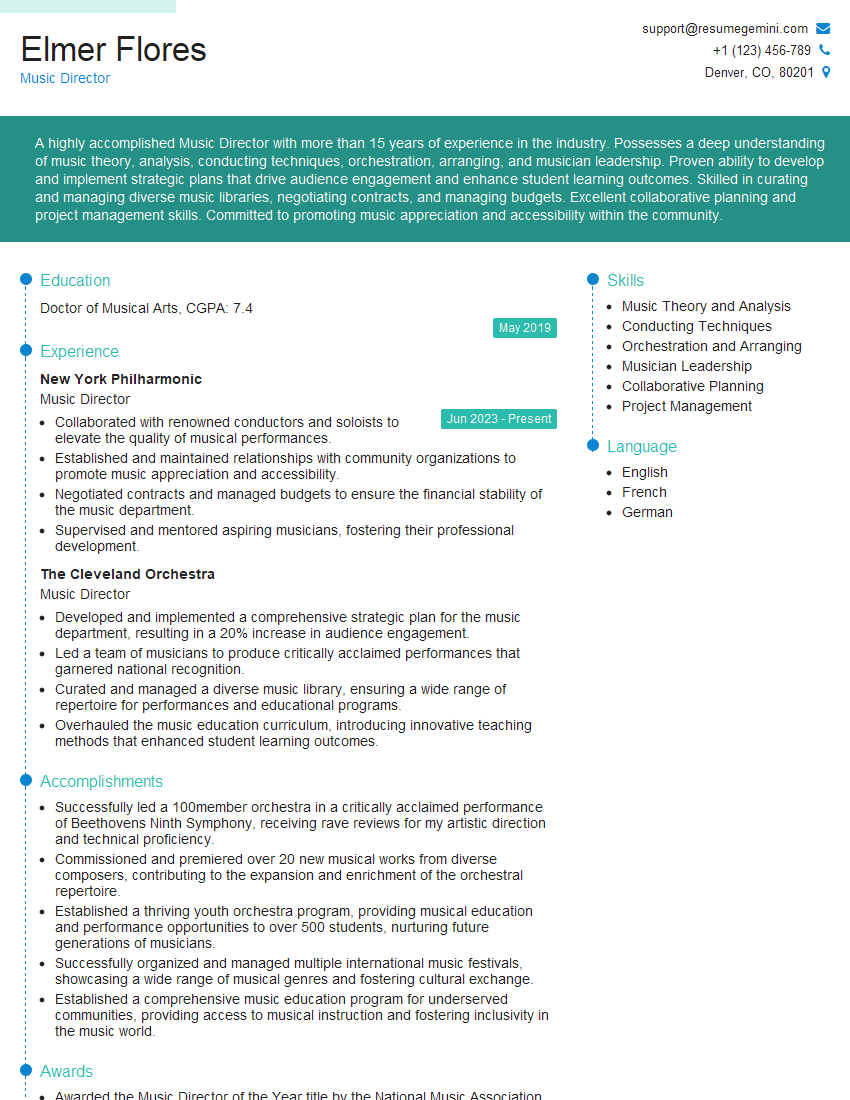
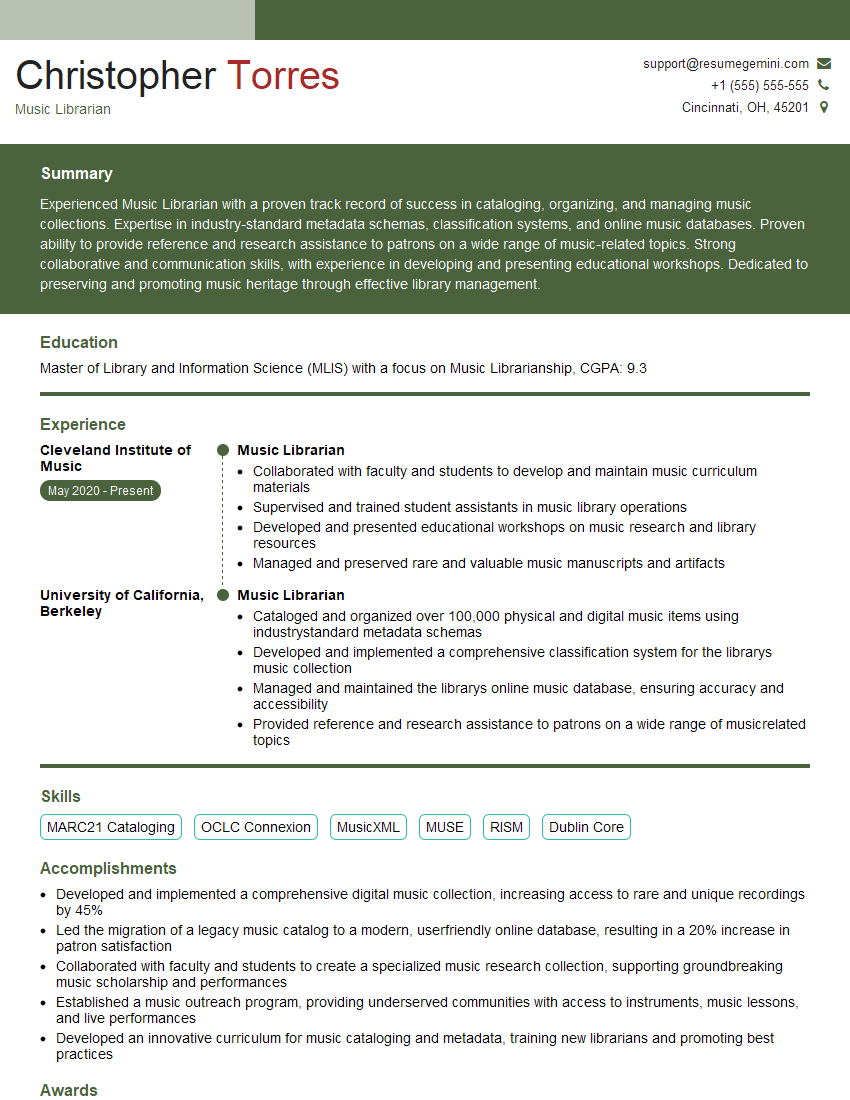
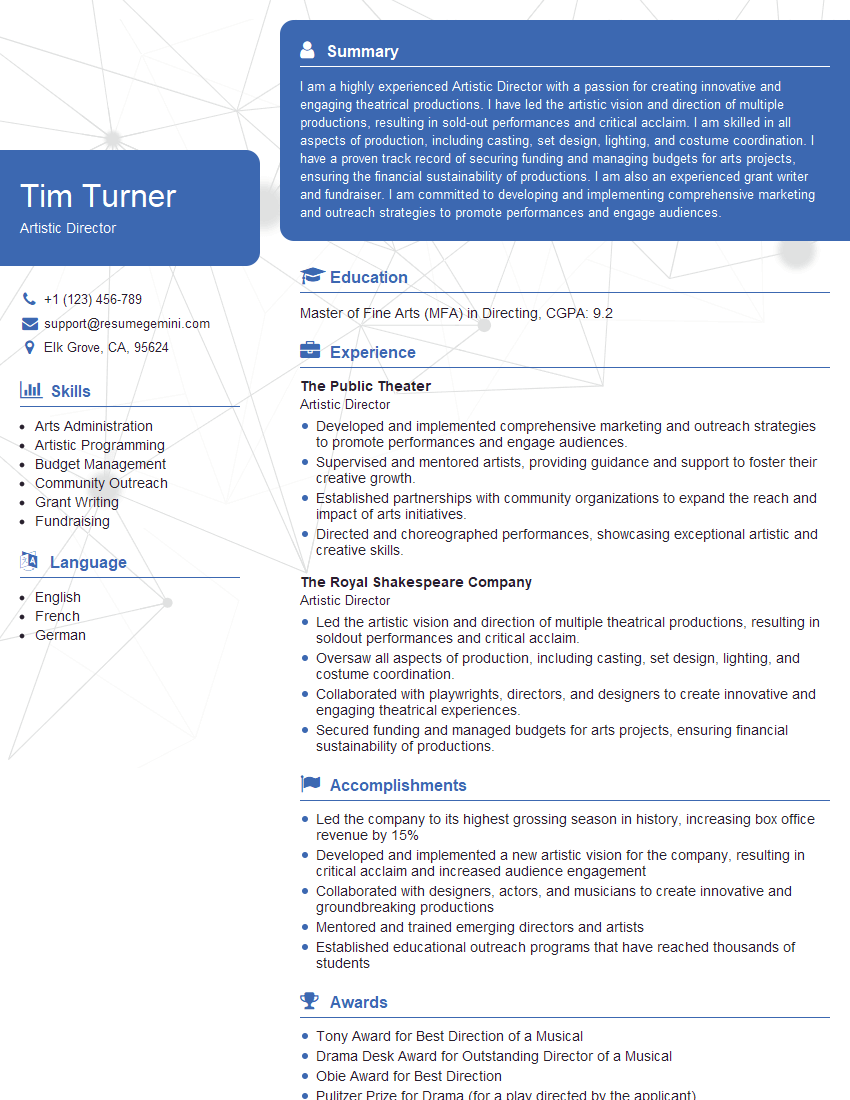
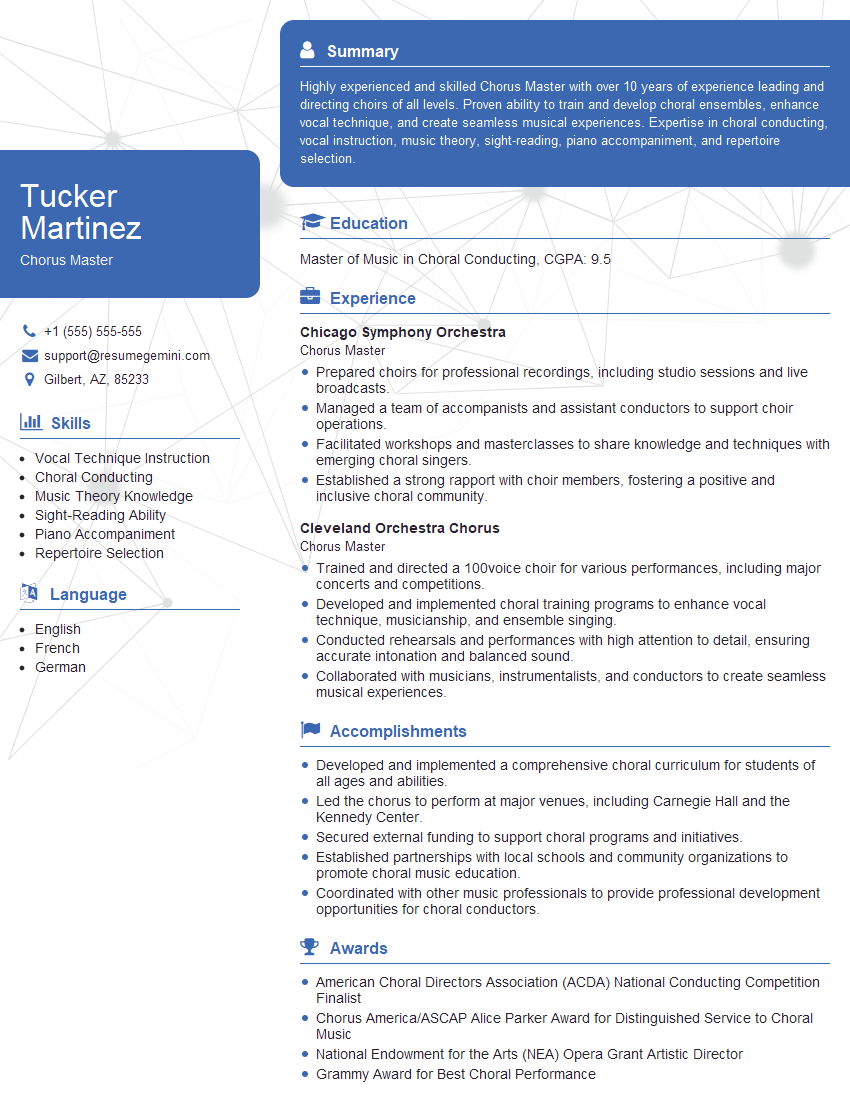
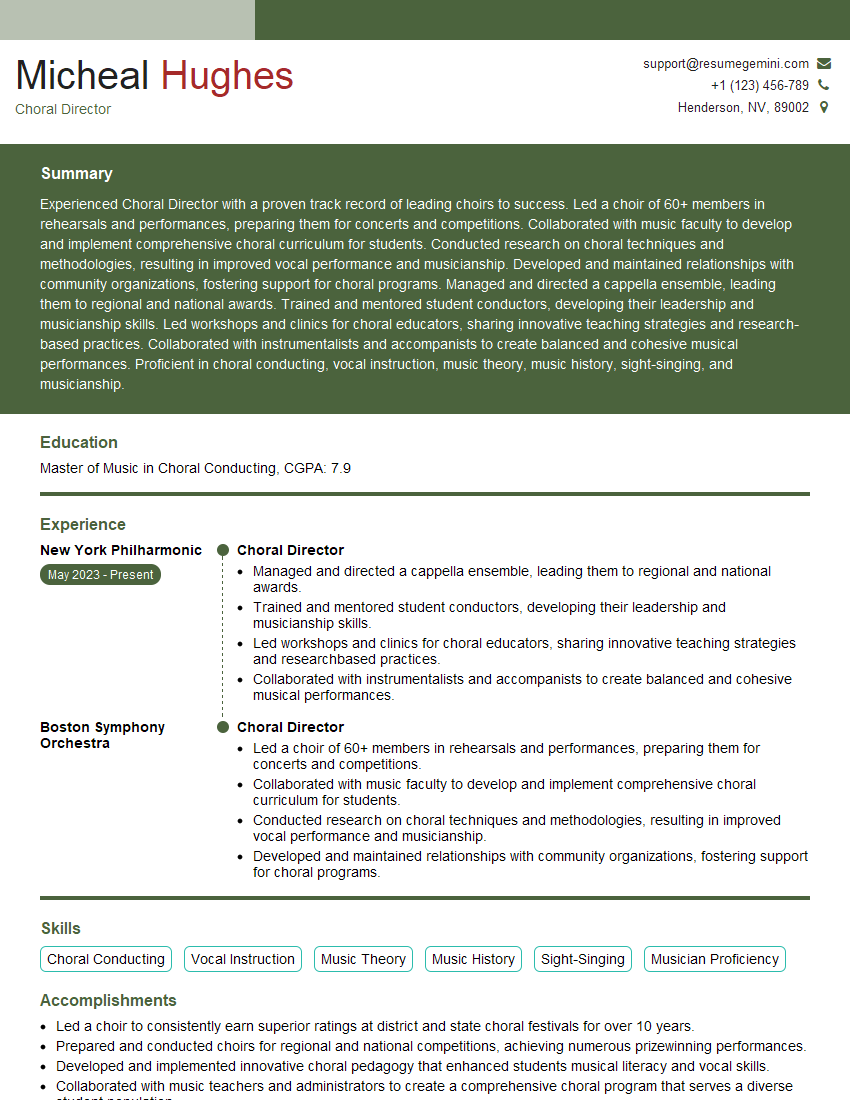
Mastering Ensemble Repertoire Selection significantly enhances your career prospects in orchestral management, arts administration, and related fields. Demonstrating a strong understanding of these concepts will set you apart from other candidates. To increase your chances of landing your dream role, it’s crucial to present your skills and experience effectively through a well-crafted, ATS-friendly resume. ResumeGemini is a trusted resource to help you build a professional and impactful resume tailored to the specific demands of your target positions. Examples of resumes tailored to Ensemble Repertoire Selection roles are available to guide you through this process.
Explore more articles
Users Rating of Our Blogs
Share Your Experience
We value your feedback! Please rate our content and share your thoughts (optional).
What Readers Say About Our Blog
Very informative content, great job.
good