Preparation is the key to success in any interview. In this post, we’ll explore crucial Experience in arranging and composing music interview questions and equip you with strategies to craft impactful answers. Whether you’re a beginner or a pro, these tips will elevate your preparation.
Questions Asked in Experience in arranging and composing music Interview
Q 1. Describe your experience in arranging music for different ensembles (e.g., string quartet, big band, orchestra).
My experience in arranging spans a wide range of ensembles. I’ve arranged for intimate settings like string quartets, where the focus is on intricate interplay and counterpoint, to larger formations such as big bands, demanding a keen understanding of jazz harmony and rhythmic complexity, and finally, the full orchestra, requiring a mastery of orchestration and balancing diverse instrumental timbres.
For string quartets, I often prioritize the vertical harmonic texture, ensuring each voice has a clear melodic and rhythmic role. With big bands, I relish the opportunity to explore the unique sonic palette of each instrument, using sections like the saxophones, trumpets, and trombones to create contrasting textures and dynamic shifts. Orchestral arrangements demand a deeper understanding of instrumentation and the need to create a cohesive blend of sounds while showcasing the strengths of individual sections. For instance, I might use the strings for a soaring melody, the brass for powerful punctuations, and the woodwinds for delicate countermelodies.
A recent project involved adapting a solo piano piece for a string orchestra. This required carefully considering the piano’s dynamic range and translating its complex harmonies into a transparent and effective orchestral arrangement. The challenges included balancing the individual string parts, ensuring each instrument contributed appropriately to the overall sonic tapestry without overshadowing the others.
Q 2. Explain your process for arranging a piece of music, from initial concept to final product.
My arranging process is iterative and often begins with a deep listening to the source material (if arranging an existing piece) or a clear conceptualization of the desired mood and style (for original compositions).
- Analysis: I meticulously analyze the melody, harmony, rhythm, and form of the piece, identifying key elements and potential areas for development.
- Sketching: I create initial sketches, often using piano or a digital audio workstation (DAW), experimenting with different instrumental combinations and voicings.
- Instrumentation: I select the instruments most appropriate for each section, considering their range, timbre, and expressive capabilities. This often involves balancing the contrasting timbres of different instrumental families.
- Harmony and Melody: I focus on creating interesting harmonic progressions and melodic lines that are both engaging and appropriate for the chosen instruments. This might involve re-harmonizing sections to enhance the piece’s overall effect.
- Rhythm and Groove: I carefully craft rhythmic patterns and grooves, paying attention to the pulse and feel of the music. For dance-oriented pieces, this is critical for creating a driving rhythm.
- Dynamics and Articulation: I add dynamic markings and articulation instructions to shape the phrasing and emotional expression of the piece. This adds depth and nuance.
- Revision and Refinement: The final stage involves meticulous revision, often incorporating feedback from performers or conductors, ensuring a balanced and effective arrangement.
For example, when arranging a simple folk song for a string quartet, I might begin by harmonizing the melody with simple triads, then add inner voices to create a richer texture. I would then focus on the rhythmic and dynamic variety to keep the piece engaging and prevent it from sounding monotonous.
Q 3. How do you approach harmonizing melodies for different instrumental sections?
Harmonizing melodies for different instrumental sections requires a deep understanding of each instrument’s range, timbre, and technical capabilities. My approach involves creating voice-leading that is both smooth and interesting, avoiding awkward leaps or parallel fifths or octaves.
I often use a combination of techniques: close-position voicings for a fuller sound, spread voicings for a more transparent texture, and inverted chords to add variety. For instance, I might use a close voicing in the lower strings for a powerful bass line, while using a spread voicing in the upper strings to create a more delicate countermelody. The choice of voicing will depend on the overall texture and the emotional impact I want to achieve.
Furthermore, understanding the inherent characteristics of different instrumental families is crucial. The rich, warm timbre of the cellos might require a different harmonic approach than the bright, clear sound of the violins. I might use simpler harmonies for the less agile instruments, while exploring more complex harmonies with the more versatile instruments.
Q 4. Discuss your experience with music notation software (e.g., Sibelius, Finale).
I’m proficient in both Sibelius and Finale, using them extensively for all my arranging projects. These programs are invaluable tools for creating accurate and professional-quality scores.
Sibelius’s intuitive interface and powerful features, particularly its playback engine, allow for efficient score creation and real-time listening, facilitating quick iterative improvements. Finale’s robust capabilities for engraving and printing are equally important for delivering high-quality, publication-ready scores. The ability to easily edit and manipulate individual notes, measures, and sections within these programs is crucial for ensuring accuracy and efficiency.
Beyond basic notation, I use their advanced features for creating custom articulations, creating and editing complex rhythms, and generating multiple instrumental parts with ease. This allows me to experiment with different instrumental combinations and voicings without laborious manual transcription.
Q 5. How do you handle copyright issues when arranging existing musical works?
Copyright is paramount. When arranging existing musical works, I always obtain the necessary permissions before starting the project. This usually involves contacting the copyright holder (composer, publisher, or their representative) and negotiating a license agreement. The specifics of the agreement will vary depending on the intended use and scope of the arrangement.
Failure to secure proper licensing can lead to significant legal and financial repercussions. It is crucial to understand the nuances of copyright law and to engage with the rights holders in a transparent and professional manner to avoid any issues.
For some public domain works, licensing may not be required, but verifying the work’s copyright status is still a crucial step. There are resources available to assist in determining the copyright status of a given work.
Q 6. Describe your familiarity with different musical styles and how you adapt your arranging techniques accordingly.
My arranging experience encompasses a wide variety of styles, including classical, jazz, pop, and world music. My approach adapts significantly depending on the chosen style.
In classical arrangements, I focus on creating clear and balanced textures, emphasizing melodic interplay and harmonic sophistication. Jazz arrangements demand a strong understanding of improvisation, rhythmic complexity, and the unique timbres of jazz instruments. Pop arrangements may prioritize catchy melodies and simple, memorable harmonic progressions, often utilizing contemporary production techniques.
For example, arranging a Bach chorale for a string quartet requires a different approach than arranging a pop song for a big band. The former emphasizes contrapuntal texture and Baroque harmony, while the latter may incorporate rhythmic syncopation and a wider range of dynamic contrasts.
Q 7. Explain your approach to balancing individual instrumental parts within a larger arrangement.
Balancing individual instrumental parts is a critical aspect of arranging. It’s about achieving a cohesive ensemble sound while ensuring that each instrument contributes effectively and is heard clearly.
My approach involves careful consideration of instrumental ranges, timbres, and technical capabilities. I avoid writing passages that are overly difficult or inappropriate for certain instruments. I also pay attention to the overall dynamic balance, ensuring that no single instrument overpowers the others. This often involves adjusting the volume levels (dynamics) of individual parts during the composition and arrangement process.
Effective use of orchestration techniques like doubling (using multiple instruments to play the same part) and counterpoint (independent melodic lines that work together harmoniously) can help to create a richer texture while maintaining balance. I use panning and other mixing techniques in the final recording or playback to further refine the sonic balance.
Q 8. How do you ensure the overall sonic balance and clarity of your arrangements?
Achieving sonic balance and clarity in arrangements is paramount. It’s like a painter carefully blending colors to create a harmonious image – each instrument needs its space to breathe, yet work together cohesively. I achieve this through meticulous attention to detail in several key areas:
- Frequency Balancing: I carefully consider the frequency ranges of each instrument. For instance, I wouldn’t have two instruments occupying the same mid-range frequencies, creating muddiness. Instead, I might place a cello in the low-mid range and a viola in the upper-mid range for clearer separation.
- Panning and Stereo Imaging: Strategic panning (placing instruments left or right in the stereo field) creates depth and prevents instruments from masking each other. For example, placing the lead vocal in the center and backing vocals slightly panned left and right offers a more spacious and natural sound.
- Dynamic Processing: Using tools like EQ (equalization) and compression allows me to sculpt the sound of individual instruments and sections to fit within the overall mix. Compression can tame peaks in loud instruments, allowing quieter instruments to be heard clearly. EQ allows me to boost or cut specific frequencies to enhance or reduce certain aspects of an instrument’s timbre.
- Instrumentation: Careful selection of instrumentation is crucial. Choosing instruments with distinct timbres that complement each other contributes significantly to a clear and balanced sound. For example, combining a flute and clarinet could create a bright, almost airy texture, whereas combining a tuba and bassoon might create a rich, darker sound.
Regular listening sessions during the arrangement process, using a variety of playback systems, is vital for ensuring clarity across different listening environments.
Q 9. How do you incorporate rhythmic complexity and variation into your arrangements?
Rhythmic complexity and variation are essential for keeping an arrangement engaging. Think of it as the spice in a culinary dish – a little bit goes a long way, but the right amount can transform a simple dish into something extraordinary. I introduce rhythmic complexity using several strategies:
- Polyrhythms: Overlapping different rhythmic patterns simultaneously creates intricate textures. For example, a 3/4 rhythm played against a 4/4 rhythm can generate a compelling sense of groove and movement.
- Syncopation: Accenting unexpected beats creates surprise and interest. This can be applied to melodic lines, accompaniment figures, or even percussion parts. It’s about deliberately defying the expected pulse to make the rhythm feel more active and lively.
- Rhythmic Variation Within Sections: Rather than repeating the same rhythmic pattern throughout an entire section, I often introduce subtle variations. This might involve changing the rhythmic feel of an accompaniment figure halfway through a section, or introducing a new rhythmic element in the melody line. It keeps the ear interested and engaged.
- Using Percussion and Rhythmic Instruments: Percussion instruments are fantastic for adding rhythmic interest and texture. Experimenting with different percussion instruments and using them in contrasting ways can bring life to even the most simple melodies.
The key is to create a balance – enough complexity to be interesting, but not so much that it overwhelms the listener. It’s a balance I strive to find in every arrangement.
Q 10. Describe your experience working with musicians and conductors.
Collaborating with musicians and conductors has been a cornerstone of my career. It’s a dynamic process requiring both technical expertise and strong interpersonal skills. I’ve worked with both seasoned professionals and emerging artists across various genres.
When working with musicians, I prioritize clear communication regarding the musical intent and desired aesthetic of the arrangement. I provide detailed scores and parts, ensuring clarity in notation and articulation. This includes providing specific instructions for phrasing, dynamics, and articulations to guide their performance. It’s often a collaborative process; I’m open to suggestions and insights from the musicians themselves. I remember one session where a violinist suggested a subtle change to a bowing technique which unexpectedly enriched the texture of a particular passage.
Working with conductors involves a slightly different dynamic. It’s a more interpretive collaboration, where we discuss the overall vision and interpretational approaches for the piece. I’m always receptive to their insights about tempo, phrasing, and dynamic shadings. I’ve learned the importance of clear communication and providing the conductor with materials that are easily understood and navigable.
Q 11. How do you address feedback from clients or collaborators on your arrangements?
Feedback is invaluable to the arrangement process. I view it not as criticism, but as an opportunity to refine and improve my work. My approach involves active listening and a collaborative spirit.
- Active Listening: I carefully consider all feedback, regardless of its source. I make notes and try to understand the rationale behind each comment. Sometimes a seemingly minor suggestion can illuminate a significant issue.
- Collaborative Dialogue: I engage in a dialogue with clients or collaborators, clarifying any misunderstandings and discussing potential solutions. This might involve demonstrating alternative approaches or revisiting the arrangement’s foundational elements.
- Iterative Process: I often incorporate revisions based on feedback, creating a refined version that addresses the concerns raised. This iterative process helps to achieve a final product that meets or exceeds the client’s expectations.
- Documentation: I maintain thorough documentation of all revisions and changes made. This is crucial for tracking progress and facilitating communication.
Ultimately, my goal is to create an arrangement that not only reflects my musical vision but also aligns with the client’s needs and artistic goals.
Q 12. Explain your understanding of dynamic range and its importance in music arranging.
Dynamic range refers to the difference between the loudest and softest parts of a piece of music. It’s crucial for creating musical expression and emotional impact. Think of a dramatic movie; scenes with a wide dynamic range will be more gripping, impactful, and memorable compared to scenes with only a moderate range.
In arranging, a well-defined dynamic range allows me to create a sense of tension and release, build excitement, and communicate the emotions of the music effectively. A monotone arrangement, where all the notes are played at the same volume, would be exceptionally dull and lifeless.
I use dynamics to shape the emotional arc of a piece. A gradual crescendo can build anticipation before a climactic moment, while a sudden diminuendo can create a sense of vulnerability or reflection. The judicious use of dynamics is as critical to an arrangement as the melody or harmony. I carefully plan dynamic variations to highlight melodic and harmonic events. Consider a simple phrase: by gradually increasing the volume (crescendo) during the melodic climax, it becomes far more impactful than playing it consistently at the same level.
Q 13. How do you incorporate counterpoint and other compositional techniques into your arrangements?
Counterpoint, the art of combining independent melodic lines, is a powerful tool in arranging. It adds depth, interest, and complexity to the music. Imagine a tapestry – each melodic line is a thread, weaving together to form a rich and complex whole.
I use various counterpoint techniques, such as:
- Two-part invention: Two independent melodic lines are interwoven, creating a dynamic interplay between the voices. This is particularly effective in creating a sense of dialogue or conversation within the music.
- Imitative counterpoint: One melodic line imitates another, creating a sense of call and response. This technique can create a feeling of unity and cohesiveness, while simultaneously showcasing the individuality of the melodic lines.
- Free counterpoint: This approach offers more freedom and flexibility, allowing me to combine independent melodic lines without strict adherence to rules. It’s more spontaneous and expressive, creating richer and more unexpected textures.
Beyond counterpoint, other compositional techniques like canons, fugues, and variations can bring a unique character and sophistication to my arrangements. These techniques are valuable for adding sophistication and engaging the listener intellectually. I believe that a strong understanding of compositional techniques is crucial to creating compelling and memorable arrangements.
Q 14. Discuss your experience with music theory and its application to music arranging.
Music theory is the bedrock of my arranging work. It provides the framework for understanding harmony, melody, rhythm, and form—all essential elements for effective arranging. It’s like having a solid blueprint before constructing a building.
My understanding of music theory allows me to:
- Construct functional harmonies: I use my knowledge of chord progressions and voice leading to create satisfying and expressive harmonic frameworks for my arrangements. This includes understanding how different chords function within a key and how to create smooth transitions between them.
- Develop compelling melodic lines: I apply principles of melodic contour, intervallic relationships, and phrase structure to create memorable and expressive melodies that are both musically satisfying and emotionally resonant.
- Create rhythmic interest and variety: I utilize my understanding of rhythmic patterns and meters to create arrangements that are both engaging and rhythmically diverse.
- Write effective voicings: My knowledge of voice leading and chord spacing allows me to create clear, resonant, and expressive voicings for my arrangements. This ensures that the harmonies are both aesthetically pleasing and musically sound.
- Analyze existing music: I analyze existing pieces of music to understand their structure and compositional techniques, which I can then apply to my own arrangements.
Music theory provides a comprehensive toolbox for creative problem-solving. It empowers me to make informed decisions about every aspect of my arrangements, from the smallest melodic detail to the largest structural elements.
Q 15. How do you maintain the integrity of the original composition while making it suitable for a different ensemble?
Adapting a composition for a different ensemble requires a delicate balance between preserving the essence of the original and leveraging the unique capabilities of the new instrumentation. Think of it like translating a book – you want to convey the same story, but the language and style might need adjustment.
My approach focuses on understanding the original’s harmonic structure, melodic contours, and rhythmic drive. I then analyze the new ensemble’s timbral palette and range. For example, a string quartet arrangement might emphasize the lyrical qualities of the melody, using the violins for soaring lines and the cello for a rich harmonic foundation. A brass band arrangement, conversely, might utilize the powerful low brass for rhythmic drive and the trumpets for bright, incisive melodies. Throughout the process, I prioritize maintaining the emotional core of the piece. I might simplify certain passages to make them playable, but I’ll always strive to retain the composer’s intended mood and character.
Consider a piece originally written for piano solo. To arrange it for string quartet, I might distribute the melodic material across the four instruments, using the cello to play the bass line that the piano originally carried. The harmonies might be re-voiced to take advantage of the string textures. Conversely, arranging it for a large orchestra would allow for more expansive harmonies and a broader dynamic range, with the ability to add counter-melodies and instrumental colors not possible in the original.
Career Expert Tips:
- Ace those interviews! Prepare effectively by reviewing the Top 50 Most Common Interview Questions on ResumeGemini.
- Navigate your job search with confidence! Explore a wide range of Career Tips on ResumeGemini. Learn about common challenges and recommendations to overcome them.
- Craft the perfect resume! Master the Art of Resume Writing with ResumeGemini’s guide. Showcase your unique qualifications and achievements effectively.
- Don’t miss out on holiday savings! Build your dream resume with ResumeGemini’s ATS optimized templates.
Q 16. Explain your approach to creating a cohesive musical narrative through arrangement.
Creating a cohesive musical narrative in an arrangement involves shaping the listener’s experience through strategic choices in pacing, dynamics, and instrumentation. It’s like crafting a story with chapters and climaxes.
I start by identifying the emotional arc of the original composition. Are there distinct sections? What are the key emotional moments? I then build the arrangement to highlight these moments, using dynamics to create tension and release. For instance, a quiet, introspective section might be followed by a powerful crescendo, building to a dramatic climax. I also use instrumentation to enhance the narrative. A solo instrument might be used to highlight a particularly poignant melody, while a full ensemble might be used to create a sense of grandeur or excitement.
A practical example would be arranging a pop song for a symphony orchestra. I might begin with a subdued string introduction to establish a mood, followed by a fuller orchestral statement of the main theme. The bridge section could feature a solo flute, creating a sense of intimacy before returning to the full orchestra for a powerful, emotionally resonant conclusion. Throughout the arrangement, I would aim for a logical flow, guiding the listener through a satisfying and emotionally impactful journey.
Q 17. Describe your experience with different recording techniques and their impact on your arrangements.
My experience encompasses a range of recording techniques, from analog to digital, each significantly impacting the final arrangement. Analog recording, with its warmth and subtle imperfections, can lend a vintage, intimate quality to an arrangement. Digital recording, on the other hand, offers precision and flexibility, enabling detailed editing and manipulation of sound.
I’ve worked with close-miking techniques to capture the nuanced details of individual instruments, as well as room miking to capture the ambient space and create a sense of spaciousness. I’ve also experimented with various microphone types – condenser mics for clarity, dynamic mics for power, and ribbon mics for a vintage feel – each contributing a unique sonic character. The choice of recording technique is fundamentally intertwined with the aesthetic vision of the arrangement. A highly polished, modern arrangement might benefit from detailed digital recording, while a more organic, raw sound might be achieved with analog techniques and minimal processing.
For instance, in a recording session for a jazz ensemble arrangement, using close-miking on the instruments allowed for a clear and defined separation of each instrumental part. This was crucial for capturing the intricate interplay between musicians. Conversely, using room mics in the recording of a string quartet arrangement allowed for a more natural, spacious sound, highlighting the blend of the instruments and creating a sense of intimacy.
Q 18. How do you use orchestration to create specific moods and emotions in your arrangements?
Orchestration is the art of assigning musical lines to different instruments, a crucial element in shaping the mood and emotional impact of an arrangement. It’s like painting with sonic colors.
Consider the use of high strings (violins and violas) to create a sense of brightness and lightness, or low strings (cellos and basses) for a more somber and weighty feel. Brass instruments can add power and grandeur, while woodwinds can contribute delicacy and warmth. Percussion instruments offer rhythmic vitality and textural variety. By carefully selecting and combining these instrumental colors, I can paint a rich sonic tapestry that evokes the desired emotions.
For instance, to create a sense of suspense, I might use a low, sustained cello line with muted trumpets playing sparse, dissonant chords. For a joyful mood, I could use bright, playful melodies in the woodwinds, accompanied by a driving rhythmic pulse from the percussion. Careful attention to instrumental balance and layering is also key; a well-balanced arrangement avoids muddiness and allows each instrument’s contribution to be heard clearly.
Q 19. Explain your familiarity with different musical forms (e.g., sonata form, rondo form).
My familiarity with musical forms like sonata form and rondo form is essential for both arranging and composing. Understanding these forms helps me structure pieces logically and effectively, creating a clear and satisfying musical journey for the listener.
Sonata form, with its exposition, development, and recapitulation, provides a framework for building tension and release. I might adapt this form in an arrangement by using the exposition to introduce the main themes, the development section to explore variations and contrasts, and the recapitulation to return to the main themes with added richness and emotional depth. Rondo form, with its recurring main theme interspersed with contrasting episodes, offers a different approach, often used to create a more lighthearted or dance-like feel.
For example, when arranging a piece based on a theme and variations, the understanding of rondo form would help in deciding on the placement and character of the variations, ensuring a logical and effective structure. Similarly, arranging a piece that is inherently dramatic could benefit from adhering to the structure of sonata form, allowing for a carefully built-up crescendo and a satisfying resolution.
Q 20. How do you deal with time constraints and deadlines when arranging music?
Meeting deadlines is crucial in arranging. My approach involves meticulous planning and efficient workflow. I start by breaking down the project into manageable tasks, setting realistic timelines for each stage. This includes analyzing the source material, sketching out the arrangement, writing the full score, and revising based on feedback.
Prioritization is essential. I focus on the most crucial aspects first, ensuring that the core structure and emotional impact of the arrangement are firmly established before addressing finer details. Effective time management involves utilizing tools like project management software to track progress and identify potential bottlenecks. Furthermore, clear communication with the client or employer is critical to manage expectations and avoid unexpected delays.
For example, if faced with a tight deadline, I might initially focus on creating a functional arrangement with the essential elements in place. Subsequent revisions will allow for more detailed work and polishing, ensuring that the arrangement meets the highest standards within the given timeframe. This prioritization of essential elements over minute details ensures that the core of the arrangement is not compromised by time constraints.
Q 21. Describe your experience with transcribing music.
Transcribing music involves carefully notating a performance or recording, capturing the melodic, harmonic, and rhythmic content. It’s like creating a blueprint from a building’s existing structure. My experience includes transcribing both solo and ensemble performances, ranging from classical to jazz.
The process typically begins with careful listening to the source material, identifying the key melodic lines and harmonic progressions. I then use music notation software to enter the transcribed material, paying close attention to detail – accuracy is paramount. This includes accurately representing articulations, dynamics, and phrasing. The level of detail required depends on the purpose of the transcription; for example, a transcription for educational purposes might need more detail than one intended for a simple arrangement.
I’ve had experience transcribing recordings for various purposes: creating study scores for musicians, adapting existing material for different ensembles, or even recreating lost scores based on existing recordings. The process often involves repeated listening and comparison to ensure accuracy and musical integrity. For example, transcribing a complex jazz solo requires attentiveness to both the melodic contours and rhythmic nuances, as well as the subtle inflections and improvisational flourishes that define the performer’s unique style.
Q 22. How do you adapt your arrangements to suit specific performance venues or acoustics?
Adapting arrangements to different venues involves considering the space’s acoustics—how sound reflects and reverberates. A large, reverberant cathedral needs a different approach than a small, intimate club.
- Reverberation Time (RT60): In a cathedral with a long RT60 (the time it takes for sound to decay), I might simplify the arrangement, avoiding dense textures that would become muddy. I might also boost the clarity of the instruments’ higher frequencies to cut through the reverb.
- Room Size and Shape: A small club might require less bass reinforcement, as the low frequencies will naturally build up. In contrast, a larger space might need more bass to compensate for the sound’s dispersion.
- Instrumentation: My choice of instrumentation can also reflect the venue. Acoustic instruments might be ideal for a cathedral, while electronic instruments might be better suited for a club.
- Dynamic Range: I might adjust the dynamic range of my arrangement. A larger space can handle a wider dynamic range (louder peaks and quieter passages), while a smaller space might benefit from a more compressed arrangement for consistent volume.
For example, when arranging a piece for a small jazz club, I’d prioritize clarity and intimacy, perhaps focusing on a smaller ensemble with instruments that project well in close quarters. For a large concert hall, I might opt for a fuller orchestration with more dynamic contrast and careful consideration of the hall’s natural amplification of certain frequencies.
Q 23. Explain your understanding of different audio mixing techniques relevant to your arrangements.
Audio mixing is crucial for creating a balanced and engaging listening experience. It involves adjusting the levels, equalization (EQ), panning, and effects of individual tracks to achieve a cohesive sound. I utilize several key techniques:
- EQ: This shapes the frequency spectrum of individual instruments, removing muddiness or boosting certain frequencies to highlight specific characteristics. For example, I might use a high-pass filter to remove low-frequency rumble from a vocal track, or a boost in the presence range (around 2-5kHz) to make it cut through the mix.
- Compression: This reduces the dynamic range, making quieter sounds louder and louder sounds softer. This creates a more consistent level, which is particularly useful for vocals or lead instruments.
- Panning: This places instruments in the stereo field—left, right, or center. Effective panning creates width and depth, preventing the mix from sounding flat. I carefully pan instruments to avoid masking and create a spatial image.
- Reverb and Delay: These effects simulate the sound of a space and add depth and ambience. I use reverb sparingly to avoid making the mix sound artificial. Delay can add rhythm and interest, creating space between musical elements.
Think of it like a painter using different colors and brushstrokes. EQ is like choosing the colors, compression is like managing the intensity of the strokes, panning is like positioning elements on the canvas, and reverb/delay add a sense of atmosphere.
Q 24. Describe your proficiency with audio editing software (e.g., Pro Tools, Logic Pro).
I’m highly proficient in both Pro Tools and Logic Pro, having used them extensively for over a decade. My skills encompass all aspects of digital audio workstation (DAW) use, from basic recording and editing to advanced mixing, mastering, and MIDI sequencing.
- Pro Tools: I’m comfortable with advanced features such as Elastic Audio for time-stretching and pitch-shifting, automation for creating dynamic arrangements, and session management for large, complex projects.
- Logic Pro: I utilize its extensive virtual instrument library, advanced MIDI editing capabilities, and powerful scoring tools. I can efficiently create orchestral arrangements, use complex plugins, and manage large sample libraries.
- Workflow: My workflow is highly efficient, allowing me to work quickly and accurately. I use keyboard shortcuts extensively and employ effective organizational techniques to manage tracks, folders, and files within the DAW.
In practice, I’ve used these skills to build multi-track recordings from scratch, edit live performances, and create high-quality masters for client delivery. I’m adept at troubleshooting technical issues and optimizing workflows for maximum efficiency.
Q 25. How do you ensure your arrangements are both musically interesting and technically feasible?
Balancing musical interest and technical feasibility is key. Musically interesting arrangements often involve complex harmonies, rhythmic variations, and dynamic shifts. However, these can become technically challenging to perform or reproduce.
- Instrument Capabilities: I carefully consider the range and capabilities of the instruments used. Demanding passages are rewritten or simplified if necessary to remain within the performers’ technical abilities.
- Ensemble Size and Makeup: I tailor the ensemble to the complexity of the arrangement. A complex piece might require a larger orchestra, while a simpler one might work well with a small chamber ensemble.
- Rehearsal Time and Budget: I consider available rehearsal time. Overly complex arrangements might require more time for rehearsals, which may not be feasible given project constraints. Similarly, the budget influences the level of studio recording and post-production that can be achieved.
- Progressive Complexity: I often build complexity gradually, starting with a more straightforward section before introducing more challenging elements. This keeps the arrangement engaging without overwhelming the performers or listeners.
For example, if a passage proves overly challenging for a specific instrumentalist, I might modify the melodic contour or simplify the rhythmic complexity. The goal is always to maintain the musical integrity of the arrangement while ensuring its technical feasibility within the given constraints.
Q 26. How do you manage your workload when working on multiple projects simultaneously?
Managing multiple projects requires meticulous organization and prioritization. I use a project management system to track deadlines, tasks, and communication with clients.
- Detailed Scheduling: I create detailed schedules for each project, allocating specific time blocks for different tasks. This ensures that I dedicate sufficient time to each project without getting overwhelmed.
- Prioritization: I prioritize projects based on deadlines and urgency. I focus on the most pressing tasks first, ensuring that critical deadlines are met.
- Communication: Open communication with clients is essential for managing expectations. I keep clients informed about progress and any potential delays.
- Delegation (when possible): If feasible, I might delegate certain tasks to assistants or collaborators to manage workload more efficiently.
- Time Blocking: I dedicate specific blocks of time each day to specific tasks for each project, creating a dedicated workflow.
Using project management software, I can track progress visually and identify potential bottlenecks. I’ve learned that maintaining clear communication with clients and establishing realistic timelines is vital for success when juggling multiple projects simultaneously.
Q 27. Explain your understanding of music publishing and licensing.
Music publishing and licensing are crucial aspects of the music industry. Music publishing involves managing the copyright of musical works (the composition itself), while licensing involves granting permission to use a musical work in a specific context.
- Copyright: Copyright protects the composer’s rights to their work, preventing unauthorized reproduction or distribution. It’s typically assigned to a music publisher, who handles administration and licensing.
- Mechanical Licenses: These licenses grant permission to reproduce and distribute a musical work, such as on a physical record or digital platform.
- Synchronization Licenses (Sync): These allow the use of a musical work in a visual medium, such as a film, television show, or commercial.
- Performance Licenses: These grant permission to perform a musical work publicly, such as in a concert or other live setting.
Understanding these aspects is critical. I work closely with publishers to ensure that my compositions are properly protected and licensed, receiving appropriate compensation for their use. I know the differences between different types of licenses and ensure I am using the appropriate type of license for specific projects.
Q 28. Describe your experience creating music for specific media (e.g., film, video games).
I have considerable experience composing for various media, including film, television, and video games. My approach varies depending on the specific medium and its requirements.
- Film Scoring: This demands a deep understanding of storytelling and visual narrative. My focus is on creating music that enhances the emotional impact of scenes, underscoring key plot points, and building dramatic tension. For example, a scene depicting a tense confrontation might be scored with dissonant chords and a driving rhythm, while a romantic scene might feature a more lyrical and melodic score.
- Video Game Music: This often involves creating modular music that adapts dynamically to gameplay. I utilize techniques such as procedural music generation to create music that responds to player actions, maintaining engagement throughout the game. The music might transition seamlessly between different moods and styles to reflect changes in the game environment or player progress.
- Television: Composing for television frequently involves adhering to specific style guidelines. I can work within existing frameworks, creating music that seamlessly fits within a show’s overall aesthetic. This also includes composing for different segments of a show – a comedic scene will differ significantly from a serious or dramatic one.
In each case, I collaborate closely with directors, producers, and game designers to ensure that the music perfectly complements the visual narrative and overall project goals. The focus always remains on enhancing the viewer or player experience.
Key Topics to Learn for Experience in arranging and composing music Interview
- Musical Theory Fundamentals: Understanding scales, chords, harmony, counterpoint, and rhythm is crucial for effective arranging and composing. Brush up on your knowledge of different musical forms and structures.
- Instrumentation and Orchestration: Learn about the sonic characteristics of different instruments and how to effectively utilize them in an arrangement. Practice writing for various instrument combinations and ensembles.
- Arranging Techniques: Explore different arranging styles, including harmonization, voicing, and creating interesting melodic and rhythmic counterpoints. Practice arranging existing melodies and composing your own arrangements from scratch.
- Compositional Processes: Understand various compositional techniques, such as melodic development, thematic transformation, and form. Practice composing short pieces in different styles and genres.
- Software Proficiency: Demonstrate familiarity with music notation software (e.g., Sibelius, Finale, Dorico) and Digital Audio Workstations (DAWs) (e.g., Logic Pro X, Ableton Live, Pro Tools). Be prepared to discuss your experience with these tools.
- Collaboration and Communication: Highlight your ability to collaborate effectively with other musicians, producers, and engineers. Be prepared to discuss your communication skills and how you handle feedback.
- Problem-solving in Composition: Discuss your approach to overcoming creative blocks and technical challenges during the composition and arrangement process. Show examples of how you’ve solved complex musical problems.
- Genre Specific Knowledge: Depending on the job description, be prepared to discuss your experience in specific genres (e.g., classical, jazz, pop, electronic). Showcase your understanding of the stylistic conventions of each genre.
Next Steps
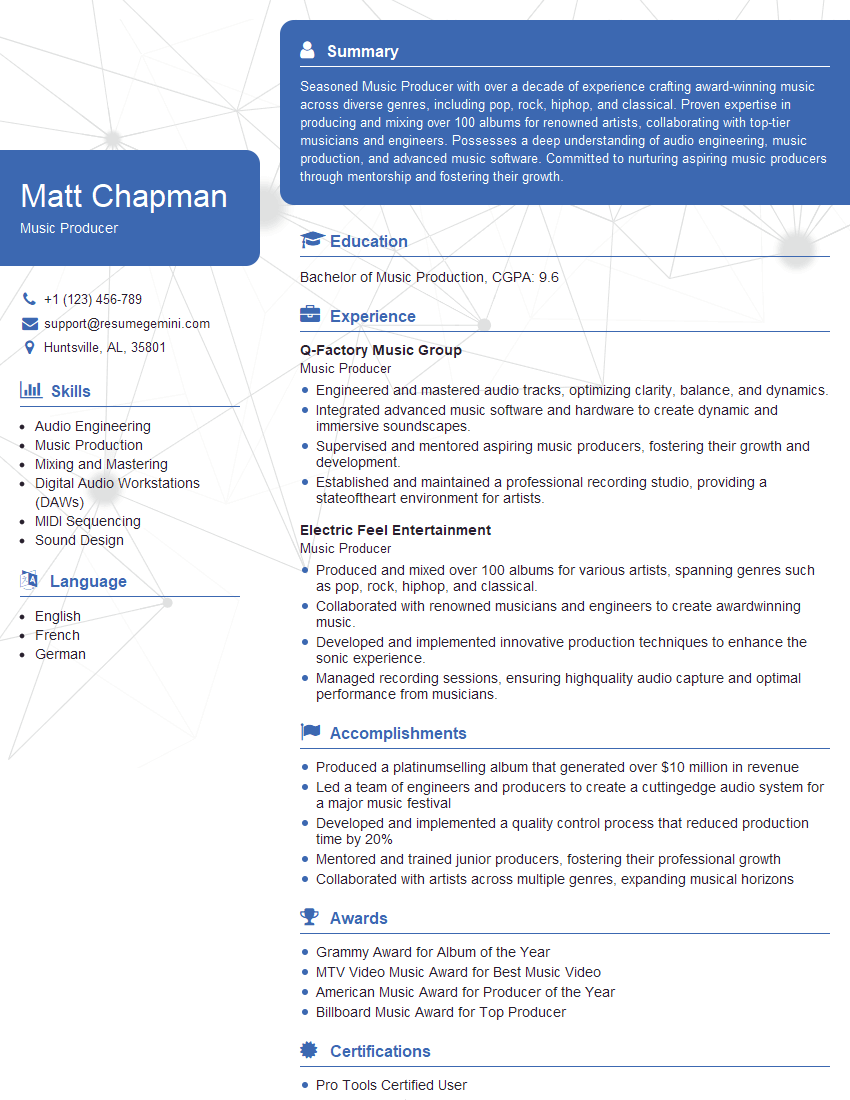
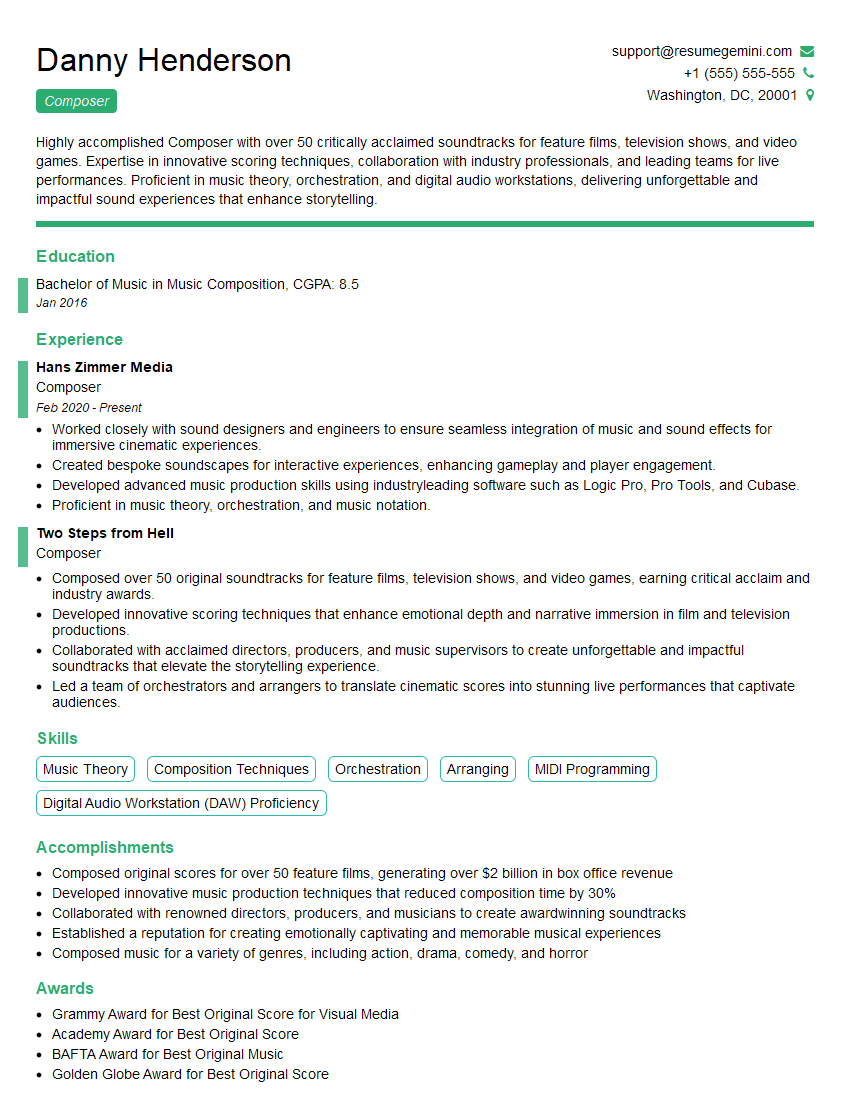
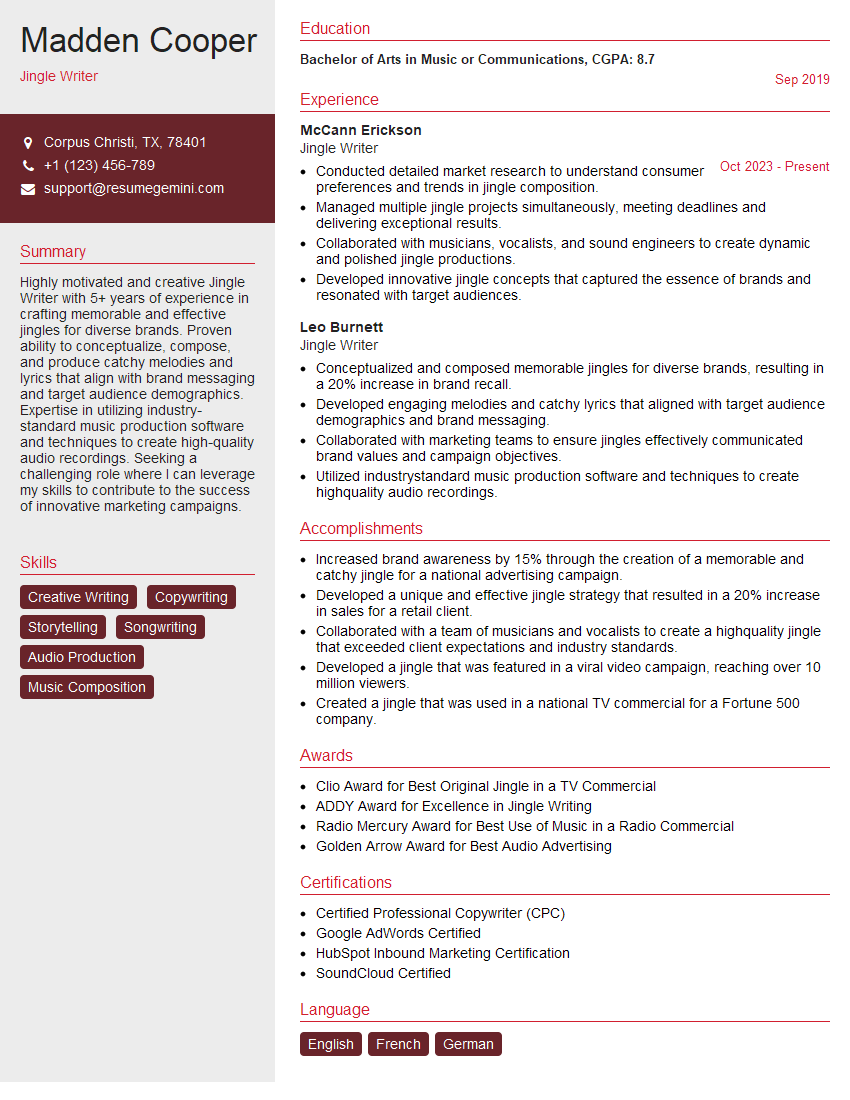
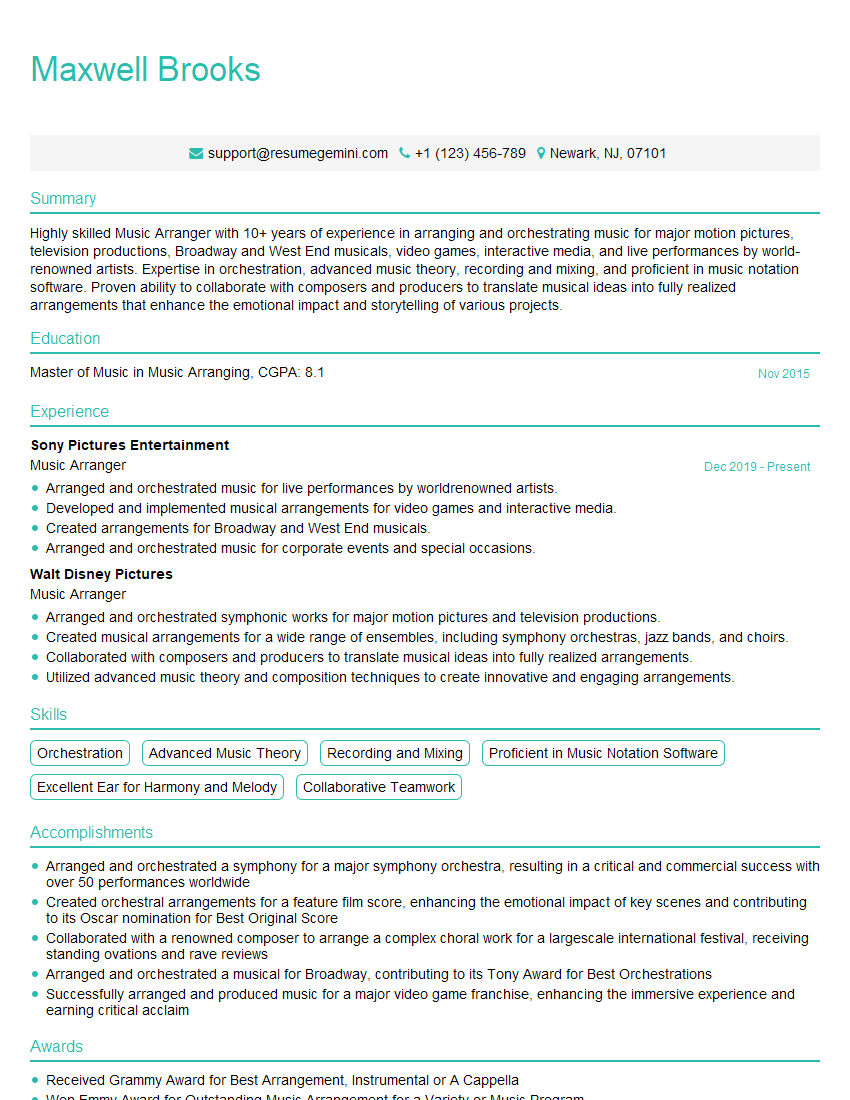
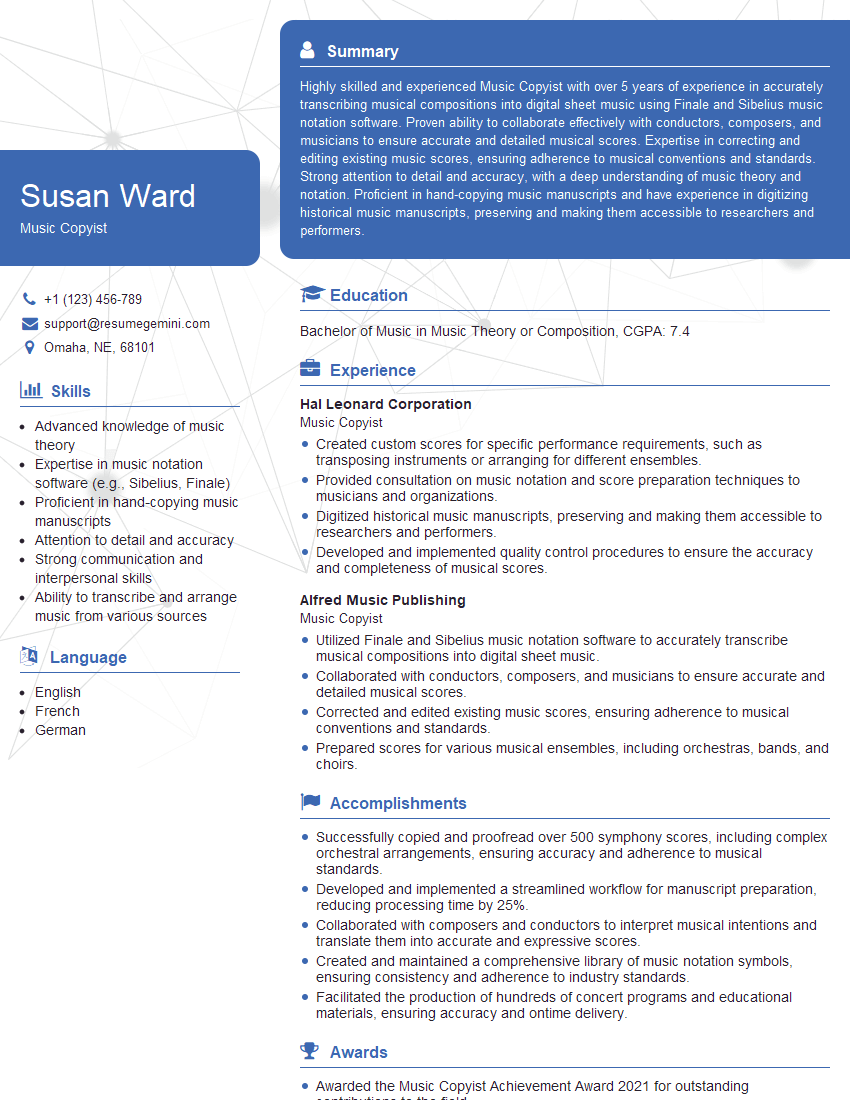
Mastering the art of arranging and composing music significantly enhances your career prospects, opening doors to diverse opportunities in the music industry. A strong, ATS-friendly resume is key to showcasing your skills and experience effectively. To maximize your job search success, we highly recommend using ResumeGemini to build a professional and impactful resume. ResumeGemini provides resources and examples of resumes tailored specifically to experience in arranging and composing music, helping you stand out from the competition. Invest time in crafting a resume that highlights your unique strengths and abilities; it’s your first impression on potential employers.
Explore more articles
Users Rating of Our Blogs
Share Your Experience
We value your feedback! Please rate our content and share your thoughts (optional).
What Readers Say About Our Blog
Very informative content, great job.
good