Interviews are more than just a Q&A session—they’re a chance to prove your worth. This blog dives into essential Experience in Music Direction and Conducting interview questions and expert tips to help you align your answers with what hiring managers are looking for. Start preparing to shine!
Questions Asked in Experience in Music Direction and Conducting Interview
Q 1. Describe your experience conducting different musical styles.
My conducting experience spans a wide range of musical styles, from the Baroque period to contemporary compositions. I’ve had the pleasure of working with orchestras, chamber ensembles, and choirs performing works by Bach, Mozart, Beethoven, Mahler, Stravinsky, and numerous contemporary composers. Each style demands a unique approach. For instance, conducting Baroque music requires a lighter touch, emphasizing articulation and ornamentation, while Romantic works often demand a more expansive and emotionally charged interpretation. Conducting contemporary pieces might involve working closely with the composer to fully understand their intent and often requires a more flexible and improvisational approach to shape the sound.
For example, conducting a Bach Brandenburg Concerto requires a meticulous attention to detail, ensuring clarity of lines and a sense of rhythmic precision. In contrast, conducting a Mahler symphony demands a broader, more dramatic gesture, conveying the vast emotional landscape of the piece. My experience allows me to adapt my technique and interpretative style to suit the specific demands of each composer and their work.
Q 2. Explain your approach to score analysis and interpretation.
My approach to score analysis is multifaceted and begins with a thorough examination of the musical notation itself. This includes identifying the harmonic structure, melodic contours, rhythmic patterns, and formal architecture of the piece. I consider the composer’s historical context, biographical information, and any available program notes or letters to deepen my understanding of their intentions. This analytical phase informs my interpretative choices. I consider phrasing, dynamics, tempo, and articulation to shape the musical narrative and bring out the essence of the work. I pay close attention to the composer’s markings, but also allow for personal interpretation based on my own musical understanding and experience, always aiming for a performance that is both faithful to the score and engaging for the audience.
For instance, when analyzing a Beethoven symphony, I might focus on the interplay between different thematic elements and how they develop throughout the movement. Understanding the composer’s use of motifs and their transformations across the work is crucial for shaping a cohesive and meaningful interpretation. I wouldn’t simply follow the score mechanically but would seek to understand the underlying structure and emotional arc of the piece to guide my interpretation.
Q 3. How do you manage rehearsal time effectively?
Efficient rehearsal time management is crucial. Before each rehearsal, I meticulously prepare a detailed plan, prioritizing the most challenging passages or sections that need the most attention. I divide the rehearsal into focused segments, tackling specific technical issues and musical details. I strive for a balance between detailed work and overall shaping of the piece. I actively encourage musicians to participate in the process, asking for their input and addressing any concerns they may have. Effective communication and a clear agenda prevent wasted time and maintain the musicians’ engagement.
I might use a system where we focus on one movement at a time, tackling technical challenges in one section before moving to another. This targeted approach makes the rehearsal more efficient, allowing us to achieve our musical goals within the allotted time. I also utilize sectional rehearsals to address individual instrumental challenges, saving overall rehearsal time.
Q 4. Describe your methods for working with different instrumental sections.
Working with different instrumental sections requires sensitivity and understanding of the individual challenges and strengths of each group. I prioritize clear communication and establish a collaborative environment where musicians feel heard and respected. I conduct separate sectional rehearsals to address specific technical issues and balance the ensemble’s sound. I give focused attention to the balance between sections, ensuring that each voice is heard clearly and contributes effectively to the overall musical texture. Building trust and rapport with each section fosters a strong ensemble sound and positive working relationships.
For example, I might spend extra time working with the brass section on achieving a consistent tone quality before integrating them with the strings and woodwinds. I would also focus on intonation and rhythmic precision specific to the instruments and the overall balance of the orchestra. Building relationships allows me to address individual needs and challenges more efficiently.
Q 5. How do you address technical challenges during rehearsals?
Addressing technical challenges during rehearsals involves a systematic approach. I begin by carefully identifying the specific problem, whether it be intonation, rhythmic accuracy, balance, or articulation. I use a combination of demonstrations, individual coaching, and sectional work to solve these problems. I often break down complex passages into smaller, more manageable units and address these units one by one. I incorporate visual aids or recordings to help musicians understand and address these technical aspects. Troubleshooting is a collaborative process, involving the musicians to find solutions that work best for them.
For example, if a passage has intonation problems, I would work with the section playing the passage, individually guiding each musician to ensure correct fingering and breathing techniques. I would then use recordings to allow the musicians to self-assess their performances.
Q 6. How do you motivate and inspire musicians?
Motivating and inspiring musicians goes beyond simply conducting technically proficient rehearsals. It involves creating a positive and supportive environment where musicians feel valued and their contributions are recognized. I emphasize the artistic goals and the overall musical narrative of the piece, encouraging musicians to connect with the emotional essence of the music. I provide constructive feedback, focusing on strengths while gently addressing areas needing improvement. I build camaraderie and trust through shared experiences, fostering a sense of collective accomplishment.
For example, I will often share insights into the composer’s life or the historical context of the music to help musicians connect with the emotional depths of the piece. I believe that clear and meaningful communication is crucial in building a supportive environment.
Q 7. Explain your process for selecting repertoire.
Selecting repertoire involves a multi-faceted process. It begins with considering the ensemble’s capabilities and technical proficiency. I also consider the audience and their preferences and the venue’s acoustics. Beyond technical aspects, I select works that are musically stimulating and engaging, offering opportunities for artistic growth and exploration. I often seek balance, incorporating well-known pieces alongside less-familiar but equally rewarding works. I also aim for thematic coherence, creating a program that flows logically and offers a cohesive musical experience for the audience.
For instance, if I’m programming a concert for a youth orchestra, I might select pieces that are challenging but also accessible, showcasing their talent while keeping the concert engaging for a diverse audience. I would include a variety of styles and periods to provide a well-rounded program.
Q 8. Describe your experience working with singers/vocalists.
Working with singers requires a deep understanding of vocal technique, phrasing, and interpretation. It’s not just about getting the right notes; it’s about bringing out the emotion and nuance in the music. My approach involves fostering a collaborative relationship built on trust and mutual respect. I begin by understanding each singer’s individual strengths and weaknesses, tailoring my coaching to their specific needs. This includes providing clear and concise instructions, offering constructive feedback, and actively listening to their concerns. For example, when working on a particularly challenging passage, I might break it down into smaller sections, focusing on breath support, diction, and phrasing. I also encourage singers to explore different vocal colors and styles to find what resonates best with the piece. Furthermore, I create a safe space where singers feel comfortable experimenting and taking risks, knowing that mistakes are part of the learning process. I’ve found that positive reinforcement and celebrating successes are key to building confidence and achieving excellent results.
Q 9. How do you handle conflicting opinions among musicians?
Conflicting opinions among musicians are inevitable, especially when dealing with artistic interpretations. My approach is based on open communication, active listening, and collaborative problem-solving. I encourage respectful dialogue, where each musician can articulate their perspective without feeling judged. I act as a facilitator, guiding the discussion towards finding common ground and a unified musical vision. Sometimes, a compromise is necessary, finding a balance between different approaches. For instance, if there’s a disagreement on tempo, we might try different tempos, listening to the effect each has on the overall performance. Other times, I’ll appeal to the overall musical structure or the composer’s intent to reach a consensus. The key is to create an environment where differing opinions are valued as opportunities for artistic growth and a richer musical outcome, not as obstacles to overcome.
Q 10. How do you maintain a positive and productive rehearsal environment?
Maintaining a positive and productive rehearsal environment is crucial for achieving a high-quality performance. I prioritize creating a supportive and respectful atmosphere where everyone feels valued and comfortable contributing. This starts with clear communication of expectations and goals. I also emphasize punctuality and preparation, ensuring that everyone comes to rehearsals ready to work. During rehearsals, I encourage active participation and constructive feedback. I also incorporate breaks to prevent fatigue and maintain energy levels. Humor and positive reinforcement are also valuable tools; acknowledging individual contributions and celebrating successes helps build morale and foster teamwork. Addressing conflicts promptly and fairly is also critical, ensuring that any issues are dealt with constructively and efficiently. Think of it as building a team – trust, communication, and respect are the cornerstones of success.
Q 11. Explain your approach to conducting large ensembles versus smaller chamber groups.
Conducting large ensembles and smaller chamber groups requires different approaches. With large ensembles (orchestras, large choirs), my focus is on clear and precise gestures to ensure that all sections are unified and balanced. I utilize a wider range of dynamic and expressive cues, ensuring clarity across the entire ensemble. Preparation and detailed score study become paramount. With smaller chamber groups, the focus shifts towards fostering a more intimate and collaborative relationship with each musician. I provide more individual coaching, focusing on the nuances of phrasing, articulation, and dynamics. The communication is more conversational, allowing for greater flexibility and spontaneous interplay between musicians. While precision is still important, the emphasis is on creating a more nuanced and expressive performance where individual voices blend seamlessly.
Q 12. Describe your experience with score preparation and editing.
Score preparation and editing are integral parts of my process. It involves a deep dive into the score, going beyond just reading the notes. I analyze the structure, phrasing, dynamics, and overall musical intent of the composer. This often involves consulting scholarly articles, program notes, and recordings of the piece. I often make editorial markings directly on the score, clarifying ambiguous passages, suggesting bowing choices for string players, or adding articulations to vocal parts. For example, I might add breath markings for singers in a long phrase to aid their performance. This meticulous process enhances clarity and facilitates a more accurate and expressive performance. The goal is to create a clear and user-friendly score that assists both me and the musicians in achieving a cohesive and artistic interpretation.
Q 13. How do you communicate your musical vision to the orchestra/choir?
Communicating my musical vision to an orchestra or choir involves several strategies. First, I articulate my interpretation during rehearsals, explaining the overall structure, the emotional arc of the piece, and the stylistic nuances I envision. I use detailed verbal cues alongside my conducting gestures to clarify phrasing, articulation, and dynamics. Demonstrating specific sections, either at the piano or by singing, can also be very helpful, especially with challenging passages. Visual aids, such as score excerpts projected onto a screen, can enhance communication. I also value incorporating the musicians’ input and suggestions, creating a shared understanding of the musical goal. Building a trusting relationship with the ensemble allows for a more receptive audience to my interpretations, transforming mere instructions into a shared artistic journey.
Q 14. How do you adapt your conducting technique to different acoustic spaces?
Adapting my conducting technique to different acoustic spaces is crucial for achieving a balanced and resonant sound. Large, reverberant halls require broader, more expansive gestures to project sound clearly and ensure the ensemble doesn’t overpower the acoustic environment. In smaller, more intimate spaces, I adjust my movements to be more subtle and nuanced to avoid overwhelming the sound. I listen carefully to the acoustic response during rehearsals, making adjustments to my conducting to compensate for any unusual reverberations or dead spots. Understanding the unique characteristics of each space is essential; for example, I might adjust the dynamic range or tempo to accommodate the acoustics. This is a matter of both experience and acute listening skills; an experienced conductor develops a sensitivity to the interaction between their gestures and the sound they produce within a given space.
Q 15. How familiar are you with different conducting techniques (e.g., Italian, German)?
My familiarity with various conducting techniques extends beyond mere stylistic awareness; it encompasses a deep understanding of their historical context, philosophical underpinnings, and practical application. The Italian style, for example, often emphasizes expressivity and rubato (flexible tempo), characterized by fluid, expansive gestures. Think of Toscanini’s legendary interpretations – his baton work was incredibly precise yet emotionally charged. Conversely, the German style, often associated with conductors like Furtwängler, tends towards a more monumental and architectonic approach, with a focus on structural clarity and weighty phrasing. I’ve studied these styles extensively, not just through observation but through actively emulating them in my own conducting, adapting elements of each to suit the specific musical demands of the piece and the ensemble’s capabilities. I’m also familiar with the less rigidly defined but equally important schools of thought from Central and Eastern Europe and other regions, each with its own unique expressive palette. The key, however, is not simply imitation, but informed synthesis and adaptation.
Career Expert Tips:
- Ace those interviews! Prepare effectively by reviewing the Top 50 Most Common Interview Questions on ResumeGemini.
- Navigate your job search with confidence! Explore a wide range of Career Tips on ResumeGemini. Learn about common challenges and recommendations to overcome them.
- Craft the perfect resume! Master the Art of Resume Writing with ResumeGemini’s guide. Showcase your unique qualifications and achievements effectively.
- Don’t miss out on holiday savings! Build your dream resume with ResumeGemini’s ATS optimized templates.
Q 16. Describe your experience with programming concerts.
Concert programming is a crucial aspect of my work, demanding careful consideration of many factors. My approach involves a multifaceted process: Firstly, I identify a central theme or concept that will unify the program, whether it’s a composer’s oeuvre, a specific historical period, or a thematic exploration (e.g., the portrayal of nature in music). Then, I carefully select works that complement each other dynamically and stylistically, creating a balanced and engaging sequence. I consider the practical aspects, such as the ensemble’s capabilities and limitations, the duration of each piece, and the overall length of the concert. The audience’s potential interest is of equal importance – I strive for a program that is both challenging and rewarding, offering a diverse musical journey. For example, for a recent youth orchestra concert, I programmed a suite by Bach, a contemporary piece showcasing their technical proficiency, and a popular, well-known piece to maintain audience engagement. This strategy allowed me to balance artistic ambition with audience accessibility.
Q 17. How do you balance artistic vision with practical considerations (e.g., budget, time constraints)?
Balancing artistic vision with practical considerations is a constant negotiation, a delicate dance between ideal and reality. My strategy involves a proactive approach that begins at the initial stages of planning. For instance, before selecting repertoire, I carefully research potential costs associated with hiring soloists, renting equipment, and managing venue fees. I also account for rehearsal time, factoring in the complexity of the music and the experience level of the performers. Finding affordable yet high-quality alternatives is sometimes necessary, such as considering student soloists or exploring less expensive venues. If time constraints are strict, I may have to prioritize certain pieces or simplify some arrangements. It is a matter of making informed choices without compromising the overall artistic integrity. I would rather present a smaller but expertly executed program than an ambitious, under-rehearsed one. Flexibility and creativity are key.
Q 18. How do you incorporate audience engagement into your performances?
Audience engagement is paramount. It’s not merely about presenting a performance; it’s about creating a shared experience. My approach involves several strategies, beginning even before the concert. Program notes that are informative and engaging, offering insights into the music’s history and context, can greatly enhance the audience’s appreciation. During the performance, I strive for clear and expressive conducting that is easily understood and visually captivating. Visual elements like stage lighting and potentially incorporating multimedia (where appropriate) can add another layer of engagement. I also utilize pre-concert talks and post-concert Q&A sessions to foster interaction and deepen understanding. For example, I might include a brief anecdote about a composer’s life or the genesis of a particular work to spark audience curiosity. The goal is to make the concert an interactive, memorable event rather than a passive experience.
Q 19. Describe your experience working with stage directors and other creative collaborators.
Collaboration is essential in music-making. My experience working with stage directors and other creative collaborators has been richly rewarding. I believe in open communication and mutual respect. With stage directors, for instance, we engage in extensive discussions during the planning phase to ensure a unified vision, aligning musical expression with theatrical action. This might involve coordinating the tempo and phrasing of the music to the actors’ movements or designing visual cues that complement the emotional arc of the piece. I value their expertise in visual storytelling, understanding that their input significantly shapes the overall aesthetic of the production. With other collaborators, such as lighting designers or set designers, the goal is a harmonious blend of all artistic elements, creating a holistic and powerful experience for the audience. A successful collaboration requires flexibility, clear communication, and a willingness to compromise while keeping the overall artistic integrity at its core.
Q 20. How do you handle unexpected challenges during a performance?
Unexpected challenges are inevitable in live performance. My approach focuses on preparedness and adaptability. Firstly, I anticipate potential problems. This includes preparing contingency plans for issues like a musician suddenly falling ill or a technical malfunction. During rehearsals, I ensure the musicians have a strong grasp of the music so they can handle minor deviations smoothly. If a problem does arise during a performance – perhaps a missed cue or a sudden change in tempo from a soloist – my focus is on maintaining calm and resolving the situation swiftly and discreetly. I utilize clear nonverbal communication with the musicians to guide them back on track without disrupting the flow of the performance. My experience has shown that maintaining composure and acting decisively are vital in managing unforeseen circumstances. Often, the audience is unaware of minor glitches unless they are drawn attention to them, demonstrating that a skilled conductor can resolve issues smoothly and maintain the integrity of the performance.
Q 21. What is your experience with score study and interpretation?
Score study and interpretation are the bedrock of my work. My approach involves a meticulous and multi-layered process. I begin with a detailed analysis of the score, considering the musical notation, the composer’s style, the historical context, and the intended instrumentation. I delve into the structural elements – form, harmony, melody, rhythm – to grasp the piece’s underlying architecture. Then, I consider the emotional and expressive qualities, seeking to understand the composer’s intentions. This involves listening to various recordings of the work, if available, but also critically analyzing the score itself, identifying subtle nuances in dynamics, articulation, and phrasing. Ultimately, my interpretation aims to be both faithful to the composer’s intentions and informed by my own musical insights and understanding, giving it a unique perspective and conveying a sincere understanding of the piece’s essence. This deep dive enables me to communicate effectively with the musicians, guiding them toward a unified and compelling performance.
Q 22. What software or technologies are you proficient in for music preparation?
My music preparation workflow heavily relies on digital tools. I’m proficient in Sibelius and Finale for score editing and notation, allowing me to create accurate parts, amend existing scores, and generate rehearsal materials efficiently. These programs are invaluable for creating custom cues, marking articulations and dynamics, and generally ensuring the musical score is ready for any ensemble or orchestra. Beyond notation software, I utilize audio editing software like Audacity and Pro Tools. Audacity is great for quick edits and generating simple backing tracks, while Pro Tools offers more advanced capabilities for complex audio manipulation and recording sessions. Finally, I’m adept at using cloud-based platforms like Google Drive for efficient score sharing and collaboration among musicians.
Q 23. Describe your experience working with diverse musical backgrounds and skill levels.
Working with diverse musical backgrounds is a core aspect of my work. I’ve conducted ensembles ranging from youth orchestras with beginner players to professional chamber groups with highly experienced soloists. My approach prioritizes individual attention. With beginners, I focus on building fundamental skills and confidence through clear instructions, positive reinforcement, and personalized exercises. For more experienced musicians, the focus shifts to nuanced interpretation, exploring stylistic choices, and collaborative problem-solving. I find that clear communication and mutual respect are key. For instance, in one project with a community orchestra, we had players ranging from high school students to retirees. To bridge the skill gap, I designed sectionals that focused on specific technical challenges, and employed a system of peer mentoring within the group, allowing experienced players to assist their colleagues. This fostered a collaborative and inclusive environment and produced a wonderful performance.
Q 24. Explain your approach to providing constructive feedback to musicians.
Constructive feedback is essential for musical growth. My approach is always specific, positive, and action-oriented. I avoid general criticisms; instead, I pinpoint areas for improvement with precise suggestions. For example, instead of saying ‘that section was sloppy,’ I might say, ‘The rhythmic precision in bars 17-20 could be improved by focusing on the eighth-note triplets; let’s try playing them slowly and precisely several times before building tempo.’ I often demonstrate the desired technique or phrasing, and encourage musicians to experiment and find solutions that work for them. I believe in creating a safe space for musicians to take risks and learn from their mistakes. It’s crucial to balance critique with encouragement. Always highlighting strengths and recognizing effort helps to build confidence and foster a more receptive environment for feedback.
Q 25. How do you handle pressure and stress in high-stakes performance situations?
High-stakes performances inevitably bring pressure. My strategy involves meticulous preparation. Thorough rehearsals, including addressing potential challenges and exploring multiple interpretations, build confidence and reduce anxiety. I also prioritize physical and mental well-being. Adequate sleep, healthy eating, and regular exercise are non-negotiable. On performance day, I focus on mindfulness techniques like deep breathing to center myself before taking the podium. I believe in building a strong rapport with the musicians; a collaborative and trusting atmosphere reduces individual pressure and fosters a collective focus. Remember, a confident conductor transmits that confidence to the orchestra, leading to a better performance.
Q 26. Describe your experience working with music publishers or copyright holders.
My experience with music publishers and copyright holders involves careful adherence to licensing agreements and legal requirements. This includes obtaining necessary permissions for performing copyrighted works, ensuring accurate attribution, and adhering to any stipulated conditions for use. I often work closely with the legal representatives of the publishers or copyright holders to ensure compliance and obtain the necessary licenses. This includes understanding different types of licenses (mechanical, synchronization, performance) and choosing the right one depending on the intended use of the music. Maintaining accurate records of licenses and permissions is crucial for transparency and compliance.
Q 27. How do you stay current with trends and developments in the field of music direction and conducting?
Staying current requires a multi-faceted approach. I regularly attend conducting masterclasses and workshops to learn from leading conductors and refine my technique. I actively engage with professional music journals, such as The Conductor’s Journal and other relevant publications, to explore emerging trends in orchestral techniques, musical analysis and new compositional styles. Further, I actively engage with the wider musical community through attending concerts, conferences, and networking events. This continuous engagement ensures that my knowledge and approach remain relevant and progressive.
Q 28. What are your long-term career goals within music direction and conducting?
My long-term career goals revolve around expanding my conducting repertoire and exploring diverse musical landscapes. I aim to lead major orchestras and opera companies internationally, fostering a rich and engaging musical experience for audiences. I am also passionate about nurturing young musical talent, and I see myself mentoring aspiring conductors and musicians, contributing to the future of the field. Furthermore, I aspire to contribute to the composition and orchestration of new works, facilitating the creation and performance of contemporary music.
Key Topics to Learn for Your Music Direction and Conducting Interview
- Score Analysis & Interpretation: Understanding musical notation, phrasing, dynamics, and articulation to effectively communicate your artistic vision to the musicians.
- Rehearsal Techniques: Developing efficient and productive rehearsal strategies, including effective communication, problem-solving, and addressing technical and musical challenges.
- Collaborative Leadership: Building strong relationships with musicians, singers, and other creative professionals; fostering a positive and supportive rehearsal environment.
- Conducting Technique: Mastering baton technique, clear communication of musical intentions through gestures, and maintaining a strong stage presence.
- Program Planning & Curating: Developing cohesive and engaging concert programs, considering audience preferences, stylistic coherence, and artistic vision.
- Technological Proficiency: Understanding and utilizing music software, digital scores, and audio-visual technologies in rehearsal and performance settings.
- Problem-Solving & Adaptability: Responding effectively to unforeseen challenges during rehearsals and performances, such as technical difficulties or unexpected absences.
- Musical History & Context: Demonstrating knowledge of relevant musical styles, historical periods, and composers to inform your interpretations and program choices.
Next Steps
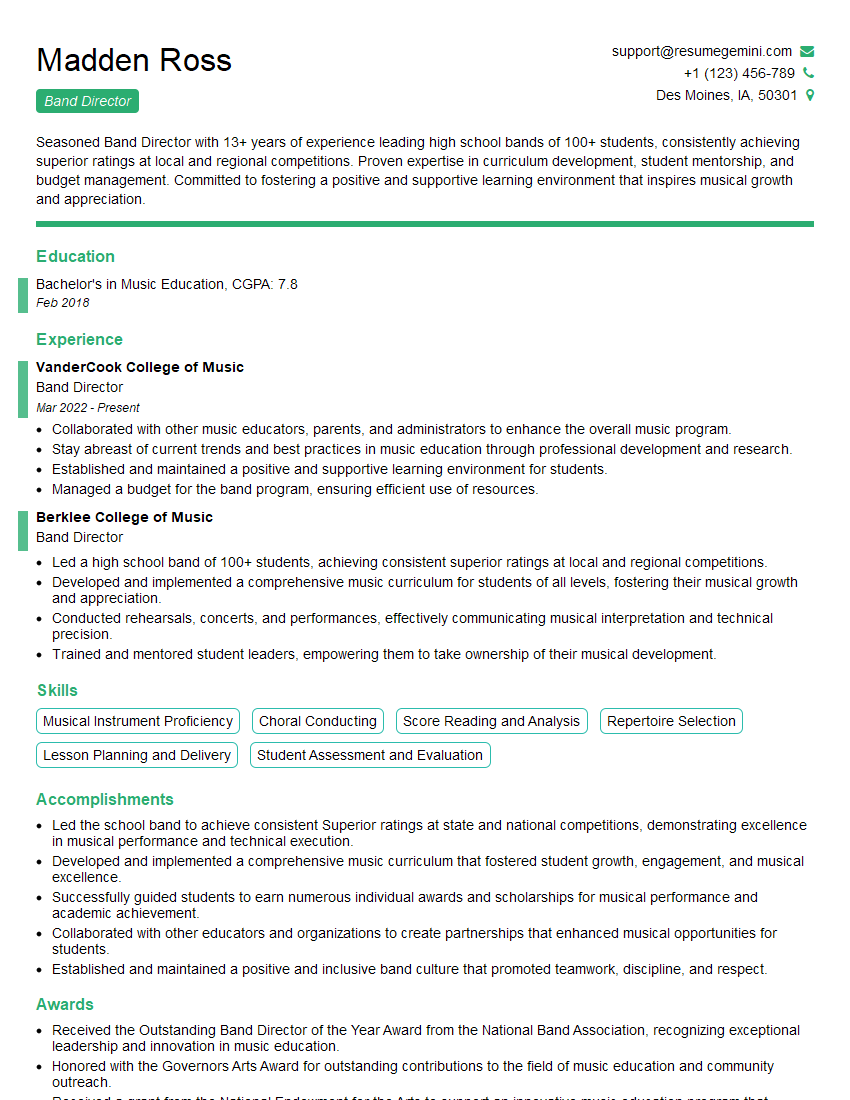
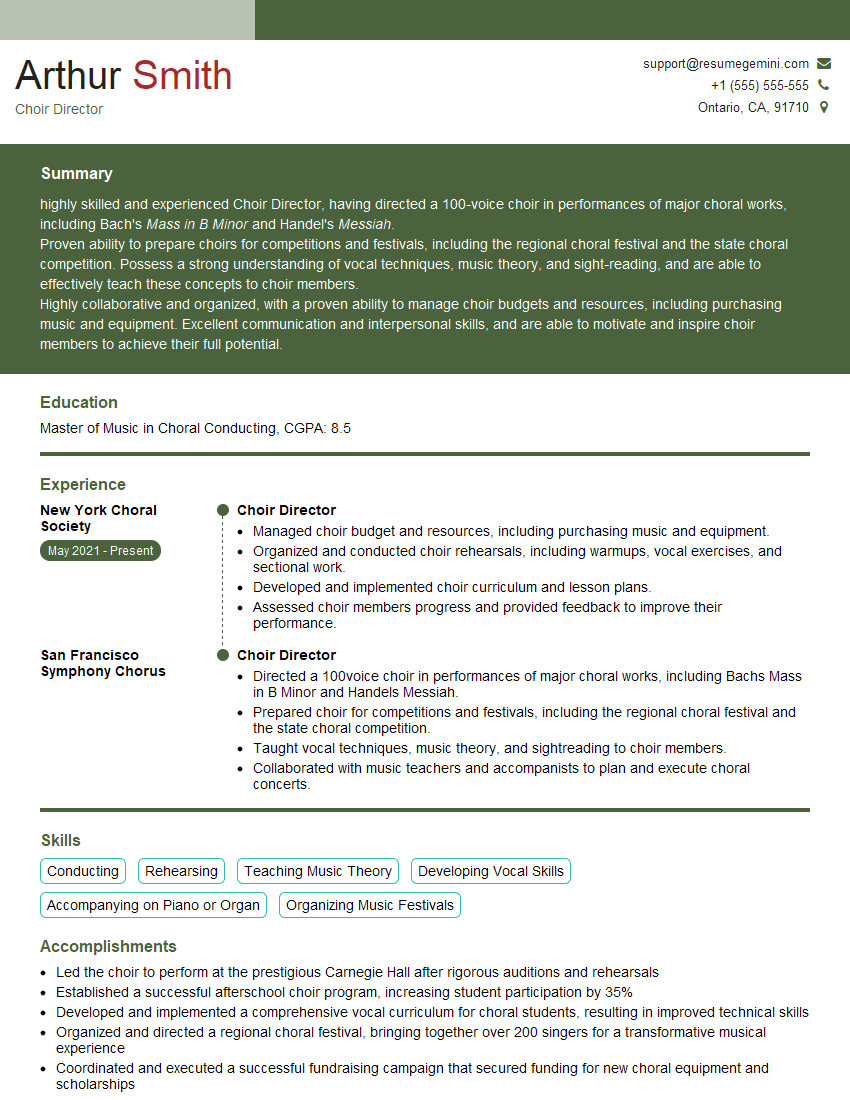
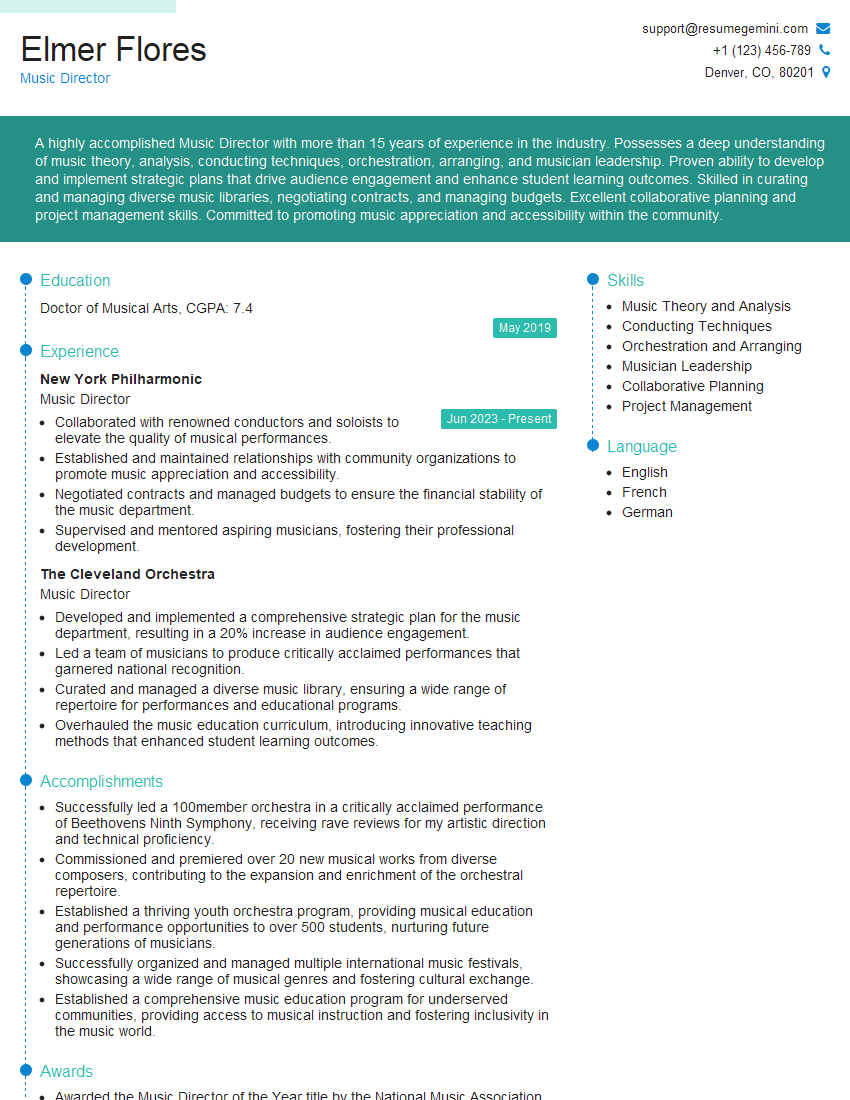
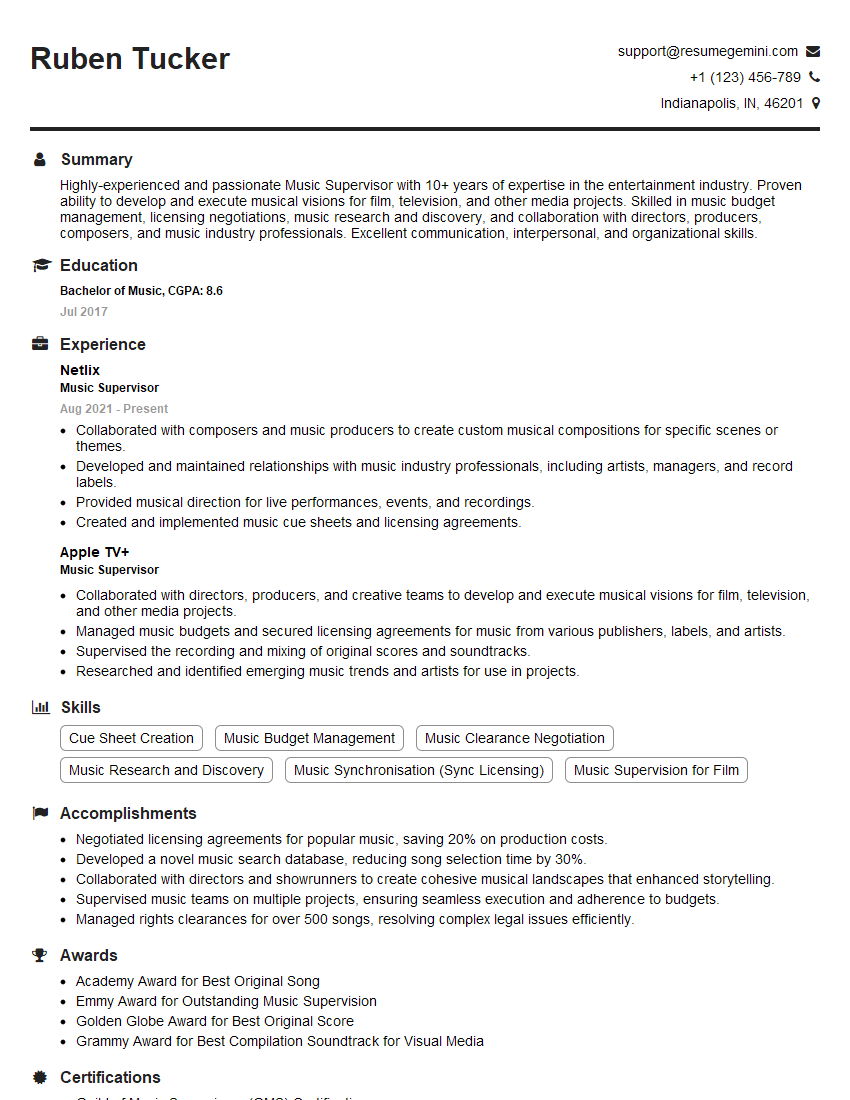
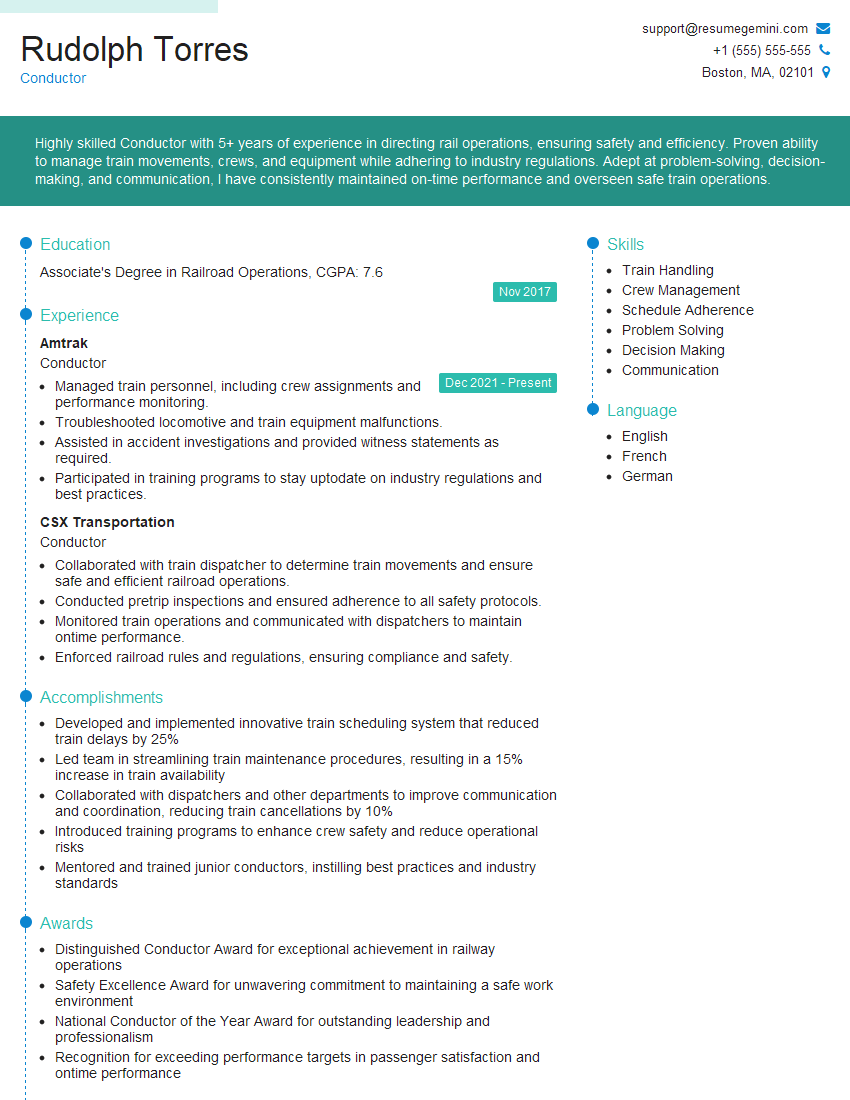
Mastering music direction and conducting opens doors to exciting career opportunities in orchestras, opera houses, theaters, and educational institutions. A strong resume is crucial for showcasing your skills and experience to potential employers. Creating an ATS-friendly resume increases your chances of getting noticed and landing an interview. ResumeGemini is a trusted resource that can help you craft a compelling and effective resume that highlights your unique talents and achievements. We provide examples of resumes tailored to Experience in Music Direction and Conducting to help guide you. Invest time in building a strong resume – it’s your first impression!
Explore more articles
Users Rating of Our Blogs
Share Your Experience
We value your feedback! Please rate our content and share your thoughts (optional).
What Readers Say About Our Blog
Very informative content, great job.
good