Are you ready to stand out in your next interview? Understanding and preparing for Experience in Music Engraving and Publishing interview questions is a game-changer. In this blog, we’ve compiled key questions and expert advice to help you showcase your skills with confidence and precision. Let’s get started on your journey to acing the interview.
Questions Asked in Experience in Music Engraving and Publishing Interview
Q 1. What music notation software are you proficient in (Sibelius, Finale, Dorico, etc.)?
I’m proficient in several music notation software packages, but my primary expertise lies in Sibelius and Finale. I’ve been using Sibelius for over 10 years, mastering its advanced features for large-scale projects, while my Finale experience is centered around its robust typesetting capabilities, particularly beneficial for complex scores. I’ve also worked with Dorico, appreciating its efficient workflow for modern composition, but my proficiency in Sibelius and Finale remains the strongest. Choosing the right software often depends on the project’s specific requirements – for instance, Sibelius’s excellent playback engine makes it ideal for composers, whereas Finale’s meticulous control over fine details is better suited for intricate engraving tasks.
Q 2. Describe your experience with music engraving software features such as text formatting, dynamic marking, and articulation.
My experience with advanced features like text formatting, dynamics, and articulation is extensive. For example, I routinely use Sibelius’s powerful text tools to create custom font styles for different sections of a score, ensuring consistent typography. When it comes to dynamics, I carefully manage the placement and sizing of crescendo and diminuendo markings to maintain visual clarity, even in dense passages. I also apply articulation markings with precision, considering their musical context and ensuring that they don’t clutter the score unnecessarily. I often use multiple layers of text to create consistent and clear markings even in densely packed passages. For example, I might use one layer for main dynamics, one for subtle dynamic shadings, and a separate layer for expression markings. The correct use of these features is key to creating a professional, easy-to-read score.
Consider the difference between a hastily placed crescendo and one carefully positioned and appropriately sized. A poorly placed or sized crescendo can be distracting to the performer and hinder their interpretation of the music. My attention to these details makes all the difference.
Q 3. How do you handle complex musical passages requiring multiple layers or intricate notation?
Handling complex passages involving multiple layers or intricate notation requires a systematic approach. I often use layers in Sibelius or Finale to separate different instrumental parts or musical ideas within a single system. This avoids clutter and allows me to manipulate individual parts independently. For instance, when engraving a dense orchestral passage, I might use separate layers for strings, woodwinds, brass, and percussion. Each layer allows for independent control over note placement, dynamics, and articulation, preventing accidental overlaps or conflicts. I also use the software’s layering functionality to create multiple instances of a specific instrument when necessary, without having to create completely separate staves.
Imagine engraving a fugue: Each voice needs to be clearly visible without overwhelming the page. Layer management becomes essential. I often create separate layers for each voice, enabling precise control over spacing and alignment. My approach ensures that the musical complexity is clearly reflected in the score without sacrificing readability.
Q 4. Explain your process for ensuring consistency in formatting and style throughout a musical score.
Maintaining consistency is paramount in music engraving. My process begins with establishing a style guide at the outset of a project, detailing specifications for spacing, font styles, dynamic markings, and other stylistic choices. This guide acts as a blueprint for the entire score. I then use the software’s style and template functions to automatically apply these specifications consistently throughout. Regular reviews and quality checks throughout the engraving process ensure that the style guide is meticulously adhered to. Inconsistencies, even minor ones, can disrupt the visual flow and detract from the overall professionalism of the score. I find it particularly helpful to create custom styles for various elements, allowing for seamless application and modification across the entire piece.
Think of it like building a house: a consistent architectural style ensures aesthetic harmony. In music engraving, consistent formatting creates a readable and pleasing score, enhancing the performer’s experience.
Q 5. How familiar are you with music copyright and licensing procedures?
I possess a solid understanding of music copyright and licensing procedures. I’m familiar with different copyright laws (e.g., US Copyright Act, international copyright treaties) and licensing agreements (e.g., mechanical licenses, synchronization licenses). I understand the importance of obtaining necessary permissions before engraving or publishing copyrighted music. I’m adept at navigating the complexities of copyright registration and ensuring that all legal requirements are met. Understanding these procedures is critical in ensuring the legal and ethical production of musical scores.
For instance, I understand the difference between a mechanical license needed for the reproduction of a musical composition and a synchronization license that allows the music to be used in a video or film production. This knowledge protects both the composer and the publisher.
Q 6. What are the common challenges faced during music engraving, and how have you overcome them?
One common challenge is handling scores with extreme dynamic ranges or complex rhythmic patterns. These can lead to visual clutter. I overcome this by strategically using spacing, layering, and visual cues like different font sizes or weights. Another challenge is integrating handwritten or scanned music into digital notation software. This often requires careful cleaning, editing, and often recreating sections. My approach involves meticulous transcription with error checks and constant cross-referencing against audio if available. Furthermore, collaborating with composers can present challenges. I address this by establishing clear communication protocols and regular feedback sessions, ensuring everyone is on the same page.
For example, a densely notated passage from a late Romantic orchestral work might require creative use of spacing and font size to maintain readability. In these cases, it’s not simply about replicating the original notation but about intelligently translating it into a clear and easy-to-read digital score.
Q 7. Describe your experience working with different musical styles and genres.
My experience spans various musical styles and genres, including classical, jazz, pop, folk, and contemporary music. I’ve worked on scores ranging from solo piano pieces to large-scale orchestral works, musicals, and film scores. This broad experience allows me to adapt my engraving techniques to the specific stylistic requirements of each genre. For example, a jazz score requires a different approach compared to a Baroque sonata, considering aspects like the use of notation, slurs, and articulations specific to each genre. The ability to adapt ensures that the final engraved score accurately reflects the composer’s stylistic intent and the inherent musical character of each piece.
For example, engraving a minimalist composition would demand a different approach compared to engraving a complex orchestral work by Mahler, reflecting the contrasting musical aesthetics and the need to match visual representation to stylistic choices. I always prioritize adapting my workflow to meet the unique demands of each musical style.
Q 8. How do you manage revisions and feedback during the engraving process?
Managing revisions and feedback is crucial for creating accurate and aesthetically pleasing music engravings. My approach involves a structured system combining clear communication, version control, and iterative refinement.
Firstly, I establish clear communication channels with the composer or client. This often involves regular check-in meetings or email exchanges to discuss their preferences and feedback. I use a dedicated annotation system within my engraving software, allowing for precise feedback placement directly on the score. Each revision is saved as a separate version, ensuring easy access to earlier iterations if necessary. For example, if a composer requests a change in phrasing, I annotate the specific passage, implement the changes, and then send the revised version for their review. This iterative process continues until the composer is entirely satisfied.
Furthermore, I maintain meticulous records of all revisions, including dates, descriptions of changes made, and any relevant communication. This detailed documentation is invaluable in resolving discrepancies or answering questions at a later stage. This meticulous approach ensures the final product meets the highest standards of accuracy and reflects the composer’s artistic vision.
Q 9. How would you handle a deadline conflict with multiple projects?
Juggling multiple deadlines requires effective prioritization and time management. My strategy involves a combination of project scheduling tools, realistic time estimations, and open communication.
I start by using a project management software (like Asana or Trello) to visualize all my projects and their respective deadlines. I meticulously break down each project into smaller, manageable tasks, assigning realistic timeframes to each. This allows for better tracking of progress and identification of potential bottlenecks. I then prioritize projects based on urgency and contractual obligations. For example, if one project has a more imminent deadline with significant penalties for delay, that takes precedence.
Open communication is vital. If I foresee a conflict, I proactively discuss the situation with my clients, explaining the potential delay and exploring options to manage expectations. This might involve adjusting deadlines, re-prioritizing tasks, or potentially subcontracting parts of the work to meet tight deadlines without compromising quality.
Q 10. What is your experience with preparing files for print or digital publication?
Preparing files for publication is a critical phase requiring in-depth knowledge of industry-standard formats and quality requirements. My experience encompasses both print and digital publication workflows.
For print publication, I meticulously prepare files in high-resolution PDF/X format, ensuring optimal quality for printing. This involves checking for font embedding, color profiles, and image resolution to guarantee accurate reproduction. For example, I always make sure all fonts are embedded to prevent font substitution issues during printing. The final file undergoes a thorough quality check to ensure that the layout is consistent, and there are no missing elements.
For digital publication, I prepare files compatible with various platforms like MusicXML and PDF. MusicXML offers a structured format useful for interactive scores and editing, whereas PDF provides a high-quality visual representation for viewing and downloading. I frequently use both formats depending on the publisher’s requirements and the intended user experience.
Q 11. What quality control measures do you employ to ensure accuracy in engraving?
Quality control is paramount in music engraving. My approach is multi-layered and involves meticulous checks at every stage of the process.
Firstly, I employ a rigorous proofreading method. This involves carefully checking for any errors in notation, rhythm, or articulation. I often use multiple passes, focusing on different aspects of the score in each pass, such as rhythm, pitch, and articulation independently. I use both software tools and manual checks to ensure complete accuracy.
Secondly, I leverage software features to automate certain checks. For example, many engraving programs offer tools to identify potential inconsistencies or errors in the notation. Finally, I conduct a final review, often involving a ‘fresh-eyes’ approach – taking a break before the final check allows for better error detection.
Q 12. How do you collaborate with composers, arrangers, and other musicians?
Collaboration is the cornerstone of successful music engraving. I foster strong working relationships with composers, arrangers, and musicians built on open communication and mutual respect.
My approach involves actively seeking feedback throughout the engraving process. This includes regular meetings or correspondence to discuss stylistic choices, technical details, and aesthetic preferences. I actively encourage composers to share their vision, ensuring that the final engraved score precisely reflects their artistic intent. For example, if a composer has a specific preference for a particular type of slurs, I will always incorporate that.
I adapt my communication style to suit the individual preferences of each collaborator. Some composers prefer detailed written communication, while others might prefer more informal discussions. Adaptability ensures seamless and productive collaborations.
Q 13. Explain your workflow for handling large-scale projects.
Managing large-scale projects necessitates a structured and organized workflow. My process involves meticulous planning, task delegation (if applicable), and consistent progress tracking.
Initially, I divide the project into smaller, manageable sections. This allows for easier tracking of progress and reduces the feeling of being overwhelmed by the sheer size of the project. Each section is then assigned a specific timeframe, and progress is monitored meticulously. I utilize project management software to streamline task assignment and keep everyone on the same page. For example, for a large orchestral score, I might divide it into individual movements or even sections within a movement.
Regular check-ins and communication with the client or team are integral to ensure the project remains on track. Any issues or challenges are addressed promptly, preventing delays or errors in the final product. This systematic approach guarantees that large, complex projects are executed efficiently and accurately.
Q 14. What is your experience with music publishing contracts?
My experience with music publishing contracts is extensive, covering various aspects from copyright considerations to royalty structures. I’m familiar with the complexities of different agreement types, including exclusive and non-exclusive publishing deals.
I understand the importance of clearly defined terms and conditions within a contract, including the scope of rights granted to the publisher, payment terms, and the duration of the agreement. I ensure that contracts accurately reflect the agreement between the composer and publisher, protecting the interests of both parties. For example, I am familiar with different royalty structures, such as mechanical royalties for recordings and print royalties for sheet music sales. I know how these can be tailored to suit specific circumstances.
Furthermore, I am aware of the legal implications of copyright and related rights, understanding the composer’s rights and the publisher’s responsibilities in upholding these rights. A clear understanding of legal frameworks is crucial for ensuring a smooth and legally sound publishing process.
Q 15. How familiar are you with different music publishing models (e.g., print, digital, subscription) ?
Music publishing models have evolved significantly, moving beyond traditional print to encompass digital distribution and subscription services. Understanding these models is crucial for effective music engraving and publishing.
- Print Publishing: This traditional method involves printing scores and selling physical copies. It’s still relevant for specific markets, like orchestral scores or high-quality sheet music for educational institutions, but it faces challenges from digital alternatives in terms of cost and distribution.
- Digital Publishing: This involves distributing music scores electronically, often as PDFs, interactive scores (using notation software like Sibelius or Dorico), or through online platforms. This offers greater accessibility and lower production costs, allowing for wider distribution and potentially greater reach to potential customers.
- Subscription Models: These models offer access to a library of scores for a recurring fee. This is becoming increasingly common, especially for educational institutions or individual musicians needing access to a wide variety of music. Think of it like Spotify or Netflix, but for sheet music.
My experience encompasses all three models. I’ve worked on projects requiring traditional print publication, managed the digital distribution of scores through online platforms, and even contributed to the development of a subscription-based library for a major music educational publisher. Understanding the nuances of each model, from file format requirements to copyright considerations, is vital for success in modern music publishing.
Career Expert Tips:
- Ace those interviews! Prepare effectively by reviewing the Top 50 Most Common Interview Questions on ResumeGemini.
- Navigate your job search with confidence! Explore a wide range of Career Tips on ResumeGemini. Learn about common challenges and recommendations to overcome them.
- Craft the perfect resume! Master the Art of Resume Writing with ResumeGemini’s guide. Showcase your unique qualifications and achievements effectively.
- Don’t miss out on holiday savings! Build your dream resume with ResumeGemini’s ATS optimized templates.
Q 16. Describe your understanding of music copyright laws.
Music copyright law protects the rights of composers and publishers to their original musical works. It’s a complex area with both national and international dimensions, but at its core, it grants the copyright holder exclusive rights to reproduce, distribute, perform, and display their work.
Understanding copyright is essential for anyone involved in music publishing. For instance, it dictates how we handle permissions for the reproduction of musical works. We need to ensure that any publication is legally sound and that appropriate royalties are paid to the copyright holder, whether it’s the composer or their designated publishing house.
I’m familiar with the intricacies of copyright law, including the duration of copyright protection, fair use exceptions, and the process of obtaining necessary licenses for reproduction and distribution. This includes understanding the differences between copyright for a musical composition and the copyright for a particular arrangement of that composition.
A common scenario I deal with is obtaining mechanical licenses when a musical work will be recorded. This requires navigating complex legal frameworks and ensuring all permissions are in place before the project can move forward. Ignoring copyright laws could lead to serious legal repercussions, including lawsuits and hefty fines.
Q 17. How do you manage music metadata and catalog information?
Efficient music metadata management is paramount. It ensures accurate identification, retrieval, and distribution of musical works. This usually involves using metadata standards and appropriate databases.
I utilize standardized metadata schemas like MusicXML for detailed information on individual scores. This includes the composer’s name, title, instrumentations, opus number, and copyright details. Further, I utilize dedicated database systems to manage a catalog, ensuring quick and easy retrieval of specific scores. This might involve relational databases (like MySQL or PostgreSQL) or specialized music cataloging software. This database tracks not only the metadata, but also crucial information like publication status, licensing agreements, and sales data.
For example, if a publisher requests an update to an existing score, the accurate and readily accessible metadata helps pinpoint the correct version and allows for a swift response. Without this, it’s like searching for a needle in a haystack.
Q 18. How would you address a discrepancy between the composer’s intentions and the existing notation?
Discrepancies between composer intentions and existing notation are a common challenge. It requires careful consideration, research, and often, communication with the composer.
My approach involves first thoroughly examining the existing notation and any available documentation (like sketches, recordings, or correspondence) to understand the context. I then might consult scholarly materials, recordings of similar works by the composer, or even contact the composer directly (if possible) to clarify their intentions. I’d meticulously document all my findings and any decisions made, which often involves writing detailed annotations within the score itself, justifying my changes and ensuring transparency.
A practical example would be addressing ambiguous phrasing or dynamics in a score. I would analyze the overall context of the piece, consider the composer’s style, and potentially consult recordings if available to determine the most appropriate interpretation. Ultimately, respecting the composer’s artistic vision while presenting a clear and consistent score is the goal, and full documentation is key.
Q 19. What is your familiarity with music libraries and archival systems?
My familiarity with music libraries and archival systems is extensive. I understand the importance of preserving and accessing musical works for research, performance, and educational purposes.
I have experience with various library catalogs and databases, including those maintained by national libraries, academic institutions, and specialized music archives. I know how to navigate different cataloging systems, use search terms effectively, and interpret bibliographic information relevant to scores and other musical materials. This includes understanding different types of music archives—from digital repositories to physical collections—and their strengths and limitations.
In my work, I’ve utilized both online databases (like RISM) and visited physical archives to research musical works. This understanding is particularly vital when working on historic editions or when seeking to verify the authenticity of a score.
Q 20. How do you troubleshoot technical issues related to music notation software?
Troubleshooting technical issues in music notation software is an integral part of the job. It requires a systematic approach and a strong understanding of the software’s functionalities.
My strategy is to first identify the problem precisely. Is it a software glitch, a user error, or a compatibility issue? I then try the basic troubleshooting steps like restarting the software or checking for updates. If that doesn’t solve the problem, I systematically explore possible causes:
- File corruption: Attempting to open the score in a different software or creating a new file and transferring the elements.
- Plugin conflicts: Disabling plugins one by one to see if that resolves the issue.
- System resource limitations: Checking for sufficient RAM and disk space.
- Software bugs: Checking online forums or contacting the software developer’s support team.
For example, a common issue is unexpected behavior in playback. I’ve often found the solution lies in verifying the correct instrument assignments or checking for unintended MIDI controller data.
Q 21. Describe your experience with proofreading and editing music scores.
Proofreading and editing music scores demands meticulous attention to detail and a deep understanding of musical notation. It’s a crucial stage to ensure accuracy and clarity.
My approach involves multiple passes through the score, checking different aspects:
- Accuracy of notation: Ensuring proper rhythm, pitch, articulation, and dynamics are accurately represented.
- Consistency of style: Maintaining a unified style throughout the score regarding notation conventions, spacing, and layout.
- Clarity and readability: Ensuring that the score is easily understandable and visually appealing to the performer.
- Technical correctness: Checking for any technical errors, such as incorrect clef changes or accidental omissions.
I work collaboratively with composers, checking for their feedback at each stage. Often, a second pair of eyes are needed to catch subtle errors, and this collaborative approach allows for a superior final product. This process isn’t just about finding mistakes, but ensuring a seamless and enjoyable experience for the performer.
Q 22. How do you ensure the accessibility of your engraved scores (e.g., for visually impaired musicians)?
Ensuring accessibility for visually impaired musicians is paramount in music engraving. It’s not just about creating a beautiful score; it’s about making music inclusive. My approach involves several key strategies. Firstly, I utilize MusicXML, a standardized format that allows for the creation of digital scores readable by screen readers. This allows software designed for the visually impaired to interpret the musical notation accurately, including pitch, rhythm, and dynamics. Secondly, I meticulously add descriptive text within the MusicXML file detailing the musical context and providing cues for navigation. Think of it like adding captions to a video – it provides crucial information for understanding the score. For example, I’d describe complex chord progressions or explain nuances in phrasing. Thirdly, I ensure sufficient contrast between the notation and the background in the printed or digital version to enhance readability, often using larger fonts and bolder lines where appropriate. Finally, I collaborate with organizations specializing in accessibility to ensure my techniques meet the highest standards, and I routinely test the score’s readability using assistive technologies. A recent project involved a challenging contemporary piece; creating detailed descriptions of the unconventional notation was key to making it accessible.
Q 23. What are the differences between engraving for concert scores and for teaching materials?
Engraving for concert scores and teaching materials differs significantly in their focus and design. Concert scores prioritize elegance and clarity for professional musicians. They need to be aesthetically pleasing and instantly understandable, often with minimal clutter. Think of the scores used by a symphony orchestra – they need to be efficient, yet sophisticated. For example, system breaks (page breaks) are carefully planned to avoid interrupting musical phrases. Conversely, teaching materials prioritize pedagogical clarity. They often include extra elements to aid learning, such as fingerings, articulations, rhythmic explanations, and chord symbols, even for more advanced students. A simplified arrangement for beginners would prioritize readability and ease of understanding over a purely aesthetically pleasing layout. One project involved creating a concert score for a string quartet and a simplified version for students, highlighting the different approaches needed for each.
Q 24. Explain your experience with creating different types of musical scores (e.g., full scores, parts, lead sheets).
My experience spans a broad range of musical score types. I’m proficient in creating full scores, which encompass all instrumental parts in a single document. This requires a deep understanding of orchestration and voice leading to ensure clarity and balance. I also routinely create individual parts, extracting the appropriate lines from the full score for each instrument or voice. Accuracy is vital here, as a single mistake can disrupt a performance. Furthermore, I’ve prepared lead sheets, simplified arrangements that show melody, chords, and lyrics, primarily for singers or small ensembles, ideal for quick learning and rehearsal. Recently, I worked on a project involving a full orchestral score, individual parts for each section, and a piano reduction for a solo recital, demonstrating my ability to adapt my engraving to a variety of formats. The process requires careful organization and attention to detail to ensure consistency across all versions.
Q 25. How familiar are you with different musical clefs, key signatures, and time signatures?
My familiarity with musical notation is extensive. I possess a thorough understanding of various clefs (treble, bass, alto, tenor), key signatures (major and minor), and time signatures (simple, compound, irregular). I can accurately interpret and reproduce complex rhythmic and melodic patterns, including those found in various historical periods and musical styles. I understand the nuances of each clef’s range, the implications of different key signatures on pitch, and the rhythmic implications of different time signatures. I regularly use these elements to create accurate and readable scores. A recent project involved a piece utilizing multiple clefs and unusual time signatures, requiring precise attention to detail to ensure accurate engraving.
Q 26. What is your experience with preparing music for various instrumental ensembles?
I have extensive experience preparing music for diverse instrumental ensembles, including string quartets, orchestras, wind bands, jazz combos, and chamber ensembles. My work involves not only the accurate transcription and engraving of the music but also the careful consideration of each instrument’s capabilities and idiomatic writing styles. For instance, I need to consider the technical limitations of instruments and ensure the music is playable and comfortable. This necessitates understanding of instrument ranges and voicings. For large ensembles like orchestras, balancing the different instrumental sections is crucial. I’ve worked on many projects for different types of ensembles requiring adaptations and careful consideration to each instrument. For example, I once worked on a piece requiring special notation for a rare instrument, demonstrating my adaptability and depth of knowledge.
Q 27. How do you manage version control for music scores?
Version control in music engraving is crucial, especially in collaborative projects. I utilize a combination of strategies to manage different revisions and iterations of a score. I rely heavily on dedicated music notation software that offers built-in version history, allowing me to revert to previous versions if necessary. I also employ a robust file naming system incorporating date and revision numbers (e.g., ‘score_v1.2_2024-10-27.musicxml’). For larger projects, I use external version control systems like Git, which provides comprehensive tracking of changes and facilitates collaboration among multiple engravers. Furthermore, I maintain detailed documentation outlining the changes made in each revision, allowing for easy tracking of modifications and ensuring clarity for collaborators. This meticulous approach prevents errors and ensures the project maintains integrity across multiple iterations.
Q 28. Describe your approach to staying current with new technologies and trends in music engraving and publishing.
Staying current in this field requires continuous learning. I actively participate in online forums, attend industry conferences, and subscribe to relevant journals to stay informed about new software updates, innovative engraving techniques, and emerging trends. I regularly experiment with new software features and explore different workflows to enhance my efficiency and the quality of my work. I also participate in online communities of music engravers to exchange ideas and best practices. I also stay updated with software advancements and new technologies by regularly checking for new versions, updates and exploring new features to make my process more efficient and effective. A recent example is learning the latest advancements in AI for music composition assistance.
Key Topics to Learn for Your Music Engraving and Publishing Interview
- Music Notation Software Proficiency: Understanding the nuances of various notation software (Sibelius, Finale, Dorico, etc.) including advanced features like engraving styles, score layout, and automated processes. Practical application: Be prepared to discuss specific software you’ve used and projects where you leveraged its capabilities.
- Music Theory and Compositional Understanding: A strong grasp of music theory is crucial for accurate engraving and effective communication with composers. Practical application: Be ready to explain how theoretical knowledge informs your engraving decisions, ensuring clarity and correctness in the final product.
- Copyright and Licensing: Familiarity with music publishing rights, copyright laws, and licensing agreements is vital. Practical application: Discuss your experience handling copyright information and understanding the implications for published works.
- Workflow and Collaboration: Understanding efficient workflows, including collaboration with composers, editors, and other stakeholders. Practical application: Describe your approach to project management and communication in a collaborative environment.
- Typesetting and Layout: Mastering the art of creating clean, readable, and aesthetically pleasing scores. Practical application: Explain your process for ensuring consistent formatting and visual appeal across different projects.
- Proofreading and Quality Control: The importance of meticulous proofreading and quality control to ensure accuracy and error-free publications. Practical application: Describe your methods for identifying and correcting errors in musical notation and layout.
- File Management and Archiving: Efficiently managing and archiving project files for easy retrieval and future use. Practical application: Discuss your strategies for organizing digital assets and maintaining version control.
Next Steps
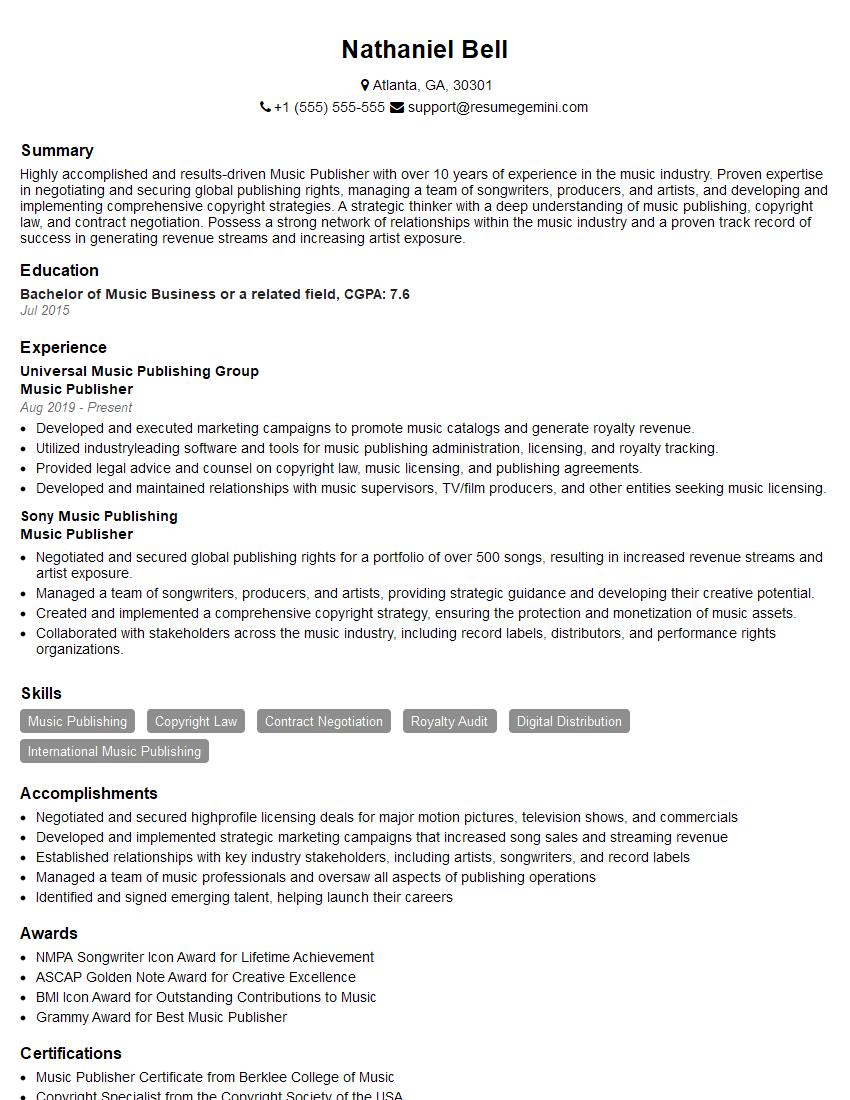
Mastering music engraving and publishing skills significantly enhances your career prospects in the music industry, opening doors to diverse roles with greater responsibility and earning potential. An ATS-friendly resume is crucial for getting your application noticed. To maximize your chances, leverage ResumeGemini to craft a compelling and effective resume that highlights your skills and experience. ResumeGemini provides examples of resumes tailored specifically to music engraving and publishing roles, offering valuable guidance and inspiration to help you stand out from the competition.
Explore more articles
Users Rating of Our Blogs
Share Your Experience
We value your feedback! Please rate our content and share your thoughts (optional).
What Readers Say About Our Blog
Very informative content, great job.
good