Cracking a skill-specific interview, like one for Solar Cell and Module Technologies, requires understanding the nuances of the role. In this blog, we present the questions you’re most likely to encounter, along with insights into how to answer them effectively. Let’s ensure you’re ready to make a strong impression.
Questions Asked in Solar Cell and Module Technologies Interview
Q 1. Explain the working principle of a silicon solar cell.
A silicon solar cell works by harnessing the photovoltaic effect. When sunlight strikes a silicon wafer, photons (light particles) excite electrons in the silicon’s crystalline structure. Silicon is a semiconductor; it’s neither a good conductor nor a good insulator. We engineer it by creating a p-n junction. This is done by doping one side of the silicon with a material that introduces extra holes (positive charge carriers, p-type), and the other side with a material that introduces extra electrons (negative charge carriers, n-type).
When light hits the p-n junction, the excited electrons move from the p-side to the n-side, leaving behind positive holes. This creates an electric field across the junction. This electric field pushes the electrons towards the n-side and the holes towards the p-side, creating a voltage difference. If you connect a load (like a light bulb or battery) across the solar cell’s terminals, this voltage drives a current, generating electricity. Think of it like a one-way valve for electrons, powered by sunlight.
The electrons flow through an external circuit, performing useful work before returning to the p-side of the cell, completing the circuit. The process continues as long as sunlight is available.
Q 2. What are the different types of solar cells and their respective advantages and disadvantages?
Solar cells come in various types, each with its pros and cons:
- Crystalline Silicon (c-Si): This is the most common type, further divided into monocrystalline (single crystal, most efficient but expensive) and polycrystalline (multiple crystals, less efficient but cheaper). Advantages: High efficiency, mature technology, readily available. Disadvantages: Monocrystalline is expensive, polycrystalline has lower efficiency.
- Thin-Film Solar Cells: These use thin layers of semiconductor material, such as cadmium telluride (CdTe), copper indium gallium selenide (CIGS), or amorphous silicon (a-Si). Advantages: Flexible, lightweight, lower manufacturing cost. Disadvantages: Lower efficiency compared to c-Si, potential environmental concerns with some materials (like CdTe).
- Perovskite Solar Cells: A relatively new type using perovskite materials, which offer potential for high efficiency and low cost. Advantages: High power conversion efficiency potential, low manufacturing cost potential, flexible and lightweight. Disadvantages: Still under development, long-term stability remains a challenge, some materials contain lead, raising environmental concerns.
- Organic Solar Cells (OPVs): Made from organic polymers or small molecules. Advantages: Flexible, lightweight, potentially low cost, can be printed on various substrates. Disadvantages: Lower efficiency than other types, limited lifespan, sensitive to environmental factors.
The choice of solar cell type depends on various factors like cost, efficiency requirements, application (e.g., rooftop installation vs. space application), and environmental considerations.
Q 3. Describe the process of solar cell manufacturing.
The manufacturing process varies depending on the type of solar cell. For crystalline silicon cells, it generally involves these steps:
- Silicon Ingot Growth: High-purity silicon is melted and then solidified into large cylindrical ingots using the Czochralski (CZ) method for monocrystalline silicon or directional solidification for polycrystalline silicon.
- Wafer Slicing: The ingots are sliced into thin wafers using diamond wire saws.
- Surface Texturing: The wafer surface is textured to increase light trapping.
- Diffusion/Ion Implantation: Dopants (like phosphorus and boron) are introduced to create the p-n junction.
- Metallization: Metal contacts (usually silver and aluminum) are deposited to collect the generated current.
- Anti-Reflective Coating: A thin layer of material is applied to reduce light reflection.
- Testing and Sorting: Finished cells are tested to determine their performance characteristics, and sorted by efficiency.
Thin-film solar cell manufacturing involves different techniques like sputtering, chemical vapor deposition, or screen printing, depending on the material used. Each type of cell has its unique intricacies and production processes, and many steps involve sophisticated equipment and cleanroom environments.
Q 4. What are the key parameters used to characterize solar cell performance?
Key parameters characterizing solar cell performance include:
- Short-Circuit Current (Isc): The current flowing when the cell’s terminals are shorted (0V). It reflects the amount of light absorbed and converted to charge carriers.
- Open-Circuit Voltage (Voc): The voltage across the cell’s terminals when no current flows (open circuit). It’s determined by the semiconductor material and junction properties.
- Fill Factor (FF): A measure of the cell’s quality, indicating how rectangular the I-V curve is. It represents the ratio of the maximum power point to the product of Isc and Voc.
- Efficiency (η): The overall efficiency of the cell, calculated as the product of Isc, Voc, and FF, divided by the incident light power. It shows how well the cell converts sunlight into electricity.
- Temperature Coefficient of Voc and Isc: These describe how Voc and Isc change with temperature.
These parameters are crucial for evaluating the performance and comparing different solar cells. For example, a high fill factor indicates less energy loss within the cell.
Q 5. Explain the concept of anti-reflective coatings in solar cells.
Anti-reflective coatings (ARCs) are crucial because a significant portion of sunlight is reflected from the solar cell surface due to the difference in refractive indices between air and silicon. This reflection reduces the amount of light absorbed and consequently the power generated.
ARCs work by reducing this reflection. They are typically thin layers of materials with a refractive index between that of air and silicon. By carefully choosing the thickness and refractive index of the coating, we create interference effects that minimize the reflected light. Imagine light waves interfering destructively, canceling out the reflected light, allowing more light to enter the silicon and contribute to current generation.
Common ARC materials include silicon nitride (Si3N4) and titanium dioxide (TiO2). The application of ARCs significantly boosts the efficiency of solar cells.
Q 6. How do you measure the efficiency of a solar cell?
Solar cell efficiency is measured by characterizing its current-voltage (I-V) curve under standard test conditions (STC) – typically 1000 W/m² irradiance, 25°C cell temperature, and AM 1.5 solar spectrum. The I-V curve is obtained by measuring the current and voltage at various points while illuminating the cell.
The efficiency (η) is calculated as:
η = (Vmp * Imp) / (Pin) * 100%
where:
Vmpis the voltage at the maximum power point.Impis the current at the maximum power point.Pinis the incident light power (typically 1000 W/m² under STC).
The maximum power point (Vmp, Imp) is determined from the I-V curve, representing the highest power output the cell can produce. Specialized equipment, such as solar simulators and I-V curve tracers, are used in this measurement.
Q 7. What are the common defects found in solar cells and how are they identified?
Common defects in solar cells can significantly impact their performance and lifespan. These defects can be broadly classified into:
- Microcracks: Tiny cracks in the silicon wafer, reducing the effective area and leading to current leakage.
- Shunts: Low-resistance paths across the p-n junction, causing current leakage and reduced voltage.
- Metallization defects: Poor contact between the metal grid and the silicon, leading to higher resistance and reduced current collection.
- Contaminants: Impurities in the silicon material, affecting carrier recombination and reducing efficiency.
- LID (Light Induced Degradation): A phenomenon where efficiency decreases after exposure to light.
Defect identification involves various techniques, including:
- Visual inspection: Using microscopes to identify microcracks and metallization defects.
- Electroluminescence (EL) imaging: Applying voltage and observing light emission patterns to reveal shunts and other defects.
- Infrared (IR) thermography: Detecting temperature variations due to shunts or other localized heating.
- I-V curve analysis: Analyzing the shape of the I-V curve to identify shunts and other performance issues.
Early detection and mitigation of these defects are crucial for ensuring high-quality and reliable solar cells.
Q 8. Explain the different types of solar modules and their applications.
Solar modules come in various types, each suited to different applications. The most common distinctions are based on cell technology and module configuration.
- Crystalline Silicon Modules: These are the most prevalent type, further divided into monocrystalline and polycrystalline modules. Monocrystalline modules use single-crystal silicon, resulting in higher efficiency (typically 18-22%) but higher cost. They are ideal for space-constrained applications where maximizing power output is crucial, like residential rooftops or smaller commercial projects. Polycrystalline modules utilize multiple silicon crystals, offering lower cost and slightly lower efficiency (typically 15-17%). They are suitable for larger-scale projects where cost-effectiveness is prioritized.
- Thin-Film Modules: These modules use thin layers of photovoltaic material deposited on a substrate (like glass or flexible plastic). Types include amorphous silicon (a-Si), cadmium telluride (CdTe), and copper indium gallium selenide (CIGS). Thin-film modules are generally less efficient than crystalline silicon but can be more flexible and cost-effective, making them suitable for building-integrated photovoltaics (BIPV) or applications requiring flexible panels.
- Perovskite Modules: This emerging technology uses perovskite materials, which are known for their potential for high efficiency and low manufacturing costs. However, long-term stability and scalability are still under development. Perovskites are promising for niche applications and are showing significant potential in tandem cells with Silicon cells.
The choice of module type depends on factors such as budget, available space, aesthetic considerations, and the desired power output. For instance, a homeowner might choose monocrystalline modules for their higher efficiency despite the higher initial cost, while a large-scale solar farm might opt for polycrystalline modules to minimize overall investment.
Q 9. Describe the process of solar module assembly.
Solar module assembly is a multi-step process that involves several key stages:
- Cell Preparation: Silicon solar cells are inspected and sorted based on their performance characteristics. Any defective cells are discarded.
- Stringing: Individual cells are connected in series using conductive ribbons or wires to form strings. This process requires precision to ensure proper electrical contact and minimize energy losses.
- Tabbing: The strings of cells are then connected to larger busbars, typically using silver paste or other conductive materials, creating a more robust electrical connection.
- Encapsulation: The cell strings are embedded in a protective layer of ethylene-vinyl acetate (EVA) sheets and then laminated between a front glass sheet and a backsheet. This step is crucial for protecting the cells from environmental factors.
- Framing: An aluminum frame is attached to the laminated module, providing structural support and ease of handling during installation. Junction boxes are also added, providing connection points for electrical wiring.
- Testing: After assembly, each module undergoes rigorous testing to ensure it meets performance specifications and quality standards. This includes checks for electrical parameters, mechanical integrity, and visual inspection.
Imagine building a sandwich: the cells are the filling, the EVA is the soft bread, and the glass and backsheet are the outer slices. This ‘sandwich’ is then encased in a sturdy frame to complete the solar module.
Q 10. What are the different types of encapsulation materials used in solar modules?
Encapsulation materials in solar modules serve to protect the solar cells from the elements and maintain their performance. Key encapsulation materials include:
- Ethylene-Vinyl Acetate (EVA): This is the most common encapsulant, a transparent thermoplastic polymer that provides excellent adhesion to cells, glass, and backsheet while protecting against moisture and UV radiation.
- Polyvinyl butyral (PVB): Offers better UV and temperature resistance compared to EVA, resulting in superior long-term durability. However, it is generally more expensive.
- Silicone: Suitable for high-temperature applications and offers excellent flexibility and UV resistance. Silicone encapsulants are often used for flexible solar modules or those exposed to extreme temperature variations.
- Tedlar (PVF): A type of fluoropolymer commonly used as a backsheet. It’s known for its durability, moisture resistance, and UV resistance.
The choice of encapsulation material depends on factors such as module design, cost, and the desired performance characteristics. For instance, PVB might be chosen for modules in harsh climates, while EVA remains popular due to its cost-effectiveness.
Q 11. How do you test the performance of a solar module?
Solar module performance testing is critical to ensure quality and reliability. Testing involves several steps:
- I-V Curve Measurement: This measures the current-voltage characteristics of the module under different illumination conditions, providing data on its short-circuit current (Isc), open-circuit voltage (Voc), maximum power point (MPP), and fill factor (FF). These parameters are crucial for determining the module’s efficiency.
- Power Output Measurement: Determines the actual power generated by the module under standard test conditions (STC), typically 1000 W/m² irradiance, 25°C cell temperature, and AM1.5 solar spectrum.
- Spectral Response Measurement: This determines the module’s sensitivity to different wavelengths of light.
- Thermal Cycling Testing: This evaluates the module’s ability to withstand temperature variations, simulating real-world operating conditions.
- Damp Heat Testing: This tests the module’s resistance to humidity and high temperatures.
- Potential Induced Degradation (PID) Testing: This evaluates the module’s susceptibility to PID, a degradation mechanism that can affect the module’s performance over time.
- Mechanical Load Tests: Checks for mechanical integrity and strength, simulating wind loads and snow loads.
These tests ensure that the module meets the specified performance standards and can withstand the rigors of real-world operation.
Q 12. What are the common failure modes of solar modules?
Solar modules can fail due to various reasons, categorized as:
- Cell Degradation: This can occur due to manufacturing defects, prolonged exposure to UV radiation, high temperatures, or PID.
- Encapsulation Failure: Cracks or delamination in the EVA, glass breakage, or backsheet degradation can lead to moisture ingress, cell degradation, and reduced performance.
- Bypass Diode Failure: Bypass diodes protect individual cells from excessive reverse voltage. Failure of these diodes can lead to hot spots, potentially causing further damage or even fire hazards.
- Connector Problems: Loose connections, corrosion, or damage to the connectors can significantly affect module performance.
- Mechanical Damage: Physical damage from hail, wind, or impacts can cause cracks in the glass or cells, leading to performance degradation.
Understanding these common failure modes helps in proactive maintenance, selecting appropriate modules for the environment, and extending the lifespan of the solar energy system.
Q 13. Explain the concept of bypass diodes in solar modules.
Bypass diodes are incorporated into solar modules to protect individual cells from reverse voltage and prevent hot spots. Imagine a string of Christmas lights – if one bulb goes out, the entire string goes dark. Bypass diodes act like a ‘shunt’ path around a faulty cell. When a cell is shaded or damaged, it can develop a reverse voltage, which can overheat and potentially damage neighboring cells. Bypass diodes allow current to bypass the faulty cell, keeping the rest of the module operating efficiently. This prevents cascading failures and safeguards the overall performance of the module.
Each bypass diode is typically placed parallel to a group of cells (often 36). When a cell fails or becomes shaded, current bypasses the faulty area, preventing the accumulation of heat, thereby protecting the module from damage and maintaining its overall efficiency.
Q 14. Describe the different types of solar inverters and their functions.
Solar inverters convert the direct current (DC) electricity generated by solar panels into alternating current (AC) electricity, which is what most homes and businesses use. There are several types:
- String Inverters: These are the most common and cost-effective type. They connect to a single string of solar panels and are simpler to install. However, if one panel in the string fails or is shaded, the entire string’s output is affected.
- Microinverters: These are small inverters that are attached to each individual solar panel. They maximize energy harvest even if one panel is shaded, and offer superior monitoring capabilities. However, they are more expensive than string inverters.
- Power Optimizers: These devices sit between the solar panels and the string inverter and provide similar benefits to microinverters, but are typically less expensive and more flexible than microinverters.
- Central Inverters: These large inverters are used in large-scale solar power plants. They’re highly efficient but require extensive cabling.
The choice of inverter type depends on the size and complexity of the solar system, budget, and the desired level of monitoring and performance optimization. For example, a homeowner with a small rooftop system might opt for a string inverter for its simplicity and cost-effectiveness, while a large commercial installation might use central inverters for efficiency.
Q 15. What are the safety precautions to be followed while working with solar panels?
Working with solar panels involves inherent risks, primarily due to the high voltages and currents they handle. Safety should always be the top priority. Here are key precautions:
- Always assume the panels are energized: Never touch any part of a solar panel system without first verifying it’s completely de-energized by a qualified electrician.
- Use appropriate Personal Protective Equipment (PPE): This includes insulated gloves, safety glasses, and closed-toe shoes. For larger systems, consider a hard hat and arc flash protection.
- Understand the system’s electrical layout: Familiarize yourself with the wiring diagram before working on any part of the system. Knowing where the disconnect switches are crucial in case of emergencies.
- Work in teams: Never work alone on a solar panel system. Having a colleague nearby ensures immediate assistance if an accident occurs.
- Follow all applicable codes and regulations: Adhere to local electrical codes, national standards (like NEC in the US), and manufacturer’s instructions.
- Proper grounding and bonding: Ensure the system is properly grounded to prevent electrical shocks and protect against lightning strikes.
- Avoid working during inclement weather: Rain, snow, or strong winds can create hazardous conditions and increase the risk of electrical shock.
For instance, a common mistake is assuming a disconnected panel is safe. However, residual capacitance can still hold a dangerous charge, requiring careful discharge procedures.
Career Expert Tips:
- Ace those interviews! Prepare effectively by reviewing the Top 50 Most Common Interview Questions on ResumeGemini.
- Navigate your job search with confidence! Explore a wide range of Career Tips on ResumeGemini. Learn about common challenges and recommendations to overcome them.
- Craft the perfect resume! Master the Art of Resume Writing with ResumeGemini’s guide. Showcase your unique qualifications and achievements effectively.
- Don’t miss out on holiday savings! Build your dream resume with ResumeGemini’s ATS optimized templates.
Q 16. Explain the concept of Maximum Power Point Tracking (MPPT).
Maximum Power Point Tracking (MPPT) is a technique used in solar power systems to maximize the energy harvested from solar panels. Solar panels don’t produce their maximum power output at a single voltage and current; their output depends on solar irradiance (sunlight intensity) and temperature.
The MPPT algorithm constantly monitors the voltage and current produced by the panel and adjusts the load (usually an inverter) to operate at the point where the product of voltage and current (power) is maximized. Think of it like finding the highest point on a hill – the MPPT algorithm continuously searches for that peak power point.
Imagine a hill representing the power output curve of a solar panel. The x and y axes represent voltage and current respectively. The MPPT algorithm is like a hiker constantly moving around the hill to find the highest point (maximum power). Different algorithms exist, each with varying complexities and efficiencies, such as Perturb and Observe, Incremental Conductance, and Hill Climbing.
Without MPPT, a fixed voltage/current configuration would lead to significantly lower energy harvest, especially under changing sunlight conditions. The improvement can be quite substantial, ranging from a few percent to over 20%, depending on the system and conditions.
Q 17. How do you design a solar PV system for a residential building?
Designing a residential solar PV system involves a multi-step process:
- Energy assessment: Determine the household’s average monthly energy consumption. This data is usually available from utility bills.
- Site assessment: Evaluate the available roof space, orientation (south-facing is ideal in the Northern Hemisphere), shading, and structural integrity. Satellite imagery and on-site inspections are crucial.
- Panel selection: Choose suitable solar panels considering factors like efficiency, power output, size, and warranty. The available roof space dictates the number of panels.
- Inverter selection: Select an inverter capable of handling the total power output of the panels. Microinverters offer advantages in terms of partial shading tolerance, while string inverters are typically more cost-effective.
- System sizing: Calculate the total system capacity (kWp) required to meet the household’s energy needs, considering factors like energy consumption, panel efficiency, and derating factors.
- Wiring and mounting design: Plan the wiring layout, ensuring appropriate cable sizing and routing. Choose suitable mounting hardware based on the roof type and structure.
- Permitting and inspections: Obtain necessary permits from local authorities and comply with relevant building codes. Inspections are required at various stages of the installation.
- Installation and commissioning: Install the panels, inverters, and other system components. Commissioning involves testing and verifying the system’s functionality and safety.
For example, a household consuming 1000 kWh/month might require a 5-kWp system, depending on local solar irradiance. The specific number and type of panels and the inverter size would be determined based on this and other factors.
Q 18. What are the factors that affect the performance of a solar PV system?
Several factors impact the performance of a solar PV system:
- Solar irradiance: The intensity of sunlight significantly affects power output. Cloudy days will result in lower generation.
- Ambient temperature: Higher temperatures typically reduce panel efficiency. Temperature coefficients are provided by manufacturers.
- Shading: Even partial shading can drastically reduce the overall system output due to the series connection of panels within a string. Optimizers or microinverters can mitigate this.
- Panel degradation: Panel efficiency slowly degrades over time, typically at a rate of 0.5-1% per year.
- Soiling: Dust, dirt, bird droppings, and snow can accumulate on panels, reducing their efficiency. Regular cleaning is recommended.
- System losses: Losses occur in wiring, connectors, and the inverter. Poorly designed systems will exhibit higher losses.
- Angle of incidence: The angle at which sunlight strikes the panel affects its efficiency. Solar trackers help optimize this.
- Inverter efficiency: The efficiency of the inverter affects the amount of usable energy that is delivered to the grid or batteries.
For instance, a system performing below expectations might be due to significant shading, soiling, or a faulty inverter.
Q 19. How do you troubleshoot a faulty solar PV system?
Troubleshooting a faulty solar PV system requires a systematic approach:
- Visual inspection: Check for any visible damage to panels, wiring, or connectors.
- Check the inverter: Look for error codes displayed on the inverter’s screen. Consult the manufacturer’s documentation for interpretation.
- Measure voltage and current: Use a multimeter to measure the voltage and current at various points in the system to identify any abnormalities.
- Check the circuit breaker: Ensure the main circuit breaker and any branch circuit breakers are switched on.
- Monitor production data: Many inverters provide data logging capabilities. Analyze the production data to identify periods of low or zero energy generation.
- Verify system grounding: Ensure proper grounding and bonding to prevent electrical hazards and performance issues.
- Test individual panels: If a problem is identified within a string of panels, test each panel individually to pinpoint the faulty unit.
- Consult professional help: If the problem persists, consult a qualified solar technician or electrician.
For example, if the system is producing zero energy, the first check would be the main circuit breaker. If that’s fine, then you would examine the inverter for error codes and then check the voltage and current readings.
Q 20. Explain the concept of solar irradiance and its effect on PV system performance.
Solar irradiance refers to the amount of solar radiation (sunlight) that reaches a given surface area. It’s typically measured in kW/m² or W/m². It’s a critical factor influencing PV system performance because it directly impacts the power output of solar panels.
Higher solar irradiance translates to higher power generation. Conversely, lower irradiance, such as on cloudy days or during early morning/late evening, will result in reduced power output. The relationship isn’t always linear, as the panel’s efficiency also depends on temperature.
Consider this analogy: Imagine a water wheel powered by a river. The amount of water flowing (irradiance) determines how fast the wheel turns (power output). A stronger flow means more power.
Precise irradiance data is used in solar system design to estimate yearly energy production. This data is often obtained from weather databases or through on-site measurements. Systems are often designed to handle variations in irradiance to ensure consistent performance throughout the year.
Q 21. What are the different types of solar trackers and their advantages?
Solar trackers dynamically adjust the orientation of solar panels throughout the day to maximize their exposure to sunlight. This leads to significantly higher energy generation compared to fixed-tilt systems.
Several types of solar trackers exist:
- Single-axis trackers: Rotate around a single axis (either east-west or north-south), following the sun’s movement across the sky. East-west trackers are more common, tracking the sun’s azimuth.
- Dual-axis trackers: Rotate around two axes, allowing for continuous optimization of the panel’s angle to the sun. This provides the highest energy yield but is also the most expensive.
- Fixed-tilt systems: The simplest type, with panels installed at a fixed angle. Optimizing the tilt angle for the local latitude is important for efficiency.
Advantages of Trackers:
- Increased energy yield: Trackers substantially increase energy production compared to fixed-tilt systems, often by 20-30% or more, depending on location and climate.
- Improved efficiency in low-light conditions: Trackers improve performance during the early morning and late afternoon hours when sunlight is at a lower angle.
- Reduced land requirements: By increasing the energy yield per unit area, trackers can reduce the amount of land needed for a given energy production target.
However, trackers add to the initial system cost and complexity. The choice between trackers and fixed-tilt systems depends on several factors, including the cost of electricity, local solar irradiance patterns, and available land.
Q 22. Explain the role of battery storage in solar PV systems.
Battery storage in solar PV systems plays a crucial role in addressing the intermittency of solar energy. Sunlight isn’t always available, especially at night or during cloudy periods. Batteries act as a buffer, storing excess solar energy generated during peak sunlight hours and releasing it when needed, ensuring a continuous power supply. This is particularly valuable for off-grid systems or for enhancing grid stability in on-grid setups.
Think of it like a water reservoir. During the day, the sun (solar panels) fills the reservoir (battery). At night, or when the sun is weak, the reservoir releases water (energy) to meet demand. This improves the reliability and self-sufficiency of the solar system.
There are various battery technologies used, including lead-acid, lithium-ion, and flow batteries, each with its advantages and disadvantages regarding cost, lifespan, and energy density. The choice of battery system depends on factors like energy storage capacity requirements, budget, and environmental considerations.
Q 23. Discuss the environmental impact of solar energy.
The environmental impact of solar energy is overwhelmingly positive, making it a crucial part of the transition to renewable energy. Unlike fossil fuels, solar energy doesn’t produce greenhouse gases during operation, significantly reducing carbon emissions and mitigating climate change. However, it’s important to consider the entire lifecycle, including manufacturing, transportation, installation, and end-of-life disposal.
Manufacturing solar panels requires energy and resources, and some materials used, like silicon, require processing that can have environmental consequences. Furthermore, the disposal of old panels needs careful management to avoid releasing harmful substances into the environment. However, research and technological advancements continuously strive to minimize the environmental footprint of solar energy, focusing on more sustainable materials and recycling processes. The net environmental impact of solar energy is considerably more beneficial than fossil fuels.
Q 24. What are the latest advancements in solar cell and module technologies?
The field of solar cell and module technologies is constantly evolving. Recent advancements include:
- Perovskite solar cells: These offer the potential for higher efficiencies and lower manufacturing costs compared to traditional silicon cells. They are still under development but show great promise.
- Tandem solar cells: Combining different types of solar cells, like perovskites and silicon, allows for broader light absorption and increased efficiency, exceeding the limitations of single-junction cells.
- Improved silicon wafer technology: Advances in manufacturing processes are leading to higher-quality silicon wafers with fewer defects, resulting in more efficient and durable solar cells.
- Bifacial solar panels: These panels absorb light from both sides, increasing energy generation by up to 30% compared to traditional panels, especially effective in environments with high albedo (reflectivity).
- Smart modules: Integration of microelectronics allows for real-time monitoring, performance optimization, and improved safety features.
These advancements are driving down the cost of solar energy and increasing its overall efficiency and reliability, making it a more competitive and attractive energy source.
Q 25. How do you calculate the energy yield of a solar PV system?
Calculating the energy yield of a solar PV system involves considering several factors. A simplified approach involves the following:
- Determine the system size (kWp): This represents the peak power output of the system under standard test conditions (STC).
- Estimate the average daily solar irradiance (kWh/m²/day): This data is usually obtained from solar resource maps or weather data specific to the location.
- Account for system losses: Losses occur due to various factors such as shading, temperature effects, soiling, and inverter efficiency. These are typically expressed as percentages and are subtracted from the gross energy output.
- Calculate annual energy generation: Multiply the system size (kWp), average daily irradiance (kWh/m²/day), and the number of sunny days in a year. Then, apply the system loss factor. For instance:
Annual Energy (kWh) = System Size (kWp) * Average Daily Irradiance (kWh/m²/day) * Number of Sunny Days * (1 - System Losses) - Refine the calculation: More precise estimations involve using specialized software and detailed modeling of the solar resource and system components. These tools also account for the angle of solar panels and other factors.
This provides a reasonable estimate of the annual energy yield. Remember that this is just an approximation, and actual output can vary due to weather patterns and other unpredictable factors.
Q 26. What are the economic factors influencing solar energy adoption?
Several economic factors influence solar energy adoption:
- Initial investment costs: The upfront cost of installing a solar PV system can be substantial, potentially hindering adoption, especially for individuals with limited financial resources.
- Incentives and subsidies: Government policies such as tax credits, rebates, and feed-in tariffs can significantly reduce the cost of solar energy, making it more accessible and attractive.
- Electricity prices: Higher electricity prices make solar energy more economically viable as the savings from reduced electricity bills can quickly offset the initial investment.
- Financing options: The availability of financing options like loans and leasing agreements can ease the financial burden of purchasing a solar system.
- Technology costs: As solar technology advances and manufacturing scales up, the cost of solar panels and other components continues to decline, making solar energy increasingly competitive with traditional energy sources.
- Return on investment (ROI): The length of time it takes for the savings from solar energy to offset the initial investment plays a major role. A shorter ROI encourages wider adoption.
The interplay of these economic factors determines the overall affordability and attractiveness of solar energy, influencing its rate of adoption.
Q 27. Explain the difference between monocrystalline, polycrystalline, and thin-film solar cells.
The three main types of solar cells—monocrystalline, polycrystalline, and thin-film—differ primarily in their silicon structure and manufacturing processes, affecting their efficiency and cost.
- Monocrystalline silicon cells: These are made from a single, large silicon crystal, resulting in a uniform structure and high efficiency (typically 18-22%). They are typically black in color and are known for their higher energy output per unit area. They are more expensive due to the energy-intensive process to produce a single crystal.
- Polycrystalline silicon cells: These are made from multiple silicon crystals melted together, resulting in a less uniform structure and slightly lower efficiency (typically 15-17%). They have a characteristic blueish color and are less expensive than monocrystalline cells.
- Thin-film solar cells: These use thin layers of photovoltaic materials like cadmium telluride (CdTe) or copper indium gallium selenide (CIGS) deposited on a substrate. They are flexible, lightweight, and less expensive than crystalline silicon cells but generally have lower efficiency (typically 8-12%).
The choice between these cell types depends on factors like budget, efficiency requirements, aesthetic considerations, and the specific application. For example, monocrystalline cells might be preferred for high-efficiency rooftop systems, while thin-film cells might be suitable for large-scale utility projects where cost is a primary concern.
Q 28. Discuss the challenges and opportunities in the solar energy industry.
The solar energy industry faces both challenges and opportunities:
- Challenges:
- Intermittency: Solar power is intermittent, relying on sunlight availability. This necessitates effective energy storage solutions or grid integration strategies.
- Land use: Large-scale solar farms require significant land areas, raising concerns about land use conflicts and environmental impacts.
- Material availability and cost: The availability and cost of raw materials for solar panel manufacturing can fluctuate, impacting the overall cost of solar energy.
- Recycling: Efficient and environmentally friendly recycling methods for end-of-life solar panels are crucial for sustainability.
- Grid infrastructure: Integrating large amounts of solar energy into existing electricity grids requires upgrades and improvements to grid infrastructure.
- Opportunities:
- Technological advancements: Ongoing research and development lead to higher efficiency solar cells, reduced costs, and improved performance.
- Falling costs: The cost of solar energy continues to fall, making it increasingly competitive with other energy sources.
- Growing demand: The global demand for renewable energy is rapidly increasing, creating significant growth opportunities for the solar industry.
- Energy independence: Solar energy offers the potential for greater energy independence for both individuals and nations.
- Job creation: The solar industry is a significant source of job creation in manufacturing, installation, and maintenance.
Addressing the challenges and capitalizing on the opportunities will be crucial for the continued growth and success of the solar energy industry.
Key Topics to Learn for Solar Cell and Module Technologies Interview
- Solar Cell Physics: Understanding the photovoltaic effect, band gap engineering, and the operation of different solar cell types (e.g., silicon, thin-film, perovskite).
- Module Design and Manufacturing: Familiarize yourself with cell interconnection techniques, encapsulation materials, and module testing procedures. Consider the impact of different designs on performance and durability.
- Solar Module Performance and Degradation: Learn about factors affecting module efficiency (e.g., temperature, irradiance, shading) and common degradation mechanisms. Understanding how to analyze and mitigate these factors is crucial.
- Material Science in Solar Cells: Explore the properties of various semiconductor materials used in solar cells and their impact on efficiency and cost. This includes understanding doping, defects, and surface passivation.
- Renewable Energy Systems Integration: Understand how solar modules are integrated into larger renewable energy systems, including grid-connected and off-grid applications. Knowledge of power electronics and energy storage is beneficial.
- Troubleshooting and Diagnostics: Be prepared to discuss common solar module failures, their causes, and diagnostic techniques used to identify and resolve them. Practical experience is highly valued.
- Advanced Solar Cell Technologies: Explore emerging technologies such as tandem cells, Perovskite solar cells, and other advanced concepts to demonstrate your forward-thinking approach.
Next Steps
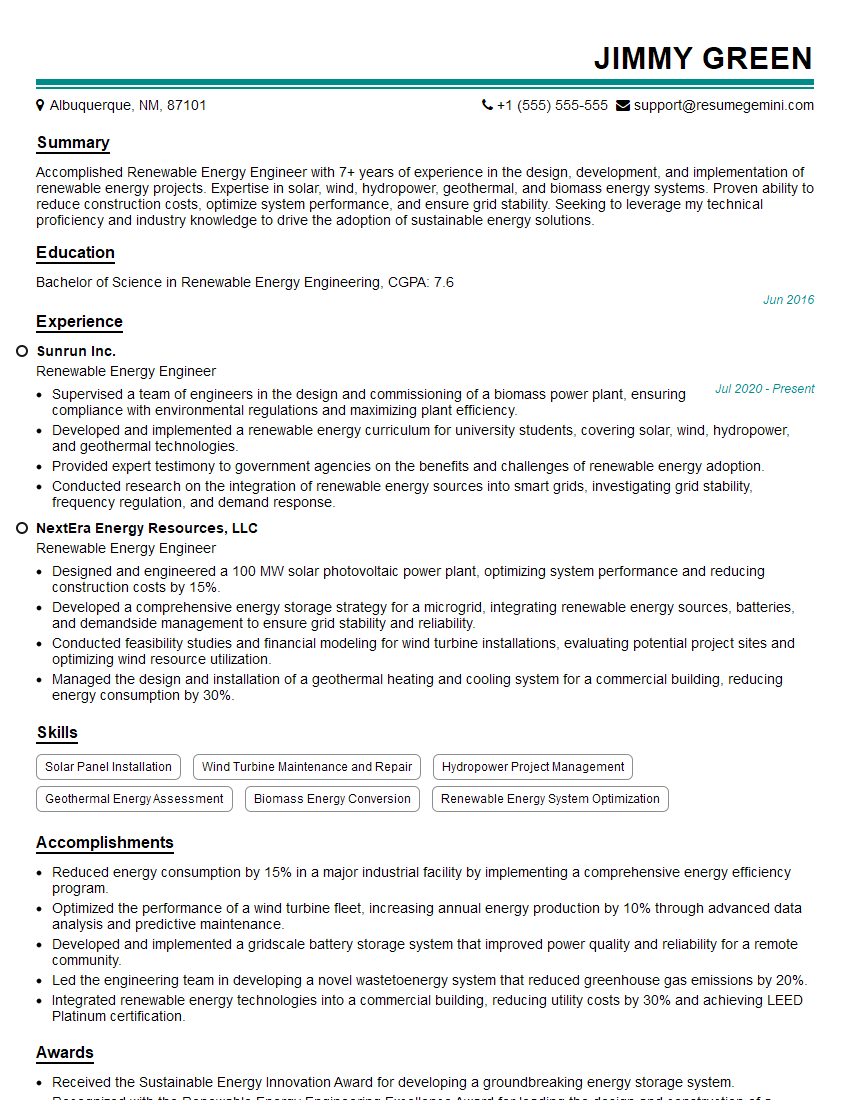
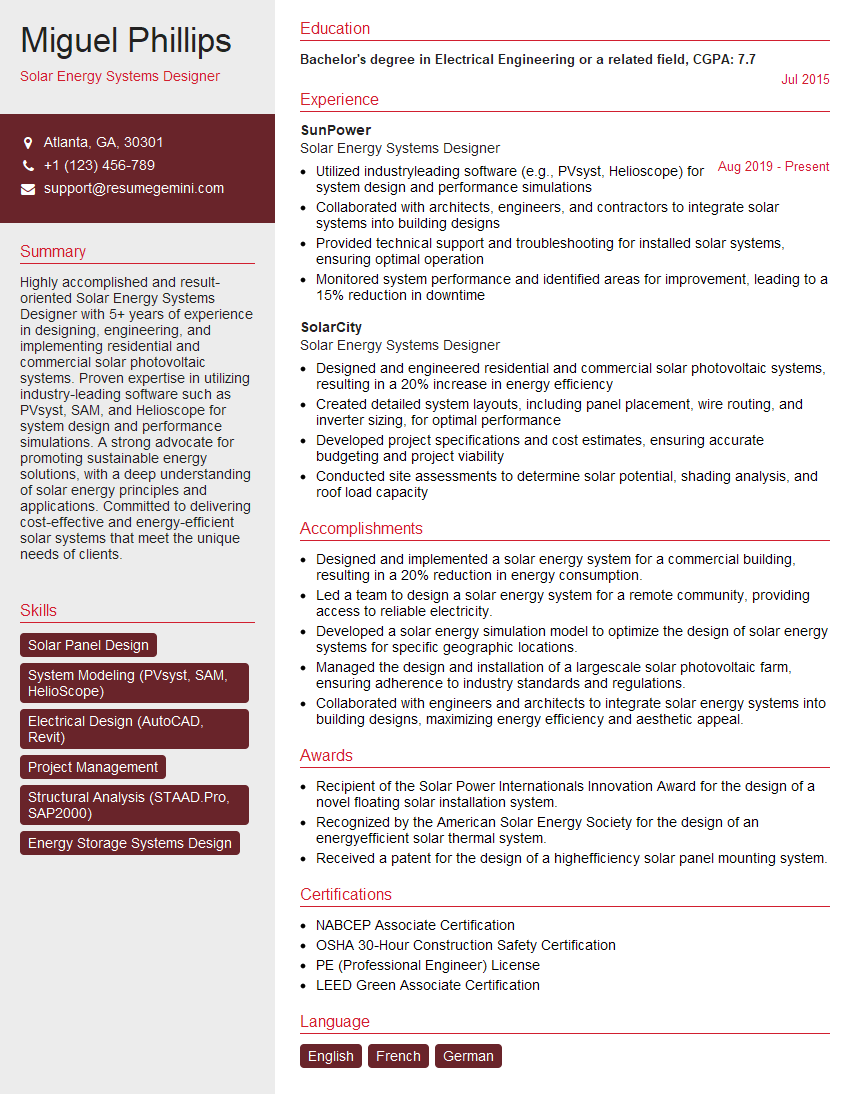
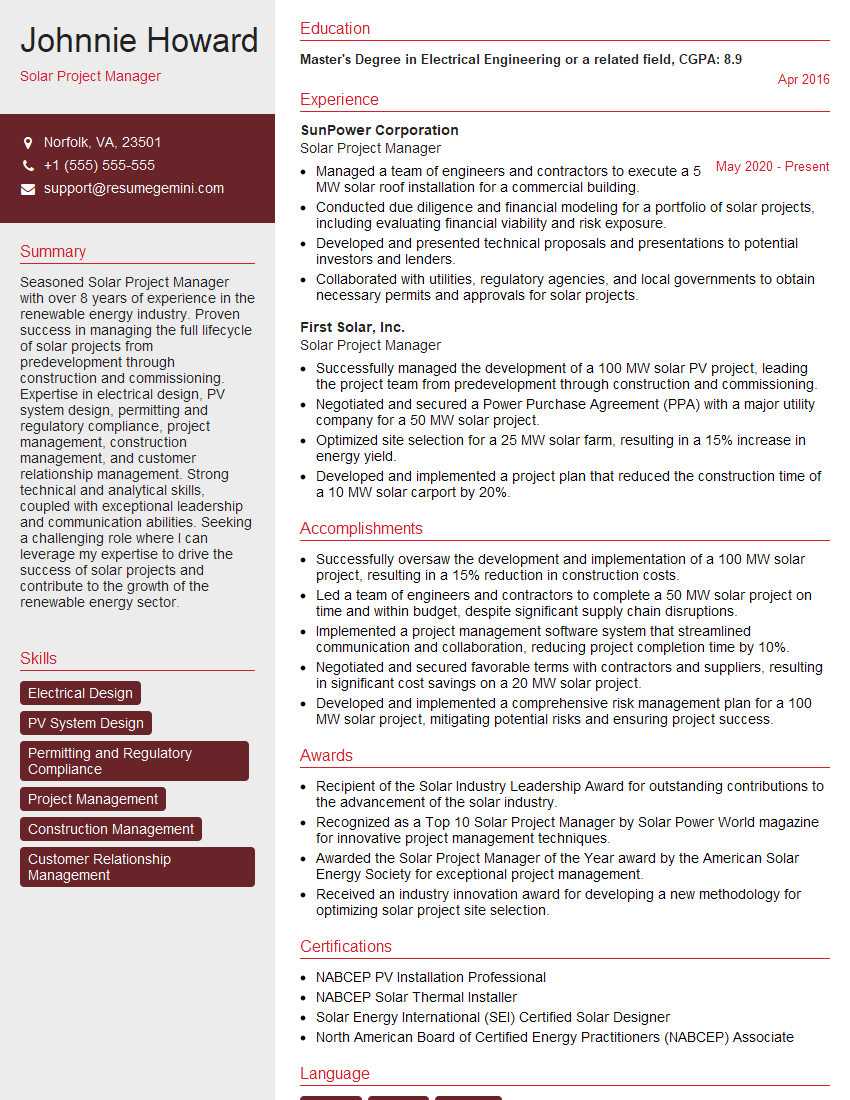
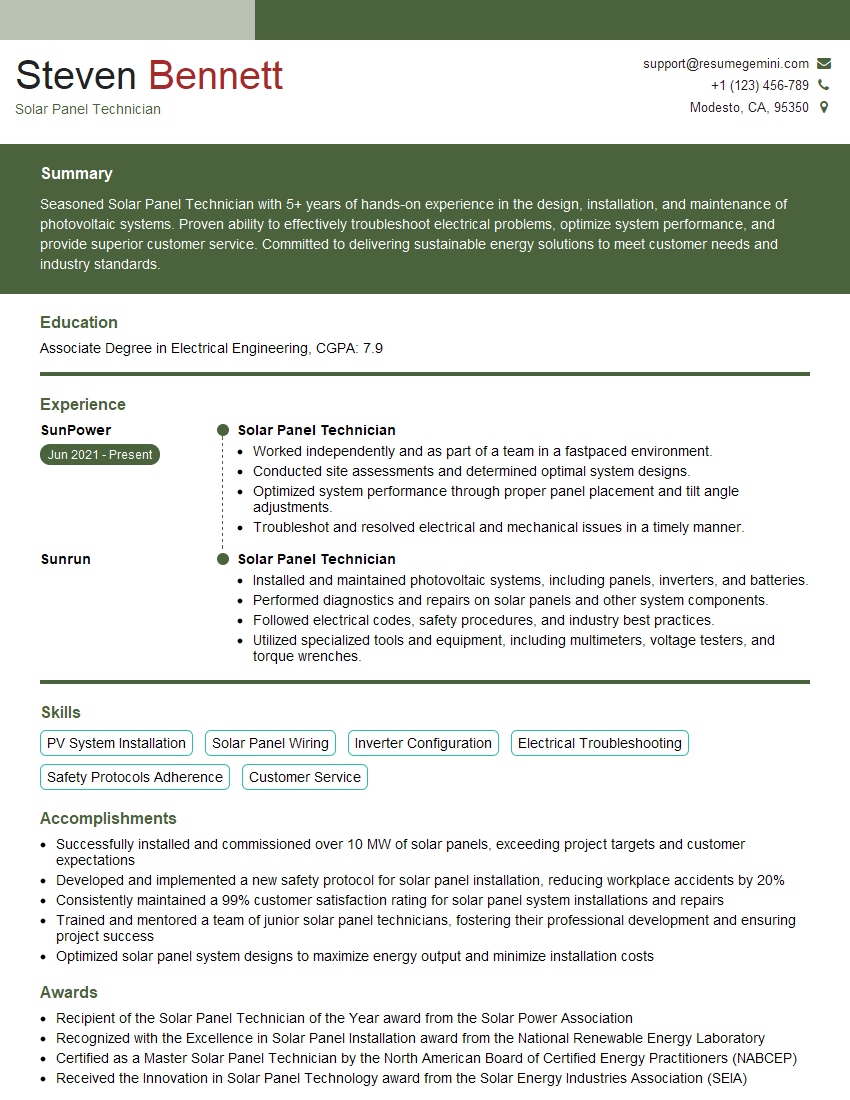
Mastering Solar Cell and Module Technologies opens doors to exciting and impactful careers in a rapidly growing industry. A strong understanding of these technologies is essential for securing leading roles in research, development, manufacturing, and deployment. To maximize your job prospects, creating an ATS-friendly resume is critical. An effectively crafted resume highlights your skills and experience in a way that Applicant Tracking Systems can easily recognize, leading to more interview opportunities. We recommend using ResumeGemini, a trusted resource for building professional resumes. ResumeGemini provides examples of resumes tailored to Solar Cell and Module Technologies, helping you present your qualifications in the best possible light. Invest time in crafting a compelling resume – it’s your first impression on potential employers.

Explore more articles
Users Rating of Our Blogs
Share Your Experience
We value your feedback! Please rate our content and share your thoughts (optional).
What Readers Say About Our Blog
Very informative content, great job.
good