Interviews are more than just a Q&A session—they’re a chance to prove your worth. This blog dives into essential Experience in Music Licensing and Copyright Protection interview questions and expert tips to help you align your answers with what hiring managers are looking for. Start preparing to shine!
Questions Asked in Experience in Music Licensing and Copyright Protection Interview
Q 1. Explain the difference between mechanical and performance rights.
Mechanical and performance rights are two distinct types of copyright that govern the use of musical works. Think of it like this: mechanical rights are about the physical reproduction of a song, while performance rights cover public performances.
- Mechanical Rights: These rights grant permission to reproduce and distribute a musical work in physical formats (CDs, vinyl) or digital downloads. They are essentially the right to *make* copies of the song. Imagine a band selling their album – they need mechanical licenses to do so. The songwriter(s) and/or music publisher typically own these rights.
- Performance Rights: These rights grant permission to publicly perform a musical work, whether live or via broadcast (radio, television, streaming services). This is the right to *play* the song. A restaurant playing background music needs a performance license, as does a radio station airing a song. Performing rights organizations (PROs) like ASCAP, BMI, and SESAC typically collect and distribute these royalties on behalf of songwriters and publishers.
The key difference lies in the type of use: mechanical rights are for making copies, while performance rights are for public performances.
Q 2. Describe the process of obtaining a synchronization license.
Securing a synchronization license is crucial when you want to use a pre-recorded musical work (song) in a visual media project, such as a film, television show, commercial, or video game. It’s a complex process but here’s a breakdown:
- Identify the Rights Holder: Determine who owns the copyright – the songwriter, the publisher, or both. You may need to contact multiple parties.
- Negotiate the License: Contact the rights holder directly or through a music supervisor (often employed for large productions). Negotiate the terms of the license, including the scope of use (geographic area, duration, media types), the fee, and any creative restrictions.
- Formal Agreement: Once terms are agreed upon, a formal synchronization license agreement is drawn up, outlining all aspects of the usage, including payment schedule and any potential future uses.
- Payment and Delivery: You’ll typically pay a one-time fee or a royalty based on the agreement. Once the payment is cleared, you’ll receive the cleared track and necessary documentation.
- Usage Reporting (if applicable): Some agreements require usage reports for tracking purposes, particularly for longer-term licenses or those with royalty components.
It’s crucial to have a lawyer experienced in music licensing review and approve any synchronization license agreement before signing. Failure to secure the proper licenses can lead to expensive copyright infringement lawsuits.
Q 3. What are the key elements of a music licensing agreement?
A comprehensive music licensing agreement should clearly detail several key elements:
- Parties Involved: Clearly identifies the licensor (copyright owner) and the licensee (the party using the music).
- Licensed Work: Specifies the exact musical work(s) being licensed, including title, composer, and any relevant identifiers.
- Scope of License: Defines the permitted uses (e.g., synchronization, mechanical reproduction, performance, etc.), the geographic territory, and the duration of the license.
- License Fee: Specifies the payment terms, including the amount, payment schedule, and any applicable royalties.
- Term and Renewal: Specifies the duration of the license and the possibility of renewal.
- Exclusivity: States whether the license is exclusive (only the licensee can use the work) or non-exclusive (others can also use it).
- Warranties and Indemnities: Addresses the responsibilities of both parties in relation to copyright ownership and potential legal issues.
- Termination Clause: Details the conditions under which the license can be terminated.
- Governing Law: Specifies which jurisdiction’s laws will govern the agreement.
A well-drafted agreement protects both the copyright holder and the licensee, preventing disputes and ensuring clarity on usage rights.
Q 4. How do you handle copyright infringement claims?
Handling copyright infringement claims requires a swift, careful, and professional approach. The first step is to thoroughly investigate the claim.
- Verify the Claim: Determine if the alleged infringement is indeed a violation of copyright. This involves comparing the infringing work with the copyrighted work to identify substantial similarities.
- Identify the Infringer: Determine who is responsible for the infringement – the individual, company, or platform hosting the infringing content.
- Negotiation (if possible): Attempt to negotiate a settlement with the infringer. This may involve issuing a cease and desist letter demanding the removal of the infringing content and payment for damages.
- Legal Action: If negotiation fails, it’s necessary to pursue legal action through a copyright lawsuit. This involves presenting evidence of ownership and infringement to the court.
- Out-of-Court Settlement: Even during legal proceedings, there’s potential for out-of-court settlements. This can often be a cost-effective solution compared to protracted litigation.
It’s crucial to consult with an experienced intellectual property attorney to navigate these complexities and protect your rights.
Q 5. What are the different types of music licenses?
Music licenses vary depending on the intended use. Here are some common types:
- Mechanical Licenses: For reproducing and distributing a musical work (CDs, downloads).
- Performance Licenses: For publicly performing a musical work (live performances, radio, TV).
- Synchronization Licenses: For using a musical work in synchronization with visual media (films, TV, commercials).
- Print Licenses: For reproducing musical notation (sheet music).
- Master Use Licenses: For using a specific recording of a musical work (the master recording).
- Grand Rights Licenses: For dramatic presentations of musical works (musicals, plays).
- Streaming Licenses: For making music available through digital streaming platforms.
The specific type of license needed will depend entirely on the intended use of the music. It’s imperative to acquire the appropriate license to avoid copyright infringement.
Q 6. Explain the concept of public domain music.
Public domain music refers to musical works whose copyright has expired or has been forfeited, making them free to use without needing permission. Think of it as music that’s entered the collective cultural ownership.
Copyright protection in most countries typically lasts for a specific period (often the life of the author plus a number of years). Once this period ends, the work enters the public domain. However, there are some nuances and exceptions depending on the jurisdiction. Factors affecting public domain status include the date of creation, the date of publication, and the existence of any copyright renewals.
Public domain music offers a vast resource for filmmakers, game developers, and other creatives looking for royalty-free music. But it’s crucial to verify the work’s public domain status to be absolutely sure there are no remaining restrictions.
Q 7. How do you calculate music royalties?
Calculating music royalties is a complex process that differs depending on the type of royalty (mechanical, performance, synchronization), the agreement, and the governing PROs (if applicable).
Mechanical Royalties: These are typically calculated based on the number of copies sold or downloads of a song, with a set statutory rate per copy.
Performance Royalties: These are more intricate. PROs track performances of songs and distribute royalties to songwriters and publishers based on factors like the frequency of airplay, the duration of the performance, and the size and type of venue (for live performances).
Synchronization Royalties: These are negotiated individually for each synchronization license. The fee can vary greatly depending on the use, duration, and the prominence of the music in the project.
Accurate royalty calculation requires detailed accounting of usage, detailed contractual agreements, and adherence to industry standards. Many music publishers and PROs have dedicated royalty departments to manage these calculations, so it is generally best to work with a professional music licensing expert.
Q 8. What are the legal implications of using copyrighted music without permission?
Using copyrighted music without permission has serious legal implications. It’s essentially theft of intellectual property. The copyright holder has exclusive rights to reproduce, distribute, perform, and display their work. Infringing on these rights can lead to significant consequences.
- Copyright Infringement Lawsuits: Copyright holders can sue for damages, which can include the infringer’s profits, the copyright holder’s losses, and statutory damages (set amounts determined by the court). These damages can be substantial, even for seemingly minor infringements.
- Injunctions: A court may order the infringer to stop using the copyrighted music immediately. This can halt a project or business operation until the issue is resolved.
- Criminal Penalties: In some cases, particularly involving large-scale or willful infringement, criminal charges can be filed, leading to fines and even imprisonment.
- Reputation Damage: The negative publicity associated with a copyright infringement lawsuit can severely damage an individual’s or company’s reputation.
Imagine a small film production company using a popular song in their movie without a license. They could face a lawsuit resulting in significant financial penalties and the film’s removal from distribution.
Q 9. Describe your experience with music licensing databases and platforms.
My experience with music licensing databases and platforms is extensive. I’ve worked with a wide range of them, from large, comprehensive platforms like Harry Fox Agency and Audiam, to smaller, niche libraries specializing in specific genres. These platforms offer varying functionalities, but generally include:
- Search Capabilities: Advanced search filters to find specific songs or artists based on criteria such as genre, mood, instrumentation, and more.
- Licensing Information: Detailed licensing terms, including usage rights, fees, and royalty structures.
- Clearance Processes: Streamlined systems for obtaining licenses, often including online forms and secure payment methods.
- Metadata Management: Tools for managing metadata associated with licensed tracks, including tracking usage and reporting.
For example, I recently used Harry Fox Agency to secure licenses for background music in a documentary. Their platform allowed me to easily search their catalog, review licensing agreements, and submit payment securely. This significantly streamlines the licensing process and minimizes the risk of legal issues.
Q 10. What is the role of a Performing Rights Organization (PRO)?
Performing Rights Organizations (PROs), such as ASCAP, BMI, and SESAC in the US, are crucial intermediaries in the music licensing process. They represent songwriters, composers, and music publishers, collecting licensing fees from users who publicly perform or broadcast their members’ music.
- Collecting Royalties: PROs track the public performance of their members’ music and collect royalties from businesses like radio stations, television networks, bars, restaurants, and concert venues.
- Distributing Royalties: These collected royalties are then distributed to the copyright holders (songwriters and publishers) based on the usage of their music.
- Licensing Administration: PROs simplify the licensing process for businesses by providing blanket licenses that cover the performance of a vast catalog of music.
Think of a local coffee shop playing music throughout the day. They wouldn’t need to negotiate individual licenses with each songwriter; instead, they obtain a blanket license through a PRO, ensuring they have the right to perform the music and the songwriters receive their fair share.
Q 11. How do you ensure compliance with music licensing regulations?
Ensuring compliance with music licensing regulations requires a proactive and multi-faceted approach.
- Proper Research and Due Diligence: Thoroughly research the usage rights of any music you intend to use. This involves identifying the copyright holder and verifying the availability of licenses for the intended purpose.
- Utilizing Licensing Platforms: Employing reputable music licensing platforms helps ensure that you’re obtaining valid licenses and paying the correct fees.
- Maintaining Records: Keep detailed records of all music used, including licenses obtained, payment details, and usage details. This documentation is crucial for demonstrating compliance.
- Seeking Legal Advice: Consult with an attorney specializing in music copyright law to ensure compliance with the complexities of music licensing regulations.
- Regular Audits: Conduct regular audits of your music usage to ensure that you’re adhering to your licensing agreements and to identify any potential compliance issues.
For example, before using music in a commercial video, I always check licensing terms on relevant platforms. I create a spreadsheet documenting each track’s usage and associated license, allowing me to manage usage and demonstrate compliance if needed.
Q 12. Explain the concept of fair use in music licensing.
Fair use is a legal doctrine that permits limited use of copyrighted material without obtaining permission from the copyright holder. It’s a complex area of law, and determining whether a particular use qualifies as fair use involves a multi-factor test. There’s no simple yes or no answer; it’s highly fact-specific.
- Purpose and Character of the Use: Is the use transformative (adding new meaning or message) or is it primarily for commercial purposes?
- Nature of the Copyrighted Work: Is the work factual or creative? Creative works generally receive stronger copyright protection.
- Amount and Substantiality of the Portion Used: Using only a small portion is more likely to be considered fair use than using a large portion.
- Effect of the Use Upon the Potential Market: Does the use harm the market for the original work?
A classic example often cited is a parody. If a song is parodied in a comedic context, it might be considered fair use because it transforms the original work and doesn’t compete with it commercially. However, using a significant portion of a song for a commercial advertisement is highly unlikely to qualify as fair use.
Q 13. How do you negotiate music licensing fees?
Negotiating music licensing fees can be challenging. Factors such as the usage type (film, television, advertising, etc.), the length of the license, the scope of usage rights (geographic, temporal, etc.), and the popularity of the music all play a role in determining the fee.
- Understanding the Market: Research similar licensing agreements to understand the prevailing market rates.
- Defining Usage Requirements: Clearly define the specific intended usage of the music to ensure you’re obtaining the appropriate license.
- Building Relationships: Developing strong relationships with publishers and rights holders can lead to more favorable licensing terms.
- Presenting a Strong Case: Highlight the potential value and exposure that your project can bring to the music.
- Flexibility and Compromise: Be prepared to negotiate and compromise on various aspects of the license to reach an agreement.
For example, when licensing music for a short film, I’ve successfully negotiated lower fees by offering the artist promotional opportunities in exchange for a reduced licensing cost, showcasing a win-win scenario.
Q 14. What is a compulsory license and when is it applicable?
A compulsory license is a unique feature of US copyright law that applies to musical works. It allows certain users to record and distribute a previously recorded musical work without needing permission from the copyright holder, but they must pay a statutory royalty fee.
- Applicability: It primarily applies to the creation of sound recordings, not the underlying musical composition itself. The original recording must already exist.
- Conditions: The licensee must pay the statutory royalty rate established by the Copyright Office, and they must adhere to specific rules regarding the notice and information they must provide to the copyright owner.
- Limitations: A compulsory license doesn’t apply to the underlying musical composition. Separate licenses are still needed to use the music itself; the compulsory license only covers the act of making a new sound recording of an existing song.
Imagine a cover band wanting to create a new recording of a popular song. They can’t just use the original recording; they need to make their own, and a compulsory license allows them to do so while paying a set fee to the copyright owner of the sound recording.
Q 15. Describe your experience with international music licensing regulations.
International music licensing is a complex landscape, varying significantly across countries. My experience encompasses navigating these differences, understanding local laws and collecting societies (like ASCAP, BMI, PRS, etc.), and securing the necessary clearances for usage in different territories. For example, securing rights for a film soundtrack intended for global distribution requires licensing agreements with relevant rights holders in each target country, considering variations in copyright terms and compulsory licensing schemes. This often involves working with local licensing agents or international organizations to ensure compliance and prevent infringement.
I’m proficient in identifying the appropriate rights holders (composers, publishers, songwriters, and master rights owners), negotiating fair and legally sound agreements, and ensuring that all necessary permissions are obtained before use. Understanding the nuances of each territory’s laws, including the length of copyright protection and limitations on use, is crucial in this process. For instance, moral rights for the author of a musical work might be protected more stringently in some countries than in others.
Career Expert Tips:
- Ace those interviews! Prepare effectively by reviewing the Top 50 Most Common Interview Questions on ResumeGemini.
- Navigate your job search with confidence! Explore a wide range of Career Tips on ResumeGemini. Learn about common challenges and recommendations to overcome them.
- Craft the perfect resume! Master the Art of Resume Writing with ResumeGemini’s guide. Showcase your unique qualifications and achievements effectively.
- Don’t miss out on holiday savings! Build your dream resume with ResumeGemini’s ATS optimized templates.
Q 16. How do you track and manage music royalties?
Tracking and managing music royalties involves a multi-faceted approach, incorporating both technological solutions and meticulous manual processes. It begins with diligently maintaining a comprehensive database of all licensed works, detailing the specific licenses granted, the rights licensed (synchronization, mechanical, performance, etc.), the licensing fees, and the payment terms. This database serves as the foundation for accurate royalty accounting.
We leverage specialized royalty management software to automate various tasks. These systems integrate data from various sources, including digital platforms (Spotify, Apple Music, YouTube), performance rights organizations (PROs), and direct licensing deals. The software helps track usage, calculate royalties owed, and generate accurate reports for both rights holders and licensees. Manual reconciliation of statements from different sources is an essential part of this process, ensuring accuracy and identifying any discrepancies. Regular reporting and transparency are key to maintaining positive relationships with all stakeholders.
Q 17. What are the best practices for managing music copyrights?
Effective copyright management is paramount. Best practices involve proactively registering copyrights for all musical compositions and sound recordings with the appropriate copyright offices (like the U.S. Copyright Office or equivalent international bodies). This establishes a clear legal record of ownership and provides crucial evidence in case of infringement. Beyond registration, meticulous record-keeping is essential. This includes maintaining comprehensive contracts, detailed licensing agreements, and accurate accounting of all usage. Regular audits ensure compliance with copyright laws and identify potential issues before they escalate.
It’s also crucial to implement measures to prevent unauthorized reproduction and distribution of the music. This can include using digital rights management (DRM) technologies, monitoring online platforms for infringements, and pursuing legal action against those who violate copyright laws. Education of all stakeholders involved – from musicians and producers to distributors and licensees – about copyright law and its implications is critical.
Q 18. How do you deal with conflicting copyright claims?
Conflicting copyright claims are unfortunately common in the music industry. Addressing them requires a thorough investigation into the validity of each claim. This often involves examining copyright registration documents, analyzing the musical works for similarity or derivation, and potentially consulting legal experts specializing in copyright law. Collaboration and negotiation are crucial in resolving such disputes. We attempt to identify the rightful copyright holder, often through meticulous research of historical records and interviews with relevant parties.
Mediation or arbitration might be considered as a more cost-effective approach compared to litigation. If a mutually agreeable solution can’t be reached, formal legal proceedings, including lawsuits, may be necessary. Documenting the entire process rigorously – all evidence gathered, communications, and attempted resolutions – is vital, regardless of the chosen resolution path.
Q 19. What is your experience with digital music licensing and distribution?
My experience with digital music licensing and distribution is extensive. I understand the intricacies of licensing music for various digital platforms, such as streaming services (Spotify, Apple Music, Tidal), online video platforms (YouTube, Vimeo), and social media platforms (TikTok, Instagram). This encompasses negotiating digital distribution agreements, managing metadata, ensuring proper royalty payments, and tracking usage across multiple platforms. I’m adept at navigating the technical aspects of metadata standards (like ISRCs and ISWCs), ensuring accurate tracking and royalty allocation.
I have worked with various digital distribution companies, understanding their processes, contracts, and payment structures. The use of digital distribution platforms like DistroKid or CD Baby is commonplace in today’s music industry, and ensuring efficient and reliable data transfer to these platforms is paramount for successful digital music distribution.
Q 20. Describe a situation where you had to solve a complex music licensing issue.
One particularly challenging situation involved a dispute concerning the synchronization rights for a song in a major motion picture. Initially, the rights were believed to be held by a publishing company, but during the final stages of production, a competing claim emerged from a separate songwriter claiming co-authorship and thus partial rights to the song. This created a significant delay and threatened to halt production. We immediately launched a thorough investigation, examining the song’s history, reviewing contracts, and collaborating with music historians and legal experts.
Through detailed analysis of original recordings, songwriting credits, and witness testimonies, we successfully established the validity of the original publishing company’s claim and negotiated a settlement with the competing claimant. This involved a complex legal process, careful analysis of relevant copyright laws, and careful negotiation to ensure a swift resolution without jeopardizing the film’s release. This case highlighted the importance of thorough due diligence, comprehensive record-keeping, and the ability to swiftly navigate complex legal and contractual issues.
Q 21. How familiar are you with music metadata standards?
I am very familiar with music metadata standards. Understanding and applying standards such as ISRC (International Standard Recording Code) for sound recordings and ISWC (International Standard Musical Work Code) for compositions is fundamental to effective music licensing and distribution. These codes are essential for accurately tracking usage and ensuring proper royalty payments. Other important metadata elements include the title, artist, album, composer, publisher, and writer information.
My experience includes working directly with these codes within digital distribution systems, ensuring their accuracy and consistency across different platforms. I also understand the importance of properly tagging metadata to facilitate effective searching, filtering, and reporting. The use of correctly formatted metadata is essential not only for accurate royalty accounting but also for the effective marketing and discoverability of music online.
Q 22. What is your understanding of the DMCA?
The Digital Millennium Copyright Act (DMCA) is a US law designed to protect copyrighted works in the digital environment. It addresses issues surrounding online copyright infringement, specifically focusing on the role of online service providers (OSPs) in facilitating such infringements. A crucial aspect is the DMCA’s ‘notice and takedown’ system. This means that if a copyright holder believes their work has been infringed upon online, they can issue a DMCA takedown notice to the OSP hosting the infringing content. The OSP is then obligated to remove or disable access to the material. Failure to comply can result in legal repercussions for the OSP. Beyond takedown notices, the DMCA also criminalizes the production and dissemination of devices or services primarily designed to circumvent copyright protection measures (like DRM).
In practical terms, imagine a musician discovers their song is being illegally streamed on a platform like YouTube. Under the DMCA, they can file a takedown notice with YouTube, providing evidence of their copyright and the infringing activity. YouTube, as an OSP, is then required to remove the offending video.
Understanding the DMCA is paramount in music licensing because it sets a legal framework for how copyrighted music is handled online. It’s a crucial tool for protecting artists’ rights and enforcing their copyrights in the digital age.
Q 23. How do you handle music licensing requests from different media?
Handling music licensing requests across different media requires a nuanced approach, adapting to the unique needs of each platform. For example, licensing music for a film requires a different process than licensing for a television commercial or a video game. Film licensing often involves synchronization licenses (allowing the use of music synchronized with visuals) and master licenses (covering the underlying sound recording). Television commercials may necessitate shorter snippets of music, potentially leading to a simpler licensing agreement. Video games might require extended usage, potentially incorporating interactive elements or requiring a broader license covering multiple platforms.
Each licensing request involves detailed negotiations. We need to determine the scope of usage, geographic territories, duration, media type, and the desired fee structure. We also carefully review the licensee’s project to ensure it aligns with the composer’s and publisher’s artistic vision and brand values. Contracts are meticulously drafted to protect the rights of all parties involved. A clear understanding of the media’s context is crucial – a track that fits a horror movie might be completely unsuitable for a children’s cartoon.
Q 24. What is your experience with music licensing in different territories?
Music licensing across territories presents significant complexities due to varying copyright laws and regulations. Each country or region might have its own collection societies (like ASCAP, BMI, and SESAC in the US, or PRS in the UK) handling the collection and distribution of royalties. This necessitates a detailed understanding of these organizations’ processes and agreements. For instance, a license for use in the US might require separate negotiations with individual publishers and collection societies, unlike a blanket license across Europe. The legal frameworks surrounding copyright, particularly the duration of copyright protection and permitted uses, can drastically differ between jurisdictions. This makes international licensing a meticulous process requiring specialist legal counsel and a thorough grasp of international copyright law.
I’ve worked on projects spanning Europe, North America, and parts of Asia, requiring adaptation of contracts to comply with local laws and negotiations with local rights holders. Each project necessitates meticulous research and legal review to ensure compliance and protect the interests of our clients.
Q 25. Describe your experience working with music publishers and composers.
My experience collaborating with music publishers and composers has been integral to my success. It involves building strong relationships based on trust, transparency, and mutual respect. These collaborations require a keen understanding of both the artistic and commercial aspects of music. I’ve worked closely with publishers to navigate their catalogs, identify suitable tracks for various projects, and negotiate fair and equitable licensing agreements. With composers, the process often involves understanding their creative vision and ensuring that the licensing terms reflect their artistic contributions and market value. I’ve frequently acted as a liaison between composers, publishers, and licensees, ensuring efficient communication and resolving any conflicts that might arise.
One particular project involved securing the rights to a lesser-known but incredibly evocative piece for a documentary. The direct collaboration with both the composer and publisher was vital in crafting an agreement that benefited all parties while ensuring the film’s emotional impact.
Q 26. What are the ethical considerations in music licensing?
Ethical considerations in music licensing are paramount. Transparency and fairness are crucial. This means ensuring accurate representation of the usage, disclosing all relevant information to both licensees and rights holders, and negotiating fair compensation for the rights granted. Avoiding deceptive practices, such as misrepresenting the scope of usage or underpaying royalties, is crucial. Protecting the artistic integrity of the music is also important – a licensee’s use should not distort or diminish the original work’s creative intent. Respecting the rights holders’ wishes regarding how their music is used is equally essential. For example, if a composer has strong reservations about a project’s tone or message, these must be carefully considered. Ultimately, ethical licensing promotes trust and fosters long-term relationships within the music industry.
Q 27. Explain your experience with contract review in the context of music licensing.
Contract review in music licensing is critically important. It involves meticulously scrutinizing each clause to identify potential risks or ambiguities. Key aspects include clearly defining the scope of the license (geographic territories, media, duration), the payment structure (royalties, advances, one-time fees), and the permitted uses of the music. The contract should clearly outline the rights granted to the licensee and the responsibilities of both parties. We look for loopholes or unclear language that could lead to disputes. I often employ a ‘redlining’ process, identifying areas requiring clarification or modification and then negotiating these issues with the other party. This often involves consulting with legal experts to ensure complete compliance and protection of my clients’ interests. A successful contract review protects both rights holders and licensees from potential liabilities and ensures that the licensing process is smooth and transparent.
Q 28. How do you stay current with changes in music licensing law?
Staying current with changes in music licensing law requires a multi-pronged approach. I regularly subscribe to legal journals and industry publications specializing in copyright and music licensing. I attend conferences and workshops organized by relevant professional organizations to learn about recent case law and legislative developments. I maintain close relationships with legal professionals specializing in music law to receive updates and seek advice when needed. Monitoring the activities of collection societies, both domestically and internationally, is also essential. I leverage online resources to stay informed about new technologies and their impact on copyright protection. Adapting to the evolving digital landscape and anticipating its legal ramifications is a continual process. Continuous learning is crucial to maintaining proficiency and providing optimal service in this dynamic industry.
Key Topics to Learn for Your Music Licensing and Copyright Protection Interview
- Copyright Basics: Understanding copyright ownership, duration, and limitations. Practical application: Analyzing a music contract to identify copyright holders and licensing terms.
- Licensing Types: Mechanical, synchronization, performance, print, and other relevant licenses. Practical application: Determining the appropriate license for a specific use case (e.g., film, video game, commercial).
- Copyright Infringement: Identifying potential infringement scenarios and understanding legal remedies. Practical application: Assessing the risk of copyright infringement in a proposed project.
- Licensing Agreements: Negotiating and interpreting licensing agreements, including royalty structures and reporting requirements. Practical application: Analyzing a licensing agreement to ensure fair terms and accurate royalty payments.
- Digital Rights Management (DRM): Understanding the role of DRM in protecting copyrighted music in digital environments. Practical application: Evaluating different DRM solutions for online music distribution.
- International Copyright Law: Navigating the complexities of copyright protection across different countries. Practical application: Understanding the legal implications of using music from different regions.
- Copyright Registration & Enforcement: The process of registering copyrights and enforcing copyright protection through legal channels. Practical application: Developing a strategy for protecting your client’s music from unauthorized use.
- Best Practices: Ethical considerations and industry standards in music licensing and copyright protection. Practical application: Developing a robust compliance program to minimize copyright infringement risks.
Next Steps: Unlock Your Career Potential
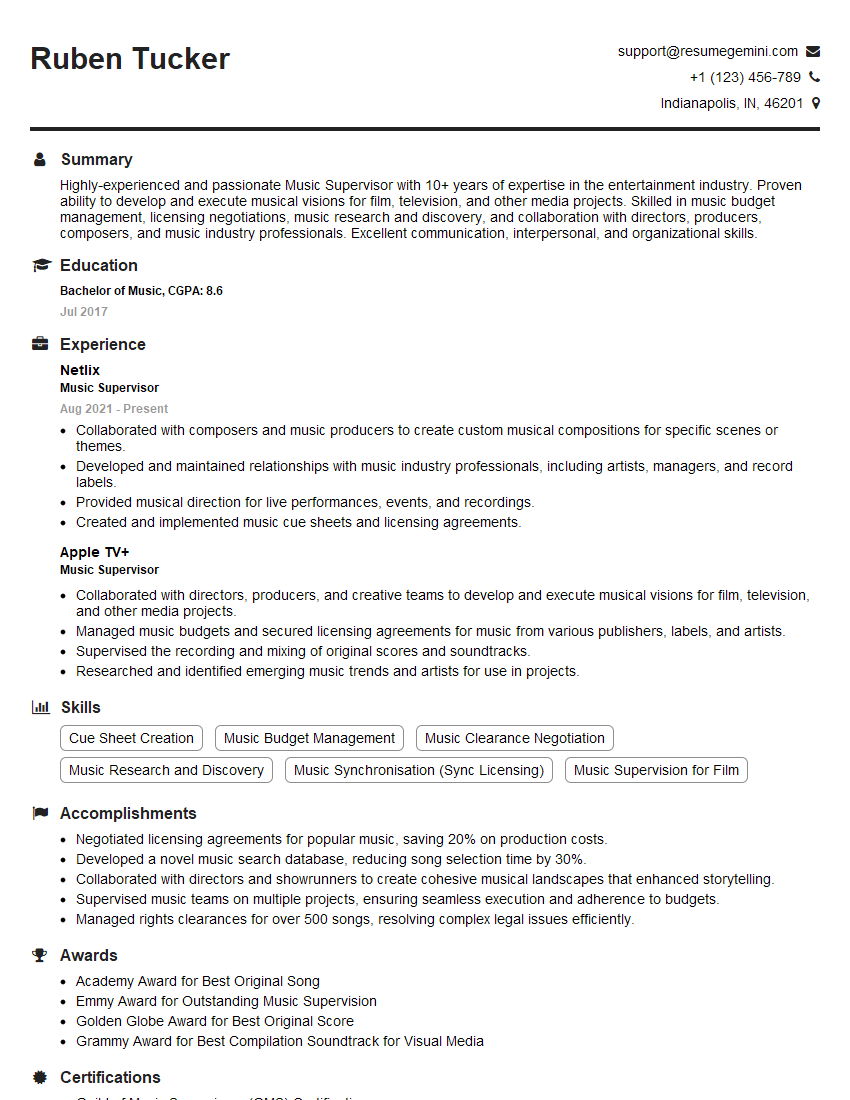
Mastering music licensing and copyright protection is crucial for career advancement in the music industry. A strong understanding of these concepts demonstrates professionalism, expertise, and a commitment to ethical practices. To significantly boost your job prospects, create an ATS-friendly resume that effectively showcases your skills and experience. ResumeGemini is a trusted resource that can help you build a compelling and impactful resume. Take advantage of our examples of resumes tailored to music licensing and copyright protection roles to gain a competitive edge.
Explore more articles
Users Rating of Our Blogs
Share Your Experience
We value your feedback! Please rate our content and share your thoughts (optional).
What Readers Say About Our Blog
Very informative content, great job.
good