Every successful interview starts with knowing what to expect. In this blog, we’ll take you through the top Experience in Quality Control and Inspection for Buttonhole Products interview questions, breaking them down with expert tips to help you deliver impactful answers. Step into your next interview fully prepared and ready to succeed.
Questions Asked in Experience in Quality Control and Inspection for Buttonhole Products Interview
Q 1. Describe your experience inspecting buttonholes for defects.
My experience in buttonhole inspection involves a multi-faceted approach, encompassing visual examination, dimensional checks, and functional testing. I’ve inspected thousands of buttonholes across various garment types, from delicate blouses to heavy-duty workwear. My process starts with a visual sweep, looking for obvious flaws. Then, I proceed with precise measurements using specialized tools to ensure dimensional accuracy and adherence to client specifications. This process ensures that every buttonhole meets the required quality standards and enhances the overall garment’s appeal and functionality.
For example, during a recent inspection of a batch of shirts, I identified a subtle inconsistency in the stitching tension of a particular production run. While not immediately apparent to the naked eye, this slight variation could compromise the durability of the buttonholes over time. My timely detection prevented a larger batch of defective products from reaching the market.
Q 2. What are the common defects found in buttonholes?
Common buttonholes defects can be broadly categorized into dimensional flaws and stitching issues. Dimensional defects include incorrect size, uneven width, poor placement (e.g., too far from the edge, misaligned), and improper shape (e.g., too narrow, too long, or distorted). Stitching defects encompass broken stitches, skipped stitches, loose stitches, inconsistent stitch length, bird’s-eye (irregular stitching), and unraveling.
Beyond these, functional defects exist where the buttonhole doesn’t function properly. For instance, a buttonhole might be too tight to accommodate the button, or its edges might be too rough, potentially snagging fabric or damaging the button.
Q 3. How do you measure buttonhole size and placement accuracy?
Measuring buttonhole size and placement involves using precision instruments like digital calipers and rulers. For size, I use calipers to measure the length and width of the buttonhole, ensuring it falls within the acceptable tolerance range. Placement accuracy is determined using a ruler and often a template that aligns with the garment’s design specifications. I carefully measure the distance from the buttonhole’s edge to the garment’s edge, ensuring consistency across all buttonholes on a given garment and across a batch.
For example, if a design calls for a buttonhole precisely 15mm from the edge, I’d use a ruler to verify this distance and note any deviation. This meticulous measurement ensures the overall aesthetic appeal and functionality of the garment.
Q 4. Explain your experience using different inspection tools (e.g., calipers, rulers).
My experience with various inspection tools is extensive. I’m proficient with digital calipers for precise measurements of length, width, and depth. I also use rulers, both metallic and flexible, for measuring distances and verifying placement. Magnifying glasses and loupes are essential for detecting minute stitching defects, while specialized gauges can verify buttonhole shape and alignment. I’m also familiar with using digital microscopes for detailed analysis of stitch formation.
The choice of tool depends on the specific task. For instance, calipers are perfect for accurately measuring buttonhole dimensions, while a ruler is ideal for verifying placement relative to garment edges. The magnifier comes into play for catching those subtle defects that might be missed by the naked eye.
Q 5. What are the acceptable tolerances for buttonhole size and placement?
Acceptable tolerances for buttonhole size and placement vary depending on the garment type, fabric, and client specifications. However, typical tolerances for size might be ±0.5mm for length and width. Placement tolerances are often more stringent, possibly within ±1mm or less depending on the design. These tolerances are usually specified in the technical design documents provided by the client.
For example, a tolerance of ±0.2mm might be required for a high-end garment, indicating a higher level of precision. These tolerances ensure the functionality and aesthetic appeal of the final product.
Q 6. How do you document and report quality control findings?
I meticulously document quality control findings using a combination of methods. Each inspected garment or batch receives a unique identification number. I utilize standardized inspection checklists to record the type and quantity of defects. Detailed descriptions of the defects, along with supporting photographic or microscopic evidence, are included in the report. I also use spreadsheets or databases to track the data and perform statistical analysis to identify trends or patterns.
The final report provides a comprehensive overview of the inspection findings, including the total number of units inspected, the number of defects found, the types of defects, and any recommendations for corrective actions. This report is crucial for improving the production process and ensuring that future batches meet the required quality standards.
Q 7. Describe your experience using statistical process control (SPC) techniques in buttonhole inspection.
My experience with Statistical Process Control (SPC) techniques in buttonhole inspection involves monitoring key process parameters such as buttonhole length, width, and placement. I use control charts, specifically X-bar and R charts, to track these parameters over time. This allows for the early detection of process variations, helping to prevent defects and ensure consistent quality.
For example, by monitoring buttonhole length using an X-bar and R chart, I can identify if the process mean or variability is drifting outside the acceptable limits. This data-driven approach enables proactive corrective actions, preventing large batches of defective products from being produced.
Q 8. How do you handle discrepancies between your inspection findings and production standards?
Discrepancies between inspection findings and production standards are addressed through a systematic process. First, I meticulously review my findings, ensuring accuracy and consistency in application of the standards. I double-check my measurements and compare them against the reference samples. If the discrepancy persists, I investigate potential causes. This might involve examining the production machinery for malfunctions, reviewing operator training records, or analyzing the quality of raw materials. I document all findings, including photographic evidence if necessary, and report the issue to the production supervisor. We then collaboratively decide on the appropriate corrective action, which could range from minor adjustments to machine settings to a complete line shutdown for thorough maintenance and retraining. For instance, if a consistent issue with buttonhole length is detected, I’d investigate factors like needle size, stitch density settings on the machine, or even the quality of the thread being used. A collaborative approach ensures a swift, effective resolution while minimizing production downtime.
Q 9. What is your experience with different types of buttonhole stitching?
My experience encompasses a wide range of buttonhole stitching techniques. I’m proficient in identifying and assessing the quality of keyhole buttonholes, bound buttonholes, and welt buttonholes. Each type presents unique challenges in terms of inspection. For example, keyhole buttonholes require careful scrutiny of the bar tacking at the ends for strength and evenness. Bound buttonholes demand attention to the neatness and consistency of the binding, ensuring there are no gaps or puckering. Welt buttonholes need evaluation of the clean stitching line and the flawless placement within the welt itself. I’ve worked with various machine types, from older models to the latest computerized embroidery machines, and understand the nuances in stitching quality produced by each. My experience extends to evaluating different thread types and their impact on the final appearance and durability of the buttonhole.
Q 10. How do you identify and classify different types of buttonhole defects?
Buttonhole defects are categorized based on their nature and severity. Common defects include:
- Length discrepancies: Buttonholes too long or too short compared to the standard.
- Stitching irregularities: Uneven stitches, skipped stitches, or broken threads.
- Bar tack issues: Weak or uneven bar tacks at the buttonhole ends.
- Binding defects (for bound buttonholes): Gaps, puckering, or inconsistent binding.
- Placement errors: Buttonholes not centered or positioned correctly.
- Fabric damage: Holes, tears, or distortion around the buttonhole.
Q 11. Explain your process for verifying buttonhole functionality.
Verifying buttonhole functionality involves more than just visual inspection. I test the buttonhole’s ability to accommodate a button of the specified size. I use a calibrated gauge to measure the buttonhole’s width and length to ensure it’s within tolerance. I also assess the strength of the stitches by gently applying pressure to the buttonhole, attempting to pull apart the stitches. Any weakness or excessive give indicates a potential defect. For bound buttonholes, I’d test the smooth passage of a button through the opening without snagging or resistance. I document the findings for each buttonhole tested and flag any that fail the functionality test. This approach combines both objective measurements with functional testing to provide a comprehensive evaluation of the buttonhole quality.
Q 12. What are your methods for preventing buttonhole defects?
Preventing buttonhole defects is achieved through a multi-pronged approach. This starts with meticulous attention to machine maintenance: regular cleaning, lubrication, and calibration are crucial. Proper operator training is equally important. Operators need to understand the importance of precise adjustments and should be regularly assessed on their technique. Thorough raw material inspection is also vital. Defective threads, inconsistent fabrics, or damaged needles can all lead to buttonhole defects. Implementing a robust quality control system at each stage of production helps catch potential problems before they become major issues. Regular monitoring of machine performance and consistent feedback loops help identify emerging issues and enable timely intervention. I also actively participate in brainstorming sessions to enhance the overall process and identify potential problem areas.
Q 13. How do you ensure consistency in buttonhole inspection across different inspectors?
Consistency in buttonhole inspection is achieved through standardized training, clear guidelines, and the use of calibrated measuring tools. All inspectors undergo comprehensive training that covers the identification of different defect types and the use of the scoring system. We use standardized checklists and reference samples to ensure consistent application of quality standards. Regular calibration checks of measuring instruments are also part of our process. Periodic inter-inspector comparisons are conducted, where multiple inspectors assess the same samples to identify and address any discrepancies in their evaluations. A feedback mechanism allows inspectors to highlight ambiguities or difficulties encountered during inspections, leading to continuous process improvements and greater consistency across the team.
Q 14. Describe your experience with root cause analysis of buttonhole defects.
Root cause analysis of buttonhole defects often involves a structured approach, like the 5 Whys method. When a consistent defect is detected, I systematically ask “Why?” five times to delve deeper into the underlying issue. For example, if buttonholes are consistently too short:
- Why are they too short? (Incorrect machine settings)
- Why are the settings incorrect? (Operator error)
- Why did the operator make the error? (Lack of training)
- Why was there a lack of training? (Oversight in training program)
- Why was there an oversight? (Insufficient quality control procedures for training)
Q 15. How familiar are you with AQL (Acceptable Quality Limit) standards?
AQL, or Acceptable Quality Limit, is a crucial standard in quality control. It defines the acceptable percentage of defective items in a batch. Instead of aiming for zero defects (which is often unrealistic and costly), AQL sets a limit that balances quality with practicality. Different AQL levels represent different levels of stringency. For example, a lower AQL (like 0.65%) means a stricter standard than a higher AQL (like 1.5%). In buttonhole production, we might use AQL to define the maximum acceptable number of flawed buttonholes per 100 garments. The specific AQL level chosen depends on factors like the product’s criticality, customer requirements, and cost considerations. We’d carefully select an AQL level that balances maintaining high product quality while avoiding unnecessary inspection costs and production delays. The selection process involves considering the potential consequences of defects; a higher-risk product, like a safety garment, would necessitate a much lower AQL than, say, a decorative item.
Career Expert Tips:
- Ace those interviews! Prepare effectively by reviewing the Top 50 Most Common Interview Questions on ResumeGemini.
- Navigate your job search with confidence! Explore a wide range of Career Tips on ResumeGemini. Learn about common challenges and recommendations to overcome them.
- Craft the perfect resume! Master the Art of Resume Writing with ResumeGemini’s guide. Showcase your unique qualifications and achievements effectively.
- Don’t miss out on holiday savings! Build your dream resume with ResumeGemini’s ATS optimized templates.
Q 16. How do you prioritize defects based on their severity and impact?
Defect prioritization is critical for efficient quality control. We use a system based on the severity and impact of the defect. We categorize defects into three levels: Critical, Major, and Minor. Critical defects are those that compromise the safety or functionality of the garment. For example, a buttonhole that completely unravels is a critical defect. Major defects significantly affect the garment’s appearance or usability but don’t pose a safety risk. An example would be a buttonhole that is noticeably off-center or unevenly stitched. Minor defects are those that have a negligible impact on the garment’s appearance or function – like a tiny, barely visible imperfection in the stitching. We address critical defects first, followed by major, and then minor ones. This ensures that we prioritize addressing the issues with the most significant potential impact on customer satisfaction and product safety.
Q 17. What is your experience with quality control software or systems?
I have extensive experience using various quality control software and systems. I’m proficient in systems that track defects, generate reports, analyze data for trend identification, and manage inspection procedures. For instance, I’ve worked with systems that allow for real-time data entry during inspection, automating data collection and generating detailed reports that highlight defect trends and the overall quality of production runs. These systems allow for data-driven decision-making to identify and address root causes of defects, improving overall efficiency. I am also familiar with software that integrates with our manufacturing equipment to automatically collect and record production data, helping us to link quality issues directly to specific machines or processes. This helps in preventive maintenance and process improvement.
Q 18. Describe a time you identified a significant buttonhole defect that could have resulted in a customer complaint. How did you resolve it?
In a previous role, we discovered a significant defect in a large batch of buttonholes – they were consistently too small to accommodate the intended buttons. This was initially missed during the initial inspection. The consequence was the potential for customer returns and brand damage. I immediately implemented a stop-work order and initiated a thorough investigation. We used a precision measuring instrument to verify the size discrepancies across a sample of buttonholes. The root cause was traced to a slight miscalibration in the buttonhole stitching machine. The machine was recalibrated, and all affected garments were re-inspected, with the faulty ones being reworked or replaced. We also implemented stricter quality checks in the future, including more frequent calibrations of our machinery and a more stringent inspection process with more thorough checks on buttonhole size. This proactive approach ensured that the defect didn’t recur.
Q 19. What are the key differences between different buttonhole types (e.g., keyhole, bound, etc.) and how do you inspect them?
Different buttonhole types require distinct inspection methods. Keyhole buttonholes are characterized by their elongated, key-shaped opening; bound buttonholes feature a reinforced edge; and standard buttonholes are the most common type. Inspecting keyhole buttonholes focuses on ensuring the correct shape and size, the strength of the stitching, and the absence of any frayed edges. Bound buttonholes require examining the neatness and evenness of the binding, in addition to the stitch quality. Standard buttonholes are checked for even stitch length, proper alignment, and consistent size to accommodate the button. The inspection process involves using visual inspection aids such as magnifying glasses or digital microscopes to detect even minor imperfections. We also use gauges to measure dimensions against specifications and verify dimensional consistency. Each buttonhole type has a specific set of criteria for acceptance or rejection, and these are meticulously documented and followed.
Q 20. How do you handle high-volume buttonhole inspections efficiently and accurately?
High-volume buttonhole inspection demands efficient and accurate methods. We employ a combination of techniques to maintain quality and speed. This includes using automated inspection systems where feasible, supplemented by manual inspections performed by trained inspectors working in teams. We might use sampling techniques, carefully selecting representative samples of the overall production to inspect, rather than examining every single buttonhole. Statistical Process Control (SPC) charts are used to monitor the process continuously. Any deviation from established quality parameters is immediately flagged, allowing for proactive adjustments. The use of specialized tools like digital microscopes also allows for faster and more detailed visual inspection. Training inspectors meticulously on the correct inspection techniques and providing them with the necessary tools ensure accuracy and efficiency. Regular calibration of measurement instruments also maintains consistent standards across all inspectors.
Q 21. What is your experience with different types of fabrics and how they affect buttonhole quality?
Fabric type significantly influences buttonhole quality. Heavier fabrics, like denim, may require stronger stitching to prevent unraveling, while delicate fabrics like silk necessitate a finer stitch to avoid damage. The fabric’s weave structure also plays a role; a loose weave might require more attention during stitching and inspection to ensure a secure and clean buttonhole. Synthetic fabrics might behave differently than natural ones, requiring adjustments to machine settings and inspection criteria. We take into account the specific fabric properties when setting up our production parameters, including stitch length, tension, and machine needles. The inspection process is also adapted to the fabric type. For example, we might use different magnification levels for delicate fabrics compared to robust ones. Our quality control procedures include careful consideration of the fabric’s unique characteristics throughout the entire production and inspection process.
Q 22. Describe your experience with auditing buttonhole manufacturing processes.
My experience with auditing buttonhole manufacturing processes encompasses a holistic approach, starting from raw material inspection to the final product. I’ve audited numerous factories, employing various methodologies like visual inspection, dimensional measurement using calibrated tools (like micrometers and calipers), and functional testing to assess buttonhole strength and durability. I meticulously examine each stage, including the cutting, stitching, reinforcement, and finishing processes, looking for deviations from established specifications and identifying potential root causes of defects. For example, in one audit, I noticed inconsistent thread tension leading to weak buttonholes. This was traced back to a poorly maintained sewing machine. Addressing this issue led to a significant reduction in defects.
Beyond simple visual checks, I utilize statistical process control (SPC) charts to monitor key parameters like buttonhole length, width, and stitch density over time, identifying trends and predicting potential issues. This proactive approach allows for preventative measures, minimizing production disruptions and maximizing product quality.
- Visual Inspection: Checking for flaws like skipped stitches, uneven stitching, broken threads, and incorrect buttonhole shape.
- Dimensional Measurement: Using calibrated tools to ensure buttonholes meet specified dimensions.
- Functional Testing: Assessing buttonhole strength and durability through repeated buttoning and unbuttoning.
- Statistical Process Control (SPC): Analyzing data to identify trends and predict potential problems.
Q 23. How familiar are you with relevant industry standards and regulations?
I’m very familiar with relevant industry standards and regulations, including those pertaining to garment construction, textile testing, and quality management systems. My expertise covers standards such as ISO 9001 (Quality Management Systems), AATCC test methods (for colorfastness and other textile properties), and relevant national and international standards specific to buttonhole manufacturing processes. Understanding these standards allows me to set appropriate acceptance criteria during inspections and ensure that products meet the required quality levels. For example, I know the importance of ensuring that buttonhole strength meets the standards for the intended garment application. A buttonhole on a heavy-duty work jacket will require significantly more strength than one on a delicate blouse.
Q 24. What is your experience with implementing corrective actions to improve buttonhole quality?
Implementing corrective actions is a crucial aspect of my role. When quality issues arise, I follow a structured approach. First, I meticulously document the defect type, frequency, and location within the manufacturing process. Then, I work with the production team to pinpoint the root cause using tools like root cause analysis (RCA) or fishbone diagrams. This process involves examining the materials, machinery, methods, and manpower involved. Once the root cause is identified, we implement corrective actions, which might include adjusting machine settings, replacing faulty equipment, retraining personnel, or modifying production procedures.
For instance, a recurring defect of inconsistent buttonhole lengths was traced to inconsistent thread feed in the sewing machine. The solution involved adjusting the tension settings and conducting regular maintenance checks, which resolved the issue. I also ensure that effective preventive measures are put in place to prevent similar defects from occurring in the future. This often involves implementing better quality control checks at various stages of production.
Q 25. Explain your experience with training other inspectors on buttonhole quality control procedures.
I have extensive experience training inspectors on buttonhole quality control procedures. My training approach combines theoretical knowledge with hands-on practical sessions. I start by explaining the relevant standards, specifications, and defect types. Then, I conduct guided inspections, providing immediate feedback and demonstrating the correct techniques for visual inspection, dimensional measurement, and functional testing. I create customized checklists and training materials tailored to the specific requirements of the buttonhole manufacturing process being audited. I use a variety of teaching methods, including visual aids, case studies, and role-playing exercises, to ensure effective knowledge transfer and retention. Regular assessments and feedback sessions allow me to gauge trainees’ understanding and identify areas needing further clarification.
Q 26. How do you maintain accurate records and documentation for your inspections?
Maintaining accurate records and documentation is paramount in quality control. I use a combination of digital and physical methods to ensure comprehensive record-keeping. For each inspection, I compile detailed reports including date, time, inspector’s name, batch number, sample size, type of defects found, and the number of defects per sample. I utilize spreadsheets for data entry and analysis, and generate charts and graphs to visualize inspection results and trends over time. Digital records are stored securely and backed up regularly. Physical samples of defective products are kept as evidence alongside their corresponding inspection reports. This allows for traceability and supports any further investigation if necessary. All documentation adheres to company policies and industry standards for data management.
Q 27. How do you stay updated on industry best practices for buttonhole quality control?
Staying updated on industry best practices is critical in this rapidly evolving field. I achieve this through continuous professional development, including attending industry conferences and workshops, subscribing to relevant trade publications and journals, and actively participating in online forums and communities. I also regularly review the latest updates and revisions to industry standards and regulations. By keeping abreast of the latest advancements in technology and quality management techniques, I can improve my own skills and ensure that our inspection procedures remain at the cutting edge. This allows us to adopt best practices to enhance the efficiency and effectiveness of our quality control processes.
Q 28. Describe your problem-solving approach when dealing with unusual or complex buttonhole defects.
When confronted with unusual or complex buttonhole defects, I employ a systematic problem-solving approach. The first step involves detailed documentation of the defect, including photographic evidence if available. Then, I systematically eliminate possible causes through a process of elimination, considering factors such as material variations, machine malfunction, operator error, and environmental conditions. I often involve a multidisciplinary team, including engineers, technicians, and production personnel, to brainstorm potential solutions and discuss various scenarios. We may conduct controlled experiments to identify the root cause. Once the root cause is identified, we develop and implement corrective actions. These actions are carefully monitored to ensure their effectiveness in resolving the issue and preventing recurrence. The entire process is meticulously documented, lessons learned are shared with the team, and improvements are integrated into the quality control process.
Key Topics to Learn for Your Quality Control and Inspection of Buttonhole Products Interview
- Understanding Buttonhole Manufacturing Processes: Familiarize yourself with the various stages of buttonhole production, from initial fabric preparation to final finishing. This includes understanding different buttonhole types (e.g., keyhole, bound, etc.) and their manufacturing methods.
- Quality Control Standards and Metrics: Learn about relevant industry standards and best practices for buttonhole quality. Understand key metrics used to measure quality, such as defect rates, dimensional accuracy, and stitch density. Be prepared to discuss your experience with specific quality control methodologies.
- Inspection Techniques and Tools: Develop a strong understanding of the various tools and techniques used for buttonhole inspection, including visual inspection, measuring instruments (calipers, rulers), and potentially automated inspection systems. Practice describing your proficiency in using these tools.
- Defect Identification and Classification: Master the ability to identify and classify common buttonhole defects (e.g., broken stitches, inconsistent sizing, holes, poor alignment). Practice articulating the root causes of these defects and potential solutions.
- Data Analysis and Reporting: Learn how to collect, analyze, and report quality control data effectively. Be prepared to discuss your experience with data visualization and presenting findings to stakeholders.
- Problem-Solving and Continuous Improvement: Showcase your ability to identify areas for improvement in the quality control process. Be ready to describe your experience with implementing solutions and contributing to a culture of continuous improvement within a manufacturing environment.
- Safety and Compliance: Understand relevant safety regulations and compliance requirements related to buttonhole manufacturing and quality control.
Next Steps: Unlock Your Career Potential
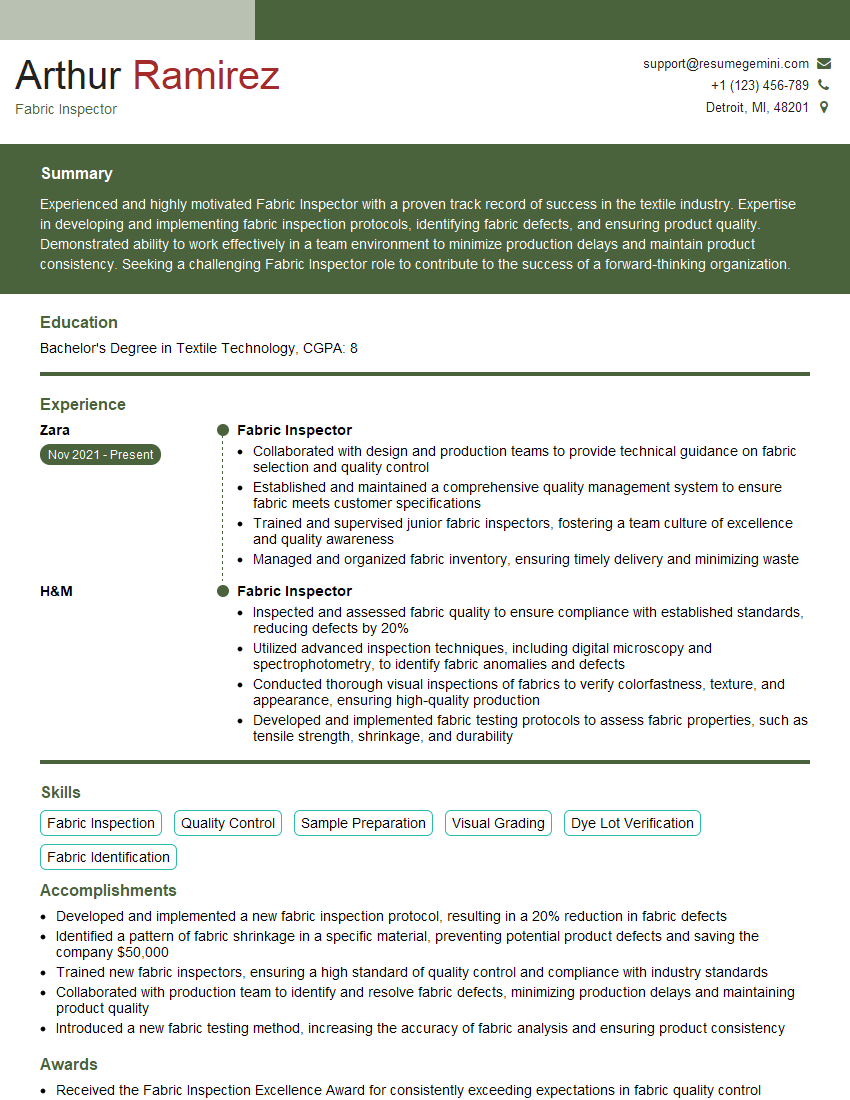
Mastering Quality Control and Inspection for buttonhole products opens doors to rewarding career opportunities in the textile and apparel industry. A strong understanding of these concepts demonstrates your attention to detail, problem-solving skills, and commitment to quality – highly valued attributes by employers. To significantly increase your chances of landing your dream role, focus on building an ATS-friendly resume that effectively showcases your skills and experience. ResumeGemini is a trusted resource to help you create a professional and impactful resume that stands out from the competition. We provide examples of resumes tailored to Quality Control and Inspection of Buttonhole Products to guide you.

Explore more articles
Users Rating of Our Blogs
Share Your Experience
We value your feedback! Please rate our content and share your thoughts (optional).
What Readers Say About Our Blog
Very informative content, great job.
good