Feeling uncertain about what to expect in your upcoming interview? We’ve got you covered! This blog highlights the most important Experience in renewable energy research interview questions and provides actionable advice to help you stand out as the ideal candidate. Let’s pave the way for your success.
Questions Asked in Experience in renewable energy research Interview
Q 1. Explain the different types of renewable energy sources and their relative advantages and disadvantages.
Renewable energy sources harness naturally replenishing resources to generate power. The main types include solar, wind, hydro, geothermal, and biomass. Each has its own set of advantages and disadvantages.
- Solar Power:
- Advantages: Abundant, widely available, low maintenance (after initial installation), declining costs.
- Disadvantages: Intermittency (sunlight dependent), land use requirements, manufacturing impacts.
- Wind Power:
- Advantages: High energy output in favorable locations, relatively low environmental impact (excluding manufacturing and transport), cost-effective in suitable areas.
- Disadvantages: Intermittency (wind dependent), noise pollution, visual impact, potential threat to birds and bats.
- Hydropower:
- Advantages: Reliable, high energy output, long lifespan, water storage potential.
- Disadvantages: High upfront costs, significant environmental impact (habitat alteration, methane emissions from reservoirs), potential for displacement of communities.
- Geothermal Power:
- Advantages: Reliable, consistent energy output, low greenhouse gas emissions.
- Disadvantages: Geographic limitations (requires areas with geothermal activity), potential for induced seismicity, high upfront costs.
- Biomass Energy:
- Advantages: Carbon neutral (when sustainably managed), widely available, can utilize waste products.
- Disadvantages: Potential for air pollution, land use competition with food production, sustainability concerns depending on biomass source.
For example, a large-scale solar farm might be ideal in a sunny desert region, while a wind farm might be more suitable in a consistently windy area. However, careful consideration must be given to the local environmental factors and community acceptance in each case.
Q 2. Describe your experience with different renewable energy modeling software (e.g., HOMER, PVsyst).
My experience encompasses several renewable energy modeling software packages. I’ve extensively used HOMER for microgrid design and optimization. I’ve found HOMER particularly useful for evaluating the economic and technical feasibility of off-grid and hybrid renewable energy systems. It allows for a detailed analysis of various renewable energy sources, energy storage options, and load profiles to determine the optimal system configuration and size. For example, I used HOMER to design a solar-diesel hybrid system for a remote community, optimizing the balance between solar PV, diesel generators, and battery storage to minimize cost and greenhouse gas emissions.
Additionally, I have experience with PVsyst, a software specialized in photovoltaic system design and performance simulation. PVsyst helps model the performance of solar PV systems under varying climatic conditions. I’ve used it to assess the performance of different solar panel technologies and array layouts, optimizing system design to maximize energy output and minimize shading effects. For instance, in a recent project, PVsyst helped me demonstrate that a specific dual-axis tracking system could increase energy yield by 15% compared to a fixed-tilt system.
Q 3. What are the key challenges in integrating renewable energy sources into the existing power grid?
Integrating renewable energy into existing grids presents significant challenges due to their inherent intermittency and variability. Key challenges include:
- Intermittency and Variability: Solar and wind power fluctuate with weather conditions, requiring sophisticated forecasting and grid management strategies to maintain grid stability.
- Grid Infrastructure Limitations: Existing grids were designed for centralized power generation and may not be equipped to handle the decentralized nature of renewable sources. Upgrades may be needed to accommodate bidirectional power flows and accommodate the increased demand on existing assets.
- Voltage and Frequency Control: Maintaining grid frequency and voltage within acceptable limits is crucial for reliable operation. The intermittent nature of renewable energy can make this more difficult. Advanced grid control systems and energy storage solutions are needed to address these issues.
- Transmission and Distribution Infrastructure: Renewable energy sources are often located remotely from load centers, requiring upgrades to transmission and distribution infrastructure to transport the generated power efficiently.
- System Integration and Control: Efficient integration necessitates advanced control systems that can seamlessly manage the interaction between renewable energy sources, traditional generators, and grid demands.
For example, a sudden drop in wind power generation can lead to frequency deviations, potentially causing widespread blackouts. To solve this, effective grid management systems incorporating forecasting, smart grids, and energy storage are crucial.
Q 4. Discuss the environmental impacts of different renewable energy technologies.
The environmental impacts of renewable energy technologies are generally much lower than those of fossil fuels, but they aren’t entirely without consequences.
- Solar Power: Manufacturing processes can involve hazardous materials and energy consumption, but operational emissions are negligible. Land use is a consideration, as are the eventual disposal or recycling of panels.
- Wind Power: Impacts on birds and bats are a concern, but these effects are being mitigated through improved turbine design and siting strategies. Manufacturing and transportation also have environmental costs.
- Hydropower: Dam construction can lead to habitat loss, altered water flows, and greenhouse gas emissions from flooded vegetation. Sedimentation can also impact downstream ecosystems.
- Geothermal Power: Potential for induced seismicity and emissions of gases (although generally lower than fossil fuels) are considerations.
- Biomass Energy: Sustainable biomass practices minimize negative impacts, but unsustainable practices can lead to deforestation, soil erosion, and air pollution.
It’s crucial to conduct thorough environmental impact assessments for each project to minimize adverse effects and maximize the environmental benefits of renewable energy. Sustainable sourcing of materials and responsible site selection are paramount.
Q 5. Explain the concept of energy storage and its importance in renewable energy systems.
Energy storage is crucial for renewable energy systems because it addresses the intermittency problem. Renewable sources like solar and wind don’t produce power consistently; energy storage systems buffer this variability, ensuring a reliable power supply.
Different storage technologies exist, including:
- Batteries: Lithium-ion batteries are prevalent, offering relatively high energy density and efficiency. They are crucial for grid-scale applications and also power smaller systems like those found in homes.
- Pumped Hydro Storage: This uses excess energy to pump water uphill, releasing it to generate power when demand is high. It is a mature technology suitable for large-scale storage but requires specific geographical conditions.
- Compressed Air Energy Storage (CAES): This technology stores energy by compressing air into underground reservoirs, releasing it to drive turbines. Suitable for large-scale grid applications but also has site-specific limitations.
- Thermal Energy Storage: This technology stores energy as heat, often using molten salts or other materials. This approach is suitable for concentrating solar power applications.
Without energy storage, the grid would experience frequent imbalances between supply and demand, leading to instability and potentially blackouts. Storage allows for a smoother transition towards a higher share of renewable energy sources in the power generation mix.
Q 6. What are your experiences with life cycle assessments (LCA) of renewable energy projects?
Life Cycle Assessments (LCAs) provide a comprehensive evaluation of the environmental impacts of a renewable energy project throughout its entire lifecycle, from raw material extraction to decommissioning. My experience with LCAs includes conducting them for various renewable energy projects, using software tools like SimaPro or Gabi.
The LCA process involves:
- Goal and Scope Definition: Clearly defining the project’s boundaries, functional unit (e.g., kWh of electricity produced), and impact categories to be assessed.
- Inventory Analysis: Quantifying all inputs and outputs of the project, including energy consumption, material use, emissions, and waste generation.
- Impact Assessment: Evaluating the environmental impacts using various impact assessment methods, such as characterization factors, to assess the significance of the environmental burdens.
- Interpretation: Analyzing the results and identifying potential environmental hotspots and areas for improvement.
For instance, I conducted an LCA for a wind farm project, assessing the environmental impacts of manufacturing the turbines, construction, operation, and decommissioning. The results highlighted the significance of material selection and efficient transportation in minimizing the project’s carbon footprint. LCAs are essential for ensuring that renewable energy projects truly deliver their environmental benefits.
Q 7. How do you analyze the economic feasibility of renewable energy projects?
Analyzing the economic feasibility of renewable energy projects involves a comprehensive assessment of costs and revenues over the project’s lifetime. This typically includes:
- Capital Costs: These include equipment costs (turbines, panels, inverters, etc.), land acquisition, construction, and permitting.
- Operational Costs: These involve maintenance, repair, insurance, and operations and management costs.
- Revenue Streams: These can include electricity sales to the grid, government subsidies, carbon credits (if applicable), and potential ancillary services revenue.
- Financial Metrics: Key metrics used for evaluation include Net Present Value (NPV), Internal Rate of Return (IRR), Payback Period, and Levelized Cost of Energy (LCOE).
For example, to assess the economic viability of a solar PV project, we’d calculate the total capital costs, including the cost of the PV panels, inverters, balance of system components, and installation. We’d then estimate the annual energy generation, based on solar resource assessment and system performance simulations. We’d then project energy prices and estimate revenues based on power purchase agreements or feed-in tariffs. Finally, we’d use discounted cash flow analysis to determine the NPV, IRR, and LCOE, considering various discount rates and financing scenarios.
Sensitivity analysis is crucial to evaluate the project’s robustness to uncertainties in input parameters such as energy prices, interest rates, and operational costs.
Q 8. Describe your experience with data analysis techniques used in renewable energy research.
My experience in data analysis within renewable energy research is extensive, encompassing various techniques crucial for understanding and optimizing renewable energy systems. I’ve worked extensively with time series analysis, vital for predicting solar and wind power output based on historical weather data. This often involves using statistical models like ARIMA (Autoregressive Integrated Moving Average) or more advanced machine learning methods like LSTM (Long Short-Term Memory) networks to forecast production and integrate renewables effectively into the electricity grid. Furthermore, I’m proficient in spatial analysis using GIS (Geographic Information Systems) software to identify optimal locations for renewable energy projects, considering factors like solar irradiance, wind speed, and land availability. Finally, I utilize statistical methods such as regression analysis to assess the correlation between renewable energy generation and other factors (e.g., energy consumption, economic growth). For instance, I recently used multiple linear regression to model the relationship between solar panel tilt angle, solar irradiance, and energy generation, improving the design and efficiency of a photovoltaic system in a real-world project.
I am also adept at handling large datasets, often employing techniques for data cleaning, preprocessing, and feature engineering to ensure the accuracy and reliability of my analyses. This includes dealing with missing data, handling outliers, and performing dimensionality reduction where necessary. My expertise extends to data visualization, using tools like Python’s matplotlib and seaborn libraries to create insightful charts and graphs that effectively communicate findings to both technical and non-technical audiences.
Q 9. What are some key metrics used to evaluate the performance of renewable energy systems?
Key metrics used to evaluate renewable energy systems performance vary depending on the specific technology, but some common ones include:
- Capacity Factor: This metric indicates how effectively a renewable energy system generates power relative to its maximum capacity. A higher capacity factor suggests better utilization of the resource. For example, a wind turbine with a 40% capacity factor means it generated power at 40% of its maximum output over a given period.
- Energy Yield: This simply refers to the total amount of energy produced over a specific time frame, often expressed in kWh or MWh. It’s a straightforward measure of overall productivity.
- System Efficiency: This encompasses the overall efficiency of the entire energy conversion process. In solar PV, this includes factors like panel efficiency, inverter efficiency, and energy losses due to wiring and shading. For wind turbines, it considers aerodynamic efficiency and mechanical losses.
- Levelized Cost of Energy (LCOE): This metric represents the total cost of energy production over the system’s lifetime, divided by the total energy generated. It provides a comprehensive measure of the economic viability of the project.
- Reliability and Availability: These metrics assess the system’s uptime and its ability to consistently produce energy. Downtime due to maintenance or malfunctions significantly impacts overall performance.
These metrics, often combined, allow for a thorough assessment of renewable energy system performance, informing decision-making on design optimization, maintenance scheduling, and resource allocation.
Q 10. Explain your understanding of different renewable energy policy mechanisms.
Renewable energy policy mechanisms are crucial for driving the transition to a sustainable energy future. They can be broadly categorized as:
- Feed-in Tariffs (FITs): These provide guaranteed prices for renewable energy generated and fed into the electricity grid, incentivizing investment in renewable energy projects. The government pays a predetermined rate per unit of renewable energy produced, reducing the financial risk for producers.
- Renewable Portfolio Standards (RPS): These mandate that a certain percentage of a region’s electricity must come from renewable sources by a specific date. This approach indirectly stimulates the renewable energy market by creating a guaranteed demand.
- Tax Credits and Incentives: Governments often offer tax breaks, rebates, or other financial incentives to encourage the adoption of renewable energy technologies. This makes renewable energy options more economically attractive compared to fossil fuels.
- Carbon Pricing Mechanisms: These include carbon taxes or emissions trading schemes that put a price on carbon emissions, making fossil fuels more expensive and thus increasing the competitiveness of renewable energy.
- Renewable Energy Zones (REZs): These designate specific geographic areas as optimal for renewable energy development, streamlining permitting processes and providing grid infrastructure support.
The effectiveness of each mechanism depends on various factors, including the specific context, the level of government support, and the market conditions. A well-designed policy mix usually combines several mechanisms for optimal impact.
Q 11. Describe your experience with experimental design and data collection in renewable energy research.
My experience in experimental design and data collection in renewable energy research is deeply rooted in rigorous methodology. I have designed and executed numerous experiments to assess the performance of various renewable energy technologies under diverse conditions. This involves carefully defining research objectives, selecting appropriate experimental variables, designing controlled experiments, and employing appropriate statistical methods to analyze the results. A recent project involved a comparative study of different types of solar trackers – single-axis and dual-axis – measuring energy output under varying solar angles and weather conditions. I meticulously designed the experiment, ensuring accurate measurement of solar irradiance, ambient temperature, and energy output, using calibrated sensors and data loggers. Data collection involved using automated data acquisition systems to record high-frequency data, reducing human error.
Careful attention is paid to minimizing bias and ensuring the reproducibility of the results. This includes employing randomization techniques, using appropriate sample sizes, and implementing quality control measures throughout the data collection process. My approach always includes thorough documentation of the experimental setup, data collection procedures, and data analysis methods, ensuring transparency and reproducibility of the findings. I am proficient in various data acquisition techniques, such as using weather stations, power meters, and specialized sensors to obtain comprehensive data relevant to the specific experimental setup.
Q 12. How familiar are you with different types of solar panels and their characteristics?
My familiarity with different types of solar panels is comprehensive, covering their characteristics and applications. Key distinctions include:
- Monocrystalline Silicon: These panels are made from a single silicon crystal, resulting in higher efficiency (typically 18-22%) and a more aesthetically pleasing black appearance. They are generally more expensive.
- Polycrystalline Silicon: Made from multiple silicon crystals, these panels offer slightly lower efficiency (around 15-17%) compared to monocrystalline but are typically more affordable.
- Thin-Film Solar Panels: These use thin layers of photovoltaic material deposited on a substrate like glass or plastic. They are flexible, lighter, and can be less efficient (8-13%), but they can be manufactured at lower costs and are suited for various applications like building-integrated photovoltaics (BIPV).
- Perovskite Solar Cells: These emerging technology cells offer high potential efficiency and are relatively low-cost, but their long-term stability and scalability remain areas of ongoing research.
The choice of solar panel depends on factors such as budget, available space, aesthetic preferences, and climatic conditions. Each type exhibits a unique performance profile concerning energy generation, temperature coefficient, degradation rate, and cost-effectiveness.
Q 13. Discuss the different types of wind turbines and their suitability for various locations.
Wind turbines are categorized primarily by their axis of rotation:
- Horizontal-Axis Wind Turbines (HAWTs): These are the most common type, with the rotor shaft oriented horizontally. They are efficient at capturing wind energy and are suitable for various locations, from onshore plains to offshore environments. Their design can vary, including two-bladed or three-bladed configurations, which influence their performance characteristics and suitability to different wind regimes.
- Vertical-Axis Wind Turbines (VAWTs): These have the rotor shaft oriented vertically. They have advantages such as not requiring yaw mechanisms (which rotate the turbine to face the wind) and can potentially be more efficient at low wind speeds. However, VAWTs typically have lower efficiency at higher wind speeds compared to HAWTs and are less commonly deployed on a large scale.
Suitability for various locations depends on several factors: wind speed and consistency, land availability, environmental regulations, and grid connection proximity. Onshore locations often favor HAWTs due to their higher efficiency at the typical wind speeds encountered. Offshore wind farms usually use larger HAWTs due to consistent higher wind speeds, enabling greater energy production despite higher installation costs. VAWTs might find niche applications in urban areas or locations with limited space, where their orientation and simpler design provide advantages.
Q 14. What are your experiences with geothermal energy exploration and resource assessment?
My experience with geothermal energy exploration and resource assessment involves utilizing geophysical and geological methods to identify and characterize geothermal resources. This includes interpreting geological data to assess the subsurface structure, identifying potential geothermal reservoirs, and estimating the resource’s size and potential energy yield. I’ve worked on projects that involved utilizing techniques like:
- Geophysical Surveys: These include magnetotelluric (MT) surveys, which use electromagnetic fields to image the subsurface resistivity, aiding in the identification of geothermal reservoirs; seismic surveys to map subsurface faults and fractures that can enhance geothermal resource potential; and gravity surveys to determine variations in subsurface density, indicating potential geological structures that influence geothermal activity.
- Geochemical Analysis: Analyzing water and gas samples from existing wells and springs provides crucial information about reservoir temperature, salinity, and potential for geothermal energy production.
- Geological Mapping and Modeling: Integrating geological data from various sources, including surface mapping, well logs, and seismic data, facilitates the creation of 3D geological models that help in visualizing the geothermal reservoir and estimating its potential.
- Resource Assessment: Using the data acquired from surveys and analysis, I perform resource assessments to estimate the size, temperature, and producibility of the geothermal reservoir. This involves creating numerical models that simulate fluid flow and heat transfer within the reservoir to predict long-term energy output and economic viability.
The process is iterative, often requiring data refinement and model recalibration as new information becomes available. It’s critical to minimize uncertainties and maximize accuracy in assessing the potential of geothermal energy resources, ensuring responsible and sustainable development.
Q 15. Explain your understanding of biomass energy conversion technologies.
Biomass energy conversion technologies involve transforming organic matter into usable energy. This organic matter, ranging from agricultural residues to dedicated energy crops, contains stored solar energy that can be harnessed. Several key technologies exist:
- Thermochemical Conversion: This involves high-temperature processes to break down biomass. Examples include gasification (converting biomass into a syngas, a mixture of carbon monoxide and hydrogen), pyrolysis (heating biomass in the absence of oxygen to produce bio-oil and char), and direct combustion (burning biomass directly for heat or electricity generation). Think of it like a very controlled and efficient bonfire, but instead of just heat, we capture the energy for useful purposes.
- Biochemical Conversion: This uses biological processes to break down biomass. The most prominent example is anaerobic digestion, where microorganisms decompose biomass in the absence of oxygen to produce biogas (primarily methane and carbon dioxide), which can be used for electricity generation or heat. This is similar to how our digestive systems work, but on a much larger scale, producing energy instead of waste products.
- Biofuel Production: Biomass can be converted into liquid fuels like ethanol or biodiesel. Ethanol is commonly produced through fermentation of sugars found in crops like corn or sugarcane, while biodiesel is created through transesterification of vegetable oils or animal fats. These biofuels can then replace or supplement traditional fossil fuels in transportation.
The choice of technology depends on several factors including the type of biomass, the desired energy form, and economic considerations. My research has focused heavily on optimizing gasification processes to improve efficiency and reduce emissions.
Career Expert Tips:
- Ace those interviews! Prepare effectively by reviewing the Top 50 Most Common Interview Questions on ResumeGemini.
- Navigate your job search with confidence! Explore a wide range of Career Tips on ResumeGemini. Learn about common challenges and recommendations to overcome them.
- Craft the perfect resume! Master the Art of Resume Writing with ResumeGemini’s guide. Showcase your unique qualifications and achievements effectively.
- Don’t miss out on holiday savings! Build your dream resume with ResumeGemini’s ATS optimized templates.
Q 16. What are the challenges associated with hydropower development and how can they be mitigated?
Hydropower, while a clean and reliable energy source, faces several challenges.
- Environmental Impacts: Dam construction can disrupt river ecosystems, affecting fish migration, water quality, and riparian habitats. Sedimentation behind dams can also reduce their lifespan and reservoir capacity. This is a significant concern, and careful environmental impact assessments are crucial.
- Social Impacts: Hydropower projects can displace communities, impacting livelihoods and cultural heritage. This requires careful planning and stakeholder engagement to mitigate these negative consequences.
- Economic Costs: The initial investment for hydropower projects can be substantial. Further, the electricity generated might not be cost-competitive with other renewable sources in all locations.
- Water Availability: Hydropower relies on sufficient water flow. Climate change and increasing water scarcity can significantly impact its reliability.
Mitigation strategies involve incorporating environmental flow requirements in dam designs, employing fish ladders or other fish passage technologies, investing in community development programs, and exploring smaller-scale hydropower options with minimal environmental impact. Lifecycle cost analyses and careful site selection can help optimize economic viability. Diversification of the energy portfolio to reduce reliance on a single hydropower plant can also help mitigate risks associated with water scarcity.
Q 17. How familiar are you with different energy storage technologies (e.g., batteries, pumped hydro)?
I am very familiar with various energy storage technologies. They are essential for integrating intermittent renewable energy sources like solar and wind into the grid.
- Batteries: These range from Lithium-ion batteries (commonly used in electric vehicles and grid-scale storage) to other chemistries like flow batteries, which are particularly well-suited for long-duration storage. Battery technology is constantly evolving, with ongoing research focusing on improving energy density, lifespan, and cost-effectiveness. I’ve worked extensively analyzing the performance of Lithium-ion batteries in grid-scale applications.
- Pumped Hydro Storage: This involves pumping water uphill to a reservoir during periods of low electricity demand and then releasing it to generate electricity when demand is high. It’s a mature technology with long duration storage capabilities but requires suitable geography. I’ve conducted research comparing the efficiency and economic viability of pumped hydro storage against other storage options in different geographical locations.
- Other technologies: Other notable storage solutions include compressed air energy storage (CAES), thermal energy storage, and various forms of chemical energy storage. Each has its own strengths and weaknesses, making the selection highly context-dependent.
The selection of the most suitable storage technology depends on factors like storage duration, power capacity, cost, geographical constraints, and environmental impact.
Q 18. Describe your experience with analyzing renewable energy time series data.
My experience with analyzing renewable energy time series data is extensive. I’ve used various statistical and machine learning techniques to analyze data from solar, wind, and hydropower resources. This includes:
- Descriptive Statistics: Calculating mean, standard deviation, and other statistical measures to understand data characteristics.
- Time Series Analysis: Employing techniques like autocorrelation and partial autocorrelation functions to identify patterns and trends in data.
- Forecasting: Utilizing models such as ARIMA (Autoregressive Integrated Moving Average) and various machine learning algorithms (e.g., LSTM neural networks) to predict future energy production. For example, I developed a model using LSTM networks that accurately predicted solar power output up to 24 hours in advance, significantly improving grid management capabilities.
- Data Cleaning and Preprocessing: Handling missing data, outliers, and noise in the data sets is crucial for reliable analysis and forecasting. I have experience with various imputation methods and filtering techniques.
My analysis helps to optimize grid operations, assess the reliability of renewable energy sources, and facilitate better integration into the power system. For example, accurate forecasting allows grid operators to manage power imbalances and avoid blackouts.
Q 19. How do you evaluate the reliability and stability of renewable energy systems?
Evaluating the reliability and stability of renewable energy systems involves assessing several key aspects:
- Resource Variability: Analyzing the intermittency of renewable energy resources (solar, wind) and their impact on grid stability. We often use statistical methods and historical data to quantify this variability.
- Forecasting Accuracy: Assessing the accuracy of energy production forecasts, as this impacts grid planning and dispatch decisions. I use metrics such as Mean Absolute Error (MAE) and Root Mean Squared Error (RMSE) to evaluate forecast performance.
- Grid Integration: Analyzing the impact of renewable energy integration on grid frequency, voltage stability, and overall system security. This often involves power flow simulations and stability studies.
- Component Reliability: Assessing the reliability of individual components (solar panels, wind turbines, batteries) and their impact on overall system performance. This may involve analyzing failure rates and implementing redundancy measures.
- Energy Storage Capacity: Determining whether sufficient energy storage is available to compensate for intermittency and ensure grid stability. We evaluate storage capacity needs based on forecasted energy production and grid demand.
Comprehensive system modeling and simulations play a crucial role in evaluating reliability and stability. We often use software like PowerWorld Simulator or similar tools to assess the performance of renewable energy systems under various scenarios.
Q 20. Explain your understanding of smart grid technologies and their role in integrating renewable energy.
Smart grid technologies are crucial for effectively integrating renewable energy sources into the power system. They enable a more efficient, reliable, and flexible grid capable of handling the intermittent nature of renewables.
- Advanced Metering Infrastructure (AMI): Smart meters provide real-time data on energy consumption, enabling better demand-side management and integration of distributed generation from renewables. This allows for dynamic pricing schemes and encourages consumers to shift energy usage to times of higher renewable generation.
- Distributed Generation Management: Smart grids allow for better control and coordination of distributed renewable energy sources (solar panels, small wind turbines) throughout the grid. This improves efficiency and system stability.
- Energy Storage Management: Smart grid technologies help manage and optimize the use of energy storage systems to balance supply and demand, mitigating the intermittency of renewable resources. This includes sophisticated algorithms that optimize charging and discharging schedules based on real-time conditions.
- Demand-Side Management (DSM): Smart grids enable demand-side management programs that encourage consumers to shift their energy usage to times of higher renewable generation. This can help balance the grid and reduce reliance on fossil fuel-based peaker plants.
In essence, smart grids act as the nervous system of a modernized power system, enabling better communication, control, and optimization of renewable energy resources. My work has involved developing algorithms for optimal power flow in smart grids with high penetrations of renewable energy.
Q 21. Discuss the role of artificial intelligence and machine learning in renewable energy research.
Artificial intelligence (AI) and machine learning (ML) are transforming renewable energy research and applications. Their capabilities are particularly valuable in areas where complex data analysis and prediction are required.
- Predictive Maintenance: ML algorithms can analyze sensor data from wind turbines and solar panels to predict potential failures, enabling proactive maintenance and reducing downtime. This reduces operational costs and maximizes energy production.
- Improved Forecasting: AI/ML models can improve the accuracy of renewable energy production forecasts, leading to better grid management and reduced reliance on fossil fuel backup power. My research has shown that deep learning models can significantly outperform traditional time series forecasting techniques in this area.
- Optimal Energy Dispatch: AI/ML algorithms can optimize energy dispatch from various sources, including renewables and traditional power plants, ensuring grid stability and maximizing the use of renewable energy.
- Resource Assessment: AI can analyze satellite imagery and other geographical data to identify optimal locations for renewable energy projects, considering factors like solar irradiance, wind speed, and environmental impact.
- Smart Grid Optimization: AI can optimize smart grid operations, improving efficiency, reliability, and integration of renewable energy sources.
The ability of AI/ML to process large datasets, identify complex patterns, and make accurate predictions makes them invaluable tools for accelerating the transition to a sustainable energy future. My work focuses on applying deep learning techniques to improve the accuracy and efficiency of renewable energy systems.
Q 22. What are the future trends and challenges in renewable energy research?
The future of renewable energy research is incredibly exciting, but also faces significant hurdles. We’re seeing a strong push towards higher efficiency, lower cost, and improved scalability across all renewable energy sources.
- Increased Efficiency: Research is focused on improving the efficiency of solar panels beyond current limits, developing next-generation wind turbine designs with higher energy capture rates, and optimizing the performance of biofuel production. This often involves exploring novel materials and advanced manufacturing techniques.
- Reduced Costs: A major challenge is bringing down the cost of renewable energy technologies to make them truly competitive with fossil fuels. This requires innovation in materials science, manufacturing processes, and supply chain optimization. For instance, research into cheaper and more efficient battery technologies for energy storage is crucial.
- Improved Scalability: Scaling up renewable energy production to meet global demand is a massive undertaking. Research focuses on efficient grid integration, advanced energy storage solutions (like pumped hydro or large-scale batteries), and smart grids to manage intermittent energy sources effectively.
- Grid Integration and Storage: The intermittent nature of solar and wind power necessitates robust and efficient energy storage and smart grid management systems. Research in advanced battery technologies, pumped hydro storage, and other storage solutions is paramount. Developing sophisticated algorithms for smart grids to predict energy demand and optimize resource allocation is another critical area.
- Environmental Impacts: Minimizing the environmental footprint of renewable energy technologies is vital. Research is ongoing to reduce the carbon footprint of manufacturing processes, improve the sustainability of material sourcing, and mitigate the environmental effects of large-scale renewable energy projects (e.g., land use for solar farms).
Challenges include securing sufficient funding, overcoming regulatory hurdles, addressing public perception, and managing the complex interplay between various stakeholders.
Q 23. Describe a project where you overcame a significant technical challenge in renewable energy research.
During my doctoral research, I worked on optimizing the performance of organic solar cells. We faced a significant challenge in improving the power conversion efficiency (PCE) of these cells, which was significantly lower than that of traditional silicon-based solar cells. The challenge stemmed from the inherent limitations of organic materials, including their tendency to degrade under sunlight and their relatively low charge carrier mobility.
Our solution involved a multi-pronged approach. First, we synthesized novel organic materials with improved light absorption properties and enhanced charge transport characteristics. We used a combination of experimental techniques, such as thin-film deposition and spectroscopic characterization, to carefully tailor the molecular structure of these materials. Second, we developed an innovative device architecture that optimized charge separation and collection within the organic solar cell. This involved creating a precise interfacial layer between the organic materials to minimize recombination losses. Finally, we employed advanced simulation techniques to guide our experimental work and optimize the device parameters.
Through this collaborative effort, we successfully increased the PCE of our organic solar cells by over 20%, a substantial improvement in the field. This work was published in a peer-reviewed journal and helped establish new design principles for organic solar cells.
Q 24. Explain how you would approach a new renewable energy research problem.
My approach to a new renewable energy research problem follows a structured, iterative process:
- Problem Definition and Literature Review: I begin by thoroughly defining the problem and conducting an extensive literature review to understand the current state of knowledge, identify existing solutions, and pinpoint knowledge gaps.
- Hypothesis Formulation: Based on the literature review, I formulate testable hypotheses regarding potential solutions to the problem. This involves identifying key factors influencing the problem and formulating specific, measurable, achievable, relevant, and time-bound (SMART) goals.
- Experimental Design and Methodology: I develop a robust experimental design to test my hypotheses. This includes selecting appropriate materials, techniques, and instrumentation; planning the experimental workflow; and establishing appropriate control groups.
- Data Collection and Analysis: I meticulously collect and analyze data using appropriate statistical methods. I use visualization tools to identify trends and patterns in the data. Rigorous statistical analysis helps ensure the validity of my conclusions.
- Results Interpretation and Conclusion: I interpret the results in the context of my hypotheses and the existing literature. I draw scientifically sound conclusions and discuss the implications of my findings.
- Dissemination: I actively disseminate my findings through publications in peer-reviewed journals, presentations at scientific conferences, and reports to funding agencies.
This iterative process allows for continuous refinement of my approach based on the results obtained at each stage. It ensures that my research is scientifically rigorous, reproducible, and contributes meaningfully to the advancement of renewable energy technologies.
Q 25. What is your experience with grant writing and securing funding for renewable energy projects?
I have extensive experience in grant writing and securing funding for renewable energy projects. I’ve successfully secured funding from various sources, including national science foundations, private foundations, and industry partners. My grant writing process involves:
- Identifying Funding Opportunities: I meticulously search for relevant funding opportunities through online databases and networking events.
- Developing a Compelling Proposal: I craft compelling proposals that clearly articulate the research problem, proposed methodology, expected outcomes, and budget justification. I emphasize the potential impact of the research and its relevance to societal needs.
- Building Strong Collaborations: I actively collaborate with researchers from diverse disciplines to create strong, multi-institutional proposals. This collaborative approach strengthens the proposal’s scientific merit and broadens its impact.
- Refining and Submitting Proposals: I revise and refine proposals based on feedback from colleagues and mentors before submitting them. I ensure all submissions adhere to the specific requirements and guidelines of the funding agency.
I have a strong track record of success in securing funding, which demonstrates my ability to effectively communicate the value of my research and to manage research projects within budgetary constraints. My experience includes writing proposals for projects ranging from basic research to applied technology development.
Q 26. How do you stay up-to-date on the latest advancements in renewable energy technologies?
Staying current in the rapidly evolving field of renewable energy requires a multifaceted approach:
- Peer-Reviewed Journals: I regularly read prominent journals such as Nature, Science, Energy & Environmental Science, and Joule, focusing on areas relevant to my research interests.
- Conferences and Workshops: Attending international conferences and workshops provides opportunities to learn about the latest breakthroughs from leading researchers in the field and network with colleagues.
- Online Databases and Resources: I utilize online databases such as Web of Science and Scopus to access research articles and publications. I regularly check the websites of major research institutions and government agencies working in renewable energy.
- Industry Reports and News: I follow industry news and reports to understand market trends and technological advancements. This helps me to identify emerging research directions and translate research findings into practical applications.
- Professional Networks: I actively participate in professional organizations and networks, attending webinars and seminars, to connect with experts and stay abreast of developments.
This combined strategy ensures I maintain a comprehensive understanding of the latest advancements in renewable energy technologies and their potential applications.
Q 27. Describe your experience collaborating with multidisciplinary teams in renewable energy research.
I have extensive experience collaborating with multidisciplinary teams in renewable energy research. My collaborations have involved engineers, material scientists, chemists, economists, and policymakers. These collaborations have been crucial for successfully addressing complex challenges in the field.
For instance, in a recent project focused on integrating renewable energy sources into the electricity grid, our team included electrical engineers specializing in power systems, computer scientists experienced in developing grid management algorithms, and economists who analyzed the economic impacts of renewable energy integration. Effective collaboration required clear communication, mutual respect, and a shared understanding of our individual expertise and contributions to the overall project goals. We utilized project management tools and regular team meetings to ensure the project progressed efficiently and effectively. We also developed a collaborative work plan that outlined roles and responsibilities, milestones, and communication protocols. This collaborative approach enabled us to successfully complete the project and achieve our research objectives.
I believe that successful interdisciplinary collaboration hinges on open communication, effective leadership, and a shared commitment to the project’s goals. My experience has taught me the importance of valuing diverse perspectives and using each team member’s unique skillset to its full potential.
Q 28. What are your career goals in the field of renewable energy research?
My career goals center on contributing to a sustainable energy future through impactful research and technological innovation. I aspire to:
- Lead Research Projects: I aim to lead ambitious research projects that push the boundaries of renewable energy technologies and address critical challenges facing the field.
- Mentor and Train Future Researchers: I strive to mentor and train the next generation of renewable energy researchers, fostering a collaborative and supportive research environment.
- Translate Research into Applications: I want to bridge the gap between fundamental research and practical applications by actively seeking opportunities to translate my research findings into commercially viable technologies.
- Influence Policy and Decision-Making: I hope to contribute to informed policy decisions related to renewable energy by engaging with policymakers and disseminating research findings to a wider audience.
- Advance Scientific Knowledge: Ultimately, my goal is to contribute meaningfully to the advancement of scientific knowledge in renewable energy, leading to a cleaner, more sustainable world.
I believe that by combining rigorous scientific research with a strong commitment to collaboration and outreach, I can make a significant contribution to solving the global energy challenge.
Key Topics to Learn for Renewable Energy Research Interviews
- Solar Energy Technologies: Understanding photovoltaic (PV) cell principles, solar thermal systems, and advancements in solar energy efficiency. Explore practical applications like grid-tied systems, off-grid solutions, and building-integrated photovoltaics.
- Wind Energy Systems: Familiarize yourself with various turbine designs, wind resource assessment techniques, and the integration of wind farms into power grids. Consider the environmental impact and mitigation strategies.
- Bioenergy and Biofuels: Study the processes of biofuel production from different feedstocks, their sustainability aspects, and the challenges related to land use and greenhouse gas emissions. Understand lifecycle analysis and its application.
- Hydropower and Geothermal Energy: Learn about different hydropower plant designs and their environmental considerations. Explore the principles of geothermal energy extraction and its potential for sustainable electricity generation.
- Energy Storage Technologies: Understand the importance of energy storage for renewable energy integration. Explore various technologies such as batteries, pumped hydro storage, and compressed air energy storage, and their respective advantages and limitations.
- Smart Grids and Energy Management: Learn about the role of smart grids in integrating renewable energy sources and managing fluctuating energy supply. Understand demand-side management strategies and their impact.
- Data Analysis and Modeling: Develop proficiency in analyzing renewable energy data, using simulation tools, and applying statistical methods to predict energy production and optimize system performance. This includes understanding uncertainties and risk assessment.
- Research Methodology and Project Management: Familiarize yourself with the scientific method, experimental design, data analysis, and reporting. Understand project planning, budgeting, and team collaboration within a research setting.
Next Steps
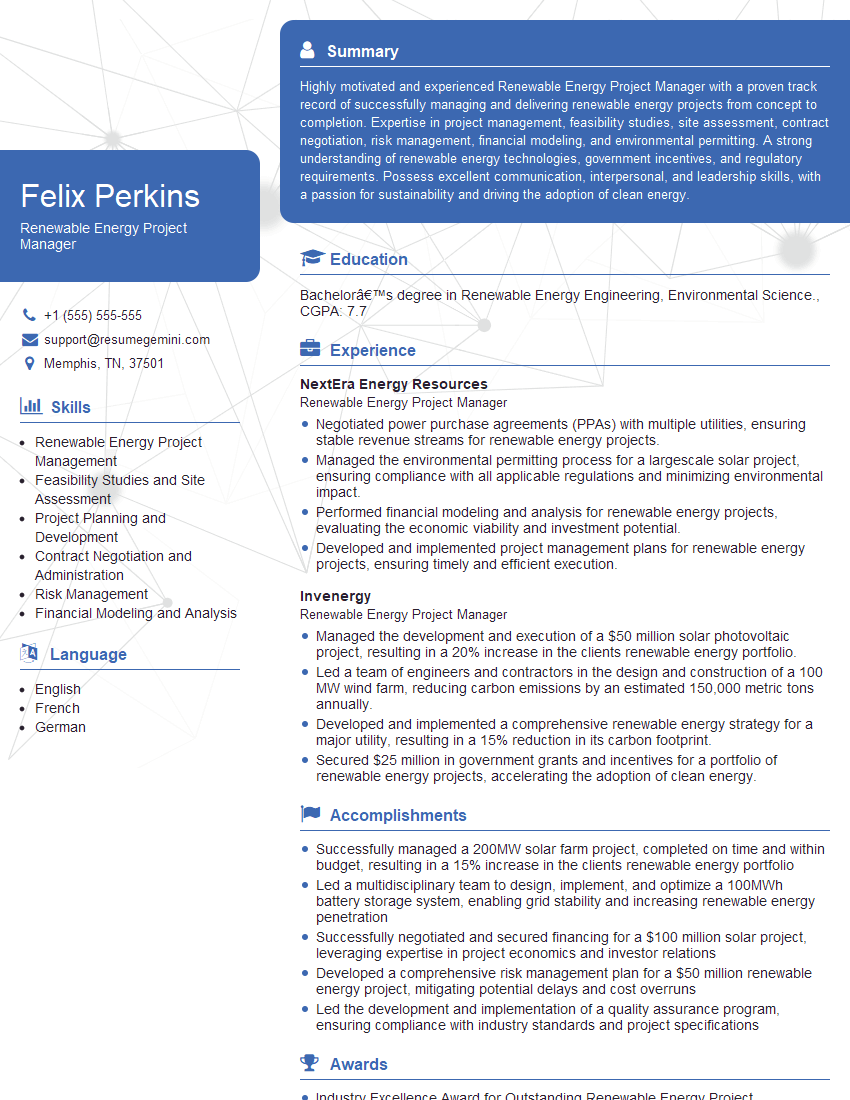
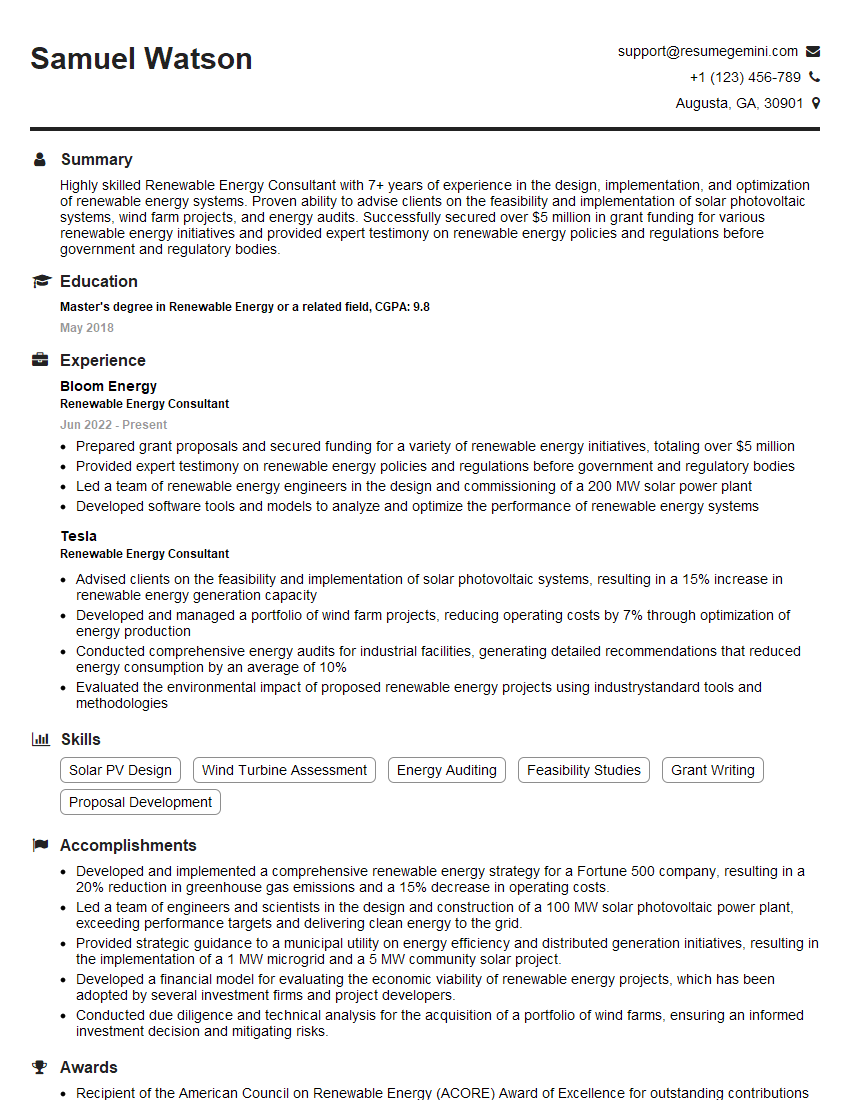
Mastering these key areas in renewable energy research is crucial for career advancement in this rapidly growing field. A strong understanding of both the theoretical concepts and practical applications will significantly enhance your interview performance and open doors to exciting opportunities. Creating an ATS-friendly resume is essential for increasing your visibility to potential employers. We highly recommend using ResumeGemini to build a professional and impactful resume that highlights your skills and experience effectively. ResumeGemini provides examples of resumes tailored to renewable energy research roles to help you craft a compelling application.
Explore more articles
Users Rating of Our Blogs
Share Your Experience
We value your feedback! Please rate our content and share your thoughts (optional).
What Readers Say About Our Blog
Very informative content, great job.
good