Feeling uncertain about what to expect in your upcoming interview? We’ve got you covered! This blog highlights the most important Experience in teaching singing or songwriting interview questions and provides actionable advice to help you stand out as the ideal candidate. Let’s pave the way for your success.
Questions Asked in Experience in teaching singing or songwriting Interview
Q 1. Describe your teaching philosophy for vocal technique.
My vocal technique teaching philosophy centers on holistic development, focusing not just on the mechanics of singing, but also on the artistry and emotional expression. I believe in building a strong foundation through proper breathing, posture, and resonance, then gradually incorporating more advanced techniques. This approach avoids early burnout and fosters a love for the craft. I emphasize individualized instruction, adapting techniques to each student’s unique vocal anatomy and learning pace. For example, a student with a naturally breathy voice might need more focused work on breath control and abdominal engagement than someone with a naturally powerful voice. We work together to identify their strengths and weaknesses, building upon the former while addressing the latter through targeted exercises and feedback.
Q 2. How do you adapt your teaching methods to different learning styles?
I believe in catering to diverse learning styles, employing a multi-sensory approach. Visual learners benefit from diagrams illustrating vocal anatomy and breath mechanics. Auditory learners thrive through listening exercises and aural feedback. Kinesthetic learners require hands-on activities like physical exercises to improve posture and breath support. For instance, I might use visual aids to explain resonant spaces in the body, provide recordings for students to analyze their vocal quality, and incorporate physical exercises like diaphragmatic breathing. Regular check-ins and personalized feedback are crucial to ensure the effectiveness of these diverse teaching methods. I might use a combination of methods – say, a visual diagram followed by a kinesthetic exercise – to reinforce the concept for a more holistic learning experience.
Q 3. What vocal exercises do you use to improve breath support?
Improving breath support is fundamental. I use a variety of exercises, starting with basic diaphragmatic breathing exercises. This involves lying on the back with knees bent, placing a hand on the abdomen to feel the expansion and contraction during inhalation and exhalation. We progress to hissing exercises to control airflow, and sustained vowel sounds (‘ah’, ‘ooh’, ‘ee’) on various pitches to strengthen breath control and endurance. I also incorporate lip trills and tongue trills to improve airflow efficiency and relaxation of the vocal cords. For example, a student might practice sustaining a single note on a lip trill for increasingly longer durations, building stamina and breath control. We then integrate these into singing phrases to develop breath management in a musical context. A crucial element is recognizing tension and working to release it through controlled breathing exercises.
Q 4. Explain your approach to teaching sight-singing.
My approach to sight-singing is gradual and sequential, starting with simple melodic patterns and gradually increasing in complexity. I begin by teaching basic solfège (do-re-mi) and rhythmic notation. We start with simple intervals, moving from unison to perfect fifths and octaves. I use visual aids, like solfège hand signs, to assist students in memorization and understanding melodic intervals. Exercises include sight-singing simple songs initially, progressively adding more challenging rhythms and harmonies. For example, we might start with a simple folk song in a major key before moving to minor keys or songs with more complex rhythmic patterns. Positive reinforcement and breaking down complex pieces into smaller, manageable sections are vital to building confidence and competence. It’s about developing aural skills and understanding of musical notation.
Q 5. How do you assess a student’s vocal range and tone?
Assessing vocal range and tone involves a combination of methods. First, we explore the comfortable high and low notes the student can produce comfortably. We do this through vocalization exercises, gradually ascending and descending in pitch until their vocal limits are identified. I then listen carefully to the quality of their voice, noting any vocal issues like breathiness, tension, or strain. I use a combination of listening to their vocalizations and observing their posture and breathing techniques. For instance, a student might have a limited range due to tension in their throat or neck; this would be addressed through targeted exercises. Understanding their vocal timbre – the unique quality of their voice – informs how we approach their training, ensuring that their lessons enhance their natural vocal characteristics.
Q 6. What strategies do you employ to help students overcome performance anxiety?
Performance anxiety is a common challenge. My approach is multifaceted. We start by acknowledging and validating the student’s feelings. I encourage open communication and discuss strategies for coping. This includes progressive exposure to performance situations, starting with small, informal performances in a safe environment. We use visualization techniques, imagining successful performances to build confidence. Breathing exercises, such as deep, controlled breaths before performances, can calm nerves. I also teach mindfulness techniques to help students stay grounded and present in the moment. Finally, focusing on the joy of sharing their music, rather than the pressure of performance, helps shift the focus away from anxiety. I help them reframe their perspective, transforming performance anxiety into excitement.
Q 7. Describe your process for teaching songwriting structure (verse, chorus, bridge).
Teaching songwriting structure involves a step-by-step process. We start with understanding the basic components: verse, chorus, bridge. I explain their functions; verses tell the story, choruses are the memorable hook, and bridges provide a contrast or change of perspective. We then explore different lyrical approaches. I encourage brainstorming ideas, focusing on a central theme or narrative. Once the lyrical content is established, we work on melody and rhythm, experimenting with different melodic patterns and rhythmic variations for each section. This often involves working with chords and chord progressions that support the emotion of the lyrics. The goal is to develop a song that has a coherent structure, capturing the listener’s attention and conveying a message. We also explore different structural variations, showing how professional songwriters might deviate from the basic verse-chorus-bridge pattern to create more dynamic songs. I always prioritize the student’s unique style and inspiration.
Q 8. How do you teach students to develop compelling lyrics?
Developing compelling lyrics is a journey of crafting honest and relatable stories through words and rhythm. It’s not just about rhyming; it’s about connecting with the listener on an emotional level. I teach students a multi-step process:
Idea Generation: We brainstorm using prompts, freewriting, and exploring personal experiences, observations, and emotions. For example, I might ask them to write about a specific memory, a dream, or a social issue that resonates with them.
Storytelling Structure: We work on structuring their ideas into a narrative with a beginning, middle, and end, even if it’s a short song. We explore different poetic devices like metaphors and similes to paint vivid pictures with words.
Word Choice and Imagery: I emphasize choosing precise words that evoke specific feelings and images. We examine the connotations of words and how they contribute to the overall mood and message. For instance, replacing ‘sad’ with ‘heartbroken’ or ‘lonely’ adds a deeper layer of emotion.
Rhythm and Meter: Understanding basic rhythm and meter is crucial. We experiment with different syllable counts and rhythmic patterns to find what fits the melody and enhances the emotional impact of the words. We may use tools like clapping or tapping to establish rhythm before writing.
Revision and Refinement: This is a crucial step where we focus on clarity, concision, and impact. We read lyrics aloud, identifying awkward phrasing or weak imagery and refining until the lyrics resonate strongly.
Ultimately, compelling lyrics are about authenticity and emotional honesty. I encourage my students to write about what truly moves them, and guide them in expressing it effectively through words.
Q 9. What software or tools do you use to assist in songwriting instruction?
Technology plays a vital role in modern songwriting. I utilize several tools to enhance my instruction:
Digital Audio Workstations (DAWs): Software like GarageBand (for beginners) or Logic Pro X/Ableton Live (for more advanced students) allows students to experiment with melodies, chords, and rhythms, laying the foundation for their lyrics. They can immediately hear how their words fit the music.
Lyric Writing Software: While less crucial than DAWs, programs offering rhyming dictionaries and thesaurus functions can be helpful, particularly for beginners exploring word choices.
Cloud Collaboration Platforms: Tools like Google Docs or Dropbox allow for seamless collaboration and feedback sharing between student and teacher, regardless of location.
Audio/Video Recording Software: Recording themselves singing and playing allows students to self-assess their progress, identify areas for improvement, and track their growth over time.
I find that using technology effectively makes the songwriting process more accessible, engaging, and efficient. It bridges the gap between theory and practice, allowing students to actively experiment and learn through hands-on experience.
Q 10. How do you encourage creativity and self-expression in your students?
Encouraging creativity and self-expression is paramount. My approach focuses on creating a safe and supportive environment where students feel comfortable taking risks and exploring their unique voices:
Removing Judgment: I emphasize that there’s no such thing as a ‘bad’ idea in the creative process. We focus on building upon initial concepts rather than criticizing them.
Diverse Prompts and Exercises: I use a range of prompts – from personal experiences to fictional scenarios, images, or even abstract concepts – to spark diverse ideas and break through creative blocks. We might try writing a song from the perspective of an inanimate object or a historical figure.
Improvisation and Experimentation: We incorporate improvisation exercises with instruments or vocals to encourage spontaneous expression and generate unexpected musical ideas that can translate into lyrics.
Celebrating Individuality: I highlight the unique qualities of each student’s work, emphasizing the value of their personal voice and perspective. I make sure that every student feels heard and understood, and their artistic voice is validated.
By fostering a culture of experimentation and acceptance, I empower my students to express themselves authentically and discover their unique creative potential.
Q 11. Explain your approach to teaching music theory relevant to singing and songwriting.
My approach to teaching music theory is practical and directly applicable to singing and songwriting. Instead of dry theory, I integrate concepts organically within the creative process:
Basic Melody Construction: We explore the building blocks of melodies—intervals, scales, and modes—through practical exercises. Students learn to create melodic lines that are both musically satisfying and expressive.
Chord Progressions and Harmony: I introduce fundamental chord progressions and harmonic principles, demonstrating how they underpin many popular song structures. Students learn to build simple chord progressions to accompany their melodies.
Rhythm and Meter: We delve into different rhythmic patterns and time signatures, recognizing how rhythm impacts both the musical feel and the delivery of lyrics. We use rhythmic exercises to improve students’ sense of timing.
Form and Structure: We analyze various song forms (verse-chorus, bridge, etc.) and explore how different structures impact the overall narrative and emotional impact of a song. Students learn how to structure their own songs effectively.
By connecting theoretical concepts to hands-on songwriting and performance, students understand the ‘why’ behind the theory and how it enhances their creative output. It’s not about memorizing rules but about understanding how musical elements work together to create effective songs.
Q 12. How do you handle students with different levels of musical experience?
I cater to diverse levels of musical experience by employing differentiated instruction. I assess each student’s strengths and weaknesses through initial interviews and observation, tailoring my approach accordingly:
Beginner Students: For beginners, I begin with foundational concepts, focusing on basic music theory, vocal technique, and simple songwriting structures. I provide ample support and encouragement, keeping exercises manageable and rewarding.
Intermediate Students: Intermediate students explore more advanced theoretical concepts and songwriting techniques. We work on refining their skills, experimenting with different styles and genres, and developing their individual musical voices.
Advanced Students: Advanced students are challenged with complex harmonic structures, sophisticated lyrical techniques, and in-depth exploration of musical styles. I encourage them to push their creative boundaries, explore innovative approaches, and develop their own unique stylistic fingerprints.
Personalized Learning Plans: For each student, I create a personalized learning plan that outlines specific goals, exercises, and resources. This ensures that each student is challenged appropriately and progresses at their own pace.
This approach ensures that every student, regardless of their prior experience, feels supported, challenged, and empowered to reach their full potential.
Q 13. What are some common challenges faced by beginning singers, and how do you address them?
Beginning singers often encounter several challenges:
Vocal Technique: Many struggle with breath control, posture, and vocal placement, leading to tension, strained voices, and limited range.
Pitch Accuracy: Accurate pitch is often a significant hurdle for beginners. They may struggle to hit notes consistently or maintain pitch throughout a phrase.
Stage Fright/Performance Anxiety: Performing in front of others can be daunting for new singers, causing nervousness, self-consciousness, and impacting their vocal performance.
Lack of Confidence: Beginners often lack confidence in their abilities, hindering their progress and motivation.
To address these challenges, I utilize a multi-faceted approach:
Vocal Warm-ups and Exercises: I start each session with targeted warm-ups to improve breath control, vocal flexibility, and range.
Ear Training Exercises: I use ear training exercises to improve pitch recognition and accuracy.
Performance Practice: I provide opportunities for students to perform in low-pressure environments, gradually increasing the level of performance challenges.
Positive Reinforcement and Encouragement: I focus on celebrating successes, offering constructive feedback, and building students’ confidence in their abilities.
By patiently addressing these challenges, I create a supportive and encouraging environment where beginners can develop their voices and gain the confidence to express themselves musically.
Q 14. How do you incorporate feedback into your teaching process?
Feedback is central to my teaching philosophy. I incorporate it in several ways:
Regular Check-ins: I conduct regular check-ins with students, discussing their progress, challenges, and goals. This open dialogue ensures that I am aware of any issues and can adjust my instruction accordingly.
Constructive Criticism: I provide specific, actionable feedback on both their vocal technique and their songwriting, focusing on both strengths and areas for improvement. I always frame criticism positively and constructively.
Audio/Video Recordings: Students often record their performances, allowing them to self-assess and identify areas needing attention. I then provide feedback on these recordings.
Peer Feedback: When appropriate, I incorporate peer feedback sessions, encouraging students to listen to and provide constructive feedback to one another.
Written Feedback: For songwriting, I provide detailed written feedback on lyrics, melody, and structure. This written record allows students to review the feedback at their own pace and refer back to it.
My goal is to provide feedback that is both informative and motivating, enabling students to learn from their mistakes, refine their skills, and celebrate their achievements. I emphasize the process of learning and growth, making feedback a valuable tool for ongoing improvement.
Q 15. How do you assess student progress in singing and songwriting?
Assessing student progress in singing and songwriting requires a multifaceted approach. It’s not just about technical skill, but also about artistic expression and personal growth. I use a combination of methods to track development.
- Formal Assessments: Regular performance evaluations, including graded singing exercises and songwriting assignments, provide a structured way to monitor technical proficiency and creative output. For example, I might grade a student’s vocal range, accuracy, and phrasing in a performance piece, or assess their songwriting’s lyrical content, melodic structure, and harmonic complexity.
- Informal Feedback: Ongoing feedback during lessons, including verbal comments and demonstrations, allows for more immediate adjustments and personalized guidance. I might offer suggestions on breath control, vocal tone, or lyrical storytelling. For songwriting, I’d provide feedback on the effectiveness of their chord progressions or the clarity of their lyrical message.
- Self-Assessment: I encourage students to reflect on their own progress, setting goals and tracking their own improvements. This fosters self-awareness and independence. For instance, students might keep a journal documenting their progress, challenges, and areas for improvement.
- Portfolio Development: Building a portfolio of work – recordings, written compositions, and performance videos – allows students to visually track their journey and showcase their accomplishments.
By combining these methods, I gain a comprehensive understanding of each student’s progress and tailor my teaching to their individual needs.
Career Expert Tips:
- Ace those interviews! Prepare effectively by reviewing the Top 50 Most Common Interview Questions on ResumeGemini.
- Navigate your job search with confidence! Explore a wide range of Career Tips on ResumeGemini. Learn about common challenges and recommendations to overcome them.
- Craft the perfect resume! Master the Art of Resume Writing with ResumeGemini’s guide. Showcase your unique qualifications and achievements effectively.
- Don’t miss out on holiday savings! Build your dream resume with ResumeGemini’s ATS optimized templates.
Q 16. Describe your experience teaching students of diverse backgrounds and abilities.
My experience teaching students from diverse backgrounds and abilities has been incredibly enriching. I’ve learned that musical talent manifests in myriad ways, and that a flexible approach is key to unlocking each student’s potential. I adapt my teaching style to accommodate different learning styles and preferences.
- Cultural Sensitivity: I respect the cultural context of each student’s musical background, incorporating various musical traditions and styles into our lessons, when appropriate. For example, a student who grew up listening to traditional folk music might find it easier to connect with songwriting through that genre.
- Differentiated Instruction: I differentiate my teaching to meet the needs of students with varying skill levels and learning styles. For example, a beginner might start with simple vocal exercises, while a more advanced student might work on complex vocal techniques or advanced harmonic structures in songwriting.
- Individualized Learning Plans: For students with specific learning needs or disabilities, I collaborate with parents and educational professionals to create personalized learning plans that address their individual needs.
- Creating an Inclusive Environment: I actively foster a supportive and inclusive learning environment where every student feels comfortable expressing their creativity and sharing their unique voice, regardless of their background or skill level.
This approach allows me to reach a wider range of students and help them achieve their musical goals.
Q 17. How do you maintain a positive and encouraging learning environment?
Maintaining a positive and encouraging learning environment is crucial for student success. I achieve this through several strategies.
- Positive Reinforcement: I focus on praising effort and progress, rather than solely focusing on perfection. Celebrating small victories builds confidence and motivation.
- Constructive Criticism: I deliver feedback in a supportive and encouraging manner, framing criticism as opportunities for growth and improvement. I always make sure to highlight their strengths before discussing areas for improvement.
- Open Communication: I encourage open dialogue between myself and my students, fostering a safe space for questions and concerns. I create a comfortable environment where students feel comfortable sharing their ideas and thoughts, even if they are not perfect.
- Collaboration and Teamwork: Opportunities for collaboration, such as group performances or songwriting projects, can build teamwork, encourage peer learning, and foster a sense of community.
- Fun and Engaging Activities: I incorporate fun and engaging activities into lessons to keep students motivated and excited about learning. This could involve incorporating games, creative challenges, or exploring different musical styles.
By creating a supportive and engaging classroom, I help students develop their musical talents in a positive and fulfilling environment.
Q 18. What resources do you utilize to supplement your teaching?
I utilize a variety of resources to supplement my teaching and keep my lessons fresh and engaging. These include:
- Online Learning Platforms: Platforms like YouTube offer countless tutorials, masterclasses, and performance videos on vocal techniques, music theory, and songwriting. I often share relevant resources with my students.
- Music Software and Apps: Software such as GarageBand or Logic Pro provide students with tools to compose, record, and edit their music, enhancing their creative process.
- Books and Publications: I use a range of books and publications on singing technique, music theory, songwriting, and music history to enhance my understanding and to provide students with extra learning materials.
- Workshops and Conferences: Attending professional development workshops and conferences keeps me updated on the latest teaching methods and industry trends.
- Guest Musicians and Professionals: I occasionally invite guest musicians or other professionals to share their expertise and insights with my students.
These resources broaden students’ learning experiences and provide them with the tools necessary to enhance their musical skills.
Q 19. How do you address plagiarism in student songwriting?
Addressing plagiarism in student songwriting is crucial for fostering academic integrity and promoting original creativity. My approach is multi-pronged.
- Education: I explicitly discuss the importance of originality and proper citation in songwriting, explaining the consequences of plagiarism. I explain what constitutes plagiarism and how to avoid it through proper attribution of sources.
- Clear Guidelines: I provide clear guidelines for assignments, specifying expectations for originality and outlining acceptable methods of referencing or incorporating existing musical elements.
- Source Checking: I use various online tools and resources to detect potential plagiarism in submitted work. These tools can identify similarities between a student’s work and other existing material online.
- Open Dialogue: If plagiarism is suspected, I initiate a conversation with the student to understand the circumstances and address the issue. This often involves a discussion on proper citation techniques and the value of original work.
- Consequences: Depending on the severity of the plagiarism, appropriate consequences are applied. This can range from resubmission of the assignment with proper citations to more serious disciplinary action, if needed.
This approach balances the need for accountability with the goal of fostering a learning environment where students can thrive.
Q 20. Describe your experience working with different age groups.
My experience working with different age groups has shown me that teaching musical skills requires adapting to varying developmental stages and learning styles. Each age group presents unique challenges and opportunities.
- Children (Elementary and Middle School): With younger students, I focus on building a strong foundation in music fundamentals, employing playful and interactive methods to maintain engagement. Games, movement, and simple songwriting exercises are often integral to these lessons.
- Teenagers (High School): Teenagers often have more defined musical interests and aspirations. My approach involves collaboration and exploration of various genres and styles, allowing them to develop their individuality. I work with them to cultivate their songwriting skills and focus on more complex technical aspects of singing.
- Adults: Adult students typically have a wider range of experiences and often possess specific goals, such as improving their singing voice for a specific performance or mastering a particular songwriting style. My approach with adults emphasizes personalized instruction and allows for a higher degree of student autonomy.
Understanding the developmental stages of each age group is crucial for effectively tailoring teaching methods and fostering a supportive learning environment.
Q 21. How do you handle difficult or challenging students?
Handling challenging students requires patience, understanding, and a proactive approach. I address difficult situations with a combination of strategies.
- Identifying the Root Cause: I try to understand the underlying reasons behind a student’s challenging behavior. This might involve communicating with parents or guardians if appropriate, or observing patterns in the student’s behavior during lessons.
- Clear Expectations and Boundaries: I ensure that expectations are clearly communicated and that boundaries are established from the outset. This helps prevent misunderstandings and sets a positive tone for the learning environment.
- Open Communication: I foster open and honest communication with the student, allowing them to express their concerns or frustrations. I also use clear and empathetic communication to address any negative behavior.
- Collaboration and Support: I work collaboratively with parents or guardians, school counselors, or other professionals if necessary, to provide comprehensive support for the student. This can include seeking outside help for students facing emotional or behavioral challenges.
- Positive Reinforcement: I continue to focus on rewarding positive behaviors and progress, reinforcing the desired learning environment. By highlighting their strengths and focusing on improvement, I aim to create a positive reinforcement cycle.
Addressing challenging situations requires careful consideration and a personalized approach, prioritizing the student’s well-being and learning environment.
Q 22. What are your strategies for providing constructive criticism?
Constructive criticism in music education is about fostering growth, not delivering judgment. My approach is threefold: focusing on specifics, offering solutions, and maintaining a positive and encouraging environment.
Specificity: Instead of saying “your singing is flat,” I’d pinpoint the exact notes or phrases that need adjustment. For example, “In the second verse, your pitch dips slightly on the word ‘dream.’ Let’s try focusing on supporting that note with your breath.” This allows the student to understand the problem precisely.
Solution-Oriented: Criticism shouldn’t just highlight weaknesses; it should offer pathways to improvement. After identifying the issue, I’d suggest techniques to address it. Perhaps vocal exercises to strengthen breath support, or exploring different phrasing approaches for better intonation.
Positive Reinforcement: I always begin by acknowledging the student’s strengths. Even with areas for improvement, I highlight aspects they’re doing well. This creates a safe space for learning and growth. For instance, I might say, “Your tone is beautiful and expressive. Let’s work on refining your technique in specific areas to make it even more resonant.”
Q 23. How do you balance teaching theory with practical application?
Balancing theory and practice is crucial. I believe theory provides the framework, while practical application brings it to life. I integrate them seamlessly by using theory to explain what the student is experiencing practically. For example, while teaching about major and minor scales, I’ll demonstrate how different scales create different moods in a song they are working on. Similarly, when working on songwriting, I’ll explain the chord progressions we use and how the theory behind those creates the song’s structure and feel.
I use a cyclical approach. We’ll start with a theoretical concept, then apply it through exercises or songwriting, and then analyze their practical application, highlighting areas of strength and areas where more theory might be needed. This iterative process ensures that theoretical knowledge is deeply embedded through real-world application.
Q 24. What are your professional development goals in music education?
My professional development goals revolve around staying at the forefront of music education. This includes deepening my understanding of diverse musical genres, exploring new pedagogical approaches, and integrating technology effectively. Specifically, I aim to:
Expand my expertise in contemporary music pedagogy: This involves attending workshops and conferences focusing on modern teaching methods and incorporating diverse musical styles into my curriculum.
Enhance my digital literacy: I want to become proficient in using music production software, digital audio workstations (DAWs), and online teaching platforms to enhance the learning experience.
Pursue advanced training in music therapy techniques: To broaden my skills and approach to music education, incorporating the therapeutic power of music for students struggling with emotional or physical challenges.
Q 25. Explain your understanding of copyright laws relating to music composition.
Copyright law protects original musical works, encompassing both the melody and lyrics. It grants the copyright holder exclusive rights to reproduce, distribute, perform, display, and create derivative works based on their music. Understanding this is vital for both teaching songwriting and ensuring ethical practices. When teaching songwriting, I explain that students own the copyright to their original compositions. However, using existing melodies or lyrics without permission is infringement. I emphasize the importance of original composition and explain how to obtain licenses for using copyrighted materials if necessary. This includes explaining the difference between fair use and infringement in the context of educational settings.
Q 26. Describe your experience with different vocal styles (e.g., classical, pop, jazz).
My experience spans various vocal styles. In classical training, I focus on breath control, precise intonation, and vocal technique. For pop and jazz styles, the emphasis shifts to phrasing, rhythm, and vocal expression. I tailor my teaching approach to the specific needs of each genre. For example, a classical singer needs a different level of vocal control than a pop singer; however, both benefit from strong breath support and vocal health practices. I adapt my teaching methods to match these differences. A key aspect is helping students understand the nuances of each style, including the appropriate vocal techniques and emotional delivery.
I also work with students who want to blend genres, creating a unique style of their own. This approach allows for creativity and flexibility in developing their personal musical identity.
Q 27. How do you incorporate technology into your music instruction?
Technology plays a significant role in my music instruction. I utilize digital audio workstations (DAWs) like GarageBand or Logic Pro X for recording and mixing student performances, allowing them to hear and analyze their work objectively. Online platforms such as Google Classroom or dedicated music education apps facilitate communication, sharing of materials, and assignment submissions. I also use music notation software for creating sheet music and analysis. Furthermore, I leverage video conferencing tools for online lessons, ensuring accessibility and flexibility for students. Through this technological integration, students gain experience with practical aspects of music production and collaboration.
Q 28. What are your salary expectations?
My salary expectations are commensurate with my experience and qualifications in music education, and also take into account the specific role, including responsibilities and benefits package. I am open to discussing a competitive compensation package based on industry standards and the specific requirements of the position.
Key Topics to Learn for Experience in teaching singing or songwriting Interview
- Pedagogical Approaches: Understanding various teaching methodologies (e.g., Kodály, Dalcroze, Suzuki) and their application to vocal technique and songwriting instruction.
- Curriculum Development: Designing lesson plans, structuring courses, and selecting appropriate materials tailored to different skill levels and learning styles (beginner to advanced).
- Vocal Technique & Musicianship: Demonstrating a thorough understanding of vocal anatomy, breath support, vocal health, music theory, and ear training, and ability to effectively communicate this knowledge.
- Songwriting Process: Knowledge of the songwriting process (lyrics, melody, harmony, arrangement) and the ability to guide students through each stage, including brainstorming, composition, and revision.
- Student Assessment & Feedback: Developing strategies for assessing student progress, providing constructive criticism, and fostering a supportive learning environment.
- Classroom Management & Communication: Effective strategies for managing a classroom, building rapport with students, addressing diverse learning needs, and handling challenging situations.
- Technology Integration: Familiarity with music software (DAWs, notation software) and online teaching platforms to enhance the learning experience.
- Legal & Ethical Considerations: Understanding copyright laws, ethical practices in teaching, and professional boundaries.
- Adaptability & Problem-Solving: Demonstrating the ability to adapt teaching methods to individual student needs and effectively troubleshoot technical or pedagogical challenges.
Next Steps
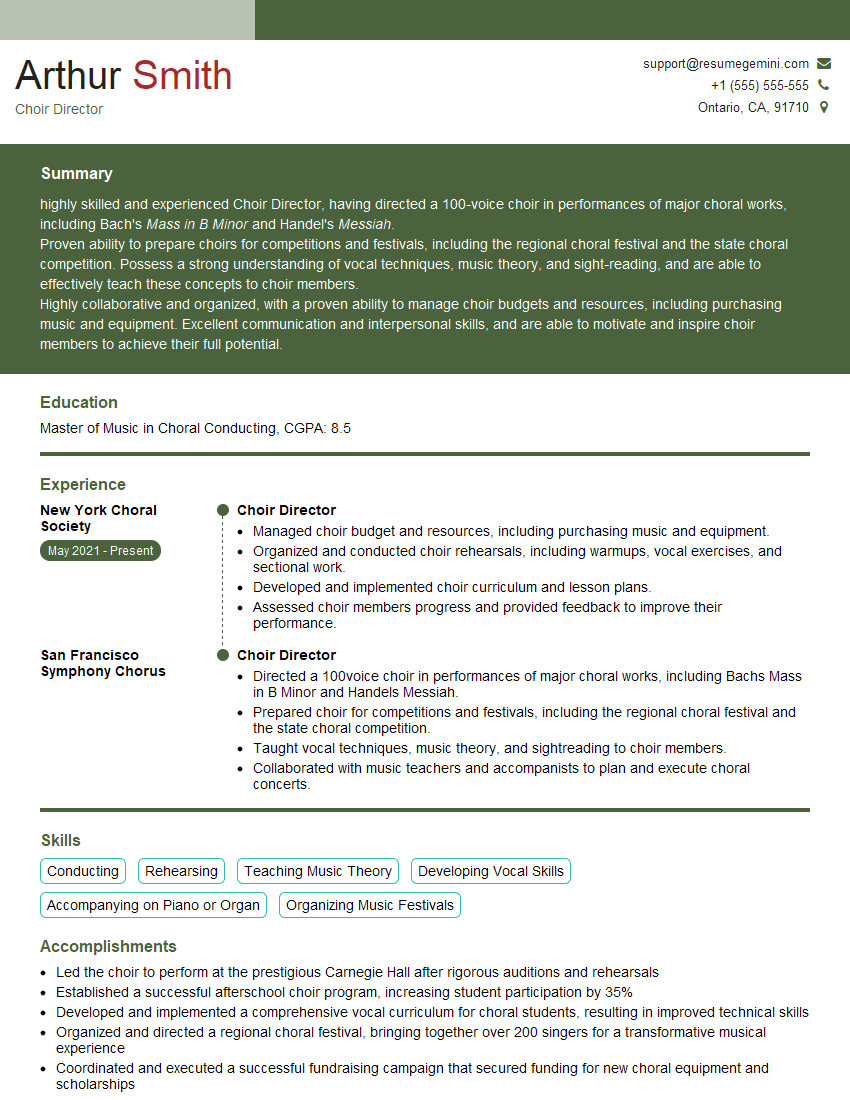
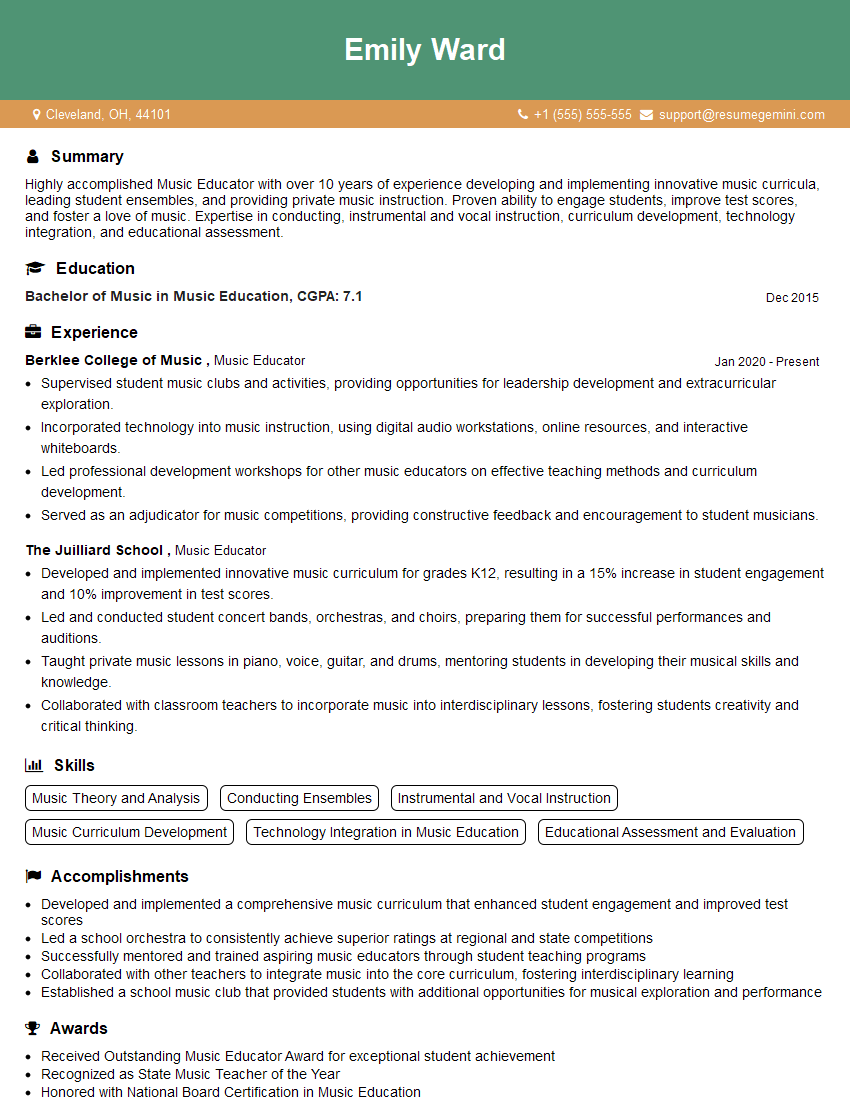
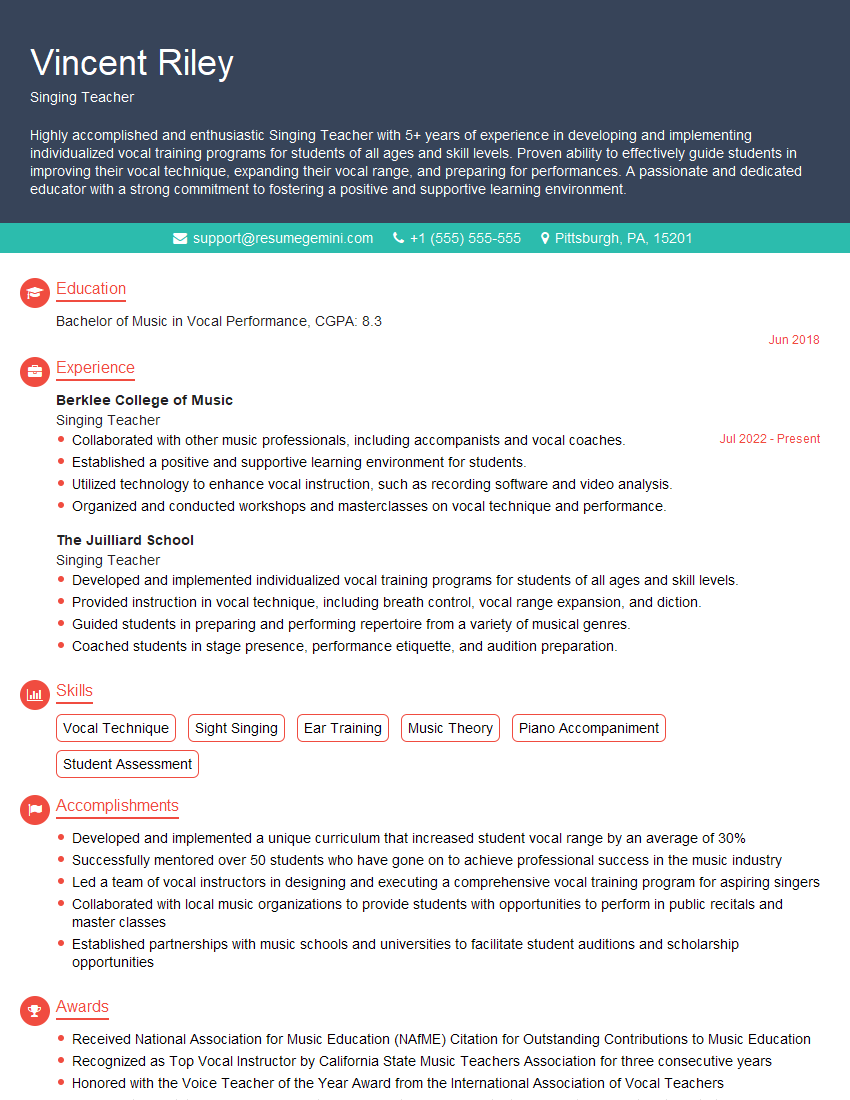
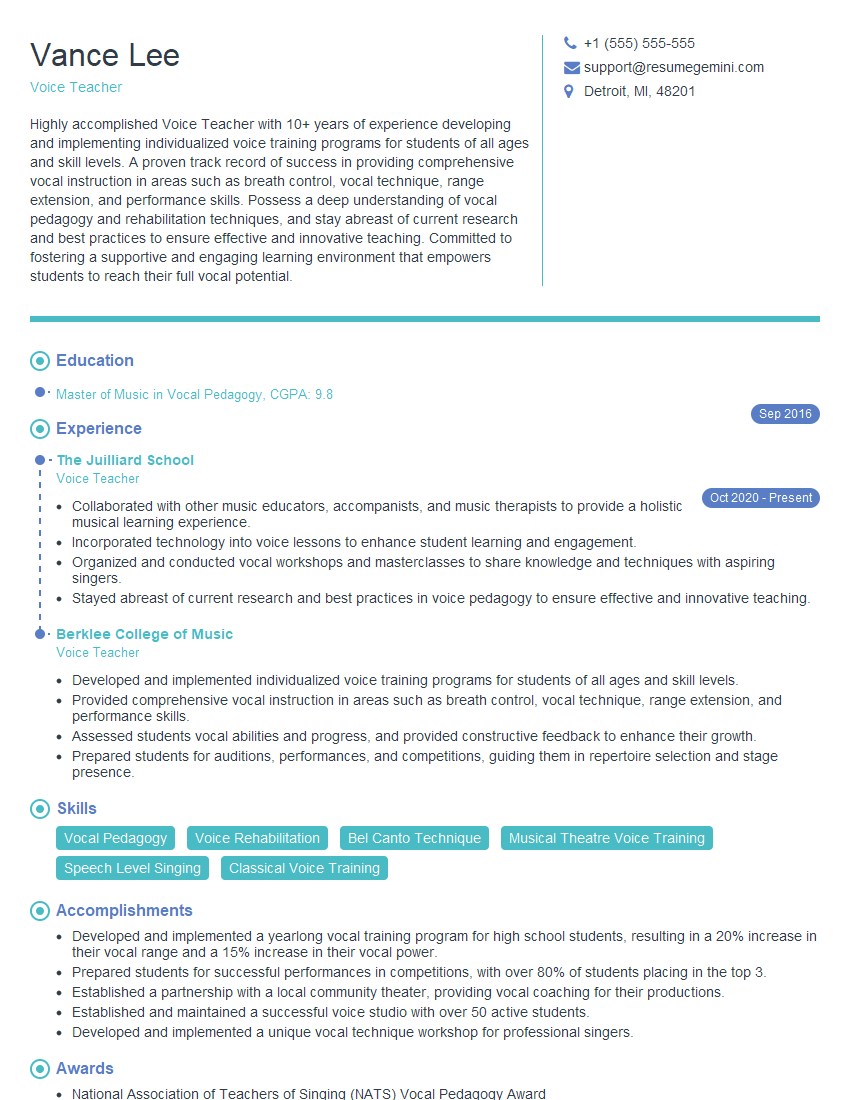
Mastering the art of teaching singing or songwriting significantly enhances your career prospects, opening doors to diverse opportunities in education, music production, and the arts. A well-crafted resume is crucial for showcasing your skills and experience effectively to potential employers. Building an ATS-friendly resume increases the chances of your application being noticed. ResumeGemini is a trusted resource to help you build a professional and impactful resume that highlights your unique qualifications. Examples of resumes tailored to experience in teaching singing or songwriting are available to help guide you through the process.
Explore more articles
Users Rating of Our Blogs
Share Your Experience
We value your feedback! Please rate our content and share your thoughts (optional).
What Readers Say About Our Blog
Very informative content, great job.
good