Feeling uncertain about what to expect in your upcoming interview? We’ve got you covered! This blog highlights the most important Experience in Threat Intelligence interview questions and provides actionable advice to help you stand out as the ideal candidate. Let’s pave the way for your success.
Questions Asked in Experience in Threat Intelligence Interview
Q 1. Explain the difference between strategic, tactical, and operational threat intelligence.
Threat intelligence can be categorized into three levels: strategic, tactical, and operational. Think of it like military planning – each level focuses on a different timeframe and scope.
- Strategic Threat Intelligence: This is the highest level, focusing on long-term trends and threats. It helps organizations understand the broader threat landscape, identifying potential future risks and informing long-term security strategies. For example, analyzing geopolitical events to predict potential cyberattacks against critical infrastructure.
- Tactical Threat Intelligence: This level focuses on specific threats and campaigns that are currently active or likely to become active in the near future. It informs short-term responses and adjustments to security measures. An example would be identifying a specific malware family targeting a particular industry and understanding its tactics, techniques, and procedures (TTPs).
- Operational Threat Intelligence: This is the most granular level, providing real-time information needed to respond to immediate threats. This often involves incident response, and directly supports the security operations center (SOC). For instance, receiving an alert about a suspicious IP address attempting to access your network and acting to block it.
In essence, strategic intelligence sets the overall direction, tactical intelligence refines the approach, and operational intelligence enables immediate action.
Q 2. Describe the STIX and TAXII standards and their importance in threat intelligence sharing.
STIX (Structured Threat Information eXpression) and TAXII (Trusted Automated eXchange of Intelligence Information) are crucial standards for sharing threat intelligence. They provide a common language and framework for exchanging threat data between organizations.
- STIX: This is a language for describing cyber threats. It uses a standardized format (typically XML or JSON) to represent information about malware, attacks, vulnerabilities, and other threat-related data. Imagine it as a universal translator for threat information. A STIX object might describe a specific piece of malware, including its characteristics, behaviors, and associated indicators of compromise (IOCs).
- TAXII: This is a protocol for securely exchanging STIX data. It defines how threat intelligence is packaged, transmitted, and received between systems. Think of TAXII as the secure delivery system for the STIX packages. It allows for automated and secure sharing of threat information, reducing manual effort and improving timeliness.
The importance of these standards lies in their ability to foster collaboration and improve the overall security posture of organizations. By using STIX and TAXII, security teams can easily share actionable intelligence, accelerating threat detection and response.
Q 3. How do you identify and prioritize threats based on their potential impact?
Threat prioritization is critical for efficient resource allocation. I use a framework that considers both the likelihood and impact of a threat. The process typically involves:
- Likelihood Assessment: This involves evaluating the probability of a threat occurring. Factors to consider include the sophistication of the attacker, the vulnerability of our systems, and the presence of indicators of compromise (IOCs) related to that specific threat.
- Impact Assessment: This evaluates the potential consequences if the threat is successful. Key considerations include the confidentiality, integrity, and availability (CIA triad) of affected data or systems, as well as the potential financial, reputational, and legal implications. A data breach affecting customer PII, for example, has a significantly higher impact than a denial-of-service attack against a less critical system.
- Prioritization Matrix: I often use a matrix to visually represent the likelihood and impact, allowing for quick identification of high-priority threats. High likelihood and high impact threats are prioritized first.
For instance, a highly sophisticated attacker targeting a critical system with a known vulnerability would be assigned a high priority, even if the likelihood isn’t 100%, because the impact is extremely high. Conversely, a low-sophistication attacker targeting an infrequently used system would be assigned a lower priority.
Q 4. What are the key sources of threat intelligence you would utilize?
My approach to threat intelligence gathering is multi-faceted and leverages a variety of sources to ensure a comprehensive view. Key sources include:
- Open-Source Intelligence (OSINT): This includes publicly available information from websites, forums, blogs, social media, and security advisories. This provides valuable context and early warnings about emerging threats.
- Commercial Threat Intelligence Feeds: Many vendors offer curated threat intelligence, providing data on malware, vulnerabilities, and attack campaigns. These often provide high-quality, timely information, but come at a cost.
- Collaboration and Information Sharing: Participation in industry groups, sharing information with peers, and utilizing platforms like MISP for threat intelligence exchange provides valuable insights and helps identify emerging threats faster.
- Internal Data Sources: Log analysis, security information and event management (SIEM) systems, and intrusion detection/prevention systems provide valuable insights into internal threats and attack patterns.
- Malware Analysis: Hands-on analysis of malware samples offers detailed information about its behavior, capabilities, and associated infrastructure.
Combining these sources allows for a more complete picture than relying on a single source.
Q 5. Explain your experience with threat intelligence platforms (e.g., MISP, ThreatConnect).
I have extensive experience with threat intelligence platforms like MISP (Malware Information Sharing Platform) and ThreatConnect. My experience includes:
- MISP: I’ve used MISP to collaboratively share threat intelligence with other organizations, contributing and leveraging data about malware, IOCs, and attack campaigns. Its open-source nature and flexibility make it invaluable for collaboration and data exchange within a community.
- ThreatConnect: I’ve used ThreatConnect for its comprehensive capabilities in threat intelligence management, including data ingestion, analysis, and reporting. Its ability to integrate with other security tools enhances its value for threat hunting and incident response. I’ve used it to create custom threat intelligence reports and dashboards to visualize threat trends and help inform strategic decision-making.
These platforms have been instrumental in improving our efficiency in threat detection, analysis, and response. They facilitate collaboration, automation, and allow for better informed decision-making.
Q 6. How do you validate the accuracy and reliability of threat intelligence?
Validating threat intelligence is paramount. I employ a multi-step process:
- Source Credibility Assessment: I evaluate the reputation and track record of the intelligence source. Is it a known reputable vendor, a trusted government agency, or a less reliable source like an anonymous online forum? The source’s history and methodology heavily influence my confidence in its claims.
- Data Triangulation: I verify information from multiple independent sources. If multiple sources corroborate the same information, it significantly strengthens its validity. This reduces the risk of relying on misinformation or biased data.
- Technical Validation: For technical indicators of compromise (IOCs), I independently verify them. This may involve using tools to check if a domain is malicious, analyzing a malware sample to confirm its behavior, or investigating IP addresses and network traffic.
- Contextual Analysis: I consider the context of the intelligence in relation to our organization’s specific environment and assets. Is this threat relevant to us? Are our systems vulnerable to this attack method?
By employing these validation methods, I ensure the reliability of the intelligence used for decision-making and operational responses, preventing us from reacting to false positives and wasting valuable resources.
Q 7. Describe your process for analyzing malware samples.
My malware analysis process is systematic and involves several stages:
- Initial Assessment: I start by using static analysis tools to get an overview of the sample without executing it. This involves examining file metadata, strings, and other characteristics that can reveal clues about its purpose and behavior.
- Dynamic Analysis: Next, I run the sample in a controlled sandbox environment to observe its behavior. This helps identify network connections, registry modifications, and file system changes it makes. Tools like Cuckoo Sandbox and any.run are invaluable here.
- Reverse Engineering: If further details are needed, I use reverse engineering techniques (using tools like IDA Pro or Ghidra) to disassemble and examine the code directly. This allows identification of the malware’s functionalities, logic, and potential command-and-control (C2) infrastructure.
- IOCs Extraction: Throughout the analysis, I collect Indicators of Compromise (IOCs) such as hashes, domain names, IP addresses, URLs, and registry keys. This data is invaluable for detecting and preventing future infections.
- Reporting and Documentation: I meticulously document my findings, including all analysis steps and IOCs. This report is used to inform security teams about the threat and how to mitigate it.
Safety is paramount. All analysis is performed in isolated, virtualized environments to protect the host system. This layered approach minimizes risk while providing a comprehensive understanding of the malware.
Q 8. How do you interpret threat intelligence reports and integrate them into your security posture?
Interpreting threat intelligence reports involves a multi-step process. First, I meticulously assess the report’s source credibility, verifying its provenance and the analyst’s expertise. Next, I focus on the report’s content, analyzing the identified threats, their tactics, techniques, and procedures (TTPs), and the potential impact on our organization. This involves understanding the context – what systems, data, or personnel are at risk. Finally, I correlate the findings with our existing security posture, identifying vulnerabilities that align with the described threats. This integrated approach allows us to prioritize mitigation efforts based on the likelihood and impact of potential incidents.
For example, if a report details a new malware campaign targeting a specific vulnerability in our CRM system, I would prioritize patching that vulnerability, implementing stronger access controls, and potentially deploying intrusion detection rules to detect attempts to exploit it. The integration happens through various channels, from updating our security awareness training to implementing new security controls, based on the specifics of the threat and our risk appetite.
Q 9. Explain your understanding of different threat actors (e.g., APT, hacktivists, nation-states).
Threat actors are diverse, each with unique motivations and capabilities. Advanced Persistent Threats (APTs) are highly sophisticated, well-funded groups, often state-sponsored, focused on long-term, stealthy operations targeting sensitive data or intellectual property. They employ advanced techniques, often going undetected for extended periods. Hacktivists are motivated by political or ideological goals, often using their skills to disrupt or deface websites or leak sensitive information. Their attacks can range from relatively simple defacements to more complex data breaches. Nation-states possess extensive resources and capabilities, conducting espionage, sabotage, or information warfare. Their attacks are often highly targeted and well-resourced, sometimes focusing on critical infrastructure.
Understanding these distinctions helps tailor our defenses. For instance, against APTs, we’d focus on advanced threat detection, proactive vulnerability management, and incident response planning. Against hacktivists, public-facing defenses, website security, and robust incident communication are key. Nation-state actors require a multifaceted approach including advanced threat hunting, strong physical security measures, and close collaboration with relevant agencies.
Q 10. How do you use threat intelligence to improve incident response capabilities?
Threat intelligence dramatically enhances incident response by providing context and direction during a security incident. Instead of reacting blindly, we can leverage preemptive knowledge of attacker TTPs to identify the root cause of an incident more rapidly and effectively. Knowing the common attack vectors and techniques used by specific threat actors allows for faster containment and remediation. Threat intelligence can help prioritize which alerts to investigate first, focusing resources on the most critical and likely threats.
For example, if we detect unusual network activity matching the TTPs of a known ransomware group highlighted in a recent intelligence report, we can immediately prioritize this alert, isolate affected systems, and begin the incident response process much more efficiently. This proactive approach significantly reduces the impact and recovery time of security incidents.
Q 11. Describe your experience with security information and event management (SIEM) systems.
I have extensive experience using SIEM systems, such as Splunk and QRadar, to collect, analyze, and correlate security logs from various sources across our network. This allows for real-time threat detection, forensic investigation, and security monitoring. I’m proficient in configuring rules and alerts based on threat intelligence feeds, enabling proactive identification of malicious activity. My experience includes developing custom dashboards and reports to visualize security trends and communicate findings effectively to stakeholders. I also utilize SIEM systems to investigate security incidents, tracing attacker activity, identifying compromised systems, and determining the extent of damage.
For example, I’ve used SIEM systems to create dashboards tracking suspicious login attempts from specific geographical locations identified in a threat intelligence report as known botnet command and control servers. This proactive monitoring allows for immediate blocking of those IP addresses, mitigating potential attacks.
Q 12. Explain your understanding of common attack vectors and techniques.
Common attack vectors and techniques include phishing emails (social engineering), exploiting software vulnerabilities (e.g., using publicly known exploits), malware infections (e.g., through drive-by downloads or malicious attachments), and denial-of-service (DoS) attacks. More advanced techniques involve using compromised credentials, supply chain attacks (compromising software or hardware vendors), and insider threats. Understanding these attack vectors is crucial for designing layered security controls. For example, multi-factor authentication helps mitigate credential compromise, while robust patching programs address software vulnerabilities.
A practical example: A phishing email containing a malicious attachment is a common attack vector. Understanding this, we implement security awareness training to educate users about identifying and avoiding such emails. Additionally, deploying email security solutions that scan attachments for malware offers a technological layer of defense.
Q 13. How do you measure the effectiveness of your threat intelligence program?
Measuring the effectiveness of a threat intelligence program is multifaceted and involves several key metrics. These include the reduction in the number and impact of security incidents, the time it takes to detect and respond to incidents, the accuracy of threat predictions, and the improvement in the overall security posture. We also track the number of actionable insights gained from intelligence reports, the efficiency of the intelligence gathering and dissemination processes, and the effectiveness of security awareness training based on intelligence findings.
For example, if the number of successful phishing attacks decreases significantly after implementing training based on threat intelligence reports, we can quantify the program’s success. Similarly, improved incident response times demonstrate the value of proactive threat intelligence in guiding and accelerating our responses to attacks.
Q 14. Describe your experience with threat modeling.
Threat modeling is a proactive risk assessment process that helps identify potential vulnerabilities in our systems and applications. It involves systematically examining our systems, identifying assets, and assessing potential threats and their impact. I use various threat modeling methodologies, such as STRIDE (Spoofing, Tampering, Repudiation, Information disclosure, Denial of service, Elevation of privilege) and PASTA (Process for Attack Simulation and Threat Analysis), to identify vulnerabilities and inform the design and implementation of security controls.
For example, when designing a new web application, a threat modeling exercise would involve identifying potential vulnerabilities such as SQL injection, cross-site scripting (XSS), and cross-site request forgery (CSRF). This allows us to incorporate security controls such as input validation, output encoding, and anti-CSRF tokens during the development process, preventing those vulnerabilities from ever existing in the first place. This proactive approach is far more cost-effective and efficient than reacting to vulnerabilities after they’re discovered.
Q 15. How do you communicate threat intelligence findings to both technical and non-technical audiences?
Communicating threat intelligence effectively requires tailoring the message to the audience. For technical audiences, I use precise terminology, detailed reports, and visualizations like network diagrams to illustrate attack vectors. I might include specific IOCs (Indicators of Compromise) like hashes, IP addresses, or domain names. For non-technical audiences, I focus on the impact – the potential consequences of a threat, the risk level, and the steps being taken to mitigate it. I use plain language, avoid jargon, and leverage analogies to make complex concepts understandable. For example, instead of saying “malicious code exploited a vulnerability in the web server,” I might say, “Hackers found a weakness in our website and used it to gain access.” I often use visuals like bar charts showing risk levels or timelines illustrating the attack sequence.
For both, I always emphasize the actionable steps we’re taking to protect against the threat, building trust and fostering collaboration. I frequently create executive summaries for high-level reports, providing a concise overview of the threat and recommended actions.
Career Expert Tips:
- Ace those interviews! Prepare effectively by reviewing the Top 50 Most Common Interview Questions on ResumeGemini.
- Navigate your job search with confidence! Explore a wide range of Career Tips on ResumeGemini. Learn about common challenges and recommendations to overcome them.
- Craft the perfect resume! Master the Art of Resume Writing with ResumeGemini’s guide. Showcase your unique qualifications and achievements effectively.
- Don’t miss out on holiday savings! Build your dream resume with ResumeGemini’s ATS optimized templates.
Q 16. What are some common indicators of compromise (IOCs) and how do you utilize them?
Indicators of Compromise (IOCs) are artifacts or evidence indicating a cyberattack has occurred or is ongoing. Common IOCs include malicious IP addresses, domain names, file hashes (MD5, SHA-1, SHA-256), URLs, email addresses, registry keys, and process IDs. I utilize IOCs in several ways:
- Threat Hunting: I proactively search for these indicators across our systems and network to identify potential threats before they cause damage.
- Incident Response: During an incident, IOCs help me quickly pinpoint the scope and extent of the compromise, aiding in containment and eradication.
- Security Monitoring: I integrate IOCs into our Security Information and Event Management (SIEM) system to trigger alerts when suspicious activity is detected.
- Threat Intelligence Platforms: I leverage threat intelligence platforms that allow for the sharing and correlation of IOCs from various sources, improving our overall threat detection capabilities.
For example, identifying a malicious IP address associated with a known botnet allows us to block traffic from that IP address, preventing further attacks. Similarly, finding a unique file hash associated with malware can alert us to infected systems and allow for immediate remediation.
Q 17. Explain your experience with vulnerability management and its relationship to threat intelligence.
Vulnerability management and threat intelligence are inextricably linked. Vulnerability management focuses on identifying and remediating security weaknesses in our systems, while threat intelligence provides context about which vulnerabilities are actively exploited by attackers. My experience involves using vulnerability scanning tools to identify known weaknesses, then leveraging threat intelligence feeds to prioritize those vulnerabilities based on their likelihood of exploitation. For example, if a threat intelligence report indicates a specific vulnerability (e.g., CVE-2023-xxxx) is actively being exploited in the wild through a zero-day attack, we immediately prioritize patching that vulnerability.
I use vulnerability data to create a risk profile that takes into account both the likelihood of exploitation (information from threat intelligence) and the potential impact of a successful attack. This allows me to focus our remediation efforts on the highest-risk vulnerabilities first. This is especially important in resource-constrained environments. Furthermore, I use threat intelligence to inform the development of secure coding practices and security architecture design to prevent vulnerabilities in the first place.
Q 18. How do you stay up-to-date with the latest threat landscape and emerging threats?
Staying up-to-date with the ever-evolving threat landscape requires a multi-faceted approach. I subscribe to several threat intelligence feeds from reputable vendors, including commercial and open-source sources. This involves regular analysis of threat reports, security advisories, and vulnerability databases like the National Vulnerability Database (NVD).
I actively participate in security communities and forums, attending webinars and conferences to hear from industry experts and learn about emerging threats. I also leverage open-source intelligence (OSINT) gathering techniques to monitor threat actor activity on the dark web and social media. This allows me to get a broader understanding of tactics, techniques, and procedures (TTPs) used by threat actors. Finally, I utilize automated threat intelligence platforms that constantly monitor and analyze threat feeds, providing real-time alerts on new threats and vulnerabilities.
Q 19. Describe a time you had to analyze a complex security incident. What was your approach?
In one instance, we experienced a significant data breach involving a sophisticated spear-phishing attack. My approach involved a systematic investigation following the NIST Cybersecurity Framework. First, I focused on containment, isolating affected systems to prevent further damage. Then, I initiated the eradication phase, removing the malware and restoring affected systems from backups. Next, I focused on the recovery phase, getting systems back online while ensuring appropriate security measures were in place. Finally, I launched a thorough analysis to identify the root cause, focusing on log analysis and network traffic examination. This included analyzing email headers, malicious attachments, and system logs to understand the attacker’s TTPs and entry point.
We identified the spear-phishing email that initiated the breach and determined how the attacker exploited a known vulnerability to gain access. This information was then used to enhance our security posture, including updating security controls, employee security awareness training, and implementing more rigorous access control measures. The entire incident response process highlighted the importance of proactive security measures and continuous monitoring.
Q 20. How do you handle conflicting threat intelligence from different sources?
Handling conflicting threat intelligence requires a critical and analytical approach. I never blindly trust a single source. I cross-reference information from multiple sources, comparing IOCs, attack descriptions, and attribution information. I assess the credibility and reputation of each source, considering factors like the source’s expertise, track record, and methodology.
If sources offer conflicting information, I try to identify the discrepancies and determine which source is more likely to be accurate. This might involve looking at the evidence presented by each source, considering the timeline of events, and consulting with other experts in the field. If a consensus cannot be reached, I prioritize caution, taking a more conservative approach and assuming the higher-risk scenario until further validation is obtained. Documenting the conflicting information and the reasoning behind my decision-making is crucial for transparency and accountability.
Q 21. Explain your experience with open-source intelligence (OSINT) gathering.
Open-Source Intelligence (OSINT) gathering is a crucial part of my threat intelligence workflow. I regularly utilize various OSINT tools and techniques to collect information from publicly available sources. This includes searching online forums and paste sites for leaked credentials or malicious code, monitoring social media for mentions of potential threats, and investigating threat actor activities on dark web forums. I use search engines, specialized OSINT tools, and online databases to gain insights into potential threats.
For example, I might use Shodan to search for exposed databases or web servers, or I might use VirusTotal to analyze suspicious files. This information helps build a broader context of threat actors, their capabilities, and their targets, enhancing my understanding of the threat landscape. It is important to adhere to legal and ethical guidelines when conducting OSINT gathering, respecting privacy and avoiding any illegal activities.
Q 22. How would you assess the risk associated with a newly discovered vulnerability?
Assessing the risk of a newly discovered vulnerability involves a multi-step process that combines technical analysis with consideration of the broader threat landscape. It’s not just about the vulnerability itself, but also about its potential impact.
Identify the vulnerability’s characteristics: This includes understanding the type of vulnerability (e.g., SQL injection, cross-site scripting, remote code execution), the affected software or system, the severity (often using CVSS scoring), and the exploitability (how easy it is to exploit).
Assess the potential impact: What would happen if the vulnerability were successfully exploited? Consider factors like data breach, system compromise, denial of service, and financial loss. Think about the confidentiality, integrity, and availability (CIA triad) of your assets.
Analyze the threat landscape: Are there known actors targeting this specific vulnerability or similar systems? Is there evidence of active exploitation in the wild (e.g., through threat intelligence feeds)? Are there readily available exploit tools?
Consider the organization’s context: The risk is not just about the technical aspects. The organization’s risk appetite, the value of the affected assets, and its ability to respond to an incident all influence the overall risk assessment. A vulnerability in a critical system requires more urgent attention than one in a less sensitive system.
Quantify the risk: This often involves using a risk matrix that combines the likelihood of exploitation with the potential impact to provide a numerical risk score. This score helps prioritize remediation efforts.
Example: Imagine a newly discovered vulnerability in a web application that handles customer credit card information. If easily exploitable and with a high impact (data breach), the risk is extremely high, requiring immediate patching and potentially notification of affected customers. Conversely, a vulnerability in a less-critical internal system with low exploitability might be assigned a lower risk, allowing for a more delayed patching schedule.
Q 23. What are the ethical considerations when collecting and using threat intelligence?
Ethical considerations in threat intelligence are paramount. The information we collect and use has significant implications for individuals, organizations, and even national security. Ethical collection and use are crucial to maintaining public trust and avoiding legal issues.
Legal compliance: We must adhere to all applicable laws and regulations, such as data privacy laws (GDPR, CCPA), computer crime laws, and intelligence gathering regulations. This includes obtaining consent when appropriate and ensuring data minimization.
Transparency and accountability: Being transparent about our intelligence gathering methods and the use of the information is essential. We must be accountable for our actions and the impact of our intelligence. This means having a clear process for oversight and review.
Data privacy and security: Protecting the confidentiality and integrity of collected data is a primary concern. We must use appropriate security measures to protect the data from unauthorized access, use, or disclosure. This includes encryption, access control, and regular security audits.
Proportionality and necessity: We must only collect and use information that is strictly necessary for our legitimate purposes. We should avoid collecting excessive amounts of data or using it for unrelated purposes.
Avoiding misuse: Threat intelligence should be used for legitimate security purposes and should never be used to violate someone’s rights or engage in illegal activities. This includes respecting the privacy of individuals even if they are potential adversaries.
Example: If we discover evidence of a planned cyberattack, we must carefully consider who we share that information with and ensure the information is used only to prevent the attack, not for unrelated purposes such as corporate espionage.
Q 24. Describe your experience with creating and maintaining threat intelligence reports.
My experience in creating and maintaining threat intelligence reports involves a structured process that ensures accuracy, relevance, and timely delivery. I’ve worked on reports ranging from short, focused assessments of specific threats to comprehensive, multi-chapter analyses of broader threat landscapes.
Data collection and analysis: This stage involves gathering data from various sources such as open-source intelligence (OSINT), commercial threat intelligence feeds, internal security logs, and vulnerability scanners. The data is then analyzed to identify patterns, trends, and indicators of compromise (IOCs).
Report structuring and writing: The findings are organized into a clear and concise report. This often includes an executive summary, a detailed analysis of the threats, relevant IOCs, and recommended mitigation strategies. Visualizations (charts, graphs) are often used to highlight key findings.
Dissemination and feedback: The reports are distributed to relevant stakeholders, such as security operations teams, management, and other departments. Feedback is collected to ensure the reports are meeting the needs of the audience and to identify areas for improvement.
Maintenance and updates: Reports are regularly updated to reflect the changing threat landscape. This includes incorporating new data, revising conclusions based on new information, and modifying recommendations as needed.
Example: In a previous role, I regularly produced weekly threat intelligence reports summarizing the latest malware campaigns targeting our industry. These reports included technical details of the malware, indicators of compromise to assist in detection, and tactical recommendations for security teams.
Q 25. How do you prioritize your work when faced with multiple high-priority threats?
Prioritizing multiple high-priority threats requires a systematic approach. It’s not just about which threat is the loudest, but which poses the greatest overall risk to the organization.
Risk assessment: Each threat is assessed based on its potential impact and likelihood of occurrence. This is often done using a risk matrix. Consider factors like the criticality of affected assets, the sophistication of the attacker, and the potential for significant damage.
Impact analysis: Determine which threat has the most significant potential impact on the business, considering financial losses, reputational damage, operational disruption, and legal implications.
Resource allocation: Allocate resources (personnel, tools, and budget) to address the highest-priority threats first. This may involve focusing on the most imminent or impactful threats while developing a plan to address the others in a prioritized sequence.
Collaboration and communication: Collaborate with other security teams and stakeholders to coordinate efforts. Clear communication about the prioritization process and the rationale behind decisions is vital.
Continuous monitoring: Maintain continuous monitoring of all threats, even those that are not currently the top priority. The threat landscape is dynamic, and priorities may need to be adjusted based on new information.
Example: If we have a critical vulnerability in a production system and a less critical phishing campaign, the vulnerability receives top priority due to its potential for immediate and significant data loss.
Q 26. How do you contribute to the development of security awareness training based on threat intelligence?
Threat intelligence plays a vital role in developing effective security awareness training. By incorporating real-world examples and recent threat trends, training becomes more engaging and relevant, leading to better user engagement and improved security posture.
Identifying relevant threats: Analyze threat intelligence data to identify the most prevalent and impactful threats targeting the organization and its employees (e.g., phishing, social engineering, malware). This forms the basis for the training content.
Developing engaging content: Create training materials that use real-world examples derived from threat intelligence data. Avoid generic or overly technical explanations. Instead, use scenarios and simulations to make the training relatable and memorable.
Tailoring content to the audience: Different departments or roles within the organization may face different threats. Tailor the training accordingly to ensure the content addresses the specific risks each group faces.
Measuring effectiveness: Assess the effectiveness of the training through methods like pre- and post-training assessments, simulated phishing campaigns, and user feedback. This helps to fine-tune the training and measure its impact.
Regular updates: Keep the training updated to reflect the changing threat landscape. New threats and attack techniques constantly emerge, and the training must adapt accordingly.
Example: If recent threat intelligence reveals a rise in spear-phishing attacks targeting the finance department, the security awareness training will include specific examples of these attacks and training on how to recognize and respond to them.
Q 27. Explain your understanding of deception technologies and their role in threat intelligence gathering.
Deception technologies are powerful tools for enhancing threat intelligence gathering. They work by deploying decoys and traps within an organization’s network and systems to lure attackers, gather intelligence about their techniques, and slow down or disrupt their activities.
Attracting attackers: Deception systems deploy realistic-looking decoys, such as fake files, servers, or accounts, designed to appear attractive to attackers. This lures them into interacting with the deception infrastructure.
Collecting intelligence: When attackers interact with these decoys, the deception system records their activities, gathering valuable intelligence on their tactics, techniques, and procedures (TTPs). This includes identifying the specific tools used, the techniques employed, and the attacker’s objectives.
Improving threat detection: The intelligence gathered from deception systems can be used to improve threat detection capabilities. This helps organizations to identify attacks earlier, reduce the dwell time of adversaries, and improve their overall security posture.
Enhancing incident response: Deception systems provide valuable context and insights that can be used to enhance incident response. By knowing what the attackers have accessed and what actions they have taken, incident responders can better understand the scope of the attack and develop more effective remediation strategies.
Example: A decoy server containing seemingly sensitive data might be deployed. When an attacker accesses it, the system logs their actions, providing insights into their methodology and tools used. This information significantly aids in detection, prevention, and response to similar attacks.
Q 28. Describe your experience with building and maintaining a threat intelligence knowledge base.
Building and maintaining a threat intelligence knowledge base requires a well-structured approach that combines technology and human expertise. It’s not just about storing data; it’s about making that data easily accessible, actionable, and valuable to the organization.
Defining scope and objectives: Clearly define what type of threat intelligence will be included in the knowledge base and how it will be used. This includes identifying the key stakeholders, their needs, and the types of threats that are most relevant to the organization.
Choosing the right technology: Select a suitable technology platform to store, manage, and analyze the threat intelligence data. This could be a dedicated threat intelligence platform, a security information and event management (SIEM) system, or a custom-built solution. The platform must allow for data organization, searching, and analysis.
Data ingestion and enrichment: Develop processes for collecting and integrating threat intelligence data from various sources (e.g., feeds, OSINT, internal logs). Enrich the data with contextual information to make it more meaningful and actionable. This might involve linking IOCs to specific threat actors, campaigns, or vulnerabilities.
Knowledge organization and tagging: Organize the data using a consistent taxonomy and tagging system. This ensures that information is easily searchable and accessible to users. This makes it easier to find relevant information quickly when needed.
Regular updates and maintenance: Continuously update the knowledge base with new threat intelligence data. Remove outdated or irrelevant information to maintain its accuracy and relevance. Regular audits and reviews are crucial.
Example: A well-maintained knowledge base might categorize threats by type (e.g., malware, phishing, ransomware), target (e.g., specific industry, geography), and threat actor (e.g., APT group, cybercrime syndicate). This allows for targeted searches and rapid access to relevant information.
Key Topics to Learn for Your Threat Intelligence Interview
- Threat Landscape Analysis: Understanding the current threat landscape, including emerging threats and attack vectors. Practical application: Analyzing threat reports and identifying trends to inform proactive security measures.
- Threat Intelligence Gathering & Sources: Identifying and utilizing various open-source and commercial threat intelligence sources. Practical application: Demonstrating experience with OSINT tools and techniques, and evaluating the reliability of different intelligence sources.
- Threat Modeling & Vulnerability Assessment: Applying threat modeling methodologies to identify potential vulnerabilities and risks within an organization’s systems and infrastructure. Practical application: Describing your approach to vulnerability assessment and mitigation strategies.
- Incident Response & Forensics: Understanding the incident response lifecycle and applying forensic techniques to investigate security incidents. Practical application: Explaining your experience in incident handling, including containment, eradication, and recovery.
- Security Information and Event Management (SIEM): Working with SIEM tools to collect, analyze, and correlate security logs. Practical application: Describing experience with specific SIEM platforms and demonstrating your ability to analyze security alerts and identify threats.
- Data Analysis & Visualization: Utilizing data analysis techniques to identify patterns and trends in threat data. Practical application: Showcasing your ability to present complex threat intelligence information in a clear and concise manner using visualizations.
- Communication & Collaboration: Effectively communicating threat intelligence findings to technical and non-technical audiences. Practical application: Describing how you’ve collaborated with security teams and other stakeholders to address security risks.
Next Steps: Unlock Your Threat Intelligence Career
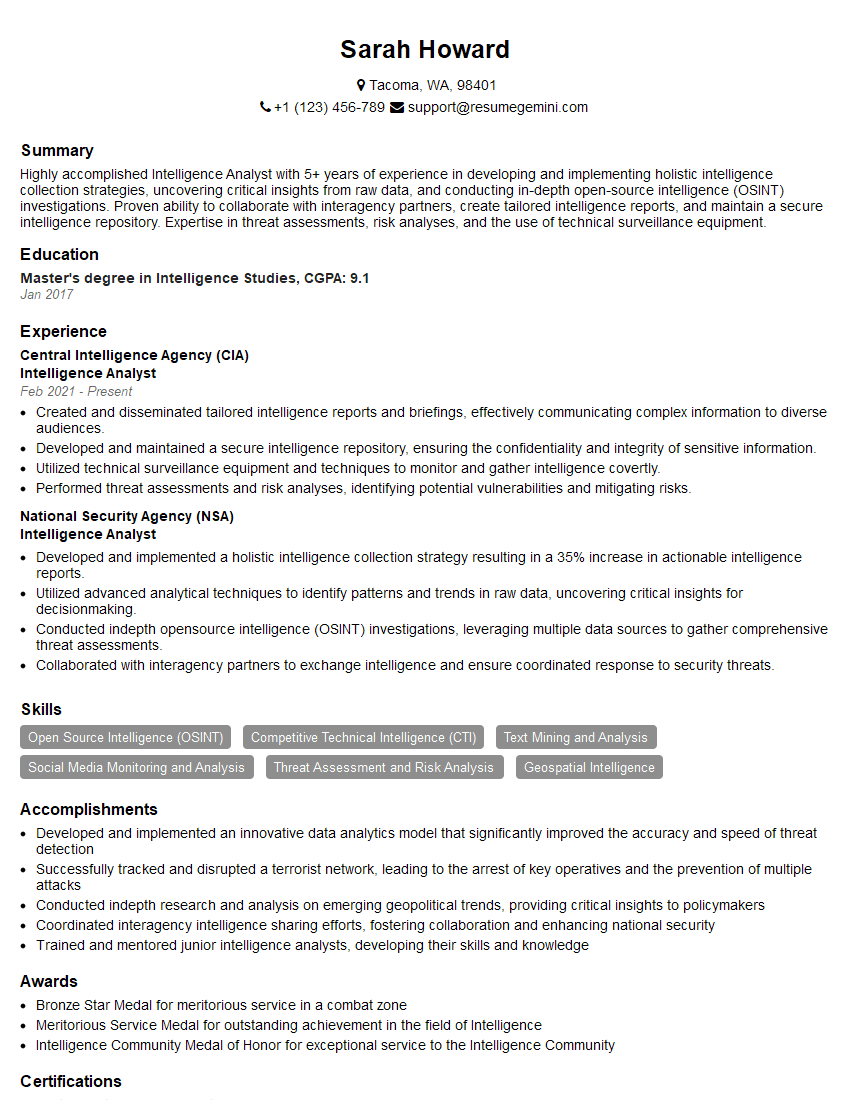
Mastering threat intelligence is crucial for career advancement in cybersecurity. It demonstrates a deep understanding of evolving threats and your ability to proactively protect organizations. To significantly boost your job prospects, focus on creating a compelling, ATS-friendly resume that highlights your skills and experience. ResumeGemini is a trusted resource to help you build a professional resume that showcases your expertise effectively. We provide examples of resumes tailored specifically to Threat Intelligence roles to give you a head start. Invest time in crafting a strong resume – it’s your first impression with potential employers.
Explore more articles
Users Rating of Our Blogs
Share Your Experience
We value your feedback! Please rate our content and share your thoughts (optional).
What Readers Say About Our Blog
Very informative content, great job.
good