Every successful interview starts with knowing what to expect. In this blog, we’ll take you through the top Hand Engraving interview questions, breaking them down with expert tips to help you deliver impactful answers. Step into your next interview fully prepared and ready to succeed.
Questions Asked in Hand Engraving Interview
Q 1. What types of metals are best suited for hand engraving?
Hand engraving thrives on the interplay between the artist’s skill and the metal’s properties. Certain metals are inherently better suited for this delicate art form due to their hardness, workability, and resistance to scratching. The ideal metal offers enough resistance to hold fine detail without being so hard that it damages tools.
- Gold: Its softness makes it relatively easy to engrave, yielding sharp lines and intricate details. However, different karats possess varying levels of hardness, influencing tool selection.
- Silver: Similar to gold, silver is relatively soft and allows for intricate work. Sterling silver is a popular choice due to its durability.
- Platinum: This is a harder metal, requiring more robust tools and greater skill. It holds detail beautifully and offers exceptional longevity.
- Steel: Harder still, steel requires specialized tools and significant experience. It’s ideal for durable, highly detailed work but demands a skilled hand.
- Brass: A softer metal often used for practice or less intricate designs, offering a good balance between ease of engraving and durability.
The choice of metal ultimately depends on the desired level of detail, the artist’s skill, and the intended lifespan of the engraved piece. A beginner might start with brass, while a master might tackle platinum.
Q 2. Explain the different types of engraving tools and their applications.
Hand engraving tools are incredibly diverse, each designed for specific purposes. The selection of tools depends on the design, the metal being engraved, and the desired effect.
- Gravers: These are the most fundamental tools, featuring a sharp point used for creating lines of varying widths and depths. They are categorized by their shape (e.g., V-shaped, U-shaped, flat) and size.
- Matting tools: These have broader points and are used to create textured backgrounds, often used to contrast with the finer detail of the main design. They can create stippled or cross-hatched effects.
- Burnishers: Unlike gravers that cut into the metal, burnishers smooth and polish surfaces, often used to refine lines or add highlights.
- Pushers: These are used for intricate detailing, creating small, precise lines and dots.
- Background tools: A range of tools with different shapes and sizes to quickly and efficiently remove metal from larger areas of a design, creating background textures.
Selecting the right tool is crucial. For example, a V-shaped graver excels at fine lines, while a U-shaped graver is better suited for wider lines and deeper incisions.
Q 3. Describe your experience with various engraving techniques (e.g., line engraving, stippling, background filling).
My experience encompasses a wide range of engraving techniques, each requiring a unique approach and tool selection.
- Line engraving: This technique involves creating lines of varying thickness and depth to build a design. Precise control and steady hand are paramount. I’ve used this extensively in creating detailed portraits and intricate patterns.
- Stippling: This involves creating a dense pattern of dots to build tonal values and textures. It’s incredibly time-consuming but can create stunning effects. I’ve used this to create the shading in engraved animal portraits.
- Background filling: This is a technique for quickly filling larger areas with texture, using tools like matting tools, and is crucial for creating contrast and visual interest within an engraving.
- Combination techniques: I regularly combine techniques within a single piece. For instance, I might use line engraving for the main subject, stippling for shading, and background filling to create a dynamic composition.
The ability to seamlessly integrate various techniques is essential to creating engaging and visually rich hand-engraved pieces.
Q 4. How do you maintain and care for your engraving tools?
Proper tool maintenance is essential for longevity and precision. Neglecting this can lead to dull tools, resulting in poor engraving quality and potential damage to the metal.
- Sharpening: Gravers need regular sharpening using sharpening stones and honing techniques. This is a skill that takes practice, and I maintain a regular sharpening schedule to ensure my tools remain precise.
- Cleaning: After each use, tools should be thoroughly cleaned to remove metal shavings and debris. A soft brush and appropriate solvents are used.
- Storage: Tools are stored securely in a designated case or box to prevent damage and maintain their sharpness. Proper organization ensures quick access to the right tool for the job.
- Inspection: Regular inspection for damage, wear, or bends is vital to prevent injury and ensure consistent performance.
Treating tools with care is an investment in the quality and longevity of one’s work. A sharp tool makes all the difference.
Q 5. Describe your process for designing and planning an engraving project.
The design and planning phase is critical. A poorly planned project can lead to frustration and subpar results. My process involves several steps:
- Concept Development: This begins with understanding the client’s vision and translating that into a design that works within the constraints of the material and the engraving technique.
- Sketching: Rough sketches are made to explore different design possibilities. This allows for experimentation and refinement before the final design is committed to the metal.
- Transferring the Design: Once the design is finalized, it is carefully transferred onto the metal surface. This may involve tracing, using a projector, or other methods depending on the complexity of the design.
- Planning Tool Selection: Based on the design and the desired effect, appropriate engraving tools are selected. Consideration is given to the different tool shapes and sizes.
- Preliminary Work: Sometimes, particularly with complex projects, a preliminary pass is made to establish the outline and major elements before proceeding to finer details.
Thorough planning greatly reduces the chance of errors and ensures the final engraving meets the highest standards.
Q 6. How do you ensure precision and accuracy in your work?
Precision and accuracy are paramount in hand engraving. It’s a balance of skill, technique, and attention to detail.
- Steady Hand: Years of practice have cultivated a steady hand, crucial for executing fine lines and intricate details.
- Proper Tool Selection: Choosing the right tool for the job ensures the desired line width and depth. A sharp tool is crucial for clean cuts.
- Magnification: Using magnifying glasses or microscopes allows for detailed inspection of the work throughout the engraving process, ensuring accuracy.
- Controlled Pressure: Applying even, controlled pressure ensures consistent lines and prevents accidental gouges.
- Planning and Layout: Careful pre-planning and a precise layout minimizes the chance of errors and maximizes efficiency.
My commitment to precision is reflected in every piece, ensuring that the final product meets my rigorous standards.
Q 7. What are some common challenges in hand engraving and how do you overcome them?
Hand engraving presents unique challenges, requiring adaptability and problem-solving skills.
- Tool breakage: Broken or damaged tools can disrupt the workflow. Maintaining a spare set of tools and having sharpening skills are crucial.
- Slippage: The metal can sometimes slip during engraving. Using proper grips, appropriate work surfaces, and techniques to secure the piece helps mitigate this.
- Uneven lines or depth: Inconsistent pressure or a dull tool can result in uneven lines. Regular sharpening, controlled pressure, and practice are key to avoid this.
- Metal fatigue: Overworking the metal can lead to inconsistencies. Taking breaks and working in short bursts helps to avoid this.
- Design errors: Errors in the initial design can be difficult to correct. Careful planning and design refinement before starting the engraving process minimize these occurrences.
Overcoming these challenges often involves patience, perseverance, and a willingness to learn from mistakes. Each challenge presents an opportunity to refine one’s skills.
Q 8. How do you handle intricate designs and detailed work?
Handling intricate designs requires a combination of precision, patience, and the right tools. Think of it like sculpting in miniature – each line, curve, and detail needs careful consideration. I start by thoroughly analyzing the design, breaking it down into smaller, manageable sections. This allows me to focus on one area at a time, ensuring accuracy and preventing errors from propagating throughout the piece. For extremely fine details, I might use very fine gravers, even employing magnification to ensure crisp lines and delicate shading. I also prioritize the correct posture and a steady hand; this minimizes tremors and fatigue, crucial for maintaining consistent precision throughout the process. For instance, when engraving a floral pattern with intricate leaves and veins, I begin with the main outlines, gradually adding smaller details like the individual leaf serrations. This layered approach, combined with meticulous attention to detail, is key to achieving a high level of fidelity to the original design.
Q 9. What are your preferred methods for transferring designs onto the metal?
Transferring designs is crucial for accuracy. I primarily use two methods: mechanical transfer and tracing. Mechanical transfer involves using a hardened steel stylus to carefully trace the design onto the metal surface, creating a series of indentations that serve as a guide for engraving. This works well for both simple and complex designs. Tracing involves using specialized graphite paper or a similar transfer medium to create a visible outline of the design on the metal. This method is faster for simpler designs, but requires more care to avoid smudging or damaging the surface. The choice of method depends on the design’s complexity and the type of metal being engraved. For intricate designs with fine details, mechanical transfer provides more accurate and durable guidance.
Q 10. Describe your experience with different types of engraving punches and gravers.
My experience encompasses a wide range of engraving tools, each suited for specific tasks and styles. I work with various types of gravers, including those with flat, round, square, and V-shaped points, each creating a unique line weight and texture. For example, a flat graver creates clean, sharp lines, ideal for outlines and lettering, while a round graver is excellent for curves and shading. I also use a variety of punches, from tiny dots to more elaborate patterns. These are especially useful for creating textures or adding decorative elements. Selecting the appropriate tool depends entirely on the specific needs of the design. A delicate filigree would call for the finest gravers and possibly punches, while a bolder, more stylized design might utilize broader tools. The material of the graver and punch matters as well, with high-carbon steel being the standard for its durability and ability to hold a sharp edge.
Q 11. How do you achieve different levels of depth and texture in your engraving?
Controlling depth and texture is fundamental to creating impactful engraving. Depth is primarily controlled by the pressure applied during engraving and the number of passes made with the tool. Lighter pressure creates shallower lines, while heavier pressure creates deeper ones. Multiple passes allow for greater control over depth and allow for creating texture. Texture is achieved by using different gravers, varying pressure, and employing techniques like cross-hatching or stippling. Cross-hatching, the layering of intersecting lines, creates shading and depth, mimicking the effects of chiaroscuro in painting. Stippling involves creating a dense pattern of small dots, adding a softer, more subtle textural element. Consider the engraved image of a mountain range. The peaks might have deep, boldly cut lines to represent height and shadow, while the valleys might be more subtly engraved with finer lines to create a sense of depth and distance.
Q 12. What is your process for creating shading and highlighting in your work?
Shading and highlighting in hand engraving are achieved through skillful manipulation of line weight, depth, and texture. Highlighting involves leaving certain areas relatively untouched, leaving the surface bright and reflective. Shading is accomplished by strategically applying lines or dots of varying density and depth. The heavier the line density or the deeper the cuts, the darker the area appears. For example, to create a shaded area in a portrait, I would use a series of closely spaced lines or dots, gradually increasing their density and depth towards the darkest parts of the shadow. This technique essentially creates a gradation of tone through the careful application of controlled cuts in the metal. The skilled application of these techniques allows for the creation of lifelike images and nuanced designs.
Q 13. How do you determine the appropriate pressure and angle when engraving?
Determining the correct pressure and angle is crucial for consistent and precise engraving. The pressure should be firm but controlled, avoiding excessive force which could damage the metal or the graver. It’s crucial to establish a consistent, light touch. The angle of the graver is determined by the type of line or texture desired. A steeper angle produces broader lines, while a shallower angle produces finer ones. The optimal pressure and angle must be adapted to the design and the specific characteristics of the metal. For example, softer metals require lighter pressure to avoid deep, uncontrolled cuts, whereas harder metals may require more force. Practice and experience are essential to developing the necessary sensitivity to control these variables effectively.
Q 14. What are your methods for assessing the quality of your engraving?
Assessing the quality of engraving involves a multifaceted approach. Firstly, I examine the piece under magnification, carefully inspecting the lines for consistency, precision, and clarity. This allows me to identify any inconsistencies or imperfections in the execution. Secondly, I assess the overall harmony of the piece; does it accurately represent the intended design and capture its spirit? Does the shading and highlighting work together to create visual depth and impact? Finally, I examine the durability and resilience of the engraving. Will it withstand the test of time and the potential wear and tear of daily handling? Through rigorous self-assessment and a critical eye, I strive for pieces of exceptional quality, where every detail is meticulously executed and the overall aesthetic is compelling.
Q 15. How do you estimate the time required for completing an engraving project?
Estimating the time for a hand engraving project requires a nuanced understanding of several factors. It’s not simply a matter of counting hours; it’s about assessing the complexity of the design, the material’s hardness, and the desired level of detail.
My process involves a detailed review of the client’s design. I consider the intricacy of the lines, the presence of shading or textures, and the overall size of the engraving area. For instance, a simple inscription on a small silver pendant might take a few hours, while a highly detailed, full-coverage engraving on a large firearm could easily take several weeks or even months. I’ll break down the project into smaller, manageable tasks, estimating the time required for each. This might include sketching, transferring the design, roughing in the lines, refining the details, and finally, polishing. I then add buffer time to account for unforeseen challenges, such as material inconsistencies or needing to adjust the design slightly during execution.
For example, if I’m engraving a hunting scene on a rifle stock, I’d carefully analyze the amount of detail in the animals, the foliage, and the background. I’d estimate the time needed for each element – the animal’s musculature, the individual leaves on a tree, etc. – then sum up these individual time estimates and add a contingency of 10-20% to account for unexpected hurdles.
Career Expert Tips:
- Ace those interviews! Prepare effectively by reviewing the Top 50 Most Common Interview Questions on ResumeGemini.
- Navigate your job search with confidence! Explore a wide range of Career Tips on ResumeGemini. Learn about common challenges and recommendations to overcome them.
- Craft the perfect resume! Master the Art of Resume Writing with ResumeGemini’s guide. Showcase your unique qualifications and achievements effectively.
- Don’t miss out on holiday savings! Build your dream resume with ResumeGemini’s ATS optimized templates.
Q 16. What software or design tools are you proficient with?
While hand engraving is primarily a hands-on craft, I utilize several software and design tools to enhance my workflow and ensure precision. I’m proficient in Adobe Illustrator for vector-based designs, allowing me to create clean, scalable artwork that can be easily transferred to the engraving surface. I also use CAD software, specifically SolidWorks, to visualize and plan complex three-dimensional engravings on items like trophies or firearms. This helps me anticipate potential challenges and plan the engraving process more effectively. Finally, I frequently employ digital imaging software like Photoshop for manipulating reference images, creating detailed sketches, and even simulating the final engraved look.
Q 17. Describe your experience with working on different types of projects (e.g., jewelry, trophies, firearms).
My experience spans a wide range of engraving projects. I’ve worked extensively on jewelry, creating intricate designs on rings, pendants, and bracelets. This work demands a high level of precision and attention to detail, particularly when dealing with delicate materials like gold and platinum. I’ve also undertaken numerous projects on trophies, engraving custom designs and inscriptions to commemorate achievements. The scale and material of these projects can vary significantly, from small plaques to large, ornate trophies. Perhaps the most challenging, and equally rewarding, projects have been on firearms. These pieces require a deep understanding of firearm construction and the ability to handle the specialized materials and delicate mechanisms involved. The level of detail often required is exceptional, and the permanence of the engraving necessitates meticulous planning and execution. One memorable project involved engraving a life-size portrait of a hunting dog onto a custom-made shotgun stock – a true test of skill and patience.
Q 18. How do you adapt your engraving techniques to various materials and projects?
Adapting my techniques to different materials is crucial for successful hand engraving. The hardness, grain structure, and texture of the material directly influence the tools and approach I employ. For example, engraving on softer metals like silver requires a lighter touch and sharper burrs than engraving on harder metals like steel. The tools themselves must be carefully chosen; softer metals might benefit from finer tools, preventing gouging, while harder metals necessitate sturdier, more robust tools. I’ve found that understanding the material’s properties is paramount. I carefully examine the workpiece before starting, understanding its grain orientation and its capacity to withstand stress. Wood engraving, for instance, requires a much different approach from metal engraving; understanding the wood’s grain direction is essential to avoid splitting or tearing. Similarly, engraving on glass or stone mandates different tools and techniques than engraving on metal.
Q 19. How do you ensure consistency in your work over time?
Maintaining consistency in my work involves a multifaceted approach. First, I prioritize meticulous tool maintenance. Keeping my burrs sharp, my punches well-aligned, and my gravers honed to perfection is key. Secondly, I maintain detailed records of my projects, including material specifications, design parameters, and the tools used. This allows me to replicate processes reliably and track improvements or identify potential issues over time. Lastly, and perhaps most importantly, I continually practice fundamental techniques. This ongoing refinement is critical to sustaining my skill level and ensuring consistency in my work. I set aside dedicated practice time to hone my skills on various materials and design elements. This not only keeps my hand steady and my eye keen but also allows me to explore new approaches and refine existing techniques.
Q 20. Describe your experience with repairing or restoring engraved items.
Repairing or restoring engraved items presents a unique set of challenges. It requires not only technical skill but also a deep understanding of the historical context and the original artisan’s techniques. My approach begins with a careful assessment of the damage, noting the extent of wear, the type of metal, and the style of engraving. I often need to carefully match the existing engraving style and depth to make repairs as invisible as possible. In some cases, the repair involves filling in lost areas with appropriate metal and then re-engraving to seamlessly integrate the repair into the existing design. The process is methodical and delicate, often requiring the use of specialized tools and a steady hand. I recently restored a Victorian-era silver locket, carefully replicating the intricate floral designs that had been partially damaged over time. This required an extensive research phase to understand the era’s engraving style and to obtain the right tools and materials for the task.
Q 21. What are some safety precautions you take while hand engraving?
Safety is paramount in hand engraving. The tools used are sharp and potentially dangerous if not handled with care. My safety precautions begin with always wearing appropriate eye protection – safety glasses with side shields are essential to protect against flying debris. I also wear a dust mask to prevent inhalation of fine metal particles generated during the engraving process. I use a well-ventilated workspace to minimize exposure to potentially harmful fumes from etching solutions or polishing compounds. Furthermore, I maintain a clean and organized workspace, ensuring that tools are properly stored and out of reach when not in use. I regularly inspect my tools for damage and replace or sharpen them as necessary. Finally, I prioritize a comfortable and ergonomic work posture to minimize strain and fatigue, reducing the risk of accidents.
Q 22. How do you handle client feedback and revisions?
Client feedback is crucial in hand engraving, as it ensures the final piece perfectly reflects their vision. I handle feedback by first actively listening and asking clarifying questions to fully understand their concerns. For example, if a client feels a design element is too subtle, we’ll discuss adjusting the depth or scale of the engraving. I then translate their feedback into actionable steps. This might involve adjusting line weights, adding details, or refining existing elements. I provide regular updates, showing the progress of the revisions using high-resolution images. This transparent communication process minimizes misunderstandings and ensures client satisfaction. If major changes are needed, I’ll provide a revised timeline. The goal is always a collaborative approach where the client feels heard and actively involved in shaping their bespoke piece.
Q 23. How do you manage deadlines and multiple projects concurrently?
Managing multiple projects and deadlines requires meticulous organization and prioritization. I utilize project management tools to track deadlines, client communication, and the progress of each piece. I break down large projects into smaller, manageable tasks, creating a detailed workflow. This allows me to focus on one task at a time, while maintaining an overall view of each project’s progress. Prioritization is based on urgency and contractual deadlines. I also schedule buffer time for unexpected delays or complications. Think of it like an orchestra conductor: each instrument (project) needs careful timing and coordination, but the conductor ensures harmony and timely completion of the entire symphony.
Q 24. Describe your experience with collaboration and teamwork within an engraving team.
Collaboration is essential in a high-volume hand engraving studio. In my previous role, I was part of a team where we regularly discussed project approaches, shared techniques, and offered constructive criticism. One specific instance involved a particularly intricate design for a commemorative plaque. A colleague with expertise in creating delicate floral patterns helped me develop a detailed plan for incorporating those elements into the larger design, and I, in return, lent my expertise on lettering styles. We regularly reviewed each other’s work, offering feedback and suggestions – a process that resulted in a much more polished and sophisticated final product. Open communication and mutual respect are vital for successful teamwork in this intricate craft.
Q 25. What are some of your favorite hand engraving artists or styles?
I’m deeply inspired by the work of many historical and contemporary engravers. From the intricate detail in the work of late 18th and early 19th-century English engravers, who pushed the boundaries of geometric patterns, to the masterful realism found in the work of contemporary artists focusing on portraits and wildlife engraving. I admire the clean lines and bold designs of the Art Nouveau movement, and their application to functional objects like pen cases and cutlery. The style influences me to constantly experiment with different depths and textures to achieve diverse effects.
Q 26. What are your plans for continued learning and skill development in hand engraving?
Continuous learning is paramount in hand engraving. My plans for skill development include exploring new techniques, like experimenting with different metals and engraving styles. I also plan on attending workshops and masterclasses offered by renowned engravers to learn from the best in the field. This could involve mastering new tools or learning advanced methods like stippling or intaglio. I’m also keen on exploring digital design tools to create precise initial designs and experimenting with new surface treatments for enhanced visual effects. It’s important to stay updated with current trends and techniques to enhance my skillset.
Q 27. What are your salary expectations?
My salary expectations are commensurate with my experience and skill level within the hand engraving industry. I’m confident that my expertise and portfolio will justify a competitive compensation package.
Q 28. Do you have a portfolio you can share?
Yes, I have a comprehensive portfolio showcasing a range of my work, including examples of different engraving styles, materials, and levels of complexity. I can readily share it with you in a digital format or provide a physical copy.
Key Topics to Learn for Hand Engraving Interview
- Tool Selection and Maintenance: Understanding the properties of different engraving tools (burrs, gravers, punches), their appropriate applications, and proper sharpening and maintenance techniques.
- Engraving Techniques: Mastering various engraving styles such as line engraving, stippling, and outlining; practical application includes creating consistent line weights and depth control.
- Material Knowledge: Familiarity with different metals (gold, silver, platinum) and their unique engraving characteristics; understanding how material hardness impacts technique and tool selection.
- Design and Layout: Proficiency in translating designs into engraved pieces; practical application involves scaling, transferring, and adapting designs for different materials and sizes.
- Safety Procedures: Understanding and adhering to all safety protocols related to using engraving tools and handling materials; practical application includes the proper use of safety glasses and ventilation.
- Troubleshooting and Problem-Solving: Identifying and resolving common engraving issues such as tool breakage, uneven lines, and material damage; developing strategies for correcting mistakes and maintaining high-quality work.
- Artistic Expression and Design Principles: Demonstrating an understanding of design principles such as balance, proportion, and composition, and how they apply to hand engraving; showcasing your artistic vision and ability to create aesthetically pleasing pieces.
Next Steps
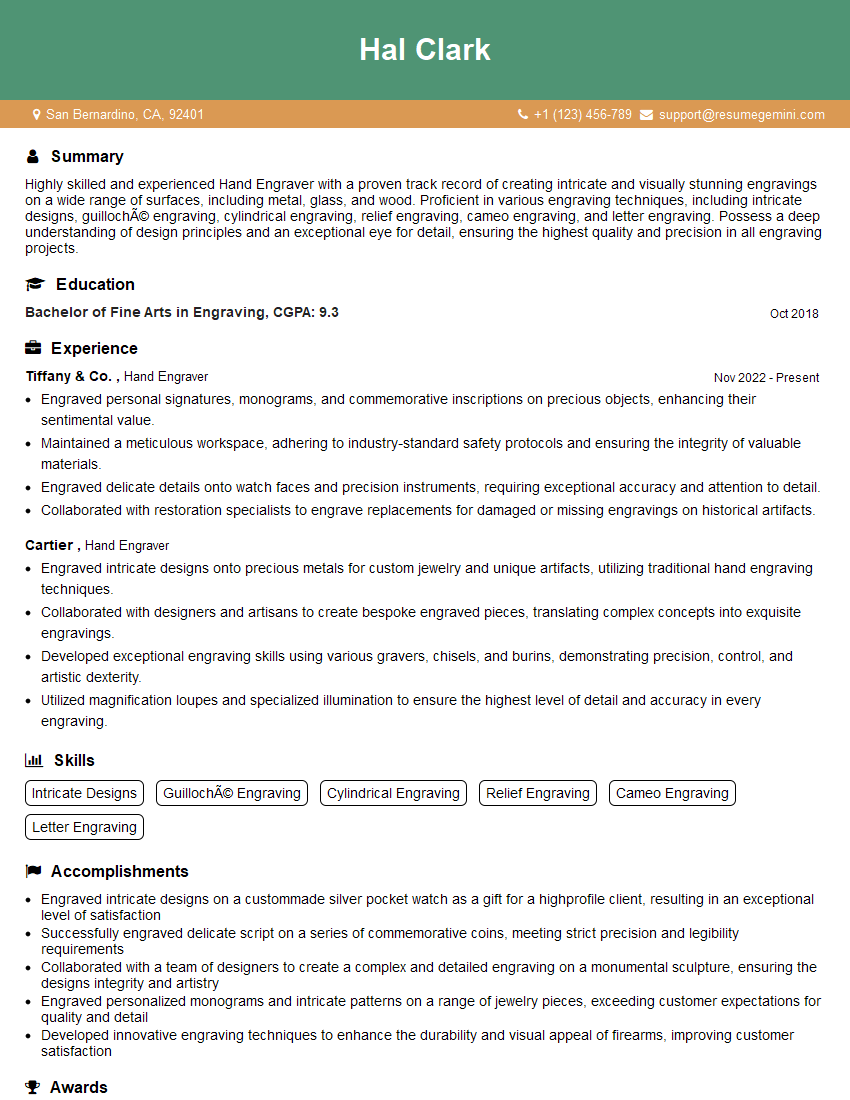
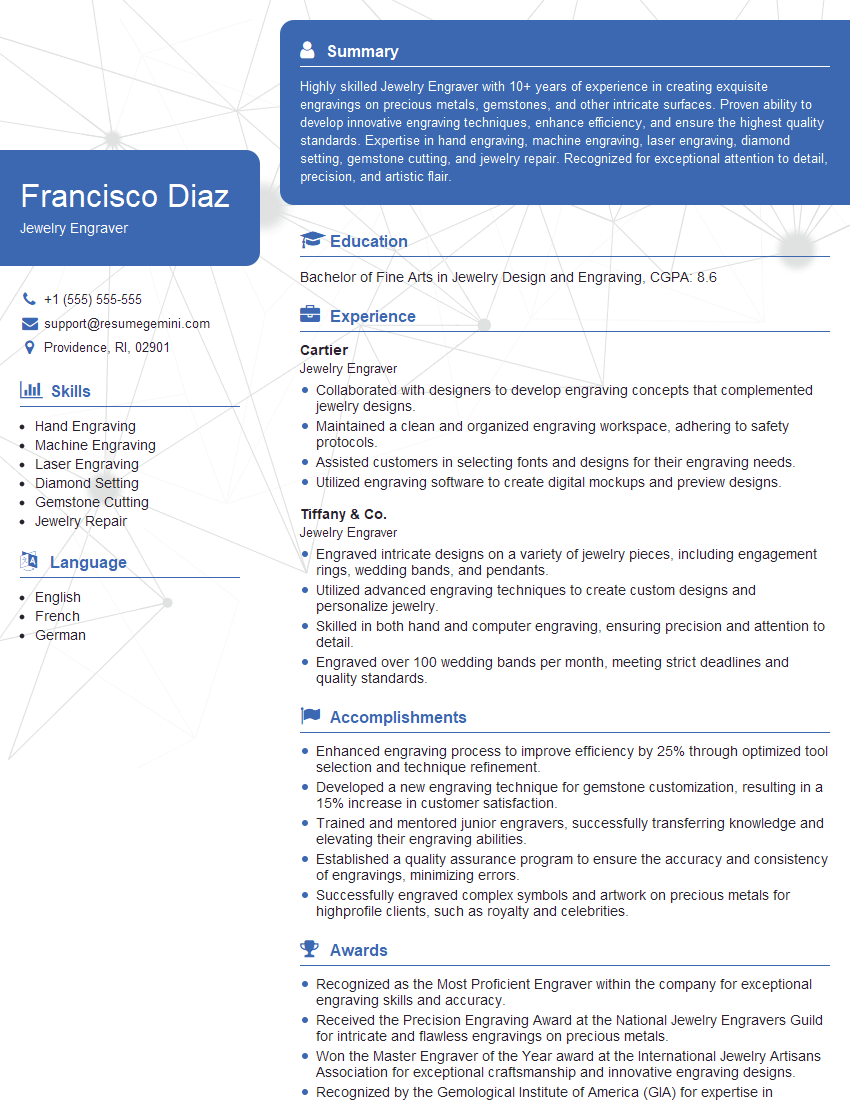
Mastering hand engraving opens doors to exciting career opportunities in jewelry making, metalwork, and other artistic fields. Your skills in precision, artistry, and problem-solving are highly valued. To maximize your job prospects, creating an ATS-friendly resume is crucial. ResumeGemini is a trusted resource to help you build a professional and impactful resume that highlights your unique abilities. Examples of resumes tailored to the hand engraving field are available to guide you. Invest time in crafting a compelling resume – it’s your first impression on potential employers.

Explore more articles
Users Rating of Our Blogs
Share Your Experience
We value your feedback! Please rate our content and share your thoughts (optional).
What Readers Say About Our Blog
Very informative content, great job.
good