Interviews are opportunities to demonstrate your expertise, and this guide is here to help you shine. Explore the essential Experience in using weight engineering software (e.g., CATIA, ANSYS) interview questions that employers frequently ask, paired with strategies for crafting responses that set you apart from the competition.
Questions Asked in Experience in using weight engineering software (e.g., CATIA, ANSYS) Interview
Q 1. Explain your experience using CATIA for weight optimization.
My experience with CATIA for weight optimization centers around leveraging its Generative Shape Design (GSD) and Knowledgeware capabilities. GSD allows me to define design objectives, such as minimizing weight while maintaining strength requirements, and then let CATIA explore a range of design alternatives. I’ve used this extensively to optimize complex parts, like aircraft fuselage sections. For example, on a recent project, we used GSD to reduce the weight of a bracket by 15% without compromising its load-bearing capacity. Knowledgeware is crucial for creating reusable design templates and automating processes. This ensured consistency and efficiency across multiple iterations of the design, accelerating the optimization process. I also utilize CATIA’s simulation tools, integrated with its CAD environment, for early-stage assessments of weight reduction strategies, feeding this data back into the GSD process for iterative refinement.
Q 2. Describe your experience using ANSYS for weight reduction analysis.
ANSYS plays a vital role in validating the weight reduction strategies explored in CATIA. I extensively use ANSYS Mechanical for Finite Element Analysis (FEA) to simulate the structural performance of lightweight designs. This involves creating accurate finite element models of the components, applying appropriate boundary conditions and loads, and running simulations to assess stress, strain, and displacement. For instance, I used ANSYS to analyze the impact of material substitutions (e.g., replacing aluminum with a composite material) on the structural integrity of an aircraft wing spar. The results from ANSYS provided crucial data for confirming whether the weight reduction achieved didn’t compromise safety or performance. Beyond static analysis, I’ve also employed ANSYS for modal and harmonic analyses to ensure the design meets vibration and fatigue requirements, crucial for aerospace applications where weight reduction often necessitates using thinner or lighter materials. This iterative process, combining CATIA for design exploration and ANSYS for validation, is essential for successful weight optimization.
Q 3. What are the key considerations in weight engineering for aerospace applications?
Weight engineering in aerospace is paramount due to its direct impact on fuel efficiency, operational costs, and payload capacity. Key considerations include:
- Safety and Certification: Designs must meet stringent safety standards and regulatory requirements (e.g., FAA, EASA). Weight reduction can’t compromise structural integrity or safety.
- Performance: Weight reduction shouldn’t negatively affect aerodynamic performance, structural strength, or functional capabilities.
- Material Selection: Selecting lightweight materials (e.g., composites, titanium alloys) with appropriate strength-to-weight ratios is crucial. This consideration includes manufacturing feasibility and cost.
- Manufacturing Processes: Weight reduction strategies must be compatible with existing manufacturing capabilities. Complex designs might increase manufacturing cost and time.
- Life Cycle Costs: While initial weight reduction efforts can save on fuel, long-term maintenance and repair costs should be considered.
- Environmental Impact: The environmental impact of material selection and manufacturing should be a part of the overall assessment.
Q 4. How do you balance performance requirements with weight reduction goals?
Balancing performance and weight reduction requires a multi-faceted approach. I often use a Pareto optimization method, where I map the trade-off between different design parameters. For example, I might plot weight versus strength or stiffness. This visualization helps identify the optimal design that achieves significant weight reduction without compromising critical performance metrics. Moreover, Design of Experiments (DOE) methodologies can systematically explore the design space, guiding the iterative design process. Finite Element Analysis (FEA), as discussed earlier, plays a vital role in validating the performance of weight-optimized designs. We carefully monitor stress levels, deflections, and natural frequencies to ensure the structural integrity and operational functionality aren’t compromised. The process is iterative, with frequent design adjustments based on simulation results and performance requirements.
Q 5. Explain your experience with different lightweight materials and their applications.
My experience includes working with a range of lightweight materials. Aluminum alloys are widely used due to their good strength-to-weight ratio and ease of manufacturing. However, for applications requiring higher strength-to-weight ratios, I’ve utilized titanium alloys, although their cost is significantly higher. Carbon fiber reinforced polymers (CFRP) are becoming increasingly prevalent due to their exceptional strength and stiffness. I’ve used CFRP extensively in aerospace applications, particularly in aircraft wings and fuselages. The challenge lies in their complex manufacturing processes and potential for damage during handling. I’ve also worked with honeycomb structures, which offer high stiffness and strength with relatively low weight. The choice of material always depends on the specific application requirements, considering factors like strength, stiffness, cost, manufacturability, and environmental impact.
Q 6. Describe your process for identifying areas for weight reduction in a design.
Identifying areas for weight reduction begins with a thorough review of the existing design. This includes:
- Material usage analysis: Determining if heavier materials can be replaced with lighter alternatives.
- Topology optimization: Using software like CATIA’s Generative Shape Design to identify areas where material can be removed without compromising structural integrity.
- Design simplification: Streamlining the design by eliminating unnecessary features or components.
- Component consolidation: Combining multiple parts into fewer, more efficient ones.
- Geometric optimization: Optimizing the shape of components to minimize weight while maintaining required strength.
This process often involves close collaboration with design and manufacturing engineers to evaluate the feasibility and cost-effectiveness of potential weight reduction strategies. The results are documented and tracked, ensuring design integrity and adherence to performance requirements.
Q 7. How do you use FEA (Finite Element Analysis) to optimize weight?
FEA is integral to weight optimization. After creating a finite element model of a component or assembly, I apply loads and boundary conditions that simulate real-world operation. The software then solves for stresses, strains, and displacements. This data is then used to identify areas of high stress concentration or excessive deformation. Based on these results, we can make targeted adjustments to the design, such as adding material in high-stress areas or removing material in low-stress areas. Topology optimization algorithms within ANSYS or similar software can automate this process, suggesting optimal material distribution for a given set of constraints. Iterative FEA simulations guide the design process, ensuring that each weight reduction step is validated to maintain structural integrity and meet performance requirements. The process continues until an optimal balance between weight and performance is achieved.
Q 8. What are some common weight reduction techniques you’ve employed?
Weight reduction is crucial in many industries, and I’ve employed several techniques throughout my career. These often involve a combination of approaches for optimal results. Some common ones include:
Material Substitution: Replacing heavier materials (like steel) with lighter alternatives (like aluminum alloys, composites, or even advanced polymers) while maintaining the required strength and stiffness. For instance, I once replaced a steel chassis in a vehicle design with a carbon fiber reinforced polymer (CFRP) chassis, resulting in a significant weight reduction without compromising structural integrity.
Design Optimization: This involves modifying the geometry of components to reduce material usage without sacrificing functionality. This can range from simple shape changes to more complex topology optimizations (which I’ll discuss in the next answer). In a project designing a satellite component, we used design optimization to thin critical areas of the structure without affecting its ability to withstand launch vibrations.
Hollowing or Thinning: Reducing the thickness or creating hollow sections in components where strength is not critical. Imagine a structural beam; we can make it thinner in areas with less stress concentration, while ensuring that it is strong enough in areas requiring higher load capacity. I’ve successfully applied this to many automotive part designs.
Feature Consolidation: Combining multiple parts into a single, more efficiently designed component. This minimizes the overall weight and reduces manufacturing costs. For example, we once combined three separate brackets into one integrated part in a robotics project, yielding significant weight savings.
Q 9. Explain your understanding of topology optimization for weight reduction.
Topology optimization is a powerful computational technique that helps determine the optimal material layout within a given design space. It starts with a defined design space and boundary conditions (loads and constraints), then iteratively removes material from areas that contribute minimally to the overall structural performance. The result is a lightweight design that satisfies all imposed constraints.
Think of it like sculpting: You start with a large block of clay and remove material until you have the desired shape while maintaining structural integrity. Software like ANSYS and CATIA have powerful topology optimization tools. The algorithm typically aims to minimize weight while maintaining stiffness or strength constraints.
For example, in one project, we used topology optimization on a complex engine bracket. The initial design was heavy and unnecessarily bulky. After topology optimization, we obtained a design that was significantly lighter, with almost 50% weight reduction, while maintaining sufficient strength and rigidity. The final design looked quite organic and unexpected, highlighting the power of the algorithm to find innovative solutions.
Q 10. How do you handle conflicting design requirements during weight optimization?
Conflicting design requirements during weight optimization are common. For example, we might need to minimize weight while maintaining high stiffness, strength, and manufacturability. To address these conflicts, I employ a multi-objective optimization approach.
This involves defining multiple objectives (weight, stiffness, strength, etc.) and using optimization algorithms to find a Pareto front. The Pareto front represents a set of optimal solutions, where improvements in one objective require compromises in another. From the Pareto front, we select the solution that best balances the conflicting requirements based on the project’s priorities. Often, this involves collaborative discussions with other engineers and stakeholders to weigh the relative importance of different design goals.
For instance, in a project designing an aircraft component, we had conflicting demands for light weight and high fatigue resistance. By using multi-objective optimization and careful consideration of material properties, we achieved a design that satisfied both requirements within acceptable tolerances.
Q 11. Describe your experience with different weight optimization algorithms.
My experience encompasses several weight optimization algorithms, including:
Gradient-based methods: These algorithms use gradient information to iteratively improve the design. They are efficient but can get stuck in local optima. Examples include steepest descent and conjugate gradient methods.
Genetic algorithms: These are evolutionary algorithms that mimic natural selection. They are robust and can explore a wider range of design spaces, but they are computationally more expensive.
Simulated annealing: This algorithm is inspired by the annealing process in metallurgy. It allows for occasional uphill moves to escape local optima, making it effective in finding globally optimal solutions, but it is slower.
Topology optimization algorithms: These algorithms, as mentioned before, are specifically designed for finding optimal material layouts. They are generally powerful, but can sometimes lead to designs that are difficult to manufacture.
The choice of algorithm depends heavily on the problem’s complexity, available computational resources, and the desired accuracy of the solution.
Q 12. How do you validate your weight reduction simulations?
Validation is crucial in weight engineering. I typically employ a multi-pronged approach:
Mesh Convergence Studies: Ensuring the results are independent of the mesh used in the finite element analysis (FEA). This involves refining the mesh and observing whether the results change significantly. If the results don’t change appreciably, it suggests the mesh is sufficiently refined.
Comparison with Analytical Solutions: Where possible, comparing the simulation results with analytical solutions or simplified models. This provides a sanity check and helps identify potential errors.
Experimental Validation: Performing physical tests on prototypes to verify the simulated results. This is often the most conclusive validation method, although it can be costly and time-consuming. In one instance, we conducted fatigue tests on a prototype component to validate the results of our weight optimization simulations. The experimental data closely matched the predicted performance.
Sensitivity Analysis: Assessing the sensitivity of the results to changes in input parameters (material properties, loads, boundary conditions). This helps to identify critical parameters and assess the uncertainty in the predictions.
Q 13. What are some common challenges in weight engineering and how have you overcome them?
Weight engineering presents several challenges:
Balancing competing requirements: As discussed before, minimizing weight often conflicts with other design goals like strength, stiffness, and manufacturability.
Computational cost: Weight optimization simulations can be computationally expensive, especially for complex designs.
Manufacturing constraints: Optimized designs might be difficult or costly to manufacture using existing processes.
Material availability and cost: Lighter materials are not always readily available or affordable.
I overcome these challenges by:
Employing efficient optimization algorithms and leveraging high-performance computing resources.
Close collaboration with manufacturing engineers to ensure manufacturability.
Careful consideration of material selection, balancing weight reduction with cost and performance.
Iterative design process: Continuously refining the design based on simulation results and feedback from manufacturing and testing.
Q 14. Explain your experience with design for manufacturing (DFM) considerations in weight engineering.
Design for Manufacturing (DFM) is paramount in weight engineering. An optimized design that is impossible or prohibitively expensive to manufacture is useless. I integrate DFM considerations throughout the weight optimization process.
This includes:
Considering manufacturing processes: Choosing materials and geometries that are compatible with the intended manufacturing processes (e.g., casting, forging, additive manufacturing). For example, if we’re using additive manufacturing, we might design for lattice structures which are much more weight efficient than traditional approaches.
Minimizing assembly complexity: Designing components that are easy to assemble to reduce manufacturing time and costs. This could involve careful consideration of tolerances, surface finishes, and joining methods.
Addressing tooling limitations: Considering the limitations of available tooling and equipment during the design process.
Evaluating manufacturability early: Working closely with manufacturing engineers to assess the manufacturability of designs early in the process.
For example, in a recent project involving a complex aerospace component, we worked with the manufacturing team to choose a suitable manufacturing process (a specific type of casting) and adjust the design to avoid complex tooling or assembly procedures. This integration saved both weight and manufacturing costs.
Q 15. How do you communicate complex technical information to non-technical stakeholders?
Communicating complex technical information to non-technical stakeholders requires a shift in perspective. Instead of focusing on intricate details, I prioritize conveying the impact of the technical aspects. I use clear, concise language, avoiding jargon whenever possible. Visual aids like charts, graphs, and simplified diagrams are invaluable. For example, instead of explaining finite element analysis results in detail, I’d show a simple bar graph comparing the weight reduction achieved against project goals. Analogies are also helpful; I might compare the weight reduction to improving a car’s fuel efficiency – something everyone can relate to. I always ensure I am tailoring my message to the audience’s level of understanding and focusing on the key takeaways, such as cost savings or improved performance.
In essence, it’s about translating technical language into a common language that everyone can understand, ultimately focusing on the ‘so what?’ of the technical findings.
Career Expert Tips:
- Ace those interviews! Prepare effectively by reviewing the Top 50 Most Common Interview Questions on ResumeGemini.
- Navigate your job search with confidence! Explore a wide range of Career Tips on ResumeGemini. Learn about common challenges and recommendations to overcome them.
- Craft the perfect resume! Master the Art of Resume Writing with ResumeGemini’s guide. Showcase your unique qualifications and achievements effectively.
- Don’t miss out on holiday savings! Build your dream resume with ResumeGemini’s ATS optimized templates.
Q 16. What software packages are you proficient in for weight engineering?
My proficiency in weight engineering software spans several key packages. I am highly experienced with CATIA, particularly its surfacing and generative design capabilities for creating lightweight yet robust parts. I am also proficient in ANSYS, using its various modules (Mechanical, Fluent) for finite element analysis (FEA) and computational fluid dynamics (CFD) simulations to validate designs and predict their performance under various load conditions. Furthermore, I have experience with HyperWorks, a comprehensive suite offering pre and post-processing capabilities that complement my work in CATIA and ANSYS. Finally, my knowledge extends to scripting languages such as Python, which are crucial for automating tasks and creating custom analysis tools.
Q 17. Describe a project where you significantly reduced the weight of a component.
In a recent project involving the redesign of a car door, we were tasked with achieving a 15% weight reduction without compromising structural integrity or safety. Using CATIA, we first performed a topology optimization study to identify areas where material could be removed without significantly impacting stiffness. This involved defining load cases and boundary conditions representing real-world usage scenarios. The resulting topology suggested substantial material removal in specific areas. We then refined this optimized geometry using CATIA’s surfacing tools, ensuring manufacturability and aesthetic appeal. ANSYS was used to validate the design. FEA simulations confirmed the structural integrity of the redesigned door, demonstrating that it met all safety standards. The final design achieved a 17% weight reduction, exceeding the initial target, which led to significant fuel efficiency improvements for the vehicle.
Q 18. How do you prioritize different weight reduction strategies?
Prioritizing weight reduction strategies requires a balanced approach considering multiple factors. I typically use a weighted scoring system that considers:
- Impact: How significant is the weight reduction potential of each strategy?
- Feasibility: How easily can the strategy be implemented given manufacturing constraints and costs?
- Cost: What are the associated costs of materials, tooling, and modifications?
- Risk: What are the potential risks and consequences of failure if the strategy is not successful?
I assign numerical weights to each factor based on project-specific priorities. For example, in a high-performance application, impact might receive a higher weight than cost. The strategies are then scored against these criteria, allowing for a clear ranking and prioritization. This systematic approach allows for data-driven decision making.
Q 19. What are the limitations of using simulation software for weight optimization?
Simulation software, while incredibly powerful, has its limitations in weight optimization. Firstly, material modeling is an approximation; real-world materials exhibit complex behaviors not always fully captured by the models. Secondly, boundary conditions in simulations are simplified representations of complex interactions. The accuracy of the results heavily depends on how realistically these conditions are defined. Thirdly, manufacturing tolerances are difficult to fully account for in simulation, which can lead to discrepancies between simulated and real-world performance. Finally, the computational cost of highly accurate simulations can be prohibitive, forcing compromises between accuracy and simulation time.
Q 20. How do you account for manufacturing tolerances during weight analysis?
Accounting for manufacturing tolerances is crucial to avoid unrealistic designs. I typically address this in several ways. Firstly, I incorporate tolerance data directly into the CAD model, using features like design intent and tolerance specifications within CATIA. Secondly, I perform sensitivity analyses within ANSYS, simulating variations in component dimensions based on the defined tolerances. This allows me to assess the impact of these variations on stress levels and other performance parameters. Finally, I may use Monte Carlo simulations, which involve running multiple analyses with randomly sampled tolerances to obtain a probabilistic distribution of performance characteristics. This provides a more realistic and comprehensive understanding of the potential impact of manufacturing variation.
Q 21. Explain your understanding of different material properties and their impact on weight.
Understanding material properties is fundamental to weight engineering. Key properties influencing weight include density (mass per unit volume), Young’s modulus (stiffness), yield strength (resistance to plastic deformation), and fatigue strength (resistance to cyclic loading). For example, aluminum alloys offer a good strength-to-weight ratio compared to steel, making them suitable for applications where weight reduction is a primary goal. However, their lower stiffness might necessitate a larger cross-sectional area for similar structural performance. Similarly, carbon fiber composites offer extremely high strength-to-weight ratios, but their higher cost and complex manufacturing processes need to be considered. The selection of the right material requires careful trade-offs between weight, cost, manufacturability, and performance requirements, and this often involves using specialized material databases that contain all the necessary properties for analysis.
Q 22. How do you ensure the structural integrity of a lightweight design?
Ensuring the structural integrity of a lightweight design is a delicate balancing act between reducing weight and maintaining sufficient strength and stiffness. It’s not simply about removing material; it’s about strategically optimizing the material distribution to maximize strength-to-weight ratio. This involves a multi-step process.
- Finite Element Analysis (FEA): I extensively use FEA software like ANSYS to simulate real-world loading conditions on the design. This allows me to predict stress, strain, and displacement under various scenarios (static, fatigue, impact, etc.). For example, I might simulate the impact forces on a car bumper during a low-speed collision to ensure it meets safety standards while remaining lightweight.
- Material Selection: Choosing the right material is crucial. High-strength-to-weight ratio materials like aluminum alloys, carbon fiber composites, or titanium alloys are often preferred for lightweight designs. The selection depends on the specific application, cost considerations, and environmental factors.
- Topology Optimization: This powerful technique uses software algorithms to remove material from areas of low stress concentration, effectively creating an optimized structure with minimal weight loss. Imagine a sponge – topology optimization essentially carves out the unnecessary parts, leaving only the essential load-bearing structure.
- Design for Manufacturing (DFM): The design must be manufacturable. Complex geometries can be expensive and time-consuming to produce, so practicality is key. I always collaborate with manufacturing engineers to ensure that the lightweight design is feasible and cost-effective.
- Testing and Validation: Finally, physical prototypes are tested to validate the FEA predictions. This might involve destructive testing like tensile strength tests or non-destructive testing like ultrasonic inspection to ensure the design meets the required safety and performance criteria.
Q 23. Describe your experience with different types of weight reduction analyses (e.g., static, dynamic).
My experience spans various weight reduction analyses, each suited to different application scenarios.
- Static Analysis: This is used to determine the structural response of a component under constant loads. For instance, I used static analysis in CATIA to optimize the design of an aircraft wing spar, ensuring it could withstand the expected weight and aerodynamic loads during flight.
- Dynamic Analysis: This assesses the response to time-varying loads, such as vibrations or impacts. I employed dynamic analysis in ANSYS to analyze the vibrational characteristics of a car chassis, optimizing its design to minimize noise and vibration while reducing weight.
- Modal Analysis: This identifies the natural frequencies and mode shapes of a structure. This is crucial for preventing resonance, which can lead to catastrophic failures. For example, I used modal analysis to design a lightweight helicopter rotor blade that avoids resonant frequencies during operation.
- Fatigue Analysis: This predicts the lifespan of a component under cyclic loading. For instance, I used fatigue analysis to design a lightweight connecting rod for an engine, ensuring it could withstand millions of cycles without failure.
The choice of analysis depends on the specific application and the type of loading the component will experience. Often, a combination of these analyses is used to ensure a comprehensive understanding of the structural behavior.
Q 24. How do you incorporate sustainability considerations into your weight engineering projects?
Sustainability is paramount in my weight engineering projects. Reducing weight contributes to sustainability in several ways:
- Reduced Material Consumption: Lighter designs require less material, minimizing the environmental impact of raw material extraction and processing.
- Improved Fuel Efficiency: In transportation applications, lighter vehicles consume less fuel, reducing greenhouse gas emissions. For example, I worked on a project to reduce the weight of a delivery truck, leading to significant fuel savings and a smaller carbon footprint.
- Extended Product Lifespan: By optimizing designs for longevity and durability, we reduce the need for frequent replacements, minimizing waste and resource consumption. This involves careful consideration of material selection and fatigue analysis to ensure a longer product lifespan.
- Recyclable Materials: I prioritize the use of recyclable materials whenever feasible, contributing to a circular economy and reducing reliance on virgin materials. This often involves exploring the use of recycled aluminum alloys or bio-based composites.
Beyond material choices, I consider the overall environmental impact of the manufacturing process. This includes energy consumption during production and transportation of components.
Q 25. What are your preferred methods for documenting your weight engineering work?
Comprehensive documentation is essential for ensuring traceability, collaboration, and future reference. My preferred methods include:
- Detailed Design Reports: These reports document the design process, including initial concepts, FEA results, material selection justifications, and design iterations. They include tables summarizing key performance indicators (KPIs) like weight savings and stress levels.
- CAD Models and Drawings: 3D CAD models (using CATIA or similar) provide a visual representation of the design, while detailed drawings specify dimensions, tolerances, and material specifications.
- FEA Results and Reports: These reports include graphical representations of stress, strain, and displacement, allowing for a thorough analysis of the structural behavior.
- Version Control Systems: Using a version control system like Git allows for efficient tracking of design changes and collaboration among team members.
- Digital Mockups: This enables visualization of the assembly and helps identify potential issues early in the design process, improving efficiency and collaboration.
Q 26. Describe your experience with collaborating with multidisciplinary teams on weight reduction projects.
Weight reduction projects are inherently multidisciplinary, requiring close collaboration among engineers from various disciplines. My experience includes working with:
- Design Engineers: Close collaboration with design engineers is essential to ensure the lightweight design meets all functional requirements.
- Manufacturing Engineers: Their input is vital for ensuring the design is manufacturable and cost-effective. I regularly discuss manufacturing processes and limitations with them to make design adjustments if necessary.
- Materials Engineers: Their expertise ensures we select the most appropriate materials, considering factors like strength, stiffness, cost, and environmental impact.
- Testing Engineers: They conduct physical tests to validate the design and ensure it meets performance requirements.
Effective communication and the use of collaborative tools like shared online repositories are key to success in multidisciplinary teams. I always strive to create a collaborative environment where everyone feels comfortable sharing their insights and expertise.
Q 27. How do you stay updated on the latest advancements in weight engineering techniques and software?
Staying updated on advancements in weight engineering is a continuous process. I utilize various methods:
- Industry Conferences and Workshops: Attending conferences like SAE International or ASME events provides exposure to the latest research and industry best practices.
- Professional Journals and Publications: Regularly reading journals like the Journal of Materials Processing Technology or Composite Structures keeps me abreast of advancements in materials and analysis techniques.
- Online Courses and Webinars: Platforms like Coursera and edX offer valuable courses on advanced FEA techniques and lightweight design principles.
- Software Updates and Training: I actively participate in training programs provided by software vendors like Dassault Systèmes (CATIA) and ANSYS to stay current with new features and functionalities.
- Networking with Peers: Engaging with other weight engineering professionals through online forums and professional organizations facilitates knowledge sharing and collaboration.
Q 28. Describe your experience with cost optimization in relation to weight reduction.
Cost optimization is intrinsically linked to weight reduction. While lightweight materials can be expensive, the overall cost savings can be substantial. My approach involves:
- Material Cost Analysis: Comparing the cost of various materials with their performance characteristics (strength, stiffness, weight) allows for optimal material selection balancing performance and cost.
- Manufacturing Cost Analysis: Simple designs are generally cheaper to manufacture. I collaborate with manufacturing engineers to select manufacturing processes that minimize costs while maintaining the integrity of the lightweight design.
- Life Cycle Cost Analysis (LCCA): This considers the entire cost of ownership, including manufacturing, operation, maintenance, and disposal. A lighter vehicle, for instance, may have lower fuel consumption, offsetting the higher initial material cost.
- Value Engineering: This iterative process involves identifying areas where cost can be reduced without compromising performance. For example, I might replace a costly titanium component with a less expensive aluminum alloy, if the performance trade-off is acceptable.
Balancing weight reduction and cost requires a holistic approach, considering the entire lifecycle of the product and its associated costs.
Key Topics to Learn for Experience in using weight engineering software (e.g., CATIA, ANSYS) Interview
- Understanding Weight Optimization Techniques: Explore various methods for reducing weight without compromising structural integrity, including material selection, topology optimization, and design for manufacturing (DFM) principles.
- Proficiency in CAE Software: Demonstrate hands-on experience with CATIA or ANSYS, showcasing your skills in modeling, meshing, simulation setup, and result interpretation. Be prepared to discuss specific modules used and analyses performed (e.g., FEA, CFD).
- Finite Element Analysis (FEA) Fundamentals: Understand the theoretical basis of FEA, including element types, boundary conditions, and load application. Be ready to discuss different analysis types relevant to weight engineering (e.g., static, modal, fatigue).
- Material Properties and Selection: Showcase your knowledge of various engineering materials and their properties relevant to weight optimization. Explain how to choose appropriate materials based on strength, stiffness, weight, and cost considerations.
- Practical Applications and Case Studies: Prepare examples from your past projects where you successfully applied weight engineering principles to reduce weight and improve design efficiency. Quantify your achievements whenever possible.
- Problem-Solving and Troubleshooting: Be prepared to discuss challenges encountered during weight optimization projects and how you overcame them. Highlight your ability to analyze results, identify issues, and propose effective solutions.
- Design for Manufacturing (DFM) Considerations: Explain how weight optimization strategies integrate with manufacturing processes. Discuss constraints and limitations imposed by manufacturing techniques and how to address them.
Next Steps
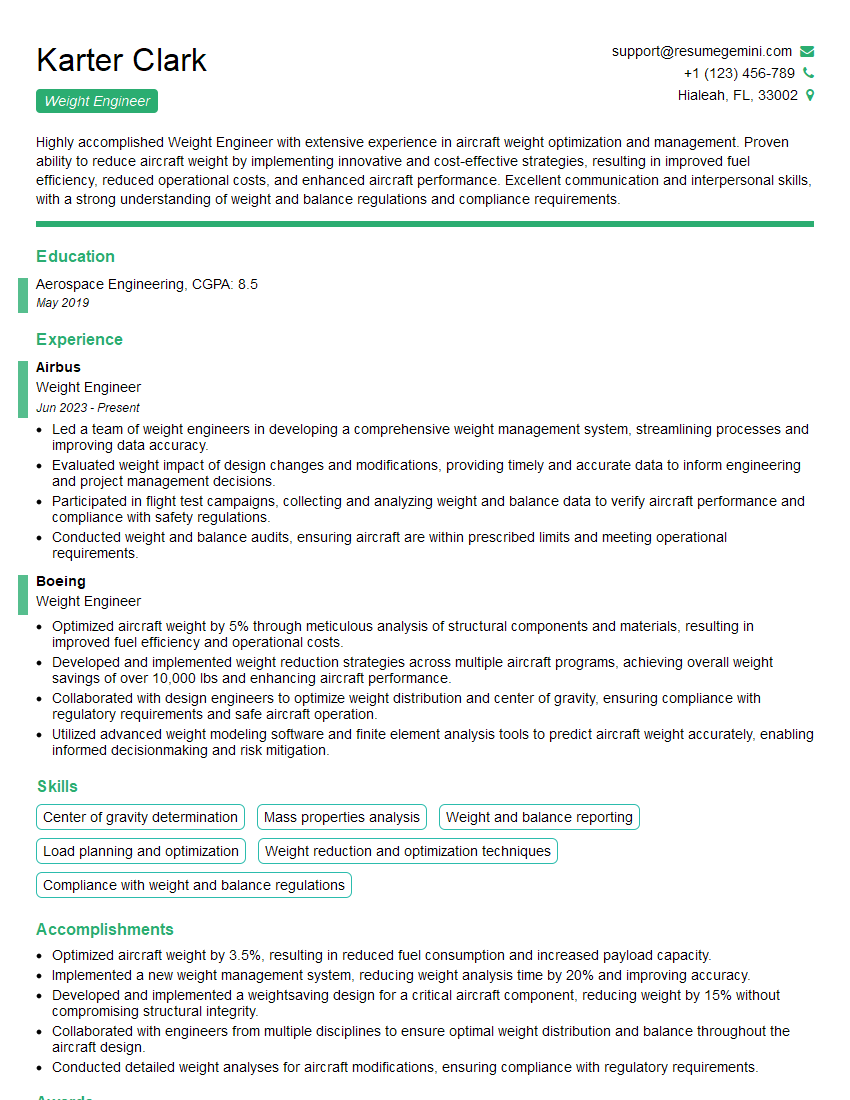
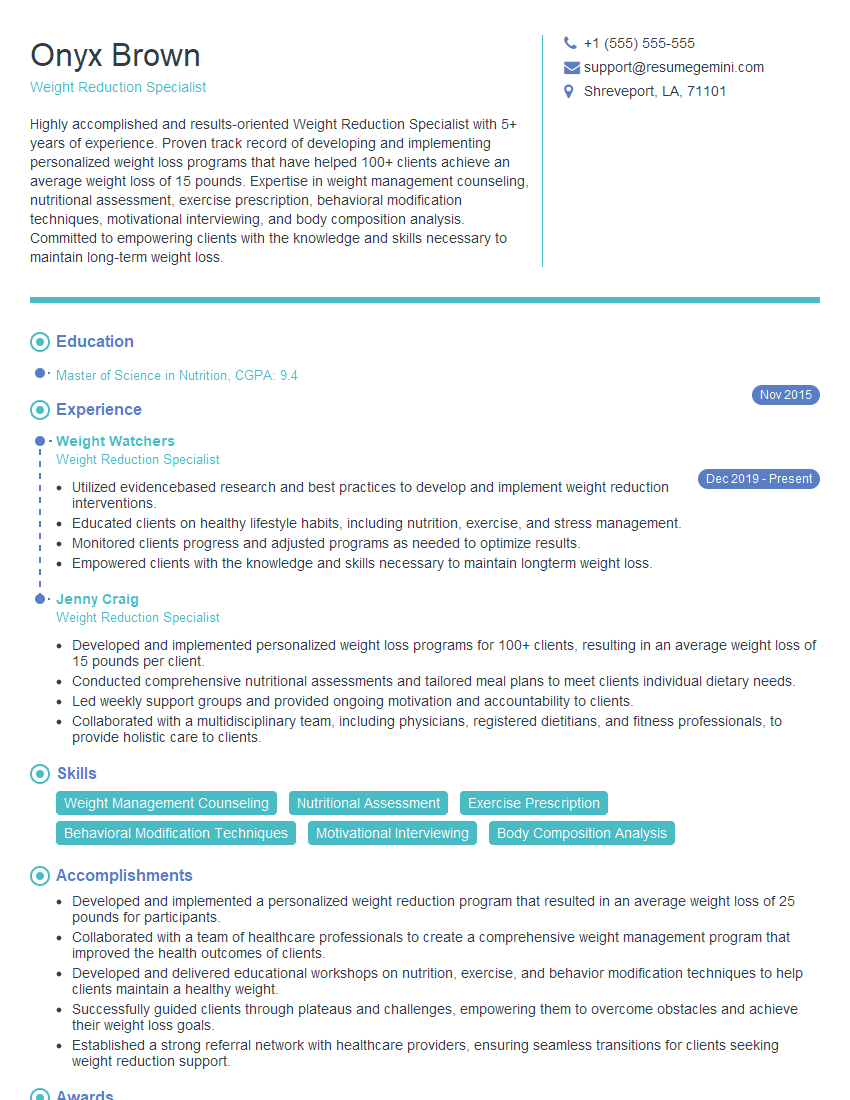
Mastering weight engineering software like CATIA and ANSYS is crucial for career advancement in many engineering fields, opening doors to exciting roles with increased responsibility and compensation. To maximize your job prospects, crafting an ATS-friendly resume is essential. ResumeGemini is a trusted resource to help you build a professional and impactful resume that highlights your skills and experience effectively. Examples of resumes tailored to showcasing experience in weight engineering software (e.g., CATIA, ANSYS) are available to guide you. Take the next step towards your dream career today!
Explore more articles
Users Rating of Our Blogs
Share Your Experience
We value your feedback! Please rate our content and share your thoughts (optional).
What Readers Say About Our Blog
Very informative content, great job.
good