The thought of an interview can be nerve-wracking, but the right preparation can make all the difference. Explore this comprehensive guide to Experience with automated die-cutting systems interview questions and gain the confidence you need to showcase your abilities and secure the role.
Questions Asked in Experience with automated die-cutting systems Interview
Q 1. Describe your experience with different types of automated die-cutting machines.
My experience encompasses a wide range of automated die-cutting machines, from flatbed die cutters commonly used for smaller runs and intricate designs to high-speed rotary die cutters ideal for mass production. I’ve worked extensively with both servo-driven and hydraulic systems, each offering unique advantages. Servo-driven machines provide precise control and repeatability, making them perfect for intricate designs and demanding quality standards. Hydraulic systems, while perhaps less precise, offer immense power for cutting thicker materials. I’m also familiar with specialized machines like laser die cutters for delicate materials and those incorporating automated feeding and stacking systems to enhance efficiency. For example, I once worked on a project using a Bobst flatbed die cutter for producing custom packaging inserts requiring extremely accurate registration. For higher volumes, we switched to a Heidelberg rotary die cutter to significantly increase production speed.
Q 2. Explain the process of setting up a die-cutting job, from receiving the die to the finished product.
Setting up a die-cutting job is a meticulous process. It starts with receiving the cutting die, meticulously inspecting it for any damage or wear. Next, I’ll carefully mount the die onto the machine, ensuring proper alignment and securing mechanisms are correctly engaged. Then, I’ll select the appropriate cutting material and feed it into the machine according to the manufacturer’s specifications. The machine’s settings, such as cutting pressure, speed, and registration, are then adjusted based on the material’s thickness and the die’s design. A test run is crucial – this allows me to evaluate the cut quality, registration accuracy, and identify any potential issues before proceeding with full production. This is followed by quality checks of the finished product to ensure consistency and accuracy before packaging. Think of it like baking a cake; careful preparation, precise measurements, and test baking are all vital to achieving a perfect result.
Q 3. How do you troubleshoot common problems encountered during die-cutting operations?
Troubleshooting die-cutting problems often involves systematic investigation. Common issues include inaccurate cutting, material jams, and registration problems. I start by carefully examining the cut samples for patterns; for example, inconsistent cuts might point to a worn die or improper pressure settings, while registration issues could signal problems with the die’s mounting or material feeding system. A jammed machine might indicate a problem with the material itself, a faulty sensor, or a mechanical issue. I methodically check each component, starting from the material feed, die alignment, and machine settings. My experience allows me to quickly identify the root cause and implement the appropriate solution, which could involve adjustments to machine parameters, die replacement or repair, or even adjustments to the material handling process. In one instance, I identified a seemingly minor misalignment in the die’s mounting, causing significant registration issues that were resolved with simple but precise adjustments.
Q 4. What are the safety protocols you follow when operating automated die-cutting equipment?
Safety is paramount. Before operating any automated die-cutting equipment, I always ensure all safety guards are in place and functioning correctly. I never attempt to adjust the machine while it’s running. Appropriate personal protective equipment (PPE), including safety glasses, gloves, and hearing protection, is always worn. Regular machine inspections are conducted to identify any potential hazards. Furthermore, I strictly adhere to the manufacturer’s safety guidelines and company protocols. This includes lockout/tagout procedures when performing maintenance or repairs to prevent accidental starts. Safety isn’t just a checklist; it’s an ingrained mindset.
Q 5. How do you ensure the quality of die-cut products?
Ensuring quality involves a multi-stage process. Starting with incoming material inspection, I check for defects, ensuring consistency in thickness and quality. During the production process, regular sampling and visual inspection of the cut pieces are conducted. I use precision measuring tools like calipers to verify dimensions and accuracy. We also use automated vision systems in some production lines to detect defects such as incomplete cuts or misregistration. Statistical process control (SPC) charts are used to monitor and analyze process variations, helping to identify trends and prevent defects. Finally, a detailed final inspection of the finished product is carried out before release.
Q 6. Describe your experience with different types of dies (e.g., steel rule, magnetic, rotary).
My experience includes working with various die types. Steel rule dies are versatile and cost-effective for simpler designs and lower volumes. Magnetic dies offer flexibility and easy changes for smaller jobs. Rotary dies excel in high-speed, high-volume production, particularly for repetitive designs like labels and packaging. I’ve also worked with specialized dies for specific materials, including those designed for embossing or debossing. Choosing the right die type is crucial for efficiency and product quality. For example, a steel rule die might be sufficient for a small-scale promotional item, while a rotary die would be necessary for mass production of cardboard boxes.
Q 7. Explain the importance of proper die maintenance and storage.
Proper die maintenance and storage are crucial for extending die lifespan and maintaining cutting accuracy. After each use, dies should be thoroughly cleaned to remove any debris or material fragments. Regular sharpening or repair is necessary, especially for steel rule dies. Dies should be stored in a clean, dry environment, preferably in protective cases to prevent damage or corrosion. Improper storage can lead to rust, damage, or loss of accuracy. Imagine storing knives without proper protection; they would dull and become useless. The same principle applies to dies – proper care ensures longevity and precision.
Q 8. How do you monitor and adjust machine settings to achieve optimal cutting performance?
Optimizing die-cutting performance hinges on precise machine settings. I monitor several key parameters, starting with the cutting pressure. This is adjusted based on the material thickness and the complexity of the die. Too little pressure results in incomplete cuts, while too much can lead to damage or distortion. I regularly check the blade sharpness; dull blades cause ragged edges and reduce accuracy. The speed of the machine is also crucial. Slower speeds are typically better for intricate designs or delicate materials to ensure clean cuts. Finally, I continuously monitor the registration – the alignment of the die to the material. Inaccurate registration leads to miscuts. I use a combination of digital readouts on the machine, visual inspection of test cuts, and quality control checks at regular intervals to fine-tune these settings for optimal results. For example, when working with thick cardboard, I might increase the pressure and slightly decrease the speed to ensure clean cuts through the material without damaging the die. For delicate paper, the opposite approach is often necessary.
Q 9. Describe your experience with different cutting materials (e.g., paper, cardboard, plastics).
My experience spans a wide range of die-cutting materials. I’ve worked extensively with various paper types, from thin tissue paper to thick, coated board. Each requires a different approach. Thin papers require lower pressure and potentially slower speeds to avoid tearing. Thicker boards demand higher pressure and sometimes specialized dies. I’m also experienced with various cardboards, including corrugated board, which necessitates careful consideration of the flute orientation to avoid crushing or uneven cuts. Furthermore, I’ve worked with plastics, including thin films and thicker sheets. These require different dies and often necessitate adjustments to minimize heat build-up during the cutting process. For instance, when cutting through multiple layers of corrugated cardboard, I often need to adjust the pressure and speed multiple times during the process depending on the changes in the layers, and ensure that the material is consistently fed. The process also varies for flexible materials like thin plastics compared to more rigid materials.
Q 10. How do you handle material jams or other production stoppages?
Material jams are a common occurrence in die-cutting. My first step is always safety – ensuring the machine is turned off and the area is clear before attempting any intervention. The cause of the jam must then be identified. Common causes include material misalignment, wrinkled or damaged material, or a build-up of waste. I carefully remove the jammed material, paying attention not to damage the die or the machine. If the jam is severe or involves a complex issue, I consult the machine’s operational manual and may seek assistance from a maintenance technician. After clearing the jam, I inspect the material feed system and make any necessary adjustments to prevent future occurrences. For instance, if I find wrinkled material causing a jam, I might check the unwind tension or make sure the material is appropriately conditioned to reduce moisture. Accurate diagnostics are crucial to effective problem-solving; I use a systematic approach combining visual inspection, machine logs, and sometimes troubleshooting charts to isolate the root cause.
Q 11. Explain your experience with die-cutting software and programming.
I’m proficient in several die-cutting software packages, including [mention specific software, e.g., Esko ArtiosCAD, Adobe Illustrator]. My experience includes designing and programming dies, optimizing nesting patterns for maximum material yield, and generating cutting paths for various machine types. I understand the nuances of different file formats and can adapt designs to different machine capabilities. For example, I have experience using vector graphics to create dies for intricate designs and working with raster images to handle more complex geometries. My programming skills involve creating cutting paths and nesting that avoid common pitfalls such as sharp angles or tight clearances which can damage the die and impact production efficiency. I thoroughly test every program before running it on the machine.
Q 12. How do you interpret and follow technical drawings and specifications?
Interpreting technical drawings and specifications is fundamental to my role. I understand various notations, including dimensions, tolerances, materials, and finishing requirements. I can translate these specifications into machine settings and create accurate cutting programs. For example, understanding tolerances is key to ensuring the die-cut parts meet the required precision. I use various measuring tools, such as calipers and micrometers, to verify the dimensions during and after the cutting process, ensuring they are within the acceptable tolerances specified in the technical drawing. In the case of complex designs with multiple components, I develop a methodical approach, step-by-step, ensuring each part complies with the specifications. Thorough understanding prevents costly errors and guarantees the final product meets client requirements.
Q 13. What are your methods for preventing scrap and maximizing material yield?
Minimizing scrap and maximizing material yield is a continuous pursuit. This involves several strategies. Efficient nesting is paramount – I use software to optimize the placement of shapes on the material to reduce waste. Precise cutting, achieved through meticulous machine settings and maintenance, also contributes. I also regularly inspect the material for defects before cutting to prevent wasting good material on flawed sections. Moreover, I keep detailed records of material usage to identify areas for improvement and to track trends in waste generation. For example, by analyzing waste patterns over time, I could discover an issue with material alignment, leading to a process improvement that could considerably reduce scrap. A systematic approach, coupled with data analysis, is essential for maximizing efficiency.
Q 14. How do you measure and document the accuracy of die-cut parts?
Accuracy measurement is crucial and is conducted at multiple stages. During the setup process, I use test cuts to verify the alignment and cutting quality. After the run, I use a variety of tools to measure the final product’s dimensions. Calipers, micrometers, and even optical measuring systems are employed, depending on the required precision and the complexity of the parts. I meticulously document all measurements and compare them to the specifications, flagging any discrepancies. I also use statistical process control (SPC) techniques to monitor the ongoing accuracy of the process and detect any trends indicating deviations from the desired accuracy. This documentation forms part of the quality control process and serves as an important record for identifying potential issues and for continuous improvement initiatives.
Q 15. Describe your experience with quality control procedures for die-cutting operations.
Quality control in die-cutting is paramount to ensure consistent product quality and minimize waste. My approach involves a multi-stage process, starting with pre-press checks of the die and the material to be cut. This includes verifying the die’s sharpness, alignment, and overall condition, as well as inspecting the substrate for defects. During the cutting process, I meticulously monitor the machine’s performance, looking for signs of inconsistent cutting pressure, material slippage, or registration issues. Regular checks of the finished product involve visual inspection for imperfections like incomplete cuts, burrs, or misaligned cuts, using a calibrated measuring instrument. Finally, statistical process control (SPC) charts are used to track key metrics like scrap rate and defect percentage. This allows for early detection of trends and prompt corrective action. For example, if the scrap rate suddenly increases, we would investigate factors like die wear, material variations or machine settings. We utilize various sampling techniques to ensure accurate representation of quality.
Career Expert Tips:
- Ace those interviews! Prepare effectively by reviewing the Top 50 Most Common Interview Questions on ResumeGemini.
- Navigate your job search with confidence! Explore a wide range of Career Tips on ResumeGemini. Learn about common challenges and recommendations to overcome them.
- Craft the perfect resume! Master the Art of Resume Writing with ResumeGemini’s guide. Showcase your unique qualifications and achievements effectively.
- Don’t miss out on holiday savings! Build your dream resume with ResumeGemini’s ATS optimized templates.
Q 16. Explain your understanding of different types of cutting techniques (e.g., kiss-cutting, creasing).
Die-cutting employs various techniques depending on the desired outcome. Kiss-cutting is a shallow cut, partially perforating the material without completely cutting through it. This is commonly used for creating easily peelable labels or packaging components. Think of those peel-and-stick stickers; that’s kiss-cutting in action. In contrast, full-cut techniques sever the material completely, creating separate pieces. This is standard for most die-cut parts. Creasing involves scoring the material to create a defined fold line without cutting through it. This facilitates clean, consistent folding, crucial for boxes and brochures. I’ve extensive experience with all these techniques, and selecting the right one depends heavily on the material properties, desired finish and application. For instance, a thicker cardboard would require a more aggressive full cut compared to a thin paper that only needs a creasing.
Q 17. How do you ensure the consistent quality of die-cut products across multiple runs?
Maintaining consistent quality across multiple die-cutting runs requires a rigorous approach that focuses on standardization and meticulous record-keeping. Firstly, standardizing the process parameters is essential. This includes setting consistent machine settings like cutting pressure, speed, and material feed rate. Secondly, regular calibration and maintenance of the die-cutting machine is crucial to avoid inconsistencies over time. Thirdly, using consistent materials from the same batch or a certified supplier, as even minor variations in material thickness can affect cut quality. We also use control samples from each production run to compare against pre-established quality standards. Finally, meticulous documentation of the entire process, including machine settings, materials used, and quality control checks, allows us to reproduce results reliably across multiple runs. It’s like baking a cake; if you follow the recipe precisely, you’ll get a consistent result.
Q 18. What are your strategies for optimizing die-cutting production speed and efficiency?
Optimizing die-cutting production speed and efficiency requires a holistic approach encompassing various strategies. Process optimization begins with analyzing bottlenecks in the workflow. This might involve improving material handling, reducing setup times, or streamlining the quality control process. Machine maintenance is crucial for maximizing uptime and preventing production delays. This includes regular preventative maintenance schedules and quick response to any detected faults. Die design is also critical; a well-designed die minimizes cutting time and reduces waste. We also explore opportunities for automation, such as implementing automated material handling systems or integrating the die-cutting machine with other processes. In one project, optimizing the die design alone reduced cutting time by 15%, and improving material flow cut setup time by 20%.
Q 19. Explain your experience with preventative maintenance for automated die-cutting machines.
Preventative maintenance is a cornerstone of efficient and reliable die-cutting operations. My approach involves a scheduled maintenance program that includes regular lubrication of moving parts, cleaning of the cutting area, and inspection of the die and cutting blades for wear and tear. I use a checklist to ensure consistency in the maintenance procedure. The frequency of maintenance depends on the machine’s usage and the type of materials being cut. We also monitor machine performance data such as cutting pressure, speed, and power consumption. Any unusual deviation from the established parameters triggers a more thorough inspection. By proactively addressing potential issues before they cause major problems, we prevent costly downtime, maintain product quality, and extend the lifespan of the machine. It’s similar to regularly servicing your car to prevent major breakdowns down the road.
Q 20. How do you identify and report machine malfunctions or safety concerns?
Identifying and reporting machine malfunctions or safety concerns is paramount to ensure both production efficiency and workplace safety. I use a combination of visual inspection, machine performance monitoring, and operator feedback to identify potential issues. Any malfunction, regardless of how minor it seems, is documented using a standard reporting system which usually includes a detailed description of the problem, the time of occurrence, and any observed consequences. Safety concerns are immediately reported to the supervisor, and the machine is shut down until the issue is addressed and declared safe. A thorough investigation is then conducted to determine the root cause and implement corrective actions to prevent recurrence. This is critical not only for preventing accidents but also for preserving the quality of the output and maintaining production schedules.
Q 21. What are your problem-solving techniques when dealing with unusual or complex die-cutting issues?
Troubleshooting complex die-cutting issues requires a systematic and logical approach. I typically use a structured problem-solving methodology, starting with a clear definition of the problem. This involves gathering data, such as defect rates, machine logs, and operator feedback. I then move on to hypothesis generation, identifying potential causes based on my experience and knowledge. Next, I test my hypotheses, through controlled experiments, adjustments to machine settings, or material substitutions. Finally, I analyze the results and implement the appropriate corrective actions. For example, if experiencing inconsistent cuts, I would systematically investigate factors such as die wear, incorrect cutting pressure, or material variations. This methodical approach helps isolate the root cause, implement effective solutions, and prevent similar issues from recurring. It’s about detective work – carefully examining clues to understand and solve the mystery.
Q 22. Describe your experience with working in a team environment in a die-cutting operation.
In my experience, collaborative teamwork is paramount in a successful die-cutting operation. I’ve been part of teams ranging from 5 to 15 individuals, including machine operators, setup technicians, quality control inspectors, and supervisors. Effective communication is key; we use daily huddles to discuss production schedules, identify potential bottlenecks, and address any urgent issues. For example, during a particularly tight deadline for a large order of custom-shaped packaging, our team leveraged each member’s expertise. The setup technician expertly programmed the die-cutting machine, the operators monitored the process for quality, and the QC inspector ensured adherence to specifications. Through clear communication and mutual support, we successfully met the deadline and maintained high quality standards. We also relied heavily on shared documentation and checklists to ensure consistency and minimize errors. This collaborative approach fostered a positive work environment and improved overall efficiency.
Q 23. How do you prioritize tasks and manage your time effectively during busy production periods?
Prioritizing tasks and managing time during peak production is crucial. I use a combination of techniques, including Kanban boards (both physical and digital) to visualize workflow, prioritize urgent tasks, and track progress. I break down large projects into smaller, manageable tasks, and use time-blocking to allocate specific time slots for each task. For example, during a period of high demand, I might allocate the first two hours of the day to urgent setup tasks, followed by two hours for monitoring ongoing production runs, and then an hour for addressing quality control issues. This structured approach prevents me from feeling overwhelmed and allows me to maintain a consistent output even under pressure. I also utilize software tools to track production times and identify any potential delays proactively, allowing for adjustments to the schedule as needed. Regular communication with my team helps ensure everyone is on the same page and potential roadblocks are identified early.
Q 24. How do you stay up-to-date with the latest technologies and advancements in die-cutting?
Staying current with die-cutting technology is essential for remaining competitive. I actively participate in industry conferences and webinars, such as those hosted by organizations like the Die Cutting Association. I subscribe to relevant trade publications and journals, including online resources and industry blogs. I also actively seek out online training courses on new software and equipment. Furthermore, I network with other professionals in the field through industry associations and online forums to exchange best practices and insights into emerging trends. I find that hands-on experience is invaluable. Whenever possible, I participate in demonstrations and training sessions on new equipment and software updates to ensure I have practical experience with the latest technology. For instance, recently I attended a seminar on the implementation of AI-driven quality control systems in die cutting, which significantly enhanced my understanding of this evolving area.
Q 25. What are your career aspirations related to automated die-cutting systems?
My career aspirations involve becoming a subject matter expert in automated die-cutting systems, focusing on process optimization and the integration of advanced technologies. I aim to contribute to the development and implementation of innovative solutions that improve efficiency, reduce waste, and enhance product quality in die-cutting operations. Specifically, I’m interested in exploring the potential of predictive maintenance using machine learning and the integration of Industry 4.0 technologies to create fully automated and interconnected die-cutting systems. This would involve improving efficiency, reducing downtime, and enhancing overall productivity within the industry.
Q 26. Describe a time you had to solve a complex problem related to die-cutting.
During a production run of intricate laser-cut labels, we encountered a recurring problem with inconsistent cutting depth, leading to significant defects. Initially, we suspected issues with the laser itself. However, after systematic troubleshooting, we discovered the problem was caused by slight variations in the material thickness within the roll. To solve this, we implemented a closed-loop feedback system using a laser sensor to dynamically adjust the cutting depth based on the real-time measurement of material thickness. This required collaboration with the engineering team to integrate the sensor and modify the machine’s control software. The solution significantly improved cutting consistency and reduced defects, demonstrating the importance of meticulous analysis and collaborative problem-solving in addressing complex issues within die-cutting operations. The implementation of this feedback system resulted in a 75% reduction in rejected labels.
Q 27. How do you handle pressure and deadlines in a fast-paced die-cutting environment?
Working in a fast-paced die-cutting environment demands resilience and efficient time management. I thrive under pressure by staying organized, prioritizing tasks effectively (as explained earlier), and communicating openly with my team. I find that breaking down large tasks into smaller steps helps reduce feelings of being overwhelmed. When deadlines approach, I focus on the most critical aspects first and delegate tasks when appropriate. It’s also important to anticipate potential delays and proactively identify solutions, rather than reacting to them at the last minute. Maintaining a positive attitude and a problem-solving approach is key to navigating high-pressure situations successfully, while still maintaining the quality of work.
Q 28. Describe your experience with different types of automated feeding systems used in die cutting.
I have experience with several automated feeding systems commonly used in die cutting, including sheet feeders, roll feeders, and pile feeders. Sheet feeders are ideal for handling pre-cut sheets of material, offering precision and control, but are less efficient for high-volume applications. Roll feeders are best suited for high-volume production with continuous material flow, but require careful attention to material tension and alignment. Pile feeders are suitable for handling stacks of sheets, offering flexibility in material size and thickness. My experience includes working with various brands of each type, including those with advanced features like automated registration systems and non-contact sensors to detect material defects and prevent jams. Selecting the appropriate feeding system depends heavily on the specific application – the material type, thickness, size, volume, and required level of precision all play significant roles. I understand the nuances of each system and can effectively troubleshoot and maintain them to ensure optimal performance.
Key Topics to Learn for Automated Die-Cutting Systems Interviews
- Die-Cutting Machine Operation & Maintenance: Understanding the mechanical components, safety procedures, and routine maintenance tasks crucial for efficient operation. This includes preventative maintenance schedules and troubleshooting common malfunctions.
- Die Design & Construction: Knowledge of different die types (e.g., steel rule, magnetic, rotary), materials used, and the process of designing and constructing dies for various applications. This includes understanding tolerances and their impact on final product quality.
- Material Handling & Feeding Systems: Familiarity with various material feeding mechanisms and their impact on die-cutting efficiency and product quality. This includes understanding the challenges of different material types (e.g., paper, cardboard, plastics).
- Automation & Control Systems: Experience with PLC programming, HMI interfaces, and automated control systems used in modern die-cutting machines. Understanding how these systems optimize production and ensure consistent output.
- Quality Control & Inspection: Methods for inspecting die-cut products for defects, understanding quality control metrics, and implementing corrective actions to maintain production standards. This includes familiarity with statistical process control (SPC) techniques.
- Troubleshooting & Problem Solving: Ability to diagnose and resolve common issues encountered during the die-cutting process, utilizing problem-solving methodologies to minimize downtime and maximize efficiency.
- Safety Regulations and Best Practices: Thorough understanding and adherence to all relevant safety regulations and best practices for operating die-cutting machinery, including lockout/tagout procedures.
Next Steps
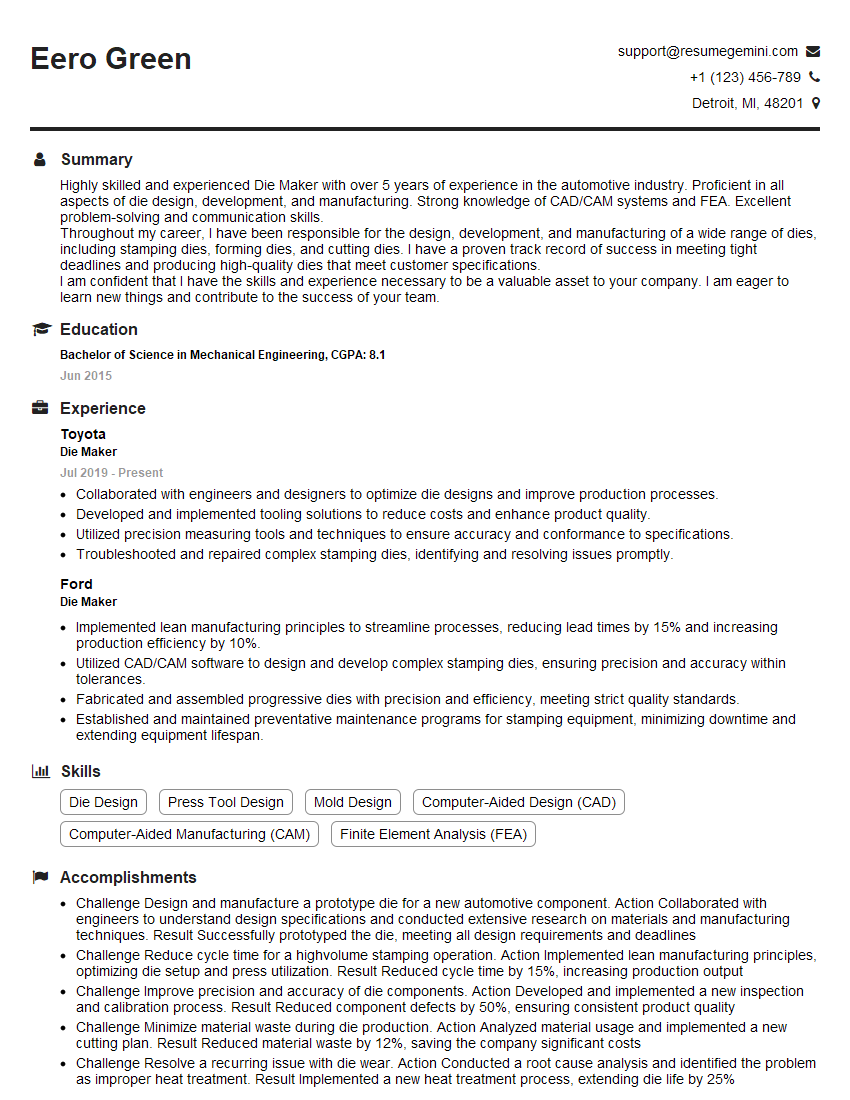
Mastering automated die-cutting systems is essential for career advancement in manufacturing and packaging industries. Proficiency in this area demonstrates valuable technical skills and problem-solving abilities, opening doors to higher-paying roles and greater responsibility. To maximize your job prospects, create an ATS-friendly resume that highlights your expertise effectively. ResumeGemini is a trusted resource to help you build a professional and impactful resume that catches the attention of recruiters. Examples of resumes tailored to experience with automated die-cutting systems are available to guide you.
Explore more articles
Users Rating of Our Blogs
Share Your Experience
We value your feedback! Please rate our content and share your thoughts (optional).
What Readers Say About Our Blog
Very informative content, great job.
good