The right preparation can turn an interview into an opportunity to showcase your expertise. This guide to Experience with Casting Databases interview questions is your ultimate resource, providing key insights and tips to help you ace your responses and stand out as a top candidate.
Questions Asked in Experience with Casting Databases Interview
Q 1. Describe your experience with various casting databases (e.g., Casting Networks, Breakdown Services).
My experience with casting databases spans several years and encompasses platforms like Casting Networks, Breakdown Services, and smaller, agency-specific systems. I’m proficient in navigating their unique interfaces, understanding their respective data structures, and leveraging their features for efficient casting processes. For instance, with Casting Networks, I’ve mastered the art of creating targeted searches using complex Boolean logic to find actors matching specific criteria, saving significant time compared to manual searching. With Breakdown Services, my expertise lies in effectively managing submissions, tracking actor availability, and collaborating with casting directors to streamline the selection process. In smaller, proprietary systems, I’ve adapted quickly to varying data structures and functionalities, often contributing to process improvements through suggesting customized reporting and data management solutions.
I’m not just a user; I understand the underlying principles of these systems, allowing me to troubleshoot effectively and suggest optimizations. For example, I’ve identified inefficiencies in certain workflows within Breakdown Services and proposed solutions that have been implemented to improve team efficiency. This demonstrates my proactive approach to improving casting processes through efficient data management.
Q 2. How do you ensure data accuracy and integrity within a casting database?
Data accuracy and integrity are paramount in a casting database. My approach is multi-faceted and involves several key strategies. First, I establish clear data entry guidelines and provide comprehensive training to all users. This includes consistent formatting for names, contact information, and other crucial fields. Second, I implement data validation rules within the database itself. This can include things like mandatory fields, data type restrictions (e.g., ensuring phone numbers are numeric), and range checks (e.g., ensuring age is within a reasonable range). Third, regular data audits are conducted, both manually and using automated tools, to identify and correct inconsistencies or errors. Think of it like a meticulous proofreading process—only for your casting database. Finally, I utilize data deduplication techniques (discussed further in a later question) to eliminate duplicate entries and maintain a clean, accurate database.
For example, I once implemented a custom script to automatically flag potentially incorrect data points based on inconsistencies in addresses or contact information. This proactive approach drastically reduced the number of errors and improved the overall reliability of the data.
Q 3. Explain your process for importing and exporting data in a casting database.
Importing and exporting data from a casting database requires careful planning and execution to avoid data loss or corruption. My process involves several steps. First, I identify the format of the data I need to import or export (e.g., CSV, XML, JSON). Second, I thoroughly review the data structure of both the source and destination systems to ensure compatibility. Discrepancies need to be handled accordingly— either through data transformation scripts or manual adjustments. This step is crucial to prevent data mapping issues during the transfer. Then, I choose the appropriate import/export method offered by the database system. Many systems allow for direct import/export functionality, while others may require the use of third-party tools or custom scripts. Finally, I always perform rigorous checks after import/export to validate data integrity and address any issues that may have arisen.
For instance, when migrating data from one casting database to another, I’ve utilized custom Python scripts to transform data formats and ensure all fields map correctly. This prevents errors and ensures a seamless transition.
Q 4. What methods do you use to maintain the security and confidentiality of data in a casting database?
Data security and confidentiality are paramount. My methods include adhering to strict access control policies, using strong passwords, and leveraging encryption to protect sensitive actor information. We employ role-based access control (RBAC) to restrict access to data based on the user’s role within the organization. For example, casting assistants might only have read access to certain data, while casting directors have full access. Additionally, I enforce regular password changes and utilize multi-factor authentication (MFA) to enhance security. Data encryption, both in transit and at rest, is essential to prevent unauthorized access even if the database is compromised. Regular security audits and penetration testing help identify vulnerabilities and enhance overall security posture. Finally, I maintain detailed logs of all database activity to track access and modifications for auditing and troubleshooting purposes.
Think of it like a high-security vault – multiple layers of protection to ensure only authorized personnel can access the sensitive information within.
Q 5. How do you troubleshoot common issues encountered while working with a casting database?
Troubleshooting common casting database issues typically involves a systematic approach. I start by identifying the nature of the problem— is it a data entry error, a software glitch, a connectivity issue, or a problem with the database structure? Then, I consult the database documentation and error logs for clues. If the issue stems from data, I might examine the data validation rules to ensure accuracy. If the issue relates to software, I may try restarting the database, updating drivers, or contacting the software vendor for support. Connectivity problems could require network troubleshooting or checking server status. Database structure problems may necessitate schema adjustments or data migration strategies.
For example, I once resolved a slow query by optimizing the database’s indexes. Another time, I identified a recurring data entry error by implementing a custom validation rule that prevented the entry of incorrect data types.
Q 6. Describe your experience with data cleaning and deduplication techniques.
Data cleaning and deduplication are essential for maintaining a high-quality casting database. Data cleaning involves identifying and correcting errors, inconsistencies, and inaccuracies in the data. This might include standardizing data formats, resolving inconsistencies in spelling, correcting incorrect data entries, and handling missing values. Deduplication focuses on identifying and merging or removing duplicate entries. This is crucial to prevent errors in reporting and analysis. My methods involve using both manual review and automated tools. For manual review, I might use SQL queries or spreadsheet functions to identify duplicates and inconsistencies. Automated tools leverage algorithms to find similar records based on various criteria— for example, comparing names, contact information, and other relevant attributes. A crucial component is establishing clear criteria for determining what constitutes a duplicate. This often involves considering phonetic matching and fuzzy logic to account for minor variations in spellings.
I’ve successfully implemented deduplication procedures using SQL queries and specialized software to reduce redundancy in large datasets, improving the overall efficiency of database searches and reporting accuracy.
Q 7. How do you generate reports and analyze data from a casting database?
Generating reports and analyzing data from a casting database is a critical part of my role. I utilize the database’s built-in reporting features, along with tools like SQL and spreadsheet software, to extract meaningful insights. I can create reports on various metrics, such as the number of submissions received, the diversity of the talent pool, the number of actors cast for specific roles, or actor availability trends. This informs decisions about casting strategies, talent acquisition, and overall project management. For deeper analysis, I employ statistical methods and data visualization techniques to uncover patterns and trends in the data. For instance, I might use charts and graphs to visually represent actor demographics or create predictive models to forecast talent availability based on past casting data.
For example, by analyzing submission data, I’ve identified specific search terms that are most effective in attracting the right actors for a particular role, leading to a significant improvement in the efficiency of the casting process.
Q 8. What are your preferred methods for querying and filtering data within a casting database?
My preferred methods for querying and filtering data in a casting database revolve around leveraging the power of SQL (Structured Query Language) and the database system’s built-in search functionalities. For example, I frequently use WHERE clauses to filter results based on specific criteria, such as actor’s height, experience, or availability. I also utilize JOIN statements to combine data from multiple tables – say, combining an actor’s profile with their agent’s contact information. Beyond basic SQL, I’m proficient in using advanced techniques like LIKE for pattern matching (finding actors with names containing ‘John’, for instance) and BETWEEN for range searches (finding actors aged 25-35).
Furthermore, many modern casting databases offer advanced search interfaces with user-friendly features like autocomplete, multiple filter options (e.g., filtering by ethnicity, skills, and union status simultaneously), and the ability to save and reuse frequently used queries. I’m experienced in utilizing these features to improve efficiency and streamline the casting process.
For instance, in a recent project, I used a combination of SQL queries and the database’s advanced search to quickly identify actors matching very specific criteria for a period drama. This significantly sped up the initial selection phase, saving time and resources.
Q 9. How familiar are you with different data structures and their application in casting databases?
My familiarity with data structures is crucial to optimizing casting database performance. Relational databases, at their core, employ relational structures, using tables linked by keys. I’m also experienced with NoSQL databases, which could be beneficial for handling unstructured data like headshots or video auditions. Understanding these structures allows for informed decisions in database design. For example, storing actor photos as separate files linked via a URL is often more efficient than embedding them directly into the relational database.
For structured data like actor profiles (name, age, contact information, etc.), relational databases (using tables and relationships) are ideal for data integrity and efficiency. However, handling less structured data, such as actor resumes or audition tapes (which can have variable formats and sizes), might necessitate utilizing NoSQL databases or object storage solutions integrated with the core database system. The choice depends on the specific needs and characteristics of the casting database.
Q 10. Describe your experience with data normalization and relational database design.
Data normalization and relational database design are fundamental to building a robust and maintainable casting database. I use normalization techniques (like 1NF, 2NF, 3NF) to minimize data redundancy and improve data integrity. This involves breaking down larger tables into smaller, more focused ones, linked through relationships.
For example, instead of storing an actor’s address within their main profile table, I’d create a separate ‘Addresses’ table with a unique ID for each address. This ensures that if an actor moves, we only need to update one record in the ‘Addresses’ table, maintaining consistency across all the actor’s projects.
In designing relational databases, I carefully consider the relationships between tables (one-to-one, one-to-many, many-to-many) and enforce referential integrity to prevent orphaned records. Well-designed relational databases improve data accuracy, consistency, and the overall performance of queries.
Q 11. How do you ensure the efficiency and scalability of a casting database?
Ensuring efficiency and scalability of a casting database requires a multifaceted approach. First, proper database design (as discussed earlier) is critical. Choosing the right database system (relational or NoSQL, depending on needs) is crucial. For large-scale projects, cloud-based database solutions often offer better scalability and automatic scaling features.
Indexing is another key aspect for performance optimization. Appropriate indexing of frequently queried fields (like actor name, age, location) significantly speeds up searches. Database tuning, which includes optimization of query execution plans and memory allocation, is essential. Regular monitoring of database performance metrics (query times, resource usage) helps to proactively identify and address potential bottlenecks.
Furthermore, using caching mechanisms, storing frequently accessed data in memory for faster retrieval, is often beneficial. Finally, employing load balancing techniques across multiple database servers can significantly improve the scalability to handle growing amounts of data and user requests.
Q 12. Explain your understanding of database backup and recovery procedures.
Database backup and recovery are paramount for data protection and business continuity. I employ a robust backup strategy that includes regular full backups (e.g., weekly) and incremental backups (e.g., daily), capturing only the changes since the last backup. This balance ensures data protection while minimizing storage space and backup time.
The backups are stored in a secure, offsite location (cloud storage or geographically separate servers) to protect against data loss from physical disasters or security breaches. I regularly test the recovery process to ensure that backups can be restored successfully and that the recovery time objective (RTO) and recovery point objective (RPO) are met. This involves simulating a database failure and restoring it from backup to verify the integrity and efficiency of the recovery procedure.
Detailed documentation of the backup and recovery procedure is essential. The documentation should include details about backup schedules, storage locations, recovery steps, and contact information for support. I always follow industry best practices for data security and compliance regulations throughout the backup and recovery process.
Q 13. Have you worked with APIs or integrations related to casting databases?
Yes, I have extensive experience working with APIs and integrations related to casting databases. I’ve integrated casting databases with various applications, including talent agency management systems, project management software, and client-facing portals. These integrations streamline workflows, allowing for seamless data exchange between different systems.
For example, I’ve developed APIs that allow talent agents to access and update their clients’ profiles within the casting database. I’ve also built integrations that automatically synchronize casting calls from a project management system into the database. This automation helps to eliminate manual data entry and minimizes the risk of errors. My experience encompasses RESTful APIs and other integration methods, utilizing technologies like JSON and XML for data exchange.
In one project, I created a custom API that connected a casting database to a client’s website, allowing casting directors to search for talent directly from the website. This dramatically improved the efficiency of their casting processes.
Q 14. Describe your experience with data visualization tools used with casting data.
Data visualization is crucial for deriving meaningful insights from casting data. I’m proficient in using various tools, such as Tableau and Power BI, to create dashboards and reports that provide a clear and concise overview of casting trends and performance metrics.
For example, I can create visualizations that show the distribution of actors by age, gender, ethnicity, or other relevant demographics. I can also create visualizations that track the number of auditions held, the number of actors cast, and the overall efficiency of the casting process. These visualizations help identify areas for improvement and make data-driven decisions to optimize casting workflows.
In a recent project, I used Tableau to create a dashboard that tracked the success rate of casting calls over time. This dashboard revealed a seasonal trend in casting success, allowing us to proactively plan our casting strategies and allocate resources more effectively. These insights improved our overall efficiency and helped us to consistently meet our deadlines.
Q 15. How do you handle data conflicts or inconsistencies in a casting database?
Data conflicts and inconsistencies are inevitable in any large database, especially one as dynamic as a casting database. Think of it like a bustling film set – lots of people making changes simultaneously. My approach involves a multi-pronged strategy focusing on prevention and resolution.
Proactive Data Validation: I implement strict data validation rules at the point of entry. This could involve custom scripts or database triggers that check for data type mismatches, impossible values (e.g., a negative age), and inconsistencies between related fields. For example, if a ‘casting call’ record specifies a required ‘actor age range’, I’d ensure that any linked ‘actor profile’ records attempting to apply match this range.
Data Auditing and Reconciliation: Regular data audits help pinpoint anomalies. I use SQL queries to identify potential inconsistencies, such as duplicate records or conflicting information (e.g., an actor listed with two different addresses). Reconciliation involves carefully reviewing these discrepancies and using my knowledge of the business context to correct or resolve conflicts.
Version Control and Change Tracking: Implementing a robust version control system allows for tracking modifications and reverting to earlier versions if necessary. This could involve using database features such as timestamps or utilizing a separate versioning database. Imagine having a ‘roll-back’ mechanism, just like in a film production when you discover a mistake in a scene.
Conflict Resolution Procedures: Establishing clear guidelines on how to handle conflicts is crucial. This might include prioritizing data from a trusted source or applying a predefined conflict resolution rule (e.g., the most recent entry takes precedence). Clearly documenting these procedures is vital for consistency.
Career Expert Tips:
- Ace those interviews! Prepare effectively by reviewing the Top 50 Most Common Interview Questions on ResumeGemini.
- Navigate your job search with confidence! Explore a wide range of Career Tips on ResumeGemini. Learn about common challenges and recommendations to overcome them.
- Craft the perfect resume! Master the Art of Resume Writing with ResumeGemini’s guide. Showcase your unique qualifications and achievements effectively.
- Don’t miss out on holiday savings! Build your dream resume with ResumeGemini’s ATS optimized templates.
Q 16. What is your experience with database performance tuning?
Database performance tuning is essential for maintaining a responsive casting database, especially when dealing with high volumes of data and concurrent users. My experience includes a range of optimization techniques.
Query Optimization: I use query analyzers to identify performance bottlenecks in SQL queries. Techniques like indexing, using appropriate joins (e.g., inner vs. outer joins), and optimizing subqueries can significantly improve query execution times. For example, using an index on frequently queried columns like ‘actor name’ or ‘role’ can dramatically speed up search functionality.
Database Design: Proper database design is crucial for performance. Normalization minimizes data redundancy, which reduces storage space and improves query performance. Choosing appropriate data types for each field also has a significant impact. For example, using an appropriate data type for storing large text fields avoids unnecessary space overhead.
Hardware Optimization: In many cases, performance issues can be addressed through hardware upgrades. This might involve increasing RAM, using faster SSD storage, or even distributing the database across multiple servers. This is like having a more powerful film editing computer to process footage faster.
Caching: Employing caching mechanisms can reduce database load. Caching frequently accessed data in memory can drastically improve response times. I’ve used various caching strategies, from simple in-memory caching to more complex distributed cache solutions.
Q 17. How would you approach the task of migrating data from one casting database to another?
Migrating data between casting databases is a complex process that requires careful planning and execution. It’s like moving a film studio – each element needs to be handled with precision.
Assessment: I begin by thoroughly assessing both the source and target databases, understanding their schemas, data types, and constraints. This includes identifying any potential data transformation needs.
Data Extraction, Transformation, and Loading (ETL): I utilize ETL tools to extract data from the source, transform it to match the target database schema, and load it into the destination. I might write custom scripts or utilize pre-built ETL packages depending on complexity.
Data Validation and Quality Checks: After the migration, rigorous data validation checks are performed to ensure data integrity. This includes comparing record counts, verifying checksums, and performing spot checks to confirm data accuracy.
Incremental Updates: To avoid lengthy downtime for future updates, I typically implement an incremental update strategy. Data is synced only for changed or new records after the initial migration, minimizing the impact on ongoing production.
Testing and Rollback Plan: A comprehensive testing plan should simulate real-world usage scenarios to ensure that the migrated data is functional. Having a rollback plan in place is crucial for handling unexpected errors.
Q 18. Describe your experience with different database platforms (e.g., SQL, NoSQL).
My experience spans various database platforms, each with its own strengths and weaknesses. Choosing the right platform depends on the specific needs of the casting database.
SQL Databases (e.g., PostgreSQL, MySQL, SQL Server): I’m proficient in relational database management systems (RDBMS). SQL offers excellent data integrity and scalability for structured data. These are great for storing and managing actor profiles, casting calls, and project information with clearly defined relationships.
NoSQL Databases (e.g., MongoDB, Cassandra): I have experience with NoSQL databases, particularly useful for handling semi-structured or unstructured data. This could be useful for storing less structured information, such as free-form notes about actors or behind-the-scenes details on productions.
Cloud-Based Databases (e.g., AWS RDS, Azure SQL Database, Google Cloud SQL): I’m also comfortable working with cloud-based databases, leveraging their scalability and elasticity to adapt to varying data loads.
My choice of platform always depends on the trade-offs between data structure, scalability requirements, and budget constraints.
Q 19. How do you prioritize tasks and manage your workload when working with a casting database?
Prioritizing tasks and managing workload effectively is critical in a fast-paced environment. I use a combination of methods.
Project Management Tools: I utilize project management tools (e.g., Jira, Trello) to track tasks, assign priorities, and monitor progress. This helps visualize the workflow and ensure that critical tasks are addressed promptly.
Prioritization Matrices: I apply prioritization matrices (e.g., Eisenhower Matrix) to categorize tasks based on urgency and importance. This helps focus on the most crucial tasks first.
Time Blocking: I allocate specific time blocks for different tasks to maintain focus and avoid context switching. This is like scheduling specific times for different aspects of film production.
Communication and Collaboration: Open communication with stakeholders is crucial for managing expectations and ensuring alignment on priorities. Regular progress updates and feedback sessions keep everyone informed.
Q 20. Explain your experience with creating and maintaining custom reports.
Creating and maintaining custom reports is a significant part of my role. I’ve built reports using various tools and techniques.
SQL Reporting: I write SQL queries to extract specific data subsets for reporting. This is a powerful method for generating customized reports tailored to specific needs.
Reporting Tools: I’ve used reporting tools (e.g., Tableau, Power BI) to create interactive and visually appealing dashboards and reports, which make it easier to understand trends and key performance indicators.
Data Visualization: I focus on clear and concise data visualization, using charts, graphs, and tables to represent information effectively. The goal is to make the data easily interpretable for all stakeholders.
Report Maintenance: I ensure that reports are regularly updated and maintained to reflect changes in the database schema or reporting requirements. This includes documenting the reports for easy understanding and future modification.
Q 21. Describe your experience with data validation and error handling.
Data validation and error handling are paramount for ensuring data integrity. My approach is proactive and comprehensive.
Input Validation: I implement data validation at the point of data entry, using constraints and checks to prevent invalid data from entering the database. This could involve using database constraints (e.g., NOT NULL, CHECK), or writing custom validation scripts.
Data Cleansing: Regular data cleansing processes help identify and correct existing errors in the database. This might involve identifying and correcting inconsistencies, deleting duplicates, or standardizing data formats.
Error Handling and Logging: I implement robust error handling mechanisms to gracefully handle unexpected situations, such as database connection errors or data integrity violations. Comprehensive logging is used to track errors and troubleshoot problems.
Automated Testing: Automated testing plays a crucial role in verifying the correctness of data validation and error handling procedures. Unit tests and integration tests help to identify potential issues early on.
Q 22. How do you stay up-to-date with advancements in casting database technologies?
Staying current in the dynamic field of casting database technologies requires a multi-pronged approach. I actively participate in industry conferences like those hosted by organizations focused on talent management and technology. These events offer invaluable insights into the latest trends and innovations. I also subscribe to relevant industry publications and online resources, such as specialized blogs and newsletters, which provide regular updates on new software releases and best practices. Furthermore, I engage with online professional communities and forums, participating in discussions and sharing knowledge with other experts. This peer-to-peer learning is crucial for staying abreast of emerging challenges and solutions. Finally, I dedicate time to exploring and experimenting with new technologies myself, often through free trials or pilot projects, to gain firsthand experience with the latest tools and techniques.
Q 23. Describe a time you had to solve a complex data problem within a casting database.
In a previous role, we faced a significant data integrity issue. Our casting database, which relied on manual data entry, had developed inconsistencies in actor profiles. This resulted in inaccurate search results and difficulties in matching actors to roles. The problem stemmed from duplicate entries, inconsistent data formatting (e.g., different variations in address formats), and missing data points. To solve this, I first implemented a data cleansing process. This involved developing a series of SQL scripts to identify and consolidate duplicate records, standardize data formats, and flag missing information. For example, one script used fuzzy matching algorithms to identify actors with slightly different names or addresses, consolidating these profiles. Secondly, I implemented data validation rules in the input forms to prevent future inconsistencies. This prevented the same errors from occurring in the future. This included mandatory fields and dropdown menus for standardized data points. The successful resolution drastically improved search accuracy and the overall efficiency of the casting process.
Q 24. What are the key performance indicators (KPIs) you track in relation to a casting database?
The key performance indicators (KPIs) I track for a casting database are multifaceted and directly tied to efficiency and effectiveness. These include:
- Search Accuracy: The percentage of successful searches that yield relevant results. Low accuracy indicates data quality problems or inefficiencies in the search functionality.
- Data Entry Speed: The average time taken to enter a new actor profile or casting call. This reflects the ease of use and efficiency of the database interface.
- Database Uptime: The percentage of time the database is available and accessible to users. Downtime leads to disruption and loss of productivity.
- Number of Duplicate Records: The count of duplicate entries, indicating the need for data cleansing and improved data validation.
- Matching Rate: The percentage of casting calls that successfully match with suitable actors. This metric highlights the database’s effectiveness in connecting talent with opportunities.
- User Satisfaction: Gathered through surveys or feedback mechanisms, this measures the overall ease of use and helpfulness of the database for all users.
Tracking these KPIs allows for ongoing monitoring of the database’s performance and identification of areas for improvement.
Q 25. How would you approach improving the overall usability of a casting database?
Improving the usability of a casting database requires a user-centric approach. I would start by conducting user interviews and surveys to understand the pain points experienced by different user groups (casting directors, actors, agents). Based on this feedback, I would prioritize improvements based on their frequency and severity. For example, if many users struggle to find specific actors based on certain criteria, I would focus on improving search functionality and filtering options. This might involve redesigning the search interface, adding more robust filtering capabilities (such as adding advanced search operators), and providing clear and concise search result displays. Another common area for improvement is simplifying data entry processes. This could involve reducing the number of required fields, implementing auto-complete features, or using drag-and-drop functionalities. Finally, I would incorporate user feedback into regular design iterations. The key is to continually refine and optimize the interface based on real-world usage patterns.
Q 26. What are your experience with different access control and permission settings in a casting database?
I have extensive experience with various access control and permission settings in casting databases. These typically involve role-based access control (RBAC), where different user roles (e.g., administrator, casting director, actor) are granted different permissions. Administrators might have full access, while casting directors might only be able to access casting calls and actor profiles relevant to their projects. Actors may only be able to view and update their own profiles. Implementing granular permissions is vital for data security and maintaining confidentiality. This often involves utilizing features built into the database system (e.g., SQL Server’s built-in security features) or integrating with a dedicated access control system. I’ve worked with systems that used password management protocols, multi-factor authentication, and audit trails to track user activity and ensure accountability. Furthermore, I have experience configuring different levels of data visibility to ensure that only authorized personnel have access to sensitive information. For instance, financial details or contact information may have separate access restrictions.
Q 27. Describe your experience with data archival and retention policies.
Data archival and retention policies are crucial for compliance and efficient database management. My experience involves developing and implementing policies that adhere to legal requirements and industry best practices. This begins with clearly defining the retention period for different types of data. For example, actor profiles might be retained indefinitely, while casting call data may only need to be kept for a few years. The next step involves defining procedures for archiving the data. This might involve exporting data to an archive database or transferring it to a secure cloud storage solution. I typically use a combination of techniques that optimize both data availability and minimize storage costs. We’ll compress the data before archiving to reduce the storage space. For example, converting images into smaller formats or removing unnecessary data fields. Regular backups are also crucial, stored in a separate location to prevent data loss in case of system failure. Furthermore, I implement measures to ensure data integrity during the archiving process, using checksums or other validation techniques to verify data accuracy. Access control extends to archived data, ensuring only authorized personnel can access it, even after data is moved to an archive.
Q 28. How would you train a new team member on the use of the casting database?
Training a new team member on a casting database involves a structured approach combining hands-on training with ongoing support. I’d begin with an overview of the database’s purpose and key functionalities. This will be followed by a guided tour of the user interface, explaining each section and its purpose. Next, I’d provide practical, hands-on training using specific scenarios. This would include adding a new actor profile, searching for actors based on various criteria, and creating a new casting call. This practical exercise reinforces what they learn in the initial training phase. I’d provide step-by-step instructions with screen captures or video demonstrations for reference. Following this, I’d schedule regular check-ins to answer questions, offer additional support, and address any challenges they encounter. I also find creating a comprehensive knowledge base or user manual beneficial, providing a central resource for ongoing learning. This self-help tool allows them to find information on specific functions and troubleshoot issues independently. I believe this comprehensive approach fosters both immediate understanding and continued skill development.
Key Topics to Learn for Experience with Casting Databases Interview
- Understanding Casting Database Structures: Familiarize yourself with common database structures used in casting (relational, NoSQL, etc.), including data organization and relationships between different entities (actors, projects, agents).
- Data Entry and Management: Practice efficient and accurate data entry techniques, including handling different data types and ensuring data integrity. Understand data validation and cleaning processes.
- Search and Filtering Techniques: Master advanced search and filtering capabilities within casting databases. This includes understanding Boolean logic, wildcard searches, and utilizing various filter options to efficiently locate specific talent.
- Reporting and Analytics: Learn how to generate reports from casting database information, understanding key metrics relevant to casting projects and talent management. Explore the use of data visualization for effective communication.
- Software Proficiency: Develop practical skills in using popular casting database software, understanding their unique features and functionalities. Be prepared to discuss your experience with specific platforms.
- Data Security and Privacy: Understand the importance of data security and privacy within the context of a casting database. Familiarize yourself with relevant regulations and best practices.
- Problem-Solving and Troubleshooting: Be ready to discuss how you’ve handled data errors, inconsistencies, or technical issues within a casting database environment. Showcase your problem-solving skills.
Next Steps
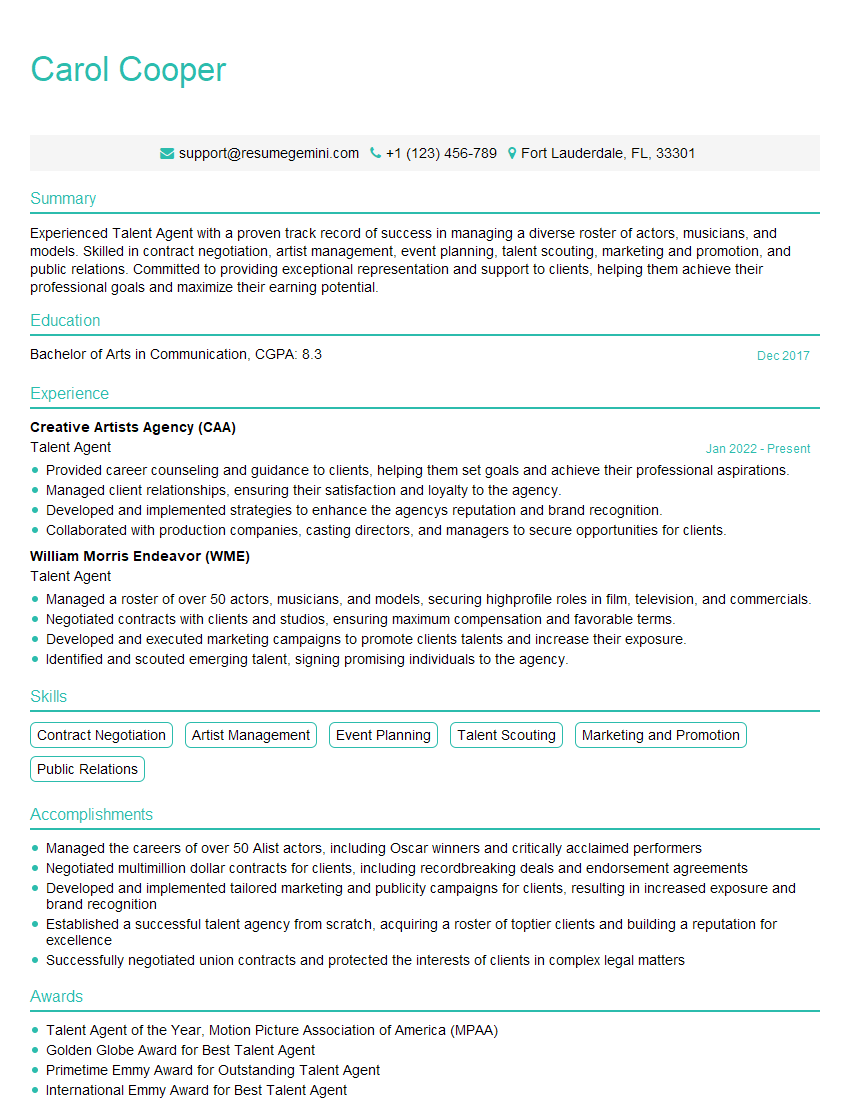
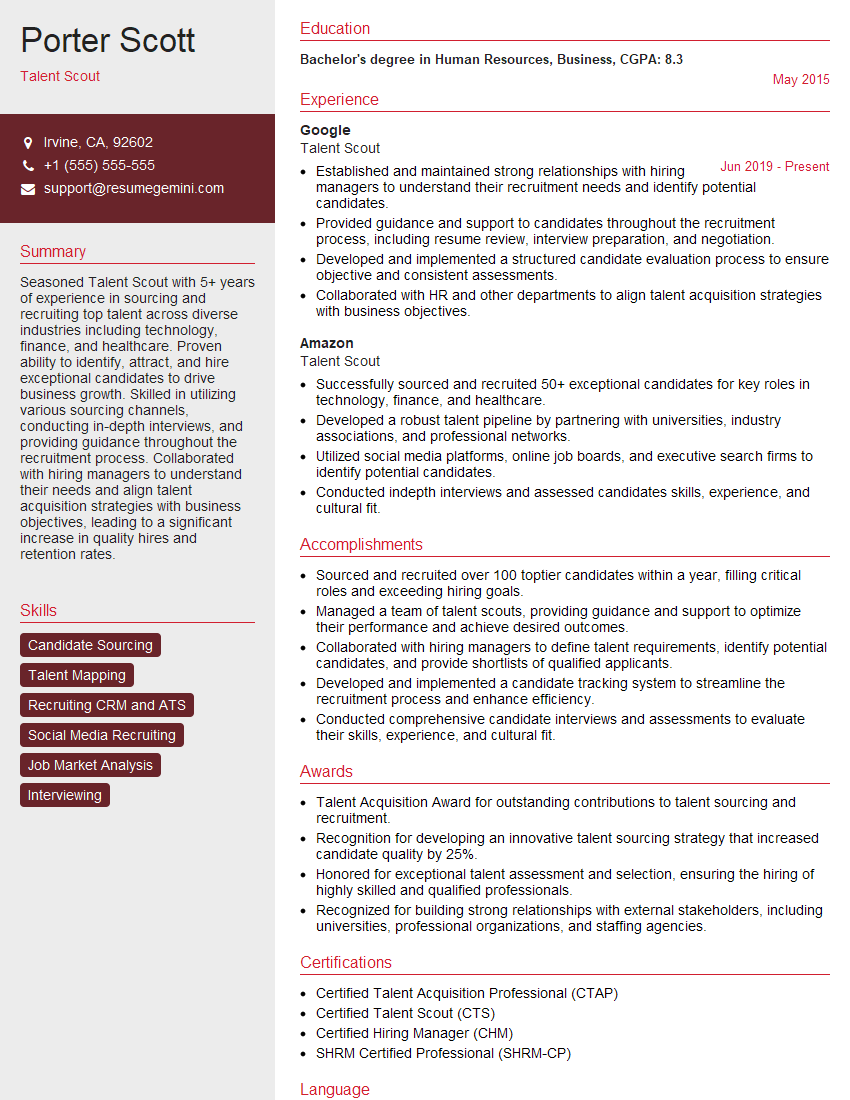
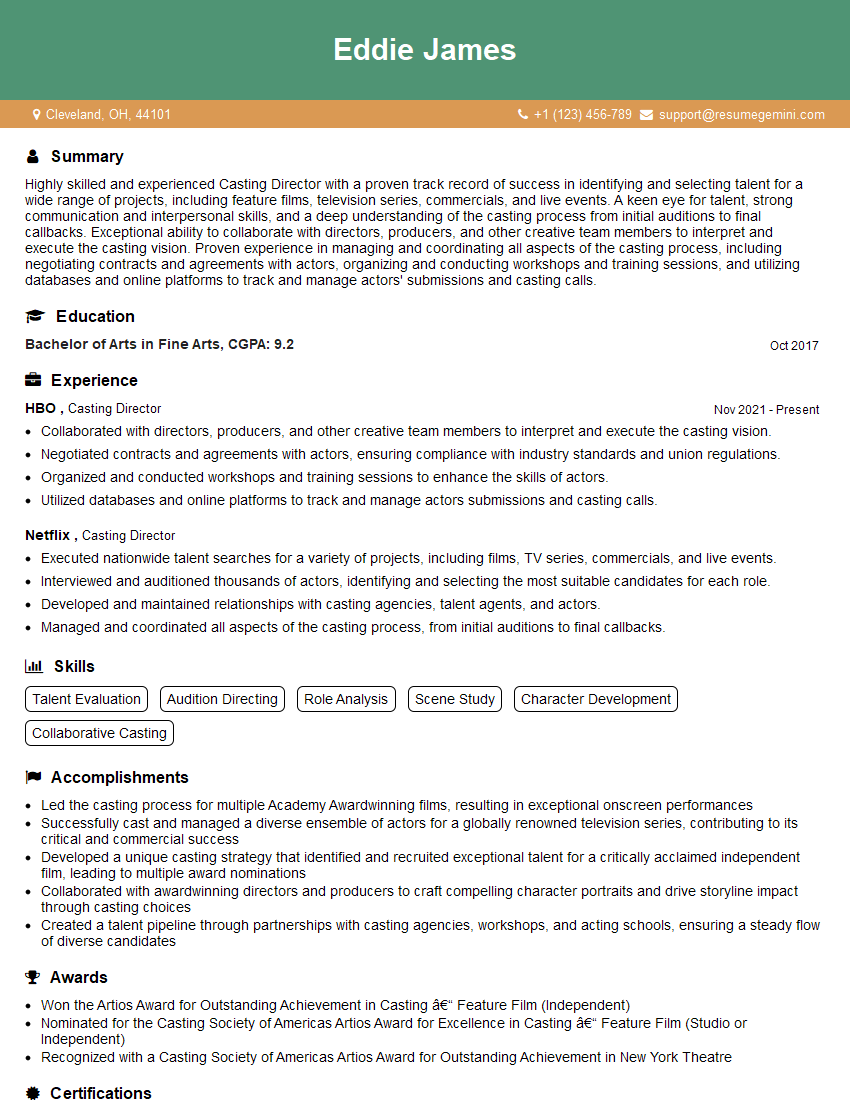
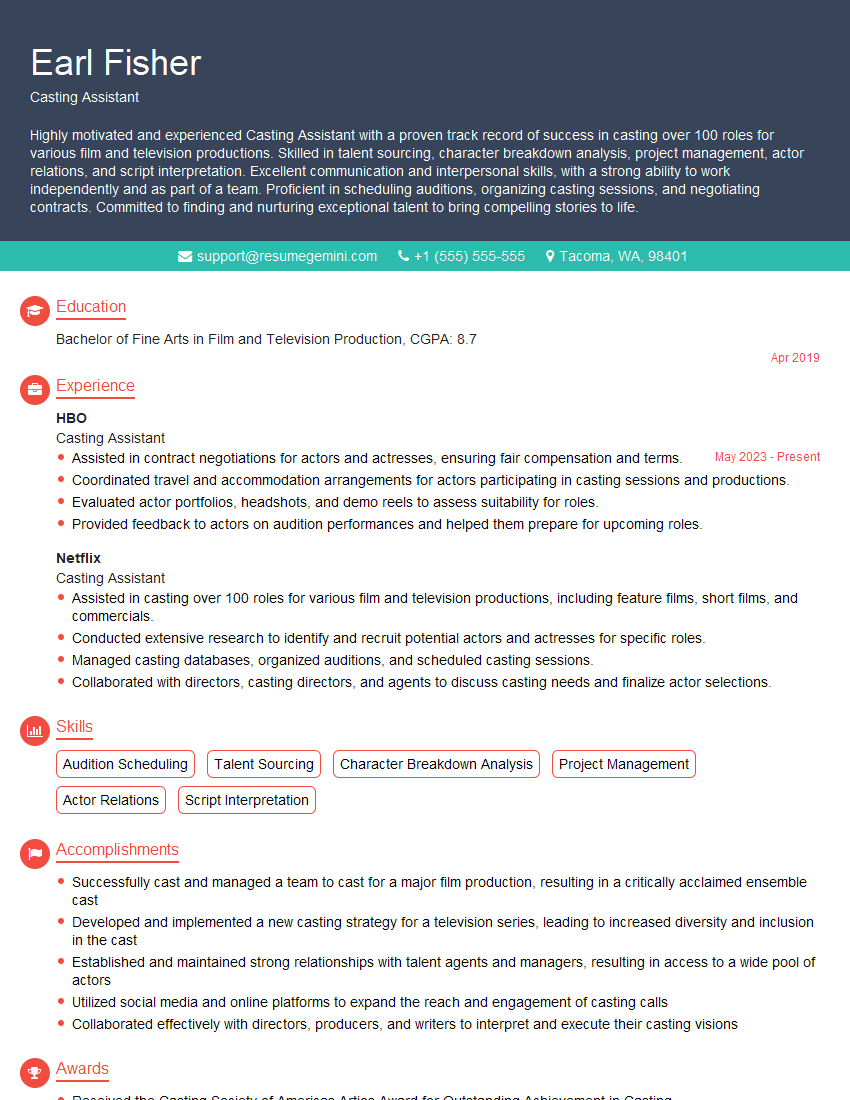
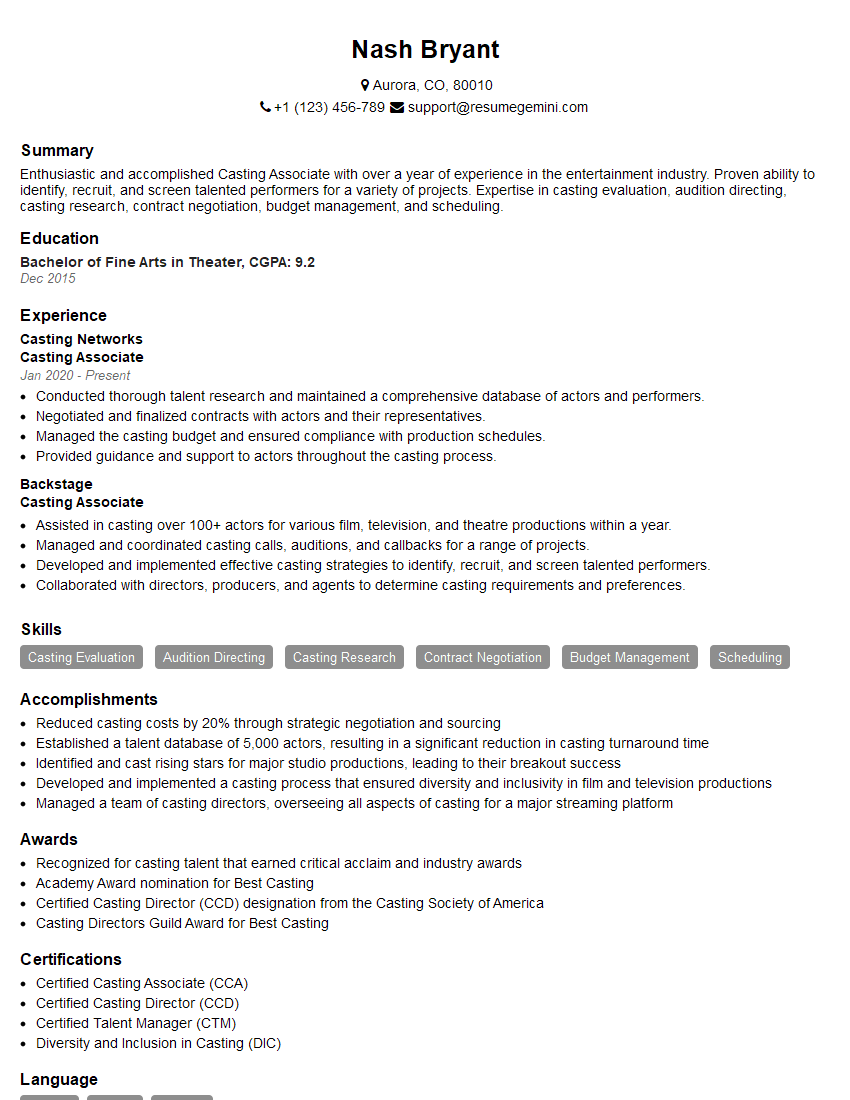
Mastering experience with casting databases significantly enhances your value to any production company or talent agency. Proficiency in this area demonstrates crucial organizational, technical, and analytical skills. To maximize your job prospects, building an ATS-friendly resume is vital. ResumeGemini can help you craft a compelling and effective resume that highlights your skills and experience in casting databases. Examples of resumes tailored to Experience with Casting Databases are available to further guide your preparation.
Explore more articles
Users Rating of Our Blogs
Share Your Experience
We value your feedback! Please rate our content and share your thoughts (optional).
What Readers Say About Our Blog
Very informative content, great job.
good