Feeling uncertain about what to expect in your upcoming interview? We’ve got you covered! This blog highlights the most important Mechanical Engraving interview questions and provides actionable advice to help you stand out as the ideal candidate. Let’s pave the way for your success.
Questions Asked in Mechanical Engraving Interview
Q 1. What types of materials are commonly engraved using mechanical methods?
Mechanical engraving works on a wide variety of materials, each presenting unique challenges and requiring specific tool and technique adjustments. Common materials include metals like aluminum, brass, steel, and even precious metals like gold and silver. These materials respond differently to cutting forces and require different bit selections and speeds. Plastics, such as acrylic and polycarbonate, are also frequently engraved, offering a broader range of color and finish options. Wood, particularly hardwoods, is another popular choice, demanding careful consideration of grain direction to avoid chipping or tearing. Finally, some harder stones, like granite and marble, can be engraved, though this often necessitates specialized diamond-tipped tools and a slower, more deliberate approach.
- Metals: Aluminum (easy to engrave), Brass (produces a pleasing contrast), Steel (requires more powerful tools and slower speeds).
- Plastics: Acrylic (versatile and visually appealing), Polycarbonate (durable and impact-resistant).
- Wood: Hardwoods like oak and walnut (require sharper bits and careful grain consideration).
- Stone: Granite and Marble (demand specialized diamond tooling).
Q 2. Explain the difference between rotary and pantograph engraving.
Rotary and pantograph engraving are two distinct mechanical engraving methods, differing primarily in their approach to translating a design onto the material. Rotary engraving uses a spinning bit controlled by computer numerical control (CNC) or manually guided along a template. Think of it like a tiny, very precise drill. The design is essentially traced by the rotating bit. Pantograph engraving, conversely, employs a mechanical linkage system—a pantograph—to scale and transfer a design from a master template to the workpiece. The master template, usually larger than the final engraving, is traced manually, and the mechanical linkage system accurately reproduces the design at a smaller scale onto the material. Rotary engraving offers greater precision and repeatability for complex designs, while pantograph engraving provides a more hands-on, artistic approach and can be adapted for larger or more irregularly shaped workpieces.
Imagine trying to carve a detailed design into a small metal plate. Rotary engraving would be like using a CNC machine with a tiny drill bit programmed to follow the design precisely. Pantograph engraving, however, would be more like using a drafting tool to enlarge a smaller sketch and then using that enlargement to create a carving.
Q 3. Describe your experience with various engraving tools and their applications.
My experience spans a variety of engraving tools, each suited to specific materials and applications. I’m proficient with both single-flute and multi-flute bits for various materials. Single-flute bits are ideal for intricate details and fine lines, creating clean cuts in softer materials. Multi-flute bits, particularly in V-shaped profiles, excel at creating deeper engravings and sharper lines in harder materials and plastics. For metals, I’ve used carbide-tipped bits for durability and precision and diamond-tipped bits for extremely hard materials like certain stones. I’ve also worked with gravers for hand engraving, requiring a high degree of skill and control. The choice of tool always depends on the material, design complexity, desired depth, and the final finish. For example, a delicate floral design on a silver pendant would require a single-flute carbide bit or hand graver, whereas a deep lettering on a brass plaque might employ a multi-flute carbide bit on a rotary engraver.
Q 4. How do you select the appropriate cutting depth and feed rate for a given material and design?
Selecting the appropriate cutting depth and feed rate is critical for achieving high-quality engravings without damaging the material or the tool. This involves careful consideration of several factors. The material’s hardness plays a crucial role—harder materials require shallower cuts and slower feed rates to prevent tool breakage or material tearing. The design’s complexity also influences these parameters; intricate details require shallower cuts and slower speeds to avoid damaging fine lines. The bit’s type and size further impact the settings; smaller bits generally require shallower cuts and slower feed rates. Finally, the desired depth of engraving influences the settings; deeper engravings will naturally require a slower feed rate.
For example, engraving a deep inscription into steel necessitates a significantly slower feed rate and shallower cuts compared to engraving a shallow design into soft wood. Experimentation and calibrated testing are essential to fine-tune these parameters for optimal results. Improper settings might result in damaged tools, rough edges, or an incomplete engraving.
Q 5. What safety precautions do you follow when operating engraving machinery?
Safety is paramount in mechanical engraving. I always wear appropriate personal protective equipment (PPE), including safety glasses to shield my eyes from flying debris, hearing protection to mitigate the noise produced by the machinery, and a dust mask to prevent inhalation of fine particles generated during the engraving process. I ensure the machine is properly grounded to prevent electrical shocks and that all safety guards are in place before operation. I always secure the workpiece firmly to prevent it from moving unexpectedly during the engraving process. I inspect the tooling before each use to detect any signs of damage that might lead to breakage or injury. I also regularly maintain the equipment to ensure its safe operation.
Additionally, I’m very mindful of the moving parts of the machine and maintain a safe distance during operation. I never operate machinery while fatigued or under the influence of any substance that might impair my judgment. Always treating the equipment with respect is critical for maintaining a safe working environment.
Q 6. How do you ensure the accuracy and precision of your engravings?
Accuracy and precision are ensured through several key practices. First, I carefully prepare the workpiece, ensuring it is clean, securely fastened, and properly aligned. I use precise design software to create detailed, vector-based designs. These designs are then sent to the CNC machine with accurate parameters. Regular calibration and maintenance of the engraving machine are essential to guarantee accuracy. I carefully check the tool’s sharpness and alignment before starting the process. Regular checks during the engraving process allow for immediate corrections if any deviations occur. Post-engraving, I always inspect the work for any flaws or inaccuracies and take necessary corrective actions.
Think of it like building a complex structure. Careful planning and the use of precise tools are essential for ensuring that the final product is accurate and precisely reflects the initial design. Regular quality checks during each step are crucial for timely identification and correction of errors.
Q 7. Explain your experience with different types of engraving bits/tools.
My experience encompasses a wide range of engraving bits/tools, each with its unique properties and applications. I’ve worked with various bit materials such as high-speed steel (HSS), carbide, and diamond, each possessing different hardness and durability characteristics. The choice of material is directly related to the material being engraved. I’ve used different bit profiles, including V-shaped, U-shaped, and ball-nose bits, each producing a distinct engraving style. V-shaped bits create sharp, crisp lines, U-shaped bits produce wider, more rounded engravings, and ball-nose bits are ideal for creating smooth curves and three-dimensional effects. In addition to the standard bits, I’ve also used specialized tools like drag knives for cutting and engraving various materials and gravers for hand engraving delicate designs.
The selection of the bit is akin to selecting the right brush for a painting. Each bit has unique properties that impact the final result, and the choice is determined by the desired style and effect.
Q 8. Describe your experience with CAD/CAM software for engraving design and programming.
My experience with CAD/CAM software in mechanical engraving is extensive. I’m proficient in several industry-standard packages, including Mastercam, VCarve Pro, and Aspire. These programs are crucial for transforming a design concept into a set of instructions for the CNC machine. My workflow typically involves importing a design (either created in a vector graphics editor like Adobe Illustrator or sketched directly in the CAD software), then using the CAM functions to generate toolpaths. This involves selecting the appropriate cutting tools, defining cut depths, and optimizing feed rates to ensure both speed and precision. For example, when engraving a detailed portrait, I might use a series of progressively smaller tools to achieve fine detail, starting with a roughing pass to remove bulk material and finishing with a fine finishing pass for a smooth, polished result. I’m also adept at using simulations within the software to preview the toolpaths and identify any potential collisions or problems before sending the code to the machine, a critical step in preventing costly mistakes.
Q 9. How do you troubleshoot common problems encountered during the engraving process?
Troubleshooting in mechanical engraving often involves a systematic approach. A common problem is broken tools, which usually manifests as inconsistent cutting depth or unexpected chatter. My first step is always to visually inspect the tool and the workpiece. A chipped or dull tool needs immediate replacement. Another frequent issue is inconsistent material hardness. For example, variations in density within a piece of wood can lead to uneven engraving. In such cases, adjusting the feed rate or using a more robust tool might be necessary. Machine-related issues, such as loose connections or belt slippage, can also affect the engraving quality. I address these by regularly checking the machine’s mechanical components and electrical connections. Sometimes, it’s a software problem – a misconfigured toolpath or incorrect machine settings. In these cases, I carefully review the CAM program and the machine parameters. Finally, if the problem persists, I might consult the machine’s documentation or contact the manufacturer’s technical support. It’s a blend of mechanical understanding, software expertise, and careful observation.
Q 10. Explain your experience with CNC engraving machine maintenance and calibration.
CNC engraving machine maintenance and calibration are essential for consistent, high-quality results. My routine maintenance includes regular cleaning of the machine, including removing dust and chips from the working area and lubrication of moving parts. I also check and tighten all bolts and fasteners to prevent vibrations and ensure machine rigidity. Calibration is equally important. This involves accurately setting the machine’s zero point (the reference point for all movements), which is crucial for accurate engraving. I accomplish this using a variety of methods, including probe-based systems or manual alignment using precision gauges. Regular spindle calibration is also important to ensure consistent cutting speed and depth. I monitor the spindle’s speed and torque to identify potential issues, adjusting as needed. Finally, regular software updates and periodic checks for machine error codes are part of my ongoing preventative maintenance strategy. Prevention is always more efficient than a major repair.
Q 11. How do you handle complex or intricate engraving designs?
Handling complex or intricate engraving designs requires a strategic approach that combines careful planning with advanced CAM techniques. For very fine details, I’ll use smaller engraving bits and multiple passes, sometimes employing techniques like vector engraving for clean lines and raster engraving for filled areas. To avoid tool breakage, I always analyze the toolpaths carefully in the simulation, looking for potential areas of stress or collisions. Complex 3D engravings might require multiple setups and the use of specialized tooling. I’ll often break down complex designs into smaller, manageable sections, creating separate toolpaths for each section and then carefully assembling them. Accurate vectorization of the artwork is critical. A poorly vectorized design will result in poor engraving. This requires significant experience in vector editing and often involves considerable manual cleanup. Essentially, it is a process of thoughtful problem-solving combined with a deep knowledge of both design and machine capabilities.
Q 12. What are the limitations of mechanical engraving compared to other engraving methods?
While mechanical engraving offers unique advantages like precision and depth control, it has limitations compared to other methods like laser or chemical engraving. Mechanical engraving is slower and can be more labor-intensive, especially for large-scale projects. It’s also limited by the availability of suitable tooling. Very fine details might be difficult to achieve, and certain materials might be too hard or brittle to engrave mechanically. Laser engraving, for example, can achieve much finer detail and can engrave a wider range of materials. Chemical etching offers a different type of aesthetic and can create depth with relative ease. The choice of method depends on the specific project requirements and the desired result. Ultimately, mechanical engraving excels in situations where high precision, depth control, and tactile feedback are critical.
Q 13. Describe your experience working with different engraving machine controllers.
I have worked with a variety of engraving machine controllers, including those based on Mach3, LinuxCNC, and proprietary systems. My experience spans different control interfaces, from simple hand-wheels and jog controls to sophisticated touchscreen interfaces with advanced features. Understanding the specific nuances of each controller is essential. For example, Mach3’s configuration options allow for very fine-tuned control, but require a deeper understanding of its settings. LinuxCNC, on the other hand, offers a more open and customizable platform but requires a different set of programming skills. Regardless of the controller, a strong understanding of G-code programming is crucial. The ability to interpret, modify, and troubleshoot G-code is fundamental to efficient and effective engraving. Each controller presents unique challenges and opportunities, but my adaptable skill set allows me to work effectively with any system.
Q 14. How do you ensure the quality and consistency of your engravings across multiple parts?
Ensuring consistent quality across multiple parts requires meticulous attention to detail at every stage of the process. First, a crucial step is precise machine calibration. This ensures consistent depth and accuracy of cuts across multiple runs. Second, the use of standardized procedures and settings for each engraving minimizes variation. This involves careful selection and maintenance of engraving tools, ensuring that they are sharp, properly sized, and consistently used. Third, maintaining a constant material supply is crucial, as variations in material properties can lead to inconsistencies. For example, variations in wood grain or density can alter engraving depth. Finally, regular machine maintenance, as previously described, is critical in preventing drifts in accuracy over time. Consistent monitoring of the cutting process and regular quality checks using a measuring tool help to catch minor issues early. By implementing these measures, I maintain high quality and consistency across the production of multiple parts.
Q 15. Explain your experience with different types of engraving fixtures and clamping methods.
Choosing the right engraving fixture is crucial for accuracy and efficiency. My experience spans various fixture types, tailored to the workpiece and engraving process. For small, delicate parts, I utilize soft-jaw chucks or vacuum chucks that provide gentle yet secure clamping, preventing damage. Larger, more robust parts might require a vice or specialized fixtures with custom-designed clamping points. The clamping method itself must also be carefully considered. Excessive clamping pressure can distort the workpiece, leading to inaccuracies. I always strive for even pressure distribution, avoiding localized stress points. For instance, when engraving a thin sheet metal part, I would opt for a vacuum chuck and carefully adjust the vacuum pressure to ensure secure holding without deformation. For intricate designs requiring precise registration, I rely on precision-machined fixtures with locating pins and dowels, guaranteeing repeatability. In contrast, for high-volume production runs with simple designs, I’d employ more efficient, automated systems with quick-change fixtures.
Career Expert Tips:
- Ace those interviews! Prepare effectively by reviewing the Top 50 Most Common Interview Questions on ResumeGemini.
- Navigate your job search with confidence! Explore a wide range of Career Tips on ResumeGemini. Learn about common challenges and recommendations to overcome them.
- Craft the perfect resume! Master the Art of Resume Writing with ResumeGemini’s guide. Showcase your unique qualifications and achievements effectively.
- Don’t miss out on holiday savings! Build your dream resume with ResumeGemini’s ATS optimized templates.
Q 16. How do you manage and organize your engraving projects and deadlines?
Project management is essential in mechanical engraving. I employ a project management system combining a digital task management tool like Asana or Trello, with a physical Kanban board for a visual overview. Each project begins with a detailed breakdown of tasks, deadlines, and required materials. This information is entered into my digital system, allowing for easy tracking of progress and identification of potential bottlenecks. The Kanban board aids in prioritizing tasks and visually monitoring workflow. Critical path analysis is applied to identify tasks that must be completed before others can begin, and deadlines are set accordingly, factoring in potential delays. Regular progress reviews are held with clients, and any necessary adjustments are communicated and implemented promptly. For example, if a material delivery is delayed, I immediately adjust the schedule and proactively inform the client, preventing unexpected setbacks.
Q 17. Describe your experience with different engraving processes (e.g., routing, milling, etc.).
My experience encompasses a range of engraving processes, including routing, milling, and laser engraving. Routing is ideal for creating deep, intricate designs in softer materials like wood or plastics. I’m proficient in selecting the appropriate router bits and feed rates to achieve the desired surface finish and depth. Milling, on the other hand, is more versatile, suitable for harder materials like metals and offers greater precision for complex geometries. Here, selection of the correct end mill, spindle speed, and depth of cut is paramount. Laser engraving provides a non-contact method, offering high precision for delicate work or marking on sensitive materials. I have extensive experience in adjusting laser parameters – power, speed, frequency – to achieve optimal engraving results, varying parameters depending on the material and desired outcome. For instance, for engraving a detailed logo on a titanium plate, I would select a high-precision milling process with a small diameter end mill. Conversely, for marking a serial number on a plastic component, I might choose laser engraving for its speed and efficiency.
Q 18. How do you interpret engineering drawings and specifications for engraving?
Interpreting engineering drawings is fundamental to my work. I meticulously examine the drawings for details such as dimensions, tolerances, material specifications, and surface finish requirements. Understanding the callouts for depth, width, and font size of the engraving is crucial. I also pay close attention to any annotations regarding surface preparation, such as pre-finishing or masking areas. Any ambiguities or uncertainties are clarified with the client or engineering team before commencing the engraving process. For example, if a drawing specifies a tolerance of ±0.005 inches for depth, I would utilize precision measuring instruments to ensure the engraved depth falls within this tolerance. If the drawing calls for a specific surface finish, such as a mirror finish, I’d select appropriate cutting parameters and post-processing techniques accordingly.
Q 19. What are your preferred methods for checking the accuracy of engraved parts?
Accuracy verification is a crucial step in my workflow. I employ a multi-faceted approach utilizing a combination of measuring instruments depending on the specific requirements of the part. For dimensional accuracy, I employ calibrated micrometers, calipers, and coordinate measuring machines (CMMs) to verify the dimensions of the engraving. For depth measurements, depth micrometers are used. Optical comparators help verify the accuracy of intricate details and compare the engraved part to the original design. Surface finish is assessed using surface roughness measurement techniques and visual inspection under magnification. Data from these measurements is meticulously recorded and compared to the specified tolerances. For instance, after engraving a complex mold cavity, I’d use a CMM to verify the dimensional accuracy of all features to ensure the mold functions correctly.
Q 20. Describe your experience with quality control procedures in a mechanical engraving setting.
Quality control is a continuous process, not just a final check. It starts with selecting appropriate materials and tooling, ensuring they meet the required specifications. During the engraving process, regular checks are performed to monitor the accuracy and quality of the work. This includes checking for any defects such as burrs, scratches, or inconsistencies in depth. After completion, rigorous inspection is carried out using the aforementioned measuring instruments. All data is documented and compared against the client’s specifications, ensuring adherence to quality standards. If defects are identified, corrective actions are taken, and root cause analysis is conducted to prevent recurrence. A detailed inspection report, including all measurements and any identified defects or deviations, is provided to the client. This ensures transparency and provides a record of the quality control process.
Q 21. How do you stay updated on the latest technologies and advancements in mechanical engraving?
Staying updated is crucial in this rapidly evolving field. I actively participate in industry conferences and workshops, attending both local and international events to learn about the newest technologies and techniques. Trade publications, journals, and online forums are regular sources of information, keeping me abreast of advancements in CNC technology, new materials, and software upgrades. I also maintain professional relationships with other engravers and industry experts, engaging in discussions and exchanging knowledge. Continuous professional development ensures I remain at the forefront of mechanical engraving techniques and maintain the highest level of proficiency.
Q 22. Explain your experience with different types of engraving finishes.
Engraving finishes are crucial for the final aesthetic appeal and durability of a piece. My experience encompasses a wide range, from the delicate matte finish achieved through careful rotary engraving to the bold, deep relief created by hand-chiseling techniques. I’m proficient in achieving various levels of depth and texture.
- Line Engraving: This yields crisp, fine lines ideal for detailed lettering or intricate designs. The finish can range from a subtle, almost invisible line to a clearly defined, deep groove depending on the depth of cut.
- Rotary Engraving: This method, using rotating bits, can produce a wide variety of finishes, from smooth and polished to textured and rough. The choice of bit and speed dramatically impacts the final look. For example, a fine-pointed bit at high speed creates precise lines, while a broader bit at lower speed yields a more filled-in, less defined effect.
- Hand Engraving: This allows for exquisite control and unique textures, resulting in finishes impossible to replicate with machines. The gravers used and the pressure applied significantly influence the final finish, from highly polished surfaces to rough, hammered textures.
- Chemical Etching: Though not strictly mechanical, this process complements mechanical engraving and allows for different finishes by controlling the etching time and chemicals used, leading to varied depths and textures, often providing a matte appearance.
Understanding these finishes allows me to tailor the engraving process to precisely match a client’s vision.
Q 23. How do you handle customer requests and specifications regarding custom engravings?
Handling customer requests involves a collaborative process that begins with a thorough understanding of their vision. I start by actively listening to their ideas, asking clarifying questions to understand their expectations regarding design, style, material, and desired finish. This includes discussing budget and timelines.
Once I have a complete understanding, I create digital mock-ups, often using CAD software, which allows for iterative revisions and client feedback before committing to the final engraving. This ensures complete client satisfaction. Throughout the project, I maintain open communication, promptly addressing concerns and providing updates on progress. If any unexpected challenges arise during the process, I proactively communicate those to the client, outlining potential solutions and their impact on the timeline or budget.
For complex engravings, detailed specifications such as font styles, precise dimensions, and even specific graver techniques are meticulously documented to ensure the final product precisely meets the client’s expectations. The final step always includes a quality inspection to confirm the engravings flawlessly adhere to their specifications.
Q 24. What is your experience with different types of engraving software?
My experience with engraving software spans various platforms, from industry-standard CAD programs like AutoCAD and SolidWorks, to specialized engraving software such as EngraveLab and VCarve Pro. Each program offers unique features.
- CAD Software (AutoCAD, SolidWorks): These are excellent for creating highly precise 3D models, essential for complex projects or when integrating engravings with other design elements.
- Engraving-Specific Software (EngraveLab, VCarve Pro): These programs streamline the engraving workflow with features like vector trace tools for converting images into engraving paths, automatic toolpath generation, and simulations of the engraving process. This minimizes errors and ensures efficient tool utilization.
I’m comfortable adapting to different software based on the complexity and requirements of each project. My proficiency extends beyond simply operating these programs; I understand their capabilities and limitations, enabling me to make informed decisions about the optimal software for each job.
Q 25. Describe a time you had to solve a challenging problem during the engraving process.
One particularly challenging project involved engraving a deeply intricate design onto a highly polished, curved stainless steel surface. The delicate nature of the design, combined with the material’s reflectivity, presented significant difficulties for toolpath generation and execution. The risk of slippage and damage to the surface was high.
To solve this, I employed a multi-faceted approach:
- Detailed 3D Modeling: I meticulously created a 3D model in SolidWorks to accurately capture the curvature of the surface. This allowed for precise toolpath generation that compensated for the curve, minimizing the risk of tool slippage.
- Specialized Tool Selection: I chose a high-quality, small-diameter engraving bit with a robust shank to minimize vibration and maximize stability.
- Iterative Testing: Before engraving the final piece, I conducted test runs on scrap material with identical curvature and finish to fine-tune the toolpath, speeds, and feeds. This allowed me to identify and correct any potential issues before they affected the final product.
- Lubrication and Cooling: During engraving, I used a specialized cutting fluid to reduce friction, heat generation, and the risk of surface damage.
Through this methodical approach, I successfully engraved the design without damage, delivering a high-quality product that met the client’s expectations.
Q 26. How do you maintain clean and organized workspaces?
Maintaining a clean and organized workspace is paramount for efficiency, safety, and producing high-quality work. My approach focuses on both daily organization and preventative measures.
- Daily Cleanup: At the end of each day, I meticulously clean my workspace, removing all debris, wiping down surfaces, and storing tools and materials appropriately. This prevents the accumulation of dust and debris, which can interfere with precision and machine functionality.
- Tool Organization: I maintain a carefully organized system for storing tools and bits, categorized by type and size. This ensures quick access to the necessary tools and reduces the risk of damage or misplacement.
- Material Management: Materials are stored neatly and labeled, preventing confusion and allowing for efficient retrieval. This includes using appropriate containers for different materials to avoid cross-contamination.
- Preventative Maintenance: I regularly inspect and maintain equipment, ensuring it’s clean and free of any obstructions. This reduces the risk of malfunctions and enhances the longevity of the machines.
A clean and organized workspace is not merely about aesthetics. It’s a fundamental aspect of ensuring safety, precision, and efficiency in the engraving process. It allows me to focus on the creative aspects of my work without distractions.
Q 27. What is your understanding of different types of engraving tooling materials?
Engraving tooling materials are critical for achieving specific finishes and handling various substrates. My experience includes working with a variety of materials:
- High-Speed Steel (HSS): A common choice for its versatility and durability. Different grades of HSS offer varying hardness and wear resistance, making them suitable for a broad range of materials.
- Carbide: Offers superior hardness and wear resistance compared to HSS, making it ideal for engraving hard materials like hardened steel or ceramics. However, it’s more brittle and requires careful handling to avoid chipping.
- Diamond: The hardest material available, offering exceptional durability and performance on extremely hard substrates. Diamond tooling is often used for specialized applications or ultra-fine detailing.
The selection of tooling material depends heavily on the substrate’s hardness and the desired level of detail. Incorrect material selection can lead to tool breakage, damage to the substrate, or a poor quality finish. My understanding of these properties ensures I always choose the best tool for the job.
Q 28. What is your experience working with different types of engraving substrates?
My experience encompasses a wide range of engraving substrates, each presenting unique challenges and requiring specific techniques and tools.
- Metals: From soft metals like aluminum and brass to hard metals like steel and titanium, each requires a different approach, often involving variations in cutting speed, feed rate, and tooling. Different finishes can be achieved on metals through variations in the engraving process, for example, a brushed finish on aluminum versus a highly polished engraved surface on stainless steel.
- Plastics: The range extends from hard plastics like acrylic to softer plastics like ABS. The choice of engraving technique and tooling is influenced by the plastic’s hardness and its tendency to melt or deform under pressure. Some plastics require specialized techniques to prevent surface damage.
- Wood: Different wood types have different grain structures and densities, requiring adjustments to the engraving process to achieve optimal results. Hardwoods require more robust tooling, while softer woods may need lighter cuts to avoid tearing or chipping.
- Glass and Stone: These require specialized tooling and often more delicate techniques to prevent cracking or chipping. This often involves controlled depth of cut and specialized coolants.
My understanding of these materials and their properties allows me to choose the correct techniques and tools to ensure the quality of the engraving and avoid any damage to the substrate.
Key Topics to Learn for Mechanical Engraving Interview
- Fundamentals of Engraving Processes: Understanding various mechanical engraving methods (e.g., rotary, pantograph, CNC), their strengths, weaknesses, and applications.
- Material Selection and Properties: Knowledge of suitable materials for engraving (metals, plastics, wood), their machinability, and surface finishing considerations.
- Tooling and Fixture Design: Familiarity with different engraving tools, their geometry, wear mechanisms, and the design of appropriate fixtures for precise and efficient engraving.
- CNC Programming and Operation: Experience with CAM software, G-code programming, machine setup, and operation for automated engraving processes. Understanding of toolpath optimization for efficiency and surface finish.
- Quality Control and Inspection: Methods for inspecting engraved parts for dimensional accuracy, surface quality, and adherence to specifications. Understanding of quality control metrics and statistical process control (SPC).
- Safety Procedures and Regulations: Awareness of safety protocols and regulations related to operating engraving machinery and handling materials. Understanding of Personal Protective Equipment (PPE) requirements.
- Troubleshooting and Problem-Solving: Ability to diagnose and resolve common issues encountered during engraving, such as tool breakage, material defects, and dimensional inaccuracies.
- Design for Manufacturability (DFM): Understanding how design choices impact the engraving process and the ability to optimize designs for efficient and cost-effective manufacturing.
Next Steps
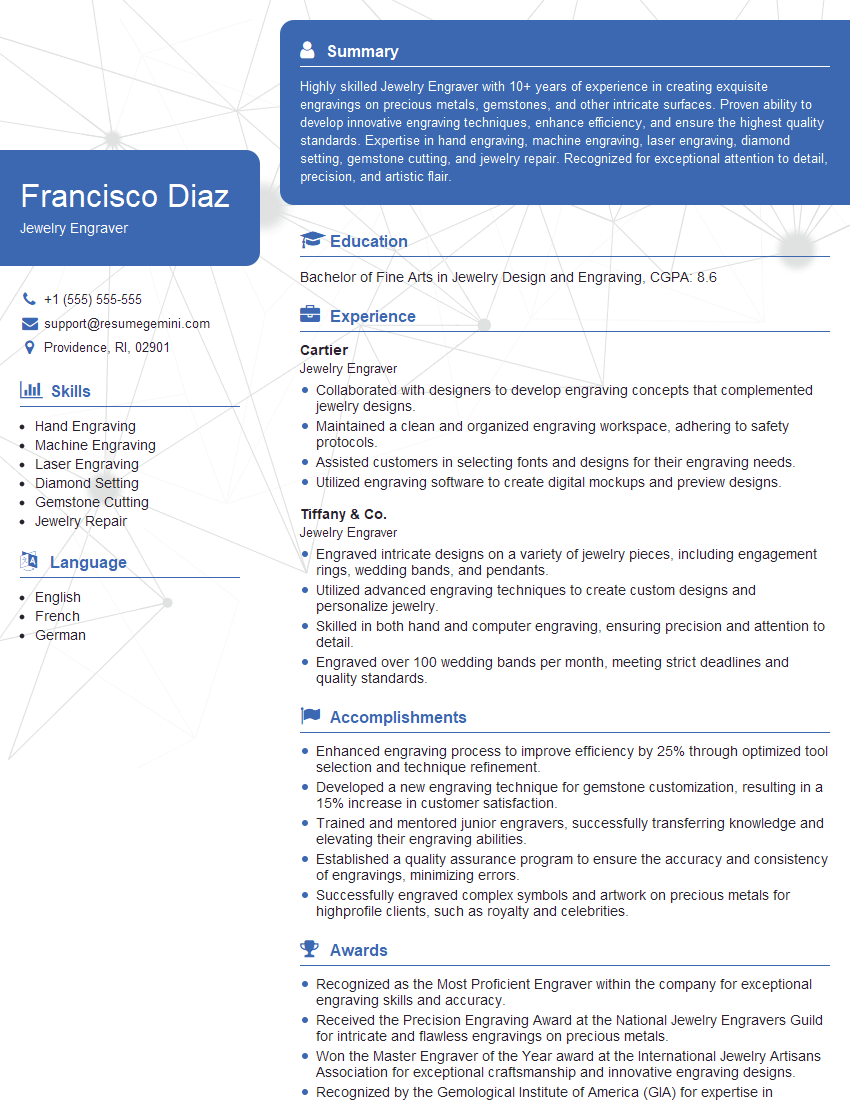
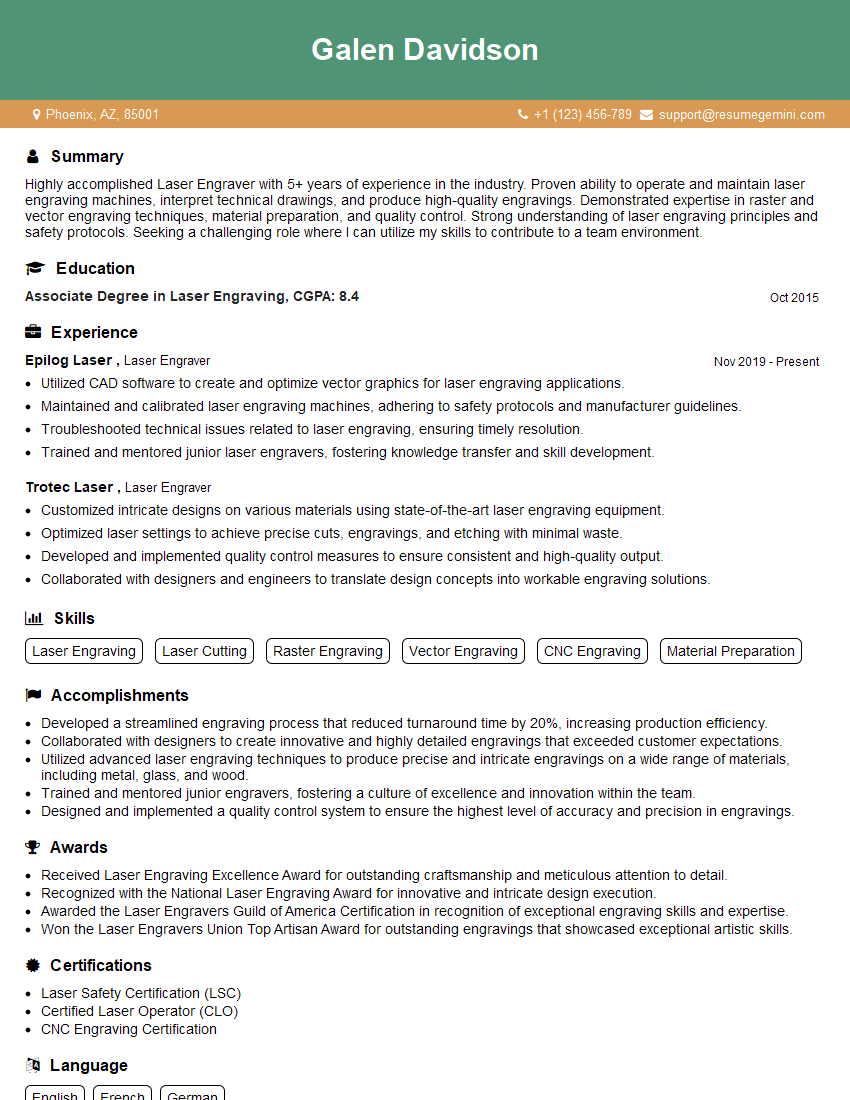
Mastering Mechanical Engraving opens doors to a rewarding career with diverse opportunities in manufacturing, personalization, and artistic creation. To maximize your job prospects, a strong, ATS-friendly resume is crucial. ResumeGemini is a trusted resource that can help you craft a professional resume that highlights your skills and experience effectively. Examples of resumes tailored to Mechanical Engraving are available to guide you. Invest the time to create a compelling resume – it’s your first impression on potential employers.


Explore more articles
Users Rating of Our Blogs
Share Your Experience
We value your feedback! Please rate our content and share your thoughts (optional).
What Readers Say About Our Blog
Very informative content, great job.
good