The right preparation can turn an interview into an opportunity to showcase your expertise. This guide to Experience with machine learning interview questions is your ultimate resource, providing key insights and tips to help you ace your responses and stand out as a top candidate.
Questions Asked in Experience with machine learning Interview
Q 1. Explain the difference between supervised, unsupervised, and reinforcement learning.
Machine learning algorithms are broadly categorized into three types: supervised, unsupervised, and reinforcement learning. The key difference lies in how the algorithm learns from data.
Supervised Learning: This is like having a teacher. You provide the algorithm with labeled data – that is, data where the input features are paired with the correct output (the ‘label’). The algorithm learns to map inputs to outputs based on this labeled data. Think of it like teaching a child to identify different fruits by showing them pictures of apples, bananas, and oranges, along with their names. Examples include image classification, spam detection, and predicting house prices.
Unsupervised Learning: This is like exploring a new city without a map. You only have the data points, and the algorithm needs to find patterns and structure within the data without any pre-defined labels. The algorithm might group similar data points together (clustering) or find hidden relationships (dimensionality reduction). Examples include customer segmentation, anomaly detection, and topic modeling.
Reinforcement Learning: This is like training a dog. You have an agent that interacts with an environment and receives rewards or penalties based on its actions. The algorithm learns to choose actions that maximize cumulative rewards over time. Examples include game playing (AlphaGo), robotics control, and personalized recommendations.
Q 2. What is the bias-variance tradeoff?
The bias-variance tradeoff is a fundamental concept in machine learning that describes the balance between model complexity and its ability to generalize to unseen data.
Bias: This refers to the error introduced by making simplifying assumptions about the data. A high-bias model (like a linear model) might make inaccurate assumptions about the data’s underlying structure and fail to capture complex relationships, leading to underfitting. Think of it as a simplified map of a city that misses many details.
Variance: This refers to the model’s sensitivity to fluctuations in the training data. A high-variance model (like a very complex decision tree) might fit the training data perfectly but perform poorly on new data because it has learned the noise in the training set. This is known as overfitting. Think of it as a hyper-detailed map of a small area that’s not representative of the city as a whole.
The goal is to find a sweet spot between bias and variance: a model that is complex enough to capture the important patterns in the data, but not so complex that it overfits the noise.
Q 3. Describe different types of model evaluation metrics (e.g., precision, recall, F1-score, AUC).
Model evaluation metrics help us assess the performance of a machine learning model. The choice of metric depends heavily on the specific problem and business goals.
Precision: Out of all the instances predicted as positive, what proportion was actually positive? High precision means fewer false positives.
Precision = True Positives / (True Positives + False Positives)Recall (Sensitivity): Out of all the actual positive instances, what proportion did the model correctly predict as positive? High recall means fewer false negatives.
Recall = True Positives / (True Positives + False Negatives)F1-Score: The harmonic mean of precision and recall. It provides a balanced measure considering both false positives and false negatives.
F1-Score = 2 * (Precision * Recall) / (Precision + Recall)AUC (Area Under the ROC Curve): Measures the model’s ability to distinguish between classes across different thresholds. A higher AUC indicates better classification performance. The ROC curve plots the true positive rate against the false positive rate at various threshold settings.
For example, in a medical diagnosis system, high recall is crucial (we want to identify all diseased individuals, even if it means some false positives), while in spam detection, high precision is more important (we want to avoid flagging legitimate emails as spam, even if it means missing some spam emails).
Q 4. Explain overfitting and underfitting. How can you mitigate these issues?
Overfitting and underfitting are two common problems in machine learning that hinder the model’s ability to generalize to new data.
Overfitting: The model learns the training data too well, including noise and outliers, resulting in poor performance on unseen data. Imagine memorizing the answers to a test without understanding the underlying concepts – you’ll do well on that specific test but fail on a similar one.
Underfitting: The model is too simple to capture the underlying patterns in the data, leading to poor performance on both training and test data. Imagine trying to understand complex physics concepts using only basic arithmetic.
Mitigation Techniques:
Cross-validation: Evaluate the model on multiple subsets of the data to get a more robust estimate of its performance.
Regularization: Penalize complex models by adding constraints to the model parameters (L1, L2 regularization).
Feature selection/engineering: Select relevant features and create new ones that improve model performance.
Increase training data: More data helps the model to better generalize.
Use simpler models: If overfitting occurs, try a simpler model with fewer parameters.
Early stopping: Stop training when the model’s performance on a validation set starts to decrease.
Q 5. What are regularization techniques and why are they used?
Regularization techniques are used to prevent overfitting by adding a penalty to the model’s complexity. This penalty discourages the model from learning overly complex relationships that might only fit the training data well.
L1 Regularization (LASSO): Adds a penalty proportional to the absolute value of the model’s coefficients. It tends to shrink some coefficients to exactly zero, performing feature selection.
L2 Regularization (Ridge): Adds a penalty proportional to the square of the model’s coefficients. It shrinks coefficients towards zero but doesn’t necessarily set them to zero.
The strength of the penalty (the regularization parameter) is a hyperparameter that needs to be tuned. Regularization helps improve the model’s generalizability and prevents overfitting by discouraging overly complex models.
Q 6. Compare and contrast different regression algorithms (e.g., linear regression, logistic regression, polynomial regression).
These are all regression algorithms used to predict a continuous target variable.
Linear Regression: Models the relationship between the target variable and predictors using a linear equation. It assumes a linear relationship exists, which may not always be the case. Simple, interpretable, but can be inaccurate for non-linear relationships.
Logistic Regression: Despite the name, it’s a classification algorithm (predicting a categorical variable), but can also be extended to ordinal regression. It models the probability of the target variable belonging to a particular class. Uses a sigmoid function to map the linear combination of predictors to a probability between 0 and 1.
Polynomial Regression: Extends linear regression by adding polynomial terms of the predictors. This allows it to model non-linear relationships, but can easily overfit if the degree of the polynomial is too high.
In essence, linear regression assumes a straight line relationship, logistic regression predicts probabilities, and polynomial regression uses curves to model relationships. The choice depends on the data’s characteristics and the desired model complexity.
Q 7. Compare and contrast different classification algorithms (e.g., SVM, Naive Bayes, decision trees, random forests).
These are all classification algorithms used to predict a categorical target variable.
SVM (Support Vector Machine): Finds the optimal hyperplane that maximizes the margin between different classes. Effective in high-dimensional spaces and can model non-linear relationships using kernel functions. Can be computationally expensive for very large datasets.
Naive Bayes: Based on Bayes’ theorem, assuming feature independence. Simple, fast, and works well with high-dimensional data, even with limited training data. The independence assumption can be violated in real-world scenarios.
Decision Trees: Create a tree-like model of decisions based on feature values. Easy to understand and interpret, but can be prone to overfitting. Random forests mitigate this by creating an ensemble of decision trees.
Random Forests: An ensemble method that combines multiple decision trees. Reduces overfitting, improves accuracy, and provides estimates of feature importance. More computationally intensive than a single decision tree.
The choice of algorithm depends on factors like data size, dimensionality, the presence of non-linear relationships, and the interpretability requirements. For instance, decision trees are great for interpretability, while SVMs excel in high-dimensional settings, and Random Forests offer a balance of accuracy and robustness.
Q 8. Explain the concept of a confusion matrix.
A confusion matrix is a visual tool used to evaluate the performance of a classification model. Imagine you’re building a spam filter; the confusion matrix shows you how well your model distinguishes between spam and not-spam emails. It’s a table showing the counts of true positive (correctly identified spam), true negative (correctly identified non-spam), false positive (incorrectly identified spam – a ‘false alarm’), and false negative (incorrectly identified non-spam – a missed spam email) predictions.
Example: Let’s say we have a model that classifies images as cats or dogs. A confusion matrix might look like this:
		Predicted Cat	Predicted Dog
Actual Cat		80		20
Actual Dog		10		90
This tells us that out of 100 images, 80 cat images were correctly classified, 20 were incorrectly classified as dogs, 10 dog images were incorrectly classified as cats, and 90 were correctly classified. From this, we can calculate metrics like precision, recall, and F1-score, giving a more comprehensive view than just accuracy alone.
Q 9. What is cross-validation and why is it important?
Cross-validation is a powerful technique used to evaluate the performance of a machine learning model and prevent overfitting. Overfitting occurs when a model performs exceptionally well on the training data but poorly on unseen data. Imagine training a model to recognize handwritten digits using only examples of ‘2’s written by one person; it might perform brilliantly on more of that person’s ‘2’s but fail miserably with other handwriting styles.
Cross-validation addresses this by splitting your data into multiple subsets (folds). The model is trained on some folds and tested on the remaining fold. This process is repeated multiple times, with different folds used for training and testing each time. The average performance across these folds gives a more robust estimate of how the model will perform on new, unseen data. Common techniques include k-fold cross-validation (where k is the number of folds) and leave-one-out cross-validation.
Importance: Cross-validation provides a more reliable measure of model performance than a single train-test split, reducing bias and giving a better indication of how your model will generalize to real-world data. It’s a crucial step in model selection and hyperparameter tuning.
Q 10. How do you handle missing data in a dataset?
Handling missing data is a critical step in any machine learning project. Ignoring it can lead to biased and unreliable results. There are several approaches, each with its own advantages and disadvantages:
- Deletion: This involves removing rows or columns with missing values. This is simple but can lead to significant data loss if many values are missing.
- Imputation: This involves filling in missing values with estimated values. Common methods include:
- Mean/Median/Mode Imputation: Replacing missing values with the mean, median, or mode of the respective column. Simple but can distort the distribution if many values are missing.
- K-Nearest Neighbors (KNN) Imputation: Imputing missing values based on the values of similar data points. More sophisticated but computationally expensive.
- Regression Imputation: Predicting missing values using regression models based on other features. More accurate than simpler methods but requires careful consideration of which features to use.
- Model-Based Approaches: Some models, such as XGBoost or certain neural networks, can handle missing data directly without the need for pre-processing.
Choosing the right approach: The best method depends on the nature of the data, the amount of missing data, and the chosen model. Understanding the reason for missing data (e.g., Missing Completely at Random, Missing at Random, Missing Not at Random) can also inform the choice.
Q 11. Explain the concept of dimensionality reduction techniques (e.g., PCA, t-SNE).
Dimensionality reduction techniques aim to reduce the number of variables (features) in a dataset while preserving important information. This is beneficial for several reasons: it can improve model performance by reducing noise and overfitting, reduce computational cost, and make data visualization easier.
Principal Component Analysis (PCA): PCA is a linear transformation that projects data onto a lower-dimensional space defined by principal components – new uncorrelated variables that capture the most variance in the data. It’s widely used for data preprocessing and feature extraction. Imagine compressing a high-resolution image; PCA effectively finds the most important aspects of the image to retain while discarding less significant details.
t-distributed Stochastic Neighbor Embedding (t-SNE): t-SNE is a non-linear dimensionality reduction technique particularly useful for visualization. It aims to preserve local neighborhood relationships between data points in the high-dimensional space when projecting them onto a lower-dimensional space (often 2D or 3D). This makes it great for visualizing clusters in high-dimensional data, where PCA might fail to reveal the underlying structure.
Choosing the right technique: PCA is suitable when the data is linearly separable and you want to capture the maximum variance. t-SNE is better for visualization and highlighting clusters in non-linearly separable data, but it is computationally expensive for large datasets.
Q 12. What are some common feature scaling techniques?
Feature scaling is the process of transforming features to have a similar range of values. This is crucial for many machine learning algorithms, especially those that use distance-based calculations like k-NN or algorithms that are sensitive to feature magnitudes, such as gradient descent in neural networks. Unscaled features can cause certain features to dominate others due to differing scales, which can negatively affect performance.
Common techniques:
- Min-Max Scaling (Normalization): Scales features to a range between 0 and 1. Formula:
x' = (x - min) / (max - min) - Z-score Standardization: Transforms features to have a mean of 0 and a standard deviation of 1. Formula:
x' = (x - mean) / standard deviation - Robust Scaling: Similar to Z-score but uses median and interquartile range instead of mean and standard deviation. Less sensitive to outliers.
Choosing the right technique: Min-Max scaling is suitable when the data distribution is roughly uniform. Z-score standardization is preferred when the data has a Gaussian distribution or when outliers are a significant concern. Robust scaling is robust to outliers.
Q 13. Explain different types of neural networks (e.g., CNN, RNN, LSTM).
Neural networks are powerful computational models inspired by the structure and function of the human brain. Different architectures are suited for different types of data and tasks:
- Convolutional Neural Networks (CNNs): CNNs excel at processing grid-like data, such as images and videos. They use convolutional layers to extract features from local regions of the input, making them highly effective for tasks like image classification, object detection, and image segmentation. Think of them as scanning an image with filters to identify edges, corners, and other features.
- Recurrent Neural Networks (RNNs): RNNs are designed for sequential data, such as text and time series. They have connections that loop back on themselves, allowing them to maintain a memory of past inputs. This makes them suitable for tasks like natural language processing (NLP), machine translation, and speech recognition. They ‘remember’ words in a sentence to understand context.
- Long Short-Term Memory (LSTMs): LSTMs are a special type of RNN designed to address the vanishing gradient problem, which limits the ability of standard RNNs to learn long-range dependencies in sequences. LSTMs are particularly effective for processing long sequences of data, making them a preferred choice for complex NLP tasks and time series forecasting. They possess mechanisms to control the flow of information through time, enabling them to remember long-past relevant information.
These are just a few examples; many other specialized neural network architectures exist, each tailored to specific problem domains.
Q 14. What is backpropagation?
Backpropagation is the core algorithm used to train most neural networks. It’s a method for calculating the gradient of the loss function with respect to the network’s weights. The loss function measures how well the network is performing; the goal is to minimize this loss. Backpropagation works by propagating the error signal back through the network, layer by layer. This error signal indicates how much each weight contributed to the error in the network’s prediction.
The process:
- Forward Pass: Input data is fed through the network, and predictions are generated.
- Loss Calculation: The loss function computes the difference between the network’s predictions and the true values.
- Backward Pass: The error signal is propagated back through the network, calculating the gradient of the loss function with respect to each weight.
- Weight Update: The weights are updated using an optimization algorithm (like gradient descent) to reduce the loss. This process iterates until the network converges to a satisfactory performance level.
Backpropagation is essentially a chain rule application for calculating gradients. It’s a fundamental algorithm that enables the training of complex neural networks, enabling them to learn from data and make accurate predictions.
Q 15. Explain gradient descent and its variants (e.g., stochastic gradient descent).
Gradient descent is an iterative optimization algorithm used to find the minimum of a function. Imagine you’re standing on a mountain and want to get to the bottom (the minimum). Gradient descent helps you find the path of steepest descent by taking steps in the direction opposite to the gradient (the slope) of the function at your current location. Each step size is determined by a learning rate.
Variants:
- Stochastic Gradient Descent (SGD): Instead of calculating the gradient using the entire dataset (which can be computationally expensive), SGD uses only a single data point at each iteration. This makes it faster but introduces more noise, leading to a more erratic path to the minimum. Think of it as taking many small, potentially inaccurate steps.
- Mini-Batch Gradient Descent: A compromise between batch and stochastic gradient descent. It calculates the gradient using a small random sample (mini-batch) of the data at each iteration. This reduces the noise compared to SGD while still being more efficient than batch gradient descent. It’s like taking slightly larger, more informed steps.
- Other variants include Adam, RMSprop, and AdaGrad, which adapt the learning rate for each parameter, often leading to faster convergence.
Example: Imagine you’re training a linear regression model. The cost function (the function we want to minimize) represents the error between predicted and actual values. Gradient descent iteratively adjusts the model’s parameters (weights and bias) to reduce this error, reaching the minimum cost.
Career Expert Tips:
- Ace those interviews! Prepare effectively by reviewing the Top 50 Most Common Interview Questions on ResumeGemini.
- Navigate your job search with confidence! Explore a wide range of Career Tips on ResumeGemini. Learn about common challenges and recommendations to overcome them.
- Craft the perfect resume! Master the Art of Resume Writing with ResumeGemini’s guide. Showcase your unique qualifications and achievements effectively.
- Don’t miss out on holiday savings! Build your dream resume with ResumeGemini’s ATS optimized templates.
Q 16. What are hyperparameters and how are they tuned?
Hyperparameters are settings that control the learning process of a machine learning model. They are not learned from the data like model parameters (weights and biases) but are set before training begins. Think of them as the knobs and dials you adjust to optimize the model’s performance.
Tuning Hyperparameters:
- Grid Search: This is a brute-force approach where you try out all combinations of hyperparameters within a predefined range. It’s simple but can be computationally expensive for high-dimensional hyperparameter spaces.
- Random Search: This approach randomly samples hyperparameter combinations from the search space. Surprisingly, it often outperforms grid search, especially when some hyperparameters have a more significant impact than others.
- Bayesian Optimization: This sophisticated technique uses a probabilistic model to guide the search, intelligently exploring promising regions of the hyperparameter space. It is more efficient than grid and random search, especially for complex models.
- Manual Search based on domain knowledge: This approach leverages your understanding of the problem and the algorithm to select suitable hyperparameter values.
Example: In a Support Vector Machine (SVM), the hyperparameter C controls the trade-off between maximizing the margin and minimizing the classification error. Tuning C affects the model’s ability to generalize to unseen data. We would use one of the tuning methods described above to find an optimal value for C.
Q 17. What is A/B testing and how is it used in machine learning?
A/B testing is a randomized experiment used to compare two or more versions of a system (e.g., a website, an app, or a machine learning model) to determine which performs better. It’s a crucial tool for evaluating the impact of changes and ensuring we are deploying the most effective solution.
In Machine Learning: A/B testing is used to compare different models, algorithms, or features. For example, you might have two different models predicting customer churn. You would randomly assign a subset of customers to each model and then compare their performance based on a key metric, such as accuracy or precision.
Example: Let’s say you have two recommendation systems: one based on collaborative filtering and another based on content-based filtering. You can use A/B testing to see which system results in higher click-through rates or conversion rates. The results guide the choice of the better performing system for production.
Q 18. How do you deploy a machine learning model?
Deploying a machine learning model involves making it accessible and operational in a real-world environment. This process typically involves several steps:
- Model Selection and Evaluation: Choose the best performing model based on rigorous testing and evaluation metrics.
- Model Packaging: Package the model with necessary dependencies (libraries, configurations) into a deployable format.
- Infrastructure Setup: Prepare the infrastructure (servers, cloud platforms, etc.) to host and serve the model. This might involve setting up APIs, databases, and monitoring tools.
- Deployment Strategy: Choose a deployment strategy (e.g., batch processing, real-time prediction) depending on the application. A phased rollout (A/B testing) is often preferred to minimize risk.
- Monitoring and Maintenance: Continuously monitor the model’s performance in production, address any issues, and retrain the model as needed to maintain accuracy and efficiency.
Example: A fraud detection model might be deployed as a real-time API, processing transactions and flagging suspicious activity. The model would be integrated into the bank’s existing systems, providing immediate feedback.
Q 19. What are some common challenges in deploying machine learning models to production?
Deploying machine learning models to production presents several challenges:
- Data Drift: The distribution of data in production may differ from the training data, leading to a decline in model performance over time.
- Scalability: Handling a large volume of requests efficiently can be challenging, requiring robust infrastructure and optimized model architecture.
- Monitoring and Maintenance: Keeping track of model performance, detecting anomalies, and retraining models requires continuous effort and resources.
- Security and Privacy: Protecting sensitive data used by and generated by the model is crucial, necessitating robust security measures.
- Integration with Existing Systems: Integrating the model seamlessly with existing infrastructure and workflows can be complex and time-consuming.
- Explainability and Interpretability: Understanding why a model makes certain predictions is critical for building trust and diagnosing potential issues. Black-box models can be difficult to troubleshoot.
Example: A deployed recommendation system might encounter data drift if customer preferences change over time. This necessitates periodic retraining to keep the system relevant.
Q 20. Explain the difference between batch gradient descent, mini-batch gradient descent, and stochastic gradient descent.
These three variants of gradient descent differ primarily in how they compute the gradient of the loss function:
- Batch Gradient Descent: Calculates the gradient using the entire training dataset at each iteration. It provides a very accurate gradient but can be slow, especially for large datasets. Imagine carefully surveying the entire mountain before taking each step.
- Mini-Batch Gradient Descent: Calculates the gradient using a small random sample (mini-batch) of the data at each iteration. This offers a good balance between accuracy and efficiency. Think of it as scouting a small area of the mountain before taking each step.
- Stochastic Gradient Descent (SGD): Calculates the gradient using only a single data point at each iteration. It’s very fast but can be noisy, leading to an erratic path to the minimum. This is like taking many small, potentially haphazard steps based on limited information.
The choice depends on the dataset size and computational resources. Mini-batch gradient descent is often preferred as it strikes a balance between speed and accuracy.
Q 21. What are activation functions and why are they important?
Activation functions are mathematical functions applied to the output of a neuron (node) in a neural network. They introduce non-linearity, enabling the network to learn complex patterns. Without activation functions, a neural network would simply be a linear transformation, severely limiting its capabilities.
Importance:
- Introducing Non-linearity: Activation functions allow neural networks to approximate non-linear relationships in data, which is crucial for solving many real-world problems.
- Enabling Gradient-Based Learning: Many activation functions are differentiable, allowing for the use of gradient-based optimization algorithms like gradient descent to train the network.
- Controlling Output Range: Different activation functions have different output ranges (e.g., sigmoid outputs values between 0 and 1, ReLU outputs values greater than or equal to 0). This can be useful for specific tasks, such as binary classification (sigmoid) or regression (linear).
Examples:
- Sigmoid: Outputs values between 0 and 1, often used in binary classification.
- ReLU (Rectified Linear Unit): Outputs the input if positive, otherwise 0. Popular for its efficiency and effectiveness.
- Tanh (Hyperbolic Tangent): Outputs values between -1 and 1.
The choice of activation function depends on the specific task and network architecture.
Q 22. Describe different types of deep learning architectures.
Deep learning architectures are the fundamental structures of artificial neural networks used to solve complex problems. They vary greatly in their design and application. Here are some key types:
- Feedforward Neural Networks (FNNs): These are the simplest type, where information flows in one direction, from input to output, without loops. They’re often used for tasks like classification and regression. Think of it like a simple assembly line – each step processes the data and passes it on.
- Convolutional Neural Networks (CNNs): Specifically designed for image and video processing, CNNs use convolutional layers to detect patterns and features in spatial data. Imagine a magnifying glass scanning an image, identifying edges and shapes. They’re widely used in image recognition, object detection, and medical imaging.
- Recurrent Neural Networks (RNNs): RNNs excel at processing sequential data like text and time series. They have loops, allowing information to persist from one time step to the next. Think of it as having a memory – the network remembers previous inputs to understand the context of the current input. Examples include language translation and speech recognition.
- Long Short-Term Memory (LSTM) networks and Gated Recurrent Units (GRUs): These are advanced types of RNNs designed to mitigate the vanishing gradient problem, allowing them to learn long-range dependencies in sequential data more effectively. They’re more powerful variations of RNNs, better suited for complex sequences.
- Autoencoders: Used for dimensionality reduction and feature extraction, autoencoders learn a compressed representation of the input data. They’re like a sophisticated compression algorithm that learns to reconstruct the original data from a smaller representation.
- Generative Adversarial Networks (GANs): GANs consist of two networks, a generator and a discriminator, that compete against each other. The generator creates synthetic data, while the discriminator tries to distinguish between real and generated data. This leads to the generator producing increasingly realistic data. They’re used for tasks such as image generation and style transfer.
The choice of architecture depends heavily on the specific problem and the nature of the data.
Q 23. What are some ethical considerations in machine learning?
Ethical considerations in machine learning are crucial and often overlooked. The potential for bias, fairness issues, and misuse is significant. Here are some key concerns:
- Bias and Fairness: ML models learn from data, and if that data reflects existing societal biases (e.g., gender, race), the model will likely perpetuate and even amplify those biases. This can lead to unfair or discriminatory outcomes. For example, a loan application model trained on biased data might unfairly deny loans to certain demographic groups.
- Privacy: ML models often require large amounts of data, which may include sensitive personal information. Protecting this data and ensuring compliance with privacy regulations is paramount. Data breaches and misuse can have severe consequences.
- Transparency and Explainability: Many complex ML models (e.g., deep learning models) are “black boxes,” making it difficult to understand how they arrive at their predictions. Lack of transparency can erode trust and make it challenging to identify and correct biases or errors.
- Accountability and Responsibility: When an ML model makes a mistake with real-world consequences, it’s crucial to determine who is responsible. This involves establishing clear lines of accountability for the development, deployment, and monitoring of these systems.
- Job displacement: Automation driven by ML can lead to job losses in certain sectors. Addressing this requires thoughtful planning and retraining initiatives.
Addressing these ethical concerns requires careful data curation, model validation, and ongoing monitoring. It’s essential to incorporate ethical considerations throughout the entire ML lifecycle.
Q 24. How do you handle imbalanced datasets?
Imbalanced datasets, where one class significantly outnumbers others, pose a challenge for machine learning models. Models trained on such data tend to be biased towards the majority class, performing poorly on the minority class. Here are some techniques to address this:
- Resampling techniques:
- Oversampling: Increasing the number of instances in the minority class. This can involve duplicating existing instances or generating synthetic instances using techniques like SMOTE (Synthetic Minority Over-sampling Technique).
- Undersampling: Reducing the number of instances in the majority class. This can involve randomly removing instances or using more sophisticated techniques like NearMiss.
- Cost-sensitive learning: Assigning different misclassification costs to different classes. This penalizes the model more heavily for misclassifying the minority class, encouraging it to learn better from this class.
- Ensemble methods: Combining multiple models trained on different subsets of the data or with different resampling techniques. This can improve overall performance and reduce bias.
- Anomaly detection techniques: If the minority class represents anomalies or outliers, anomaly detection algorithms might be more appropriate than traditional classification methods.
The best approach depends on the specific dataset and the problem. Often, a combination of these techniques yields the best results. It’s essential to carefully evaluate the performance of the model on both the majority and minority classes using appropriate metrics such as precision, recall, F1-score, and AUC.
Q 25. Explain the concept of transfer learning.
Transfer learning leverages knowledge gained from solving one problem to improve performance on a related problem. Instead of training a model from scratch, we use a pre-trained model (often a deep learning model trained on a massive dataset like ImageNet) as a starting point. This significantly reduces training time and data requirements.
For example, imagine you’ve trained a model to recognize cats and dogs. You can then use the learned features (layers of the network) as a foundation for a new model that recognizes different breeds of dogs. You would essentially “transfer” the knowledge about general image features and adapt it for the specific task of dog breed recognition.
The process usually involves:
- Choosing a pre-trained model: Selecting a model architecture and pre-trained weights that are relevant to your task.
- Fine-tuning: Adjusting the pre-trained model’s weights on your new dataset. This could involve retraining all layers or just the top layers, depending on the size of your dataset and the similarity between the tasks.
- Feature extraction: Using the pre-trained model’s features as input to a new model. The pre-trained model acts as a feature extractor, while a simpler model (e.g., a support vector machine) is trained on top of these extracted features.
Transfer learning is especially useful when data is scarce or computational resources are limited. It significantly accelerates model development and improves performance.
Q 26. What is the difference between L1 and L2 regularization?
L1 and L2 regularization are techniques used to prevent overfitting in machine learning models. Overfitting occurs when a model learns the training data too well, performing poorly on unseen data. Both methods add a penalty term to the model’s loss function, discouraging overly complex models.
L1 regularization (LASSO): Adds a penalty term proportional to the absolute value of the model’s weights. This encourages sparsity, meaning many weights become exactly zero. Think of it as selectively eliminating less important features.
L2 regularization (Ridge): Adds a penalty term proportional to the square of the model’s weights. This shrinks the weights towards zero, but doesn’t force them to be exactly zero. It’s like gently reducing the influence of all features.
The choice between L1 and L2 depends on the problem:
- L1 is useful for feature selection, as it can effectively eliminate irrelevant features.
- L2 is generally preferred when all features are likely to be relevant, and you want to prevent overfitting without removing any features.
Here’s a simple illustration of the penalty terms added to the loss function (J):
- L1:
J = J(original) + λ * Σ|wi| - L2:
J = J(original) + λ * Σwi²
where λ is the regularization strength (a hyperparameter), and wi are the model’s weights.
Q 27. Discuss your experience with a specific machine learning project.
In a previous role, I worked on a project to develop a fraud detection system for a credit card company. The goal was to build a model that could accurately identify fraudulent transactions in real-time. We used a massive dataset of historical transactions, labeled as either fraudulent or legitimate. This was a classic classification problem with a significant class imbalance (fraudulent transactions were far less frequent than legitimate ones).
We explored several models, including logistic regression, support vector machines, and various deep learning architectures. We addressed the class imbalance using oversampling techniques like SMOTE and cost-sensitive learning. We also employed ensemble methods to improve model robustness and accuracy.
The key challenges included handling noisy data, optimizing model performance with limited computational resources, and ensuring the model could process transactions in real-time. Model evaluation was critical, focusing on metrics like precision and recall to minimize false positives (incorrectly flagging legitimate transactions) and false negatives (missing fraudulent transactions).
The final model deployed showed a significant improvement in fraud detection accuracy compared to the existing system, resulting in a substantial reduction in financial losses for the company. This project showcased the power of machine learning to solve real-world problems with tangible business impact.
Q 28. Describe a time you had to debug a machine learning model.
During a project involving image classification, our model consistently performed poorly on a specific subset of images, despite showing good overall accuracy. After extensive investigation, we discovered that these images had a unique artifact – a small watermark in the corner. This watermark, barely visible to the human eye, was affecting the model’s feature extraction process.
Our debugging process involved:
- Visual inspection: Manually examining the poorly classified images to look for patterns and anomalies.
- Data analysis: Investigating the dataset to understand the distribution of these images and their features.
- Feature visualization: Using techniques like Grad-CAM to visualize the features the model was focusing on, allowing us to understand why it was misclassifying these images.
- Data augmentation: We systematically added the watermark to some of the correctly classified images in order to see how the model reacted.
- Model retraining: After identifying the watermark as the culprit, we pre-processed the images to remove it, and retrained the model. This significantly improved the model’s performance on the problematic subset of images.
This experience highlighted the importance of thoroughly understanding the data and carefully analyzing model behavior when debugging. Often, the source of the problem lies in unexpected aspects of the data rather than the model itself.
Key Topics to Learn for Machine Learning Interviews
- Supervised Learning: Understand regression (linear, logistic) and classification algorithms. Be prepared to discuss model selection, evaluation metrics (e.g., accuracy, precision, recall, F1-score), and bias-variance tradeoff.
- Unsupervised Learning: Familiarize yourself with clustering techniques (k-means, hierarchical) and dimensionality reduction methods (PCA, t-SNE). Understand their applications and limitations.
- Deep Learning: Grasp the fundamentals of neural networks, including convolutional neural networks (CNNs) for image processing and recurrent neural networks (RNNs) for sequential data. Be ready to discuss different activation functions and optimization algorithms (e.g., backpropagation, gradient descent).
- Model Evaluation and Selection: Know how to choose appropriate evaluation metrics based on the problem, handle overfitting and underfitting, and perform cross-validation. Understand techniques like regularization and hyperparameter tuning.
- Practical Applications: Be prepared to discuss real-world applications of machine learning in various domains, such as image recognition, natural language processing, recommendation systems, or time series forecasting. Highlight projects where you’ve applied these techniques.
- Data Preprocessing and Feature Engineering: Demonstrate your understanding of data cleaning, handling missing values, feature scaling, and creating new features to improve model performance. This is crucial for practical application.
- Algorithm Selection and Justification: Explain your reasoning behind choosing specific algorithms for different problems. Highlight the strengths and weaknesses of various approaches.
Next Steps
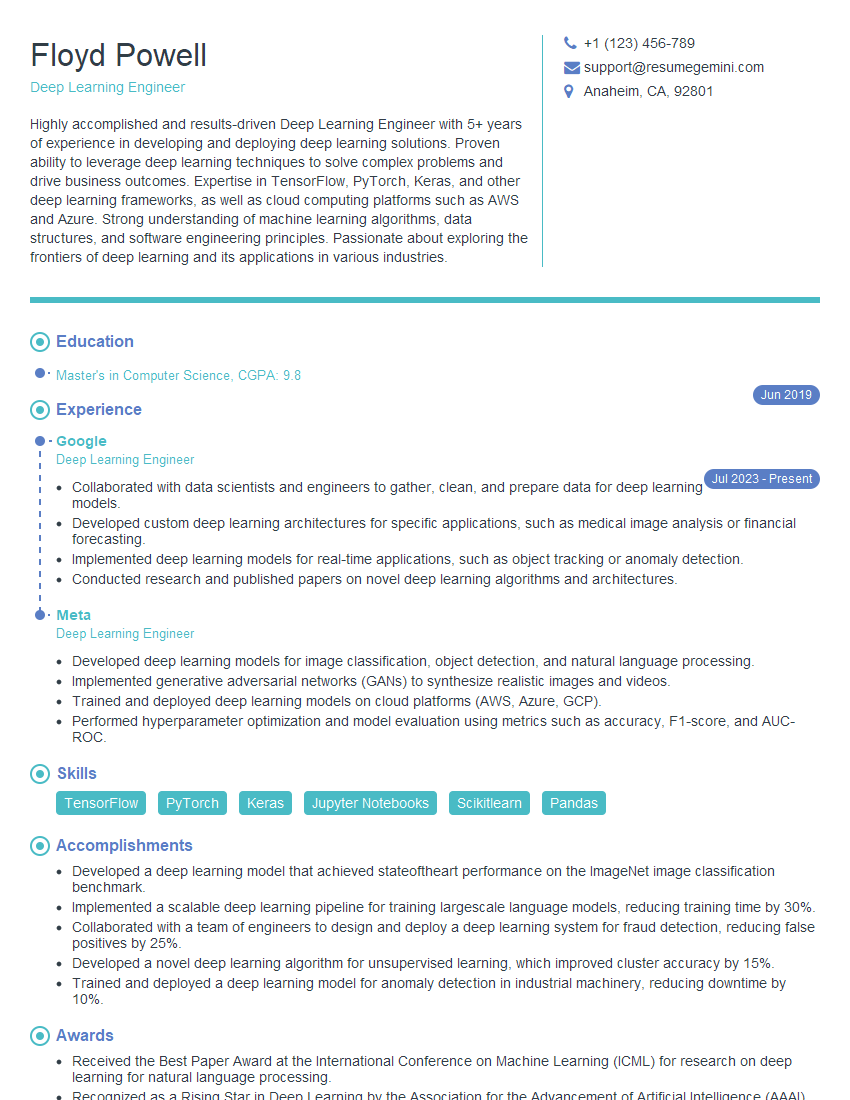
Mastering machine learning is crucial for a successful and rewarding career in today’s data-driven world. It opens doors to exciting roles and significant growth potential. To maximize your chances of landing your dream job, create a compelling and ATS-friendly resume that showcases your skills and experience effectively. ResumeGemini is a trusted resource that can help you build a professional and impactful resume. We provide examples of resumes tailored to machine learning roles to guide you through the process. Invest time in crafting a strong resume—it’s your first impression on potential employers.



Explore more articles
Users Rating of Our Blogs
Share Your Experience
We value your feedback! Please rate our content and share your thoughts (optional).
What Readers Say About Our Blog
Very informative content, great job.
good