Unlock your full potential by mastering the most common Yarn Machine Operation interview questions. This blog offers a deep dive into the critical topics, ensuring you’re not only prepared to answer but to excel. With these insights, you’ll approach your interview with clarity and confidence.
Questions Asked in Yarn Machine Operation Interview
Q 1. Describe your experience operating different types of yarn machines.
Throughout my career, I’ve gained extensive experience operating a variety of yarn machines, including ring spinning machines, rotor spinning machines, air-jet spinning machines, and open-end spinning machines. Each machine presents unique challenges and requires a different skill set for optimal operation and maintenance. For instance, ring spinning, while producing high-quality yarns, demands meticulous attention to details like twist and tension control. Rotor spinning, on the other hand, prioritizes speed and efficiency, necessitating a focus on maintaining consistent fiber flow and preventing clogging. My expertise extends to understanding the specific parameters of each machine type, adjusting settings for different yarn qualities (fineness, strength, and evenness), and identifying potential issues before they impact production.
For example, I’ve successfully transitioned a production line from ring spinning to rotor spinning, significantly increasing output while maintaining acceptable yarn quality by meticulously adjusting the rotor speed, air pressure, and drafting system parameters. This required deep understanding of both machine types and the ability to adapt quickly to different technologies.
Q 2. Explain the process of yarn preparation.
Yarn preparation is a critical preliminary stage that directly influences the final yarn quality. It’s like preparing the ingredients for a recipe – if the ingredients are not properly prepared, the final product will be affected. This multi-step process typically involves:
- Baling and opening: Removing the tightly packed bales of fibers and opening them to loosen the fibers, preventing unevenness in the final yarn.
- Cleaning: Removing impurities such as leaves, seeds, and short fibers to improve fiber quality and reduce yarn defects. This often involves machinery like carding machines.
- Blending: Combining different fibers to achieve specific yarn properties (e.g., strength, softness, color). This allows for customizing the yarn to meet specific needs.
- Carding: Aligning and straightening the fibers to create a continuous web. This removes any remaining impurities and ensures even fiber distribution.
- Combing (optional): A more intensive process used for high-quality yarns, which removes shorter fibers and further improves parallelism and evenness.
- Drawing: Gradually reducing the thickness of the fiber web while simultaneously improving parallelism and uniformity. It’s repeated several times for optimal results.
- Roving preparation: This final stage prepares the fiber web into a soft, slightly twisted strand called roving, which is ready to be spun into yarn.
The quality of the yarn preparation directly impacts the efficiency and productivity of the spinning process and the quality of the final product. If the fibers are not properly cleaned, blended, and aligned, the resulting yarn may be weak, uneven, and prone to breakage.
Q 3. How do you identify and troubleshoot common yarn machine malfunctions?
Identifying and troubleshooting yarn machine malfunctions requires a systematic approach. It’s like diagnosing a car problem – you need to know where to look for clues. I start by observing the machine’s operation, listening for unusual sounds, and checking for visible signs of problems such as broken parts, excessive vibration, or inconsistent yarn production. Common malfunctions include:
- Yarn breakage: Could be due to insufficient twist, fiber imperfections, or machine settings.
- Yarn unevenness: Often caused by problems in the drafting system or inconsistent fiber feed.
- Machine vibrations: May indicate misalignment or worn-out bearings.
- Clogging: Common in rotor spinning and air-jet spinning machines, typically due to excessive buildup of fibers.
My troubleshooting process involves carefully inspecting each component, checking the settings, and systematically eliminating potential causes. I use specialized tools for precise measurements and adjustments, always following safety procedures. For example, if yarn breakage is frequent, I would first check the twist settings, then examine the fiber quality, and finally assess the tension settings. If the problem persists, I’d consult the machine’s manual and perhaps contact the manufacturer’s technical support.
Q 4. What safety procedures do you follow while operating yarn machinery?
Safety is paramount in yarn machine operation. I always adhere to strict safety protocols, including:
- Personal Protective Equipment (PPE): Wearing safety glasses, hearing protection, and appropriate clothing to prevent injuries from flying debris, noise, and moving parts.
- Machine guards: Ensuring all machine guards are securely in place before starting operation to prevent accidental contact with moving parts.
- Lockout/Tagout procedures: Following proper lockout/tagout procedures before performing maintenance or repairs to prevent accidental starts.
- Regular machine inspections: Conducting regular inspections to identify potential hazards such as worn-out parts or loose connections.
- Emergency shut-off procedures: Being familiar with the location and operation of emergency shut-off switches and emergency response procedures.
I also prioritize training and awareness. I regularly refresh my knowledge of safety procedures and ensure that any personnel working around the machinery are properly trained and informed about the risks. Safety is not just a set of rules; it’s a mindset that prioritizes preventing accidents before they happen.
Q 5. How do you ensure the quality of the yarn produced?
Ensuring yarn quality involves continuous monitoring and adjustment throughout the entire production process. This is done through a combination of visual inspection, regular testing, and precise machine control. Key aspects include:
- Visual inspection: Regularly checking the yarn for defects such as neps (small knots), slubs (thick places), and weak points.
- Evenness testing: Using instruments like Uster Tester to measure the uniformity of the yarn’s thickness. This ensures consistent quality throughout the yarn length.
- Strength testing: Using tensometers to measure yarn tensile strength, ensuring the yarn can withstand the stresses of subsequent processing.
- Hairiness testing: Checking the amount of loose fibers protruding from the yarn surface, which impacts the feel and appearance of the fabric.
- Machine adjustments: Continuously monitoring and adjusting machine parameters such as twist, tension, and drafting to maintain optimal yarn quality.
I also maintain detailed records of the quality control checks to track performance and identify trends. If a quality issue arises, I analyze the data to identify the root cause, make necessary adjustments, and implement preventative measures to prevent it from recurring. Proactive quality control saves time and resources in the long run.
Q 6. What are the different types of yarn and their properties?
Yarn types vary widely based on fiber composition, spinning method, and intended use. Here are a few examples:
- Cotton yarn: Soft, absorbent, and comfortable, commonly used in clothing and household textiles. Its properties vary depending on the cotton variety and processing methods.
- Wool yarn: Warm, insulating, and naturally elastic, used in sweaters, blankets, and other apparel. Different wool types (e.g., merino, cashmere) have different properties.
- Polyester yarn: Strong, durable, and wrinkle-resistant, often blended with other fibers for improved performance. It’s popular for outerwear and upholstery.
- Silk yarn: Luxurious, lustrous, and smooth, valued for its drape and delicate feel. It’s used in high-end clothing and accessories.
- Linen yarn: Strong, durable, and absorbent, known for its crisp texture. It’s often used in home furnishings and apparel.
Each yarn type possesses unique properties – some are stronger, some are softer, some are more resistant to shrinkage or wrinkles. Understanding these properties is critical for selecting the appropriate yarn for a given application. For example, a strong polyester yarn would be suitable for a heavy-duty industrial fabric, while a soft cotton yarn would be better suited for a delicate baby garment.
Q 7. Explain the concept of yarn count and its significance.
Yarn count refers to the fineness or thickness of a yarn. It’s a way to standardize and compare yarns across different types and manufacturers. It essentially indicates how many units of length (e.g., meters or yards) there are in a given unit of weight (e.g., grams or pounds). Several systems exist, including:
- English count (indirect): Expresses the number of hanks (840 yards) per pound.
- Metric count (direct): Expresses the number of grams per 1000 meters.
- Tex: The weight in grams of 1000 meters of yarn.
For example, a yarn with an English count of 40 means there are 40 hanks (840 yards each) in one pound of yarn. A higher yarn count indicates a finer yarn (more length per unit weight), while a lower yarn count indicates a coarser yarn. The significance of yarn count lies in its ability to provide a standard for specifying yarn thickness, which is crucial for predicting fabric properties, selecting appropriate knitting or weaving equipment, and controlling the final product’s appearance and drape.
Q 8. Describe your experience with yarn winding and spooling.
Yarn winding and spooling are crucial post-spinning processes ensuring the yarn is neatly packaged for further processing or sale. Winding involves taking yarn from a spinning frame or other source and carefully wrapping it onto a bobbin or package. Spooling is the process of transferring yarn from one package to another, often for larger-scale applications or to create a more uniform package. My experience encompasses operating various winding and spooling machines, ranging from simple manual winders to highly automated systems with precision tension control and automatic package building. I’m proficient in troubleshooting common issues like yarn breakage, uneven winding, and package defects, optimizing machine settings to achieve the highest quality and efficiency. For instance, I once resolved a persistent problem of package sloughing (where the yarn slips off the package) on a high-speed winder by adjusting the winding tension and pre-tension settings, ultimately increasing productivity by 15%.
I’ve worked with various yarn types, including cotton, polyester, and blends, and understand how fiber properties influence the optimal winding parameters. I also have experience with different package types, such as parallel, cross-wound, and cheese packages, and am familiar with their respective advantages and disadvantages.
Q 9. How do you maintain yarn machine efficiency and productivity?
Maintaining yarn machine efficiency and productivity involves a multi-faceted approach focused on prevention, optimization, and proactive problem-solving. This includes:
- Regular preventative maintenance: This is key to preventing breakdowns and ensuring consistent performance. I meticulously follow maintenance schedules, including cleaning, lubrication, and part replacements as needed.
- Operator training and skill development: Well-trained operators are more efficient and less prone to errors. I’m always willing to share my expertise and help colleagues improve their skills.
- Process optimization: Continuously monitoring and adjusting machine parameters, such as speed, tension, and yarn path, are essential to fine-tune the process for optimal output. For example, I once identified a bottleneck in a spinning line by analyzing production data and identified a minor adjustment to the drafting system which increased production by 8%.
- Quick and effective troubleshooting: Recognizing and addressing problems promptly minimizes downtime and wasted material. My experience allows for swift diagnostics and solutions to minimize interruptions.
- Data analysis and reporting: Tracking key performance indicators (KPIs) helps identify areas for improvement and highlights potential problems before they escalate.
Q 10. What are the key performance indicators (KPIs) for yarn machine operation?
Key Performance Indicators (KPIs) for yarn machine operation focus on efficiency, quality, and productivity. These typically include:
- Production rate (meters/minute or kilograms/hour): Measures the quantity of yarn produced per unit of time.
- Machine uptime (%): Represents the percentage of time the machine is operational versus downtime due to maintenance or repairs.
- Yarn breakage rate (breaks/kilogram): Indicates the frequency of yarn breaks, a measure of yarn quality and machine stability.
- Waste rate (%): Tracks the percentage of yarn lost due to breakage, defects, or other causes.
- Package quality (uniformity, appearance): Assesses the visual appeal and consistency of the finished yarn packages.
- Energy consumption (kWh/kg): Measures the energy efficiency of the machine operation.
Regular monitoring of these KPIs allows for proactive adjustments to optimize the process and maintain high standards.
Q 11. Describe your experience with preventative maintenance on yarn machines.
Preventative maintenance is critical for maximizing yarn machine lifespan and minimizing downtime. My experience involves performing various maintenance tasks, including:
- Regular cleaning of machine components: Removing lint, dust, and other debris to prevent clogging and ensure smooth operation. This also includes cleaning sensors and other critical components.
- Lubrication of moving parts: Using the correct lubricants to reduce friction, wear, and tear. I am meticulous in following manufacturer-recommended lubrication schedules and techniques.
- Inspection of belts, gears, and other mechanical components: Checking for wear and tear, misalignment, or damage. This allows for the timely replacement of worn parts to prevent larger scale failures.
- Calibration of sensors and electronic controls: Ensuring accurate measurements and control of critical parameters. This is particularly important for maintaining consistent tension and winding speed.
- Record-keeping: Maintaining detailed logs of maintenance activities, including dates, tasks performed, and any identified issues. This is crucial for tracking maintenance history and predicting potential future problems.
I adhere strictly to manufacturer-specified maintenance schedules and am proactive in identifying potential issues before they impact production.
Q 12. How do you handle yarn machine breakdowns and repairs?
Handling yarn machine breakdowns and repairs involves a systematic approach focusing on safety, efficiency, and minimizing downtime. My process generally includes:
- Safety first: Immediately shutting down the machine and securing the area to prevent accidents.
- Assessment of the problem: Identifying the cause of the breakdown through visual inspection, listening for unusual sounds, and checking error codes (if applicable).
- Troubleshooting: Using my knowledge and experience to attempt a repair. This might involve replacing a faulty component, adjusting settings, or clearing a jam.
- Documentation: Thoroughly documenting the problem, the steps taken to troubleshoot it, and the solution. This information is useful for future reference and preventative measures.
- Calling for support (if necessary): If the problem is beyond my expertise, contacting the maintenance team or manufacturer for assistance. I will already have gathered diagnostic information to expedite the process.
- Repairs and testing: After repairs, the machine is thoroughly tested to ensure proper functionality and safety before resuming operation.
I prioritize swift and effective problem-solving to minimize production delays. For example, once I resolved a complex electrical fault on a high-speed winder, reducing downtime by three hours compared to the typical repair time.
Q 13. What is your experience with different types of spinning systems?
My experience encompasses various spinning systems, including ring spinning, rotor spinning, air-jet spinning, and friction spinning. I understand the advantages and disadvantages of each system and how they impact yarn properties and production efficiency:
- Ring spinning: Produces high-quality, strong yarns but is relatively slower and less energy-efficient than other systems. I’m well-versed in the nuances of ring spinning, including drafting, twisting, and winding parameters.
- Rotor spinning: A faster and more energy-efficient process, ideal for producing short-staple yarns. I understand how rotor spinning influences yarn hairiness and strength properties.
- Air-jet spinning: Allows for the production of fine, even yarns, but requires careful control of air pressure and other parameters. My experience includes troubleshooting common air-jet spinning issues like yarn breakage and unevenness.
- Friction spinning: A more recent technology, producing yarns with unique properties such as high bulk and softness. I am familiar with its principles and the specific maintenance requirements associated with this system.
My understanding of these systems allows me to adapt to various yarn production environments and quickly become proficient with new machinery.
Q 14. Explain the role of tension control in yarn production.
Tension control is paramount in yarn production, impacting yarn quality, machine efficiency, and the final product’s properties. Consistent tension is essential to prevent yarn breakage, unevenness, and defects. Insufficient tension can lead to loose, weak yarn, while excessive tension can cause fiber damage and breakage. In practice, tension is controlled at several stages of the yarn manufacturing process:
- Spinning: Maintaining consistent drafting and twisting tensions ensures uniform yarn structure and strength.
- Winding: Precise tension control during winding prevents package defects such as sloughing, hard spots, and uneven package density.
- Spooling: Tension control during spooling ensures a smooth transfer of yarn and avoids creating snarls or knots.
Advanced yarn manufacturing machines often employ sophisticated electronic tension control systems with sensors monitoring yarn tension and automatically adjusting parameters to maintain a consistent level. Properly calibrated tension control mechanisms are crucial for achieving high-quality yarn with minimal waste and maximum production efficiency. I’m adept at troubleshooting issues related to tension control, identifying causes of variations, and making adjustments to ensure optimal settings across various stages of the production line.
Q 15. How do you monitor and control yarn quality parameters?
Monitoring and controlling yarn quality parameters is crucial for consistent production and meeting customer specifications. This involves a multi-faceted approach, incorporating both automated systems and human oversight.
- Automated Monitoring: Modern yarn machines are equipped with sensors that continuously monitor parameters like yarn count (fineness), strength, evenness (uniformity of thickness), hairiness (number of protruding fibers), and imperfections. These readings are typically displayed on a machine interface and logged for analysis. For example, a sudden drop in yarn strength might indicate a problem with the spinning process or raw material quality.
- Visual Inspection: Regular visual inspections of the yarn are essential. This involves checking for things like neps (small entangled fiber clusters), slubs (thick places in the yarn), and other visible defects. A trained technician can identify subtle variations that might not be picked up by the automated sensors.
- Laboratory Testing: Periodically, yarn samples are taken and subjected to rigorous laboratory testing to verify the quality parameters. These tests might include measurements of yarn tenacity, elongation, and other physical properties. This data provides a comprehensive picture of the yarn’s quality and allows for comparisons with historical data and customer specifications.
- Control Mechanisms: Based on the monitoring data, adjustments can be made to the machine settings. For instance, if the yarn count is too low, the machine’s tension can be adjusted. Similarly, identifying excessive hairiness might necessitate a change in the carding or combing processes upstream.
Think of it like baking a cake – you wouldn’t just throw ingredients together and hope for the best. You meticulously follow a recipe (SOPs), monitor the temperature (parameters), and adjust as needed (control mechanisms) to ensure the final product is perfect.
Career Expert Tips:
- Ace those interviews! Prepare effectively by reviewing the Top 50 Most Common Interview Questions on ResumeGemini.
- Navigate your job search with confidence! Explore a wide range of Career Tips on ResumeGemini. Learn about common challenges and recommendations to overcome them.
- Craft the perfect resume! Master the Art of Resume Writing with ResumeGemini’s guide. Showcase your unique qualifications and achievements effectively.
- Don’t miss out on holiday savings! Build your dream resume with ResumeGemini’s ATS optimized templates.
Q 16. What are the common causes of yarn defects and how do you address them?
Yarn defects can stem from various sources throughout the production process. Understanding these causes is key to effective problem-solving.
- Raw Material Issues: Poor quality fibers, inconsistent fiber length, or excessive impurities can lead to defects like neps, slubs, and weak yarn. Addressing this requires careful selection and inspection of the raw materials.
- Machine Malfunctions: Issues with machine settings, worn parts, or improper maintenance can result in inconsistencies in yarn parameters like count, evenness, and strength. Regular maintenance and prompt repair of malfunctioning parts are crucial here. For example, a faulty drafting system can lead to uneven yarn.
- Environmental Factors: Humidity and temperature fluctuations can significantly impact yarn quality, leading to variations in twist and strength. Maintaining a stable environmental control in the spinning room is important.
- Operator Error: Incorrect machine settings, improper handling of materials, or lack of attention to detail can contribute to defects. Thorough training and clear operating procedures are essential to minimize human error.
Troubleshooting yarn defects is a systematic process. I usually start by investigating the type and location of the defect, examining machine logs, and checking the raw materials. The process is similar to detective work – finding clues and piecing them together to identify the root cause.
Q 17. Describe your experience with different types of fibers used in yarn production.
My experience encompasses a wide range of fibers commonly used in yarn production. Each fiber type presents unique challenges and opportunities.
- Cotton: A staple fiber, cotton is known for its softness, absorbency, and breathability. Working with cotton involves managing fiber length consistency and minimizing nep formation during processing.
- Wool: A natural fiber known for its warmth and elasticity. Processing wool requires careful attention to prevent felting and ensure consistent yarn quality. The variations in fiber diameter and crimp require skilled adjustments to machine settings.
- Polyester: A synthetic fiber prized for its durability and resilience. Polyester yarn is often blended with natural fibers to improve strength and wrinkle resistance. The smooth, consistent nature of polyester simplifies processing but requires careful control of tension to prevent breakage.
- Silk: A luxurious natural fiber known for its smoothness and luster. Processing silk demands meticulous care due to its delicate nature. The challenges include maintaining fiber integrity and minimizing breakage.
- Blends: Many yarns are blends of different fibers, leveraging the unique properties of each component. For example, cotton/polyester blends combine the softness of cotton with the durability of polyester. Managing blend ratios and maintaining even fiber distribution are key aspects of working with blended yarns.
Each fiber presents its own set of characteristics that inform the production process, from fiber preparation to spinning. Understanding these nuances is crucial for producing high-quality yarn.
Q 18. How do you interpret and respond to machine error codes?
Computerized yarn machines utilize complex systems, and error codes are critical for diagnosing and resolving problems. My approach to interpreting and responding to these codes is systematic.
- Understanding Error Codes: I refer to the machine’s manual or online documentation to understand the meaning of each code. These manuals usually provide detailed explanations and possible causes for each error.
- Troubleshooting: Once the code is understood, I systematically investigate the potential causes. This might involve checking sensor readings, inspecting machine components, or verifying power supply. I may need to consult with colleagues or service technicians for complex issues.
- Record Keeping: I maintain meticulous records of all error codes, their causes, and the corrective actions taken. This is essential for preventative maintenance and trend analysis.
- Preventive Maintenance: Regular maintenance is critical to prevent errors. This includes routine checks of machine components, cleaning, lubrication, and replacement of worn parts.
For example, an error code indicating ‘low yarn tension’ might suggest a problem with the drafting system or a build-up of material. I would systematically check these areas, making adjustments or repairs as needed. Each error code guides me to investigate a specific aspect of the machine’s operation.
Q 19. Explain the importance of following standard operating procedures (SOPs).
Following standard operating procedures (SOPs) is paramount in yarn production for ensuring safety, consistency, and quality. SOPs provide a structured approach to every aspect of the process.
- Safety: SOPs outline safety procedures to prevent accidents, such as lockout/tagout procedures for maintenance and proper handling of materials. Following these procedures protects operators and equipment.
- Consistency: SOPs ensure uniformity in production processes. This eliminates variations caused by operator differences or improvisation, resulting in a consistent yarn quality.
- Quality: By following SOPs precisely, we maintain the necessary parameters and settings, reducing defects and maximizing efficiency. This translates to a superior final product.
- Training: SOPs serve as a training tool for new operators, allowing for consistent quality regardless of experience levels. They provide a clear path to mastery.
Think of SOPs as a recipe for a consistent, high-quality product. Just like a baker wouldn’t change the ingredients and steps in a recipe without reason, we must follow the SOPs to ensure consistent and safe operation.
Q 20. How do you ensure the consistent quality of yarn throughout the production process?
Maintaining consistent yarn quality throughout the production process requires a comprehensive strategy, blending automated controls, meticulous monitoring, and proactive measures.
- Raw Material Consistency: Beginning with consistent raw materials is essential. This includes careful selection and testing of fibers to ensure uniformity in length, strength, and other properties.
- Process Control: Precise control of machine parameters, such as twist, tension, and speed, throughout the spinning process is crucial. Automated systems and regular monitoring help maintain these parameters within acceptable ranges.
- Regular Monitoring: Continuous monitoring of yarn quality using automated sensors and regular visual inspections help identify potential issues early. Immediate correction can prevent larger-scale problems.
- Preventive Maintenance: Regular maintenance of machinery prevents malfunctions and ensures the machines operate at peak efficiency. This includes cleaning, lubrication, and timely replacement of parts.
- Operator Training: Well-trained operators are essential to maintaining consistent processes. They are able to identify deviations from SOPs and make appropriate adjustments.
Consistency is not just about the final product; it’s about every step along the way. It’s a continuous effort involving technology and human expertise working in tandem.
Q 21. Describe your experience with computerized yarn machines.
I have extensive experience operating and maintaining computerized yarn machines. These advanced machines offer significant advantages over their traditional counterparts.
- Automated Control: Computerized machines allow for precise control of various parameters, ensuring greater consistency and reducing operator error. Settings can be programmed and adjusted digitally, leading to improved efficiency.
- Data Acquisition and Analysis: These machines collect vast amounts of data on yarn quality parameters, facilitating real-time monitoring and analysis. This allows for immediate identification and correction of potential issues.
- Diagnostics and Troubleshooting: Computerized systems provide diagnostic error codes and alerts, simplifying troubleshooting and maintenance. This reduces downtime and enhances operational efficiency.
- Improved Efficiency: Automated processes and optimized settings lead to increased production speed and reduced waste.
- Advanced Features: Many computerized machines offer sophisticated features such as automatic doffing (removing full bobbins), yarn clearing systems, and predictive maintenance capabilities. These significantly enhance the overall production process.
Working with computerized yarn machines requires a higher level of technical understanding, but the benefits in terms of quality, consistency, and efficiency are substantial. It’s like moving from manual drafting to using a powerful word processor – the capabilities are significantly enhanced.
Q 22. How do you manage and organize your workload in a fast-paced production environment?
In a fast-paced production environment, efficient workload management is crucial. I utilize a combination of techniques to stay organized and productive. Firstly, I prioritize tasks based on urgency and importance, focusing on those with the tightest deadlines or most significant impact on production. This often involves a daily planning session where I review the production schedule and identify potential bottlenecks. Secondly, I leverage tools like production management software to track progress, monitor machine performance, and identify potential issues proactively. Thirdly, and perhaps most importantly, I foster strong communication with my team. Open communication ensures everyone is aware of their responsibilities and any changes in the production schedule. This proactive approach minimizes delays and ensures smooth workflow, even under pressure. For example, I once faced an unexpectedly large order with a tight deadline. By prioritizing critical tasks, effectively communicating with the team, and using the production management software to track progress, we successfully completed the order on time and met all quality standards.
Q 23. What is your experience with different yarn production processes (e.g., ring spinning, rotor spinning)?
My experience encompasses both ring spinning and rotor spinning processes. Ring spinning, a more traditional method, produces finer and higher-quality yarns, but at a lower production speed. I’m proficient in troubleshooting common ring spinning issues such as end breakage, yarn unevenness, and traveler malfunctions. My expertise includes adjusting parameters like twist, speed, and tension to achieve optimal yarn quality. Rotor spinning, on the other hand, is a high-speed process suitable for coarser yarns. I’m familiar with the nuances of rotor spinning, including its ability to process short fibers efficiently. I have experience maintaining and optimizing rotor spinning machines, troubleshooting issues related to rotor cleaning, airflow, and fiber opening. In both processes, I’m skilled in understanding the effects of different fiber types and blends on the final yarn characteristics.
Q 24. Explain your understanding of yarn twisting and its effect on yarn properties.
Yarn twisting is the process of spirally combining fibers to form a continuous yarn. The degree of twist significantly affects yarn properties. Higher twist levels increase yarn strength, tensile strength, and abrasion resistance, but decrease its softness and bulk. Think of it like twisting a rope – the tighter the twist, the stronger and less likely to unravel it is. However, excessive twist can lead to harshness and reduced elongation. Conversely, lower twist levels produce softer, bulkier yarns, but with reduced strength. The optimal twist depends on the intended end-use of the yarn. For example, a strong, durable yarn for denim might require a high twist, while a soft, fluffy yarn for sweaters might require a lower twist. Precise control over twist is crucial for consistent yarn quality and achieving desired fabric properties.
Q 25. How do you contribute to a safe and efficient work environment?
Contributing to a safe and efficient work environment is paramount. This involves adhering to all safety regulations, including proper use of personal protective equipment (PPE) and regular machine maintenance. I actively participate in safety training and promote a culture of safety awareness among my colleagues. For example, I regularly inspect machines for potential hazards and report any issues promptly. I also actively contribute to the implementation of improvements in safety procedures. Furthermore, I believe in a collaborative work environment where open communication fosters efficiency. By promptly addressing issues and collaborating with my team, I ensure the smooth operation of machines and overall production flow. This approach minimizes downtime and maximizes productivity while ensuring everyone’s safety.
Q 26. What are your skills in using measuring instruments for yarn quality control?
I’m proficient in using a range of measuring instruments crucial for yarn quality control. This includes using instruments such as a Uster Tester for analyzing yarn evenness, strength, and imperfections; a lea tester to determine yarn length and count; and a hairiness tester to measure yarn surface fuzz. I’m adept at interpreting data from these instruments to identify potential problems in the spinning process. My understanding extends beyond simply using the instruments; it includes interpreting the data in relation to production parameters and making informed adjustments to improve yarn quality. For example, I recently identified a problem with excessive hairiness in the yarn using the hairiness tester. By analyzing the data and correlating it with machine settings, I traced the issue to improper drafting settings, which was then adjusted to restore optimal yarn quality.
Q 27. Describe a time you had to solve a complex problem related to yarn machine operation.
During a production run, we experienced a significant increase in yarn breakage on a specific ring spinning machine. The initial troubleshooting steps, like checking tension and cleaning the machine, didn’t solve the problem. I systematically investigated potential causes, analyzing data from the Uster Tester and production records. I discovered a correlation between the increased breakage and fluctuations in the humidity levels in the spinning room. By suggesting the implementation of a more efficient humidity control system, the problem was resolved, minimizing downtime and reducing yarn waste. This experience highlighted the importance of methodical troubleshooting, data analysis, and problem-solving, emphasizing a scientific approach to solving complex operational issues.
Q 28. What are your career goals related to yarn machine operation?
My career goals involve enhancing my expertise in yarn machine operation and contributing to advancements in yarn production technology. I aim to become a highly skilled and knowledgeable specialist, capable of optimizing production processes and improving overall efficiency and quality. I’m particularly interested in exploring opportunities to implement new technologies and automation techniques to enhance production efficiency and reduce waste. Ultimately, I aspire to hold a leadership role within a textile manufacturing organization, where I can share my expertise and contribute to the company’s success by leading and mentoring others.
Key Topics to Learn for Yarn Machine Operation Interview
- Machine Setup and Operation: Understanding the different types of yarn machines, their functionalities, and the proper procedures for setup, start-up, and shutdown. This includes pre-operational checks and safety protocols.
- Yarn Quality Control: Knowing how to identify and address yarn defects, including variations in thickness, strength, and color. This involves understanding quality control measures and implementing corrective actions.
- Troubleshooting and Maintenance: Developing skills in diagnosing and resolving common machine malfunctions. This includes preventative maintenance procedures and the ability to identify the root cause of problems.
- Raw Material Handling: Understanding the properties of different fibers and their impact on yarn production. This involves proper storage, handling, and feeding of raw materials into the machine.
- Production Optimization: Learning techniques to maximize efficiency and minimize waste during yarn production. This encompasses understanding production targets and implementing strategies for improvement.
- Safety Procedures and Regulations: Demonstrating a thorough understanding of all safety protocols related to yarn machine operation, including lockout/tagout procedures and personal protective equipment (PPE) usage.
- Data Analysis and Reporting: Understanding how to collect and analyze production data to identify trends, track performance, and make informed decisions about process improvements.
Next Steps
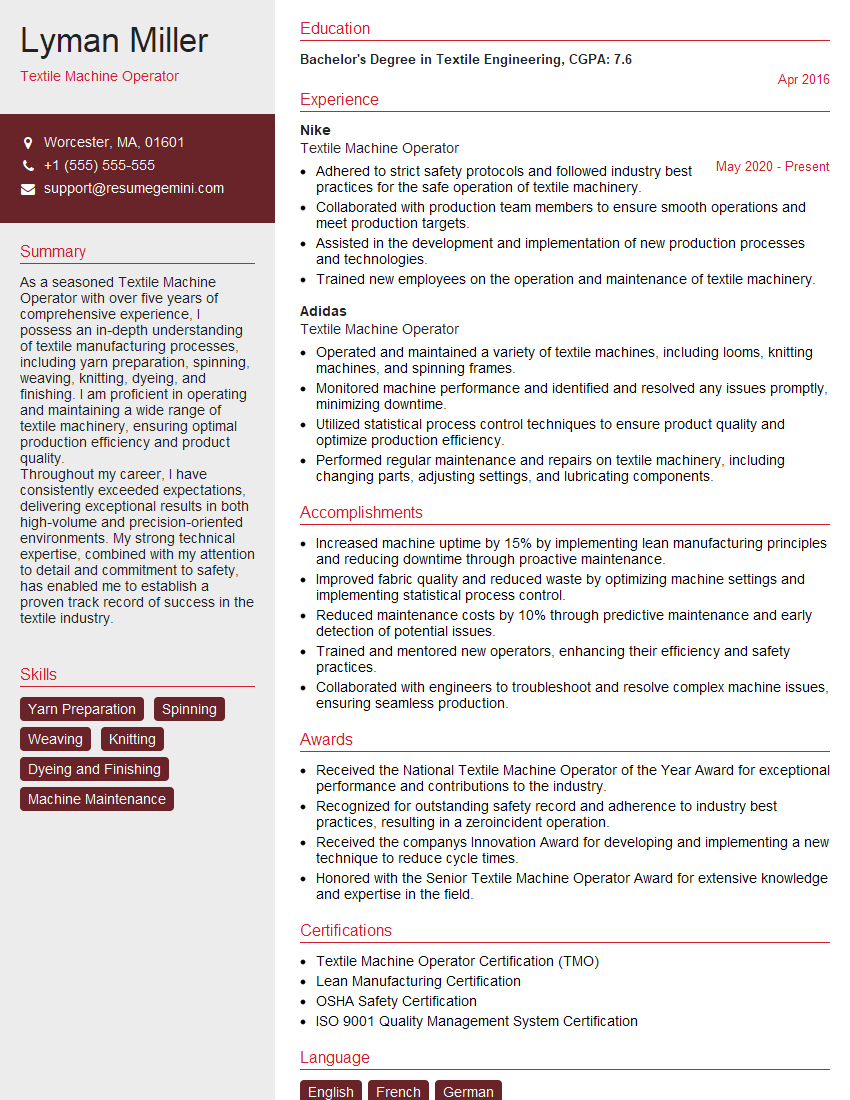
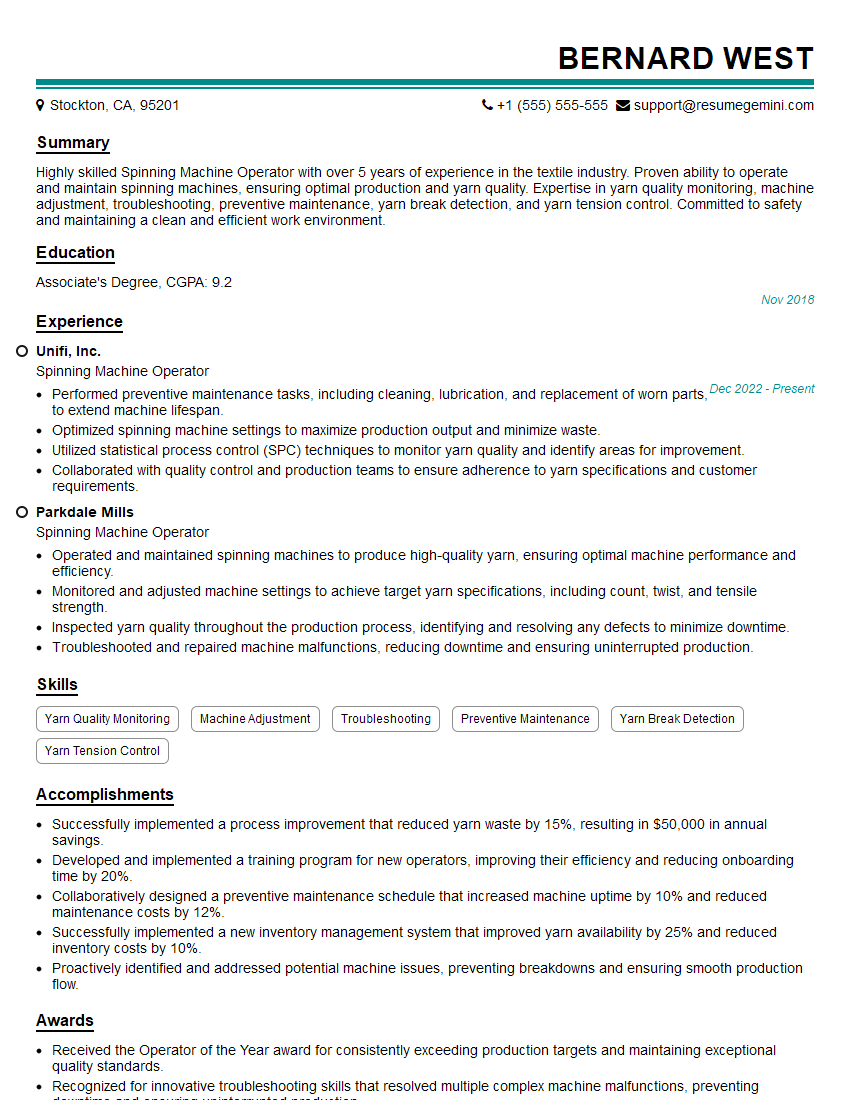
Mastering Yarn Machine Operation opens doors to a rewarding career with excellent growth potential within the textile industry. To enhance your job prospects, creating a strong, ATS-friendly resume is crucial. ResumeGemini is a trusted resource that can help you build a professional resume that highlights your skills and experience effectively. Examples of resumes tailored to Yarn Machine Operation are available to help you craft a compelling application that stands out from the competition.



Explore more articles
Users Rating of Our Blogs
Share Your Experience
We value your feedback! Please rate our content and share your thoughts (optional).
What Readers Say About Our Blog
Very informative content, great job.
good