Cracking a skill-specific interview, like one for Experience with Poultry Breeding and Genetics, requires understanding the nuances of the role. In this blog, we present the questions you’re most likely to encounter, along with insights into how to answer them effectively. Let’s ensure you’re ready to make a strong impression.
Questions Asked in Experience with Poultry Breeding and Genetics Interview
Q 1. Explain the principles of quantitative genetics in poultry breeding.
Quantitative genetics is the cornerstone of poultry breeding, focusing on the inheritance of traits controlled by many genes, each having a small effect. It uses statistical methods to understand how these genes influence economically important traits like egg production, growth rate, and meat quality. Think of it like baking a cake – the final product (trait) depends on many ingredients (genes) interacting in complex ways. We can’t see each individual gene’s contribution directly, but we can observe the overall result and use statistical models to estimate the genetic contribution to the variation we see.
Key principles include heritability (the proportion of trait variation due to genetics), genetic correlation (how genes affecting one trait also influence others), and breeding value (an estimate of an animal’s genetic merit for a specific trait). Understanding these allows breeders to predict the outcome of mating decisions and make informed selection choices to improve the flock’s overall performance. For example, high heritability for egg number means that selecting hens with high egg production will be more effective in improving egg production in the next generation, compared to a trait with low heritability.
Q 2. Describe different selection methods used in poultry breeding (e.g., mass selection, pedigree selection, progeny testing).
Several selection methods are used in poultry breeding, each with its strengths and weaknesses:
- Mass Selection: The simplest method, where individuals are selected based on their own performance. Imagine choosing the highest egg-laying hens from a flock to become parents of the next generation. It’s easy to implement, but less effective for traits with low heritability or significant environmental influence.
- Pedigree Selection: This method uses the performance of an individual’s relatives (parents, siblings) to predict its breeding value. It’s particularly useful for traits expressed later in life or difficult to measure directly. For instance, we might select a bird based on the egg production of its mother and sisters, even if the bird itself is still young.
- Progeny Testing: This involves evaluating an individual’s breeding value based on the average performance of its offspring. It’s highly effective, but time-consuming and expensive because it requires raising and measuring the performance of a large number of offspring before selecting the parent.
Often, breeders combine these methods to leverage their strengths and mitigate their weaknesses. For example, they might initially use mass selection to quickly reduce the average age at first egg, followed by progeny testing to fine-tune genetic improvement.
Q 3. What are the advantages and disadvantages of using genomic selection in poultry breeding?
Genomic selection (GS) uses DNA markers across the genome to predict an animal’s breeding value directly. It offers several advantages:
- Early Selection: Breeding values can be predicted at a very young age, accelerating the breeding cycle significantly.
- Increased Accuracy: GS can improve the accuracy of breeding value estimation, especially for traits with low heritability.
- Selection for Multiple Traits: GS allows simultaneous selection for many traits, increasing efficiency and streamlining the breeding process.
However, there are disadvantages:
- High Initial Cost: Developing and implementing GS requires substantial investment in genotyping technology and data analysis.
- Data Requirements: GS relies on large amounts of high-quality phenotypic and genotypic data, which can be challenging to acquire and manage.
- Accuracy Depends on Population Structure: GS models are trained on specific populations; their accuracy can decrease when applied to different populations.
In poultry, GS is increasingly being used for traits difficult to measure early in life, such as disease resistance or meat quality. It presents a powerful tool but requires careful planning and resource allocation.
Q 4. How do you assess the heritability of a trait in poultry?
Heritability is estimated using statistical analysis of phenotypic data from related individuals. Common methods include:
- Parent-offspring regression: Comparing the trait values of parents and their offspring. A steeper slope indicates higher heritability.
- Half-sib analysis: Comparing the trait values of individuals sharing a common parent. The variance among the half-sibs reflects the genetic variance.
- Animal models: Complex statistical models that consider the pedigree information and environmental factors to estimate heritability.
For example, if we observe a strong correlation between the egg production of hens and their daughters, this suggests that egg production has high heritability. The exact estimation requires sophisticated statistical software, such as ASReml or BLUPF90, that account for various environmental factors and the pedigree relationships within the flock.
Q 5. Explain the concept of inbreeding depression and its implications for poultry breeding.
Inbreeding depression is the reduction in fitness (survival, reproduction, and overall health) that occurs when closely related individuals mate. This is because harmful recessive genes, which are usually masked in outbred populations, become homozygous (present in two copies) in inbred offspring, leading to undesirable phenotypes. Think of it like inheriting two copies of a faulty gene – the detrimental effect becomes apparent.
In poultry breeding, inbreeding depression can manifest as reduced egg production, hatchability, chick survival, growth rate, and disease resistance. The severity depends on the level of inbreeding and the genetic architecture of the traits involved. Breeders carefully monitor inbreeding coefficients and implement strategies to minimize its impact, prioritizing genetic diversity to enhance overall flock health and productivity.
Q 6. Discuss strategies for managing genetic diversity in a poultry breeding program.
Maintaining genetic diversity is crucial for long-term breeding success. Strategies include:
- Crossbreeding: Mating individuals from different lines or breeds to introduce new genetic material and increase heterozygosity. This is analogous to mixing different types of flour in baking, enhancing the resulting product.
- Population structure management: Maintaining multiple lines or populations within the breeding program to prevent excessive inbreeding within each line.
- Cryopreservation of genetic material: Storing semen or embryos from superior individuals to preserve valuable genetic diversity and potentially reintroduce it later.
- Optimal contribution selection: Using genetic algorithms to design mating schemes that maximize genetic gain while maintaining sufficient diversity.
Modern breeding programs often use sophisticated genetic management tools to track and optimize genetic diversity, balancing the need for genetic gain with the prevention of inbreeding depression. This ensures the long-term viability and success of the poultry population.
Q 7. What are the common challenges in estimating breeding values in poultry?
Estimating breeding values accurately in poultry presents several challenges:
- Environmental effects: Traits are influenced by numerous environmental factors (nutrition, climate, disease), which can confound the estimation of genetic effects. For example, poor nutrition might mask the true genetic potential of a high-growth bird.
- Maternal effects: The mother’s genotype and environment can influence the phenotype of her offspring, making it challenging to separate maternal effects from direct genetic effects. A hen’s excellent egg production might be due to her genes or her superior ability to provide nutrients.
- Measurement error: Inaccurate or incomplete phenotypic data can lead to biased estimates of breeding values. For instance, inconsistent weighing of birds can lead to errors in growth rate estimates.
- Genotype x environment interactions: The expression of a gene can differ across different environments, making it difficult to estimate breeding values universally applicable across farms.
Breeders address these challenges using sophisticated statistical models that account for environmental factors, maternal effects, and genotype x environment interactions. Accurate data collection and management are crucial to minimize errors and improve the accuracy of breeding value estimations.
Q 8. How do you design a mating system to improve specific traits in poultry?
Designing a mating system for poultry improvement hinges on understanding the heritability of the desired traits and employing appropriate breeding strategies. For instance, if we want to increase egg production, we’d focus on hens with high laying rates. We can use several methods:
- Mass Selection: Selecting the best individuals based on their phenotype (observable characteristics) for mating. This is simple but less precise.
- Pedigree Selection: Tracking family lines to identify superior genetic lineages. This is more accurate as it considers the genetic merit of ancestors.
- Progeny Testing: Evaluating the offspring of potential parents to gauge their breeding value. This method is particularly effective for traits with low heritability.
- Inbreeding: Mating closely related individuals to increase homozygosity and fix desirable genes. However, inbreeding can also increase the risk of recessive genetic disorders, so careful monitoring is crucial.
- Crossbreeding: Mating individuals from different breeds to exploit hybrid vigor (heterosis), enhancing traits like growth rate and disease resistance. This is often used to create commercial broiler breeds.
- Selection Index: A statistical approach that combines multiple traits into a single score, enabling simultaneous improvement of several traits. For example, we might combine egg production, egg weight, and feed efficiency into a single index.
The choice of mating system depends on factors like the heritability of the trait, the availability of resources, and the desired level of genetic improvement. For example, in a small-scale operation, mass selection might be suitable, while large-scale commercial operations often utilize complex selection indices and progeny testing.
Q 9. What are the ethical considerations in poultry breeding?
Ethical considerations in poultry breeding are paramount. We must prioritize animal welfare throughout the entire process. Key concerns include:
- Minimizing suffering: Breeding programs should avoid practices that cause unnecessary pain, distress, or injury to birds. This includes careful management of breeding environments, avoiding harsh selection criteria, and providing appropriate veterinary care.
- Genetic diversity: Maintaining genetic diversity within breeds is vital to prevent inbreeding depression and to adapt to changing environmental conditions and disease challenges. Loss of genetic diversity can compromise the long-term health and resilience of the population.
- Sustainable practices: Breeding programs should be environmentally sustainable, minimizing the environmental impact of poultry production. This includes reducing the reliance on antibiotics and minimizing waste.
- Transparency and traceability: Openness about breeding practices and clear traceability of breeding lines are important for consumer confidence and accountability.
- Responsible use of technology: The application of genetic engineering and other advanced technologies in poultry breeding must be carefully considered, adhering to strict ethical guidelines and regulations to prevent unintended consequences.
Ethical breeding practices require a multidisciplinary approach involving geneticists, veterinarians, animal welfare experts, and policymakers, working collaboratively to ensure responsible and sustainable poultry production.
Q 10. Describe your experience with different poultry breeds and their characteristics.
My experience encompasses a wide range of poultry breeds, each with unique characteristics. For example:
- Leghorn: Known for their high egg production, Leghorns are a popular choice for commercial egg layers. They are typically white, active, and relatively small.
- Rhode Island Red: A dual-purpose breed, Rhode Island Reds are valued for both their egg production and meat quality. They are hardy, adaptable, and known for their reddish-brown plumage.
- Cornish: These birds are known for their fast growth rate and meat production, making them a cornerstone of the broiler industry. They are typically heavier and less active than layer breeds.
- Brahma: This is a large, feathered breed, prized for its ornamental qualities. While not known for high egg production or meat yield, their hardiness and unique appearance make them popular among hobbyists.
Understanding the specific strengths and weaknesses of each breed is crucial for making informed breeding decisions. For instance, a cross between a fast-growing broiler breed and a disease-resistant breed can result in offspring with improved overall performance. This is how many commercial hybrids are developed.
Q 11. How do you evaluate the economic value of a genetic improvement program?
Evaluating the economic value of a genetic improvement program requires a comprehensive approach. We need to consider both the costs and benefits.
- Costs: These include expenses related to breeding stock, research and development, personnel, facilities, and data analysis.
- Benefits: These are typically measured in increased production efficiency and reduced costs. For example, improved feed conversion ratios (the amount of feed required to produce a unit of meat or eggs), increased growth rates, enhanced disease resistance, and better egg quality all contribute to higher profitability.
We can use various economic models, such as cost-benefit analysis or net present value calculations, to estimate the return on investment (ROI) of the genetic improvement program. Factors like the market price of poultry products, the length of the breeding cycle, and the rate of genetic gain must be incorporated into these models. A successful program will demonstrate a positive ROI, meaning the benefits outweigh the costs over the program’s lifespan.
For example, a 1% improvement in feed conversion ratio can translate to significant savings in a large-scale poultry operation.
Q 12. Explain different methods for assessing reproductive performance in poultry.
Assessing reproductive performance in poultry involves analyzing several key parameters:
- Fertility: The percentage of eggs that are fertilized. This can be determined by candling eggs to assess the presence of an embryo.
- Hatchability: The percentage of fertile eggs that hatch successfully. Factors affecting hatchability include incubation conditions, egg quality, and genetic factors.
- Egg production rate: The number of eggs laid per hen per year. This is a crucial indicator of laying hen performance.
- Egg weight: The average weight of eggs laid. Larger eggs command higher market prices.
- Egg quality: This includes factors like shell strength, yolk color, and albumen quality. These attributes affect the market value and consumer acceptance of the eggs.
- Broodiness: The tendency of hens to sit on their eggs to incubate them. This trait can be advantageous in some breeding situations but detrimental in commercial egg production.
These parameters are often analyzed using statistical methods to identify genetic factors influencing reproductive traits and to select superior breeding birds. Data is usually collected using routine record-keeping and performance testing across generations.
Q 13. Discuss the role of molecular markers in poultry breeding.
Molecular markers play a significant role in modern poultry breeding, allowing us to identify genes associated with desirable traits. These markers can be DNA sequences, such as:
- Single nucleotide polymorphisms (SNPs): These are variations in a single nucleotide base in the DNA sequence. SNPs are abundant throughout the genome and are relatively easy to assay.
- Microsatellites: These are short, repetitive DNA sequences that show high variability between individuals. They can be useful for parentage testing and identifying genetic diversity.
By associating markers with specific traits (using techniques like genome-wide association studies or GWAS), we can use them for:
- Marker-assisted selection (MAS): This involves selecting individuals based on their marker genotype, rather than solely on their phenotype. MAS can improve selection accuracy, especially for traits that are difficult or expensive to measure.
- Genomic selection (GS): A more advanced technique that uses genome-wide marker data to predict the breeding value of individuals. GS is particularly useful for traits with low heritability or complex genetic architecture.
Molecular markers significantly accelerate the genetic improvement process by increasing selection accuracy and efficiency. This leads to faster progress and a more targeted selection of desirable traits.
Q 14. How do you analyze data from poultry breeding experiments?
Analyzing data from poultry breeding experiments usually involves a multi-step process combining statistical modeling and visualization.
- Data Collection: Meticulous record-keeping is crucial. This includes data on pedigree, phenotypes (e.g., egg production, body weight), and genotypes (if molecular markers are used).
- Data Cleaning: Identifying and correcting errors or outliers in the dataset is essential for accurate analysis.
- Statistical Analysis: Depending on the research question, various statistical methods are employed. These include:
- Analysis of Variance (ANOVA): To compare the means of different groups (e.g., different breeds or treatment groups).
- Regression analysis: To model the relationship between variables (e.g., the relationship between genotype and phenotype).
- Mixed models: To account for the hierarchical structure of data, considering factors like family relationships and environmental effects.
- Quantitative Trait Loci (QTL) mapping: To identify chromosomal regions associated with specific quantitative traits.
- Data Visualization: Presenting the results in clear and understandable graphs and tables is crucial for effective communication. This includes creating histograms, scatter plots, and other appropriate visualizations.
- Interpretation and Conclusion: The results of the analysis are carefully interpreted to draw conclusions about the effectiveness of the breeding program and to inform future breeding strategies.
Software packages like R, SAS, or specialized animal breeding software are commonly used for these analyses. The choice of statistical methods and software depends on the experimental design, the type of data collected, and the research objectives.
Q 15. What are your experiences with different statistical software packages used in poultry genetics?
Throughout my career in poultry genetics, I’ve extensively used several statistical software packages. My proficiency spans from basic descriptive statistics to advanced mixed-model analyses crucial for genetic evaluations. I’m highly proficient in ASReml (for its power in handling complex datasets with numerous random effects, common in animal breeding), and R (leveraging packages like ‘lme4’ and ‘sommer’ for similar analyses and its vast flexibility for data visualization and custom script development). I’ve also utilized SAS in the past, particularly when working with large-scale datasets and requiring robust procedures for quantitative genetics analyses, such as best linear unbiased prediction (BLUP) for evaluating breeding values. My experience extends to using these tools to analyze data from diverse poultry breeding programs, involving traits ranging from egg production and body weight to disease resistance and meat quality. For example, in one project involving broiler chickens, I used ASReml to analyze data from a large pedigree, modeling the genetic effects of multiple traits simultaneously to improve the accuracy of breeding value estimations.
Career Expert Tips:
- Ace those interviews! Prepare effectively by reviewing the Top 50 Most Common Interview Questions on ResumeGemini.
- Navigate your job search with confidence! Explore a wide range of Career Tips on ResumeGemini. Learn about common challenges and recommendations to overcome them.
- Craft the perfect resume! Master the Art of Resume Writing with ResumeGemini’s guide. Showcase your unique qualifications and achievements effectively.
- Don’t miss out on holiday savings! Build your dream resume with ResumeGemini’s ATS optimized templates.
Q 16. Describe your experience with poultry breeding databases and management systems.
My experience with poultry breeding databases and management systems is extensive. I’ve worked with both proprietary and open-source systems, focusing on their application in managing pedigree information, phenotypic data, and genomic data. I’m familiar with systems that incorporate features like individual animal tracking, performance recording, and data quality control. For example, I’ve used pedigree management software to track family lines and ensure accurate genetic relationship matrices are created for genomic selection. In several projects, I’ve been involved in developing and improving these database systems to streamline data flow and improve analysis efficiency. The transition to cloud-based solutions has significantly changed how data is handled, and I’ve successfully integrated cloud technologies for data storage, collaboration, and analysis, ensuring data integrity and security. One key aspect is familiarity with different data formats (e.g., .csv, .ped, .map) and the ability to manipulate and clean data effectively before analysis.
Q 17. How do you manage and interpret genomic data in poultry breeding?
Managing and interpreting genomic data in poultry breeding requires a multi-step approach. It starts with data quality control, identifying and removing outliers or erroneous data points. Then, I use various bioinformatics tools to perform quality control checks on the genotypes. This includes assessing genotyping call rates, minor allele frequencies, and population stratification. The core analysis focuses on Genome-Wide Association Studies (GWAS) to identify genomic regions associated with traits of interest. I typically use software like PLINK and GCTA for GWAS analysis and subsequently use the identified SNPs in genomic prediction models using methods like GBLUP (Genomic Best Linear Unbiased Prediction) or Bayesian approaches. I then utilize these predictions to inform selection decisions. For instance, I once worked on a project where we identified SNPs associated with resistance to a specific avian disease, which we subsequently incorporated into a genomic selection index for improved disease resistance in the breeding program.
Q 18. What is your experience with marker-assisted selection (MAS)?
Marker-assisted selection (MAS) is a powerful tool that allows for the incorporation of genetic marker information into selection decisions. My experience includes designing and implementing MAS schemes using various types of markers, including SNPs (Single Nucleotide Polymorphisms) and microsatellites. The process begins with identifying markers linked to genes controlling traits of interest. This typically requires conducting GWAS. Once suitable markers are identified, their information is included into selection indices or used to directly select candidates with favorable genotypes. A key aspect is accounting for marker linkage disequilibrium (LD) – the non-random association of alleles at different loci – to optimize the selection process. In one project, we implemented MAS to select chickens for improved feed efficiency by incorporating markers linked to genes associated with digestion and metabolism. This resulted in a faster and more accurate selection process compared to traditional phenotypic selection.
Q 19. Explain the concept of genetic correlation and its importance in poultry breeding.
Genetic correlation refers to the relationship between the breeding values of two different traits. A positive genetic correlation means that superior animals for one trait tend to be superior for the other trait, while a negative correlation indicates the opposite. Understanding genetic correlations is crucial in poultry breeding because it helps predict the response to selection for one trait on another trait. For example, a positive correlation between egg production and egg size means selecting for higher egg production will likely increase egg size as well. Conversely, a negative correlation between growth rate and feed efficiency necessitates careful consideration of selection strategies to avoid undesirable outcomes. I often use multi-trait animal models to estimate genetic correlations, helping breeders to develop efficient breeding programs that consider the interconnectedness of various economically important traits.
Q 20. How do you identify and select superior breeding candidates using different selection indices?
Identifying and selecting superior breeding candidates involves employing different selection indices, which combine information on multiple traits. The choice of index depends on the traits’ economic values and their genetic correlations. Common indices include the index, where weights are assigned based on the relative economic importance of each trait. I also use BLUP (Best Linear Unbiased Prediction) and genomic selection (GS) approaches to estimate breeding values and select animals with higher predicted genetic merit. When using genomic selection, genomic estimated breeding values (GEBV) replace traditional breeding values, taking advantage of all available genomic information to create more accurate predictions. The process involves evaluating the performance data of numerous candidates, generating predictions based on the chosen index or model, and then ranking the candidates based on their predicted merit, prioritizing those with the highest predicted values. Furthermore, I use simulation studies to test the effectiveness of different selection indices under different scenarios to optimize breeding strategies.
Q 21. Discuss the impact of environmental factors on poultry performance and breeding decisions.
Environmental factors significantly impact poultry performance and breeding decisions. Factors like temperature, humidity, housing conditions, and nutrition affect growth rate, feed efficiency, egg production, and disease resistance. Failure to account for environmental variations can lead to inaccurate evaluations of genetic merit and ineffective selection programs. Therefore, carefully designed experimental designs and statistical models (often including environmental covariates) are essential to disentangle genetic and environmental effects. For example, when analyzing egg production data, I would include factors such as season, hen age, and flock size as covariates in my statistical models to adjust for environmental influence. Understanding these environmental impacts is vital for making informed breeding decisions and developing resilient poultry lines capable of performing well across different environments. I regularly incorporate environmental data into my analyses to generate more accurate estimations of breeding values and make more effective breeding decisions.
Q 22. How do you handle unexpected problems or challenges in a poultry breeding program?
Unexpected challenges are inevitable in poultry breeding. My approach centers on proactive risk management and a robust problem-solving framework. First, I establish a comprehensive monitoring system for key performance indicators (KPIs) like mortality rates, feed conversion ratios, and egg production. Any deviation from established norms triggers an immediate investigation.
For instance, a sudden increase in mortality might indicate a disease outbreak. My response would involve rapid diagnostic testing, isolating affected birds, implementing biosecurity measures, and possibly consulting with veterinary specialists. A drop in egg production could be due to nutritional deficiencies, environmental stress, or reproductive issues, necessitating adjustments to feed formulation, environmental controls, or breeding strategies.
Problem-solving involves a systematic approach: 1) Identify the problem precisely, collecting data; 2) Analyze potential causes through various analyses (e.g., blood tests, genetic screening); 3) Develop and implement solutions (e.g., vaccination, culling, genetic selection); 4) Monitor the effectiveness of implemented solutions and adapt as needed; 5) Document findings for future reference and improvement. This structured approach ensures that challenges are addressed efficiently and effectively, minimizing losses and informing future breeding decisions.
Q 23. Describe your experience in developing and implementing a poultry breeding program.
I’ve been involved in several poultry breeding programs, from initial design to final implementation. One notable project focused on developing a broiler line with improved feed efficiency and breast meat yield. The program started with a thorough genetic evaluation of existing lines, identifying superior individuals based on performance data and pedigree analysis. We then employed a selective breeding program, meticulously tracking the performance of offspring across multiple generations.
This involved implementing advanced statistical methods such as best linear unbiased prediction (BLUP) to estimate breeding values and make informed selection decisions. We also utilized genomic selection techniques, leveraging DNA markers to predict the genetic merit of individuals more accurately than traditional pedigree-based methods. The program involved careful management of breeding stock, rigorous data collection, and regular performance evaluation. The success of the program was measured by a significant increase in feed efficiency and breast meat yield in the final lines, demonstrating the effectiveness of our breeding strategy. This involved close collaboration with nutritionists and poultry health experts to optimize other factors influencing performance.
Q 24. What are your experiences with disease resistance in poultry breeding?
Disease resistance is paramount in poultry breeding. My experience encompasses both traditional and modern approaches. Traditional methods include selecting birds that have naturally survived disease outbreaks, a form of natural selection. We also utilize marker-assisted selection (MAS) to identify genes associated with disease resistance, allowing for more efficient and accurate selection.
For example, we used MAS to select for resistance to avian influenza. We identified specific genetic markers linked to increased resistance, allowing us to identify superior breeding candidates even before they’re exposed to the virus. This reduced the risk of widespread outbreaks and improved the overall health and productivity of the flock. Modern techniques, such as genome-wide association studies (GWAS), allow for even more precise identification of genes responsible for disease resistance, enabling us to create birds with enhanced resilience against various pathogens. We also consider the interplay between genetics and environmental factors, optimizing husbandry practices to complement the genetic improvements in disease resistance.
Q 25. Discuss your knowledge of different poultry production systems and their implications for breeding strategies.
Poultry production systems vary greatly, influencing breeding strategies. Intensive systems, characterized by high stocking densities, require birds with robust health and stress tolerance. Breeding programs for these systems prioritize disease resistance, efficient feed conversion, and heat tolerance.
In contrast, free-range or pasture-based systems demand birds with foraging ability, resilience to parasites and predators, and adaptability to variable environmental conditions. Breeding strategies in this context will focus on traits like foraging behavior, natural disease resistance, and adaptability to different climates and environments. The breeding objectives must always align with the specific requirements of the chosen production system to maximize efficiency and profitability. For instance, birds selected for intensive systems might not perform well in free-range systems, demonstrating the need to carefully tailor breeding programs.
Q 26. How familiar are you with the latest advancements in poultry genomics and breeding technologies?
I’m highly familiar with the latest advancements in poultry genomics and breeding technologies. These include high-throughput genotyping technologies, allowing for cost-effective genome-wide analysis of large populations. Genomic selection, using dense SNP markers to predict breeding values, significantly improves selection accuracy compared to traditional methods.
Furthermore, CRISPR-Cas9 gene editing technology offers exciting possibilities for targeted genetic modifications. While its application in poultry breeding is still relatively new, it holds great potential for improving traits such as disease resistance and meat quality. I am constantly updating my knowledge through scientific publications, industry conferences, and collaborations with researchers at the forefront of these technologies. Understanding and implementing these advanced techniques are essential for developing superior poultry lines that are more productive, resilient, and sustainable.
Q 27. What are your career goals related to poultry breeding and genetics?
My career goals are centered on advancing the field of poultry breeding and genetics to contribute to a more sustainable and efficient poultry industry. I aim to lead innovative research projects focusing on developing poultry lines with enhanced disease resistance, improved feed efficiency, and enhanced welfare. This involves leveraging the latest genomic and breeding technologies to achieve significant improvements in these areas.
Furthermore, I strive to mentor and train the next generation of poultry geneticists, promoting collaboration and knowledge sharing within the field. I am also passionate about disseminating research findings to a broader audience, including producers and policymakers, to ensure the practical application of scientific advances. Ultimately, I envision contributing to a global food system that is both productive and responsible, ensuring food security while minimizing the environmental impact of poultry production.
Q 28. Describe your experience with collaborating with other researchers and stakeholders in poultry breeding projects.
Collaboration is essential in poultry breeding. I have a strong track record of working effectively with researchers from diverse disciplines, including geneticists, nutritionists, veterinarians, and economists. In one project, we collaborated with a team of epidemiologists to develop a disease surveillance system, effectively identifying and mitigating potential outbreaks. This involved sharing data, expertise, and resources to achieve a common goal.
My experience also encompasses successful collaborations with industry stakeholders, including poultry breeders, producers, and processors. This involved translating research findings into practical recommendations for improving farm management practices and breeding strategies. Open communication and mutual respect are fundamental to successful collaboration. I believe that diverse perspectives and expertise can significantly enhance the impact of research and accelerate the development of improved poultry lines.
Key Topics to Learn for Experience with Poultry Breeding and Genetics Interview
- Poultry Genetics Fundamentals: Understanding Mendelian inheritance, quantitative genetics, and the genetic basis of economically important traits (e.g., egg production, growth rate, disease resistance).
- Breeding Programs and Selection Methods: Familiarity with various selection indices, genomic selection, marker-assisted selection, and their practical application in improving poultry breeds.
- Quantitative Trait Loci (QTL) Mapping and Analysis: Understanding the principles of QTL mapping and its role in identifying genes affecting important traits. Experience with statistical software for QTL analysis is beneficial.
- Molecular Genetics Techniques: Knowledge of PCR, DNA sequencing, and other molecular techniques used in poultry genetic research and breeding programs.
- Population Genetics and Breeding Strategies: Understanding concepts like inbreeding depression, heterosis, and the development and management of breeding populations.
- Practical Application: Experience designing and implementing breeding programs, analyzing data from breeding trials, and interpreting results to make informed breeding decisions.
- Problem-Solving: Demonstrating ability to troubleshoot issues related to breeding programs, data analysis, and genetic interpretation. Be prepared to discuss challenges faced and solutions implemented.
- Industry Trends and Technologies: Staying updated on advancements in poultry genetics, including genomic technologies and their applications in the poultry industry.
Next Steps
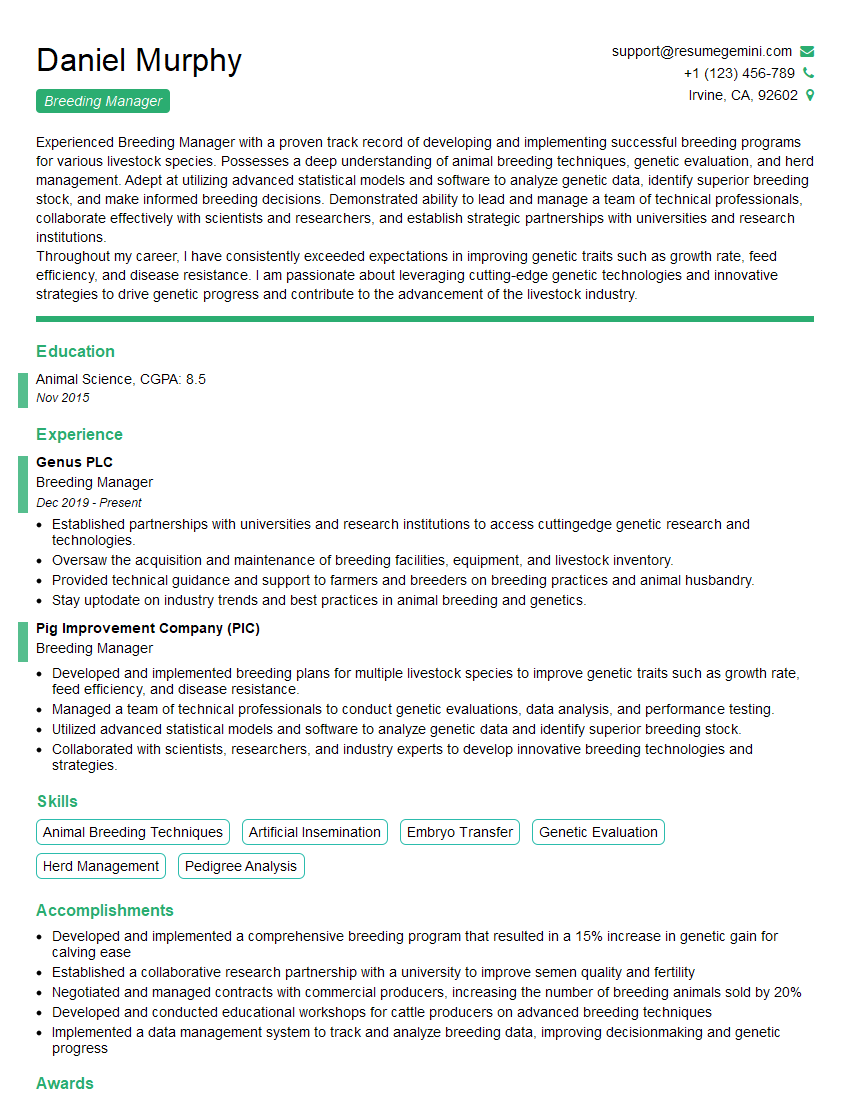
Mastering poultry breeding and genetics significantly enhances your career prospects in the agriculture and biotechnology sectors, opening doors to diverse and rewarding roles. A strong resume is crucial for showcasing your expertise and securing your ideal position. Creating an ATS-friendly resume is paramount to ensuring your application gets noticed by recruiters. We recommend using ResumeGemini, a trusted resource, to build a professional and impactful resume that highlights your skills and experience effectively. Examples of resumes tailored to Experience with Poultry Breeding and Genetics are provided to help guide your preparation.
Explore more articles
Users Rating of Our Blogs
Share Your Experience
We value your feedback! Please rate our content and share your thoughts (optional).
What Readers Say About Our Blog
Very informative content, great job.
good