Interviews are opportunities to demonstrate your expertise, and this guide is here to help you shine. Explore the essential Experience with solar project troubleshooting and repair interview questions that employers frequently ask, paired with strategies for crafting responses that set you apart from the competition.
Questions Asked in Experience with solar project troubleshooting and repair Interview
Q 1. Describe your experience troubleshooting faulty solar panels.
Troubleshooting faulty solar panels begins with visual inspection. I look for obvious signs of damage like cracks, hotspots (discolored areas indicating cell failure), or debris accumulation. Then, I use a multimeter to measure the voltage and current of each individual panel within a string. A significant drop in voltage or current compared to other panels in the same string strongly indicates a faulty panel. For example, if a string of panels is producing 300V and one panel shows only 10V, it’s likely the culprit. Further investigation might involve infrared thermography to pinpoint hotspots, which are invisible to the naked eye, but reveal internal cell damage. If a panel is confirmed faulty, I’ll verify the manufacturer’s warranty and arrange for replacement.
One memorable case involved a system exhibiting inconsistent power output. After the initial visual inspection proved fruitless, I employed infrared thermography and discovered a small, almost imperceptible crack in one cell of a panel. This crack, invisible to the eye, was causing a significant power loss. This highlights the importance of utilizing multiple diagnostic techniques.
Q 2. How do you diagnose problems with solar inverters?
Diagnosing inverter problems often starts by checking the inverter’s display for error codes. These codes provide valuable clues to the problem’s source. Next, I check the AC output of the inverter using a multimeter. No AC output indicates a problem within the inverter itself. I also check the DC input from the solar array. A low DC input might point to a problem with the panels or the wiring, while a high DC input could indicate a problem with the inverter’s maximum power point tracking (MPPT) algorithm. Finally, I examine the inverter’s cooling system, ensuring proper ventilation and the absence of any overheating. A common cause of inverter failure is overheating due to dust accumulation or poor ventilation. I’ll frequently check the manufacturer’s specifications for acceptable operating temperatures.
For instance, I once worked on a system where the inverter was tripping frequently. The error code indicated an over-temperature condition. After inspecting the inverter, I found that dust had accumulated significantly, restricting airflow and leading to overheating. Cleaning the inverter and ensuring proper ventilation resolved the issue.
Q 3. Explain the process of testing solar panel strings for voltage and current.
Testing solar panel strings involves systematically measuring the voltage and current at various points in the string. I start by disconnecting the string from the inverter to isolate it for safe testing. Then, using a multimeter capable of measuring both DC voltage and current, I measure the voltage at the beginning and end of the string. A significant voltage drop across the string indicates a problem. Next, I measure the current flowing through the string. Low current, even with a good voltage, could indicate shading or other issues affecting the panels’ performance. To pinpoint problems within the string, I’ll then test each individual panel’s voltage and current. This is done systematically, working through each panel one-by-one to find the source of any drop in output.
Think of it like testing a series of batteries in a flashlight; if one battery is weak, the entire circuit will be affected. The same principle applies to solar panel strings.
Q 4. What are the common causes of low solar panel output?
Low solar panel output has several common causes. The most frequent is shading. Even partial shading of a single panel can significantly reduce the entire string’s output due to the series connection of panels. Another common cause is dirty panels; dust, bird droppings, and pollen accumulate on the panels, reducing their ability to absorb sunlight. Faulty panels, as discussed earlier, are another major contributor. Wiring problems, including loose connections, corrosion, or damaged cables, can also severely restrict power flow. Finally, environmental factors like temperature and the angle of the sun (affecting the amount of solar irradiance) can also influence output. Comprehensive testing is crucial to pinpoint the exact cause.
I once encountered a system with dramatically lower than expected output. After initial checks, it turned out that a large tree branch had recently grown over part of the array, causing substantial shading. Trimming the branch completely restored the system’s performance, emphasizing the importance of regular array inspection.
Q 5. How do you identify and resolve issues with solar array grounding?
Grounding issues in solar arrays can lead to safety hazards and performance problems. I use a multimeter to test the continuity between the grounding points of the array and the earth ground. A high resistance reading indicates a grounding problem. The issues can range from loose connections at the ground rod, corrosion on the grounding wire, or a damaged grounding wire itself. I also visually inspect the grounding wire and connections for any signs of damage or corrosion. Proper grounding is essential for safety, ensuring that the array is properly earthed to prevent electrical shocks in case of a fault. If a grounding problem is identified, I will replace any corroded or damaged wires, ensuring all connections are tight and clean.
A reliable ground is essential for both safety and performance, acting as a path for fault currents, ensuring the safety of personnel working on the system and preventing potential damage to equipment.
Q 6. Describe your experience with diagnosing and repairing DC wiring issues in a solar system.
Diagnosing DC wiring problems typically involves visually inspecting all the wiring for signs of damage, loose connections, or corrosion. I use a multimeter to measure the voltage at various points along the wiring to identify voltage drops, which point to the location of the fault. A significant voltage drop indicates a problem with the wiring, whether it’s a loose connection, a break in the wire, or corrosion causing high resistance. Infrared thermography can also help identify overheating in the wiring, caused by high resistance due to loose connections or damaged insulation. Repairing these issues might involve tightening loose connections, replacing damaged sections of wiring, or addressing corrosion.
In one instance, an intermittent power outage plagued a system. Using infrared imaging, we detected a hotspot on a section of DC wiring that had deteriorated insulation due to prolonged exposure to sunlight. Replacing the damaged section resolved the intermittent power loss.
Q 7. How do you troubleshoot problems with solar system monitoring systems?
Troubleshooting solar system monitoring systems starts by checking the network connection – ensuring the system is properly connected to the internet or local network. Next, I’ll check the system’s software and firmware for any error messages or updates needed. If the monitoring system shows inconsistent or incorrect data, I’ll verify the data from the inverters and other components using separate measurements with a multimeter. This helps determine if the issue is with the monitoring system itself or the solar array. If the problem stems from the monitoring system, I investigate the system’s configuration settings, looking for incorrect parameters or settings. If the issue persists, I might need to contact the system’s manufacturer for support or a system reset or replacement might be needed.
Remember, data inconsistency could be indicative of problems with individual components, which then need to be diagnosed separately. Data is a great starting point but not the only tool.
Q 8. What safety precautions do you take when working on a solar panel array?
Safety is paramount when working with solar arrays. Think of it like this: you’re working with high voltage DC electricity, and potentially hazardous materials. My standard safety procedure begins with a thorough site survey to identify potential hazards, such as overhead power lines, uneven terrain, and wildlife. Then, I always use appropriate personal protective equipment (PPE), including insulated gloves, safety glasses, arc flash protective clothing, and steel-toed boots. Before touching any component, I ensure the system is completely de-energized by using a qualified DC voltage tester and locking out and tagging out the disconnect switches. I also communicate clearly with my team and any other workers on site, establishing a clear communication protocol to avoid accidents. Finally, I always follow the manufacturer’s safety guidelines for all equipment. For example, I would never work on a wet or snowy roof without additional safety measures.
Q 9. Explain the process of replacing a faulty solar panel.
Replacing a faulty solar panel involves several steps. First, I’d visually inspect the panel for obvious damage, like cracks or hotspots. Then, using the same safety procedures mentioned earlier, I de-energize the system. Next, I carefully disconnect the panel’s wiring harness, usually using a specialized DC disconnect tool to avoid accidental contact. The panel’s mounting system, whether it’s a rail system or a clamp, is then detached, carefully lowering the panel to the ground. Installing the new panel is the reverse of this process; attaching the mounting, reconnecting the wiring, and ensuring proper grounding. After installation, I rigorously test the new panel’s output and system performance to ensure proper functionality and integration. I once had to replace a panel that was damaged by a falling tree branch. It was a tricky situation, but following these steps ensured a safe and efficient replacement.
Q 10. How do you test the functionality of a solar charge controller?
Testing a solar charge controller involves verifying its voltage, current, and temperature readings. I’d start by checking the battery voltage to ensure it’s within the controller’s operating range. Then, I use a multimeter to measure the input voltage from the solar array and the output voltage to the battery. The current readings (both input and output) are also crucial, confirming the charge controller is regulating power flow efficiently. Temperature monitoring is critical, as overheating can indicate a problem. Many modern controllers have built-in monitoring systems with digital displays, but a clamp-on ammeter and infrared thermometer can provide additional data points. Significant discrepancies between expected and measured values point to a faulty controller – perhaps a short circuit or a failing component. For instance, I once diagnosed a faulty controller when I found that the output voltage was significantly lower than the input, indicating a problem with the internal circuitry.
Q 11. What are the common causes of overheating in solar inverters?
Overheating in solar inverters is often due to a combination of factors. Excessive dust accumulation on cooling fins hinders heat dissipation. This is common in dusty environments. Another cause is a faulty cooling fan—the most obvious cause. Furthermore, shading on the PV array can cause the inverter to work harder to process the uneven power input, leading to overheating. Inefficient ventilation around the inverter, for example, being installed in a poorly ventilated space, can also contribute. Finally, internal component failure within the inverter itself can generate excess heat. I recommend regularly inspecting inverters for dust and debris buildup and ensuring adequate ventilation. A preventative maintenance plan is critical to extending the lifespan of inverters. For example, I had a case where an inverter constantly overheated because it was installed in an enclosed space with poor airflow.
Q 12. How do you diagnose and repair issues with solar system racking and mounting?
Diagnosing issues with racking and mounting often begins with a visual inspection, looking for loose bolts, corrosion, or damage from weather or impacts. I check for signs of stress on the mounting structure or any misalignment. Using a level, I confirm the proper tilt and orientation of the array. Loose bolts or corroded connections are tightened or replaced. Misalignment can often be corrected by adjusting the mounting hardware. For significant structural damage, professional engineers may need to assess the repair options, which might involve replacing sections of the racking system. I once encountered a situation where high winds had loosened several bolts on a mounting system. Prompt detection and tightening prevented a potentially catastrophic failure.
Q 13. Describe your experience with using diagnostic tools for solar systems.
My experience with diagnostic tools spans a variety of instruments. I regularly use multimeters to measure voltage, current, and resistance. Clamp-on meters provide accurate current measurements without disconnecting wires. I employ infrared thermometers to identify overheating components. Specialized solar system monitoring software provides real-time system performance data and helps pinpoint potential issues. Data loggers record long-term system performance trends, allowing me to identify intermittent issues that might not be immediately apparent. Data from these tools provides crucial information to interpret the health and functioning of the entire system. For example, using a data logger, I once identified an intermittent fault in a string of solar panels that was only happening under specific temperature conditions.
Q 14. How do you interpret solar system performance data?
Interpreting solar system performance data involves analyzing several key metrics. Power output (kW) shows the current power generation. Energy yield (kWh) indicates the total energy produced over a period. Performance ratios compare actual energy production to potential production, revealing losses due to shading, soiling, or equipment malfunction. I also look at voltage and current data to assess the health of individual panels and strings. Comparing daily and monthly energy production against historical data reveals trends and identifies potential issues, such as panel degradation or system faults. For example, a sudden drop in energy yield might indicate a faulty inverter or a significant amount of shading. A consistent underperformance compared to the system’s capacity might point towards issues with the solar panels themselves, or insufficient cleaning.
Q 15. Explain the different types of solar panel defects and their troubleshooting methods.
Solar panel defects can range from minor issues to significant failures. Common defects include cracked cells, hotspots (localized overheating), delamination (separation of layers within the panel), bypass diode failures, and shading effects. Troubleshooting involves a systematic approach. First, a visual inspection is crucial to identify physical damage like cracks or discoloration. Infrared thermography can detect hotspots, which are often caused by a shadowed cell or a faulty diode. A multimeter can check for voltage and current output from individual panels and strings, pinpointing the affected areas. For example, a significantly lower voltage from one panel compared to others suggests a problem within that specific panel. If a diode is faulty, the affected panel might still produce some power, but at a reduced level. Replacing damaged panels or individual cells is the usual solution, and sometimes bypass diodes need to be repaired or replaced as well.
- Cracked Cells: Visible cracks reduce output; replacement is necessary.
- Hotspots: Detected by infrared scans; indicates a cell or bypass diode problem; repair or panel replacement required.
- Delamination: Reduces efficiency; usually requires panel replacement, though not always immediately critical.
- Bypass Diode Failure: Reduces the output of the affected string or panel but may not immediately shut it down; can sometimes be repaired.
Career Expert Tips:
- Ace those interviews! Prepare effectively by reviewing the Top 50 Most Common Interview Questions on ResumeGemini.
- Navigate your job search with confidence! Explore a wide range of Career Tips on ResumeGemini. Learn about common challenges and recommendations to overcome them.
- Craft the perfect resume! Master the Art of Resume Writing with ResumeGemini’s guide. Showcase your unique qualifications and achievements effectively.
- Don’t miss out on holiday savings! Build your dream resume with ResumeGemini’s ATS optimized templates.
Q 16. How do you handle a situation where a solar system is producing significantly less power than expected?
Low solar power output demands a methodical investigation. Begin by checking the obvious: weather conditions (cloudy days reduce output significantly), panel cleanliness (dirt and debris reduce efficiency), and inverter status. Use monitoring tools (if available) to observe system performance. Low power could stem from several sources: faulty panels, shading, wiring issues, or inverter problems. I would start by measuring the voltage and current at different points in the system – from the panels themselves, to the combiner box, to the inverter. This helps to isolate the problem area. For instance, if the voltage at the panels is normal but low at the inverter, the issue is likely in the wiring between them. If the problem is with the panels, using an infrared camera to identify hotspots will help pinpoint specific issues like cracked cells or shading problems. A faulty inverter would show up as having no power, despite healthy panel and wiring. If necessary, I’d perform a thorough inspection of the entire system to rule out less obvious issues like loose connections or corrosion.
Q 17. Describe your experience with working on different types of solar inverters (e.g., string, microinverters).
I have extensive experience with various inverter types, including string inverters, microinverters, and power optimizers. String inverters are the most common and handle multiple panels in series. Troubleshooting them often involves checking for AC output, checking the DC input voltage from the panels, and inspecting the inverter’s internal components for any errors indicated by lights or diagnostic codes. Microinverters, on the other hand, provide individual monitoring and optimization for each panel, significantly simplifying troubleshooting. A faulty microinverter only affects a single panel, making identification and replacement straightforward. Power optimizers are similar to microinverters but lack the AC power output functionality. They improve the overall performance of the string by optimizing the power output of each panel. Issues with power optimizers typically manifest as performance inconsistencies within the string. My approach involves using the manufacturer’s diagnostic tools and following their troubleshooting guides to isolate the problem.
Q 18. How do you troubleshoot issues related to shading on solar panels?
Shading significantly impacts solar panel performance. Even partial shading on a single panel can reduce the overall system output due to the effects of string configurations. Troubleshooting begins with visual inspection to identify shaded panels. If a panel is partially shaded, it can create hotspots and reduce power generation for the entire string. The best solution is to eliminate the shading if possible by trimming trees or adjusting panel orientation. If this isn’t feasible, installing panel-level optimizers or microinverters can mitigate the shading effect and allow unshaded panels to operate at their full capacity, even if some panels are shaded. I use specialized software and tools to analyze shading patterns and predict their impact on the system’s overall performance.
Q 19. What are your methods for preventing and mitigating solar system failures?
Preventing and mitigating solar system failures requires a multi-pronged approach. Regular inspections are crucial, checking for loose connections, corrosion, and signs of damage. Employing high-quality components from reputable manufacturers reduces the likelihood of premature failure. Proper installation according to manufacturer specifications and local codes is also vital. The system should be designed to withstand environmental conditions. Surge protection is necessary to protect against power surges that can damage the inverter and other components. Regular cleaning of panels to remove dirt, leaves, and bird droppings is another essential preventative measure. Using monitoring systems and data analysis can help identify potential issues before they escalate. For example, a gradual decline in panel output could indicate potential problems that should be investigated. I use predictive maintenance strategies that leverage data to forecast potential problems allowing for proactive repairs or replacements.
Q 20. Describe your experience with performing preventative maintenance on solar systems.
Preventative maintenance is critical for ensuring optimal solar system performance and longevity. My typical preventative maintenance checklist includes: a visual inspection of all components, including panels, inverters, wiring, and mounting hardware; checking for any physical damage or corrosion; testing the DC voltage and current output of the panels; measuring the AC output of the inverter; cleaning the panels; tightening any loose connections; and reviewing data from monitoring systems. I also perform infrared thermal imaging to detect hotspots that could be caused by defects or shading. The frequency of preventative maintenance depends on the system’s age, location, and environmental conditions. For instance, systems in areas with high humidity or frequent dust storms would require more frequent cleaning and inspection.
Q 21. How do you handle emergency situations involving solar system malfunctions?
Emergency situations require a rapid and effective response. My approach involves prioritizing safety first – always turning off the system if there is a risk of electrical shock or fire. Then I will perform an initial assessment to determine the nature of the problem and its severity. For example, a smoking inverter requires immediate isolation and disconnection. Once the immediate danger has been mitigated, I will begin troubleshooting, using my diagnostic tools to identify the root cause of the malfunction. Involving the client and keeping them updated on the situation is crucial. If the issue requires specialized knowledge or parts, I will collaborate with other professionals or the manufacturer as needed. Detailed documentation is kept of each emergency situation and the remedial actions taken. The goal is not just to resolve the immediate issue but also to prevent similar incidents in the future by implementing appropriate preventative measures and improvements to the system’s design or components.
Q 22. Explain your experience with different types of batteries used in solar systems.
My experience encompasses a wide range of battery technologies used in solar energy storage. I’ve worked extensively with flooded lead-acid (FLA), gel cell, and AGM (Absorbent Glass Mat) batteries, which are common in smaller off-grid and backup systems. More recently, I’ve gained significant experience with lithium-ion batteries, including various chemistries like LFP (Lithium Iron Phosphate) and NMC (Nickel Manganese Cobalt), which are increasingly popular due to their higher energy density and longer lifespan. Understanding the specific characteristics of each battery type – their charging profiles, discharge rates, depth of discharge limits, and maintenance requirements – is crucial for effective troubleshooting and system optimization.
- Flooded Lead-Acid (FLA): These are the most traditional type, requiring regular watering and prone to stratification. Troubleshooting often involves checking electrolyte levels, specific gravity, and for signs of sulfation.
- Gel Cell and AGM: These are sealed, maintenance-free options, but still require monitoring of voltage and internal resistance to identify aging or failure. They are more tolerant of deep discharges than FLA batteries.
- Lithium-ion (LFP & NMC): These offer superior performance but require sophisticated Battery Management Systems (BMS) to regulate charging and discharging, preventing overcharging, over-discharging, and overheating. Diagnosing issues often involves analyzing BMS data logs.
For example, I once diagnosed a rapid capacity fade in a residential solar system using FLA batteries by identifying high internal resistance through a simple voltage drop test. Replacing the batteries resolved the issue. In another case, a lithium-ion battery bank exhibited unusual charging behavior; by analyzing the BMS data, I pinpointed a faulty cell within the battery pack and recommended its replacement.
Q 23. How do you identify and fix issues with battery charging and discharging?
Identifying issues with battery charging and discharging involves a systematic approach. It begins with checking the obvious: are the batteries connected correctly? Is the charging source (solar panels, grid) providing sufficient power? Then, I move to more detailed diagnostics, using multimeters to measure voltages, currents, and resistances.
- Voltage Measurements: Checking the individual battery voltages and the overall bank voltage reveals whether the batteries are charging correctly or experiencing excessive discharge. Low voltage indicates a problem.
- Current Measurements: Monitoring the charging and discharging current helps assess the rate of energy flow. Unexpectedly low charging current suggests a problem with the charge controller or solar array. High discharging current could indicate a faulty load or a problem within the battery bank.
- Resistance Measurements: High internal resistance within a battery indicates damage or sulfation (in FLA batteries). This test requires specialized equipment.
- Battery Management System (BMS) Data: For lithium-ion systems, accessing BMS data provides detailed insights into battery health, individual cell voltages, temperature, and charging/discharging parameters.
For instance, if I encounter a system where the batteries aren’t charging, I would first check the fuses and circuit breakers. Then, I’d use a multimeter to verify the voltage and current output from the solar panels and the charge controller. If the problem persists, I’d move on to checking the wiring connections and testing the charge controller itself. The troubleshooting process is iterative, eliminating possibilities until the root cause is identified.
Q 24. How do you ensure the safety and compliance of your work with relevant codes and standards?
Safety and compliance are paramount. My work always adheres to relevant national and local electrical codes, such as the National Electrical Code (NEC) in the US. This includes understanding and applying lockout/tagout procedures, proper grounding and bonding techniques, and using appropriate personal protective equipment (PPE), such as insulated gloves and safety glasses. I meticulously document every step of my work, including safety checks and compliance measures. Before commencing any work, I thoroughly inspect the site for potential hazards, including overhead power lines and ground faults.
Regular training and certifications are also key. I participate in ongoing professional development to stay current with the latest safety standards and best practices. This ensures I am fully aware of and compliant with all the regulations and that my work meets the highest safety standards.
For example, before working on any high-voltage components, I perform a lockout/tagout procedure to isolate the system from power. I also use ground fault circuit interrupters (GFCIs) to protect against electrical shocks. All my work is documented and reviewed to ensure adherence to code and safety regulations.
Q 25. Describe your familiarity with different types of solar system design and their potential troubleshooting issues.
My familiarity with solar system designs extends from simple off-grid systems to complex grid-tied installations with battery storage. I’m experienced with various configurations, including:
- Grid-tied systems: These systems rely on the utility grid as the primary power source and feed excess solar energy back to the grid. Troubleshooting typically involves checking inverter operation, panel performance, and grid connection issues.
- Off-grid systems: These systems operate independently of the utility grid. Troubleshooting here focuses on battery health, charge controller function, and the load management strategies.
- Hybrid systems: These systems combine grid-tied and off-grid capabilities, providing backup power during outages. Troubleshooting is more complex, requiring a thorough understanding of both aspects.
Potential issues vary greatly depending on the design. For instance, a grid-tied system might experience issues due to anti-islanding protection (a safety feature that disconnects the system if the grid fails). An off-grid system may face problems from battery degradation or undersized charge controllers. I address these challenges using a methodical approach – starting with simple checks before moving to more in-depth analysis. I frequently use specialized diagnostic tools, such as clamp meters, infrared thermometers, and data loggers, to identify and resolve the issues swiftly and efficiently.
Q 26. How do you communicate technical information to non-technical personnel?
Communicating technical information to non-technical personnel requires clear, concise, and relatable language. I avoid jargon and use simple analogies to explain complex concepts. I focus on explaining the ‘why’ behind the issue, not just the ‘what’.
For example, when explaining the cause of low solar power production, I might say something like, “Imagine your solar panels as a group of workers. If some of them are sick or shaded, the entire team produces less power.” I use visuals, such as diagrams and photos, to enhance understanding. I also listen actively to their concerns, answer their questions patiently, and ensure they feel comfortable asking for clarifications.
I tailor my communication based on the audience’s level of understanding, adjusting the depth and complexity of my explanation. Ultimately, the goal is to ensure that they understand the problem, the solution, and the next steps involved.
Q 27. Explain your experience working with different types of solar panel technologies (e.g., monocrystalline, polycrystalline).
I’ve worked with various solar panel technologies, understanding their strengths and weaknesses is vital for effective troubleshooting.
- Monocrystalline silicon panels: These are known for their high efficiency and aesthetic appeal, but can be more expensive. Troubleshooting might involve identifying micro-cracks or hot spots.
- Polycrystalline silicon panels: These are a more cost-effective option, offering slightly lower efficiency than monocrystalline panels. Similar troubleshooting techniques apply, focusing on cell damage or shading issues.
- Thin-film panels: These offer flexibility and suitability for specific applications but typically have lower efficiency. Troubleshooting may involve assessing the integrity of the thin-film layers.
For instance, when dealing with a performance issue in a monocrystalline panel array, I start by visually inspecting the panels for physical damage, such as cracks or dirt accumulation. I use an infrared camera to detect hot spots, which indicate potential cell damage. If the issue is not apparent visually, I employ an I-V curve tracer to measure the performance characteristics of individual panels and identify underperforming units.
Q 28. What is your approach to continuous learning and staying up-to-date with advancements in solar technology?
Continuous learning is crucial in this rapidly evolving field. I maintain my expertise through several strategies:
- Industry publications and conferences: I regularly read trade magazines and attend industry conferences to stay abreast of new technologies and best practices.
- Online courses and webinars: I participate in online courses and webinars offered by reputable organizations and manufacturers to enhance my skills and knowledge.
- Manufacturer training programs: I actively seek out training programs offered by solar panel and inverter manufacturers to deepen my understanding of their products and troubleshooting techniques.
- Networking with peers: I maintain a strong professional network with other solar technicians and engineers, allowing me to share knowledge and stay informed about industry advancements.
For example, recently, I completed a training course on the latest generation of lithium-ion battery technologies and their associated safety protocols. This enhanced my ability to handle more complex battery storage systems effectively and safely.
Key Topics to Learn for Solar Project Troubleshooting and Repair Interviews
- Understanding Solar Panel Functionality: Grasp the theoretical operation of photovoltaic cells, including the conversion of sunlight to electricity and the factors affecting efficiency. Be prepared to discuss different panel types and their characteristics.
- Troubleshooting Common Solar System Issues: Practice explaining your experience diagnosing problems such as low power output, faulty inverters, shading issues, wiring faults, and grounding problems. Detail your methodical approach to identifying the root cause.
- Practical Repair Techniques: Showcase your hands-on experience with repairing or replacing faulty components, including solar panels, inverters, racking systems, and wiring. Highlight your proficiency with relevant tools and safety procedures.
- Electrical Safety Procedures: Demonstrate a strong understanding of and adherence to all relevant electrical safety regulations and best practices. Explain how you ensure personal safety and prevent damage to equipment during troubleshooting and repairs.
- Data Analysis and System Monitoring: Explain your experience interpreting performance data from solar inverters and monitoring systems to identify potential problems and optimize system performance. Discuss the use of diagnostic software and tools.
- Communication and Client Interaction: Highlight your ability to clearly explain complex technical issues to non-technical clients, provide updates on repair progress, and build rapport.
- Preventive Maintenance Strategies: Discuss your experience performing routine inspections and maintenance tasks to prevent future problems and ensure optimal system performance. Highlight your understanding of preventative maintenance schedules.
Next Steps
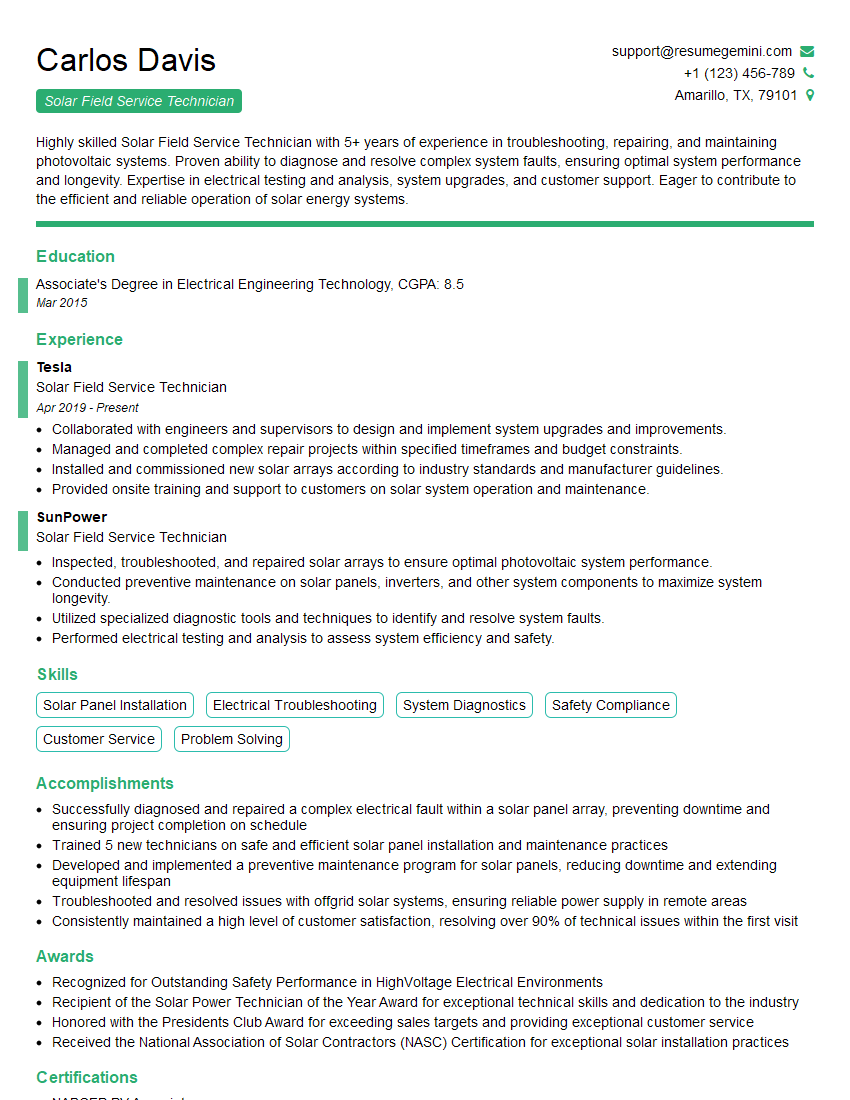
Mastering solar project troubleshooting and repair is crucial for career advancement in the rapidly growing renewable energy sector. Proficiency in these skills demonstrates a valuable combination of technical expertise and practical problem-solving abilities, leading to increased job opportunities and higher earning potential. To maximize your chances of securing your dream role, it’s vital to create a strong, ATS-friendly resume that highlights your key skills and experience. ResumeGemini is a trusted resource that can help you build a professional and impactful resume tailored to your specific experience. Examples of resumes tailored to solar project troubleshooting and repair are available to guide you. Take the next step toward your successful career transition today!

Explore more articles
Users Rating of Our Blogs
Share Your Experience
We value your feedback! Please rate our content and share your thoughts (optional).
What Readers Say About Our Blog
Very informative content, great job.
good