Interviews are opportunities to demonstrate your expertise, and this guide is here to help you shine. Explore the essential Expertise in software development for automating processes and creating custom tools. interview questions that employers frequently ask, paired with strategies for crafting responses that set you apart from the competition.
Questions Asked in Expertise in software development for automating processes and creating custom tools. Interview
Q 1. Explain the difference between scripting and programming in the context of automation.
Scripting and programming are both used for automation, but they differ significantly in scope and complexity. Think of scripting as writing a set of instructions for a specific task, often using a high-level language that’s interpreted rather than compiled. Programming, on the other hand, involves designing and building more complex, structured applications, often using compiled languages that offer greater performance and control.
In automation, scripting might be used for a quick task like automating a file transfer or modifying a few settings. This is typically done using languages like Python, Bash, or PowerShell, which are easily integrated with existing tools. Programming, however, is more suitable for building robust and scalable automation frameworks capable of handling many diverse tasks and complex logic. A good example would be building a custom framework for automated testing with features like reporting, logging, and parallel execution which would require a more structured approach akin to programming rather than scripting.
- Scripting: Quick, task-specific, interpreted languages, less complex, easier to learn.
- Programming: Complex applications, compiled languages, requires more planning and structured design, greater power and control.
Q 2. Describe your experience with various automation frameworks (e.g., Selenium, Cypress, Robot Framework).
I have extensive experience with several automation frameworks, each suited for different purposes. Selenium is my go-to for web UI automation due to its versatility and wide browser support. I’ve used it extensively for end-to-end testing, automating complex workflows involving multiple web pages and interactions. For example, I used Selenium to automate testing for a large e-commerce platform, ensuring that the checkout process functioned correctly across different browsers and devices. Cypress, on the other hand, excels in its speed and developer-friendly debugging capabilities. It’s ideal for front-end testing, and its real-time reloading speeds up the development cycle significantly. I’ve successfully employed Cypress in projects where rapid iteration and quick feedback were critical. Lastly, Robot Framework offers a more structured, keyword-driven approach. It’s particularly useful for automating processes that involve interacting with various systems (web, API, databases). I’ve used it effectively to automate complex system integration testing.
Q 3. How do you handle unexpected errors or exceptions during automation execution?
Robust error handling is crucial for reliable automation. My approach involves a layered strategy. Firstly, I implement try-except blocks around critical code sections to catch specific exceptions. For example, try: ... except FileNotFoundError: .... This allows me to handle known errors gracefully, logging them and perhaps taking alternative actions. Secondly, I implement comprehensive logging to track the execution flow. This makes it easier to pinpoint the root cause of unexpected errors during debugging. Finally, I utilize assertions and checks throughout the automation scripts to ensure the expected outcomes at various stages. Failing assertions trigger clear error messages, helping me quickly identify the points of failure. I might also implement retry mechanisms for transient errors (e.g., network issues) to increase robustness.
try:
    # Code that might raise an exception
except Exception as e:
    logger.error(f"An error occurred: {e}")
    # Handle the exception appropriately
    raise  # Re-raise the exception if you want to stop execution
Q 4. What are the key considerations for designing scalable and maintainable automation solutions?
Scalability and maintainability are paramount. Key considerations include modular design, where the automation scripts are broken down into smaller, reusable components. This improves readability, simplifies debugging, and allows for easier scaling. I also use version control (Git) to track changes, collaborate efficiently, and revert to previous working versions if needed. Using well-defined naming conventions and clear documentation are essential for maintaining code clarity. Furthermore, employing a consistent coding style and adhering to best practices makes it much simpler for others (or myself later) to understand and modify the codebase. Lastly, choosing appropriate tools and technologies from the beginning helps establish a solid foundation. This includes utilizing a framework designed for scalability, using a robust testing framework, and implementing a system for efficient reporting and monitoring.
Q 5. Explain your experience with CI/CD pipelines and their integration with automation processes.
CI/CD pipelines are integral to the automation process. I have experience integrating automation tests into these pipelines using tools like Jenkins, GitLab CI, or Azure DevOps. This ensures that automation tests run automatically upon code changes, providing immediate feedback on the impact of new features or bug fixes. For example, in a typical scenario, the pipeline would trigger the automated test suite after each code commit. Test results are then reported back to the pipeline, triggering alerts if failures occur. This approach helps in achieving continuous integration and continuous delivery/deployment by ensuring code quality is maintained throughout the development process. The integration process typically involves configuring the CI/CD tool to execute the automation scripts and then interpreting the results to determine whether the build should proceed.
Q 6. How do you ensure the quality and reliability of your automated solutions?
Ensuring quality and reliability involves several steps. First, thorough test planning and design are essential. This means clearly defining test cases, selecting appropriate testing methodologies, and ensuring adequate test coverage. I emphasize the use of various testing techniques (unit, integration, system, and even end-to-end) to catch defects at different levels. Regular code reviews help catch errors early on and ensure coding best practices are followed. Automation scripts themselves need testing and validation through rigorous testing with varied input data. Finally, comprehensive logging and reporting make it easy to track test execution, identify areas for improvement, and gain insights into potential system vulnerabilities.
Q 7. Describe your experience with different testing methodologies in an automation context (unit, integration, system).
My experience encompasses various testing methodologies in an automation context. Unit testing involves testing individual components of the code in isolation to verify their functionality. I use tools like pytest or JUnit for this. Integration testing verifies interactions between different components or modules. I might use mocking or stubbing techniques here to simulate external dependencies. System testing validates the entire system as a whole, ensuring all components work together correctly. This frequently involves end-to-end tests that simulate real-world scenarios. The choice of methodology depends on the specific needs of the project. For example, in a project with a complex microservices architecture, a focus on unit and integration testing would be crucial before moving to system-level tests. In smaller projects, you might find it sufficient to perform a mix of unit and system-level tests. Properly structured test cases, clear documentation, and adherence to best practices are vital across all testing types.
Q 8. What are some common challenges you’ve faced during automation projects, and how did you overcome them?
Automation projects, while offering immense efficiency gains, often face unforeseen hurdles. One common challenge is inaccurate or incomplete data. For example, in a project automating data entry from PDFs, inconsistent formatting or missing fields can easily derail the process. To overcome this, I employ robust data validation techniques, including regular expressions and schema validation, coupled with error handling and logging mechanisms to identify and address problematic data points. Another recurring issue is dealing with unexpected changes in the target system. If the application being automated undergoes an interface redesign or a functionality change, the automation scripts can break. To mitigate this, I prioritize modular design, making it easier to update specific parts of the code without affecting the entire system. I also advocate for implementing robust monitoring and alerting systems to catch these issues early.
Furthermore, managing scope creep is crucial. Initially well-defined projects can expand unexpectedly, jeopardizing timelines and budgets. I combat this by rigorously documenting requirements, using Agile methodologies for iterative development, and proactively communicating with stakeholders to manage expectations and adjust scope as needed.
Q 9. How do you choose the right tools and technologies for a specific automation task?
Selecting the right tools and technologies hinges on a thorough understanding of the automation task itself. Factors to consider include the scale of the project, the complexity of the target system, the available resources, and the expertise of the team. For tasks involving web browser interactions, Selenium with Python or Java is often a solid choice. Python’s versatility makes it suitable for diverse tasks, including scripting, data manipulation, and machine learning. Java offers robustness and scalability for large-scale projects. For system administration and Windows-specific automation, PowerShell excels. If the project requires integrating with cloud platforms like AWS or Azure, their respective SDKs (Software Development Kits) are preferred.
I typically start by evaluating the available options, considering factors like ease of use, community support, and existing infrastructure. I often create prototypes to test different tools and technologies before committing to a final decision. The choice should be driven by pragmatic considerations and not simply by the latest trendy technology. For example, while a new, cutting-edge tool might seem attractive, its lack of documentation or community support could significantly slow down the development process.
Q 10. Explain your experience with version control systems (e.g., Git) in an automation development context.
Version control, using Git, is absolutely paramount in any automation development project. It forms the backbone of collaborative development, allowing multiple developers to work concurrently on the same project without overwriting each other’s changes. I utilize branching strategies (e.g., Gitflow) to manage different features or bug fixes in isolation. This ensures that the main branch (typically ‘main’ or ‘master’) always maintains a stable and working version of the code. Commit messages are meticulously crafted to clearly describe the changes made in each commit, making it easier to track the evolution of the codebase and understand the rationale behind different decisions. Pull requests are used to review and merge code changes, promoting code quality and reducing errors. Regularly pushing changes to a remote repository provides a backup and facilitates collaboration amongst team members.
I also leverage Git’s features for rollback capabilities. If an issue arises, I can easily revert to a previous, stable version of the code, minimizing downtime and reducing the impact of errors. Using Git effectively contributes to a highly organized, maintainable, and robust automation solution.
Q 11. How do you manage dependencies and conflicts in a large-scale automation project?
Managing dependencies and conflicts in large-scale projects requires a well-defined strategy. Dependency management tools such as pip (for Python) or Maven (for Java) are essential for managing external libraries and ensuring that all required components are compatible with each other. A clear dependency tree helps visualize the relationships between components and facilitates troubleshooting. For instance, if a change in one library breaks another, the dependency tree clarifies the impact and guides the resolution. A consistent approach to dependency versioning (e.g., semantic versioning) is vital. This ensures clarity on compatibility between different versions and minimizes unexpected issues.
Resolving conflicts usually involves carefully examining the conflicting code changes. Tools like Git’s merge tools help visualize the differences and allow developers to make informed decisions on which changes to accept or resolve manually. Automated testing is also critical in preventing and detecting conflicts. Thorough unit and integration tests ensure that changes don’t break existing functionality, making it easier to identify and resolve conflicts early in the development process. Regular code reviews and clear communication between team members further enhance the process of identifying and resolving potential conflicts before they become significant problems.
Q 12. Describe your experience with different programming languages used for automation (e.g., Python, Java, PowerShell).
My experience spans various programming languages, each offering unique advantages for different automation scenarios. Python, with its extensive libraries like `requests` for web interactions and `beautifulsoup` for web scraping, is my go-to language for many automation tasks. Its readability and large community support make it ideal for rapid prototyping and development. Java, known for its robustness and scalability, is particularly useful for large, complex enterprise applications. I’ve leveraged its capabilities in creating highly reliable and maintainable automation systems for critical business processes. PowerShell, with its deep integration with the Windows operating system, proves invaluable for system administration tasks, including managing Active Directory and deploying software. The choice of language always depends on the specific requirements of the project and the existing infrastructure.
For example, if I need to automate a task involving web scraping and data analysis, Python would be the natural choice, while for building a robust, enterprise-level automation system that interacts with various databases, Java would be a more appropriate option.
Q 13. How do you approach designing reusable and modular automation components?
Designing reusable and modular components is essential for creating maintainable and scalable automation solutions. This means breaking down the automation process into smaller, independent units that can be reused across multiple projects or different parts of the same project. I follow principles of object-oriented programming (OOP), encapsulating specific functionalities within classes or modules. For instance, if my automation needs to interact with a specific web application, I create a separate module responsible for interacting with that application, keeping the core logic separate from the interaction details. This way, if the application’s interface changes, I only need to modify that module without affecting the overall automation flow.
Using well-defined interfaces and abstracting away implementation details allows for greater flexibility and maintainability. I strive to use design patterns like the Factory pattern to create components in a flexible way, abstracting the creation of objects, enabling easy swapping of implementations without modifying the core logic.
Q 14. Explain your understanding of different automation patterns (e.g., Page Object Model, Command Pattern).
Automation patterns provide proven blueprints for structuring automation code. The Page Object Model (POM) is highly effective for UI automation. It encapsulates UI elements (buttons, text fields, etc.) within separate classes, making the code more organized, readable, and maintainable. For instance, if the UI changes, you update only the page object class instead of modifying numerous test scripts. The Command Pattern is useful when you need to decouple request senders from request handlers. This allows for greater flexibility in handling actions, allowing for easier addition, removal and queueing of commands. The command itself can hold data and context related to the action it represents. This is particularly helpful in complex scenarios where you have multiple actions to perform sequentially or concurrently.
Choosing the right pattern depends on the specific requirements. POM excels in UI automation for its maintainability, while the Command Pattern provides flexibility in managing complex sequences of actions. Often a combination of patterns provides the most robust and elegant solution.
Q 15. How do you measure the success and ROI of an automation project?
Measuring the success and ROI of an automation project requires a multifaceted approach. It’s not just about saving time; it’s about demonstrating tangible value to the business. We need to define key performance indicators (KPIs) upfront, aligning them with specific business goals.
- Cost Savings: Calculate the reduction in labor costs, operational expenses, or material costs due to automation. For example, if a manual process took 10 hours per week at $50/hour, automation reducing it to 2 hours saves $400 per week, translating to significant annual savings.
- Efficiency Gains: Track improvements in processing speed, throughput, or cycle time. Did the automation reduce processing time from days to hours? Quantify these gains in percentages or concrete numbers.
- Error Reduction: Measure the decrease in errors or defects resulting from automation. This is crucial in areas like data entry or manufacturing where manual processes are prone to mistakes. The reduced error rate translates to lower costs associated with rework, quality control, and customer dissatisfaction.
- Improved Compliance: If the automation enhances regulatory compliance (e.g., automated data backups, security protocols), quantify the reduced risk of non-compliance penalties.
- Increased Revenue: In some cases, automation can directly increase revenue by enabling faster product launches, improved customer service, or enhanced sales processes.
By meticulously tracking these KPIs before, during, and after implementation, we can build a compelling case for the ROI. This involves using robust reporting and analytics tools to visualize the data and present findings in a clear, concise manner to stakeholders.
Career Expert Tips:
- Ace those interviews! Prepare effectively by reviewing the Top 50 Most Common Interview Questions on ResumeGemini.
- Navigate your job search with confidence! Explore a wide range of Career Tips on ResumeGemini. Learn about common challenges and recommendations to overcome them.
- Craft the perfect resume! Master the Art of Resume Writing with ResumeGemini’s guide. Showcase your unique qualifications and achievements effectively.
- Don’t miss out on holiday savings! Build your dream resume with ResumeGemini’s ATS optimized templates.
Q 16. Describe your experience with monitoring and logging in automation systems.
Effective monitoring and logging are critical for the health, security, and maintainability of any automation system. I typically employ a layered approach:
- Application-Level Logging: Within the automation code itself, I use detailed logging statements to track events, exceptions, and key data points. This might involve using libraries like
log4jin Java or Python’s built-inloggingmodule. The level of detail should be tailored to the specific task, ranging from basic informational messages to critical errors. - System-Level Monitoring: I leverage system monitoring tools to track resource utilization (CPU, memory, disk space) of the automation system. This might involve tools like Prometheus, Nagios, or Datadog. These tools provide real-time visibility into the system’s performance and help identify resource bottlenecks or anomalies.
- Centralized Logging and Alerting: A centralized logging system (like ELK stack or Splunk) aggregates logs from multiple sources, enabling comprehensive analysis and troubleshooting. Setting up alerts based on specific error patterns or resource thresholds ensures timely responses to critical issues. For example, an alert triggered by unusually high error rates in a particular automation step allows for proactive intervention before a significant failure.
The choice of logging and monitoring tools depends on the specific requirements of the project, including the scale of the automation system and the budget constraints. Regardless of the tools, structured logging (JSON or XML) is preferred for efficient analysis and querying.
Q 17. How do you handle the security implications of automation solutions?
Security is paramount when designing and deploying automation solutions. I address security implications proactively at every stage of the development lifecycle:
- Secure Coding Practices: I follow industry best practices for secure coding, including input validation, output encoding, and parameterized queries to prevent SQL injection and cross-site scripting (XSS) vulnerabilities. Regular code reviews and penetration testing are essential.
- Access Control: Robust access control mechanisms are implemented to restrict access to the automation system and its resources based on the principle of least privilege. This might involve using role-based access control (RBAC) and multi-factor authentication (MFA).
- Data Encryption: Sensitive data is encrypted both in transit (using HTTPS) and at rest (using encryption at the database level or file system). Encryption keys are securely managed using industry-standard practices.
- Regular Security Audits: Regular security audits and vulnerability assessments help identify and mitigate potential security threats. Staying updated on the latest security vulnerabilities and applying necessary patches are crucial for maintaining a secure environment.
- Secrets Management: Sensitive information like API keys and passwords should never be hardcoded directly in the automation scripts. A dedicated secrets management system (e.g., HashiCorp Vault) is used to store and manage sensitive information securely.
By following these security principles, we can ensure that the automation system is resilient against various threats and maintains data integrity and confidentiality.
Q 18. Explain your experience with integrating automation with existing systems and APIs.
Integrating automation with existing systems and APIs is a common task in my work. I leverage various technologies and approaches to ensure seamless integration:
- API Integrations: I utilize RESTful APIs or other API specifications (SOAP, GraphQL) to interact with various services. Libraries and frameworks like REST-assured (Java), Requests (Python), or Axios (JavaScript) are frequently used for making API calls. Thorough API documentation and testing are essential for ensuring reliable communication.
- Message Queues: For asynchronous communication between systems, message queues (like RabbitMQ, Kafka, or Amazon SQS) provide decoupling and robustness. This approach is beneficial when dealing with systems with varying processing speeds or when fault tolerance is a critical requirement.
- Database Interactions: I utilize database connectors and ORMs (Object-Relational Mappers) to interact with various databases (SQL and NoSQL). Data transformation and mapping are often required to ensure compatibility between systems. Database transactions are used to maintain data integrity.
- ETL (Extract, Transform, Load) Processes: For large-scale data integration, I employ ETL tools to extract data from various sources, transform it as needed, and load it into a target system. Tools like Apache Kafka, Apache NiFi, and Informatica PowerCenter are used in such scenarios.
The choice of integration method depends on the specific architecture and requirements of the systems being integrated. Careful planning, robust error handling, and regular testing are vital for achieving successful integration.
Q 19. What are your preferred methods for debugging and troubleshooting automation issues?
Debugging and troubleshooting automation issues is a crucial skill. I employ a systematic approach:
- Reproduce the Issue: First, I need to consistently reproduce the error. This involves gathering detailed logs, error messages, and any relevant system information. If the error is intermittent, I might need to adjust monitoring levels to capture more information.
- Isolate the Problem: Once the issue is reproducible, I isolate the specific component or section of code causing the problem. Techniques such as code stepping, logging, and print statements are useful for identifying the root cause.
- Utilize Debugging Tools: I use debugging tools such as IDE debuggers (IntelliJ, VS Code), to step through the code and inspect variables. These tools allow setting breakpoints and examining code execution in detail.
- Examine Logs: Thoroughly analyze the logs for clues about the error. Often, the log messages contain timestamps and other contextual information that helps pinpoint the source of the problem. I look for patterns or trends in the errors.
- Use Monitoring Tools: If the issue is related to system performance, monitoring tools provide insights into CPU usage, memory leaks, network latency, etc. This can help identify resource bottlenecks.
- Test Driven Development: Writing unit and integration tests beforehand helps identify errors early in the development cycle and facilitates easier debugging.
A combination of these techniques helps ensure efficient identification and resolution of automation problems.
Q 20. How do you manage and prioritize multiple automation tasks concurrently?
Managing and prioritizing multiple automation tasks concurrently requires careful planning and efficient resource allocation. I typically use these strategies:
- Task Prioritization: Employing prioritization frameworks like MoSCoW (Must have, Should have, Could have, Won’t have) helps to rank tasks based on their business value and urgency.
- Project Management Tools: Utilizing project management tools such as Jira, Asana, or Trello aids in managing tasks, tracking progress, and assigning responsibilities.
- Workflow Automation Tools: Orchestration tools like Airflow or Jenkins are used to manage dependencies between tasks and ensure efficient execution, handling concurrency and scheduling.
- Resource Allocation: Carefully allocating computing resources (CPU, memory) to different tasks is critical, especially when dealing with computationally intensive processes. This might involve using containerization technologies (Docker, Kubernetes) to manage resource usage effectively.
- Parallel Processing: Employing parallel processing techniques (multithreading, multiprocessing) accelerates the execution of tasks that can be performed concurrently. However, the overhead of parallel processing needs to be considered, and thread safety measures must be in place.
By employing these strategies, I can effectively manage multiple automation tasks, ensuring timely completion and efficient use of resources.
Q 21. Explain your approach to documenting automation processes and code.
Comprehensive documentation is crucial for the long-term success and maintainability of any automation project. My approach includes:
- Code Documentation: I follow coding standards and write clear, concise comments within the code to explain the purpose, functionality, and logic of different sections. I use inline comments for small explanations and block comments for larger sections of code.
- Process Documentation: I create detailed documentation describing the automation process, including inputs, outputs, steps involved, and decision points. This might involve using flowcharts or diagrams to visually represent the process.
- API Documentation: For API integrations, clear API documentation is essential. I use tools like Swagger or OpenAPI to generate interactive API documentation.
- Version Control: I utilize version control systems (Git) to track changes in code and documentation over time. This ensures that the documentation is always up-to-date and allows for easy rollback if necessary.
- Readme File: A comprehensive README file provides a high-level overview of the automation system, including setup instructions, usage guidelines, and troubleshooting tips.
I believe that effective documentation is an investment that pays off in the long run. It makes the system easier to understand, maintain, and extend by others, and it minimizes the cost and effort required for future updates and modifications.
Q 22. Describe your experience working with cloud-based automation platforms (e.g., AWS, Azure, GCP).
My experience with cloud-based automation platforms like AWS, Azure, and GCP is extensive. I’ve leveraged their services to build and deploy highly scalable and reliable automated systems. This includes utilizing serverless functions (like AWS Lambda or Azure Functions) for event-driven automation, orchestrating workflows using services like AWS Step Functions or Azure Logic Apps, and managing infrastructure as code (IaC) with tools such as Terraform or CloudFormation. For example, I recently automated the deployment and scaling of a microservices architecture on AWS using ECS and EKS, significantly reducing deployment time and improving resource utilization. I’m proficient in configuring and managing various cloud services relevant to automation, including message queues (SQS, Service Bus), databases (RDS, Cosmos DB), and monitoring tools (CloudWatch, Azure Monitor). My experience spans across different cloud providers, allowing me to select the optimal platform based on project requirements and cost-effectiveness.
Q 23. How familiar are you with containerization technologies (e.g., Docker, Kubernetes) in an automation context?
Containerization technologies like Docker and Kubernetes are integral to my automation workflow. Docker allows for consistent packaging and deployment of applications across different environments, ensuring consistent behavior. Kubernetes, an orchestration platform, takes this further by automating the deployment, scaling, and management of containerized applications. I’ve used Kubernetes to create highly available and scalable automated systems, managing deployments, rollbacks, and scaling based on resource needs. For instance, I built a CI/CD pipeline using Jenkins, Docker, and Kubernetes, which automatically builds, tests, and deploys application updates, improving development speed and reducing errors. Understanding containerization allows me to create efficient, portable, and scalable automation solutions.
Example:  A Dockerfile defining an application image:
FROM python:3.9
WORKDIR /app
COPY requirements.txt requirements.txt
RUN pip install -r requirements.txt
COPY . .
CMD ["python", "app.py"]
Q 24. How do you balance automation efforts with manual testing?
The balance between automation and manual testing is crucial. While automation significantly improves efficiency and coverage for repetitive tasks, manual testing remains essential for exploratory testing, usability checks, and edge-case scenarios. My approach involves a risk-based strategy. High-risk, frequently executed processes are automated first, using frameworks like Selenium or Cypress for UI testing and unit/integration tests for backend logic. Manual testing focuses on areas where automation is difficult or less effective, ensuring comprehensive coverage. I employ a shift-left testing approach, incorporating automated tests early in the development cycle to identify and address issues proactively. This combination leads to higher quality, more robust, and reliable automated systems.
Q 25. What is your experience with RPA tools (e.g., UiPath, Automation Anywhere)?
My experience with RPA tools like UiPath and Automation Anywhere includes building and deploying robots to automate repetitive tasks within existing applications. I’ve used these tools to automate processes such as data entry, report generation, and invoice processing, significantly improving efficiency and reducing manual effort. For instance, I built an RPA bot using UiPath to automate a complex reconciliation process that previously required several hours of manual work each day, reducing the time to minutes. I understand the limitations of RPA, such as its reliance on existing UI elements, and always consider its appropriateness within the context of the overall automation strategy. I prefer to combine RPA with other automation techniques like API integration whenever possible for a more robust and maintainable solution.
Q 26. Describe a situation where you had to adapt an existing automation solution to meet changing requirements.
In one project, we had an automated system for processing customer orders. Initially, it was designed for a specific order type. When the company introduced a new order type with different data fields and validation rules, the existing automation failed. To adapt, I didn’t rebuild the entire system. Instead, I implemented a modular design, separating the order processing logic into reusable components. This allowed me to easily add a new module for the new order type, extending the automation without affecting the existing functionality. The key was careful planning, clear documentation, and a modular design to ensure future adaptability and flexibility. This reinforced the importance of designing for change from the outset.
Q 27. How do you stay updated with the latest trends and best practices in automation technology?
Staying updated in the rapidly evolving field of automation requires a multi-faceted approach. I actively participate in online communities and forums, follow industry leaders on social media and attend webinars and conferences. I also dedicate time to reading industry publications, blogs, and research papers to understand the latest technologies and best practices. Hands-on experimentation with new tools and technologies is also critical for staying ahead of the curve. Continuous learning ensures that I can leverage the most effective tools and techniques in my automation projects, delivering efficient and high-quality solutions.
Q 28. Explain your experience with performance testing and optimization of automated systems.
Performance testing and optimization are crucial for automated systems. I employ various techniques to ensure scalability and responsiveness. This includes load testing (using tools like JMeter or Gatling) to simulate real-world usage and identify bottlenecks. Profiling tools help pinpoint performance issues in the code. Database optimization, efficient algorithm design, and appropriate infrastructure scaling are all part of the process. For instance, in one project, load testing revealed a database query that was the main performance bottleneck. By optimizing the query and adding database caching, we significantly improved the system’s response time. Continuous monitoring and performance analysis are essential to proactively address and prevent performance degradation.
Key Topics to Learn for Expertise in Software Development for Automating Processes and Creating Custom Tools Interview
- Scripting Languages: Mastering Python, JavaScript, PowerShell, or similar languages is crucial for automating tasks and building custom tools. Understand their strengths and weaknesses for different automation scenarios.
- Automation Frameworks: Familiarize yourself with popular automation frameworks like Selenium (web automation), Robot Framework (general-purpose), or UiPath (Robotic Process Automation). Understand their architectures and best practices.
- API Integration: Learn how to integrate with various APIs (REST, GraphQL, etc.) to automate interactions with different services and systems. This is critical for building robust and scalable automation solutions.
- Data Processing and Manipulation: Develop proficiency in working with large datasets, using tools like Pandas (Python) or similar libraries for data cleaning, transformation, and analysis within your automation workflows.
- Version Control (Git): Demonstrate a solid understanding of Git for managing code, collaborating with others, and tracking changes throughout the development process of your automation projects.
- Databases (SQL/NoSQL): Learn how to interact with databases to store and retrieve data for your automation solutions. Understand the differences between relational and non-relational databases and when to use each.
- Software Design Principles: Apply principles like SOLID, DRY, and KISS to build maintainable and scalable automation solutions. Be prepared to discuss your design choices and justify them.
- Testing and Debugging: Develop strong testing methodologies and debugging skills to ensure the reliability and accuracy of your automation tools. Be able to discuss different testing strategies (unit, integration, etc.).
- Cloud Platforms (AWS, Azure, GCP): Understanding cloud services can be beneficial for deploying and scaling automation solutions. Familiarize yourself with relevant services such as serverless functions or containerization.
- Problem-Solving and Algorithm Design: Practice breaking down complex problems into smaller, manageable tasks and designing efficient algorithms to solve them. This is crucial for effective automation development.
Next Steps
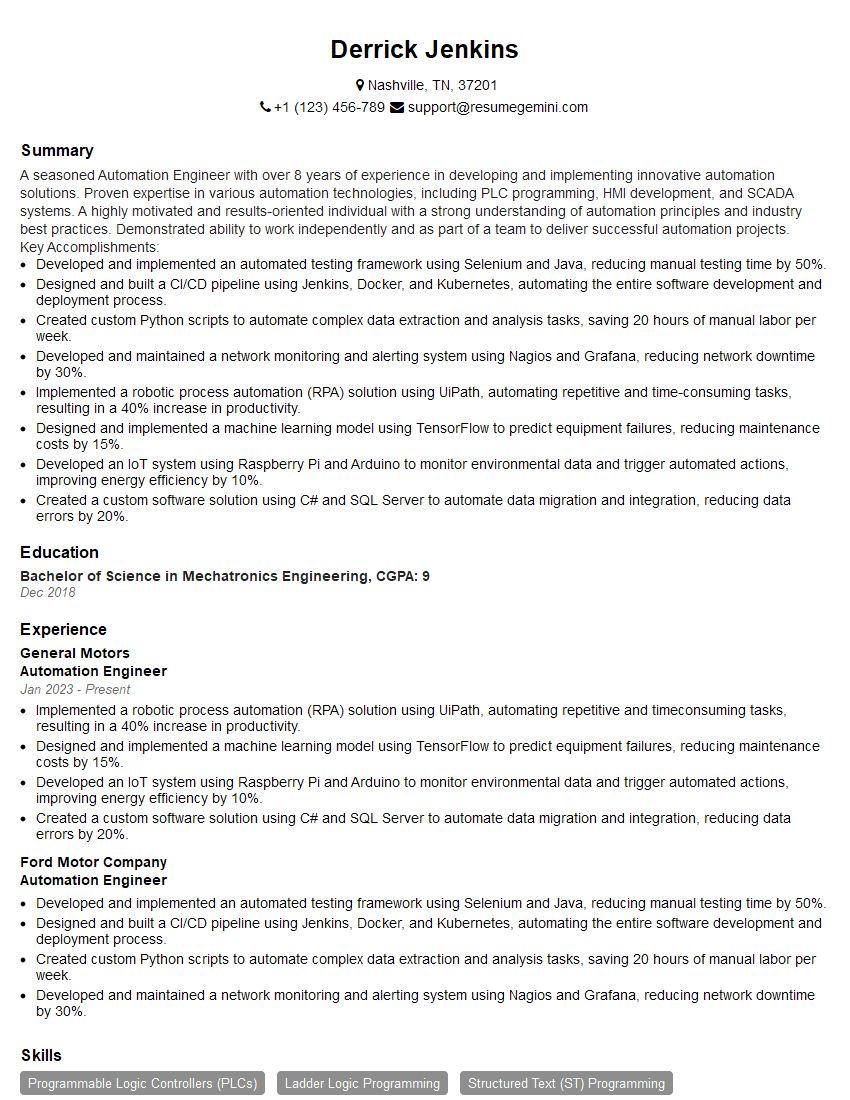
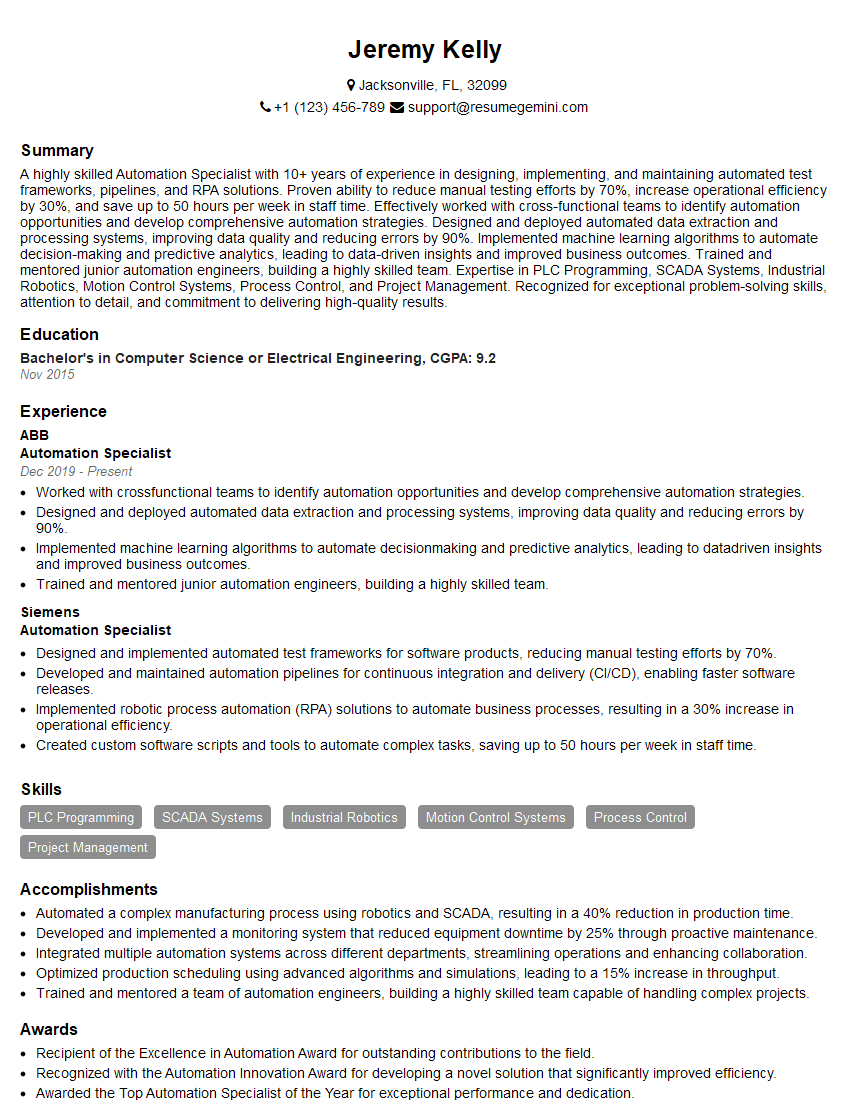
Mastering expertise in software development for automating processes and creating custom tools is highly valuable for career advancement, opening doors to exciting roles with high demand and excellent compensation. An ATS-friendly resume is essential for getting your application noticed by recruiters. To significantly boost your job prospects, leverage ResumeGemini to create a professional and impactful resume that highlights your skills and experience effectively. ResumeGemini provides examples of resumes tailored to this specific area of expertise to help you get started.
Explore more articles
Users Rating of Our Blogs
Share Your Experience
We value your feedback! Please rate our content and share your thoughts (optional).
What Readers Say About Our Blog
Very informative content, great job.
good