Interviews are opportunities to demonstrate your expertise, and this guide is here to help you shine. Explore the essential Fabric Handling and Cutting interview questions that employers frequently ask, paired with strategies for crafting responses that set you apart from the competition.
Questions Asked in Fabric Handling and Cutting Interview
Q 1. Describe your experience with different fabric types and their handling requirements.
My experience encompasses a wide range of fabrics, from delicate silks and chiffons to robust denim and heavy-duty canvas. Each fabric demands a unique approach to handling. Delicate fabrics, like silk, require gentle handling to prevent snags and tears. This includes using soft brushes for cleaning, avoiding excessive pressure during spreading, and employing sharp, well-maintained shears for cutting. Conversely, heavier fabrics like canvas may require more force during spreading and cutting, but appropriate techniques are still crucial to prevent distortion or damage. Understanding the fiber content (e.g., natural fibers like cotton and linen behave differently than synthetics like polyester) and the fabric’s weave (e.g., twill, plain weave, satin) greatly impacts how it’s handled. For example, a loosely woven fabric might require more careful spreading to prevent shifting or stretching during cutting. I’ve worked extensively with knits, wovens, and non-wovens, developing a keen sense for identifying the best handling techniques for optimal results and minimal waste.
- Silk: Requires gentle handling, specialized shears, and smooth surfaces to prevent snags.
- Denim: Needs firm spreading to prevent slippage and sharp shears or a rotary cutter for clean cuts.
- Linen: Prone to wrinkling, requiring careful handling and potentially pre-pressing before cutting.
Q 2. Explain the process of fabric spreading and layering for efficient cutting.
Efficient fabric spreading and layering are paramount for accurate cutting and minimal waste. The process typically begins with preparing the cutting table, ensuring it’s clean and free of obstructions. Then, we carefully unfold the fabric, ensuring it’s smooth and free of wrinkles. For large quantities, automated spreading machines can dramatically increase efficiency and precision. Layering involves carefully aligning multiple fabric layers, ensuring consistent thickness and preventing slippage. This often involves using weights or clamps to keep the layers in place. Accurate alignment is crucial; misalignment can lead to significant waste. We often use a ‘grain line’ or pattern marker to ensure consistent alignment across all layers. Think of it like building a perfectly stacked layer cake – each layer must be aligned perfectly to create a uniform end product. The number of layers depends on the fabric’s thickness, the cutting method (e.g., single-ply or multi-ply cutting), and the production capacity. Efficient layering also involves strategic placement to minimize fabric waste and maximize the yield from each piece of fabric.
Q 3. How do you ensure accurate fabric cutting to minimize waste?
Accurate fabric cutting is achieved through a combination of careful planning and precise execution. This starts with accurate pattern marking using precise tools, ensuring all markings align correctly with the fabric grain. We utilize various marking tools, from tailor’s chalk and disappearing ink pens to specialized computer-aided cutting systems. Consistent spreading and layering, as previously discussed, are vital. Sharp and well-maintained cutting tools are non-negotiable for clean cuts, minimizing fabric fraying and potential for errors. Additionally, employing efficient nesting techniques—optimizing the arrangement of patterns on the fabric to minimize waste—is crucial. Computer-aided design (CAD) systems are invaluable for this, creating highly efficient cutting plans. Regular quality checks throughout the process help identify and rectify any discrepancies early on, preventing larger problems later. Finally, thorough training and experience in handling various fabric types are essential for achieving consistent accuracy.
Q 4. What are the common causes of fabric defects during cutting, and how do you address them?
Common fabric defects during cutting often stem from poor handling and inadequate equipment maintenance. These include:
- Fabric slippage during cutting: This results in inaccurate cuts and potentially ruined pieces. Addressing this requires proper spreading, layering techniques, and potentially using non-slip surfaces or adhesives.
- Uneven cuts: Dull cutting tools or inconsistent pressure during cutting contribute to this. Regular sharpening and maintenance of tools are essential, as is proper training in using the equipment.
- Fabric stretching or distortion: This often arises from improper handling or excessive force during cutting, especially with delicate materials. Gentle handling and appropriate cutting techniques are necessary.
- Fabric snags or tears: These may be caused by sharp objects, rough handling, or the use of inappropriate cutting tools. Careful handling, clean cutting surfaces, and appropriate tool selection can prevent these defects.
Q 5. Describe your experience with different cutting tools and machinery.
My experience includes working with a variety of cutting tools and machinery, ranging from traditional hand shears and rotary cutters to sophisticated computer-aided cutting (CAD) systems and automated cutting tables. Hand shears, while requiring more skill and effort, offer versatility for intricate cuts and smaller projects. Rotary cutters are highly efficient for cutting multiple layers of fabric along straight lines, reducing time and effort, but require careful handling. Computer-aided cutting systems and automated cutting tables, on the other hand, are indispensable for mass production. They offer high precision, significantly reduced waste, and faster production speeds. I’m proficient in operating and maintaining all these tools, and I understand the specific applications and limitations of each. Selecting the appropriate tool for the job is critical for both efficiency and quality.
Q 6. How do you maintain the sharpness and accuracy of cutting tools?
Maintaining the sharpness and accuracy of cutting tools is crucial for precise cuts and to minimize fabric waste. For hand shears, regular honing and professional sharpening are essential. Honing, using a honing steel, aligns the blades and removes minor burrs between sharpenings. Professional sharpening should be done periodically to restore the blades to their original sharpness. Rotary cutter blades should be replaced regularly once they become dull or show signs of damage; these typically have a longer lifespan than hand shears. For automated cutting systems, regular maintenance schedules and blade replacements, as recommended by the manufacturer, are essential. These schedules typically involve checking blade alignment, adjusting pressure settings, and replacing worn parts to ensure optimal performance and prevent inaccuracies. Careful cleaning of all cutting tools after each use is paramount to prevent rust and to remove fabric remnants which can cause damage.
Q 7. Explain your understanding of fabric grain and its importance in cutting.
Fabric grain refers to the direction of the yarns in the woven fabric. It typically consists of warp yarns (running lengthwise) and weft yarns (running crosswise). Understanding fabric grain is essential for achieving accurate cuts and preventing distortion. Cutting with the grain (parallel to the lengthwise yarns) ensures the fabric maintains its shape and drape after cutting. Cutting on the bias (at a 45-degree angle to the grain) results in stretch and drape, which is often desirable in certain designs. Cutting across the grain (perpendicular to the lengthwise yarns) can lead to distortion and potential fraying. It’s analogous to cutting wood along or against the wood grain; you’d get a different result and the likelihood of the cut splitting is increased when cutting against the grain. Paying close attention to the fabric grain during pattern placement ensures the final garment hangs and drapes as intended; ignoring it can lead to significant issues with fit and appearance.
Q 8. How do you handle fabric with varying weights and thicknesses?
Handling fabrics of varying weights and thicknesses requires a nuanced approach. The key is understanding how different weights impact the fabric’s drape, its susceptibility to damage, and the appropriate handling techniques. Lighter fabrics, like silks or chiffons, are delicate and prone to snagging or stretching. They require gentle handling, often using soft gloves and avoiding sharp folds or creases. Heavier fabrics, like denim or canvas, are more durable but can be cumbersome to maneuver. They require efficient techniques to avoid strain and maintain accuracy during cutting.
For example, when working with delicate silks, I might use a large, smooth cutting surface to minimize friction and employ specialized shears designed for fine fabrics. Conversely, with heavy denim, I might utilize a cutting table with a specialized roller system to smoothly guide the fabric, and employ robust rotary cutters or electric knives for efficient and precise cuts.
The choice of storage and transport methods also depends on fabric weight. Lighter fabrics are best stored flat or on padded hangers to avoid wrinkles, while heavier fabrics can be folded more compactly, but still carefully to prevent creasing or damage.
Q 9. Describe your experience with different cutting methods (e.g., manual, automated).
My experience spans both manual and automated cutting methods. Manual cutting, using shears and pattern-marking tools, requires precision, skill, and a keen eye for detail. It’s ideal for smaller runs, intricate designs, or fabrics that are difficult to cut automatically (like extremely delicate materials or those with complex draping properties). For example, I frequently use hand shears for trimming seams on delicate lace fabrics that a rotary cutter could easily damage.
Automated cutting, using computerized cutting machines, is invaluable for larger production runs and ensuring consistency across many pieces. These machines offer speed and efficiency, particularly for repetitive cuts on simpler patterns. I have extensive experience using different types of automated cutters, including those with knife blades, laser cutting technology, and ultrasonic cutters, each suited to different types of materials and projects. These machines use digital patterns and require skilled operators to load, calibrate, and monitor the machine for optimal cutting performance and quality control.
Q 10. How do you interpret cutting patterns and specifications?
Interpreting cutting patterns and specifications is fundamental to accurate fabric cutting. This involves understanding technical drawings, grading charts (to adjust patterns for different sizes), and marking symbols that denote seam allowances, notches, and grainlines. It’s like reading a map that guides the transformation of a flat pattern into a three-dimensional garment. I begin by carefully studying the pattern pieces, noting their grainlines (the lengthwise and crosswise direction of the fabric) and matching markings.
For example, a ‘straight grain’ mark indicates that the edge of a fabric piece must align with the lengthwise grain of the fabric to avoid distortion. Notches and other symbols help align pattern pieces precisely during assembly. Specifications detail the required number of pieces for each size, the fabric type, and any specific layout requirements. I often create a detailed cutting layout to minimize fabric waste and ensure all the necessary pieces are cut efficiently.
Q 11. What are the safety procedures you follow when operating cutting machinery?
Safety is paramount when operating cutting machinery. Before using any machine, I always ensure that I’m wearing appropriate personal protective equipment (PPE), including cut-resistant gloves, safety glasses, and closed-toe shoes. Regular machine maintenance checks are crucial to prevent malfunctions. This includes lubricating moving parts, checking for blade sharpness and stability, and ensuring the machine is correctly grounded.
When using automated cutting machines, I strictly follow the manufacturer’s instructions for operation and safety protocols. I never reach into the cutting area while the machine is operating, and always use the designated safety features, such as emergency stop buttons and safety guards. For manual cutting, sharp shears should be handled and stored with care to prevent accidental cuts or injuries.
A regular safety inspection of the workstation is also critical – ensuring the area is well-lit, organized, and free from obstructions. The use of a clear layout and efficient workflow further reduces the risk of accidents. I am always mindful of my surroundings and the movement of colleagues in the cutting room.
Q 12. How do you manage fabric inventory and prevent damage?
Efficient fabric inventory management and damage prevention are essential for minimizing waste and maintaining production efficiency. This involves a combination of proper storage, careful handling, and meticulous record-keeping. I advocate for a clean and organized storage system, categorizing fabrics by type, color, and weight to facilitate quick retrieval. Fabrics are stored in designated areas with appropriate environmental controls (e.g., temperature and humidity) to prevent deterioration.
To prevent damage, I use protective coverings and avoid stacking fabrics too high. Regular inspections are conducted to identify any signs of damage or deterioration. Any damaged fabric is carefully segregated and its condition properly noted. Accurate inventory tracking, often through a computer-based system, keeps a precise record of fabric quantities and locations. Using a first-in, first-out (FIFO) system helps to reduce the risk of fabrics becoming obsolete.
Q 13. Describe your experience with quality control procedures in a cutting room.
Quality control in a cutting room focuses on ensuring accuracy, consistency, and efficiency throughout the cutting process. This starts with careful pattern preparation and extends through the entire cutting procedure. I regularly inspect cut pieces for accuracy against the pattern specifications. This includes verifying dimensions, checking for alignment to grainlines, and ensuring the correct number of pieces have been cut.
Throughout the process, I visually inspect fabrics for imperfections like discoloration, holes, or weaving irregularities. Defective fabrics are marked and set aside to avoid creating defects in finished garments. The use of standardized procedures and checklists helps to maintain consistency and traceability. Regular audits and quality control checks help to identify and correct any inconsistencies in the cutting process, maintaining high quality standards.
Q 14. How do you identify and resolve discrepancies between patterns and cut fabric?
Discrepancies between patterns and cut fabrics can stem from various sources, including errors in pattern making, marking, or cutting. To address these discrepancies, a systematic approach is crucial. I begin by comparing the cut fabric pieces to the original pattern pieces to identify the exact nature of the problem. This might involve measuring the dimensions of the cut pieces and checking for misalignment of grainlines or notches.
If the discrepancy is due to a cutting error, corrective actions might involve recutting the affected pieces. If the problem originates from an inaccurate pattern, I’d consult with the pattern maker to review and correct the master pattern. Detailed documentation of the discrepancy and the corrective action taken is essential for preventing similar issues in the future. Collaboration with the sewing team is essential, as discrepancies in the cutting room can directly affect garment construction.
Q 15. Explain your experience with computerized cutting systems (if applicable).
My experience with computerized cutting systems spans over eight years, encompassing various platforms from Gerber to Lectra. I’m proficient in operating, maintaining, and troubleshooting these systems. This includes everything from setting up cutting parameters based on fabric type and design to managing nesting software for optimal material utilization. For instance, I once significantly reduced material waste in a high-volume production run of denim jackets by meticulously adjusting the nesting algorithm in the Gerber system. This resulted in a 5% reduction in fabric consumption, representing substantial cost savings for the company. I also have experience with the pre-flighting process and quality checks for ensuring the accuracy and consistency of the cutting patterns generated by these systems. This often includes checking for pattern overlaps or inconsistencies and ensuring the correct cutting parameters are set.
Career Expert Tips:
- Ace those interviews! Prepare effectively by reviewing the Top 50 Most Common Interview Questions on ResumeGemini.
- Navigate your job search with confidence! Explore a wide range of Career Tips on ResumeGemini. Learn about common challenges and recommendations to overcome them.
- Craft the perfect resume! Master the Art of Resume Writing with ResumeGemini’s guide. Showcase your unique qualifications and achievements effectively.
- Don’t miss out on holiday savings! Build your dream resume with ResumeGemini’s ATS optimized templates.
Q 16. How do you optimize fabric layout to minimize material waste?
Optimizing fabric layout to minimize waste is crucial for efficiency and profitability. My approach involves a combination of manual and software-assisted methods. I start by analyzing the pattern pieces and their dimensions, then use specialized nesting software to arrange them on the fabric in the most space-efficient way. Techniques like ‘marker making’ (creating the layout plan) are vital. Different nesting algorithms are employed depending on the fabric type, pattern complexity, and available fabric widths. For instance, a straight-grain-sensitive fabric requires more careful nesting than a non-directional fabric. For irregular shapes, I often manually adjust the nesting to improve the fit and reduce the need for ‘fall-offs’ (excess fabric that’s removed). Thinking strategically about the grain direction of fabrics and how this influences waste is also crucial. I regularly review the nesting efficiency reports generated by the software, always seeking ways to improve the process and minimize waste. Additionally, I continuously monitor fabric usage and analyze the waste generated to identify areas for further optimization.
Q 17. Describe your experience with different types of cutting knives and blades.
My experience encompasses a wide range of cutting knives and blades, from traditional oscillating knives to advanced laser and water jet systems. Each type has its own strengths and weaknesses, and the selection depends on the fabric type and desired quality. Oscillating knives are versatile and cost-effective for many fabrics, but may cause fraying on some delicate materials. Rotary knives, on the other hand, provide a cleaner cut for many applications but require careful calibration and maintenance to prevent inconsistencies. I’m also familiar with the use of laser and water-jet cutting systems, which excel in precision and can handle intricate designs, even in thick or sensitive materials. However, these high-tech options involve higher capital investment and may not be practical for all production scales. Understanding the properties of various blade materials (e.g., carbide, steel) and their impact on cutting performance is crucial, particularly regarding durability and longevity. Regular sharpening and maintenance of all knives are essential to ensure the consistent accuracy of the cutting process.
Q 18. How do you maintain a clean and organized cutting room environment?
Maintaining a clean and organized cutting room is paramount for safety, efficiency, and quality control. We implement a strict 5S methodology (Sort, Set in Order, Shine, Standardize, Sustain), which ensures that tools are properly stored, materials are organized, and the workspace is kept clean and clutter-free. This includes regular cleaning of cutting tables, vacuuming of floors, and disposal of fabric scraps in designated bins. Safety precautions such as providing appropriate personal protective equipment (PPE) like safety glasses and gloves are strictly enforced. We use color-coded bins for different fabric types to prevent mix-ups and maintain organized material flow. Regular inspection of equipment and work surfaces prevents the accumulation of lint or dust, which can affect cutting accuracy and machine functionality. A designated cleaning schedule ensures the workspace remains safe and efficient throughout the workday.
Q 19. What is your experience with fabric pre-treatment before cutting?
Fabric pre-treatment before cutting is crucial for optimal results. The specific steps depend on the fabric type and the cutting method employed. Common pre-treatments include washing, steaming, and pressing. Washing helps to pre-shrink the fabric, minimizing shrinkage after garment construction. Steaming helps to relax the fabric and remove wrinkles, ensuring consistent cutting and reducing potential distortions. Pressing is important to provide a smooth, flat surface for the cutting process. In some cases, we may also use specialized sprays or treatments to enhance the cutting process or to prevent fraying of sensitive materials. For example, some synthetic fabrics might require a specific spray to prevent the blade from skipping or dragging. The choice of pre-treatment method is carefully considered, and detailed records are kept to ensure consistency across different batches of fabric.
Q 20. How do you handle situations with urgent cutting deadlines?
Handling urgent cutting deadlines requires a proactive and organized approach. We begin by prioritizing the most critical orders and coordinating with the design and production teams to clarify any uncertainties. This often involves re-evaluating the cutting layout to optimize efficiency, potentially sacrificing perfect nesting in favor of faster processing times. Overtime may be necessary, and we ensure proper communication and support for team members during high-pressure periods. We focus on streamlining the process, eliminating unnecessary steps, and ensuring that all equipment is functioning at peak efficiency. Clear communication amongst the team is key – updating everyone on progress and potential roadblocks ensures we stay on schedule. Having a pre-determined contingency plan in place for unexpected delays can make all the difference in meeting tight deadlines.
Q 21. What are your strategies for troubleshooting cutting machine malfunctions?
Troubleshooting cutting machine malfunctions requires a systematic approach. I start by identifying the nature of the problem. Is it a software glitch, a mechanical issue, or a problem with material handling? I then consult the machine’s operational manual and any available diagnostic tools. Simple issues, like blade adjustments or jammed sensors, are often addressed quickly. More complex problems might require contacting the machine’s manufacturer or a qualified technician. Keeping detailed maintenance logs helps in identifying patterns or trends that might suggest preventative measures. For example, if a specific blade type consistently causes problems with a particular fabric, we can switch to a more suitable alternative. A methodical approach, combined with careful documentation and communication, is crucial to minimizing downtime and maintaining efficient operation.
Q 22. How do you communicate effectively with other departments (e.g., sewing, design)?
Effective communication across departments is crucial in the garment industry. I believe in proactive, transparent communication built on mutual respect and understanding. With the sewing department, I’d use clear, concise cutting instructions – including diagrams where necessary – specifying fabric type, grain direction, and tolerance levels. This minimizes errors and ensures the sewing team has everything they need. With the design team, I’d focus on feasibility. I’d discuss the impact of design choices on the cutting process, highlighting potential challenges related to fabric usage, waste minimization, and production timelines. For instance, complex patterns might require specialized cutting techniques, increasing production time and cost, so I’d offer alternative solutions early on. Regular meetings and feedback sessions ensure everyone is informed and aligned on goals.
I also champion the use of digital communication tools like shared online platforms for pattern updates, material specifications, and production schedules. This maintains a central record of information, prevents miscommunication, and fosters collaboration.
Q 23. Describe your experience with different types of marking and measuring tools.
My experience encompasses a wide range of marking and measuring tools. I’m proficient with traditional tools like rulers, tape measures, marking pencils, and chalk. I understand the importance of accurate measurements, especially when dealing with intricate patterns and different fabric types. Beyond the basics, I’m skilled in using laser measuring tools for precise measurements, especially when dealing with large quantities of fabric. These offer speed and accuracy advantages compared to manual measurements. I’ve also worked extensively with automated cutting systems, which utilize computer-aided design (CAD) software to generate cutting patterns and control the cutting machinery. These systems often incorporate optical measuring systems to ensure accurate cutting.
For example, when working with delicate fabrics, I would opt for a soft lead pencil or tailor’s chalk to prevent damage. While, for large scale cutting, a laser measuring tool is indispensable for ensuring precision and efficiency. Experience with each tool allows me to choose the most appropriate method for each specific job.
Q 24. How do you ensure consistency in the quality of cut fabric?
Maintaining consistent quality in cut fabric involves a multi-faceted approach. Firstly, it starts with the accuracy and precision of the cutting patterns. We use high-quality CAD software to create patterns, ensuring they are accurate and consistent. Secondly, the operators need to be thoroughly trained to operate the cutting equipment correctly. Regular calibration of cutting machines is also essential to maintain precision and prevent variations in cutting. Thirdly, proper handling of the fabric before, during, and after cutting is crucial to prevent damage or distortion. This includes maintaining appropriate humidity and temperature in the cutting room to avoid fabric shrinkage or stretching. Lastly, a robust quality control system with regular inspections and checks throughout the process is vital to identify any inconsistencies early on. This might involve randomly sampling pieces to ensure they meet the required specifications and identifying and addressing any root causes of variations.
Q 25. What is your familiarity with industry-standard safety regulations for cutting operations?
Safety is paramount in any cutting operation. I’m very familiar with OSHA (Occupational Safety and Health Administration) regulations and industry best practices related to fabric cutting. This includes the proper use of personal protective equipment (PPE), such as safety glasses, hearing protection (especially with automated cutting systems), and cut-resistant gloves. Regular maintenance and inspection of all cutting equipment is crucial to prevent accidents. Proper training of all operators on safe operating procedures is a non-negotiable aspect of my work, which ensures the team understands the risks associated with the equipment and follows safety protocols. We also adhere to strict guidelines for the storage and handling of sharp tools and blades to prevent injuries. Furthermore, maintaining a clean and organized cutting area minimizes tripping hazards and other safety risks.
Q 26. How do you stay updated on the latest technologies and trends in fabric cutting?
Staying current in this dynamic field requires continuous learning. I actively participate in industry conferences and workshops, attending seminars and webinars focusing on advancements in cutting technology and fabric handling. I subscribe to relevant trade publications and online resources. Additionally, I actively network with other professionals in the field, engaging in discussions about new developments and best practices. I’m always seeking out opportunities to explore new software, cutting techniques, and materials to improve efficiency and quality. For example, recently I’ve been researching the application of AI in automated fabric cutting systems, aiming to incorporate these advancements into our processes.
Q 27. Describe your experience with implementing lean manufacturing principles in a cutting environment.
Implementing lean manufacturing principles in the cutting room has been a significant focus for me. Lean principles aim to maximize value and minimize waste. In a cutting environment, this translates to reducing material waste, optimizing workflow, and improving overall efficiency. We’ve achieved this through various strategies. For example, we use nesting software to optimize fabric layout, minimizing material waste. We’ve also implemented 5S methodologies (Sort, Set in Order, Shine, Standardize, Sustain) to maintain a clean, organized workspace which improves efficiency and prevents errors. By continuously analyzing our processes, identifying bottlenecks, and making process improvements, we’ve significantly reduced lead times and improved output. We regularly track key performance indicators (KPIs) such as material yield, cutting time, and defect rates to monitor progress and identify areas for further improvement. A good example is how we redesigned our workflow to reduce the distance fabric travels between steps, reducing handling time and operator fatigue.
Q 28. How do you contribute to a team environment in a high-pressure cutting room setting?
A high-pressure cutting room environment demands teamwork and collaboration. I believe in fostering a positive and supportive team environment, where everyone feels valued and empowered. This starts with clear communication and providing regular feedback to team members. I also encourage open dialogue and collaboration in problem-solving. When faced with a tight deadline or unexpected challenges, I lead by example, displaying a proactive and solution-oriented approach. I actively participate in resolving conflicts and ensuring that everyone feels heard. I regularly recognize and appreciate the contributions of the team to maintain motivation and morale. In this fast-paced environment, mutual respect and support are crucial in maintaining a high level of productivity and quality without sacrificing safety.
Key Topics to Learn for Fabric Handling and Cutting Interview
- Fabric Properties & Identification: Understanding different fabric types (natural vs. synthetic, weave structures, drape, weight), their characteristics, and appropriate handling techniques.
- Pre-cutting Processes: Mastering fabric inspection for defects, pre-washing and pre-shrinking techniques, and proper fabric laying and spreading methods for efficient cutting.
- Cutting Techniques & Tools: Familiarity with various cutting methods (manual, automated), understanding the use and maintenance of cutting tools (knives, shears, laser cutters), and achieving precise cuts while minimizing waste.
- Pattern Making & Grading: Knowledge of pattern construction principles, understanding grading techniques for different sizes, and the ability to adapt patterns to various fabric types.
- Quality Control & Waste Management: Implementing quality control checks throughout the process, identifying and addressing cutting errors, and minimizing fabric waste through efficient planning and techniques.
- Safety Procedures & Ergonomics: Adherence to safety protocols when using sharp tools and machinery, understanding ergonomic principles to prevent injuries, and maintaining a clean and organized workspace.
- Computer-Aided Design (CAD) in Cutting: Familiarity with CAD software used in pattern making and cutting optimization, including marker making and nesting techniques.
- Problem-Solving & Troubleshooting: Ability to identify and resolve issues related to fabric handling, cutting defects, and machine malfunctions; demonstrating practical problem-solving skills.
Next Steps
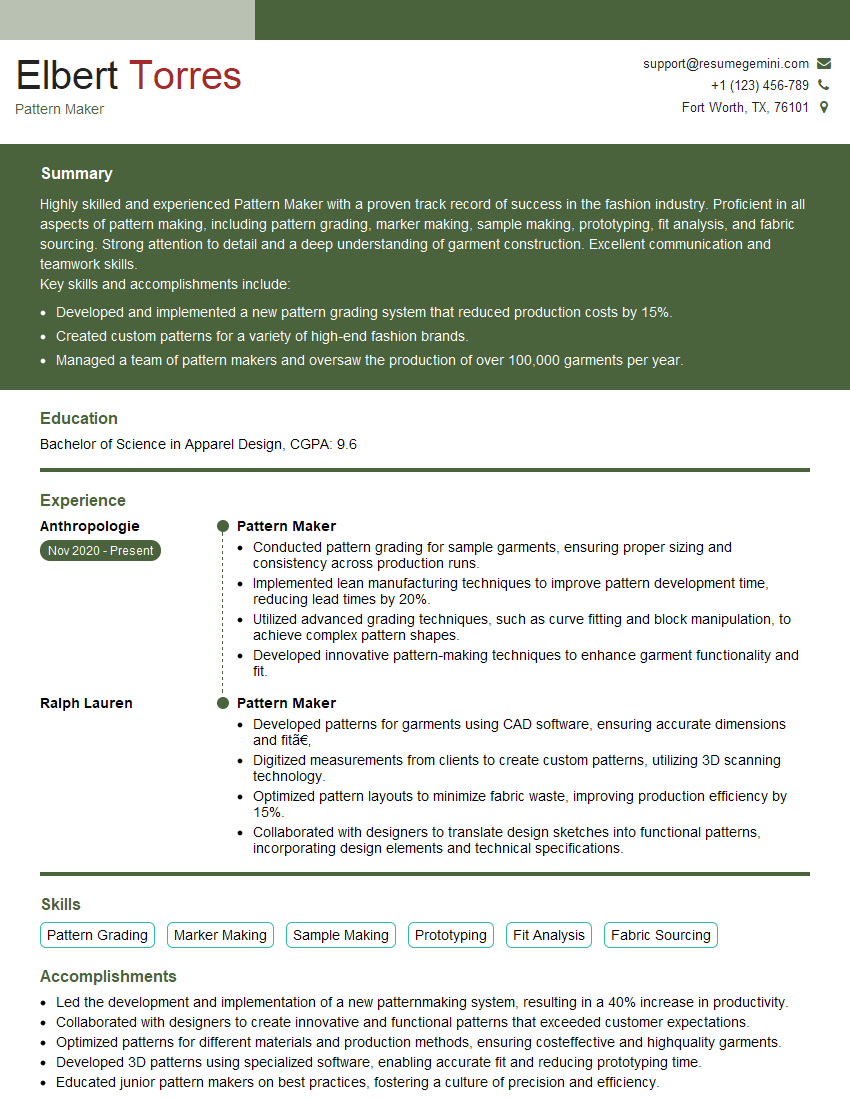
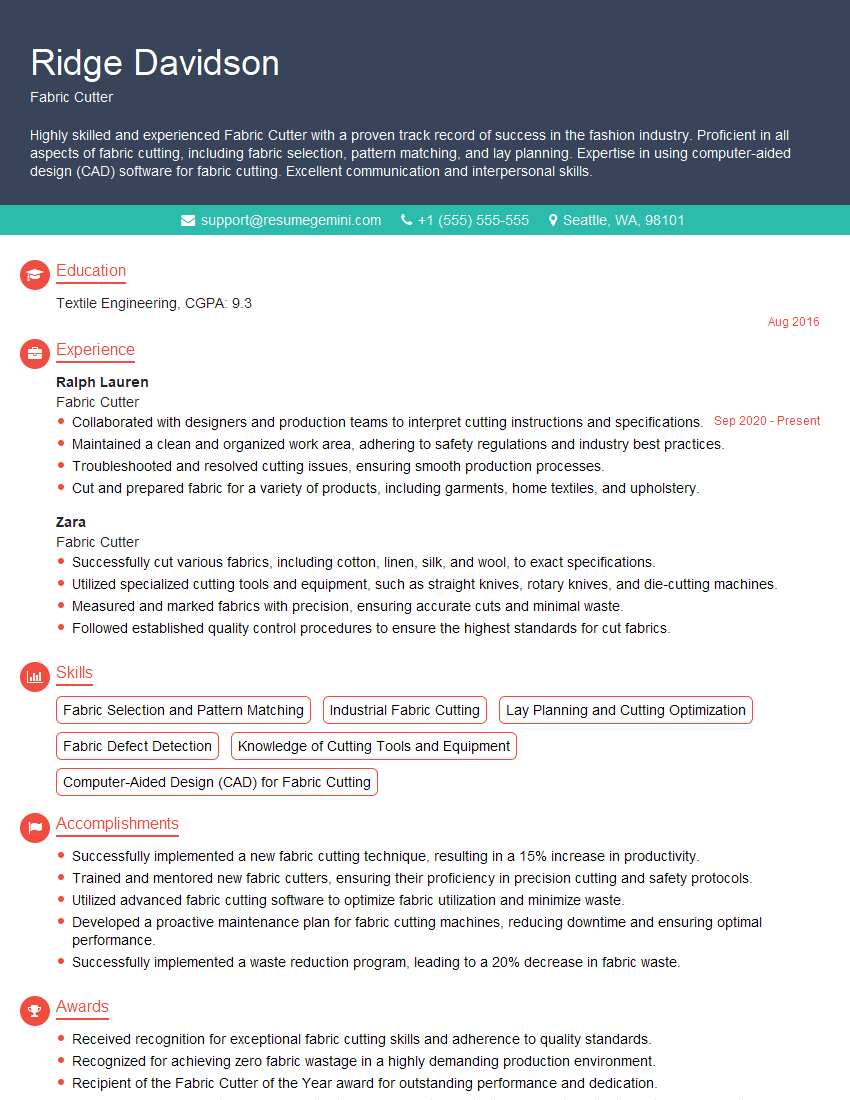
Mastering fabric handling and cutting is crucial for career advancement in the textile and apparel industries. A strong understanding of these skills demonstrates your capability to contribute efficiently and effectively to production processes, leading to increased responsibility and earning potential. To maximize your job prospects, it’s essential to create an ATS-friendly resume that highlights your expertise. ResumeGemini is a trusted resource to help you build a professional and impactful resume that will catch the eye of recruiters. We provide examples of resumes tailored specifically to Fabric Handling and Cutting to guide you in crafting your own compelling application.



Explore more articles
Users Rating of Our Blogs
Share Your Experience
We value your feedback! Please rate our content and share your thoughts (optional).
What Readers Say About Our Blog
Very informative content, great job.
good