Feeling uncertain about what to expect in your upcoming interview? We’ve got you covered! This blog highlights the most important Fabric Properties Knowledge interview questions and provides actionable advice to help you stand out as the ideal candidate. Let’s pave the way for your success.
Questions Asked in Fabric Properties Knowledge Interview
Q 1. Explain the difference between natural and synthetic fibers.
The fundamental difference between natural and synthetic fibers lies in their origin. Natural fibers are derived from plants or animals, while synthetic fibers are created artificially through chemical processes. Think of it like this: cotton comes from a plant, wool from a sheep, and polyester is manufactured from petroleum products.
- Natural Fibers: These offer unique properties like breathability, absorbency, and often a softer hand-feel, but can be more susceptible to damage from environmental factors and require more care. Examples include cotton, wool, silk, linen, and hemp.
- Synthetic Fibers: Synthetics are generally more durable, wrinkle-resistant, and less expensive than their natural counterparts. However, they might lack the breathability and softness of natural fibers, and some can contribute to environmental concerns due to their manufacturing processes. Polyester, nylon, and rayon are prime examples.
Choosing between natural and synthetic fibers depends heavily on the intended application. A breathable cotton t-shirt is ideal for summer wear, while a durable polyester jacket is better suited for outdoor activities.
Q 2. Describe the properties of cotton, wool, silk, and linen.
Let’s explore the unique properties of four key natural fibers:
- Cotton: Known for its softness, absorbency, and breathability. It’s versatile, widely used, and relatively inexpensive, making it a staple in clothing and home textiles. However, it can wrinkle easily and shrink with improper washing.
- Wool: A naturally warm and insulating fiber thanks to its crimp (wave-like structure) which traps air. Wool is also highly absorbent and resilient, making it ideal for outerwear and sweaters. It’s also relatively resistant to wrinkles. However, it can be sensitive to moths and needs careful washing.
- Silk: Luxurious and lustrous, silk is incredibly smooth and drapes beautifully. It’s also naturally hypoallergenic, making it a favorite for delicate garments. Its downside is that it’s delicate, requiring gentle hand washing or dry cleaning.
- Linen: Strong and durable, linen is known for its breathability and exceptional absorbency. It’s resistant to wrinkles and has a unique, slightly stiff hand-feel which many find desirable. However, it can wrinkle easily and is prone to creasing.
Understanding these individual properties helps designers choose the right fiber for a specific garment or textile. For example, a linen shirt is perfect for hot weather due to its breathability, while a wool coat provides warmth in colder climates.
Q 3. What are the key properties of polyester, nylon, and rayon?
Synthetic fibers offer a range of properties making them suitable for many applications:
- Polyester: A highly versatile fiber known for its durability, wrinkle resistance, and water repellency. It’s often blended with other fibers to improve their properties. It’s relatively inexpensive and easy to care for, making it common in sportswear and upholstery.
- Nylon: Strong, elastic, and lightweight, nylon is often used in hosiery, outerwear, and sportswear where strength and resilience are crucial. It’s also water-resistant and quick-drying, ideal for activewear. However, it can be less breathable than natural fibers.
- Rayon: A semi-synthetic fiber, meaning it’s made from natural cellulose (like wood pulp) but through a chemical process. Rayon has a soft hand-feel, good drape, and absorbs moisture reasonably well. It is used extensively in apparel and home furnishing, offering a smoother feel than some other synthetic options. However, it can wrinkle easily and isn’t very durable compared to polyester or nylon.
Consider the properties required for a specific item. For example, nylon’s strength makes it good for climbing ropes, while polyester’s wrinkle resistance makes it suitable for easy-care shirts.
Q 4. How does yarn count affect fabric drape and strength?
Yarn count, typically expressed as the number of hanks (840 yards) per pound, significantly impacts fabric drape and strength. A higher yarn count signifies finer, more tightly twisted yarns.
- Drape: Higher yarn counts generally result in fabrics with a softer, more fluid drape. Think of a luxurious silk scarf—it’s usually made with a very high yarn count. Lower yarn counts create stiffer, less draping fabrics.
- Strength: While higher yarn counts often mean a smoother fabric, the relationship between yarn count and strength is more complex. While finer yarns might feel delicate, they can create a stronger fabric if the yarns are tightly woven together. A tighter weave creates more interlacing points between yarns, improving overall fabric strength. Conversely, fabrics with lower yarn counts, if loosely woven, will be less strong.
In practice, a designer might select a high yarn count for a flowing gown but a lower yarn count for a more durable canvas bag.
Q 5. Explain the difference between woven and knitted fabrics.
Woven and knitted fabrics differ fundamentally in their construction methods, leading to distinct properties:
- Woven Fabrics: These are created by interlacing two sets of yarns at right angles—the warp (lengthwise) and weft (crosswise) yarns. This creates a strong, stable fabric with good dimensional stability. Examples include denim, twill, and satin.
- Knitted Fabrics: Knit fabrics are made by interlocking loops of a single yarn. This gives them stretch, flexibility, and a softer hand-feel. However, they’re generally less durable and less resistant to shrinking than woven fabrics. Examples include jersey, rib knit, and purl stitch.
The choice between woven and knitted fabrics depends on the desired properties. A woven fabric is ideal for a structured shirt, while a knitted fabric might be preferred for a comfortable sweater.
Q 6. Describe different weave structures (plain, twill, satin).
Different weave structures influence a fabric’s appearance, drape, and durability. Here are three common examples:
- Plain Weave: The simplest weave structure, where warp and weft yarns alternate in a simple over-under pattern. This produces a balanced, relatively strong fabric with a smooth surface, ideal for sheets and basic clothing. Examples include muslin and poplin.
- Twill Weave: Created by passing the weft yarn over and under two or more warp yarns, creating a diagonal pattern. Twill weaves are known for their durability and diagonal lines, often seen in denim and gabardine.
- Satin Weave: Characterized by long floats of warp or weft yarns, which create a smooth, lustrous surface. Satin weaves are less durable than plain or twill weaves but are prized for their sheen and drapability, used in evening wear and linings.
By understanding these weave structures, designers can select the ideal fabric for a particular garment or application. For example, the durability of twill makes it suitable for workwear, while the sheen of satin makes it perfect for formal dresses.
Q 7. What is the difference between warp and weft yarns?
Warp and weft yarns are the two fundamental sets of yarns used in woven fabrics. They run perpendicular to each other:
- Warp Yarns: These are the lengthwise yarns that run the length of the fabric. They are usually stronger and more tightly twisted than weft yarns to provide fabric strength and stability.
- Weft Yarns: These are the crosswise yarns that interlace with the warp yarns to create the fabric’s structure. They are often softer and less tightly twisted than warp yarns.
Think of a woven fabric like a tapestry: the warp yarns are the vertical threads, providing the foundation, and the weft yarns are the horizontal threads, adding color and pattern. The way these two sets of yarns interact determines the fabric’s final properties.
Q 8. Explain the concept of fabric weight and its implications.
Fabric weight, often expressed in ounces per square yard (oz/sq yd) or grams per square meter (gsm), refers to the mass of fabric per unit area. It’s a crucial factor influencing drape, durability, and the overall feel of a garment or textile. A heavier weight fabric, like denim, will be more substantial and durable, less prone to wrinkling, and suitable for outerwear. Conversely, a lighter weight fabric, such as chiffon, will drape beautifully, be more breathable, and appropriate for summer clothing. The choice of fabric weight depends entirely on the intended end-use.
Implications: Heavier fabrics are often warmer and more durable but can be less breathable and more expensive. Lighter fabrics are more breathable and comfortable but may be less durable and more prone to wrinkling. Understanding fabric weight is crucial for designers, manufacturers, and consumers alike to make informed decisions about fabric selection for specific applications.
Q 9. How does fabric density affect its performance?
Fabric density, often expressed as threads per inch (TPI) in both the warp (lengthwise) and weft (crosswise) directions, significantly impacts fabric performance. It refers to the closeness of yarn interlacing within the fabric structure. Higher density fabrics generally exhibit improved characteristics.
- Durability: A denser fabric is stronger and more resistant to abrasion and tearing. Think of a tightly woven canvas compared to a loosely woven muslin.
- Drape: While high density can sometimes make a fabric stiffer, appropriate yarn choice can still create a pleasing drape. A tightly woven but fine yarn will generally drape better than a loosely woven thick yarn.
- Warmth: Denser fabrics trap more air, providing better insulation and warmth. This is evident in winter coats versus summer shirts.
- Water Resistance: Higher density can make a fabric less permeable to water, though this is often enhanced by applying additional treatments.
In contrast, lower density fabrics are typically more breathable, lightweight and less expensive, but can be more prone to damage and lack the warmth of a high-density fabric.
Q 10. What are the different types of fabric finishes?
Fabric finishes are treatments applied to fabrics to modify their properties and enhance their appearance, feel, or performance. These finishes can be broadly categorized as:
- Mechanical Finishes: These involve physical processes like calendaring (pressing to create a smooth surface), shearing (removing protruding fibers), and embossing (creating raised patterns).
- Chemical Finishes: These use chemical treatments to alter fabric properties, including dyeing (adding color), mercerization (improving luster and strength of cotton), water repellents, and flame retardants.
- Aesthetic Finishes: These focus on improving the look and feel, such as softening, anti-pilling treatments, or adding a specific texture.
- Functional Finishes: These enhance performance aspects, including wrinkle resistance, stain resistance, and water resistance.
Specific examples include wrinkle-resistant finishes (often achieved through resin treatments), water-repellent finishes (using fluorocarbons or silicone-based coatings), and antimicrobial finishes (using silver nanoparticles).
Q 11. Explain the purpose of mercerization.
Mercerization is a chemical treatment applied primarily to cotton fabrics. It involves treating the fabric with a concentrated solution of sodium hydroxide (caustic soda). This process causes the cotton fibers to swell, resulting in several beneficial changes:
- Increased Luster: Mercerization significantly enhances the shine and luster of the cotton, giving it a silky appearance.
- Improved Strength: The treated fibers become stronger and more resistant to abrasion.
- Enhanced Dye Affinity: Mercerized cotton accepts dyes more readily and produces brighter, more even colors.
- Improved Dye Fastness: The dyed color is more resistant to fading from washing or sunlight.
Think of the difference between a dull, matte cotton t-shirt and a lustrous, high-quality mercerized cotton shirt. The latter is smoother, stronger, and has a more luxurious feel.
Q 12. Describe the process of dyeing and its impact on fabric properties.
Dyeing is the process of adding color to fabric fibers. It involves immersing the fabric in a dye bath containing dye molecules that bond with the fibers. Different dyeing methods exist depending on the fiber type and desired outcome. Common methods include:
- Vat dyeing: Used for cotton and other cellulose fibers, creating durable and colorfast results.
- Reactive dyeing: Creates strong bonds with cellulose fibers, offering excellent washfastness.
- Disperse dyeing: Suitable for polyester and other synthetic fibers.
Impact on Fabric Properties: Dyeing can slightly alter the fabric’s hand (feel), absorbency, and sometimes its strength. The type of dye and the dyeing process significantly impact the final color’s depth, brightness, and washfastness. Improper dyeing can lead to uneven color distribution or color bleeding during washing. Choosing the correct dyeing method for the specific fiber type is crucial to achieve desired results.
Q 13. How does fabric shrinkage occur and how can it be minimized?
Fabric shrinkage occurs due to the relaxation of fibers after weaving or knitting. The yarns, which were under tension during manufacturing, will try to return to their natural state when exposed to moisture and heat. This can happen during washing or even just due to humidity.
- Relaxation shrinkage: Occurs due to the release of internal stresses in yarns.
- Felting shrinkage: Primarily affects wool fabrics where fibers interlock and compact, reducing the overall size.
Minimizing Shrinkage: Several methods can minimize shrinkage:
- Pre-shrinking: Treating the fabric during manufacturing to reduce its potential for further shrinkage. This often involves washing or steaming the fabric.
- Using shrinkage-resistant fibers: Synthetics like polyester are less prone to shrinkage compared to natural fibers like cotton or wool.
- Careful washing: Washing in cold water and air-drying can reduce shrinkage.
- Choosing pre-shrunk fabrics: This is a straightforward approach for consumers to select fabrics that have already undergone a shrinkage treatment.
Q 14. What are the common fabric testing methods?
Various testing methods evaluate fabric properties. These tests are crucial for quality control and ensuring the fabric meets the required specifications:
- Tensile strength: Measures the fabric’s resistance to breaking under tension.
- Abrasion resistance: Determines the fabric’s ability to withstand rubbing and wear.
- Colorfastness: Assesses the resistance of the color to fading from washing, sunlight, or rubbing.
- Shrinkage: Measures the percentage reduction in fabric dimensions after washing.
- Bursting strength: Measures the force needed to rupture a fabric sample.
- Crease recovery: Evaluates the fabric’s ability to recover from wrinkling.
- Air permeability: Measures the fabric’s breathability.
- Water absorption: Tests how much water a fabric can absorb.
These tests are conducted using specialized equipment and follow standardized procedures, ensuring consistent and reliable results. The specific tests performed depend on the intended application of the fabric.
Q 15. Explain the significance of fabric drape and hand.
Fabric drape and hand are crucial properties that significantly influence the aesthetic appeal and overall quality of a textile. Drape refers to the way a fabric falls and hangs, influenced by factors like fiber type, yarn structure, and fabric construction. A good drape is often described as flowing, graceful, or elegant. Hand, on the other hand, describes the tactile feel of the fabric—its texture, softness, stiffness, and smoothness. It’s the overall sensory experience when you touch the fabric. Both drape and hand are subjective qualities, meaning different people might perceive them differently, but they play a vital role in determining a fabric’s suitability for various applications.
Examples: A lightweight silk fabric will possess an excellent drape, falling in soft, graceful folds, while a heavy wool fabric might have a stiffer, more structured drape. A cashmere sweater has a soft, luxurious hand, whereas denim might feel rougher and more durable.
Practical Application: Designers consider drape and hand when choosing fabrics for garments. A flowing drape is essential for evening gowns, while a stiffer drape is preferred for tailored jackets. The hand of a fabric affects the overall comfort and wearing experience. A soft hand is desirable for clothing worn next to the skin, whereas a coarser hand might be suitable for outdoor wear.
Career Expert Tips:
- Ace those interviews! Prepare effectively by reviewing the Top 50 Most Common Interview Questions on ResumeGemini.
- Navigate your job search with confidence! Explore a wide range of Career Tips on ResumeGemini. Learn about common challenges and recommendations to overcome them.
- Craft the perfect resume! Master the Art of Resume Writing with ResumeGemini’s guide. Showcase your unique qualifications and achievements effectively.
- Don’t miss out on holiday savings! Build your dream resume with ResumeGemini’s ATS optimized templates.
Q 16. How does fabric colorfastness affect its usability?
Colorfastness is the ability of a fabric to retain its color when exposed to various agents like washing, sunlight, and perspiration. Poor colorfastness means the fabric’s color will fade, bleed, or otherwise change over time, reducing its usability and overall quality. This can significantly impact the garment’s appearance and lifespan.
Impact on Usability: A fabric with poor colorfastness may bleed color when washed, staining other garments or leaving unsightly streaks. Sunlight can cause fading, making the garment look dull and worn. Perspiration can interact with dyes and cause discoloration, particularly in areas prone to sweating. These issues render the fabric less durable and aesthetically unappealing, limiting its practicality and market appeal.
Example: Imagine a vibrant red dress that loses its color after just a few washes. The faded, dull red detracts from its beauty and reduces the wearer’s satisfaction. Similarly, a bright blue shirt that bleeds dye in the wash can ruin other clothes and make the shirt itself unusable.
Q 17. Describe the different types of fabric defects.
Fabric defects can arise at various stages of production, from fiber preparation to weaving and finishing. They are broadly classified into:
- Fiber Defects: These include short fibers, broken fibers, neps (small entangled fiber clusters), and impurities.
- Yarn Defects: These include slubs (thickened areas in yarn), thin places, knots, and unevenness in twist.
- Fabric Defects: These are more visible and can include holes, broken ends, mispicks (incorrect interlacing of warp and weft yarns), shading (uneven dyeing), and barre (a regular variation in width).
- Finishing Defects: These can occur during processes like dyeing, printing, or finishing and may include stains, creases, wrinkles, and uneven shrinkage.
The presence of these defects reduces the quality of the fabric and can lead to customer dissatisfaction. The severity of the defect determines its impact on the fabric’s usability. Minor defects might be acceptable, while major defects may render the fabric unusable.
Q 18. What are the environmental considerations in fabric production?
Environmental considerations in fabric production are crucial for sustainability. The industry significantly impacts the environment throughout its lifecycle, from raw material production to manufacturing, transportation, and disposal. Key concerns include:
- Water Consumption: Textile production is water-intensive, with dyeing and finishing processes consuming vast amounts of water and generating wastewater.
- Energy Consumption: Manufacturing textiles requires significant energy, often from non-renewable sources, contributing to greenhouse gas emissions.
- Chemical Usage: Many processes use chemicals that can be harmful to human health and the environment if not properly managed.
- Waste Generation: Textile manufacturing generates significant amounts of waste, including textile scraps, wastewater, and chemical byproducts.
- Microplastic Pollution: The shedding of microplastics from synthetic fabrics during washing is a significant environmental concern.
Sustainable Practices: The industry is moving towards sustainable practices, including water recycling, renewable energy use, eco-friendly chemicals, and waste reduction strategies.
Q 19. Explain the concept of fabric sustainability.
Fabric sustainability focuses on minimizing the environmental and social impact of textile production and consumption. It encompasses a holistic approach, considering the entire lifecycle of a fabric, from raw material sourcing to end-of-life management.
Key Aspects: Sustainable fabrics prioritize the use of eco-friendly materials like organic cotton, recycled fibers, and innovative bio-based materials. Sustainable practices aim to reduce water and energy consumption, minimize chemical usage, and reduce waste generation. Fair labor practices, ensuring safe and ethical working conditions throughout the supply chain, are also integral to fabric sustainability. Finally, end-of-life management, including recycling and responsible disposal, contributes to minimizing the environmental impact.
Examples: Using recycled polyester reduces reliance on virgin materials and minimizes landfill waste. Employing closed-loop water systems in dyeing minimizes water consumption and pollution. Promoting fair-trade certified cotton ensures ethical sourcing and fair compensation for farmers.
Q 20. How does fiber length impact yarn strength?
Fiber length plays a significant role in yarn strength. Longer fibers generally lead to stronger yarns. This is because longer fibers can be more effectively intertwined and bonded together during spinning, resulting in a more cohesive and robust yarn structure. Shorter fibers, on the other hand, tend to create weaker yarns as they are more likely to slip or break during processing and use.
Mechanism: Longer fibers offer more surface area for inter-fiber bonding, leading to greater strength and durability. The longer the fiber, the more effectively it can be twisted and entangled with neighboring fibers, creating a stronger and more stable yarn. The increased number of points of contact between fibers enhances the yarn’s resistance to breakage under tension.
Example: Egyptian cotton, known for its long staple fibers, produces stronger and finer yarns compared to shorter staple cotton varieties. This superior yarn strength translates into stronger and more durable fabrics.
Q 21. What is the role of twisting in yarn structure?
Twisting is a fundamental process in yarn structure. It involves rotating two or more fibers around a central axis to create a continuous strand. This twisting imparts strength, stability, and specific properties to the yarn. The degree of twist is critical, as it affects various aspects of the yarn’s performance.
Role of Twist: Twisting improves yarn strength by binding individual fibers together. It enhances the yarn’s resistance to breakage and abrasion. The amount of twist also influences the yarn’s texture, feel, and elasticity. A higher twist produces a tighter, smoother yarn, while a lower twist results in a softer, more loosely structured yarn. Furthermore, twist can affect yarn properties such as bulk, extensibility, and susceptibility to pilling.
Example: A tightly twisted yarn is more resistant to breaking and is suitable for applications where strength is crucial, such as in canvas or upholstery fabrics. A loosely twisted yarn might be preferred for softer garments where comfort and drape are prioritized. The type and amount of twist are carefully controlled to achieve desired yarn characteristics tailored to the intended application.
Q 22. Describe the different types of knitting stitches.
Knitting stitches are the fundamental building blocks of knitted fabrics. They are created by interlocking loops of yarn, and the type of stitch significantly influences the fabric’s final properties – drape, texture, and strength. There are two basic categories: knit stitches and purl stitches. From these, countless variations and patterns emerge.
- Knit Stitch (or Plain Stitch): This creates a fabric with vertical lines, making it relatively stretchy and drapey. Think of a basic t-shirt fabric.
- Purl Stitch: This produces a fabric with a bumpy, textured surface. It is less stretchy than knit stitch and often used in combination with knit stitches to create various patterns.
- Garter Stitch: This is a simple stitch pattern consisting entirely of knit stitches on every row. It produces a reversible fabric with a ribbed texture.
- Stockinette Stitch: This is a common stitch pattern alternating rows of knit and purl stitches, resulting in a smooth face and a more textured reverse side. It’s widely used for its versatility.
- Rib Stitch: This stitch uses a combination of knit and purl stitches in repeating patterns, usually 1×1 (one knit, one purl), 2×2 (two knit, two purl), or other variations. It produces a more stable and less drapey fabric with good elasticity, often used in cuffs and neckbands.
Understanding these basic stitches is crucial for anyone working with knitted fabrics, whether designing garments or assessing their quality. For example, a ribbed cuff (using rib stitch) will have superior stretch and durability compared to a cuff made with garter stitch.
Q 23. Explain the concept of fabric abrasion resistance.
Fabric abrasion resistance refers to a fabric’s ability to withstand rubbing, scraping, and other forms of surface wear. It’s a crucial property, especially for fabrics intended for high-wear applications like outdoor clothing, upholstery, or workwear. A high abrasion resistance means the fabric will maintain its integrity and appearance longer, resisting pilling (the formation of small balls of fibers) and wear-through.
This resistance is affected by several factors, including the type of fiber (nylon is more resistant than cotton), the yarn construction (tightly spun yarns resist abrasion better), the fabric weave (tightly woven fabrics are more durable), and any applied finishes (some finishes enhance abrasion resistance).
Think about comparing a pair of durable work pants with a delicate summer dress. The work pants are made from a heavy-duty fabric with high abrasion resistance—likely a blend of durable fibers like cotton and polyester—to withstand daily wear and tear. In contrast, the summer dress is made with a lighter fabric with lower abrasion resistance, ideal for comfort but not designed for rugged use.
Q 24. How does fabric moisture wicking work?
Moisture wicking is the ability of a fabric to draw moisture (sweat) away from the skin and spread it across the fabric’s surface where it can evaporate. This is achieved through the use of hydrophilic (water-loving) fibers or specialized fabric treatments. The principle is simple: the fabric acts like a sponge, absorbing sweat and then transferring it to the air for evaporation.
Many athletic fabrics use moisture-wicking properties. These often use synthetic fibers like polyester or nylon, which are hydrophobic (water-repelling) in their natural state but are treated to improve their ability to absorb and wick away moisture. The fibers’ capillary action allows them to pull moisture through the fabric structure. The larger surface area created by this spreading facilitates faster evaporation. This keeps the wearer drier and more comfortable, especially during physical activity.
For example, consider a running shirt. A traditional cotton shirt would absorb sweat but remain damp and heavy against the skin, leading to discomfort. A moisture-wicking running shirt, however, will quickly transport sweat away from the body, helping the wearer stay cool and dry.
Q 25. What is the significance of fabric breathability?
Fabric breathability is the ability of a fabric to allow air and water vapor to pass through it. This is crucial for comfort, especially in clothing worn during physical activity. A breathable fabric allows the escape of perspiration, preventing the buildup of moisture against the skin and reducing the risk of overheating and discomfort.
Breathability is influenced by several factors including fiber type (natural fibers like cotton and linen are generally more breathable than synthetic fibers), yarn structure, fabric construction (open weaves are more breathable), and finishes (some finishes can reduce breathability).
Imagine wearing a heavy, non-breathable raincoat on a warm day. The lack of air circulation would cause you to overheat and become uncomfortable. On the other hand, a lightweight, breathable hiking shirt will let air pass through, keeping you cool and dry during your hike. The difference is significant for comfort and performance.
Q 26. Describe the difference between different fabric finishes, like water-resistant and waterproof.
Water-resistant and waterproof fabrics differ in their level of water protection. Water-resistant fabrics repel water to some degree but will eventually allow water to penetrate if exposed to prolonged or heavy rainfall. They often have a coating that causes water droplets to bead up on the surface. Waterproof fabrics, on the other hand, prevent water from passing through completely, offering superior protection from rain and other moisture.
A water-resistant jacket might offer sufficient protection for a light shower but would not be suitable for heavy rain or immersion. A waterproof jacket, however, would keep you dry even in torrential downpours. The difference lies in the material construction, the type of coating, and the application method. Waterproofing treatments often involve laminating a membrane to the fabric, while water-resistant coatings simply create a surface repellent layer.
For example, a lightweight, water-resistant windbreaker might be ideal for everyday use, while a heavier-duty, waterproof jacket is essential for outdoor activities in wet conditions.
Q 27. How do different fabric treatments affect their properties?
Fabric treatments significantly affect fabric properties. These treatments can enhance various aspects, including water resistance, stain resistance, wrinkle resistance, flame resistance, and softness. The treatment method depends on the desired properties and the fabric itself.
- Water-repellent finishes: These treatments create a hydrophobic surface, making the fabric resistant to water. Examples include Durable Water Repellent (DWR) finishes.
- Stain-resistant finishes: These prevent stains from penetrating the fibers, making cleaning easier. Often achieved with chemical treatments.
- Wrinkle-resistant finishes: These treatments reduce wrinkles and creases in fabrics, often through resin treatments.
- Flame-retardant finishes: These increase the fabric’s resistance to ignition and burning, crucial for safety in certain applications.
- Softening finishes: These improve the fabric’s feel and drape, often using enzymes or other chemicals.
For example, a wrinkle-resistant shirt requires less ironing and stays neat longer. Similarly, flame-retardant fabrics used in protective clothing significantly enhance safety by reducing the risk of fire-related injuries.
Q 28. How would you identify a fabric’s composition?
Identifying a fabric’s composition involves a combination of visual inspection, touch, and often, laboratory testing. Visual inspection can provide clues about the fiber type – for instance, linen has a distinct texture, while silk has a lustrous sheen. The feel of the fabric – its weight, drape, and softness – can also offer hints. However, accurate identification frequently requires more advanced techniques.
Methods for identification include:
- Burn test: This involves carefully burning a small sample of the fabric and observing the way it burns, the smell produced, and the resulting ash. Different fibers exhibit distinct burning characteristics. This is a simple test but requires caution and should only be done in a controlled environment.
- Microscopic analysis: Examining the fibers under a microscope allows for detailed observation of their shape, size, and surface structure. This is a more precise method.
- Chemical tests: Various chemical tests can identify specific fiber types. These tests are typically performed in a laboratory setting.
- Label information: Many garments include care labels stating the fabric composition. This is the easiest and often most reliable method, provided the label is accurate.
Remember that many fabrics are blends of different fibers. Precise identification may require using multiple methods. The burn test, while useful, should be used with care and should only be performed by trained individuals.
Key Topics to Learn for Fabric Properties Knowledge Interview
- Fiber Types and Properties: Understanding natural (cotton, wool, silk, linen) and synthetic (polyester, nylon, rayon) fibers; their characteristics (strength, elasticity, absorbency, drape), and suitability for different applications.
- Yarn Construction and Properties: Exploring different yarn types (spun, filament, textured) and their impact on fabric hand, durability, and appearance. Analyzing the relationship between yarn structure and fabric performance.
- Fabric Construction and Properties: Mastering various weave structures (plain, twill, satin), knit structures (jersey, rib, interlock), and their influence on fabric properties like drape, stability, and breathability. Practical application includes identifying fabric types based on their construction.
- Fabric Finishes and Treatments: Gaining knowledge of various finishes (mercerization, dyeing, printing, water-repellent treatments) and their effects on fabric aesthetics, functionality, and performance. Understanding how finishes impact the final product.
- Fabric Testing and Quality Control: Familiarizing yourself with common fabric testing methods (strength, abrasion resistance, colorfastness) and their importance in ensuring quality and meeting industry standards. Problem-solving approaches include interpreting test results and identifying potential fabric defects.
- Fabric Selection and Application: Developing the ability to select appropriate fabrics for specific end-uses (apparel, upholstery, industrial applications) considering factors like cost, performance requirements, and aesthetic considerations.
Next Steps
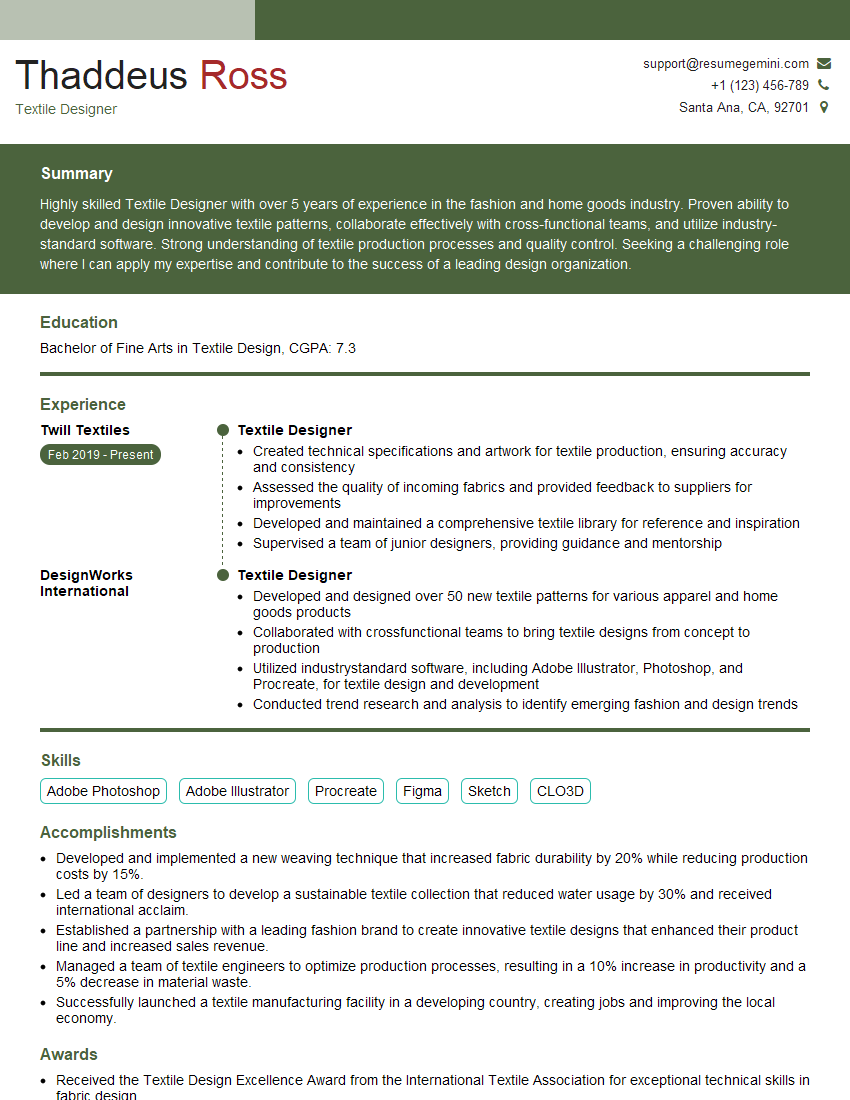
Mastering fabric properties knowledge is crucial for career advancement in the textile and apparel industries. A strong understanding of these concepts demonstrates expertise and opens doors to more challenging and rewarding roles. To significantly boost your job prospects, it’s essential to create an ATS-friendly resume that effectively highlights your skills and experience. We strongly recommend using ResumeGemini, a trusted resource for building professional resumes. ResumeGemini provides examples of resumes tailored to Fabric Properties Knowledge, helping you showcase your expertise and secure your dream job.




Explore more articles
Users Rating of Our Blogs
Share Your Experience
We value your feedback! Please rate our content and share your thoughts (optional).
What Readers Say About Our Blog
Very informative content, great job.
good