Interviews are more than just a Q&A session—they’re a chance to prove your worth. This blog dives into essential Failure Probability Analysis interview questions and expert tips to help you align your answers with what hiring managers are looking for. Start preparing to shine!
Questions Asked in Failure Probability Analysis Interview
Q 1. Explain the difference between failure rate and hazard rate.
While both failure rate and hazard rate describe how often a system fails, they differ in their perspective. Failure rate is the average number of failures per unit time over the entire lifespan of a system. Imagine a batch of lightbulbs; the failure rate would be the total number of bulbs that failed divided by the total operating hours. This gives a general idea of how often failures occur.
Hazard rate, also known as the instantaneous failure rate, focuses on the probability of failure at a specific point in time, given that the system has survived until that point. It reflects the aging of a system. Think of the same lightbulbs: a hazard rate would show that the probability of a bulb failing increases significantly after a certain number of operating hours. This explains the increased chance of failure as the system ages or experiences wear and tear. In simpler terms: failure rate is the average over the whole lifetime, while the hazard rate is the failure probability at a specific moment in time.
Q 2. Describe common failure modes and effects analysis (FMEA) techniques.
Failure Modes and Effects Analysis (FMEA) is a systematic approach to identify potential failure modes in a system and assess their impact. Several techniques exist, with variations in depth and formality:
- Basic FMEA: This involves a team brainstorming potential failure modes, their causes, effects, and severity. It’s suitable for less complex systems. A simple table is usually utilized, documenting each failure mode’s severity, occurrence, and detection.
- Design FMEA (DFMEA): Focused on potential failures during the design phase. It allows for proactive mitigation of design flaws.
- Process FMEA (PFMEA): Applied to manufacturing or operational processes. It aims to identify potential failures during production or operation.
- System FMEA: Considers failures at the system level, integrating the results of DFMEA and PFMEA to understand interactions between subsystems.
All FMEA techniques typically involve a risk priority number (RPN) calculation – a product of Severity, Occurrence, and Detection – to prioritize potential failures for mitigation. Higher RPN values indicate higher risks.
Q 3. How do you calculate the reliability of a system with multiple components?
Calculating the reliability of a system with multiple components depends on the relationship between those components.
- Series System: If components are arranged in series (one failure stops the whole system), the overall reliability is the product of the individual component reliabilities. For example, if component A has reliability of 0.9 and component B has reliability of 0.8, then the system reliability is 0.9 * 0.8 = 0.72.
- Parallel System: If components are in parallel (the system functions as long as at least one component works), the overall reliability is 1 minus the product of the individual unreliabilities (1 – reliability). For example, if component A has reliability 0.9 (unreliability 0.1) and component B has reliability 0.8 (unreliability 0.2), then the system reliability is 1 – (0.1 * 0.2) = 0.98.
- More complex systems: Systems with complex arrangements often involve using block diagrams, fault trees, or Markov models to account for different failure modes and dependencies between components. Simulation techniques might be necessary for highly intricate setups.
Understanding the component interdependencies is crucial for accurate system reliability estimation. Often, redundancy is built into systems to improve reliability; this is a key principle in aerospace, automotive and energy industry.
Q 4. What is Weibull distribution and how is it used in reliability analysis?
The Weibull distribution is a versatile probability distribution used to model the time-to-failure of various systems and components. Its shape parameter, β, determines the shape of the distribution, indicating different failure patterns:
- β < 1: Indicates decreasing failure rate (infant mortality, early failures).
- β = 1: Represents a constant failure rate (random failures).
- β > 1: Shows an increasing failure rate (wear-out failures).
The scale parameter, η, represents the characteristic life of the system. The Weibull distribution’s adaptability allows it to fit a wide range of failure data, making it useful for predicting remaining useful life (RUL) and determining optimal maintenance schedules. For instance, in analyzing the lifespan of wind turbine blades, where failures can occur due to various mechanisms, the Weibull distribution can effectively model this complex failure behavior.
Q 5. Explain the concept of Mean Time Between Failures (MTBF).
Mean Time Between Failures (MTBF) is the average time between consecutive failures of a repairable system. It’s a key metric for assessing the reliability of systems like servers, airplanes, and manufacturing equipment. A higher MTBF value suggests higher reliability. MTBF is calculated by dividing the total operating time by the total number of failures. For example: If a server operated for 10,000 hours and experienced 2 failures, its MTBF is 10,000 hours / 2 failures = 5,000 hours. Note that MTBF applies to repairable systems, whereas for non-repairable systems we use Mean Time To Failure (MTTF).
Q 6. What are different types of reliability testing?
Numerous reliability testing methods exist, each serving a different purpose:
- Life testing: Accelerated life tests (ALT), such as temperature or humidity cycling, stress the system beyond normal operating conditions to induce faster failures, providing faster estimates of reliability and failure modes.
- Component testing: Testing individual components in isolation to assess their reliability and failure modes. This helps to isolate issues and improve the design of individual components.
- System testing: Testing the complete system to assess its overall reliability. This can involve various types of testing, such as functional testing, load testing, stress testing, and environmental testing.
- Reliability growth testing: This iterative process involves testing, identifying failures, fixing them, and retesting until the desired reliability level is achieved. This approach is crucial for complex systems undergoing development.
The choice of testing method depends on factors like the complexity of the system, the budget, and the time available. A combination of these techniques are often implemented for comprehensive reliability evaluation.
Q 7. How do you perform a fault tree analysis (FTA)?
Fault Tree Analysis (FTA) is a top-down, deductive method for analyzing system failures. It starts with a defined top-level undesired event (e.g., system failure) and works backward to identify the basic causes that can lead to this event.
Performing an FTA involves these steps:
- Define the top event: Clearly state the undesired event you are analyzing.
- Identify contributing events: Determine the events that can directly cause the top event.
- Develop the fault tree: Use logic gates (AND, OR, XOR) to connect the events and represent their relationships. An AND gate means all events must occur to cause the top event, while an OR gate means any event is sufficient.
- Identify basic events: The lowest-level events in the tree are the basic events. These are typically failures of components or occurrences of external events.
- Quantify the probabilities: Assign probabilities to the basic events based on historical data, testing, or expert judgment.
- Calculate the top event probability: Use Boolean algebra or specialized software to calculate the probability of the top event occurring.
FTA is often used to pinpoint critical components or processes that have the most significant influence on system reliability and to help guide mitigation strategies. For example, in nuclear power plants, FTA plays a crucial role in safety analysis.
Q 8. Describe different methods for estimating failure probabilities.
Estimating failure probabilities is crucial in reliability engineering. We use various methods depending on the available data and the complexity of the system. These methods can be broadly categorized into data-driven and model-based approaches.
Data-driven methods: These rely on historical failure data. For example, if we have recorded the failure times of 100 light bulbs, we can use statistical methods like the Weibull distribution or the exponential distribution to estimate the probability of failure within a given time period. This is frequently done by calculating failure rates and using those rates in reliability models. This approach works best when we have a large, representative dataset of failures. If not enough data is available, other methods must be considered.
Model-based methods: When historical data is scarce or non-existent, we build models based on our understanding of the failure mechanisms. For instance, we might use a fault tree analysis (FTA) to model the ways a complex system can fail, combining individual component failure probabilities to estimate the system’s overall failure probability. Similarly, Failure Mode and Effects Analysis (FMEA) allows identifying potential failures and their effects, thus enabling preventative measures that can directly affect the failure probability.
Physics-of-failure models: These incorporate physical and chemical principles to predict failure probabilities. For example, in predicting the fatigue life of a metal component, we might use a model that considers the material properties, stress levels, and environmental factors.
Choosing the right method depends on the context. For simple systems with abundant historical data, data-driven methods are often sufficient. For complex systems or when data is limited, model-based methods are necessary.
Q 9. Explain the concept of redundancy and its impact on reliability.
Redundancy is the inclusion of duplicate components or systems to enhance reliability. Imagine a critical system with a single point of failure – if that component fails, the whole system fails. By incorporating redundancy, we create backup systems that take over if a primary component fails.
The impact on reliability is significant. Redundancy dramatically decreases the probability of system failure. For example, if we have two identical components operating in parallel (with independent failure probabilities), the system fails only if both components fail. This significantly reduces the overall failure probability.
Different types of redundancy exist. Active redundancy means all components operate simultaneously, while passive redundancy involves backup components that only activate upon primary component failure. The choice depends on the system’s requirements and cost constraints. N-modular redundancy, for instance, utilizes N identical units operating in parallel, making it exceedingly reliable, but often at a greater cost.
Q 10. How do you handle uncertainty in failure data?
Uncertainty in failure data is a common challenge. Data might be scarce, incomplete, or may not accurately represent the real-world operating conditions. We address this using several strategies:
Bayesian methods: These incorporate prior knowledge or beliefs about failure probabilities into the analysis. This allows us to combine limited data with expert judgment to obtain more robust estimates.
Non-parametric methods: These methods don’t assume a specific probability distribution for the failure data, making them useful when the underlying distribution is unknown or complex. Kaplan-Meier estimation is a great example of such method.
Sensitivity analysis: We vary input parameters (e.g., failure rates) within their range of uncertainty to assess the impact on the overall failure probability. This helps to identify the critical parameters that most influence the results.
Monte Carlo simulation: This technique uses random sampling to generate numerous possible scenarios, taking into account uncertainty in the input parameters. The result is a probability distribution of the failure probability, rather than a single point estimate.
Essentially, we strive to quantify and propagate uncertainty through the analysis, presenting results that reflect the inherent uncertainty in the data.
Q 11. What is the difference between qualitative and quantitative risk assessment?
Qualitative and quantitative risk assessments differ in their approach to evaluating risks.
Qualitative risk assessment: This is a more subjective approach that uses descriptive terms (e.g., low, medium, high) to rate the likelihood and severity of potential failures. It’s often used in the early stages of a project or when data is limited. Techniques like brainstorming and HAZOP (Hazard and Operability Study) fall into this category. It prioritizes risk identification and prioritization based on expert judgment.
Quantitative risk assessment: This approach uses numerical data and statistical methods to quantify the likelihood and consequences of potential failures. It results in numerical estimates of risk, allowing for more precise comparisons and decisions. This often involves detailed modeling and data analysis using techniques like FTA or reliability block diagrams. It builds on the findings from qualitative assessment to add numerical weight to the risk levels.
Often, a combined approach is used, starting with a qualitative assessment to identify potential failures and then using quantitative methods to refine the risk estimates.
Q 12. What are some common reliability block diagrams (RBD) techniques?
Reliability Block Diagrams (RBDs) are graphical representations of a system’s components and their reliability. Several techniques enhance their utility:
Series systems: In a series system, all components must function for the system to succeed. The overall reliability is the product of the individual component reliabilities.
Parallel systems: In a parallel system, the system functions if at least one component functions. The overall reliability is 1 minus the product of the individual component unreliability.
k-out-of-n systems: These systems function if at least k out of n components are functioning. The calculations for reliability are more complex and often require combinatorial analysis. These are used for systems requiring a minimum level of functionality.
Mixed systems: Most real-world systems are combinations of series and parallel configurations. Analyzing these requires breaking down the system into smaller series and parallel subsystems and combining their reliabilities.
RBDs facilitate a clear visualization of system architecture and the dependencies between components, making them essential tools for reliability analysis.
Q 13. How do you analyze data from accelerated life testing?
Accelerated life testing (ALT) subjects components to more stressful conditions than normal operating conditions to induce failures more quickly. Analyzing data from ALT involves several steps:
Selecting appropriate stress levels: These should be high enough to accelerate failure but not so high that they introduce artificial failure mechanisms.
Data collection: Record failure times or other relevant data at each stress level.
Statistical model fitting: Fit a statistical model (e.g., Weibull, lognormal) to the failure data. The model should account for the effects of the stress levels on the failure rate.
Extrapolation: Use the fitted model to extrapolate the failure probabilities to normal operating conditions.
Uncertainty analysis: Assess the uncertainty in the extrapolated failure probabilities due to the assumptions and limitations of the ALT method.
Common models used for ALT data analysis include the Arrhenius model (for temperature acceleration) and the Eyring model (for combined stress factors).
Q 14. Describe your experience with statistical software for reliability analysis (e.g., Minitab, R, JMP).
I have extensive experience with several statistical software packages for reliability analysis. My proficiency includes:
Minitab: I use Minitab for its user-friendly interface and comprehensive capabilities for reliability analysis, including Weibull analysis, survival analysis, and capability analysis. I’ve used it extensively for fitting distribution functions to failure data and performing reliability calculations for various systems.
R: R provides unparalleled flexibility and power for advanced statistical modeling and simulation. I’ve leveraged R’s extensive libraries (e.g., survival, reliability) to build customized models and perform complex simulations, such as Monte Carlo simulations to account for uncertainty. It’s particularly useful for complex reliability scenarios.
JMP: JMP’s strong graphical capabilities make it a valuable tool for visualizing reliability data and identifying trends. I have used its platform for exploratory data analysis, distribution fitting, and generating clear, concise reports for stakeholders.
My choice of software depends on the specific project requirements and the complexity of the analysis. For simpler analyses, Minitab’s user-friendly interface is ideal. For more complex models and simulations, R offers unmatched flexibility. JMP’s visualization tools are invaluable for conveying results effectively.
Q 15. Explain the importance of root cause analysis in reliability engineering.
Root cause analysis (RCA) is the cornerstone of reliability engineering. It’s not just about fixing a problem; it’s about understanding why the problem occurred in the first place. Without understanding the root cause, you’re merely treating symptoms, leading to recurring failures and wasted resources. A successful RCA prevents future incidents by addressing the underlying issues, not just the immediate effects.
Imagine a car overheating. Simply adding more coolant is treating a symptom. A proper RCA might reveal a faulty water pump, a clogged radiator, or a problem with the thermostat – addressing the actual root cause. In a product setting, this could mean analyzing failure data, conducting fault tree analysis (FTA), or employing the ‘5 Whys’ technique to drill down to the fundamental reason behind a product defect.
- Fault Tree Analysis (FTA): A top-down, deductive reasoning method that diagrams the various combinations of events that can lead to a particular failure.
- ‘5 Whys’: A simple, iterative questioning technique that repeatedly asks ‘Why?’ to uncover the root cause of a problem. For example: Why did the system fail? (Because the power supply failed.) Why did the power supply fail? (Because a capacitor overheated.) And so on.
Career Expert Tips:
- Ace those interviews! Prepare effectively by reviewing the Top 50 Most Common Interview Questions on ResumeGemini.
- Navigate your job search with confidence! Explore a wide range of Career Tips on ResumeGemini. Learn about common challenges and recommendations to overcome them.
- Craft the perfect resume! Master the Art of Resume Writing with ResumeGemini’s guide. Showcase your unique qualifications and achievements effectively.
- Don’t miss out on holiday savings! Build your dream resume with ResumeGemini’s ATS optimized templates.
Q 16. How do you balance the cost of improving reliability with the potential benefits?
Balancing the cost of reliability improvement against potential benefits requires a cost-benefit analysis. This involves carefully weighing the expenses of implementing reliability enhancements (e.g., improved materials, rigorous testing, design modifications) against the potential savings from reduced downtime, fewer warranty claims, enhanced product reputation, and increased customer satisfaction.
One effective approach is to prioritize improvements based on their Return on Investment (ROI). We calculate the potential cost savings from avoiding failures (reduced repair costs, lost production, etc.) and compare that to the investment needed to achieve that improvement. Using reliability prediction models, such as MIL-HDBK-217, can help estimate potential failure rates and associated costs under different scenarios. Prioritizing high-ROI projects ensures that we focus our resources on improvements that provide the biggest impact.
For example, if improving a component costs $10,000 but prevents an estimated $50,000 in annual repair costs, the ROI is clearly positive. However, if another improvement costs $50,000 and only prevents $10,000 in costs, it’s less justifiable. This process should be documented and reviewed regularly.
Q 17. What are some common metrics used to evaluate reliability?
Reliability is measured using a variety of metrics, depending on the context and the specific needs. Some common metrics include:
- Mean Time Between Failures (MTBF): The average time between failures of a system. A higher MTBF indicates greater reliability.
- Mean Time To Failure (MTTF): The average time until the first failure of a non-repairable system. This is often used for components which are not easily repaired.
- Mean Time To Repair (MTTR): The average time it takes to repair a failed system. A lower MTTR is desirable for maintainability.
- Failure Rate (λ): The number of failures per unit time. This is often expressed in failures per million hours (FPMH).
- Availability: The percentage of time a system is operational. This considers both MTBF and MTTR.
- Reliability Growth: Tracks the improvement in reliability over time, often during a testing phase of a product.
The choice of metric depends on the application. For example, in an aircraft system, MTBF is critical, whereas in a consumer product, warranty claims and customer satisfaction data might be more important indicators of reliability.
Q 18. Describe your experience with different reliability standards (e.g., MIL-HDBK-217).
I have extensive experience working with various reliability standards, including MIL-HDBK-217, IEC 61709, and Telcordia (Bellcore) SR-332. MIL-HDBK-217, for instance, is a widely used military standard for predicting the reliability of electronic parts. It provides models and data for calculating failure rates based on component type, environmental conditions, and stress levels.
My experience extends beyond simple application of these standards. I understand their limitations – they often rely on statistical data which may not perfectly reflect real-world conditions. Therefore, I also incorporate field data and accelerated testing results to refine reliability predictions and gain a more accurate and realistic assessment. I’m adept at using these standards to build models and run simulations, allowing for ‘what-if’ scenarios and informed decision-making regarding design choices and materials selection.
Furthermore, I’m familiar with the evolving landscape of reliability standards and the increasing importance of incorporating software reliability into overall system reliability assessments. I am comfortable with applying diverse standards depending on the particular application and the required level of rigor.
Q 19. How do you communicate complex reliability concepts to non-technical audiences?
Communicating complex reliability concepts to non-technical audiences requires clear, concise language and relatable analogies. Instead of using jargon like ‘failure rate’ or ‘MTBF’, I focus on explaining the concepts in terms of probabilities and risks. For instance, instead of saying ‘the MTBF is 1000 hours,’ I might say ‘there’s a one in a thousand chance of the system failing within the first hour of operation’.
Visual aids, such as graphs and charts, are invaluable. A simple bar chart showing the probability of failure at different operating times is far more accessible than complex statistical tables. I also use real-world examples that resonate with the audience. For example, if discussing reliability in the context of a car, I might talk about the probability of a car breaking down during a long road trip. Storytelling, and using relatable metaphors and analogies, can also significantly improve comprehension.
Finally, I always encourage questions and actively work to ensure everyone understands the information presented. A successful communication isn’t just about delivering information; it’s about ensuring that information is effectively received and understood.
Q 20. How do you prioritize reliability improvements in a product development cycle?
Prioritizing reliability improvements within a product development cycle requires a strategic approach. I typically use a risk-based prioritization methodology, incorporating several factors:
- Criticality: How critical is the component or system to the overall product function? Components crucial for safety or functionality warrant higher priority.
- Failure probability: What is the likelihood of failure for each component or system? Components with higher failure probabilities should be prioritized.
- Impact of failure: What are the consequences of a failure? A failure leading to safety hazards or significant financial losses requires urgent attention.
- Cost of improvement: How much will it cost to implement reliability improvements? This should be weighed against the risk and impact of failure.
- Development stage: Early identification and mitigation of reliability issues is more cost-effective than addressing problems later in the development cycle.
This process often involves creating a risk matrix, visually representing the relative risk associated with each component or system. The matrix helps rank potential improvements and allocate resources accordingly. This ensures that the most critical reliability issues are addressed first, maximizing impact while effectively managing time and resources.
Q 21. Explain the concept of maintainability and its relationship to reliability.
Maintainability and reliability are closely related but distinct concepts. Reliability refers to the probability of a system performing its intended function without failure for a specified period under stated conditions. Maintainability, on the other hand, refers to the ease and speed with which a failed system can be restored to operational status. High reliability reduces the frequency of repairs, while high maintainability reduces the time required for repairs.
Imagine a complex piece of machinery. High reliability means it rarely breaks down. High maintainability means that if it does break down, it’s easy to fix quickly. Both are crucial for overall system effectiveness. A highly reliable system with poor maintainability can still suffer prolonged downtime if a failure occurs, while a highly maintainable system with low reliability will require frequent repairs, leading to increased costs and potential safety risks.
Therefore, a well-designed system strives for both high reliability and high maintainability. This may involve using modular designs for easier repair, providing comprehensive diagnostic tools, and developing detailed maintenance procedures. The relationship is synergistic; improving one aspect often indirectly improves the other.
Q 22. Describe your experience with reliability growth testing and modeling.
Reliability growth testing is a crucial process used to identify and address weaknesses in a system during its development and early life. It’s like training an athlete – you push them to their limits, identify their weak points, and improve their performance iteratively. We use various models, like the Duane model or the Crow-AMSAA model, to mathematically represent the growth in reliability as we address these weaknesses. The Duane model, for example, assumes a constant failure rate improvement over time, expressed as a power law relationship between cumulative failures and operational time.
My experience involves designing and executing these tests, collecting and analyzing failure data, and then fitting appropriate models to estimate the future reliability. This often requires sophisticated statistical methods and involves working closely with engineering teams to understand the root causes of failures. I’ve worked on projects spanning diverse industries, from aerospace to medical devices, and always focus on developing a tailored approach based on the specific system and its operating environment. For example, in a recent project involving a telecommunication satellite, we used the Crow-AMSAA model to accurately predict the reliability growth and allocate resources effectively for corrective actions.
Q 23. How do you handle conflicting requirements for reliability, cost, and performance?
Balancing reliability, cost, and performance is a constant challenge. It’s like choosing the perfect recipe: You want the delicious taste (performance), but you need to manage the cost of ingredients (cost) and ensure food safety (reliability). There’s no one-size-fits-all solution. It often involves a trade-off and requires a robust decision-making framework.
My approach involves:
- Defining clear priorities: This typically starts with understanding the criticality of the system. A medical implant requires a much higher reliability than a consumer electronic device, even if the cost is higher.
- Using quantitative analysis: We use reliability modeling (like Fault Tree Analysis or Markov models) to quantify the impact of design decisions on reliability, and we perform cost-benefit analyses to assess the trade-offs.
- Iterative design and optimization: We start with an initial design and then iteratively improve it, considering reliability targets, cost constraints, and performance metrics. This often requires multiple simulations and risk assessments.
- Risk management: We identify and mitigate risks associated with each decision. A lower cost solution might have higher risks, and these risks must be carefully analyzed.
Ultimately, the goal is to find an optimal balance that satisfies the project objectives while minimizing risks.
Q 24. What is your experience with using simulation tools to predict system reliability?
Simulation tools are indispensable for predicting system reliability. They are like having a virtual test lab where you can explore various scenarios without the time and cost of physical testing. I have extensive experience with a variety of tools, including ARENA, Simulink, and specialized reliability software. These tools allow for the creation of detailed models of complex systems, enabling the analysis of factors such as component failures, repair times, and environmental influences.
For example, I recently used Simulink to model the reliability of a complex power grid. This involved simulating thousands of scenarios, incorporating random failure events and repair actions, to predict the probability of power outages under various conditions. The results were crucial in informing design improvements and resource allocation strategies.
The choice of simulation tool depends on the complexity of the system and the specific aspects of reliability being investigated. I select the appropriate tool based on the project requirements, ensuring that the model accurately reflects the real-world system.
Q 25. Explain different methods for predicting the remaining useful life (RUL) of components.
Predicting Remaining Useful Life (RUL) is a critical aspect of prognostics and health management. It’s like predicting how much longer your car will run before needing major repairs. Different methods are employed based on the available data and the characteristics of the component.
- Physics-of-failure models: These models use physical principles and degradation mechanisms to predict RUL. For example, predicting the remaining life of a bearing based on its wear rate.
- Data-driven models: These models use historical data and machine learning algorithms to predict RUL. This approach is particularly effective when dealing with complex systems where the underlying degradation mechanisms are not well-understood.
- Statistical methods: Techniques like Weibull analysis can be used to estimate the probability of failure within a specific timeframe, helping estimate RUL.
- Hybrid models: These models combine physics-based and data-driven approaches for improved accuracy. For instance, incorporating wear and tear sensor data into a physics-based model for a specific component.
The selection of the most appropriate method depends on factors such as the availability of data, the understanding of the degradation mechanisms, and the desired accuracy.
Q 26. How do you interpret reliability analysis results and make recommendations for improvements?
Interpreting reliability analysis results requires a critical and holistic approach. It’s not just about the numbers; it’s about understanding the implications and recommending practical solutions.
My approach involves:
- Visualizing the results: I use charts and graphs to present the findings in a clear and concise manner, making it easy for stakeholders to grasp the key takeaways.
- Identifying key areas for improvement: I focus on the most significant weaknesses revealed by the analysis. For example, if a specific component consistently shows a high failure rate, it becomes a priority for redesign or replacement.
- Prioritizing recommendations: Not all recommendations are created equal. I prioritize recommendations based on their impact on reliability, cost, and feasibility.
- Communicating the findings effectively: I communicate my findings and recommendations clearly and concisely to stakeholders, including engineers, management, and clients, ensuring that everyone understands the implications and the proposed solutions.
- Developing an action plan: I work with the project team to develop a concrete action plan that outlines the steps needed to implement the recommendations.
Ultimately, the goal is to use the analysis results to make informed decisions that improve the reliability, safety, and cost-effectiveness of the system.
Q 27. Describe a situation where you had to troubleshoot a reliability problem. What was your approach?
In a recent project involving a wind turbine system, we experienced a higher-than-expected failure rate in the gearbox. This was impacting productivity and maintenance costs. My approach involved a structured investigation:
- Data collection: We meticulously collected data on all gearbox failures, including the operating conditions, failure modes, and repair times. This involved reviewing maintenance logs and conducting field inspections.
- Root cause analysis: We used techniques like Fault Tree Analysis (FTA) and Failure Mode and Effects Analysis (FMEA) to identify the underlying causes of the failures. This revealed that excessive vibration due to uneven wind loads and inadequate lubrication were significant contributing factors.
- Corrective actions: Based on the root cause analysis, we implemented several corrective actions. This included upgrading the gearbox design to improve its vibration resistance, enhancing the lubrication system, and developing a predictive maintenance program using vibration sensors to detect potential problems early on.
- Verification: After implementing the corrective actions, we monitored the system’s performance to verify the effectiveness of the improvements. This involved analyzing the failure rate and performing further root cause analyses if any new problems arose.
This systematic approach allowed us to effectively troubleshoot the reliability problem and significantly reduce the failure rate of the wind turbine gearbox.
Q 28. What are your strategies for ensuring data integrity and accuracy in reliability analysis?
Data integrity and accuracy are paramount in reliability analysis. Garbage in, garbage out, as the saying goes. My strategies for ensuring this include:
- Data validation: I implement rigorous data validation procedures to check for outliers, inconsistencies, and errors. This often involves visual inspection of the data, statistical analysis, and cross-checking with other data sources.
- Data traceability: I maintain a clear audit trail of all data, including its source, collection method, and any transformations performed. This ensures the data’s provenance is always clear.
- Data standardization: I use standardized data formats and terminologies to minimize ambiguity and errors. This is especially important when dealing with data from multiple sources.
- Data storage and management: I use appropriate data management systems to ensure the data is stored securely and reliably. This might involve database systems or cloud-based storage solutions with robust backup and recovery mechanisms.
- Quality control: I regularly review and update data quality control procedures to ensure ongoing accuracy and completeness. This includes reviewing data collection processes and conducting periodic audits of the data.
By rigorously adhering to these strategies, I ensure that the reliability analyses are based on sound, accurate data, leading to credible and reliable conclusions.
Key Topics to Learn for Failure Probability Analysis Interview
- Reliability Fundamentals: Understanding basic reliability concepts like Mean Time Between Failures (MTBF), Mean Time To Repair (MTTR), and failure rates. This forms the bedrock of any Failure Probability Analysis.
- Probability Distributions: Mastering the application of relevant probability distributions (e.g., Weibull, Exponential, Normal) to model failure data and predict future failures. Know when to apply each distribution and understand their limitations.
- Failure Modes and Effects Analysis (FMEA): Developing a strong understanding of FMEA methodologies and their practical application in identifying potential failure points and assessing their severity.
- Statistical Methods for Data Analysis: Become proficient in using statistical techniques such as regression analysis, hypothesis testing, and confidence intervals to analyze failure data and draw meaningful conclusions.
- Software and Tools: Familiarize yourself with commonly used software and tools for Failure Probability Analysis, including reliability prediction software and statistical packages. Demonstrate practical experience with at least one.
- Fault Tree Analysis (FTA) and Event Tree Analysis (ETA): Understanding how to construct and analyze Fault Trees and Event Trees to identify potential failure scenarios and assess their probabilities.
- Practical Applications: Be prepared to discuss how Failure Probability Analysis is applied in various industries (e.g., aerospace, automotive, manufacturing) and provide specific examples from your experience.
- Problem-Solving and Critical Thinking: Focus on developing your ability to approach complex problems systematically, analyze data effectively, and communicate your findings clearly and concisely.
Next Steps
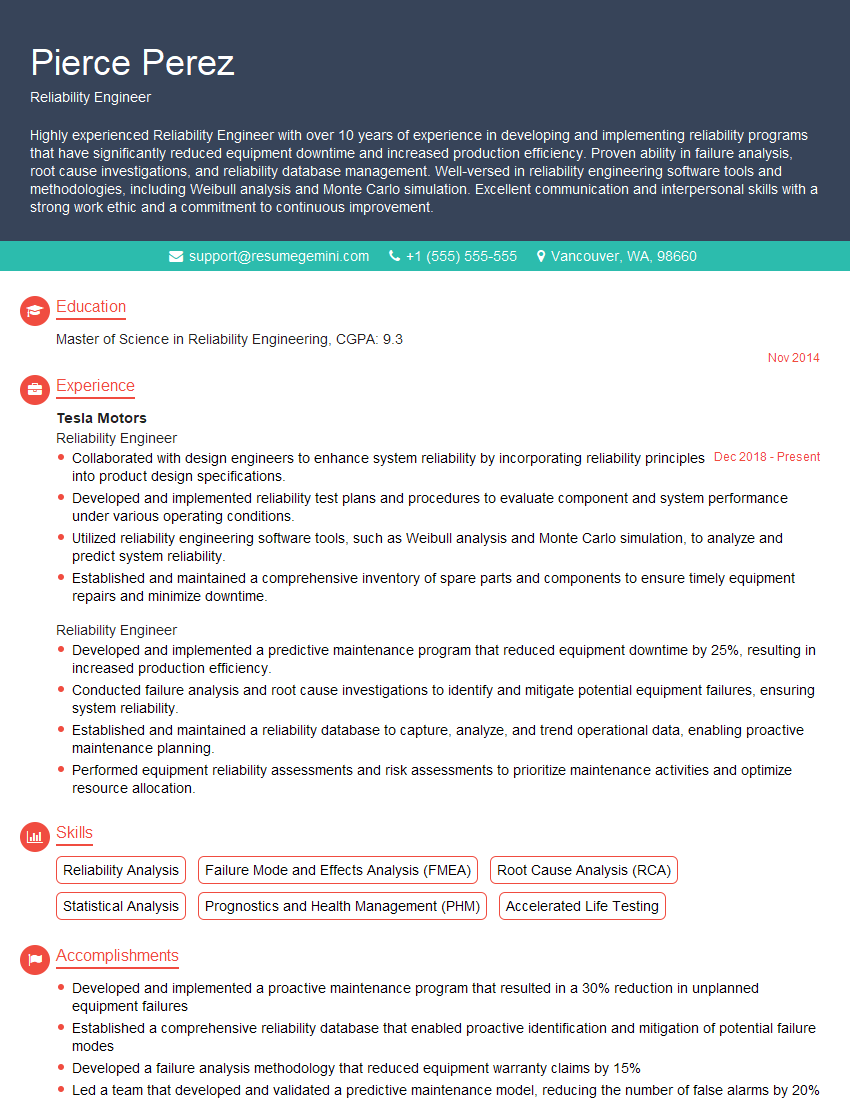
Mastering Failure Probability Analysis is crucial for career advancement in engineering, reliability, and risk management fields. It demonstrates a deep understanding of critical systems and your ability to proactively mitigate risks. To maximize your job prospects, it’s essential to have an ATS-friendly resume that highlights your skills and experience effectively. ResumeGemini can help you build a professional and impactful resume tailored to your specific experience. Examples of resumes optimized for Failure Probability Analysis roles are available to guide you. Take the next step in your career journey and create a resume that makes a lasting impression.

Explore more articles
Users Rating of Our Blogs
Share Your Experience
We value your feedback! Please rate our content and share your thoughts (optional).
What Readers Say About Our Blog
Very informative content, great job.
good