Feeling uncertain about what to expect in your upcoming interview? We’ve got you covered! This blog highlights the most important Fault Current Analysis interview questions and provides actionable advice to help you stand out as the ideal candidate. Let’s pave the way for your success.
Questions Asked in Fault Current Analysis Interview
Q 1. Explain the concept of fault current and its significance in power systems.
Fault current is the excessive electric current that flows through a power system during a short circuit or fault. Imagine a short circuit as a sudden, unintended connection between two points of different voltage in an electrical circuit – like accidentally touching the two wires of a power cord. This creates a low-impedance path, causing a massive surge of current.
Its significance lies in its potential to damage equipment, disrupt power supply, and even pose safety hazards. Understanding and managing fault currents is crucial for designing and operating safe and reliable power systems. We need to ensure that equipment can withstand these surges without failing, and that protective devices (like circuit breakers) can quickly interrupt the flow to prevent damage. Failing to do so can lead to costly repairs, production downtime, and safety risks.
Q 2. Describe different types of faults (symmetrical and asymmetrical).
Faults are broadly categorized into symmetrical and asymmetrical faults. Symmetrical faults are those that are balanced across all three phases of a three-phase system. Think of a simultaneous short circuit connecting all three phases together – this is a symmetrical three-phase fault, the simplest type to analyze.
Asymmetrical faults, on the other hand, are unbalanced. These include single-line-to-ground faults (one phase shorted to ground), line-to-line faults (two phases shorted together), and double-line-to-ground faults (two phases shorted to ground). These are more common and more complex to analyze because the unbalanced currents create different voltage drops across the system components.
Q 3. How do you calculate fault current using the symmetrical component method?
The symmetrical component method is a powerful tool for analyzing unbalanced fault conditions in three-phase power systems. It simplifies the analysis by transforming the unbalanced fault currents into three symmetrical sets of currents: positive, negative, and zero sequence currents.
The process involves several steps: First, transform the unbalanced phase currents into symmetrical components using the symmetrical component transformation matrix. Then, using the system’s impedance matrices (positive, negative, and zero sequence impedances), calculate the fault current components for each sequence. Finally, inverse transform these components back into the original phase currents to obtain the actual fault currents. This involves detailed impedance calculations and application of network theorems. Software tools are often used to perform these calculations due to their complexity.
A simplified example (for a single-line-to-ground fault): The fault current in the faulty phase (Ia) can be approximately calculated as: Ia = 3 * (Va / (Z1 + Z2 + Z0 + 3Zn)) where Va is the pre-fault voltage, Z1, Z2, and Z0 are the positive, negative, and zero sequence impedances of the system, and Zn is the neutral impedance.
Q 4. What are the key factors influencing fault current magnitude?
Several factors significantly influence the magnitude of fault currents. The most important are:
- System Voltage: Higher system voltages naturally lead to higher fault currents.
- System Impedance: Lower system impedance (resistance and reactance) results in higher fault currents. This is because the low impedance offers less opposition to the flow of current.
- Source Impedance: The impedance of the power source (generator, transformer) greatly impacts the current. A low source impedance contributes to higher fault currents.
- Fault Type: As discussed earlier, different fault types (e.g., three-phase vs. single-line-to-ground) have varying fault current magnitudes. Three-phase faults generally have the highest.
- Distance to the Fault: The further the fault is from the source, the higher the impedance encountered and consequently, the lower the fault current.
Imagine a water hose analogy: Higher water pressure (voltage) and a wider hose (low impedance) will lead to a much larger flow of water (current) than a low pressure, narrow hose.
Q 5. Explain the role of impedance in fault current calculations.
Impedance plays a crucial role in fault current calculations. It represents the opposition to the flow of current within the power system. The total impedance of the circuit path between the fault point and the power source determines the magnitude of the fault current.
System impedance comprises resistance (R) and reactance (X), with reactance often dominating at power frequencies. The impedance can be determined from the system’s parameters (e.g., line lengths, conductor sizes, transformer ratings). In fault analysis, we utilize both the total system impedance and the impedance of individual components to accurately model current flow. The lower the impedance, the higher the fault current. Accurate impedance modeling is paramount for the reliability and safety of protective relaying.
Q 6. How does the fault current vary with different fault locations?
The location of the fault significantly influences the fault current magnitude. As the fault moves further from the source, the impedance of the circuit increases, leading to a decrease in the fault current. This is because the extra lengths of cables, transformers and other components add to the overall impedance.
For instance, a fault near the power source will result in a much higher fault current compared to a fault at the end of a long transmission line, which will have higher impedance reducing the magnitude of the fault current. This is important for protective device settings; relays need to be set to detect these varying current levels accurately.
Q 7. What is the impact of system configuration (e.g., radial, ring) on fault current?
The power system configuration—radial or ring—significantly impacts fault current levels. In a radial system, power flows from a single source along various branches. A fault anywhere along a branch reduces the available current path, and the current from the source flows only through that branch. Fault current magnitude depends on the impedance of that branch.
Ring systems, which have multiple supply paths feeding the same load, exhibit lower fault current magnitudes. This is because if a fault occurs, the current can flow from multiple directions, effectively reducing the current on any one branch through the effect of parallel impedance paths. This reduces the stress on protective devices and the potential for cascading failures. The increased system complexity requires more sophisticated analytical techniques however.
Q 8. Describe the various methods used to limit fault currents.
Limiting fault currents is crucial for protecting equipment and ensuring system stability. High fault currents can cause significant damage, leading to costly repairs and potential safety hazards. Several methods are employed to achieve this, broadly categorized as reducing the available fault current or improving the system’s ability to interrupt it.
- Reactance: Increasing the impedance in the system, such as using reactors in substations, limits the flow of current during a fault. Imagine a water pipe – a narrower pipe (higher reactance) restricts the water flow (fault current).
- Resistance: Similar to reactance, adding resistance (e.g., using resistors) in the circuit increases the opposition to current flow. This method is often used for smaller systems or specific applications.
- Current-limiting fuses: These fuses have a very fast melting time, significantly reducing the energy let-through during a fault. They’re like a fast-acting valve in a pipe, quickly shutting off the flow before significant damage occurs.
- Circuit breaker design: Modern circuit breakers incorporate features to minimize the duration of the fault current, limiting the energy exposure on the equipment.
- System design considerations: Proper grounding practices, careful selection of equipment ratings, and well-planned network configurations contribute significantly to fault current limitation.
Q 9. Explain the operation of protective relays in response to fault currents.
Protective relays are the ‘brains’ of the protection system. They constantly monitor the electrical parameters of the system, such as current, voltage, and power. When a fault occurs, these relays detect the abnormal conditions and initiate a sequence of events to isolate the faulty section.
For instance, a distance relay measures the impedance to the fault. If the impedance falls within a pre-defined threshold indicating a fault within its protection zone, it sends a trip signal to the associated circuit breaker. Other types of relays, like differential relays, compare currents at both ends of a protected line. Any discrepancy signals a fault within that section. The relay’s speed and accuracy are crucial in minimizing damage and restoring the system.
Think of it like a security system. The relays are the sensors detecting intrusions (faults), and they trigger the circuit breakers (the alarm system) to isolate the problem area.
Q 10. How do circuit breakers contribute to fault current interruption?
Circuit breakers are the primary devices responsible for interrupting fault currents. They are electromechanical switches designed to quickly and safely open the circuit, isolating the faulty section from the rest of the system. They achieve this through various mechanisms, primarily arc quenching.
When a fault occurs, the circuit breaker senses the high fault current and initiates a breaking operation. This involves rapidly separating the contacts, creating an arc. The breaker then employs arc quenching techniques like compressed air or vacuum to extinguish the arc, thereby interrupting the fault current. The speed of this operation is critical; faster interruption means less damage to equipment.
Consider it like a fire sprinkler system. The sprinkler (circuit breaker) detects the fire (fault current) and quickly isolates the affected area to prevent further spread of the fire (damage).
Q 11. What are the different types of protective relays used for fault current protection?
Numerous types of protective relays cater to diverse needs in fault current protection. The choice depends heavily on the specific application and the type of fault being protected against.
- Overcurrent relays: These are the most common and respond to excessive current flow in the protected circuit. They can be time-delayed or instantaneous.
- Differential relays: These compare the currents entering and leaving a protected zone (e.g., a transformer or a busbar). Any significant difference indicates an internal fault.
- Distance relays: These measure the impedance to the fault. They are particularly effective in protecting long transmission lines.
- Pilot relays: These use communication channels between two ends of a transmission line to enhance fault detection and improve selectivity.
- Ground fault relays: These are designed specifically to detect ground faults, a common type of fault in power systems.
Each relay type has its own characteristics and settings to optimize its performance for specific applications. Proper coordination between different relays is crucial to avoid unnecessary tripping and ensure selective fault clearing.
Q 12. Explain the concept of fault current interrupting capacity (IC).
Fault current interrupting capacity (IC) is the maximum fault current that a circuit breaker can safely interrupt without sustaining damage. It is a critical parameter in circuit breaker selection. This rating indicates the breaker’s ability to withstand the tremendous forces and thermal stresses generated during the interruption of a high fault current.
Imagine a dam controlling a river’s flow. The IC rating is like the dam’s maximum capacity to withstand the sudden surge of water (fault current) during a flood (fault). If the water flow exceeds the dam’s capacity, it can lead to catastrophic damage. Similarly, if a circuit breaker’s IC rating is lower than the fault current it needs to interrupt, it may fail to interrupt the fault safely.
Q 13. How do you determine the required IC rating of a circuit breaker?
Determining the required IC rating of a circuit breaker involves a rigorous short-circuit study. This study analyzes the system to calculate the maximum possible fault current at various points in the electrical network. The study considers factors like the power system’s configuration, generator capabilities, transformer impedances, and cable characteristics.
The short circuit study will identify the highest fault current the breaker may be required to interrupt at a given location. The required IC rating should always be higher than this calculated value, usually with a safety margin to account for uncertainties and future system upgrades. This ensures the breaker can safely and reliably handle any potential fault current.
This is similar to designing a bridge – engineers perform extensive calculations to determine the maximum load the bridge must withstand, adding a safety factor to guarantee its stability under stress.
Q 14. What is the significance of short-circuit studies?
Short-circuit studies are fundamental to ensuring power system safety and reliability. They are essential for:
- Determining equipment ratings: As discussed above, these studies provide the necessary data to select circuit breakers and other equipment with adequate interrupting capacity.
- Protective device coordination: Short-circuit studies are crucial for coordinating protective relays and circuit breakers to ensure that faults are cleared selectively and efficiently without causing cascading outages.
- System stability assessment: The studies help assess the system’s ability to withstand large fault currents without causing instability or voltage collapse.
- System planning and design: These studies are essential in the planning and design phases of new power systems or upgrades to existing ones, helping to ensure adequate fault current levels and protection.
- Compliance with standards: Power system designs must comply with international and local standards regarding fault current levels and protection schemes.
In essence, short-circuit studies are a critical component of power system engineering, providing crucial information for safe and reliable system operation.
Q 15. Describe the software tools used for fault current analysis.
Several sophisticated software tools are used for fault current analysis, each offering unique capabilities. These tools typically employ advanced algorithms to simulate electrical network behavior under fault conditions.
- ETAP (Electrical Transient Analyzer Program): A widely used software package for power system analysis, including fault current calculations. It offers a graphical interface for building network models and simulating various fault types.
- EasyPower: Another popular choice, known for its user-friendly interface and comprehensive features for power system studies. It facilitates both steady-state and transient analysis, providing detailed fault current reports.
- SKM PowerTools for Windows: This suite of software provides a range of tools for power system analysis, including detailed fault current calculations, protection coordination studies, and motor starting analysis.
- PSCAD (Power Systems Computer-Aided Design): This software is particularly suited for simulating transient phenomena in power systems, offering high accuracy for fault current analysis, especially in systems with complex control schemes.
The choice of software depends on the complexity of the power system, the required level of detail, and budget constraints. For simple systems, simpler software might suffice; complex systems necessitate more powerful tools.
Career Expert Tips:
- Ace those interviews! Prepare effectively by reviewing the Top 50 Most Common Interview Questions on ResumeGemini.
- Navigate your job search with confidence! Explore a wide range of Career Tips on ResumeGemini. Learn about common challenges and recommendations to overcome them.
- Craft the perfect resume! Master the Art of Resume Writing with ResumeGemini’s guide. Showcase your unique qualifications and achievements effectively.
- Don’t miss out on holiday savings! Build your dream resume with ResumeGemini’s ATS optimized templates.
Q 16. Explain the difference between bolted and arcing faults.
The key difference between bolted and arcing faults lies in the nature of the fault contact.
- Bolted Fault: This represents an ideal short circuit where the fault impedance is negligible. It’s characterized by a direct, low-resistance connection between phases, or between a phase and ground. Think of it like a solid, metallic connection—the current flow is essentially unimpeded. Bolted faults result in the highest fault current magnitudes.
- Arcing Fault: In an arcing fault, the fault current flows through an ionized path (an arc) with significant resistance. This arc is formed by the vaporization of the material at the point of the fault. The arc resistance causes a reduction in the fault current compared to a bolted fault. Arcing faults are often characterized by intermittent current flow and can be more difficult to detect and clear.
Imagine a bolted fault as a solid bridge connecting two points, allowing maximum current flow. An arcing fault is more like a partially blocked channel, reducing the current flow.
Q 17. How do you account for the effects of arc resistance in fault calculations?
Accurately accounting for arc resistance is crucial for realistic fault current calculations, as it significantly impacts the magnitude of the fault current. Neglecting it can lead to overly optimistic estimations.
Arc resistance is highly variable and depends on several factors, including the fault current itself, the surrounding medium (air, oil, SF6 gas), and the electrode material and geometry. There’s no single, universally applicable formula for arc resistance.
Approaches to accounting for arc resistance include:
- Empirical models: These models use empirical relationships based on experimental data to estimate arc resistance as a function of current and other relevant parameters. Several such models exist, each with its own limitations and range of applicability.
- Computational models: These models, often used in sophisticated simulation software, solve the governing equations of arc physics to determine the arc resistance. They provide higher accuracy but require significant computational resources.
- Using conservative estimates: If detailed modelling isn’t feasible, using conservative estimates for arc resistance—meaning assuming a lower arc resistance than likely exists—ensures that the calculated fault current is on the higher side, promoting a safety margin in the design of protection systems.
The selection of the method depends on the complexity of the system and the desired accuracy. Often, a combination of empirical models and conservative estimations is used to get a reasonably accurate estimate.
Q 18. How does the grounding system influence fault current levels?
The grounding system significantly influences fault current levels, particularly for ground faults. A well-designed grounding system reduces the impedance of the path to ground, thus increasing the fault current magnitude for ground faults.
Here’s how it works:
- Lower Ground Impedance: A low-impedance grounding system provides a low-resistance path for fault current to flow to ground, resulting in higher fault currents. This is because Ohm’s law (V=IR) shows that with a constant voltage, lower resistance leads to higher current.
- Higher Ground Impedance: Conversely, a high-impedance grounding system limits the fault current by increasing the resistance in the fault path. While this might appear beneficial, it can be detrimental since it can result in insufficient current for proper operation of protective relays or lead to dangerous voltage buildup.
The impact on fault current depends heavily on the type of grounding system employed (solid grounding, resistance grounding, reactance grounding, etc.), the grounding electrode’s design, soil resistivity, and the presence of other grounding components like counterpoise wires. A poorly designed grounding system could lead to significantly underestimated fault currents.
Q 19. Explain the concept of grounding impedance.
Grounding impedance represents the total opposition to the flow of fault current from a faulted point to the ground. It’s a complex impedance comprising several components:
- Ground electrode resistance: Resistance of the grounding electrode itself.
- Earth resistance: Resistance of the soil surrounding the grounding electrode.
- Connection resistance: Resistance in the connections between the system and the grounding electrode.
- Inductive reactance: Reactance associated with the grounding system’s geometry.
Grounding impedance is crucial for fault current calculations because it directly impacts the magnitude of the ground fault current. A lower grounding impedance means a larger ground fault current, making it easier to detect but demanding a system capable of withstanding higher current. High grounding impedance leads to potentially dangerous conditions. Its determination typically involves using specialized measurement techniques.
Q 20. Describe different types of grounding systems.
Several types of grounding systems exist, each with its advantages and disadvantages regarding fault current levels and protection coordination. The choice depends on factors like system voltage, equipment sensitivity, and safety considerations.
- Solid Grounding: The neutral point of the transformer is directly connected to the ground with minimal impedance. This results in the highest fault currents but ensures the fastest fault clearing times.
- Resistance Grounding: A resistor is inserted between the neutral point and the ground, limiting the fault current magnitude. This approach reduces stress on equipment but may compromise the speed of fault clearing.
- Reactance Grounding: A reactor is used instead of a resistor, providing a higher degree of control over fault current. This is often used in high-voltage systems.
- Peterson Coil Grounding: Used mostly in low-voltage distribution systems, this method employs a tuned coil to neutralize ground fault currents.
- Ungrounded (Isolated) System: The neutral point is not connected to ground. This approach minimizes fault currents but risks increased transient overvoltages during ground faults.
Selecting the appropriate grounding system is crucial for ensuring both system safety and efficient fault clearing. A thorough analysis considering all factors is needed to make an informed decision.
Q 21. What are the safety considerations in fault current analysis?
Safety considerations are paramount in fault current analysis. Incorrect calculations can lead to inadequate protection systems, resulting in equipment damage, injuries, or even fatalities. Key safety considerations include:
- Accurate Modelling: The power system model used for the analysis must be sufficiently detailed and accurate to reflect the actual system conditions. Oversimplification can lead to misleading results.
- Conservative Estimates: Using conservative values for parameters like arc resistance, grounding impedance, and fault location ensures that the calculated fault currents are on the higher side, providing a safety margin.
- Protection System Coordination: Fault current calculations are crucial for coordinating protective devices such as circuit breakers, fuses, and relays. Proper coordination ensures that the fault is cleared quickly and efficiently without causing cascading failures.
- Thermal and Mechanical Limits: The calculated fault currents must be compared to the thermal and mechanical limits of equipment to determine whether the equipment can withstand the fault currents without damage. If not, additional protection measures might be necessary.
- Personnel Safety: Clear and concise documentation of the fault current analysis is essential to ensure that personnel working on the system are aware of the potential hazards. Appropriate safety measures must be in place to protect workers.
A thorough and meticulous approach to fault current analysis is crucial to ensure both the safety of personnel and the reliable operation of the electrical power system. Regular reviews and updates are necessary to reflect changes and additions in the power system.
Q 22. How do you account for transient effects in fault current analysis?
Transient effects in fault current analysis refer to the initial, rapidly changing currents that occur immediately after a fault. These are distinct from the steady-state symmetrical current, which is the relatively stable current value that would exist after the initial transients have subsided. We account for these transients using sophisticated software tools and analytical techniques.
One common method involves the use of time-domain simulations. These simulations solve the differential equations that govern the electrical network’s behavior, capturing the dynamic changes in voltage and current over time. Software packages like PSCAD or ETAP utilize these techniques. They incorporate the various system components’ transient responses, including the effect of machine reactances, transformer saturation, and arc resistance.
Another approach is to utilize symmetrical components and consider the sub-transient, transient, and synchronous reactances of generators and motors. Sub-transient reactances are used to calculate the initial peak fault current. The transient reactances model the decaying current over a shorter time frame, and the synchronous reactances eventually describe the steady state current. A simplified calculation might use a ‘multiplier’ to the symmetrical short circuit current, representing the initial peak current. This multiplier is usually found in manufacturer’s data or using more complex modelling.
Understanding transient effects is crucial for accurately sizing protective devices. Ignoring them could lead to undersized protective relays, causing delayed fault clearing, or oversized equipment, resulting in unnecessary costs and potential overprotection issues.
Q 23. Explain the concept of fault current asymmetry.
Fault current asymmetry is a phenomenon where the fault current waveform is not purely sinusoidal but has a DC offset. This offset is caused by the sudden interruption of the normal AC current flow, which leaves behind a decaying DC component superimposed on the AC current. Imagine suddenly cutting a rope that’s swinging – it won’t simply stop; it will continue to oscillate before eventually settling.
The magnitude of this DC component depends on the instant the fault occurs relative to the AC waveform. If the fault occurs at the zero-crossing point of the voltage wave, the DC component will be minimal. However, if the fault occurs at the peak voltage, the DC component will be substantial. This DC component decays exponentially, with its time constant related to the system’s X/R ratio (explained further in the next answer).
Accounting for fault current asymmetry is vital because this high initial peak current can be significantly higher than the symmetrical fault current. Protective devices need to be capable of withstanding this high initial peak value to ensure reliable operation and avoid nuisance tripping. Relay settings are often adjusted to account for this.
Q 24. How does the X/R ratio affect fault current waveform?
The X/R ratio (reactance to resistance ratio) of a power system significantly impacts the fault current waveform’s shape and decay rate of the DC offset. A high X/R ratio (typically found in high-voltage systems) results in a fault current with a slow decay of the DC offset, leading to a longer duration of high current. Think of it like this: resistance is like friction, slowing things down; reactance is more like inertia, resisting changes.
Conversely, a low X/R ratio (common in low-voltage systems) results in a faster decay of the DC offset. The fault current waveform will approach its symmetrical value much more quickly. This affects the selection of protective devices because a system with a high X/R ratio will require devices that can handle a high peak current for a longer period compared to a system with a low X/R ratio. For example, the time of current decay directly impacts the settings of protective relays.
Example: A high X/R ratio might have a DC offset that persists for several cycles, while a low X/R ratio might see the offset decay within a single cycle. This directly impacts the peak current seen and the appropriate protection settings.
Q 25. What are the challenges in analyzing fault currents in complex power systems?
Analyzing fault currents in complex power systems presents several challenges:
- System Complexity: Large interconnected networks with numerous generators, transformers, lines, and loads make modeling and analysis computationally intensive. The sheer number of variables and the possibility of interactions between components makes it hard to accurately predict fault behavior.
- Dynamic Behavior: Generators, motors, and other equipment exhibit dynamic behavior which changes the system impedance during a fault. This requires time-domain simulations to capture the system’s transient response accurately.
- Uncertainty in Data: Accurate data for all system components is often unavailable or uncertain. Imprecision in impedance values can lead to significant errors in fault current calculations. Data quality and availability is a significant factor.
- Non-Linear Elements: Elements such as saturation in transformers and arc resistance exhibit non-linear behavior, making accurate modeling even more challenging. Simplified linear models may not capture these behaviors precisely.
- Distributed Generation: The increasing integration of distributed generation (DG) sources like solar and wind power adds complexity due to their intermittent nature and the impact on fault current contributions.
Overcoming these challenges often requires advanced simulation software, sophisticated modeling techniques, and experience in interpreting results within the context of the system’s complexity.
Q 26. Explain the coordination of protective devices to limit the impact of faults.
Coordination of protective devices is crucial to limit the impact of faults. The goal is to ensure that the appropriate device trips to isolate the fault quickly and selectively, minimizing the disruption to the rest of the system. This is achieved through a carefully planned hierarchy of protection schemes.
This involves selecting protective devices (e.g., circuit breakers, fuses, relays) with appropriate settings and time characteristics. The time-current curves of different devices must be coordinated to ensure that the fault is cleared by the closest device to the fault, without causing unwanted tripping of downstream devices.
For example, a backup protection scheme at a substation might have a longer tripping time than a primary protection scheme closer to the fault location, so the primary protection operates and clears the fault quickly and efficiently. Failure to coordinate these devices leads to delayed fault clearing, and potentially cascading outages or system instability. Software tools can be used to verify the coordination of the settings.
Coordination also involves communication between devices. Modern protection systems use communication protocols to share information about fault conditions, further enhancing the speed and selectivity of fault clearing.
Q 27. How does the type of fault (LG, LL, LLG, LLL) impact the fault current?
The type of fault significantly impacts the fault current magnitude and the resulting system response:
- Line-to-Ground (LG): This is the most common type of fault. The fault current path is from the faulted phase to ground, and the magnitude of the current depends on the system grounding configuration and the impedance to ground. Ground faults typically have three components of fault current (positive, negative and zero sequence).
- Line-to-Line (LL): In an LL fault, two phases are shorted. The fault current only involves the positive and negative sequence currents and the magnitude is generally lower than an LLG fault.
- Line-to-Line-to-Ground (LLG): Here, two phases are shorted to ground. This fault often results in a high fault current because two phases are involved and the ground connection provides a low impedance path.
- Three-Phase (LLL): This is a short circuit between all three phases. The fault current is predominantly positive and negative sequence currents. The magnitude depends largely on the system’s impedance.
The impact of each fault type on the system is different and directly impacts the selection of protective devices. An LLG fault, for instance, often results in significantly higher fault currents than an LL fault requiring higher breaking capacity devices in the switchgear.
Q 28. How can you verify the accuracy of fault current calculations?
Verifying the accuracy of fault current calculations involves several methods:
- Software Validation: Ensure that the software used for the calculation is well-validated and widely accepted in the industry. Check for updates and use recognized tools.
- Data Verification: Carefully check the accuracy of all input data, including impedances of lines, transformers, and generators. Any errors in the input data will propagate through the calculation and cause inaccurate results.
- Comparison with Previous Studies: If available, compare the results with previous fault current studies or field measurements. Significant discrepancies warrant investigation.
- Sensitivity Analysis: Perform a sensitivity analysis to assess the impact of variations in input parameters on the calculated fault current. This helps identify areas where data uncertainty significantly affects the accuracy of the results.
- Site Testing: In some cases, short-circuit testing on the actual power system can provide experimental validation for calculated fault currents. While this is often impractical for larger systems, it is valuable for smaller ones.
- Peer Review: Have a knowledgeable colleague review the calculations, assumptions, and results to catch any errors or biases.
By combining these methods, you can increase confidence in the accuracy of your fault current calculations. The selection of methods depends largely on the scale and criticality of the system under analysis.
Key Topics to Learn for Fault Current Analysis Interview
- Symmetrical Fault Analysis: Understanding the theoretical basis, including per-unit systems and symmetrical components. Practical application: Calculating fault currents in simple and complex power systems.
- Unsymmetrical Fault Analysis: Mastering the analysis of single-line-to-ground, line-to-line, and double-line-to-ground faults. Practical application: Determining fault currents and voltage levels under various fault conditions.
- Fault Current Calculations using Software: Familiarity with industry-standard software packages for power system analysis. Practical application: Modeling power systems and performing fault studies using software such as ETAP or PSCAD.
- Protective Relaying Principles: Understanding how fault current analysis informs the design and coordination of protective relays. Practical application: Selecting appropriate relay settings based on calculated fault currents.
- Arc Flash Hazard Analysis: Applying fault current calculations to determine arc flash hazards and necessary safety precautions. Practical application: Performing arc flash risk assessments and implementing mitigation strategies.
- Power System Stability and Fault Current: Understanding the relationship between fault currents and system stability. Practical application: Analyzing the impact of faults on system stability and developing mitigation strategies.
- Fault Current Contribution from Different Sources: Understanding how various sources (generators, transformers, and lines) contribute to fault currents. Practical application: Analyzing fault current contribution from different sources in a complex power system.
Next Steps
Mastering Fault Current Analysis opens doors to exciting career opportunities in power system engineering, offering diverse roles and excellent growth potential. A strong understanding of this critical area significantly enhances your competitiveness in the job market. To make the most of your expertise, it’s crucial to present your skills effectively. Creating an ATS-friendly resume is essential for maximizing your chances of getting noticed by recruiters. We highly recommend using ResumeGemini to build a professional and impactful resume that highlights your skills and experience in Fault Current Analysis. ResumeGemini provides examples of resumes tailored to this field, helping you craft a document that truly showcases your capabilities.

Reliability Engineer Resume Sample

Energy Consultant Resume Sample

Automation Engineer Resume Sample

Commissioning Engineer Resume Sample

Maintenance Engineer Resume Sample

Distribution Engineer Resume Sample

Electrical Design Engineer Resume Sample

Electrical Engineer Resume Sample

Power Systems Engineer Resume Sample

Smart Grid Engineer Resume Sample

Renewable Energy Engineer Resume Sample
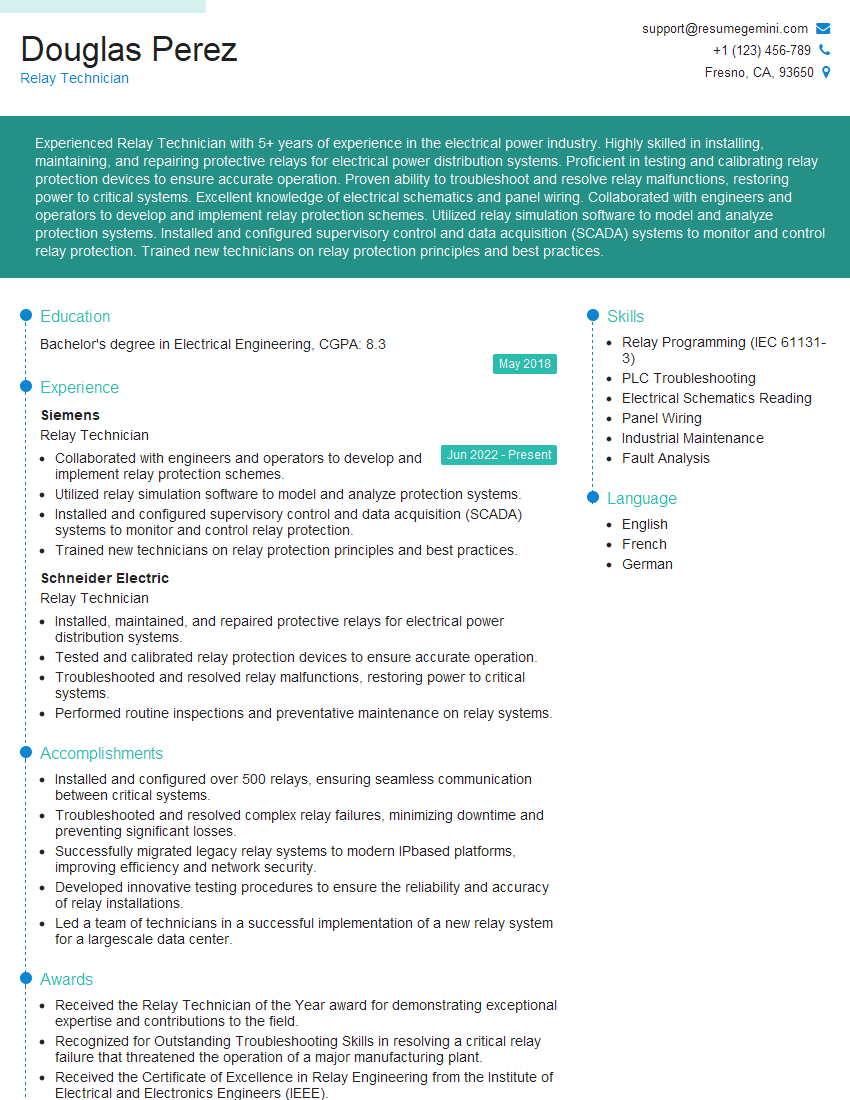
Relay Technician Resume Sample
Explore more articles
Users Rating of Our Blogs
Share Your Experience
We value your feedback! Please rate our content and share your thoughts (optional).
What Readers Say About Our Blog
Very informative content, great job.
good