Every successful interview starts with knowing what to expect. In this blog, we’ll take you through the top Lay Bricks interview questions, breaking them down with expert tips to help you deliver impactful answers. Step into your next interview fully prepared and ready to succeed.
Questions Asked in Lay Bricks Interview
Q 1. Describe your experience with different types of bricks.
My experience encompasses a wide range of brick types, each with unique properties affecting their suitability for different projects. I’ve worked extensively with common clay bricks, varying in size, color, and texture – from standard modular bricks to reclaimed bricks offering a unique aesthetic. I’m also familiar with engineering bricks, known for their superior strength and used in load-bearing applications. Furthermore, I have experience with facing bricks, chosen primarily for their visual appeal and often used in veneer applications, and concrete bricks, a cost-effective alternative often favored for their consistent dimensions and faster construction times. Each brick type demands a different approach to laying, considering factors like their size, weight, and moisture absorption rate.
- Clay Bricks: These are the most common type, offering a wide variety of colors and textures. Their strength and durability are well-established.
- Engineering Bricks: Higher compressive strength makes them ideal for foundations and retaining walls.
- Facing Bricks: Prioritize aesthetics, and are often chosen for their colour and texture.
- Concrete Bricks: A cost-effective and consistent option.
Q 2. Explain the process of laying a brick veneer.
Laying a brick veneer involves creating a non-structural outer layer of bricks over an existing structure, typically a frame wall or concrete blockwork. It’s crucial to maintain an air gap between the veneer and the backing wall for ventilation to prevent moisture damage. The process begins with establishing a level base and installing weep holes at regular intervals at the base to allow moisture to escape. We then use a suitable bonding agent and start laying the bricks, ensuring proper alignment and maintaining the desired bond pattern. Metal ties are often used to connect the veneer to the backing wall, providing stability. Finally, the pointing (filling the gaps between bricks with mortar) is done, adding a neat finish. I always inspect the backing wall for straightness and soundness before starting. For example, in a recent project, we used a combination of metal ties and adhesive to create a secure and weather resistant brick veneer on a timber frame building.
Q 3. How do you ensure the accuracy and plumb of your brickwork?
Accuracy and plumb are paramount in bricklaying. I use a combination of tools and techniques to ensure precise work. A plumb bob helps to verify vertical alignment, while a spirit level ensures horizontal accuracy. String lines stretched between accurately placed points serve as visual guides, maintaining straightness throughout the wall. Checking levels and plumbness frequently throughout the process, rather than only at the end, prevents cumulative errors. Furthermore, I carefully measure and mark out the brick courses, ensuring consistent spacing and bond patterns. Regular self-checking and the use of precision tools are vital for producing high-quality, structurally sound brickwork. For instance, I meticulously check the plumb of each corner before proceeding with the rest of the wall.
Q 4. What safety measures do you follow when working at heights?
Safety is my utmost priority when working at heights. I always use appropriate fall protection equipment, such as harnesses and safety nets, complying with all relevant regulations and site-specific safety plans. Scaffolding must be properly erected, inspected regularly, and used correctly. I ensure that all tools and materials are securely stored and handled to prevent accidental drops. Furthermore, I wear appropriate personal protective equipment (PPE), including safety helmets, high-visibility clothing, and safety footwear. Teamwork is essential – communicating clearly with colleagues about potential hazards and ensuring everyone is following safety protocols. Regular site safety meetings reinforce best practices and address potential risks proactively. For example, on a recent project involving a three-story building, we used a well-maintained scaffolding system and adhered strictly to a comprehensive safety plan, ensuring all team members were trained and equipped to work safely at heights.
Q 5. What are the different types of mortar and their applications?
Mortar is a crucial component in bricklaying, its type depending on the application and the environment. Common types include:
- Lime Mortar: A traditional mix known for its breathability, making it suitable for older buildings or areas with fluctuating temperatures. It’s softer and more flexible than cement mortars.
- Cement Mortar: Stronger and faster-setting than lime mortar, ideal for general brickwork and load-bearing structures. It has less permeability to water.
- Cement-Lime Mortar: A blend of cement and lime, combining the strength of cement with the flexibility and breathability of lime. It offers a good compromise between the two.
- Speciality Mortars: These mortars address particular concerns such as frost resistance or high-strength requirements. The choice of mortar should consider the bricks being used, the environment and structural requirements of the project.
Selecting the wrong mortar can lead to issues like cracking, efflorescence (salt deposits on the brick surface), and decreased structural integrity.
Q 6. How do you calculate the number of bricks needed for a project?
Calculating the number of bricks needed involves several steps. First, you need the precise dimensions of the wall – its length, height, and thickness. Next, determine the brick dimensions, considering the mortar joints. A standard modular brick is usually about 215mm x 102.5mm x 65mm, but the actual size needed for calculation depends on the chosen bond pattern and the joint thickness (typically 10mm-12mm). Then, calculate the area of the wall and convert it to the number of bricks needed per square meter based on the brick dimensions and the chosen bond (e.g., English bond, Flemish bond). Finally, add a percentage for waste (usually 5-10%) to account for breakage and cutting. For example, a 10m x 3m wall with standard bricks and English bond would require a significant number of bricks, and the precise calculation requires accounting for all the parameters above, including wastage.
// Example (Simplified): Area = length * height; Bricks per square meter = (1/brick area); Total bricks = Area * Bricks per square meter * waste factorQ 7. Explain the importance of proper brick bonding patterns.
Proper brick bonding patterns are crucial for structural integrity and aesthetic appeal. Different patterns offer varying strengths and visual effects. Common patterns include:
- English Bond: Alternating courses of headers (bricks laid with the short end showing) and stretchers (bricks laid with the long end showing). Provides high strength.
- Flemish Bond: Alternating headers and stretchers in each course, creating a visually appealing pattern. Generally slightly less strong than English bond.
- Stack Bond: Simplest bond, with all bricks laid as stretchers. Less strong, primarily used for aesthetic purposes and non-load bearing walls.
Choosing the right bond pattern depends on the structural requirements and the desired aesthetic. For example, a load-bearing wall might necessitate an English bond for its superior strength. Ignoring proper bonding can lead to weak points in the structure, compromising stability and potentially resulting in structural failure.
Q 8. How do you handle uneven surfaces when laying bricks?
Laying bricks on an uneven surface requires careful planning and execution. The key is to create a level bed for each course of bricks, compensating for the irregularities of the underlying ground. This involves using a combination of techniques.
- Leveling the base: Before laying any bricks, I thoroughly prepare the ground, ensuring a stable and level base. This might involve excavating and compacting the soil, or using a concrete leveling compound to fill significant dips or irregularities.
- Using a leveling mortar bed: I apply a thicker layer of mortar in low areas to bring the brick bed to a consistent height. This requires careful attention to ensure the mortar is evenly distributed. Think of it like creating a custom foundation for each row of bricks.
- Adjusting individual bricks: For minor unevenness, I adjust the individual brick position by tapping them gently with the handle of a brick hammer to ensure a level and plumb surface. It’s like a fine-tuning process to ensure a seamless finish.
- Using a spirit level and straight edge: Throughout the process, I frequently check for levelness and plumb using a spirit level and straight edge to catch and correct any irregularities. This meticulous checking helps ensure that the final wall is perfectly aligned.
For example, on a recent project with a sloping foundation, I first leveled the base using compacted gravel and then employed a variable thickness mortar bed to create a level surface for the first course of bricks. This approach ensured a stable and aesthetically pleasing wall even on challenging terrain.
Q 9. What are the common problems encountered in bricklaying and their solutions?
Bricklaying, while seemingly straightforward, presents several challenges. Addressing them promptly is crucial for a structurally sound and visually appealing outcome.
- Uneven mortar joints: Inconsistent mortar joints compromise the aesthetic appeal and structural integrity. The solution lies in using a consistent amount of mortar and employing tools like a jointer to create even joints.
- Cracking bricks: This often stems from poor quality bricks or improper handling. Careful brick selection and gentle handling during the construction process are vital to avoid such issues.
- Weak bonding: Insufficient mortar or improper brick placement weakens the structure. Using appropriate mortar mix for the application and ensuring proper bonding patterns are followed is key to strength and stability.
- Efflorescence: This white, powdery substance on brick surfaces is caused by salts leaching out of the bricks. It’s mainly an aesthetic problem, and I usually address it using a specialized cleaning solution after the wall has cured adequately.
- Weather damage: Exposure to harsh weather conditions can affect the durability of brickwork. Proper sealing and using frost-resistant bricks minimize this risk, especially in colder climates.
For instance, I once encountered a project where the bricks were cracking due to inadequate curing of the mortar. I corrected it by pausing the work, allowing the mortar to cure fully, and carefully inspecting each brick before placing it. This meticulous approach ensured the longevity of the structure.
Q 10. Describe your experience with different bricklaying tools.
My experience encompasses a wide range of bricklaying tools, each playing a specific and crucial role in efficient and quality brickwork.
- Brick Trowel: This is my everyday tool for applying and shaping mortar. I’m proficient in using different trowel sizes for varied applications, from small repairs to large-scale projects.
- Brick Hammer: Essential for tapping bricks into place and correcting minor alignment issues. I’ve learned to use it with precision, avoiding damage to the bricks.
- Level: A spirit level ensures the accuracy of every course of bricks. I constantly check the level to maintain perfect horizontal alignment.
- Plumb Bob: This tool guarantees vertical accuracy, especially critical for tall walls or complex structures.
- Line Level: I use a line level to ensure that all courses of bricks are perfectly aligned horizontally across long stretches of wall.
- Mortar Board: A necessary tool for preparing and mixing mortar, providing a convenient workspace.
- Jointer: This tool is key to creating uniform and attractive mortar joints.
My understanding of each tool’s function and optimal use comes from years of hands-on experience. I constantly refine my technique and adapt my tool usage based on the specific requirements of a project.
Q 11. How do you ensure the durability and longevity of your brickwork?
Ensuring the durability and longevity of brickwork involves a multi-faceted approach, starting even before the first brick is laid.
- High-quality materials: I always prioritize using high-quality, frost-resistant bricks, suitable for the specific climate. Using the right type of mortar, appropriate for the application, also contributes greatly to the overall structural integrity and longevity of the work.
- Proper foundation: A solid and level foundation is non-negotiable. This prevents settling and cracking in the long run.
- Correct bonding patterns: Following proper brick bonding patterns (like English bond, Flemish bond, etc.) ensures structural stability and strength.
- Careful workmanship: Precise brick placement, consistent mortar joints, and regular quality checks throughout the construction process are critical for durable results.
- Weather protection: Once the brickwork is complete, protecting it from harsh weather conditions is important. This might involve sealing the brickwork, particularly in areas exposed to heavy rainfall or freezing temperatures.
For example, in a coastal project, I ensured that all the bricks were salt-resistant and that a specialized waterproof sealant was applied to protect against the harsh maritime environment. This extra care ensures the brickwork will stand the test of time.
Q 12. What are the different types of brick bonds and their strengths?
Brick bonds refer to the pattern in which bricks are arranged within a wall. Different bonds offer varying strengths and aesthetic qualities.
- English Bond: This bond uses headers (bricks laid with their short ends showing) and stretchers (bricks laid with their long sides showing) in alternating courses. It’s strong and visually appealing, offering good stability.
- Flemish Bond: This bond utilizes alternating headers and stretchers in each course, creating a more intricate and visually striking pattern. It’s also very strong.
- Stack Bond: This is a simpler bond using only stretchers stacked vertically. While visually clean, it’s generally weaker than English or Flemish bonds and should only be used for non-load-bearing walls.
- Running Bond: Similar to stack bond but laid horizontally; also generally weaker and better suited for non-load-bearing applications.
The choice of bond depends on factors such as the wall’s load-bearing capacity, aesthetic considerations, and the overall design of the building. For instance, a load-bearing wall would ideally utilize an English or Flemish bond for its superior strength, whereas a decorative feature wall might employ a Stack bond for its simpler look.
Q 13. How do you manage your time and resources on a bricklaying project?
Effective time and resource management is vital for successful bricklaying projects. It requires careful planning and execution.
- Detailed planning: Before starting, I create a detailed project plan, including material estimations, a realistic timeline, and a clear sequence of tasks.
- Material procurement: I ensure all necessary materials are procured in advance to avoid delays. This includes bricks, mortar, tools, and any necessary scaffolding.
- Teamwork and coordination: If working with a team, clear communication and coordination are crucial. Each team member should understand their roles and responsibilities.
- Efficient techniques: Employing efficient bricklaying techniques and utilizing appropriate tools helps to maximize output and minimize wasted time.
- Regular monitoring: I monitor progress regularly to identify any potential bottlenecks or issues early on. Addressing problems promptly prevents escalating delays.
For example, on a large-scale project, I utilized a Gantt chart to visualize the project timeline and track the progress of individual tasks. This allowed for proactive management of resources and ensured timely completion.
Q 14. Explain your experience with waterproofing brickwork.
Waterproofing brickwork is crucial for its longevity and structural integrity, especially in areas prone to moisture damage. My experience includes various waterproofing methods.
- Damp-proof course (DPC): This is a layer of impermeable material inserted into the wall, typically at ground level, to prevent rising dampness.
- Water-repellent sealants: I often use high-quality, breathable sealants to protect the brickwork from rain and moisture penetration. These sealants allow the brickwork to breathe, preventing trapped moisture.
- Flashing: This involves installing waterproof membranes at critical junctions, such as window and door frames, to divert water away from the wall.
- Cavity wall construction: For new builds, I prefer cavity walls, which have an air gap between the inner and outer leaves. This gap promotes ventilation and prevents moisture buildup.
In a project involving a basement wall, I implemented a combination of a DPC, waterproof rendering, and a high-quality sealant to ensure complete protection against rising damp and groundwater penetration. The result was a structurally sound and durable basement wall, free from moisture damage.
Q 15. How do you deal with challenging weather conditions during bricklaying?
Working in challenging weather conditions requires meticulous planning and adaptation. Extreme heat can lead to mortar drying too quickly, resulting in weak bonds. Conversely, rain can saturate bricks and mortar, delaying the work and potentially compromising the structure’s integrity. My approach involves several key strategies:
- Heat: I utilize shaded areas whenever possible, work during cooler parts of the day, and use water sprays to keep the bricks and mortar adequately moist during application. I may also choose to adjust the mortar mix to compensate for quicker drying times.
- Rain: I always protect partially completed work with tarps or other coverings to prevent water damage. I carefully assess the forecast and postpone work if necessary. I also ensure proper drainage is in place around the structure to avoid water accumulation.
- Cold: Extremely low temperatures can affect mortar setting and even cause water within the mortar to freeze, damaging the structure. I might use frost-resistant mortar additives and avoid working when temperatures are significantly below freezing.
- Wind: Strong winds can dislodge loose bricks and make precise laying difficult. I take extra care to secure scaffolding and materials and might temporarily halt work during extreme gusts. I use windbreaks if the situation permits.
Ultimately, my approach is to prioritize safety and quality, understanding that compromising on either aspect can lead to costly repairs or structural issues down the line.
Career Expert Tips:
- Ace those interviews! Prepare effectively by reviewing the Top 50 Most Common Interview Questions on ResumeGemini.
- Navigate your job search with confidence! Explore a wide range of Career Tips on ResumeGemini. Learn about common challenges and recommendations to overcome them.
- Craft the perfect resume! Master the Art of Resume Writing with ResumeGemini’s guide. Showcase your unique qualifications and achievements effectively.
- Don’t miss out on holiday savings! Build your dream resume with ResumeGemini’s ATS optimized templates.
Q 16. Describe your experience working with different types of brick patterns.
I’ve had extensive experience with various brick patterns, each offering unique aesthetic and structural properties. Some examples include:
- Running Bond: The simplest and most common pattern, characterized by horizontal rows of bricks laid end-to-end. It’s efficient and structurally sound.
- Stack Bond: Bricks are vertically stacked, creating a strong, visually striking pattern often used for accents or specific architectural features. However, it’s less weather-resistant than running bond and requires more careful planning to ensure stability.
- English Bond: This pattern alternates between headers (bricks laid with their ends showing) and stretchers (bricks laid lengthwise), creating a strong and visually appealing bond. It’s a traditional and robust pattern.
- Flemish Bond: A more intricate pattern alternating headers and stretchers in each course, offering a visually rich texture. It requires more skill and time to execute properly.
- Herringbone Bond: Bricks are laid at an angle, creating a distinctive diagonal pattern that adds visual interest. This design needs careful planning for proper support and structural integrity.
My experience allows me to select and execute the appropriate pattern based on the project’s architectural style, structural requirements, and client preferences. I can adapt to almost any pattern, ensuring the project’s success.
Q 17. How do you maintain quality control throughout a bricklaying project?
Maintaining quality control is paramount. My approach is multifaceted and begins before the first brick is laid:
- Material Selection: I carefully inspect bricks for defects, ensuring consistent size, color, and strength. I also scrutinize the mortar mix to ensure it’s correctly proportioned for the intended application and environmental conditions.
- Precise Laying: I use levels, plumb bobs, and lines to ensure perfectly straight walls and consistent joints. I maintain uniform mortar thickness and spacing, preventing weak points and enhancing the aesthetic appeal.
- Regular Inspection: I conduct regular inspections throughout the project, checking for plumbness, levelness, alignment, and any signs of mortar defects or inconsistencies. This allows for early detection and correction of issues.
- Documentation: I keep detailed records of materials used, quantities, and any challenges encountered. This documentation is crucial for troubleshooting and ensures consistent quality throughout the entire project.
- Teamwork: When working with a team, I establish clear communication and quality control protocols to ensure everyone understands their responsibilities and works towards the same standards.
By implementing these measures, I can confidently deliver projects meeting the highest standards of quality and longevity.
Q 18. How do you address and fix errors in bricklaying?
Errors in bricklaying can be addressed depending on the severity and location. Minor imperfections might be addressed with careful tooling and adjustments to the mortar joints. More significant errors require a more involved solution:
- Minor Issues: Slight misalignments or uneven joints can often be corrected by carefully removing and re-laying the affected bricks, ensuring proper mortar application and alignment. Small gaps can sometimes be filled with carefully matched mortar.
- Major Issues: If a section of the wall is severely misaligned or structurally compromised, it may require more extensive reconstruction. This could involve dismantling and rebuilding the affected portion, ensuring adherence to the original plans and specifications. In such cases, safety is paramount, and I always assess structural integrity before undertaking any corrective actions.
My experience allows me to assess the situation accurately and decide on the appropriate corrective action. Prevention is always my first priority, but knowing how to effectively rectify mistakes is crucial in ensuring a successful project.
Q 19. What are the key considerations for building a brick chimney?
Building a brick chimney requires a deep understanding of structural principles, heat transfer, and safety regulations. Here are key considerations:
- Foundation: The chimney needs a strong, stable foundation capable of supporting its weight and withstanding wind loads. It needs to be properly isolated from the main building’s foundation to prevent cracks from settling.
- Flue Design: The flue (chimney’s interior) must be properly sized to efficiently remove smoke and gases. Its shape and dimensions are critical for optimal draft and preventing downdrafts.
- Mortar Selection: High-temperature mortar is essential to withstand the heat generated by the fire. Standard mortar isn’t suitable.
- Liners: A clay tile or stainless steel liner is frequently used within the flue to protect the brickwork from corrosive gases and improve efficiency.
- Structural Integrity: The chimney must be properly braced and tied into the structure to prevent collapse, especially in windy conditions.
- Code Compliance: All aspects of the chimney design and construction must strictly adhere to local building codes and fire safety regulations.
- Flashing: Proper flashing around the chimney’s intersection with the roof is crucial to prevent water penetration and leakage.
Building a chimney is a complex process that demands precision and adherence to building codes. Cutting corners could have serious consequences – from structural instability to fire hazards.
Q 20. Explain your understanding of building codes and regulations related to bricklaying.
My understanding of building codes and regulations related to bricklaying is comprehensive. I’m familiar with various local and national standards that govern aspects like:
- Brick Strength and Quality: Codes often specify minimum compressive strength requirements for bricks used in different applications.
- Mortar Specifications: Regulations specify acceptable mortar mixes, compressive strength, and water retention properties.
- Wall Thickness and Height: Building codes dictate minimum wall thicknesses based on the building’s height and intended use.
- Structural Stability: Regulations address issues like bracing, anchoring, and reinforcement to ensure structural integrity.
- Fire Safety: Codes define requirements for fireproofing, particularly around chimneys and fireplaces.
- Accessibility: Building codes address accessibility requirements for walkways, steps and other related aspects of the construction.
- Waterproofing: Regulations address proper waterproofing techniques to prevent water damage and issues related to dampness
Before starting any project, I thoroughly review and understand the applicable building codes and regulations to ensure compliance and avoid potential legal issues and safety hazards. I regularly update my knowledge to keep abreast of any changes or amendments.
Q 21. Describe your experience with bricklaying in different environments.
My experience with bricklaying spans diverse environments, including:
- Residential Construction: I’ve worked on numerous residential projects, ranging from small additions to large custom homes. This has involved working closely with homeowners, architects, and other contractors, ensuring the project meets their expectations and building codes.
- Commercial Projects: My experience also includes commercial projects such as office buildings, retail spaces, and industrial structures. These projects demand precision and efficiency, often involving larger teams and tighter deadlines.
- Restoration and Repair: I’ve worked on restoring historic brick structures, requiring careful attention to detail, preservation techniques, and using materials that match the original style.
- Outdoor Environments: This includes working in varied weather conditions, managing material logistics in remote locations, and addressing challenges posed by uneven ground conditions.
Adaptability is key in this profession. I am comfortable working in diverse settings and adjust my approach to match the project’s unique demands. My ability to adapt to different environments enhances project efficiency and ensures successful completion.
Q 22. How do you prepare the foundation for a brick structure?
Preparing a solid foundation is paramount for any brick structure’s longevity and stability. Think of it as the bedrock upon which you build your house – if it’s weak, the entire structure will suffer. The process typically involves several key steps:
- Excavation: Digging to the required depth, determined by factors like soil type, frost line, and building codes. This ensures the foundation won’t settle unevenly.
- Compaction: Thoroughly compacting the soil at the bottom of the excavation using a tamper or plate compactor. This removes air pockets and creates a stable base.
- Formwork (if necessary): For complex foundations, formwork (temporary molds) might be needed to create the desired shape and size. This is especially true for concrete foundations.
- Base Material: A layer of compacted gravel or crushed stone is often added for drainage and to further stabilize the foundation. This acts like a cushion, preventing moisture buildup.
- Concrete Pour (for concrete foundations): Reinforced concrete is poured into the prepared formwork, allowed to cure, and then checked for levelness. This provides a strong, level base for the brickwork.
- Damp Proof Membrane (DPM): A layer of DPM is crucial to prevent moisture rising from the ground, damaging the bricks and potentially causing structural issues. This is placed on top of the concrete before laying the bricks.
- Brickwork: Laying a course or two of bricks on top of the prepared foundation using mortar. This distributes the load of the superstructure evenly.
For example, on a recent project building a small garden wall, we had to excavate only a few inches, compact the soil, and lay the first course of bricks directly on the ground, given the stable and well-drained soil. However, for a larger house, we’d have utilized a reinforced concrete foundation following the full procedure outlined above.
Q 23. What are some common causes of brickwork failure?
Brickwork failure can stem from various issues, often stemming from poor planning or execution. Some common causes include:
- Inadequate Foundation: Uneven settlement or weak foundations lead to cracks and instability. This is the most common reason.
- Poor Mortar Mix: Using the incorrect mortar mix or improper mixing can result in weak bonding between bricks, leading to collapse or separation.
- Insufficient Brick Support: Lack of sufficient support, especially in arches or openings, can cause collapse. Proper lintels and arches are crucial.
- Frost Damage: Moisture trapped in the brickwork can freeze and expand, causing cracks. Proper drainage and using frost-resistant bricks is essential.
- Movement of the Ground: Subsidence or swelling of the ground beneath the foundation can exert pressure on the structure, resulting in cracks and damage.
- Poor Quality Bricks: Using damaged or substandard bricks with low compressive strength weakens the whole structure.
- Lack of Expansion Joints: Failure to incorporate expansion joints to accommodate thermal changes can lead to cracking as the structure expands and contracts with temperature fluctuations.
For instance, I once encountered a wall failure due to inadequate mortar – the mix was too weak, leading to brick separation after only a few months. Replacing the affected sections and using a correctly proportioned mix solved the problem.
Q 24. How do you plan and execute a large-scale bricklaying project?
Planning and executing a large-scale bricklaying project demands meticulous organization and coordination. It’s like orchestrating a symphony; every section needs to harmonize for a successful outcome.
- Detailed Plans and Drawings: Start with comprehensive architectural and structural drawings. These dictate every aspect, including brick type, mortar mix, and construction sequencing.
- Material Estimation and Procurement: Accurately estimating the number of bricks, mortar, and other materials is crucial to avoid delays. Software can help with this.
- Team Management: Effective leadership and communication within the team are vital. Assigning specific tasks and responsibilities keeps the project moving efficiently.
- Scheduling and Sequencing: Create a detailed schedule that outlines every step of the process, including delivery of materials, foundation preparation, and bricklaying phases.
- Quality Control: Regular quality checks are necessary to ensure that the work conforms to the plans and standards. This includes checking the levelness, plumbness, and mortar consistency.
- Safety Precautions: Prioritize worker safety by implementing safety protocols and providing necessary personal protective equipment (PPE).
- Progress Monitoring: Regularly monitor the progress to identify potential issues and make adjustments as necessary. Using project management software is highly beneficial here.
On a recent large-scale project – a multi-story apartment building – we employed a project management tool to track progress, manage resources, and ensure timely completion. This software helped us to identify potential bottlenecks early on and adjust the schedule accordingly.
Q 25. What software or tools do you use to estimate materials and labor costs?
Estimating materials and labor costs accurately is crucial for the profitability of any bricklaying project. Various tools can help with this:
- Spreadsheets: Simple spreadsheets can be used to calculate material quantities based on project plans. Manually entering labor rates and hours worked allows cost calculation.
- Dedicated Construction Estimating Software: Software like PlanSwift or ProEst offer more advanced features, including automated material calculations, labor costing tools, and reporting functionalities.
- Quantity Takeoff Software: These programs, often integrated with CAD software, automatically calculate quantities of materials needed from digital plans.
Personally, I use a combination of spreadsheets for simpler projects and a dedicated construction estimating software for larger and more complex ones. The software helps to generate detailed reports that can be shared with clients and stakeholders.
Q 26. Describe your experience with brick cutting and shaping techniques.
Brick cutting and shaping techniques are essential skills for a bricklayer. Precision is key to achieving aesthetically pleasing and structurally sound walls.
- Brick Saw: A brick saw with a diamond blade is ideal for straight cuts. It allows for precise cuts to fit bricks in various situations.
- Hand Brick Cutter: A hand-held brick cutter is useful for smaller cuts and more delicate work. Requires more skill and precision.
- Bolster and Chisel: This method is useful for more complex cuts and shaping bricks, allowing for customized shapes and curves. This method needs a skilled hand.
- Grinding Tools: Grinding tools are useful for smoothing out edges and refining cuts after using a saw or chisel.
For example, creating a curved wall requires cutting bricks into wedges or using specialized curved bricks. I have extensive experience in all these techniques and frequently adapt them based on project needs. I even customize bricks to fit unique design features.
Q 27. How do you maintain a safe and organized worksite?
Maintaining a safe and organized worksite is non-negotiable. It’s not just about compliance; it’s about protecting the team and ensuring a smooth workflow.
- Clear Pathways: Keep walkways clear of debris and materials to prevent trips and falls. A clean space helps prevent accidents.
- Proper Storage of Materials: Store bricks and other materials in a stable and organized manner to prevent collapses and injuries.
- PPE: Ensure everyone on site uses appropriate personal protective equipment (PPE), including safety glasses, gloves, and hard hats.
- Scaffolding and Ladders: Use scaffolding and ladders correctly and ensure they are inspected regularly. This is a key safety aspect.
- Tool Storage: Store tools securely and neatly to avoid accidents and to make them easily accessible to workers.
- Waste Management: Establish a system for managing waste materials to keep the site clean and organized.
On every project, I emphasize a proactive approach to safety. Daily toolbox talks, regular site inspections, and consistent communication about safety protocols are essential.
Q 28. Explain your approach to continuous learning and improvement in bricklaying.
Continuous learning is fundamental in bricklaying. The industry is constantly evolving, with new techniques, materials, and technologies emerging.
- Professional Development Courses: Attending workshops and courses keeps me updated on the latest best practices and techniques.
- Industry Publications: Reading trade magazines and journals allows me to stay abreast of new trends and developments.
- Networking: Connecting with other bricklayers and professionals allows for knowledge sharing and the exchange of ideas.
- Online Resources: Utilizing online resources, including videos and tutorials, enables me to learn and improve on specific techniques.
- Mentorship: Seeking mentorship from experienced professionals provides valuable insights and guidance.
I recently completed a course on advanced bricklaying techniques, expanding my skillset and allowing me to tackle more complex projects. I believe continuous improvement is vital for maintaining high standards of quality and professionalism.
Key Topics to Learn for Lay Bricks Interview
- Lay Bricks Terminology and Standards: Understanding industry jargon, common brick types, and standard laying patterns is crucial for effective communication and demonstrating foundational knowledge.
- Mortar Selection and Application: Learn about different mortar types, their properties, and the correct techniques for mixing and applying mortar to ensure strong and durable brickwork. This includes understanding the implications of incorrect mortar usage.
- Brick Laying Techniques: Master various bricklaying techniques, including running bond, common bond, English bond, and Flemish bond. Practice visualizing and executing these patterns efficiently and accurately.
- Structural Considerations: Understand the importance of proper bonding, load-bearing capacity, and the role of brickwork in overall building stability. Be prepared to discuss how different laying patterns affect structural integrity.
- Health and Safety Regulations: Demonstrate awareness of relevant health and safety regulations pertaining to bricklaying, including proper use of personal protective equipment (PPE) and safe working practices.
- Troubleshooting and Problem-Solving: Be ready to discuss common problems encountered during bricklaying, such as uneven surfaces, damaged bricks, and mortar issues. Explain your approach to identifying and resolving these challenges.
- Tools and Equipment: Familiarize yourself with the various tools and equipment used in bricklaying, their functions, and proper maintenance. Be able to discuss their effective use in different situations.
- Estimating and Planning: Understand the process of estimating material quantities and planning the layout of brickwork for a given project. This includes considerations for waste reduction and efficiency.
Next Steps
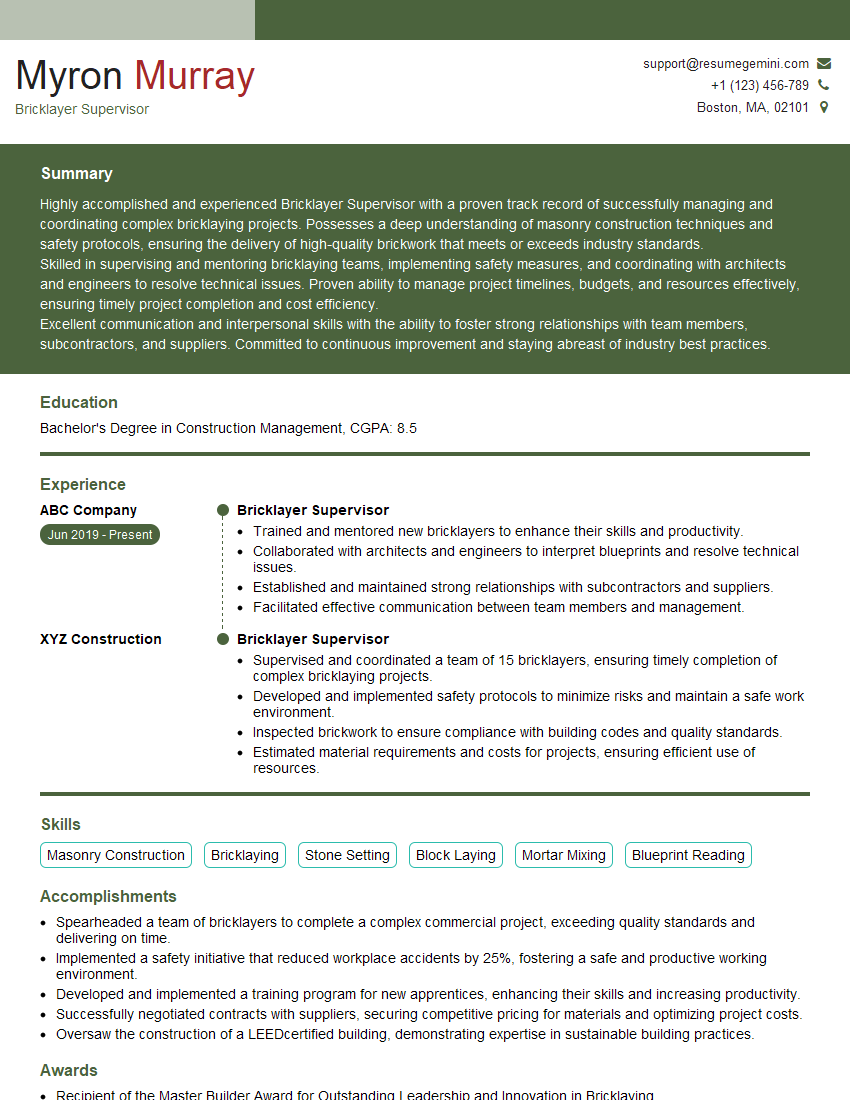
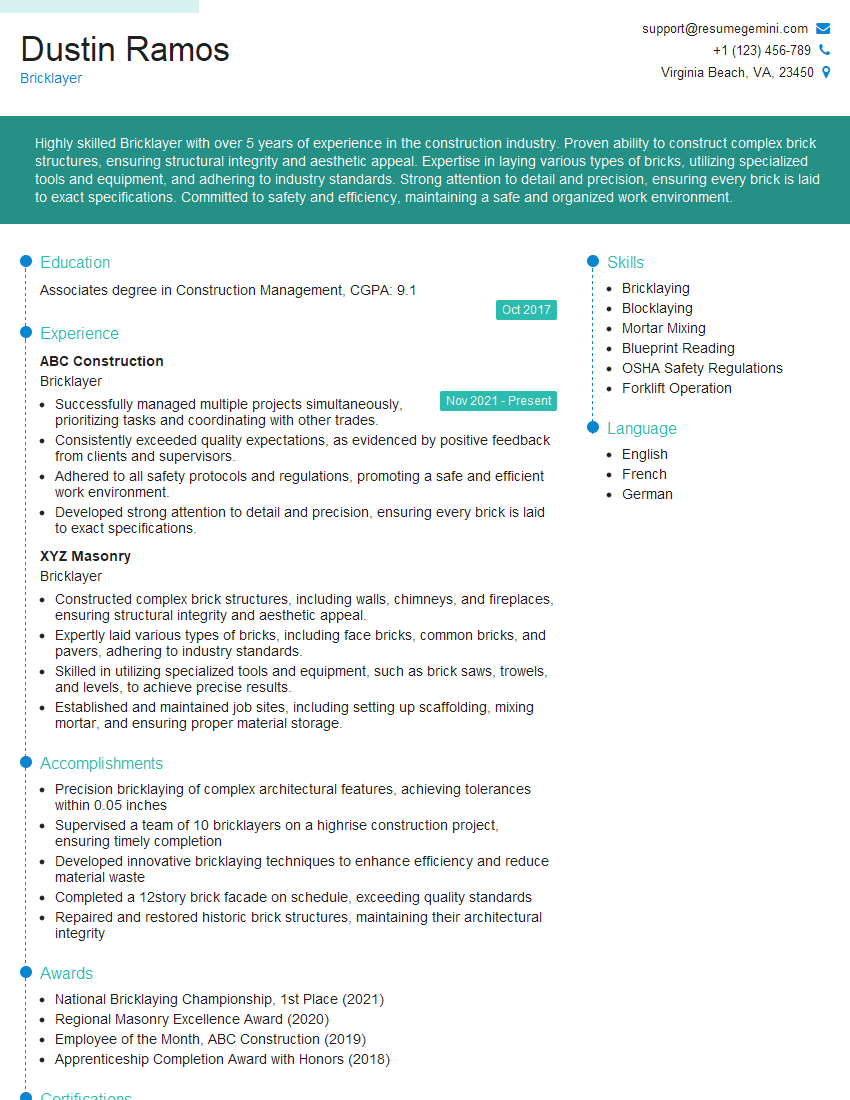
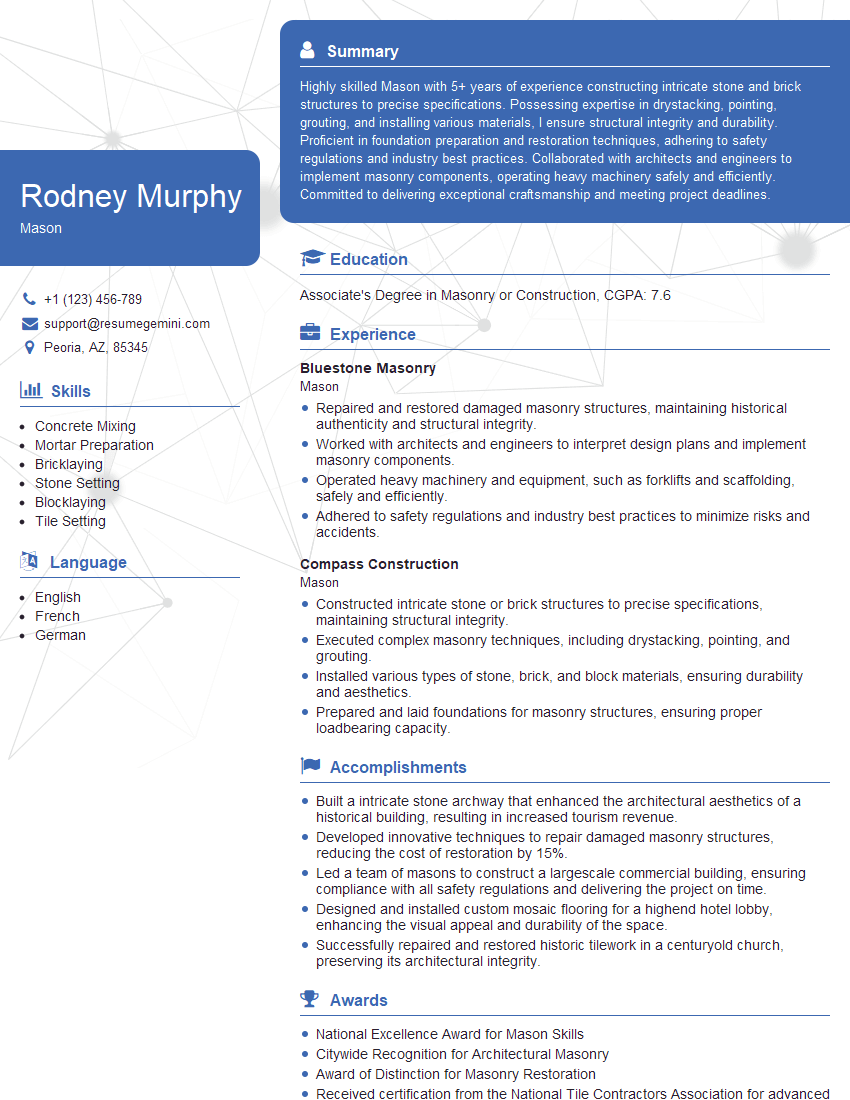
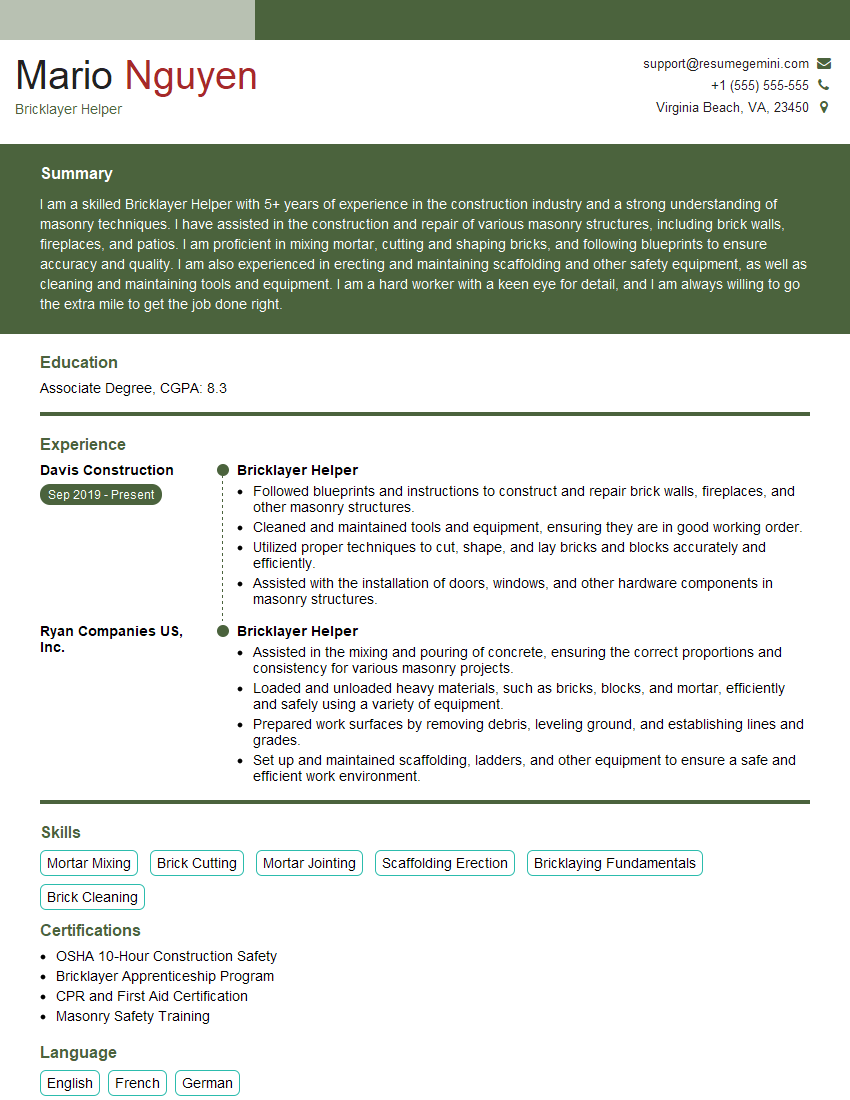
Mastering Lay Bricks skills opens doors to rewarding careers in construction and related fields, offering opportunities for growth and specialization. To maximize your job prospects, create an ATS-friendly resume that highlights your skills and experience effectively. We strongly recommend using ResumeGemini to build a professional and impactful resume that showcases your Lay Bricks expertise. Examples of resumes tailored to Lay Bricks positions are available below to guide you.



Explore more articles
Users Rating of Our Blogs
Share Your Experience
We value your feedback! Please rate our content and share your thoughts (optional).
What Readers Say About Our Blog
Very informative content, great job.
good