Unlock your full potential by mastering the most common Fiber Optic Network Performance Analysis interview questions. This blog offers a deep dive into the critical topics, ensuring you’re not only prepared to answer but to excel. With these insights, you’ll approach your interview with clarity and confidence.
Questions Asked in Fiber Optic Network Performance Analysis Interview
Q 1. Explain the concept of Optical Return Loss (ORL) and its significance in fiber optic networks.
Optical Return Loss (ORL) measures the amount of light reflected back towards the source in a fiber optic system. Think of it like an echo – a portion of the light signal doesn’t travel through the fiber but bounces back. A high ORL indicates significant light reflection, which is undesirable.
Significance: High ORL can severely degrade system performance. Reflections can interfere with the signal, causing noise, signal distortion, and even system instability. It’s especially crucial in bidirectional systems (like those using WDM technology) where light travels in both directions across the same fiber. A strong reflection can overwhelm the signal traveling in the opposite direction. ORL measurements are therefore critical during fiber optic network installation and maintenance to identify and correct issues like poor connector termination, fiber breaks, or mismatched components. A typical target is to keep ORL below a certain threshold, which depends on the system specifications, usually expressed in decibels (dB).
Q 2. Describe different types of fiber optic cables and their applications.
Fiber optic cables come in various types, primarily categorized by their core size and composition:
- Single-mode fiber: This type has a very small core diameter (around 8-10 microns) and is designed to transmit a single ray of light, resulting in much lower attenuation and much higher bandwidth over longer distances. They’re ideal for long-haul telecommunications and high-speed data transmission.
- Multi-mode fiber: With a larger core (typically 50 or 62.5 microns), multi-mode fibers allow multiple light rays to travel through simultaneously along different paths. This results in higher attenuation compared to single-mode, and thus it’s suitable for shorter distances and lower bandwidth applications. Common applications include local area networks (LANs) and building connections.
- Fiber types by material: The core material is typically silica glass. However, special fibers such as those with a photonic crystal structure or those containing different dopants can be used to fine-tune characteristics, such as for specific wavelengths or dispersion management.
The choice of fiber type depends heavily on the application’s requirements for bandwidth, distance, and cost. Single-mode is the preferred choice for long-haul, high-bandwidth applications while multi-mode is more cost-effective for shorter distances.
Q 3. What are the common causes of fiber optic attenuation?
Attenuation, the loss of signal strength over distance, in fiber optics is primarily caused by:
- Absorption: The fiber material itself absorbs some light energy, with some wavelengths being absorbed more than others. Impurities in the glass can exacerbate this issue.
- Scattering: Light scatters as it travels through the fiber, due to microscopic variations in the fiber’s density and structure. Rayleigh scattering is a significant factor, especially at shorter wavelengths.
- Bending Losses: Sharp bends in the fiber increase attenuation, leading to light leaking from the core. Macrobends (large radius bends) and microbends (tiny, irregular bends) contribute to this.
- Connector and Splice Losses: Imperfect connections between fiber sections introduce losses due to reflections and light escaping at the joints. Poorly cleaned or misaligned connectors are common culprits.
Understanding these causes is crucial for designing and maintaining fiber optic networks to minimize signal degradation.
Q 4. How does an Optical Time-Domain Reflectometer (OTDR) work?
An Optical Time-Domain Reflectometer (OTDR) is a specialized instrument used to test fiber optic cables. Imagine it like a sophisticated radar for fiber optics. It sends a short pulse of light down the fiber, and then analyzes the light that is reflected back.
How it works: The OTDR measures the time it takes for the light pulses to travel down the fiber and return, and also measures the intensity of the reflected light. Any imperfections in the fiber, such as breaks, splices, or connectors, will cause some of the light to be reflected back to the OTDR. The time delay and the amount of reflected light provide information about the location and nature of these events. The OTDR displays this information as a trace, showing attenuation over distance and events along the fiber.
Q 5. Interpret an OTDR trace: Identify events like breaks, splices, and connectors.
Interpreting an OTDR trace requires understanding the key features:
- Breaks: A break in the fiber will produce a large, sharp reflection peak on the OTDR trace, typically close to 100% reflection, signaling a complete loss of signal.
- Splices: Splices, which join two fiber segments, produce smaller reflection peaks compared to breaks. The size of the peak reflects the quality of the splice; a good splice will have a minimal reflection.
- Connectors: Similar to splices, connectors also generate reflection peaks, their size also indicating the quality of the connection. Poorly polished or misaligned connectors result in larger reflections.
- Attenuation Slope: The gradual decrease in signal strength displayed on the trace indicates the attenuation of the fiber itself. A steeper slope signifies higher attenuation.
By carefully analyzing the location, size, and shape of the peaks, a skilled technician can identify and pinpoint the problems in the fiber optic link. Experience and knowledge of the fiber type and installation are critical in correct interpretation.
Q 6. Explain the difference between single-mode and multi-mode fiber optics.
The key difference between single-mode and multi-mode fiber lies in their core size and how light propagates through them:
- Single-mode fiber: Its tiny core only allows one mode (path) of light propagation. This minimizes modal dispersion (spreading of light pulses due to different paths), enabling long-distance and high-bandwidth transmission. Think of it like a single lane highway – all traffic flows in a single path.
- Multi-mode fiber: Its larger core allows multiple modes (paths) of light to travel simultaneously. This results in modal dispersion, limiting its use to shorter distances and lower bandwidth applications. Think of it as a multi-lane highway, where vehicles might take slightly different routes, resulting in slower overall traffic.
In short: single-mode is ideal for long distances and high bandwidth, while multi-mode is more cost-effective for shorter distances and less demanding applications.
Q 7. What are the advantages and disadvantages of using DWDM technology?
Dense Wavelength-Division Multiplexing (DWDM) technology allows multiple wavelengths (colors) of light to be transmitted simultaneously over a single fiber optic cable. It’s like having multiple conversations on the same phone line, each using a different frequency.
Advantages:
- Increased Bandwidth: A single fiber can carry significantly more data, dramatically increasing network capacity.
- Cost-Effective: Utilizing existing fiber infrastructure greatly reduces the need for new cable deployment, saving substantial costs.
- Long-Haul Transmission: Suitable for long-distance communication because signal degradation is comparatively less.
Disadvantages:
- High Initial Investment: DWDM systems require specialized equipment like lasers, multiplexers, and demultiplexers, making the initial investment significant.
- Complexity: DWDM systems are complex to design, install, and maintain, requiring specialized expertise.
- Sensitivity to Environmental Factors: DWDM systems can be sensitive to environmental factors like temperature fluctuations, which can impact performance.
The decision to use DWDM depends on balancing the cost and complexity against the significant increase in bandwidth and efficiency it provides. It’s typically used in large-scale networks where the high upfront cost is justified by the long-term benefits.
Q 8. How do you troubleshoot a fiber optic network experiencing high latency?
High latency in a fiber optic network, meaning a significant delay in data transmission, can stem from various sources. Troubleshooting involves a systematic approach. First, we’d check for obvious issues like faulty connectors or splices. A simple visual inspection can often identify broken fibers or poorly connected components. Next, we’d use an Optical Time-Domain Reflectometer (OTDR) to pinpoint the location of any fiber breaks, attenuation problems, or macrobends. This device sends light pulses down the fiber and analyzes the reflected signal to detect anomalies. Then, we examine the network equipment itself – routers, switches, and optical transceivers – looking for errors or bottlenecks using network monitoring tools. Software issues, such as routing protocols misconfiguration, can also increase latency. We would check the network configuration and verify proper routing and QoS settings. Finally, if the issue persists, we may need more specialized tools like a chromatic dispersion or polarization mode dispersion tester to investigate signal impairments within the fiber itself.
For instance, I once worked on a network where high latency was traced to a poorly connected splice deep underground. The OTDR pinpointed the exact location, saving hours of digging and testing.
Q 9. Describe different fiber optic connector types and their applications.
Fiber optic connectors are crucial for reliably joining fiber optic cables. Several types exist, each with its strengths and applications:
- SC (Subscriber Connector): A simple, push-pull connector, widely used but relatively less precise than others. It’s commonly found in older installations.
- FC (Ferrule Connector): Features a threaded coupling, providing high precision and excellent repeatability. Often preferred in demanding environments requiring high stability.
- LC (Lucent Connector): A compact, push-pull connector, increasingly popular due to its small size and ease of use. Its smaller footprint is valuable in high-density applications.
- MT-RJ (Mechanical Transfer-Registered Jack): A dual-fiber connector which provides high density, but can be more sensitive to misalignments.
- ST (Straight Tip): An older bayonet-style connector, less prevalent now due to the rise of LC and SC types. It’s characterized by a twist-on, twist-off mechanism.
The choice of connector depends on factors such as the required precision, environmental conditions, and the density of the network infrastructure. For example, LC connectors are favored in data centers due to their density, whereas FC connectors might be chosen in harsh environments for their robustness.
Q 10. What is chromatic dispersion and how does it affect signal transmission?
Chromatic dispersion is a phenomenon where different wavelengths of light travel at slightly different speeds through the fiber optic cable, causing signal distortion. Think of it like a group of runners starting a race at the same time, but some running faster than others – they arrive at the finish line at different times, blurring the group. This ‘blurring’ translates to signal degradation.
This dispersion occurs because the refractive index of the fiber is wavelength-dependent. It impacts long-haul, high-bit-rate systems significantly as it leads to pulse broadening, intersymbol interference (ISI), and ultimately, reduced data transmission speed or increased bit error rate. Mitigation techniques include using dispersion-compensating fibers (DCF) which have the opposite dispersion characteristics, or employing dispersion-shifted fiber (DSF) which minimizes dispersion at the operating wavelength.
Q 11. What is polarization mode dispersion (PMD) and how can it be mitigated?
Polarization Mode Dispersion (PMD) is another type of signal distortion where different polarization states of light travel at different speeds through the fiber. Imagine two light waves traveling along slightly different paths within the fiber. This difference in travel times causes the signal to become distorted and reduces the quality of the signal over long distances. Unlike chromatic dispersion which is wavelength-dependent, PMD is more unpredictable and depends on various factors including fiber manufacturing imperfections and environmental conditions like temperature variations.
PMD mitigation strategies include using polarization-maintaining fibers (PMF), which are designed to minimize the effect of PMD, employing polarization scrambling techniques at the transmitter to average out the PMD effect, or using digital signal processing (DSP) to compensate for PMD effects at the receiver. Adaptive equalization algorithms within DSP equipment can dynamically adjust for the changing PMD characteristics of the link.
Q 12. Explain the concept of Optical Signal-to-Noise Ratio (OSNR).
Optical Signal-to-Noise Ratio (OSNR) is a crucial performance metric that indicates the strength of the optical signal relative to the noise level. A high OSNR indicates a clean signal with minimal noise, ensuring reliable data transmission. Conversely, a low OSNR suggests significant noise interference, potentially leading to bit errors and data loss. Think of it as the clarity of your voice in a crowded room. A high OSNR is like speaking clearly in a quiet room; while a low OSNR is like trying to be heard in a noisy stadium. It’s measured in decibels (dB) or dBm.
OSNR is directly affected by factors such as amplified spontaneous emission (ASE) noise in optical amplifiers, and various forms of optical noise. Maintaining a high OSNR is vital for long-haul optical communication systems, and it’s regularly monitored to ensure the quality of transmission.
Q 13. How do you perform end-to-end testing of a fiber optic link?
End-to-end testing of a fiber optic link involves a comprehensive evaluation of the entire path, from transmitter to receiver, assessing both the optical and physical aspects. It begins with a visual inspection of the cable and connectors. An OTDR is then used to assess the fiber itself, checking for attenuation, reflections, and other impairments. Optical power meters measure the power levels at various points along the link. Optical spectrum analyzers are used to examine the spectral characteristics of the signal and the presence of noise or other unwanted signals. In addition to this, bit-error-rate testing (BERT) evaluates the performance of the entire transmission path by introducing a known signal and measuring the rate of errors at the receiver. Network connectivity tools, such as ping and traceroute, are used to confirm network-layer connectivity.
These tests help to identify any problems, such as fiber breaks, excessive attenuation, or equipment malfunctions, ensuring the reliable operation of the entire link before deployment or after maintenance. A comprehensive test plan ensures that all aspects are checked, delivering a trustworthy assessment of the link’s performance.
Q 14. What are the common performance metrics used to evaluate fiber optic networks?
Several key performance metrics are used to evaluate fiber optic networks. These include:
- Attenuation: The reduction in optical power as light travels through the fiber. Measured in decibels (dB).
- Bit Error Rate (BER): The number of erroneous bits received compared to the total number of bits transmitted. A lower BER indicates better performance.
- Chromatic Dispersion: As described earlier, the broadening of light pulses due to wavelength-dependent propagation speeds.
- Polarization Mode Dispersion (PMD): As described earlier, the difference in propagation times for different polarization states.
- Optical Signal-to-Noise Ratio (OSNR): The ratio of signal power to noise power. A higher OSNR implies a cleaner signal.
- Return Loss: Measures the amount of light reflected back towards the source. A high return loss indicates good connection quality.
- Latency: The delay in data transmission.
These metrics, along with others depending on the specific application, are used to diagnose problems, optimize network performance, and ensure reliable data transmission in various scenarios.
Q 15. Explain the principles of Wavelength Division Multiplexing (WDM).
Wavelength Division Multiplexing (WDM) is a technology that allows multiple wavelengths (colors) of light to be transmitted simultaneously over a single optical fiber. Think of it like a highway with multiple lanes – each lane carries a different signal, significantly increasing the capacity of the fiber. Instead of sending a single signal, WDM allows you to transmit many signals at different wavelengths, all traveling down the same fiber simultaneously.
The principle lies in the use of specialized optical components like multiplexers and demultiplexers. A multiplexer combines the various wavelengths into a single fiber, while a demultiplexer separates them at the receiving end. Each wavelength carries a separate data stream, resulting in a substantial increase in bandwidth. This is crucial for high-capacity long-haul networks.
For example, a Dense Wavelength Division Multiplexing (DWDM) system can transmit hundreds of wavelengths on a single fiber, each operating at a slightly different wavelength within the optical spectrum. This allows for massive data transmission rates over long distances, making it the backbone of modern high-speed internet and telecommunications infrastructure.
Career Expert Tips:
- Ace those interviews! Prepare effectively by reviewing the Top 50 Most Common Interview Questions on ResumeGemini.
- Navigate your job search with confidence! Explore a wide range of Career Tips on ResumeGemini. Learn about common challenges and recommendations to overcome them.
- Craft the perfect resume! Master the Art of Resume Writing with ResumeGemini’s guide. Showcase your unique qualifications and achievements effectively.
- Don’t miss out on holiday savings! Build your dream resume with ResumeGemini’s ATS optimized templates.
Q 16. Describe different types of fiber optic network architectures.
Fiber optic network architectures can be broadly classified into several types, each suited for different needs and scales. Some common ones include:
- Star Topology: This is the most common architecture, especially in access networks. All nodes connect to a central hub (like a switch or router). It’s simple to manage but a failure at the central hub can disrupt the entire network.
- Ring Topology: Nodes are connected in a closed loop. Data travels in one direction. This offers redundancy as failure of one node doesn’t necessarily bring down the whole network. Commonly used in SONET/SDH networks.
- Mesh Topology: Multiple paths exist between nodes, providing high redundancy and fault tolerance. It’s more complex to manage but offers greater resilience. Ideal for large-scale, critical infrastructure networks.
- Bus Topology: Nodes are connected to a single cable (bus). It’s simple but susceptible to failure if the bus fails. Less common in modern fiber networks.
- Tree Topology: This is a hierarchical structure where a central node branches out to multiple subordinate nodes, forming a tree-like structure. It is a combination of star and bus topologies and is often used in larger networks.
The choice of architecture depends on factors like network size, cost considerations, required bandwidth, and fault tolerance requirements.
Q 17. How do you manage and maintain a large-scale fiber optic network?
Managing and maintaining a large-scale fiber optic network requires a multi-faceted approach that encompasses proactive monitoring, preventative maintenance, and efficient fault management.
- Optical Monitoring Systems (OMS): These systems continuously monitor various network parameters such as optical power levels, signal-to-noise ratio (SNR), and bit error rate (BER). Early detection of anomalies allows for timely intervention, preventing larger issues.
- Performance Management Software: Sophisticated software solutions provide dashboards to visualize network performance, identify bottlenecks, and facilitate proactive maintenance. This often involves trend analysis and predictive modeling.
- Regular Physical Inspections: Scheduled physical inspections of cable routes, splice closures, and equipment racks are crucial for detecting physical damage, environmental hazards, or signs of aging.
- Automated Fault Detection and Isolation: Systems that can automatically detect and isolate faults are essential for rapid response and minimal downtime. This often involves advanced algorithms and network management tools.
- Documentation: Meticulous documentation, including accurate maps of the network, fiber routes, and equipment specifications, is crucial for efficient troubleshooting and future upgrades.
A strong team of skilled technicians, engineers, and network managers is crucial for effective network management. The use of proactive measures minimizes downtime and extends the lifespan of the network.
Q 18. What are the best practices for fiber optic cable installation and termination?
Best practices for fiber optic cable installation and termination are vital to ensure network performance and longevity. Negligence here can lead to signal attenuation, high error rates, and eventual network failure.
- Proper Cable Handling: Avoid excessive bending or twisting, which can damage the fiber core. Use appropriate cable management techniques, such as cable trays and slack storage.
- Cleanliness: Maintaining cleanliness during installation and termination is paramount. Dust, dirt, and oil can significantly impact signal quality. Use appropriate cleaning tools and techniques, such as alcohol wipes and fiber optic cleaning pens.
- Precise Cleaving: A clean, precise cleave is vital for optimal connector performance. Use a high-quality cleaver to ensure a perpendicular and smooth end face.
- Connector Installation: Properly install and align connectors. Use appropriate epoxy and curing techniques for splices. This requires precision to ensure a good physical and optical connection.
- Testing: Thorough testing at each stage is essential. Use optical time-domain reflectometers (OTDRs) to identify faults, losses, and ensure that the signal is reaching its destination with acceptable quality.
Adherence to industry standards and manufacturer guidelines is crucial to ensure that the installation and termination meet the required specifications, leading to a reliable and long-lasting fiber optic network.
Q 19. Explain the role of optical amplifiers in long-haul fiber optic networks.
Optical amplifiers are essential components in long-haul fiber optic networks because they compensate for signal attenuation (loss of signal strength) over long distances. As light signals travel through the fiber, they lose power due to absorption and scattering. Optical amplifiers boost the signal strength, allowing for transmission over much longer distances without the need for frequent repeaters.
There are two main types:
- Erbium-doped fiber amplifiers (EDFAs): These amplifiers are commonly used in long-haul and undersea communication systems. They work by amplifying light signals within the 1550 nm wavelength range, which is the standard for most long-haul fiber optic communication systems.
- Raman amplifiers: These amplifiers use a different mechanism to amplify the signal. They offer wider bandwidth and flexibility compared to EDFAs, but they are generally more complex to implement.
Without optical amplifiers, the signal strength would degrade quickly, limiting the transmission distance significantly. Optical amplifiers allow for the efficient and cost-effective transmission of data across continents and oceans.
Q 20. What is the difference between dark fiber and lit fiber?
The difference between dark fiber and lit fiber lies in whether or not it’s actively carrying a signal.
- Dark Fiber: This refers to unused, unlit optical fiber. It’s the physical infrastructure – the cable itself – but no signal is being transmitted through it. Think of it as a highway without any cars on it. Organizations can lease dark fiber and then install their own equipment and transmit their own signals. This provides significant control and security.
- Lit Fiber: This is optical fiber that’s currently carrying a signal. It’s a functioning part of a telecommunications network. In our highway analogy, this is the highway with cars actively using it. Lit fiber is generally provided as a service by telecommunication companies.
The key difference lies in ownership and use. Dark fiber offers greater control and security, while lit fiber provides a readily available, pre-configured communication channel. The choice depends on the specific needs and budget of the user.
Q 21. Describe various fiber optic testing equipment and their functions.
Various fiber optic testing equipment is essential for ensuring the quality and performance of fiber optic networks. Some key pieces of equipment include:
- Optical Power Meter (OPM): Measures the optical power level at various points in the network. It helps to identify signal loss and potential problems. Think of it as measuring the strength of a light signal.
- Optical Time-Domain Reflectometer (OTDR): This is a powerful tool that measures the characteristics of the fiber optic cable, including signal loss, reflections, and the location of faults. It allows technicians to locate and pinpoint problems, such as breaks, bad connectors, or splices, along the fiber.
- Optical Spectrum Analyzer (OSA): Measures the wavelengths and power levels of multiple wavelengths in a WDM system. It’s essential for monitoring WDM channels and ensuring their integrity.
- Fiber Identifier: Used to identify the specific fibers in a cable containing many fibers. This is crucial when working with multiple fibers.
- Source and Meter: A light source generates a light signal at a specific wavelength. The meter measures the optical power of the signal. These are used for basic optical testing.
The choice of testing equipment depends on the specific task, the type of fiber optic system, and the troubleshooting needs.
Q 22. What are the security considerations for fiber optic networks?
Fiber optic networks, while offering high bandwidth and low latency, aren’t immune to security threats. Unlike copper cables, fiber optics don’t readily emit signals that can be easily tapped. However, vulnerabilities exist at the termination points – the equipment connecting to the fiber. These are the primary security concerns:
- Physical Taps and Splices: Malicious actors can physically tap into the fiber, inserting a splice to intercept or inject data. This requires specialized equipment and expertise, but it’s a real threat, particularly in less secure locations.
- Equipment Vulnerabilities: Network devices like optical transceivers, multiplexers, and routers at the network’s edges are susceptible to hacking, just like any other network equipment. Compromising these devices grants access to the network.
- Software Vulnerabilities: Network management systems (NMS) and Optical Transport Network (OTN) control software can contain vulnerabilities that could be exploited remotely. Keeping software patched and employing robust security practices is crucial.
- Insider Threats: Employees with access to fiber optic infrastructure could intentionally or unintentionally compromise security.
Mitigation strategies include robust physical security measures, regular security audits of network equipment, strong access control policies, and the use of encryption protocols throughout the network. Regular firmware updates are also critical.
Q 23. How do you address issues related to fiber optic cable breakage or damage?
Fiber optic cable breakage or damage is a serious issue, leading to service interruptions. Addressing it requires a systematic approach:
- Identify the Break: Use an Optical Time-Domain Reflectometer (OTDR) to pinpoint the exact location of the break. The OTDR sends light pulses down the fiber and measures the reflected signal, revealing breaks, splices, and other impairments.
- Access the Damaged Section: This can involve excavation, aerial work, or accessing manholes, depending on the cable’s location. Safety is paramount during this stage.
- Repair or Replace: If the damage is localized, a splice might suffice. However, extensive damage often necessitates replacing the affected section of cable. Splicing requires precision and specialized tools, ensuring minimal signal loss.
- Testing and Verification: After repair or replacement, thorough testing with an OTDR is needed to confirm signal integrity and low attenuation (signal loss).
- Documentation: All repair activities should be meticulously documented, including the location, nature of the damage, and the repair method employed.
Preventing damage is also crucial. This includes proper cable routing, trenching, and deployment techniques, along with regular inspections for potential hazards.
Q 24. Explain different methods of fiber optic splicing.
Fiber optic splicing connects two optical fibers with minimal signal loss. Several methods exist:
- Fusion Splicing: This method uses an electric arc to melt and fuse the ends of two fibers together. It creates a strong, low-loss connection but requires specialized equipment and expertise. This is the most common method for its high precision and low loss.
- Mechanical Splicing: This involves using a mechanical connector to align and join the fibers. It’s quicker and easier than fusion splicing but generally results in slightly higher signal loss. This is suitable for temporary or less demanding applications.
- Connectors: These pre-made connectors offer a quick and easy connection, but they are generally less robust and may have higher losses than splicing. They are best suited for situations needing easy, repeated connection/disconnection. Examples include SC, FC, LC, and ST connectors.
The choice of splicing method depends on factors like budget, required performance, and the environment. For high-bandwidth, long-haul networks, fusion splicing is generally preferred for its superior performance. For short-term connections or testing, mechanical splices or connectors might be used.
Q 25. Describe your experience with network monitoring tools and their application in fiber optic networks.
My experience with network monitoring tools is extensive. In fiber optic networks, these tools are indispensable for ensuring performance, identifying problems, and proactively mitigating issues. I’ve worked extensively with:
- Optical Time-Domain Reflectometers (OTDRs): Essential for locating breaks, evaluating fiber loss, and identifying other impairments. I’ve used OTDRs from various manufacturers (e.g., VIAVI, EXFO) to troubleshoot a wide range of scenarios.
- Optical Spectrum Analyzers (OSAs): Used to characterize the optical signal’s wavelength and power. OSAs are crucial for identifying wavelength-related issues and ensuring proper operation of DWDM systems.
- Network Management Systems (NMS): These systems provide centralized monitoring and control of fiber optic networks, including performance metrics, alarm management, and fault detection. I am proficient in using various NMS platforms, customizing dashboards and alerts for specific network needs.
- Performance Monitoring Tools: I utilize tools that monitor key performance indicators (KPIs) like bit error rate (BER), signal-to-noise ratio (SNR), and latency to assess overall network health and identify potential degradation.
Using these tools in conjunction provides a comprehensive picture of fiber optic network health, enabling proactive maintenance and timely resolution of issues. For example, using an OTDR to identify a fault and then confirming the repair using an OSA is common practice.
Q 26. Discuss your understanding of SONET/SDH standards and their relevance to fiber optics.
SONET (Synchronous Optical Network) and SDH (Synchronous Digital Hierarchy) are standardized protocols for transmitting data over fiber optic networks. They provide a robust and flexible framework for carrying various types of traffic, including voice, video, and data.
SONET is predominantly used in North America, while SDH is the international standard. Despite their different names, they are functionally very similar. They both provide a hierarchical structure for multiplexing lower-rate signals onto higher-rate optical carriers. This allows for efficient use of fiber bandwidth and enables easy scalability. Key aspects include:
- Framing and Multiplexing: SONET/SDH defines specific frame structures for packaging data and multiplexing multiple signals onto a single fiber. This is crucial for reliable communication and efficient bandwidth usage.
- Error Correction and Protection: These protocols include robust error correction mechanisms and protection schemes like automatic protection switching (APS) to ensure high availability and reliability. For instance, a ring topology ensures redundancy.
- Bandwidth Scalability: SONET/SDH supports various levels of bandwidth (e.g., OC-3, OC-12, OC-48, etc. for SONET; STM-1, STM-4, STM-16, etc. for SDH), allowing networks to easily adapt to changing bandwidth demands.
Their relevance to fiber optics is direct: they provide the framework for efficiently and reliably transporting high-speed data over fiber optic cables, making them the backbone of many high-capacity telecommunications networks.
Q 27. How would you design a fiber optic network for a specific application (e.g., data center, long-haul communication)?
Designing a fiber optic network requires careful consideration of various factors, and the design will differ significantly depending on the application.
Data Center: A data center network needs high bandwidth, low latency, and high availability. This might involve a high-density fiber optic backbone using multimode fiber for shorter distances and potentially single-mode fiber for longer runs. Redundancy is critical, possibly using multiple paths for critical connections and ring topologies for high availability. Dense Wavelength Division Multiplexing (DWDM) is often employed to maximize fiber capacity. Careful cable management is essential to avoid signal interference and streamline maintenance.
Long-haul Communication: Long-haul networks prioritize long distances and cost-effectiveness. This typically uses single-mode fiber because of its lower loss over longer distances. DWDM is essential to efficiently use the available bandwidth, and regeneration sites may be required at intervals to compensate for signal attenuation. Robust protection mechanisms like APS are crucial for reliability. Environmental factors (temperature, terrain) are critical considerations during planning.
In both cases, meticulous planning and design are essential. This includes determining the required bandwidth, selecting the appropriate fiber type, designing the network topology, specifying the optical equipment, and implementing robust monitoring and management tools.
Q 28. What are your experiences with troubleshooting complex fiber optic network issues and resolving them efficiently?
Troubleshooting complex fiber optic network issues requires a methodical and systematic approach. My experience includes:
- Gather Information: Begin by collecting as much information as possible. This includes symptoms, affected areas, recent changes to the network, and any error logs.
- Isolate the Problem: Use network monitoring tools (OTDR, OSA, NMS) to pinpoint the location and nature of the problem. Isolate specific segments or devices for focused testing.
- Verify Connections: Check all physical connections, ensuring proper alignment and cleanliness. Loose connectors or dirty interfaces are frequent causes of problems.
- Test Optical Signal Quality: Measure parameters like optical power, attenuation, and bit error rate (BER) to assess the quality of the optical signal. Excessive attenuation or high BER indicates a problem.
- Check Network Equipment: Examine the status and configuration of network devices, such as optical transceivers, multiplexers, and routers.
- Eliminate Possible Causes: Systematically eliminate possible causes by testing different components and configurations.
- Implement a Solution: Once the root cause is identified, implement the appropriate solution, which may involve repairing damaged fiber, replacing faulty components, or adjusting network configurations.
- Document the Resolution: Meticulously document the problem, the troubleshooting steps, and the final solution. This is vital for future reference and helps prevent recurrence.
I recall one incident where intermittent connectivity issues plagued a long-haul network. Through careful use of an OTDR, we discovered microbends in the fiber causing signal degradation. By identifying the specific location and implementing targeted repairs, we resolved the issue efficiently, minimizing service disruption.
Key Topics to Learn for Fiber Optic Network Performance Analysis Interview
- Optical Signal Degradation: Understanding attenuation, dispersion (chromatic and modal), and non-linear effects like stimulated Brillouin scattering. Practical application: Analyzing network performance metrics to pinpoint bottlenecks caused by signal degradation.
- Optical Power Budget Calculations: Mastering the calculation and optimization of optical power budgets in various network topologies. Practical application: Designing and troubleshooting fiber optic networks to ensure reliable signal transmission.
- Optical Network Monitoring & Troubleshooting: Familiarizing yourself with OTDR (Optical Time-Domain Reflectometer) principles and interpretations, along with other monitoring tools and techniques. Practical application: Identifying and resolving faults in fiber optic networks efficiently.
- Network Performance Metrics: Understanding key performance indicators (KPIs) such as bit error rate (BER), signal-to-noise ratio (SNR), and optical return loss (ORL). Practical application: Interpreting performance data to optimize network configurations and improve service quality.
- DWDM (Dense Wavelength-Division Multiplexing) Systems: Understanding the principles and functionalities of DWDM systems, including channel allocation, wavelength management, and optical amplification. Practical application: Designing and optimizing high-capacity optical networks.
- Troubleshooting Techniques: Developing a systematic approach to identifying and resolving issues within fiber optic networks. This includes fault isolation, root cause analysis, and preventative maintenance strategies.
- Network Protocols and Standards: Familiarity with relevant standards and protocols such as SONET/SDH and OTN. Practical application: Understanding the interplay between physical layer performance and higher-layer network protocols.
Next Steps
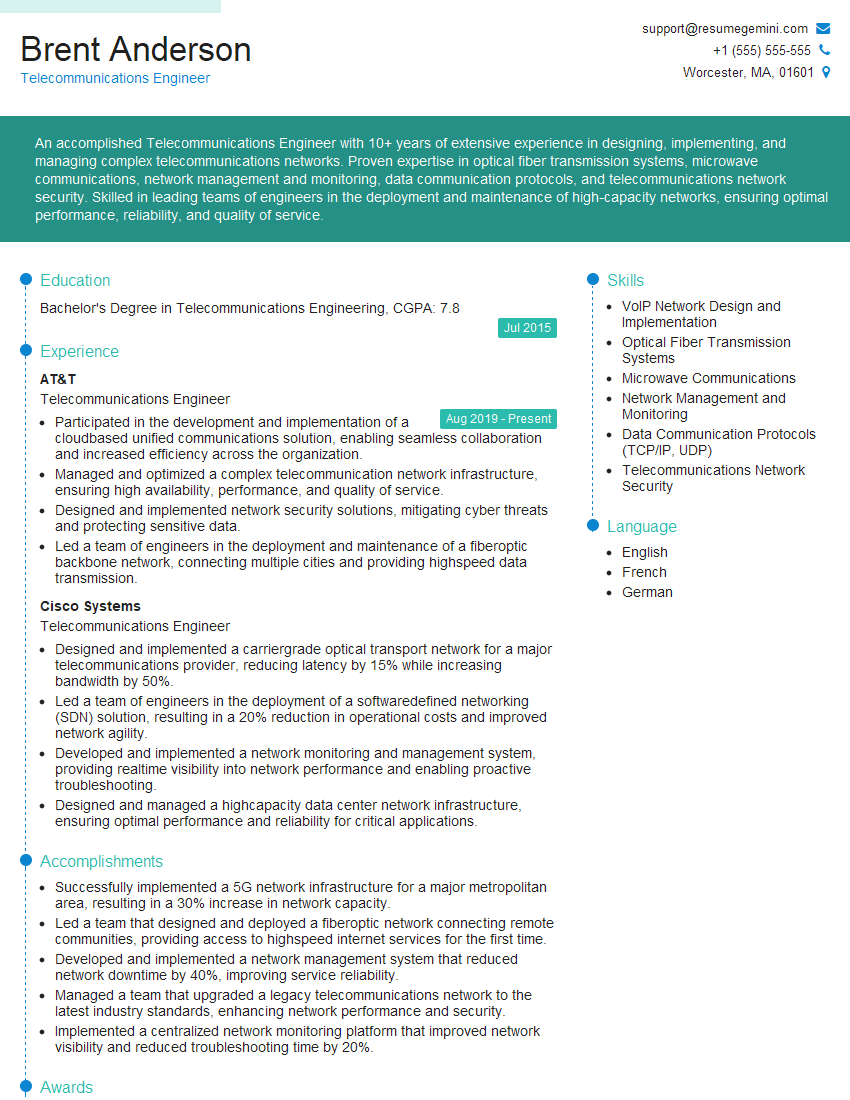
Mastering Fiber Optic Network Performance Analysis is crucial for career advancement in the telecommunications industry, opening doors to higher-paying roles and leadership opportunities. A well-crafted resume is your key to unlocking these opportunities. Ensure your resume is ATS-friendly to maximize its visibility to recruiters. We highly recommend using ResumeGemini to build a professional and impactful resume that showcases your skills and experience effectively. ResumeGemini provides examples of resumes tailored specifically to Fiber Optic Network Performance Analysis, giving you a head start in crafting your perfect application.

Explore more articles
Users Rating of Our Blogs
Share Your Experience
We value your feedback! Please rate our content and share your thoughts (optional).
What Readers Say About Our Blog
Very informative content, great job.
good