Preparation is the key to success in any interview. In this post, we’ll explore crucial Field Goal Percentage interview questions and equip you with strategies to craft impactful answers. Whether you’re a beginner or a pro, these tips will elevate your preparation.
Questions Asked in Field Goal Percentage Interview
Q 1. Define Field Goal Percentage (FG%).
Field Goal Percentage (FG%) is a fundamental statistic in basketball that measures a player’s or team’s shooting accuracy. It represents the percentage of successful field goal attempts (made shots) out of the total number of attempts. A high FG% indicates efficient shooting and a greater likelihood of scoring points.
Q 2. How is FG% calculated?
FG% is calculated using a simple formula: (Made Field Goals / Field Goal Attempts) * 100. For example, if a player makes 8 out of 15 shots, their FG% would be (8/15) * 100 = 53.3%. It’s crucial to note that this calculation excludes free throws.
Q 3. What are the limitations of using FG% as a sole performance metric?
While FG% is a valuable metric, relying on it solely can be misleading. It doesn’t account for several crucial factors. For instance, a player might have a high FG% by taking only easy shots near the basket, neglecting higher-value three-point attempts. Conversely, a player attempting many difficult shots might have a lower FG% despite being a more skilled overall shooter. Other factors like shot difficulty, type of shot (two-point vs three-point), and game situation are not reflected in FG%.
- Shot Selection: A player focusing on high-percentage shots will naturally have a higher FG%, even if they are less skilled overall.
- Shot Difficulty: A player taking many contested shots will likely have a lower FG% than one taking open shots.
- Positional Differences: Centers often have higher FG% due to closer proximity to the basket, while guards might have lower FG% due to more three-point attempts.
Q 4. How does FG% vary across different playing positions?
FG% varies significantly across different playing positions. Centers, being closer to the basket, tend to have higher FG% due to easier shots. Power forwards also usually have a higher FG% than guards or small forwards. Guards and small forwards, who often shoot more three-pointers, typically exhibit lower FG% because three-pointers are inherently more difficult. This is a natural consequence of their role on the court and the types of shots they are expected to take.
Think of it like this: a center is like a short-range sniper, while a guard is more of a long-range marksman. Each specializes in different shots, leading to varying FG%.
Q 5. Explain the relationship between FG% and effective field goal percentage (eFG%).
Effective Field Goal Percentage (eFG%) is a refined version of FG% that accounts for the added value of three-pointers. It weighs three-pointers more heavily because they are worth one more point than a two-pointer. The formula for eFG% is: eFG% = (FG + 0.5 * 3P) / FGA, where FG is field goals made, 3P is three-pointers made, and FGA is field goal attempts. A player with a higher eFG% is generally considered a more efficient scorer, reflecting the impact of their three-point shooting on their overall offensive output. Essentially, eFG% provides a more comprehensive measure of shooting efficiency than FG% alone.
Q 6. How can FG% be used to evaluate player efficiency?
FG% is a crucial component in evaluating player efficiency, although it shouldn’t be the only metric. A high FG% suggests that a player is converting their shots at a high rate, efficiently contributing to scoring. However, we must consider the context. A high FG% coupled with a high number of attempts indicates a significant offensive contribution. Conversely, a high FG% with few attempts might suggest a limited offensive role. Combining FG% with other advanced metrics like points per game, assists, rebounds, and player efficiency rating (PER) provides a more holistic assessment of a player’s overall contribution.
Q 7. Discuss the impact of shot selection on FG%.
Shot selection dramatically influences FG%. A player who consistently chooses high-percentage shots (close to the basket, open shots) will naturally have a higher FG% compared to someone taking many contested long-range shots or shots with defenders closely guarding them. Wise shot selection is a critical skill for efficient offensive play. Consider Stephen Curry, known for his incredible three-point shooting; he also demonstrates excellent judgment in selecting when to shoot from long-range versus driving to the basket for a higher-percentage shot. His shot selection contributes significantly to his overall efficiency, despite his high volume of three-pointers.
Q 8. How do you account for opponent defensive pressure when analyzing FG%?
Field Goal Percentage (FG%) is a valuable statistic, but it doesn’t exist in a vacuum. Opponent defensive pressure significantly impacts a player’s ability to score. To account for this, we need to look beyond the raw FG% and consider contextual factors. Think of it like this: a shooter might have a lower FG% against a team known for its elite defense, even if their shooting skill remains consistent.
Analyzing opponent defensive pressure involves examining several factors:
- Defensive Scheme: Was the opponent using a zone or man-to-man defense? Zone defenses can sometimes lead to slightly higher FG%, while man-to-man can be tougher.
- Defensive Personnel: The quality of the defenders guarding the shooter matters immensely. A player might shoot poorly against a lockdown defender but excel against weaker opponents.
- Shot Quality: We need to analyze the types of shots taken. Were these contested shots, open looks, or shots taken off the dribble? Contested shots naturally result in a lower FG%.
- Shot Charting: Advanced analytics like shot charts provide a visual representation of where shots were taken, allowing us to see if the player consistently struggled from certain areas of the court due to specific defensive strategies.
By incorporating these factors into the analysis, we can create a more nuanced understanding of a player’s true shooting ability and how well they perform under pressure.
Q 9. Describe how FG% can inform coaching decisions.
FG% is a crucial metric that directly informs coaching decisions at various levels. It helps coaches make strategic adjustments and optimize player performance.
- Player Rotation: A player consistently exhibiting a low FG% might see reduced playing time, especially in crucial game moments. The coach might favor players with higher efficiency.
- Offensive Play Design: If a player struggles with certain types of shots (e.g., jump shots from beyond the arc), the coach might adjust the offensive plays to create more opportunities for easier shots, such as layups or close-range shots.
- Individual Training Programs: Low FG% could trigger a reassessment of a player’s training. The coaching staff might work with the player to improve their shooting mechanics, decision-making, or mental approach.
- In-Game Adjustments: During a game, a coach might observe that a player’s FG% is dropping. This might lead to substituting the player or changing the offensive strategy to help get them better shots.
Essentially, FG% acts as a performance indicator, guiding coaching decisions related to player usage, offensive schemes, and individual development plans. For example, a coach might decide to run more pick-and-roll plays for a player who has a high FG% in those situations.
Q 10. What are some factors that can affect a player’s FG% over time?
A player’s FG% isn’t static; it fluctuates over time due to various factors. Think of it like a golfer’s putting average – it ebbs and flows.
- Injuries: An injury, even a minor one, can significantly impact shooting form and accuracy, leading to a temporary decrease in FG%.
- Fatigue: As the season progresses, fatigue can affect a player’s shooting mechanics, resulting in lower accuracy.
- Confidence: A player’s mental state plays a huge role. A slump in confidence can negatively impact their performance, lowering their FG%.
- Changes in Role/Offensive System: A change in team strategy or a new role within the team can also affect a player’s shot selection and overall FG%.
- Age and Physical Decline: As players age, their physical abilities might decline, affecting their shooting accuracy and FG%.
- Opponent Adjustments: As mentioned previously, improved defense by opponents can directly impact a player’s ability to score and thus FG%.
These factors highlight the dynamic nature of FG%, illustrating why it’s crucial to analyze it in context and over longer periods to understand a player’s true shooting ability.
Q 11. How can you use FG% data to identify areas for player improvement?
Using FG% data to identify areas for improvement is a multifaceted process.
- Shot Chart Analysis: Visualizing shot attempts on a court map reveals patterns. Are they consistently missing from a specific area? This pinpoints areas for focused practice.
- Shot Type Breakdown: Analyze FG% for different shot types (jump shots, layups, etc.). A low FG% on jump shots suggests the need for improved mechanics or shot selection.
- Game Situation Analysis: Look at FG% in different game situations (e.g., early offense, late-game pressure). Struggling in crucial moments warrants specific training to improve clutch shooting.
- Opponent-Specific Analysis: Identify if the player struggles against certain defensive players or schemes. This could inform strategies to counteract these weaknesses.
- Video Analysis: Reviewing game footage offers insights into shot mechanics, decision-making, and footwork. These factors can be corrected through tailored drills.
For example, if a player’s FG% is significantly lower on contested shots, the focus should be on improving strength and post moves to create better shot opportunities. By combining quantitative FG% data with qualitative video analysis, a comprehensive improvement plan can be designed.
Q 12. Compare and contrast FG% with other shooting metrics like three-point percentage.
While both FG% and three-point percentage (3P%) are measures of shooting accuracy, they offer different perspectives.
- FG% represents the overall shooting efficiency, encompassing all field goal attempts (two-pointers and three-pointers).
- 3P% focuses specifically on the accuracy of three-point shots.
Comparison: A high FG% indicates overall scoring efficiency, while a high 3P% suggests prowess from beyond the arc. A player might have a high FG% but a low 3P%, indicating strength in close-range shooting or a reluctance to shoot threes. Conversely, a player could have a low FG% but high 3P%, reflecting a preference for long-range shots that may not always be efficient overall.
Contrast: FG% provides a broader picture of scoring ability, while 3P% isolates long-range shooting skill. Neither metric alone tells the complete story; they complement each other.
Example: Player A has a 50% FG% and 35% 3P%, suggesting proficiency in overall shooting but perhaps some improvement needed on three-point attempts. Player B has a 45% FG% and a 40% 3P%, meaning they’re a more specialized three-point shooter whose overall efficiency could be improved.
Q 13. How can FG% be used in player scouting and recruitment?
FG% is a fundamental metric in player scouting and recruitment. Scouts use it to assess a prospect’s scoring ability and efficiency.
- Identifying High-Potential Scorers: Consistent high FG% across various levels of competition (high school, college, etc.) indicates a player’s potential for scoring at the professional level.
- Evaluating Shot Selection: Scouts analyze FG% in relation to shot type to see if a player takes and makes smart shots. A player might have a low FG% because they take too many difficult shots.
- Predicting Future Success: While not a perfect predictor, historical FG% can serve as a reasonable indicator of future success in the professional leagues. However, contextual factors always need to be considered.
- Comparing Players: Scouts use FG% to compare players with similar skill sets. For example, two power forwards might be compared based on their FG% to determine which one might be a better fit for a team’s offensive system.
However, it’s crucial to remember that FG% should not be the sole criterion. Scouts consider numerous other factors, like athleticism, defense, and intangibles when making recruitment decisions. FG% provides valuable information but needs to be contextualized within a holistic evaluation.
Q 14. Explain the concept of FG% regression to the mean.
Regression to the mean is a statistical concept stating that extreme values tend to become closer to the average over time. In the context of FG%, a player who has an unusually high FG% in one period (e.g., a hot streak) is likely to see their FG% decrease toward their true average in subsequent periods. Conversely, a player with unusually low FG% will likely see an increase towards their true average.
Example: A player shoots 60% from the field in a single game – a remarkably high value. Regression to the mean suggests that this player is unlikely to maintain this high percentage consistently. Their FG% will likely decrease in the following games, even if their overall shooting ability remains constant.
Practical Implications: When analyzing FG%, coaches and scouts need to be wary of extreme values. A single game or even a short period with exceptionally high or low FG% should be considered with caution. It’s more informative to analyze a player’s FG% over an extended period to gain a more accurate understanding of their true shooting ability.
This is because short-term variations are often influenced by factors like luck (e.g., unusually high number of lucky shots) or temporary external factors (e.g., exceptional defensive performance by the opposing team in a particular game). Focusing on the long-term trends provides a more reliable assessment.
Q 15. How can you visualize FG% data effectively?
Visualizing FG% data effectively requires choosing the right chart type to highlight key trends and patterns. Simple line graphs are excellent for showing FG% over time, allowing us to see improvement or decline. Bar charts are useful for comparing FG% across different players, teams, or game situations. Heatmaps can be powerful for visualizing FG% across different areas of the court, revealing shooting hot spots and weaknesses. For instance, a line graph showing Stephen Curry’s FG% over his career would reveal the consistency (or inconsistency) in his shooting ability over time. A bar chart could compare the FG% of all the starting point guards in the NBA during a particular season. And a court-based heatmap would show where LeBron James takes and makes the most shots.
Interactive dashboards, combining multiple visualizations, provide the most comprehensive view, allowing for dynamic exploration of the data. For example, a dashboard could allow a coach to filter FG% data by game type (home vs. away), opponent, or even quarter of the game, providing valuable insights for game planning.
Career Expert Tips:
- Ace those interviews! Prepare effectively by reviewing the Top 50 Most Common Interview Questions on ResumeGemini.
- Navigate your job search with confidence! Explore a wide range of Career Tips on ResumeGemini. Learn about common challenges and recommendations to overcome them.
- Craft the perfect resume! Master the Art of Resume Writing with ResumeGemini’s guide. Showcase your unique qualifications and achievements effectively.
- Don’t miss out on holiday savings! Build your dream resume with ResumeGemini’s ATS optimized templates.
Q 16. What statistical methods can be used to analyze FG% trends?
Analyzing FG% trends involves a range of statistical methods. Simple moving averages can smooth out short-term fluctuations, revealing underlying trends. Regression analysis helps model the relationship between FG% and other variables, such as minutes played, shot distance, or opponent defensive pressure. For example, we might use regression to determine if there’s a significant correlation between a player’s minutes played and their FG%. Time series analysis, especially ARIMA models, can be used to forecast future FG%, but the accuracy depends heavily on the data’s stationarity and the presence of seasonality. Finally, hypothesis testing (e.g., t-tests) helps determine if observed changes in FG% are statistically significant or just due to random chance. For instance, a t-test could assess if a player’s FG% improvement after implementing a new shooting technique is truly significant or merely a random fluctuation.
Q 17. How can you use FG% data to predict future performance?
Predicting future FG% performance is challenging but achievable using various techniques. Simple methods include extrapolating recent trends, assuming the current performance level will continue. More sophisticated models, like exponential smoothing or ARIMA models (as mentioned previously), account for seasonality and trend variations, offering more accurate predictions. Machine learning algorithms, such as regression trees or neural networks, can consider many factors simultaneously (e.g., fatigue, injuries, opponent, shot type), producing more complex and potentially accurate predictions. However, remember that all predictions are subject to uncertainty. The accuracy of these models depends heavily on the quality and quantity of data. Using a model to predict a rookie’s FG% in their second season will likely be less accurate than predicting an established player’s performance in the next season.
Q 18. Discuss the importance of context when interpreting FG% data.
Context is crucial when interpreting FG%. A high FG% could indicate superior shooting skill, but several factors influence it. A player might have a high FG% because they primarily take easy shots (e.g., layups). Conversely, a lower FG% doesn’t automatically mean poor shooting; they might be taking many difficult, contested shots. The strength of the opponent’s defense significantly impacts FG%. Comparing a player’s FG% against various opponents helps understand their performance in different defensive schemes. Similarly, injuries, fatigue, and changes in playing style can all influence FG%. A player recovering from injury might have a temporarily lower FG% while regaining their form. Analyzing FG% in isolation without considering the context can lead to misleading conclusions.
Q 19. How does game situation influence a player’s FG%?
Game situation dramatically impacts FG%. Players typically shoot better in situations where they have more time and space, such as late in the shot clock with the team holding a substantial lead. Under pressure, with the game on the line, or facing a tough defender, FG% often drops. The type of shot (three-pointer versus layup) also greatly influences FG%. The shot clock situation influences shot selection (hence FG%) which can affect the team’s overall performance. For example, a team might focus on higher-percentage shots in crucial moments of the game, resulting in a higher FG% in those instances. Analyzing game-specific situations reveals how players adapt their shooting strategies and how this contributes to the overall team success.
Q 20. How can you differentiate between genuine improvement and random variation in FG%?
Differentiating genuine improvement from random variation in FG% requires statistical rigor. Looking solely at the raw change in FG% is insufficient. Statistical methods such as hypothesis testing (t-tests) and confidence intervals are essential. If the change falls within the margin of error, it could well be due to chance. Conversely, if the improvement significantly exceeds this error margin, there’s strong evidence of real improvement. Consider the sample size: a small sample size makes it easier for random fluctuations to appear significant. A larger sample size increases the reliability of any observed changes. To illustrate, a player’s FG% increasing from 40% to 45% over 10 games might be random variation, while the same increase over 100 games is more likely genuine improvement.
Q 21. What are some common biases to avoid when analyzing FG%?
Several biases affect FG% analysis. Confirmation bias involves selectively focusing on data that confirms pre-existing beliefs, ignoring contradictory evidence. For example, a coach might overemphasize a player’s good games while downplaying poor ones. Survivorship bias focuses on successful players while ignoring those who failed, leading to skewed perceptions of what constitutes a successful FG%. Availability bias means overemphasizing recent performances; a string of good or bad games might disproportionately influence overall assessment. Regression to the mean is the tendency for extreme values to revert towards the average. A player having an exceptionally high FG% one game is likely to see it decrease in subsequent games. Careful consideration of these biases is crucial for objective analysis.
Q 22. Explain how FG% can be used in salary negotiations for basketball players.
Field Goal Percentage (FG%) is a crucial metric in basketball, directly reflecting a player’s shooting efficiency. In salary negotiations, a player with a consistently high FG% demonstrates greater offensive value and thus commands a higher salary. Agents use FG% alongside other statistics (like points per game, assists, rebounds) to build a compelling case for their client’s worth. For example, a player averaging 20 points per game on 60% shooting (a high FG%) is demonstrably more valuable than a player scoring the same points on 40% shooting, even if the latter has more assists or rebounds. Teams factor this efficiency into their budget allocation, understanding that efficient scorers contribute more to wins and box office revenue.
Let’s say Player A averages 20 points on 60% FG%, while Player B averages 20 points on 45% FG%. Player A needs fewer shots to score the same amount of points, making them more efficient and thus more valuable in the context of winning games. This efficiency translates to a higher salary expectation for Player A during contract negotiations.
Q 23. Describe how technology, like shot tracking systems, improves FG% analysis.
Shot tracking systems revolutionize FG% analysis by providing granular data beyond simple makes and misses. Traditional stats only tell us the final result; advanced tracking systems capture shot distance, location, angle, and even the speed and arc of the ball. This detailed information allows analysts to identify shooting tendencies, strengths, and weaknesses with much greater precision. For instance, a player might have a high overall FG%, but shot tracking might reveal they struggle significantly with shots beyond 20 feet. This nuanced understanding informs coaching strategies and player development plans.
Furthermore, these systems allow for the comparison of FG% across different shot types (e.g., jump shots, layups, free throws). This granular breakdown enables a more comprehensive assessment of a player’s strengths and weaknesses, which wasn’t readily available with traditional box score data. Teams can then use this data to create customized training plans to improve specific areas of weakness.
Q 24. How does team FG% relate to overall team success?
Team FG% is strongly correlated with overall team success. A team with high FG% is generally more efficient in scoring, which directly translates into more points and a higher probability of winning games. However, it’s important to note that it’s not the sole determining factor. Other aspects such as defense, rebounding, and turnovers also significantly impact wins and losses. Think of it as a crucial piece of the puzzle, not the entire picture.
A team with a high FG% typically outscores opponents more consistently. This efficiency reduces reliance on higher scoring volume to win games. For example, a team shooting 50% might only need to attempt slightly more shots than their opponent shooting 40% to secure a victory. However, a strong defensive team with a slightly lower FG% could still win games by stifling their opponents.
Q 25. What are some advanced statistical methods for analyzing FG% beyond simple averages?
Simple FG% averages offer a basic understanding, but advanced methods offer deeper insights. Methods like:
Adjusted FG% (eFG%): Accounts for the higher value of three-pointers by weighting them more heavily.
eFG% = (FG + 0.5 * 3P) / FGA, where FG is field goals made, 3P is three-pointers made, and FGA is field goal attempts.Effective Field Goal Percentage (eFG%): This statistic adjusts for the fact that three-pointers are worth more than two-pointers. It gives a more accurate picture of a player’s or team’s shooting efficiency.
Shot Location Analysis: Mapping shot locations using shot tracking data reveals hot zones and areas where players struggle, providing insights for both coaches and players.
Regression analysis: Can be used to determine the relationship between FG% and other variables like playing time, opponent quality, or fatigue.
These advanced methods offer a more nuanced understanding of shooting efficiency than simple averages, considering factors like shot type and context.
Q 26. How would you present FG% data to a non-technical audience?
Presenting FG% data to a non-technical audience requires clear, concise communication avoiding jargon. Instead of saying “eFG%,” one could say “adjusted shooting percentage, which accounts for the fact that three-pointers are worth more.” Visual aids like charts and graphs are crucial. A simple bar chart comparing FG% across players or teams is highly effective. Using analogies helps, for example, comparing FG% to batting average in baseball, making the concept immediately relatable.
For instance, instead of saying, “Player X had a 55% FG%,” you could say, “Player X made roughly 55 out of every 100 shots he took. That’s a very good percentage.” Focus on the practical implications. A high FG% translates to more points scored and a higher chance of winning, which is easily understood by everyone.
Q 27. Describe a situation where misinterpreting FG% led to an incorrect conclusion.
A common misinterpretation is assuming a high FG% indicates consistent performance. A player might have a high season FG% due to a hot start, followed by a significant decline in shooting later in the season. Analyzing only the overall average can mask this inconsistency. Similarly, a high FG% on low volume shots might be misleading, suggesting efficiency when the player simply took easier shots.
For example, imagine a player with a 60% FG% on only 2 shots per game. That’s a high percentage, but doesn’t necessarily indicate consistent high-scoring ability. A more accurate picture would require a deeper dive into their shot distribution, shot quality, and performance consistency over a longer period.
Q 28. How can you use FG% to identify potential trade candidates?
FG% is one factor among many when identifying potential trade candidates. A team looking to improve their scoring efficiency might target players with consistently high FG%. However, other factors are crucial like contract status, age, and overall team fit. A player with an excellent FG% but a hefty contract might not be a viable option. Similarly, a player’s FG% could be inflated due to situational factors (e.g., playing a lot with other high-scoring players).
For example, a team might identify a player with a consistently high FG% over several seasons and a reasonable contract as a potential trade target. But they’d also need to assess if their defense is sufficient, what their role in the team dynamic might be, and what their current team’s needs are.
Key Topics to Learn for Field Goal Percentage Interview
- Calculating Field Goal Percentage: Understanding the fundamental formula (Made Shots / Total Shots Attempted) and its practical application in various scenarios.
- Analyzing Shot Selection: Evaluating the effectiveness of different shot types (e.g., three-pointers, layups) and their impact on overall field goal percentage. This includes understanding factors influencing shot choice.
- Contextualizing Field Goal Percentage: Recognizing that FGP is just one metric and understanding its limitations. Consider the impact of factors like playing time, opponent quality, and team strategy.
- Advanced Statistical Analysis: Explore more nuanced analyses, such as incorporating shot location, shot clock situation, and player matchups to gain deeper insights into shooting performance.
- Interpreting Data: Effectively communicating insights derived from FGP data, both verbally and visually. This includes creating and interpreting charts and graphs to effectively showcase findings.
- Improving FGP: Discussing strategies and training methods for improving shooting accuracy and efficiency, based on data analysis and performance feedback.
Next Steps
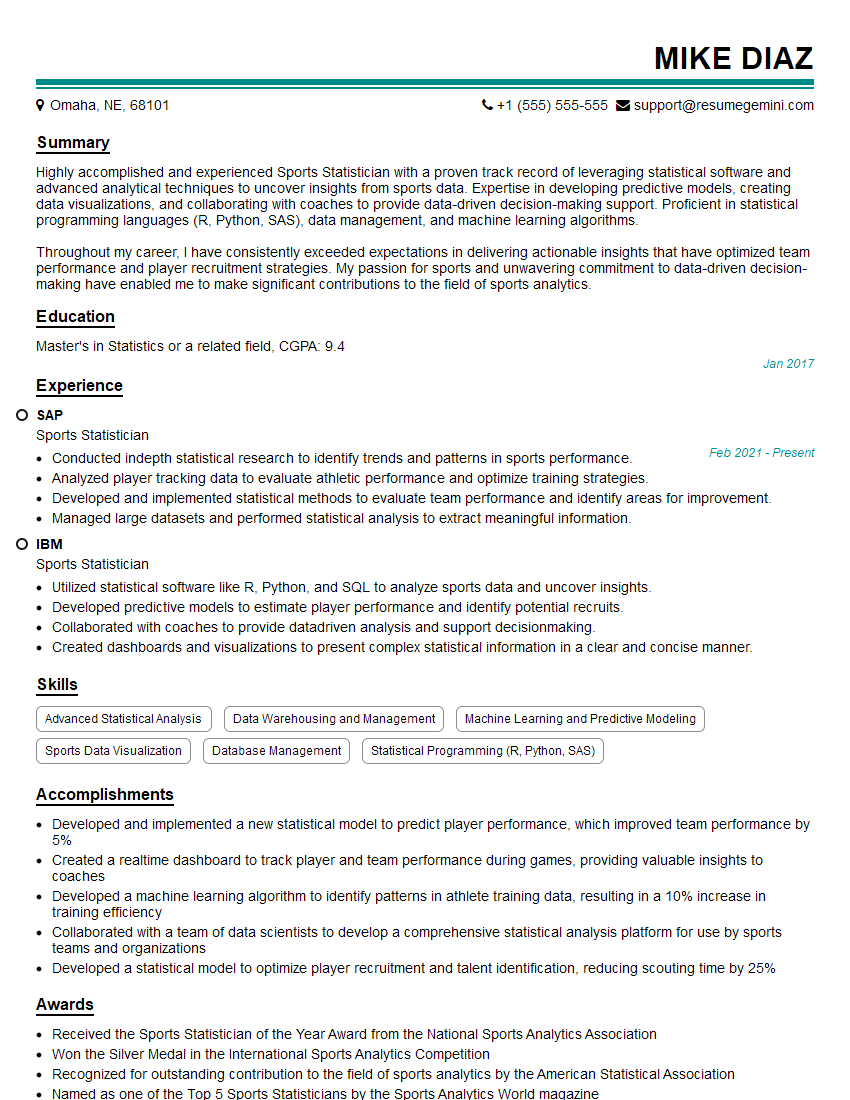
Mastering Field Goal Percentage analysis is crucial for career advancement in sports analytics and related fields. A strong understanding of this metric demonstrates your analytical skills and ability to derive meaningful insights from data. To maximize your job prospects, create a compelling, ATS-friendly resume that showcases your expertise. ResumeGemini is a trusted resource for building professional and impactful resumes. We offer examples of resumes tailored to highlight expertise in Field Goal Percentage analysis, helping you present your skills effectively to potential employers.


Explore more articles
Users Rating of Our Blogs
Share Your Experience
We value your feedback! Please rate our content and share your thoughts (optional).
What Readers Say About Our Blog
Very informative content, great job.
good