Interviews are more than just a Q&A session—they’re a chance to prove your worth. This blog dives into essential Film Score Analysis interview questions and expert tips to help you align your answers with what hiring managers are looking for. Start preparing to shine!
Questions Asked in Film Score Analysis Interview
Q 1. Explain the difference between leitmotif and musical theme.
While both leitmotifs and musical themes are recurring musical ideas in a composition, there’s a key difference. A musical theme is a broader concept – any memorable melody or melodic fragment that serves a compositional purpose. Think of the main theme of Beethoven’s Fifth Symphony – it’s a theme, but not necessarily a leitmotif.
A leitmotif, on the other hand, is a specific type of musical theme that’s closely associated with a particular character, object, idea, or emotion within a narrative work, typically a film or opera. It acts as a musical shorthand, instantly conveying meaning to the audience even without visual cues. For example, Darth Vader’s theme in Star Wars is a powerful leitmotif representing his imposing presence and dark power.
Essentially, all leitmotifs are themes, but not all themes are leitmotifs. Leitmotifs possess a narrative function that transcends mere musical beauty.
Q 2. Describe the role of harmony in creating emotional impact in a film score.
Harmony plays a crucial role in establishing and manipulating the emotional landscape of a film score. The choice of chords and their progression directly impacts the feeling conveyed. Major chords generally evoke feelings of happiness, triumph, or serenity, while minor chords tend to create feelings of sadness, tension, or suspense.
Consider the use of dissonance. Dissonant chords, which sound unstable and unresolved, build tension and anxiety. Think of a horror film scene where a character is in danger; the score might use jarring dissonances to amplify the sense of dread. Conversely, resolving those dissonances into consonant chords can bring a sense of relief or resolution.
Furthermore, the harmonic rhythm – how frequently the chords change – can also affect pacing. Slowly changing harmonies create a sense of contemplation or nostalgia, whereas rapidly shifting harmonies generate excitement or urgency.
Q 3. How does rhythm contribute to the pacing and tension of a scene?
Rhythm is the heartbeat of a film score. It dictates the pacing and tension of scenes in powerful ways. Fast rhythms, characterized by quick note values and frequent changes, create a sense of energy, excitement, or chaos, ideal for action sequences or thrilling moments.
Conversely, slow rhythms, using longer note values and slower tempo, establish calmness, sadness, or reflection, often employed in contemplative or emotionally charged scenes. A slow, deliberate rhythm can build suspense, anticipating a dramatic event.
The rhythmic patterns themselves can also influence the mood. Regular, predictable rhythms can be soothing or even hypnotic, whereas irregular, unpredictable rhythms can generate unease and anxiety. Imagine a scene where the protagonist is being hunted; irregular, syncopated rhythms in the score would heighten the sense of danger and unpredictability.
Q 4. Discuss the use of counterpoint in film scoring.
Counterpoint, the simultaneous use of independent melodic lines, adds depth and complexity to film scores. It can create a sense of conversation between musical ideas, mirroring the interactions between characters or reflecting internal conflicts within a character.
Effective use of counterpoint allows for richer harmonic textures and a more layered emotional impact. Imagine a scene with two characters having a tense conversation. One melodic line might represent one character’s determination, while another independent line represents the other’s apprehension or defiance. The interaction between these melodies conveys the complexity of their relationship.
However, counterpoint requires skill. Poorly executed counterpoint can lead to muddiness and lack of clarity. The melodies need to be distinct yet harmonically compatible to achieve the desired effect.
Q 5. Analyze the effectiveness of a specific film score in conveying a particular emotion (example needed).
Let’s analyze the effectiveness of Bernard Herrmann’s score for Alfred Hitchcock’s Psycho in conveying suspense and terror. The famous string-heavy shower scene is a masterpiece of sonic horror. Herrmann utilizes high-pitched violins playing rapid, dissonant motifs that create an unbearable sense of unease and dread.
The use of high register strings, devoid of any comforting lower register support, heightens the feeling of vulnerability and impending doom. The repetitive nature of the motif reinforces the escalating tension, making the listener feel trapped alongside the victim. The absence of a clear melodic structure emphasizes the chaotic and unpredictable nature of the violence.
This masterful use of dissonance, high register instruments, and repetitive rhythmic figures creates an unparalleled level of suspense and terror, deeply impacting the audience and cementing the scene in cinematic history. The score’s effectiveness stems from its perfect synchronization with the visuals and its ability to amplify the inherent horror of the situation.
Q 6. How does instrumentation influence the mood and tone of a scene?
Instrumentation is paramount in shaping a film score’s mood and tone. Different instruments evoke vastly different emotional responses. Strings, for instance, can create feelings ranging from ethereal beauty (violins) to powerful sorrow (cellos) or ominous suspense (violas).
Brass instruments often convey grandeur, triumph, or heroism. Woodwinds can evoke a sense of pastoral charm (flutes), mysteriousness (clarinets), or even unease (oboes). Percussion instruments contribute significantly to rhythm and tension, generating excitement or horror depending on their type and use.
Consider a romantic scene; the use of soft strings and perhaps a flute might evoke gentle feelings. In contrast, a battle scene might utilize brass fanfares, powerful percussion, and driving rhythms to enhance the feeling of conflict and power.
Q 7. Explain the concept of diegetic and non-diegetic sound in film scoring.
The distinction between diegetic and non-diegetic sound is crucial in film scoring. Diegetic sound is sound that originates from within the film’s world. The characters can hear it. Examples include dialogue, sounds of footsteps, or a radio playing in a scene.
Non-diegetic sound is sound that exists outside the film’s world. Only the audience can hear it. The primary example is the film score itself, but it also includes narration or sound effects added for dramatic emphasis that are not logically part of the scene’s reality.
Understanding this difference is essential for a film composer. The score, being non-diegetic, must complement the scene without overpowering or clashing with the diegetic sounds. It needs to enhance the emotional impact of the visuals without distracting the viewer from the narrative unfolding on screen.
Q 8. Describe your process for analyzing a film score’s effectiveness in relation to the narrative.
Analyzing a film score’s effectiveness requires a multifaceted approach. I begin by carefully watching the film multiple times, paying close attention to how the music interacts with the visuals and narrative. This involves identifying key emotional moments, plot points, and character arcs. I then meticulously analyze the score itself, noting its instrumentation, harmonic language, rhythmic patterns, and melodic motifs. The next step is to correlate these musical elements with the on-screen events. Does the music amplify the emotional impact of a scene? Does it foreshadow future events? Does it subtly underscore character development? For instance, a sudden shift to dissonant chords might effectively heighten tension during a confrontation, while a recurring lyrical theme could subtly connect emotionally resonant scenes across the film, strengthening the narrative coherence. I would then document all these observations, creating a detailed analysis that articulates how the score successfully (or unsuccessfully) enhances the film’s storytelling.
For example, consider the use of low strings and brass in the climax of a horror film. The dissonant sounds and heavy orchestration are used to build dread and tension effectively mirroring the visuals on screen. Conversely, a light and whimsical score used in a serious dramatic scene could disrupt the narrative’s emotional impact, illustrating how ineffective scoring can harm the story.
Q 9. How does a film score interact with visual elements to enhance storytelling?
Film score and visual elements engage in a powerful symbiotic relationship. The music doesn’t simply accompany the visuals; it actively interacts with them, enriching the viewer’s experience. Visual cues, like a character’s facial expression or a dramatic landscape, can be amplified by the score. A slow, melancholic melody might underscore a character’s grief, enhancing the impact of a close-up on their tear-streaked face. Similarly, a sweeping orchestral score can elevate the grandeur of a majestic vista, complementing the visual spectacle. The interplay between these two elements often works on a subconscious level, subtly shaping the audience’s emotional responses and interpretations. The timing of musical cues is crucial; a swell of strings precisely timed with a crucial moment in the narrative can drastically affect the audience’s perception of that moment.
Think of the iconic shower scene in Alfred Hitchcock’s Psycho. The shrieking strings and dissonant brass perfectly mirror the chaotic and terrifying visuals, creating a visceral experience for the viewer. The music wouldn’t be nearly as effective without the visual elements, and conversely the visuals are significantly enhanced by the powerful musical underscore.
Q 10. Compare and contrast the scoring styles of two prominent film composers.
Let’s compare the styles of Hans Zimmer and John Williams. Both are titans of film scoring, but their approaches differ significantly. John Williams is known for his instantly recognizable, lush, and often romantic themes, frequently employing a large, traditional orchestral palette. His scores are frequently characterized by clear melodies, memorable leitmotifs (recurring musical ideas associated with specific characters or themes), and a sense of grandeur. Think of the soaring themes in Star Wars or the heroic music of Indiana Jones. His work often feels classic and timeless, resonating with audiences on an emotional level through powerful, easily digestible melodies.
Hans Zimmer, on the other hand, frequently employs a more contemporary and eclectic style. He often uses electronic instruments and unconventional soundscapes alongside traditional orchestration, resulting in textures that can be both atmospheric and percussive. His scores are often characterized by their intensity and emotional depth, often reflecting a more modern and complex narrative structure. His work on films like Inception and Interstellar illustrates his masterful use of texture and sound design to create powerful emotional landscapes.
In essence, Williams’ scores often prioritize memorable melody and traditional orchestration to evoke immediate emotional responses, while Zimmer often prioritizes creating atmospheric and textured soundscapes that augment and deepen the viewer’s engagement.
Q 11. How would you approach scoring a scene involving high-stakes action?
Scoring a high-stakes action scene requires a dynamic and energetic approach. The music should mirror the intensity of the action on screen, building in tempo and intensity as the action escalates. I’d typically use a large orchestral palette, including percussion, brass, and strings, to create a sense of urgency and excitement. Rhythmic drive is crucial; complex, layered rhythms will enhance the frenetic pace of the action. The use of dissonances and unexpected melodic shifts can create heightened tension, mirroring the unpredictable nature of the action. It’s important to synchronize the music precisely with the visual action – a sharp stab of brass might accompany a sudden violent movement, while a driving percussion line could accompany a fast-paced chase sequence. Careful attention to dynamics is also essential; crescendos and diminuendos can effectively amplify the emotional peaks and valleys of the scene.
For example, the iconic action scenes in the James Bond franchise often use driving percussion, soaring brass fanfares, and quick string figures to mirror the energy and adrenaline of the events onscreen.
Q 12. How would you approach scoring a scene of quiet contemplation?
Scoring a scene of quiet contemplation requires a completely different approach. Here, the goal is not to overwhelm the audience but to subtly enhance the emotional atmosphere. I might employ a smaller ensemble, perhaps strings or woodwinds, playing softly and delicately. The harmonic language would likely be consonant and peaceful, with slow tempos and simple melodic lines. The focus would be on creating a mood of introspection and reflection, allowing the visuals and the actors’ performances to take center stage. Sparse instrumentation and minimal rhythmic activity would avoid distracting from the scene’s contemplative nature. The music should be atmospheric and evocative, enhancing the emotional tone of the scene without being intrusive.
Consider the quiet, reflective scenes in films like Brokeback Mountain. The use of sparse instrumentation and simple, melancholic melodies creates a strong emotional resonance without distracting from the power of the visuals and acting.
Q 13. Explain the importance of spotting in film score composition.
Spotting is a crucial collaborative process between the film’s director, editor, and composer. It’s essentially the process of identifying the specific points in the film where music will be used. During a spotting session, the director and editor typically screen the film while the composer takes notes, identifying cues (sections of music) for different scenes and noting their desired length, emotional tone, and overall function. This provides a clear roadmap for the composer, ensuring that the music is tailored specifically to the narrative and visual flow of the film. Without spotting, the composer would essentially be working blind, potentially creating music that doesn’t fit the film’s needs, wasting valuable time and resources.
Spotting ensures that the score is not simply a generic background accompaniment but a carefully crafted element that actively contributes to the narrative and emotional impact of the film.
Q 14. How do you incorporate source music effectively into a film?
Incorporating source music (pre-existing music used within a film) effectively requires careful consideration of its narrative function and emotional impact. It shouldn’t just be randomly inserted; instead, it should serve a specific purpose within the storytelling. The choice of song is crucial, as it must align with the mood and emotional tone of the scene. The timing of its introduction and its interaction with the original score are equally important. A sudden shift to a familiar song can create a powerful emotional reaction or serve as a thematic counterpoint to the original score. It’s often effective to use diegetic source music (music whose source is visible or implied within the film) to create a sense of realism and enhance immersion. For instance, a character listening to music on a radio provides a natural way to incorporate source music into the narrative.
Consider the use of classic rock songs in films like Guardians of the Galaxy. The curated soundtrack isn’t just background noise; it’s an integral part of the narrative, reflecting the characters’ personalities and shaping the emotional tone of the scenes. The careful selection of songs enhances the film’s retro aesthetic and evokes specific emotional responses.
Q 15. Describe your experience with different audio editing software (Pro Tools, Logic, etc.)
My experience spans several Digital Audio Workstations (DAWs), each offering unique strengths. Pro Tools remains the industry standard, particularly for large-scale orchestral scoring, due to its robust session management and extensive plugin compatibility. Its power allows for meticulous manipulation of large audio files, crucial for complex film scores. I’m also highly proficient in Logic Pro X, known for its intuitive interface and extensive MIDI editing capabilities, making it excellent for composing and experimenting with electronic or hybrid scores. I’ve also worked with Ableton Live, particularly useful for more experimental and electronic soundscapes where its loop-based workflow provides a unique creative advantage. Ultimately, my choice of DAW depends on the project’s specific requirements; the most important factor is choosing the tool best suited to achieving the desired sonic outcome.
For instance, a large-scale historical drama might require Pro Tools’ power for handling the volume and complexity of orchestral recordings, while a smaller independent film with a more experimental score might benefit from Logic Pro X’s flexibility or Ableton Live’s improvisational tools.
Career Expert Tips:
- Ace those interviews! Prepare effectively by reviewing the Top 50 Most Common Interview Questions on ResumeGemini.
- Navigate your job search with confidence! Explore a wide range of Career Tips on ResumeGemini. Learn about common challenges and recommendations to overcome them.
- Craft the perfect resume! Master the Art of Resume Writing with ResumeGemini’s guide. Showcase your unique qualifications and achievements effectively.
- Don’t miss out on holiday savings! Build your dream resume with ResumeGemini’s ATS optimized templates.
Q 16. How do you ensure the film score complements the visuals and dialogue without overpowering them?
Balancing a film score with the visuals and dialogue is a delicate art requiring careful consideration of dynamics and frequency ranges. The score should never overpower the dialogue; clarity of speech is paramount. I achieve this by employing several techniques. Firstly, I utilize dynamic processing – compression and limiting – to control the score’s overall loudness and ensure peaks don’t overwhelm quieter dialogue moments. This involves carefully analyzing the audio levels of both the score and the dialogue to identify potential conflicts and adjusting the gain staging accordingly.
Secondly, I focus on frequency balancing. The dialogue typically occupies the mid-range frequencies, so I avoid placing prominent score elements in the same frequency range. Instead, I use the lower frequencies (bass) for establishing mood and the higher frequencies (highs) for punctuating action or emphasizing certain emotional moments. This creates sonic space, allowing both the dialogue and score to coexist effectively.
Thirdly, I consider the emotional arc and narrative flow. During intense scenes, the score might be more prominent, complementing the action. However, in quieter, dialogue-heavy scenes, it should recede, providing subtle underlay that supports the emotional subtext without disrupting clarity. I frequently use techniques like spectral shaping and dynamic EQ to fine-tune the frequency relationships between the different elements to make sure that they support and amplify one another rather than clash.
Q 17. Discuss the challenges of working with a limited budget or timeline in film scoring.
Budget and timeline limitations are common challenges in film scoring. Working with a limited budget might mean using fewer musicians or relying on virtual instruments instead of live recordings. This requires creative resourcefulness. For instance, I’ve successfully employed meticulously programmed virtual instruments to create a convincing orchestral sound on a limited budget, using techniques such as layering and carefully crafting individual instrument parts to achieve depth and realism.
Tight deadlines necessitate efficient workflows and prioritization. This often involves creating detailed templates and utilizing time-saving techniques, such as composing modular sections that can be rearranged and adapted to fit different scenes. Effective communication with the director and editor is key to managing expectations and ensuring the score is delivered on time without compromising quality.
For example, I may utilize pre-composed musical ideas that can be quickly adapted to suit different scenes. It’s important to maintain flexibility and be willing to make creative compromises to meet the project’s constraints. Open communication with the client is vital to manage these expectations throughout the process and deliver a high-quality final product.
Q 18. Explain your understanding of sound design principles related to film scoring.
Sound design principles are crucial for effective film scoring. It’s not just about composing melodies; it’s about crafting a sonic environment that enhances the film’s emotional impact. This involves understanding how different sounds create mood and atmosphere. I use techniques like reverb, delay, and equalization to shape the sonic space and create a sense of realism or otherworldliness, depending on the scene. For example, a vast, reverberant sound might enhance the grandeur of a sweeping landscape, while a tight, dry sound might suggest claustrophobia in a confined setting.
The use of sound effects and foley can also be incorporated into the film score. These are not merely added ‘on top’; rather, they are often integrated seamlessly, using techniques like layering and subtle manipulation, to create a cohesive and immersive soundscape. Understanding the principles of spatial audio and 3D sound are also important, particularly in modern filmmaking where immersive sound is increasingly critical to the viewer experience. Mastering the technical aspects is only half the equation: the art lies in crafting an effective sonic environment that enhances storytelling.
Q 19. How do you manage the collaboration between composer, director, and editor?
Collaboration is crucial for a successful film score. The relationship between the composer, director, and editor is a creative partnership. Open communication and a shared understanding of the film’s artistic vision are essential. I establish this through regular meetings and feedback sessions throughout the process. Early communication about the director’s vision for the film is paramount, to establish a common understanding and a shared musical language.
I typically begin by providing the director with several different musical cues or sketches. Then, based on their feedback, the process refines, shaping the score to align with the emotional arc and narrative demands of each scene. The editor plays a vital role in providing crucial information about timing, pacing, and visual cues, aiding in creating a score that aligns perfectly with the visual flow. This iterative process of feedback and revision is pivotal in creating a score that truly serves the film.
For example, I’ll often have initial discussions with the director, including reviewing the script, storyboard, and even early cuts of the film, to ensure a clear understanding of the intended emotional tone. Through this collaborative dialogue, we identify musical themes and motifs, establishing a cohesive musical language to strengthen the narrative.
Q 20. What are some common pitfalls to avoid when analyzing a film score?
Analyzing a film score requires a methodical approach to avoid several common pitfalls. One common mistake is focusing solely on the melodic aspects while neglecting the harmonic and rhythmic structures. A complete analysis should consider all these elements in the context of the film’s narrative, examining how they contribute to the overall emotional arc.
Another pitfall is neglecting the score’s context. Analyzing a score in isolation from the film it accompanies leads to an incomplete understanding. Understanding how the music interacts with the visuals and dialogue is crucial for a comprehensive analysis. Similarly, failing to consider the historical and cultural context of the film and its score can limit your analysis’s scope and depth.
Finally, overly subjective interpretations without sufficient supporting evidence should be avoided. While personal responses are valuable, they must be grounded in observable musical elements and supported by evidence from the score itself. A rigorous analytical approach—considering musical techniques, thematic development, and their relationship to the narrative—ensures a well-supported and comprehensive evaluation.
Q 21. How do you stay current with trends in film scoring?
Staying current in film scoring requires continuous learning and engagement with the field. I regularly attend film festivals and screenings, paying close attention to the scores, noting both the use of instrumentation, musical styles, and compositional techniques. I also actively listen to a broad range of contemporary film scores, encompassing various genres. This allows me to identify emerging trends and experiment with them in my own compositions.
Furthermore, I engage with online resources, including articles, blogs, and podcasts dedicated to film music. Following prominent composers and score editors on social media also provides valuable insights into their creative process and current projects. I also actively participate in online communities and forums, engaging in discussions with fellow composers and industry professionals, exchanging ideas and keeping abreast of the latest developments in technology and compositional techniques.
Finally, I regularly attend workshops and masterclasses focusing on film scoring and related disciplines like sound design. This keeps my technical skills sharp and exposes me to innovative methods and industry best practices. Continuous learning is essential for adapting to the ever-evolving demands of the film scoring world.
Q 22. Describe your workflow when analyzing a film score for thematic consistency.
Analyzing a film score for thematic consistency involves a systematic approach focusing on identifying and tracing recurring musical ideas throughout the film. Think of it like finding a thread that weaves through the entire tapestry of the score.
Initial Listening and Notation: I begin with multiple listens to the entire score, creating a detailed notation of key melodic, harmonic, and rhythmic motifs in musical notation software. I pay close attention to how these motifs are varied and developed across different scenes.
Motif Identification and Categorization: I identify the primary thematic motifs, classifying them based on their associated characters, emotions, or plot points. For instance, a recurring string motif might represent the protagonist’s yearning, while a brass fanfare could signify triumph.
Tracing Motif Transformations: I carefully track how these motifs evolve throughout the film. Do they appear in different instrumentation, tempo, or dynamics? Are they fragmented, inverted, or combined with other motifs? These transformations reveal the composer’s narrative intentions and contribute to the thematic consistency or inconsistencies.
Contextual Analysis: Finally, I analyze the score within the context of the film’s narrative. Does the musical thematic development align with the unfolding plot and character arcs? Does the music effectively reinforce the emotional trajectory of the film?
For example, in analyzing John Williams’ score for Star Wars, I’d identify the main theme, the Imperial March, and other motifs, then trace their appearances and transformations across the film, observing how they function narratively and emotionally.
Q 23. Discuss your experience with different types of musical notation software.
My experience encompasses several prominent musical notation software packages. Each has its strengths and weaknesses, depending on the specific needs of the analysis.
Sibelius: Excellent for detailed score analysis and transcription due to its powerful editing capabilities and extensive libraries. I often use Sibelius for creating accurate transcriptions and analyzing complex orchestral textures.
Finale: Similar to Sibelius in its capabilities, Finale is another robust option. I find its engraving features particularly useful for creating publication-quality scores from my analysis.
MuseScore: A valuable free and open-source alternative. While not as feature-rich as commercial software, MuseScore is excellent for quick transcriptions and for collaborative projects. It’s a great tool for preliminary analysis.
The choice of software ultimately depends on the project’s complexity, budget, and collaborative needs. I am proficient in all three and choose the tool best suited to the task.
Q 24. How do you adapt your analysis to different genres of film?
Adapting my analysis to different film genres requires a nuanced understanding of genre conventions and their musical correlates. The analytical framework remains consistent—identifying and tracing musical themes—but the interpretations and expectations shift based on the genre.
Action/Thriller: Expect rhythmic complexity, driving tempos, and prominent percussion to emphasize suspense and excitement. The analysis focuses on how the score builds tension and enhances action sequences.
Romance: Expect lyrical melodies, slower tempos, and a focus on strings and woodwinds to create a romantic mood. Analysis emphasizes the emotional nuances and the use of melodic variation to portray character relationships.
Horror: Expect dissonant harmonies, irregular rhythms, and use of silence and unexpected sounds to create fear and suspense. The analysis should highlight the use of musical cues to enhance the psychological elements of the narrative.
Comedy: Expect unexpected musical choices, contrasting styles, and possibly ironic use of leitmotifs. The analysis examines how music plays against the visual narrative to create humor and underscore irony.
Each genre necessitates a tailored approach, but the core principles of thematic analysis remain applicable, allowing me to effectively dissect the musical narrative irrespective of the genre’s conventions.
Q 25. Explain the importance of tempo and dynamics in film scoring.
Tempo and dynamics are fundamental elements in film scoring, profoundly influencing the emotional impact and narrative effectiveness of the music. They are tools that a composer uses to paint emotions directly on the canvas of the narrative.
Tempo: The speed of the music directly reflects the mood. A fast tempo (allegro) can evoke excitement, tension, or urgency, while a slow tempo (adagio) might create a sense of melancholy, reflection, or suspense. Think of the rapid-fire strings in a chase scene versus the slow, mournful cello melody during a funeral scene.
Dynamics: The volume and intensity of the music are equally crucial. A crescendo (gradual increase in volume) can build tension, while a diminuendo (gradual decrease in volume) can create a sense of release or quiet contemplation. Sudden changes in dynamics (fortissimo to pianissimo) can startle or emphasize a specific moment.
A composer masterfully manipulates tempo and dynamics to guide the viewer’s emotions, highlight important narrative moments, and underscore the film’s overall thematic development. The interplay between these two elements creates a powerful and nuanced musical experience.
Q 26. How does the use of silence contribute to the overall impact of a film score?
Silence, often overlooked, is a powerful tool in film scoring. It’s not just the absence of sound; it’s a deliberate compositional choice with significant impact on the overall effect.
Building Tension: A sudden pause or extended silence after a burst of intense music can heighten tension and anticipation, leaving the audience hanging before the next musical event. Think of the quiet moments before a jump scare in a horror film.
Emphasizing Emotion: Silence can amplify an emotional moment, allowing the visual narrative and the audience’s emotional response to take center stage. A character’s silent reaction after a devastating event can be underscored by the absence of music, leaving the impact far more profound.
Creating Contrast: Silence can act as a stark contrast to a previous musical passage, highlighting the change in mood or atmosphere. For example, a period of silence after a chaotic action scene allows for a moment of reflection or introspection.
Ultimately, silence in film scoring is a sophisticated compositional technique, allowing the composer to control the audience’s experience by carefully manipulating the presence and absence of sound. It’s a form of active listening, where the absence of sound is still actively engaging for the audience.
Q 27. Discuss your experience with working on a post-production team.
My experience working on post-production teams has been enriching and collaborative. I’ve consistently been impressed by the synergy and teamwork involved. The process typically involves close interaction with the director, composer, editor, and sound designers.
Collaborative Scoring Sessions: I’ve participated in numerous scoring sessions where I’ve provided feedback on the music’s emotional effectiveness, structural coherence, and thematic consistency with the director’s vision. My analysis helps ensure that the score works effectively with the film.
Music Editing and Cue Creation: I’ve assisted with music editing, ensuring seamless transitions between cues and assisting with the creation of new cues to address narrative or emotional needs. This often entails using specialized software for audio editing and manipulation.
Sound Design Integration: Close collaboration with sound designers is crucial to ensure that the music complements and enhances the overall soundscape, not competing with it. This requires a deep understanding of both music and sound design principles.
My role on these teams has always focused on ensuring the score’s integrity and its contribution to the film’s artistic success. The collaborative environment fosters innovation and allows for the development of truly compelling soundtracks.
Q 28. How would you handle a disagreement with a composer or director about the music?
Disagreements are inevitable in collaborative projects. Handling them professionally and constructively is key. My approach centers on respectful communication and a focus on the overall artistic goals of the film.
Active Listening and Understanding: I always begin by carefully listening to the composer’s or director’s concerns, attempting to understand their perspective and the rationale behind their suggestions. Often, the apparent disagreement is rooted in a misunderstanding.
Data-Driven Discussion: I use my analytical skills to present a clear and reasoned argument based on my observations of the score’s effectiveness. This involves concrete examples and quantifiable metrics to support my viewpoint.
Compromise and Collaboration: My goal is not to ‘win’ the argument but to find a mutually acceptable solution that enhances the film’s overall impact. This often involves a degree of compromise and exploring alternative approaches that integrate both perspectives.
Documentation: Maintaining clear and thorough documentation of all decisions made regarding the score is crucial for resolving discrepancies and providing a reference point for future revisions.
Ultimately, a collaborative approach emphasizes mutual respect and a shared commitment to the film’s artistic success. Even disagreements can lead to creative innovation and a stronger final product. The focus should always be on the film, not individual egos.
Key Topics to Learn for Film Score Analysis Interview
- Musical Form and Structure: Understanding sonata form, thematic development, variations, and other compositional techniques used in film scores. Practical application: Analyzing how a composer uses leitmotifs to represent characters or themes throughout a film.
- Harmony and Counterpoint: Analyzing harmonic progressions, chord functions, voice leading, and contrapuntal techniques. Practical application: Identifying the emotional impact of specific harmonic choices in a scene.
- Orchestration and Instrumentation: Understanding the timbral possibilities of different instruments and how they contribute to the overall sonic landscape of a film score. Practical application: Discussing the effectiveness of a composer’s choice of instrumentation in creating a specific mood or atmosphere.
- Musical Narrative and Film Narrative: Exploring the relationship between the music and the visual storytelling in a film. Practical application: Analyzing how music enhances or contradicts the on-screen action, creating tension, suspense, or emotional resonance.
- Historical and Cultural Contexts: Understanding the historical and stylistic influences on film scores and how they relate to specific eras and genres. Practical application: Connecting the stylistic choices of a composer to broader musical trends and cinematic conventions.
- Analyzing Film Scores Through Different Lenses: Exploring different analytical approaches (e.g., Schenkerian analysis, narrative analysis, semiotic analysis). Practical application: Applying multiple analytical frameworks to gain a more comprehensive understanding of a film score’s structure and meaning.
Next Steps
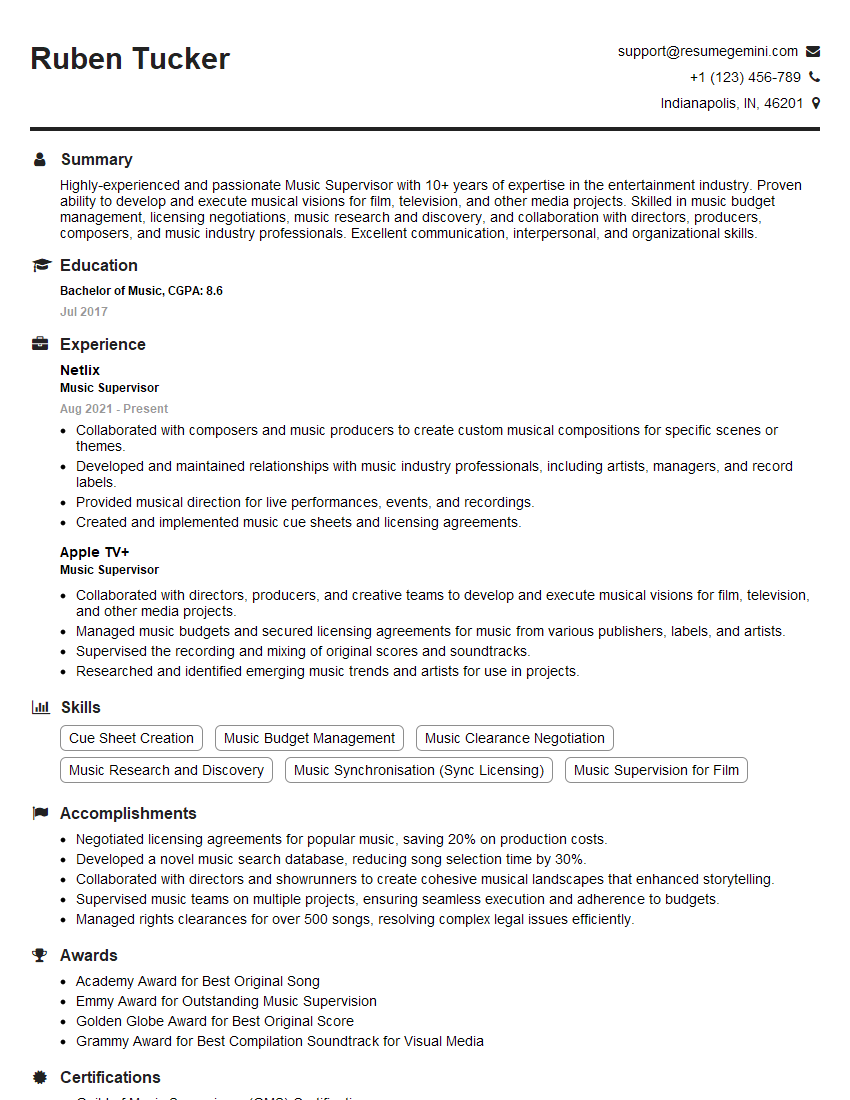
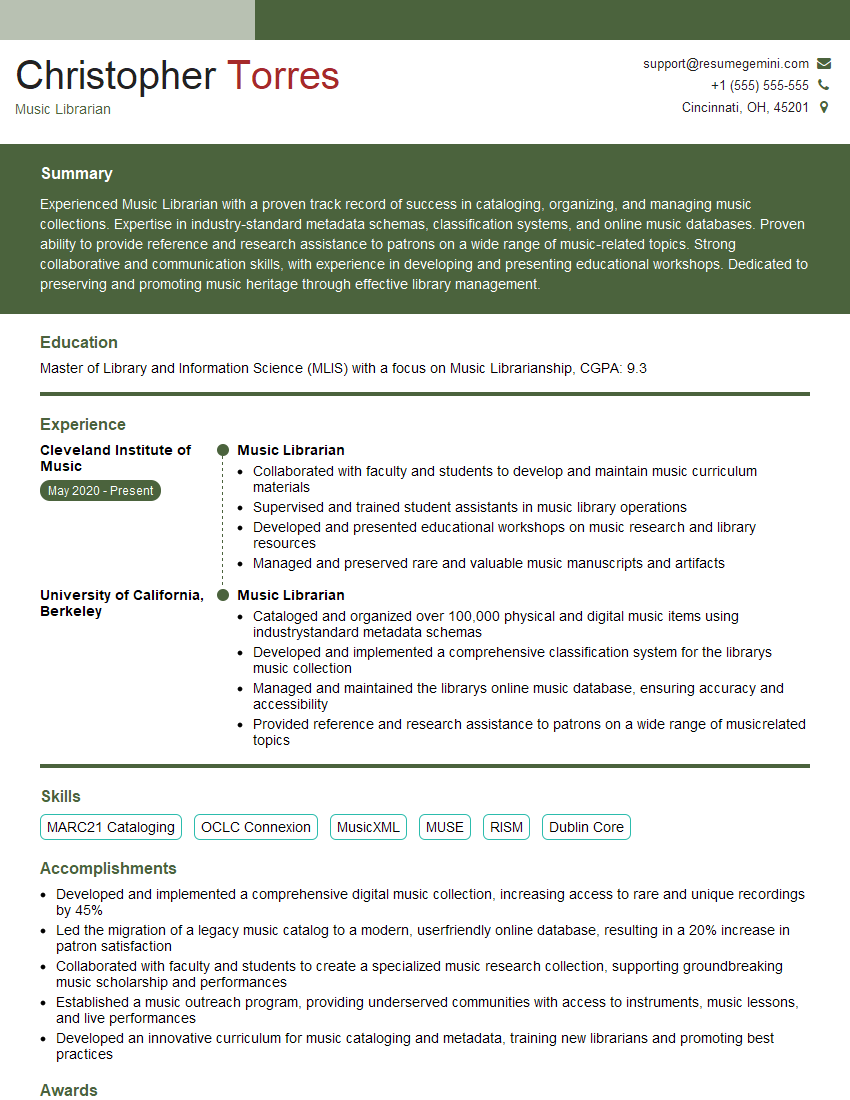
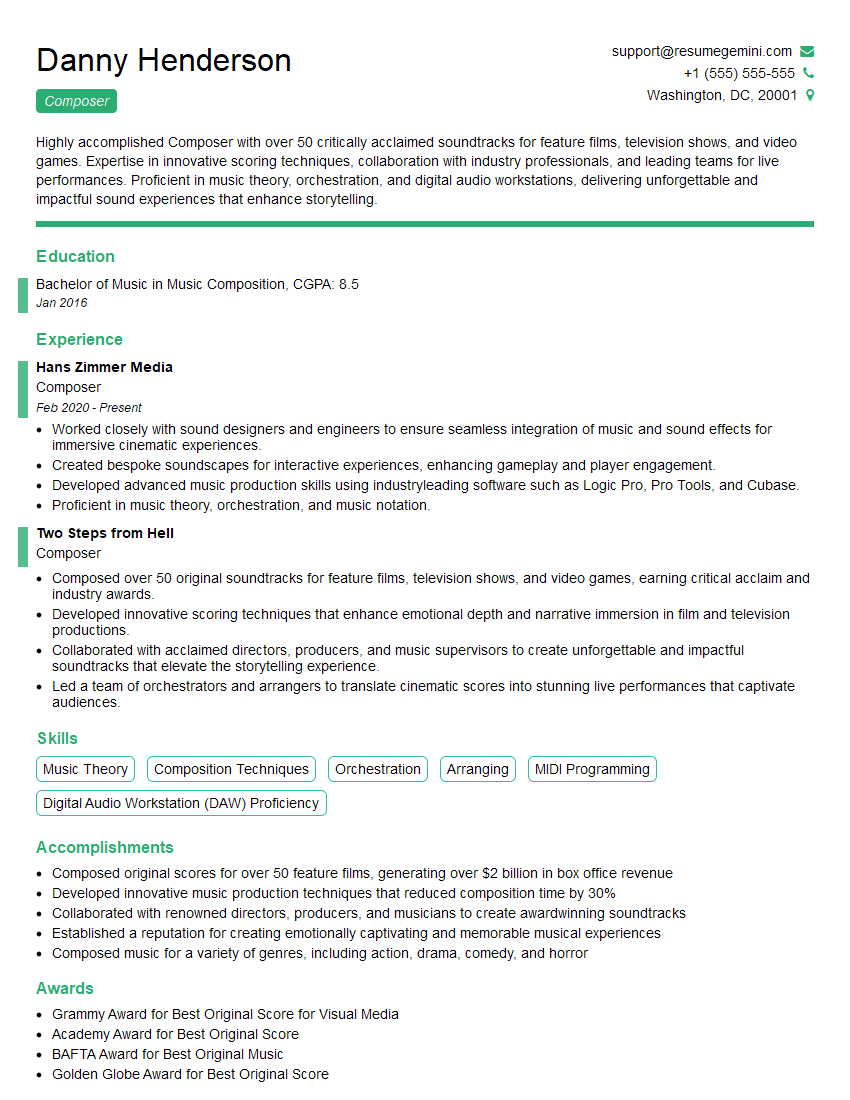
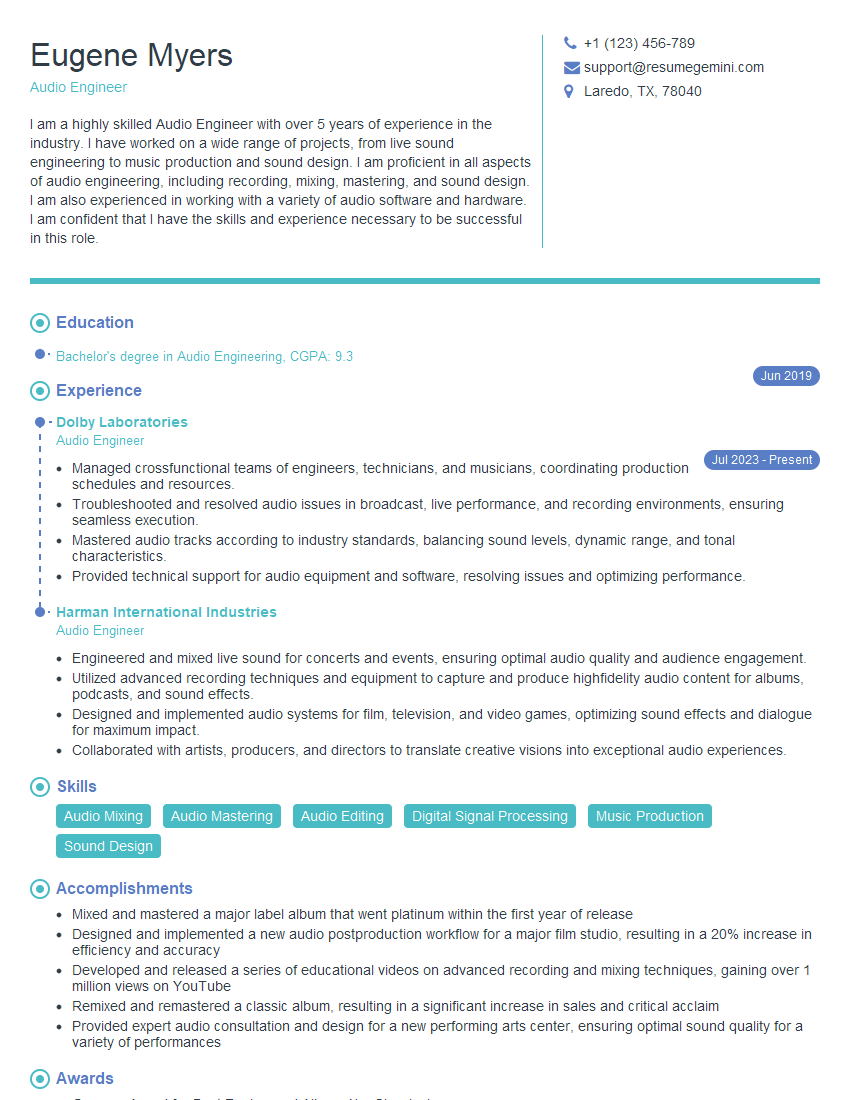
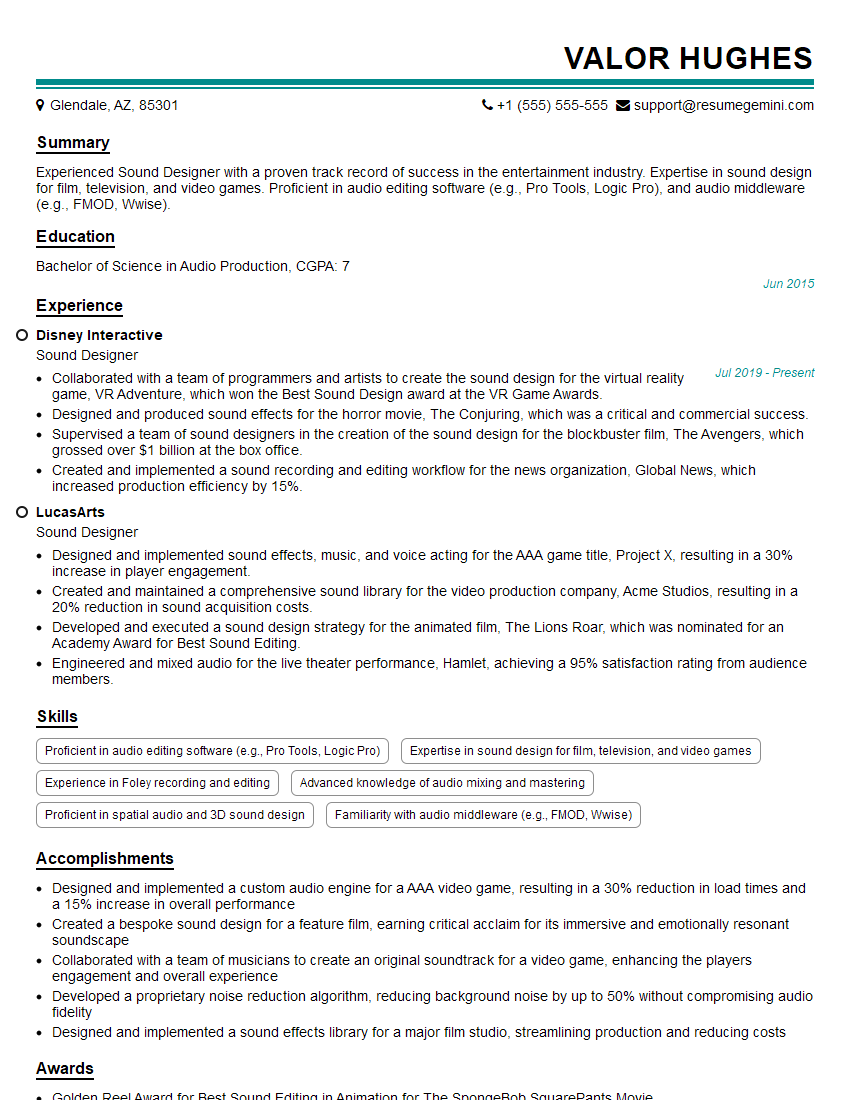
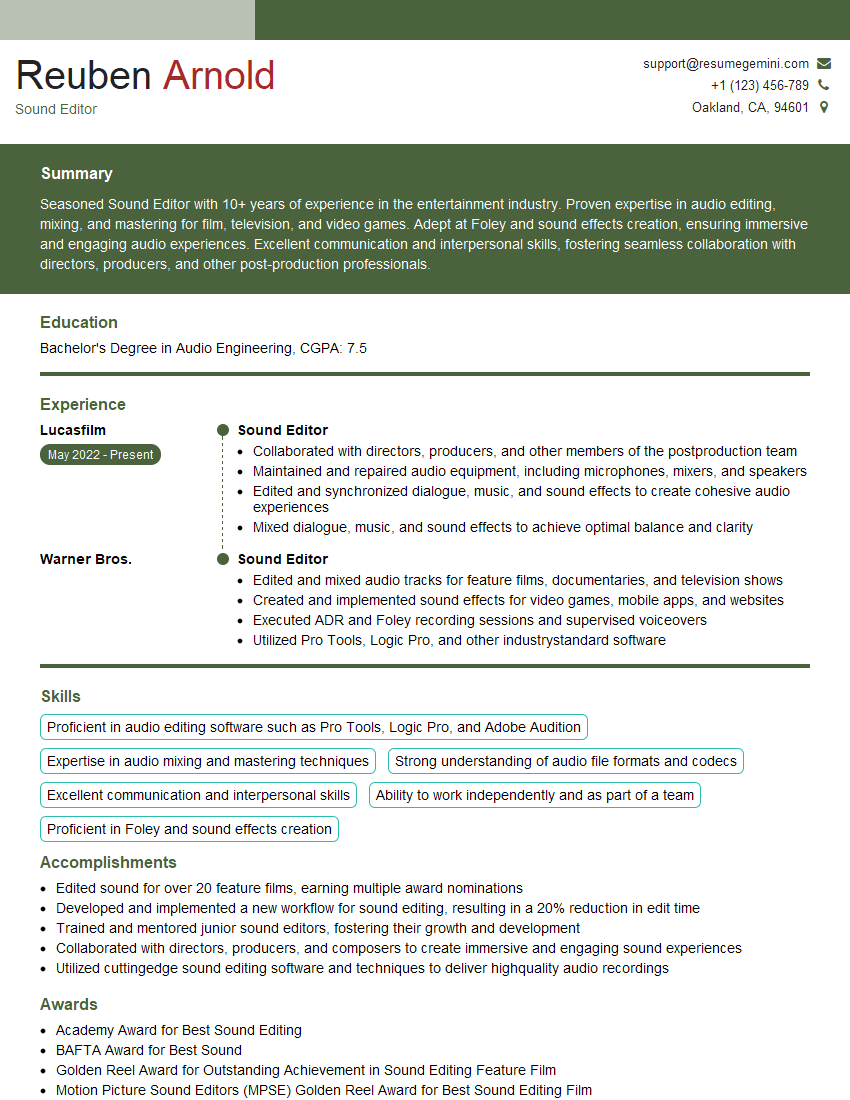
Mastering film score analysis is crucial for career advancement in the film industry, opening doors to roles such as film music critic, composer’s assistant, music editor, and academic research positions. To maximize your job prospects, it’s essential to create a resume that effectively communicates your skills and experience to Applicant Tracking Systems (ATS). Building an ATS-friendly resume is key to getting your application noticed. ResumeGemini is a trusted resource that can help you craft a compelling and effective resume tailored to the specific requirements of your desired roles. Examples of resumes specifically tailored to Film Score Analysis are available to help you get started.
Explore more articles
Users Rating of Our Blogs
Share Your Experience
We value your feedback! Please rate our content and share your thoughts (optional).
What Readers Say About Our Blog
Very informative content, great job.
good