Cracking a skill-specific interview, like one for Fire Support Team (FST), requires understanding the nuances of the role. In this blog, we present the questions you’re most likely to encounter, along with insights into how to answer them effectively. Let’s ensure you’re ready to make a strong impression.
Questions Asked in Fire Support Team (FST) Interview
Q 1. Describe the process of requesting and coordinating fire support.
Requesting and coordinating fire support is a critical process requiring precise communication and adherence to established procedures. It begins with the requesting unit identifying a target and its coordinates, as well as the type of fire support needed. This information is then passed up the chain of command, typically using established communication protocols such as radio or digital messaging systems. The fire support team (FST) then validates the request, assesses the situation, including potential collateral damage, and coordinates with the appropriate fire support assets (artillery, mortars, close air support, etc.). This often involves adjusting fire missions to minimize the risk to friendly forces, and confirming the target’s location and characteristics with other intelligence sources. A key element is the constant flow of information, from initial request to confirmation of the target’s destruction or neutralization, ensuring all parties remain aware of the situation’s evolution.
Example: Imagine an infantry platoon pinned down by enemy fire. The platoon leader identifies the enemy’s position using their grid coordinates. They’ll then request fire support through their superior officer, specifying the target location, type of munition (e.g., high-explosive), and any special instructions (e.g., avoid a nearby civilian area). The request will be passed up until it reaches the FST, which then coordinates the fire mission with the appropriate artillery battery.
Q 2. Explain the different types of fire support available.
Fire support encompasses a wide range of assets and capabilities, each tailored to specific situations. These can broadly be categorized as follows:
- Artillery: Provides long-range, indirect fire support using howitzers, cannons, or rocket launchers. It offers high firepower and area saturation capabilities. Examples include 155mm howitzers and multiple launch rocket systems (MLRS).
- Mortars: Offers shorter-range, indirect fire support, commonly used for close-in support of infantry units. They are highly mobile and provide quick response times.
- Close Air Support (CAS): Involves using aircraft (fighter jets, attack helicopters) to deliver precision strikes against enemy targets. CAS offers significant firepower but requires careful coordination to avoid collateral damage.
- Naval Gunfire Support (NGS): Uses naval artillery to support operations from the sea, often providing long-range, accurate fire power.
- Precision Guided Munitions (PGM): These guided weapons (e.g., laser-guided bombs, GPS-guided rockets) are designed to achieve high accuracy and minimize collateral damage. They enhance the precision of all fire support assets.
The choice of fire support asset depends on factors such as target location, type of target, available assets, and the surrounding environment.
Q 3. How do you ensure the safety of friendly troops during fire support operations?
Ensuring the safety of friendly troops during fire support operations is paramount. This involves a multi-layered approach:
- Precise Targeting: Using accurate coordinates and target descriptions minimizes the risk of friendly fire incidents. This often involves the use of advanced targeting systems and close coordination between the requesting unit and the fire support element.
- Target Confirmation and Verification: Employing multiple means of confirming the target location before initiating fire. This often includes visual observation, intelligence reports, and reconnaissance.
- Clear Communication: Maintaining clear and consistent communication throughout the fire support process, using standardized terminology and procedures.
- Spotting/Forward Observers: Using trained personnel to observe the effects of fire and provide corrections or adjustments to maintain accuracy and minimize collateral damage. Spotters provide real-time feedback.
- Exclusion Zones/Safety Zones: Establishing clear exclusion zones or safety zones around friendly units to prevent friendly fire incidents. These zones are communicated to all involved parties.
- Battle Damage Assessment (BDA): Conducting a thorough assessment of the results of the fire mission to confirm target neutralization and assess any unintended consequences.
Consistent adherence to safety protocols and continuous communication are crucial to maintaining safety.
Q 4. What are the key elements of a fire support plan?
A comprehensive fire support plan is essential for successful operations. It should include:
- Mission Analysis: A detailed analysis of the overall mission objectives and the role of fire support in achieving them.
- Target Acquisition Plan: Describes how targets will be identified, located, and tracked.
- Fire Support Coordination Measures (FSCM): Establish guidelines and boundaries for fire support operations to prevent friendly fire incidents and ensure coordination among different units.
- Engagement Priorities: Defines the order in which targets will be engaged, based on their importance to the mission.
- Fire Support Execution Matrix: Details the specific fire support missions, including target coordinates, types of munitions, and firing units.
- Communication Plan: Outlines communication procedures, including frequencies, call signs, and reporting methods.
- Contingency Planning: Addresses potential problems, such as equipment malfunctions or unexpected enemy actions.
A well-structured plan anticipates potential issues and provides clear guidelines for efficient and safe fire support execution.
Q 5. What are the limitations of different fire support assets?
Different fire support assets have inherent limitations. Understanding these is crucial for effective planning:
- Artillery: Limited accuracy at longer ranges, susceptibility to counter-battery fire, and weather dependence (e.g., high winds affect accuracy).
- Mortars: Shorter range than artillery, less accurate than precision-guided munitions, and vulnerable to direct fire.
- Close Air Support (CAS): Requires favorable weather conditions, vulnerable to enemy air defenses, and limited availability due to potential conflicts with other missions.
- Naval Gunfire Support (NGS): Requires close proximity to the coast, limited maneuverability in certain terrain conditions.
These limitations necessitate careful consideration of asset selection and mission planning. Often, a combination of assets is employed to overcome individual limitations and exploit complementary strengths.
Q 6. How do you prioritize targets during a firefight?
Prioritizing targets in a firefight depends on several factors and follows a structured approach. The most critical targets are usually addressed first. This prioritization often follows the ‘Kill Chain’ concept, focusing on the greatest threat to friendly forces:
- Immediate Threats: Targets directly engaging friendly forces, such as enemy snipers, machine gun nests, or tanks.
- High-Value Targets (HVTs): Individuals or assets that significantly impact enemy capabilities, such as command posts or artillery positions.
- High-Payoff Targets (HPTs): Targets whose destruction will produce the most significant tactical advantage.
- Obstacles/Interdiction: Targets hindering movement or operations such as obstacles blocking avenues of approach.
Prioritization should be dynamic and reassessed frequently. It’s based on the current tactical situation, constantly adjusting to changing conditions.
Q 7. Explain your understanding of the effects of different munitions.
Different munitions produce varied effects, which must be considered when selecting the appropriate type of fire support. Understanding these effects is crucial for effective target neutralization and minimizing collateral damage:
- High-Explosive (HE): Designed for blast and fragmentation effects, effective against personnel, lightly armored vehicles, and fortifications.
- White Phosphorus (WP): Creates a smokescreen, illumination, and incendiary effect; used for obscuration, marking targets, and suppressing enemy positions. Used with caution due to its incendiary nature.
- Illumination Rounds: Provide light for night operations, enabling better target identification and engagement.
- Smoke Rounds: Generate a smoke screen to obscure friendly movements or mask positions.
- Precision-Guided Munitions (PGM): Designed for accurate strikes against specific targets, minimizing collateral damage. Examples include laser-guided bombs and GPS-guided rockets.
The selection of munitions must consider the target’s characteristics (e.g., armored vs. unarmored), the surrounding environment, and the desired effects.
Q 8. How do you communicate with fire support assets?
Communication with fire support assets is paramount for effective fire missions. We primarily use a combination of established communication networks, including secure radios (like the AN/PRC-152 or similar systems) and digital messaging systems. The specific method depends on the operational environment and the assets involved. For example, we might use a dedicated frequency for initial requests and updates, while encrypted digital messaging handles sensitive information like grid coordinates and target descriptions. Clear and concise communication is key. We use standardized military terminology and adhere to strict call-sign protocols to avoid confusion and ensure accuracy. Think of it like a carefully orchestrated symphony – each instrument (communication method) plays its part to achieve a unified outcome.
In a typical scenario, I would initiate contact with the Fire Support Coordination Center (FSCC) or the supporting artillery unit, relaying the request for fire. This includes the type of munitions, the target location, the method of target acquisition, and the desired effects. The FSCC then coordinates the firing of the artillery, providing updates to us on the progress of the mission.
Q 9. Describe your experience with target acquisition and designation.
Target acquisition and designation is a critical aspect of fire support. My experience involves using a variety of methods including visual observation, utilizing forward observers (FOs), integrating intelligence from various sources (like drones, aerial reconnaissance, or HUMINT), and employing laser rangefinders and designators. A key aspect is confirming target location using multiple methods to ensure accuracy. We use precise grid coordinates (MGRS or UTM) to minimize friendly fire incidents and maximize effectiveness. I’m proficient in operating and interpreting data from various targeting systems, and understand the limitations and potential biases in different acquisition methods.
For example, during one operation, we relied on a drone equipped with an electro-optical/infrared (EO/IR) sensor to acquire the location of an enemy sniper team. The drone provided real-time imagery, allowing us to positively identify and precisely locate the target before designating it for artillery fire. Using laser designation, we ensured the accuracy of the target coordinates and provided immediate feedback to the artillery unit.
Q 10. How do you handle unexpected situations or communication failures during a fire support mission?
Unexpected situations and communication failures are always possibilities in a dynamic combat environment. We have established contingency plans to address these challenges. Firstly, we have backup communication methods. If our primary radio fails, we have alternate frequencies and potentially even runner communication. Secondly, we maintain situational awareness through multiple sources. If one method of target acquisition fails, we utilize others. Thirdly, we employ robust communication protocols and redundancy to ensure clear instructions are given and understood. We understand the limitations of each system and have well-rehearsed procedures to maintain communication or implement alternative methods in the event of a failure.
Imagine a scenario where communication with the FSCC is lost. In such a case, we would immediately attempt to re-establish contact using backup channels. Meanwhile, we would continue to monitor the battlefield situation, reassess priorities, and if necessary, shift to alternative fire support options or employ different tactics. Flexibility and adaptability are key to success in such situations.
Q 11. What are the key factors to consider when selecting a firing position?
Selecting a firing position is crucial for the success and safety of a fire support mission. Key factors include: concealment and cover from enemy observation and fire; observation of the target area to ensure accurate targeting; a clear line of fire to the target without obstructions; the terrain and its impact on the trajectory and accuracy of the projectiles; the proximity to friendly forces to mitigate the risk of fratricide; and the availability of communication with higher headquarters and supporting units. A good firing position balances these considerations to maximize effectiveness while minimizing risk.
For example, in a densely wooded area, a position offering excellent concealment might be prioritized over one with a slightly better line of fire, to minimize the risk of detection. Conversely, in open terrain, a position offering clear fields of fire with a good view of the target area would be paramount.
Q 12. How do you ensure accurate target location and coordinates?
Accurate target location and coordinates are paramount for effective and safe fire support. We use several methods: Global Positioning System (GPS) receivers for precise location data; laser rangefinders for precise distance measurements; grid mapping and military grid reference system (MGRS) coordinates for target location description; and cross-referencing with other sources like intelligence reports, aerial imagery, and reconnaissance data. We meticulously verify all coordinates and employ redundancy to minimize error. Double-checking and independent verification of coordinates are vital to ensure accuracy and safety.
We may use multiple GPS receivers and compare readings to identify and mitigate any potential GPS errors. We always strive for multiple sources to confirm our target location and coordinates.
Q 13. Explain your understanding of the different types of artillery and their capabilities.
My understanding of different artillery types and their capabilities is comprehensive. We utilize various artillery systems, including towed howitzers (like the M777), self-propelled howitzers (like the M109 Paladin), rocket artillery (like the HIMARS), and mortars. Each system has unique capabilities and limitations concerning range, accuracy, rate of fire, mobility, and the types of munitions they can fire. Towed howitzers are highly accurate but lack mobility, while self-propelled howitzers offer a balance of mobility and accuracy. Rocket artillery provides long-range fires but with lower accuracy compared to howitzers. Mortars provide close-range, high-angle fire support with flexibility in terrain.
The selection of the appropriate artillery system depends on the mission’s objectives, the terrain, the target’s characteristics, and the available assets. Understanding these capabilities allows for the optimization of fire support planning and execution.
Q 14. How do you integrate fire support with maneuver elements?
Integrating fire support with maneuver elements requires close coordination and communication. We establish a collaborative relationship with the maneuver commanders to understand their objectives, timelines, and the battlespace situation. We work closely with them to develop fire support plans that directly support maneuver operations. This includes coordinating targets, timelines, and the types of munitions used to achieve the desired effects. We must understand the maneuver unit’s capabilities and limitations to avoid hindering their actions.
A clear example would be coordinating a fire mission to suppress enemy positions ahead of a planned infantry assault. This requires careful coordination between the FST, the maneuver commander, and the artillery unit to ensure the fire mission is timed and targeted precisely to maximize its effectiveness and minimize friendly casualties. Continuous communication and a shared understanding of the overall plan are crucial for seamless integration.
Q 15. Describe your experience with using fire support technologies.
My experience with fire support technologies spans a wide range, encompassing both legacy systems and modern, integrated platforms. I’m proficient in using Advanced Field Artillery Tactical Data Systems (AFATDS), which allows for precise targeting and coordination of artillery assets. I’ve also worked extensively with digital fire support coordination messages, ensuring accurate and timely communication between forward observers, fire support teams, and artillery units. This includes experience with various targeting technologies such as laser rangefinders, Forward Observer (FO) hand-held devices, and unmanned aerial systems (UAS) for reconnaissance and target acquisition. For example, during a recent exercise, I successfully integrated UAS imagery into AFATDS to adjust artillery fire onto a moving target, achieving a significant increase in first-round accuracy.
Beyond the technical aspects, I’m adept at utilizing various software for mission planning, including terrain analysis tools to optimize firing positions and consider factors like terrain masking and enemy observation capabilities. This holistic approach ensures the effective and safe employment of fire support assets.
Career Expert Tips:
- Ace those interviews! Prepare effectively by reviewing the Top 50 Most Common Interview Questions on ResumeGemini.
- Navigate your job search with confidence! Explore a wide range of Career Tips on ResumeGemini. Learn about common challenges and recommendations to overcome them.
- Craft the perfect resume! Master the Art of Resume Writing with ResumeGemini’s guide. Showcase your unique qualifications and achievements effectively.
- Don’t miss out on holiday savings! Build your dream resume with ResumeGemini’s ATS optimized templates.
Q 16. How do you assess the effectiveness of fire support missions?
Assessing the effectiveness of fire support missions involves a multi-faceted approach. It goes beyond simply measuring the number of rounds fired; it’s about evaluating the overall impact on the operational objectives. We use a combination of methods, including:
- Post-mission analysis of the effects of fire support: This includes reviewing reports from ground troops, analyzing imagery from UAS or other reconnaissance assets, and evaluating the overall impact on the enemy.
- Measuring the accuracy of fire support missions: This is achieved by comparing the planned target location to the actual impact point. Factors such as weather, terrain, and the enemy’s actions can impact accuracy.
- Evaluating the speed of response time from call for fire to the impact of rounds: Timeliness is crucial in many situations. Quick reactions can mean the difference between success and failure.
- Assessing collateral damage and civilian casualties: This is a critical factor, requiring careful planning and execution to minimize unintended harm.
For instance, in one operation, we were able to verify the effectiveness of our fire mission by comparing pre- and post-strike imagery of the enemy position, demonstrating the successful neutralization of a critical target and allowing friendly forces to advance safely. Quantitative data is analyzed alongside qualitative assessments from friendly units on the ground to paint a complete picture of the mission’s success.
Q 17. What are the principles of maintaining fire support situational awareness?
Maintaining fire support situational awareness is paramount for effective operations. It’s a continuous cycle of information gathering, processing, and dissemination. The key principles include:
- Continuous intelligence gathering: Utilizing all available intelligence sources, including human intelligence (HUMINT), signals intelligence (SIGINT), and imagery intelligence (IMINT), to create a clear picture of the battlefield.
- Effective communication: Maintaining robust communication links between all elements involved in fire support operations – forward observers, fire direction centers, artillery units, and command elements. Clear and concise communication prevents misunderstandings and delays.
- Real-time tracking of friendly and enemy forces: Utilizing tools and technologies such as digital maps and common operational picture (COP) systems to visually track the movement of all elements.
- Accurate target identification and location: Ensuring the target is positively identified before initiating fire support to minimize civilian casualties and friendly fire incidents.
- Proactive risk assessment: Continuously assessing potential threats and risks, adapting plans as necessary to maintain operational security.
A good example is using a combination of ground observation reports, UAV feeds, and readily available map data to create a dynamically updated picture of the enemy’s movement, allowing us to adjust our fire support priorities and better anticipate the enemy’s actions.
Q 18. Explain your understanding of the rules of engagement concerning fire support.
Rules of engagement (ROE) for fire support are stringent and prioritize the safety of civilians and the avoidance of collateral damage. They are mission-specific and closely adhere to the laws of war. These rules clearly define:
- Target identification requirements: Strict protocols must be followed to ensure that only legitimate military targets are engaged. Positive identification is crucial to avoid civilian casualties.
- Authorization levels: Clear chain of command and approval processes for initiating fire missions. Higher authorities must authorize engagements in many situations.
- Constraints on weapon systems and munitions: Limitations on the types of weapons and munitions that can be used, depending on the location and surrounding environment.
- Engagement criteria: Specific conditions that must be met before initiating fire support, including minimizing collateral damage and ensuring proportionality of force.
A breach of ROE can have severe legal and operational consequences. Therefore, careful attention to detail and adherence to the established procedures are vital. During training, we conduct scenario-based exercises to reinforce our understanding of the rules and prepare for various situations. Each fire support mission is thoroughly briefed, adhering to all ROE, before commencement.
Q 19. How do you coordinate with other branches of the military during fire support operations?
Coordinating with other branches of the military during fire support operations is crucial for mission success. This involves seamless integration and communication with:
- Infantry units: Close coordination with infantry units is essential to provide accurate targeting data and to ensure that fire support is effectively integrated into their tactical plans. We regularly conduct joint planning sessions to synchronize efforts.
- Aviation units: Close air support (CAS) coordination requires seamless communication between fire support teams and aviation units to ensure that air strikes and artillery fire are synchronized and don’t conflict. Joint target coordination and deconfliction procedures are vital.
- Engineers: Engineers play a significant role in clearing obstacles and preparing firing positions. Coordination with engineers ensures safe and efficient artillery deployment.
- Intelligence units: Intelligence units provide crucial information regarding enemy locations, capabilities, and intentions. This information is vital for accurate target acquisition and assessment.
We rely on established communication protocols and collaborative tools like joint command and control systems to facilitate communication and avoid confusion in dynamic environments. Joint training exercises are also critical for developing effective coordination and interoperability.
Q 20. Describe your experience with casualty estimation and reporting.
Casualty estimation and reporting are critical aspects of fire support operations. It’s crucial to have a system in place for systematically tracking and reporting casualties, both friendly and enemy. This involves:
- Pre-strike assessments: Before initiating fire, we estimate the potential for civilian casualties and friendly fire incidents. This is a critical step in minimizing unintended harm.
- Post-strike assessments: After a fire mission, we analyze the effects of the fire, including assessing casualties on both sides. This is done using various methods including reconnaissance, reports from friendly forces, and intelligence analysis.
- Reporting mechanisms: We use standardized reporting formats and channels to communicate casualty information up the chain of command. Accurate and timely reporting is vital for situational awareness and decision-making.
Accurate casualty estimation is challenging, but we use a combination of pre-mission intelligence, real-time reconnaissance, and post-mission analysis to provide the most accurate estimates possible. All casualty reports are rigorously reviewed to ensure accuracy and compliance with reporting standards. The accuracy of these assessments is crucial for tactical planning and for assessing mission effectiveness.
Q 21. What are some common challenges faced in fire support operations and how do you overcome them?
Fire support operations present many challenges. Some common ones include:
- Complex terrain: Difficult terrain can significantly impact accuracy and effectiveness. We overcome this through meticulous planning, incorporating terrain analysis tools, and selecting optimal firing positions.
- Adverse weather conditions: Wind, rain, and fog can affect the accuracy of artillery fire. We address this using sophisticated meteorological data and adjusting firing solutions accordingly.
- Enemy counterfire: Enemy counterfire can disrupt fire support operations. We mitigate this risk by implementing robust defensive measures and employing effective counter-battery techniques.
- Communication failures: Loss of communication can severely impact operations. We address this by having redundant communication systems and employing effective communication protocols.
- Civilian presence near the target: The presence of civilians near the target area requires extra caution to prevent civilian casualties. This demands careful target selection, rigorous identification procedures, and stringent ROE adherence.
Overcoming these challenges requires a combination of skilled personnel, effective training, robust equipment, and detailed planning. We conduct regular training to address these challenges, emphasizing risk mitigation and contingency planning, ensuring we are prepared for a wide range of scenarios.
Q 22. Explain the importance of maintaining clear communication during a fire support mission.
Clear communication is paramount in fire support missions because lives depend on accurate and timely information exchange. A breakdown in communication can lead to fratricide, wasted ordnance, and mission failure. Think of it like a finely tuned orchestra – each instrument (member of the FST, artillery unit, etc.) needs to play in perfect harmony and in sync with the conductor (the FST leader). Any dissonance leads to chaos.
- Precision in Target Location: Using standardized grid coordinates and descriptions is critical to ensure the artillery strikes the intended target. Ambiguity can result in collateral damage.
- Clear Weapon Requests: Specifying the type of munition, desired effects (e.g., suppression, neutralization), and the desired time on target (TOT) prevents confusion and wasted resources.
- Continuous Situational Awareness: Maintaining open communication channels allows the FST to constantly update the fire support coordinator and the artillery unit on changes in the battlefield, such as enemy movement or friendly troop repositioning.
- Confirmation of Execution: Confirming that the fire mission was executed successfully, and its effects observed, closes the loop and allows for course correction if needed.
For example, using a standardized format like the nine-line fire support request is vital. Any deviation from this format can lead to significant errors, resulting in the mission’s failure.
Q 23. How do you ensure the accuracy of fire support requests?
Ensuring accuracy in fire support requests involves a multi-layered approach that begins even before the request is made. It’s not just about the final transmission; it’s about rigorous preparation and verification throughout the process.
- Precise Target Location: Using advanced targeting systems like laser designators, forward observer equipment, and unmanned aerial systems (UAS) provides accurate coordinates and minimizes error. Double-checking coordinates with multiple sources is always advisable.
- Detailed Target Description: Providing a thorough description of the target, including size, shape, and surrounding terrain, ensures that the correct target is engaged. This might involve using visual observation, reconnaissance reports, or even intelligence gathered from other sources.
- Verification Procedures: Implementing a system of checks and balances, where multiple team members verify the fire support request before transmission, significantly reduces errors. This could involve a ‘buddy check’ system.
- Feedback and Adjustment: After the fire mission, receiving and evaluating feedback on the impact (e.g., via post-strike assessments) helps refine future requests and improve accuracy. This feedback loop is crucial for continuous improvement.
Imagine requesting fire support on a concealed enemy position. Inaccurate coordinates could lead to friendly fire or failure to neutralize the threat. A robust verification process using multiple targeting methods is therefore critical.
Q 24. Describe your experience with pre-planning fire support for an operation.
Pre-planning fire support is crucial for a successful operation. It’s like creating a detailed battle plan that encompasses artillery support from the outset. I’ve been involved in several operations where meticulous pre-planning was the key to our success.
In one particular mission, we were tasked with supporting an infantry assault on a heavily defended position. We started by collaborating with the infantry unit to identify potential targets, their likely defenses, and likely avenues of approach. We then used terrain analysis software and intelligence reports to create a detailed fire support plan, identifying primary and secondary targets, and creating different fire support plans to address various potential scenarios. We developed contingency plans for alternative targets, in case the initial plan became untenable due to enemy actions or unforeseen circumstances. This involved coordinated rehearsals with the artillery unit to ensure seamless communication and synchronization during the operation. The pre-planned fire support proved instrumental in neutralizing enemy defenses and enabling a successful assault with minimal casualties.
Key elements of our pre-planning included target acquisition, coordination with supporting arms, and development of robust communications plans.
Q 25. What are your strengths and weaknesses as a Fire Support Team member?
My strengths as an FST member lie in my ability to maintain calm under pressure, my meticulous attention to detail, and my proactive approach to problem-solving. I’m also a strong communicator and work effectively as part of a team. I excel in quickly adapting to changing situations and making sound judgments based on incomplete information.
However, my weakness is occasionally being overly meticulous, which can, in rare situations, slow down the process. I’m actively working on improving my decision-making speed in high-pressure scenarios while maintaining accuracy. I’m addressing this through training exercises that simulate high-stress situations and focusing on prioritization techniques.
Q 26. Describe a time you had to make a quick decision under pressure during a fire support mission.
During a recent operation, we were supporting an assault on a fortified enemy position. As we were about to call in fire support, we received information that friendly troops had inadvertently advanced into the target area. I had to make a split-second decision – delay the fire mission, risking the success of the assault, or risk friendly casualties. We immediately alerted the artillery unit via emergency channels to cease fire and relayed the updated location of friendly troops. The situation was tense but a collaborative effort with the infantry unit ensured no friendly casualties, while repositioning the fire effectively neutralized the enemy position.
Q 27. How do you manage stress and maintain composure during a high-pressure situation?
Managing stress and maintaining composure in high-pressure situations relies on a combination of training, preparation, and personal coping mechanisms.
- Training: Regular training exercises simulate high-stress scenarios, allowing me to practice my decision-making process and refine my responses under pressure.
- Preparation: Meticulous pre-planning, redundancy in systems, and having well-defined procedures reduces uncertainty, minimizes surprises, and builds confidence.
- Physical Fitness: Maintaining good physical health allows for better mental resilience under stress.
- Mental Strategies: Techniques such as deep breathing and focusing on the immediate task at hand are valuable for managing stress in the moment.
Essentially, it’s about being prepared, being confident in your abilities, and having a clear understanding of your responsibilities.
Q 28. How do you adapt to changing circumstances during a fire support mission?
Adaptability is essential in fire support missions. The battlefield is dynamic, and plans must be flexible to respond to the evolving situation. I accomplish this through:
- Continuous Situational Awareness: Maintaining close communication with the ground troops and utilizing real-time intelligence allows me to anticipate and react to changes. I constantly monitor the battlefield and update my understanding based on new information.
- Flexible Planning: Pre-planned fire support plans should include contingency plans to address various potential scenarios. This allows me to quickly adapt to unexpected events. It’s about having options and plans B, C, and D.
- Decisive Decision-Making: In a fast-paced environment, I need to quickly assess the situation, prioritize tasks, and make the best possible decision with the information available. This includes being open to revising the plan as the situation warrants.
- Teamwork: Open communication and collaborative problem-solving with the entire fire support team are key to adapting effectively to changing conditions.
Adaptability is not about changing plans constantly, but about having the flexibility and preparedness to adjust the plan when circumstances demand it.
Key Topics to Learn for Fire Support Team (FST) Interview
- Fire Support Coordination: Understanding the process of requesting, coordinating, and adjusting fire support assets. This includes understanding the different types of fire support available and their limitations.
- Target Acquisition and Location: Mastering techniques for accurately identifying, locating, and characterizing targets for effective fire support. Practical application includes using various tools and technologies for target acquisition.
- Communication and Collaboration: Effective communication is paramount within an FST. Understand the communication protocols and procedures used to ensure seamless information flow between team members and higher headquarters. This includes understanding and utilizing various communication systems.
- Combat Simulations and Exercises: Familiarity with different types of combat simulations and exercises commonly used to train FSTs. Be prepared to discuss your experience and problem-solving skills within these scenarios.
- Weapons Systems Knowledge: Demonstrate a working knowledge of various weapon systems commonly employed in fire support operations. This includes understanding their capabilities, limitations, and appropriate use in different tactical scenarios.
- Risk Assessment and Mitigation: The ability to identify and assess potential risks associated with fire support operations and develop effective mitigation strategies is crucial. Be prepared to discuss practical examples.
- Battlefield Management and Situational Awareness: Understanding the broader operational context and maintaining a strong situational awareness of the battlefield environment is essential for effective fire support coordination.
Next Steps
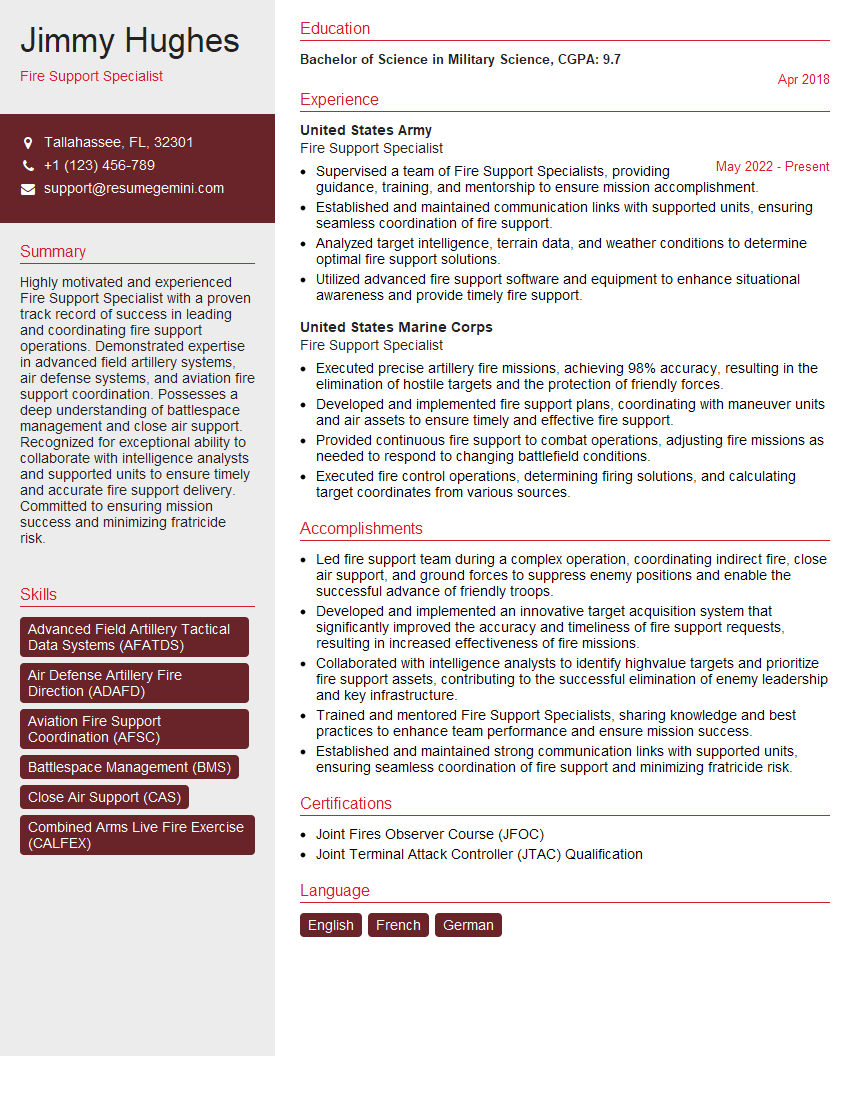
Mastering Fire Support Team operations opens doors to a rewarding and challenging career path, offering significant opportunities for professional growth and leadership development. To maximize your job prospects, it’s crucial to present your skills and experience effectively. Creating an ATS-friendly resume is paramount in ensuring your application reaches the right people. We highly recommend leveraging ResumeGemini, a trusted resource, to build a professional and impactful resume that showcases your expertise. ResumeGemini provides examples of resumes tailored specifically to Fire Support Team (FST) roles, helping you create a document that highlights your unique qualifications and experience.
Explore more articles
Users Rating of Our Blogs
Share Your Experience
We value your feedback! Please rate our content and share your thoughts (optional).
What Readers Say About Our Blog
Very informative content, great job.
good