Preparation is the key to success in any interview. In this post, we’ll explore crucial Fireworks Display Design interview questions and equip you with strategies to craft impactful answers. Whether you’re a beginner or a pro, these tips will elevate your preparation.
Questions Asked in Fireworks Display Design Interview
Q 1. Explain the different types of fireworks and their applications.
Fireworks are broadly categorized by their effects, ranging from simple aerial bursts to complex, choreographed displays. Let’s explore some key types:
- Aerial Shells: These are the most common type, launched from mortars and exploding at a predetermined height. They come in various sizes and effects, from simple star bursts to elaborate chrysanthemums, peonies, and brocades. The size determines the scale of the effect.
- Cakes: These contain multiple shells fired sequentially from a single unit, simplifying the firing process and creating a pre-programmed sequence. They are popular for smaller displays or home use.
- Roman Candles: These produce a series of colorful bursts from a single tube, creating a relatively low-level effect, often used as a transition element or for smaller shows.
- Rocket Fireworks: These ascend into the air before exploding, leaving a trail of light and sparks. They offer a more dynamic effect and can add movement to a display.
- Fountains: These are low-level fireworks that create a shower of sparks and colorful effects, ideal for ground-based displays or as a prelude to larger aerial shells.
- Special Effects: This category encompasses a wide range of innovative fireworks like glitter, smoke, and even sparkling waterfalls, adding texture and visual variety to the show.
The application of each type depends heavily on the scale and theme of the fireworks display. For example, large-scale public displays often incorporate a mix of aerial shells, rockets, and special effects for a stunning visual spectacle, while smaller, more intimate events might utilize cakes or fountains.
Q 2. Describe your experience with fireworks safety regulations and procedures.
Fireworks safety is paramount. My experience includes rigorous adherence to all local, state, and national regulations, along with comprehensive safety training. I’m proficient in risk assessments, site surveys, and developing detailed safety plans. This involves identifying potential hazards, implementing appropriate safety measures, and ensuring all personnel are properly trained and equipped. For instance, we always establish clear fire safety zones, utilize certified fireworks, and have emergency response plans in place, including trained personnel and readily available fire suppression equipment. Before each show, a meticulous inspection of equipment and the firing site takes place to minimize risk. Furthermore, I’m well-versed in the handling and storage of fireworks, following strict guidelines to prevent accidental ignition or damage. Maintaining detailed records and documentation of all aspects of the display, including permits and safety procedures, is another critical aspect of my work.
Q 3. How do you design a fireworks display to synchronize with music?
Synchronizing fireworks with music is a complex art that blends pyrotechnics and audio engineering. It starts with selecting the music, focusing on pieces with clear rhythmic and dynamic changes to which the fireworks can effectively respond. Next, the display is carefully choreographed to the milliseconds, using specialized software. Each firework element—the launch time, the type of shell, and even the duration of its effect—is meticulously mapped onto the music’s timeline. For example, a crescendo in the music might be mirrored by a series of increasingly larger and more intense firework bursts, while a quieter section might feature softer, more delicate effects. The software allows for precise timing control, ensuring that the visual elements perfectly complement the audio. Consider it like composing a visual symphony, where the fireworks become instruments playing alongside the orchestra.
Q 4. What software or tools do you use for fireworks display design and simulation?
I utilize a combination of specialized software for fireworks display design and simulation. These tools allow for 3D visualization, precise timing control, and the creation of detailed firing schedules. Popular examples include Fireworks by ETC, Weefire, and other proprietary systems used by fireworks companies. These programs usually offer a library of fireworks effects, allowing you to virtually ‘assemble’ your show. The software then generates the firing cues needed for the actual launch system. Simulating the display beforehand enables me to identify and rectify any potential issues in timing or visual harmony before the live performance.
Q 5. Explain your process for creating a fireworks display design brief.
Creating a comprehensive design brief is essential for a successful fireworks display. My process starts with a deep understanding of the client’s objectives, budget, and the venue. I then gather crucial information like the desired duration, target audience, and any special requests. For example, are there any specific themes or color palettes? Are there any technical restrictions at the venue, such as height limitations or proximity to buildings? The brief also incorporates detailed specifications, including the types of fireworks, their placement, and firing sequences. This ensures that everyone involved—from the client to the pyrotechnicians—has a clear understanding of the vision for the display. The end result is a detailed document that serves as a roadmap for the entire project.
Q 6. How do you ensure the safety of spectators and personnel during a fireworks display?
Spectator and personnel safety is my top priority. This involves establishing safety zones based on the type and size of the fireworks, with clear signage and barriers to maintain a safe viewing distance. I coordinate closely with local authorities and emergency services to develop comprehensive safety plans, including designated evacuation routes and emergency medical services. All personnel involved in the display, from pyrotechnicians to security staff, receive thorough training and safety briefings. Before the show, the site is thoroughly inspected for any potential hazards, such as debris or flammable materials. Constant monitoring during the show is also a part of the process, allowing quick response to any unexpected situations. We use controlled firing systems that allow us to remotely monitor and control the launch of the fireworks, enhancing overall safety.
Q 7. What are the key considerations when selecting fireworks for a specific venue?
Selecting fireworks for a specific venue involves careful consideration of several factors. The venue’s size, its physical characteristics (such as open space versus confined areas), the proximity of structures, and local regulations heavily influence these decisions. For instance, a large outdoor stadium will allow for bigger, more powerful shells, whereas a smaller, more confined space might require a selection of smaller fireworks or ground-based effects. Safety is again paramount, which dictates appropriate firework selection to avoid the risk of over-pressure or unintended projectile trajectories. Moreover, environmental concerns play a role, with an emphasis on environmentally friendly compositions where feasible. The client’s budget and desired aesthetics also guide firework selections, balancing the spectacular effect with practical limitations. In short, the selection process is a careful balancing act between safety, practicality, and the artistic vision.
Q 8. Describe your experience with different firing systems.
My experience encompasses a wide range of firing systems, from simple hand-lit displays to sophisticated computer-controlled systems. Early in my career, I worked extensively with hand-lit systems, which require precise timing and coordination. This experience gave me a deep understanding of the fundamental principles of fireworks sequencing and safety. Later, I transitioned to computer-fired systems, which offer far greater precision and the ability to control hundreds or even thousands of shells simultaneously. These systems utilize software to program the precise timing and firing order of each firework, creating complex and dynamic displays. I’m proficient with several leading brands, including FireOne, Total Fireworks Control, and Weco, and I’m comfortable adapting to new systems as needed. For example, on a recent large-scale event, we used a FireOne system integrated with GPS tracking for pinpoint accuracy in a challenging, expansive location. The level of control offered by these advanced systems allows for far more creative designs and the ability to synchronize the fireworks with music and other special effects.
Q 9. How do you handle unexpected issues or malfunctions during a fireworks display?
Handling unexpected issues during a fireworks display requires quick thinking and a well-rehearsed emergency plan. My approach involves a combination of preventative measures and immediate response strategies. Before any display, we conduct rigorous checks of all equipment, including fuses, firing systems, and fireworks themselves. We also establish clear communication protocols amongst the firing crew. Despite these precautions, malfunctions can occur. If a malfunction happens, the first step is to immediately cease firing. We have designated safety officers to assess the situation and implement the appropriate emergency procedures. These could involve isolating the affected unit, manually firing backup shells (if safe and feasible), or postponing the remainder of the show. For example, during a Fourth of July show, a faulty fuse resulted in a premature ignition. Our team quickly identified the problem, isolated the affected area, and safely continued the show after a brief delay. A detailed post-event analysis is always conducted to determine the cause of the malfunction and implement any necessary changes to prevent recurrence. This proactive approach ensures both the safety of the audience and the success of future events.
Q 10. What are the environmental considerations involved in fireworks displays?
Environmental considerations are paramount in modern fireworks displays. We prioritize minimizing the impact on air and water quality. This involves selecting fireworks with lower levels of pollutants, utilizing environmentally friendly manufacturing processes, and conducting displays in appropriate locations with favorable wind conditions to disperse smoke and debris. Proper cleanup procedures after the event are also essential to mitigate any potential environmental damage. For instance, we often choose fireworks with reduced levels of heavy metals and particulate matter. We also work closely with local environmental agencies to obtain necessary permits and ensure compliance with all regulations. For water-based displays, we carefully assess the impact on aquatic life, choosing locations and products that minimize disruption. Increasingly, we are exploring the use of eco-friendly alternatives, such as low-impact pyrotechnics and LED-based light shows, to further reduce the environmental footprint of our displays.
Q 11. How do you manage the logistics and scheduling of a large-scale fireworks event?
Managing the logistics and scheduling of a large-scale fireworks event requires meticulous planning and coordination. It starts months in advance with site selection, which involves careful consideration of factors such as audience capacity, safety regulations, and accessibility. We then develop a detailed schedule that outlines every step, from equipment delivery and setup to the actual firing sequence and post-event cleanup. This schedule incorporates timelines for various tasks, including permit acquisition, pyrotechnic preparation, security arrangements, and emergency response planning. Detailed risk assessments are crucial. Communication is key, so we use project management software to keep all stakeholders informed. For example, for a recent city-wide celebration, we used a Gantt chart to visualize the project timeline, track milestones, and manage dependencies between different tasks, ensuring the event progressed smoothly and on schedule.
Q 12. Describe your experience with budgeting and cost control for fireworks displays.
Budgeting and cost control are crucial aspects of fireworks display design. We develop detailed cost estimates that include the price of fireworks, equipment rental, labor costs, permits, insurance, and contingency funds. We explore various options to optimize costs while maintaining the quality and scope of the display. This might involve negotiating with firework suppliers, utilizing existing equipment wherever possible, and optimizing the firework shell selection to achieve the desired visual effect with cost-effectiveness. We track expenses meticulously throughout the project, ensuring adherence to the approved budget. For example, we might compare prices from multiple fireworks suppliers to secure the best deals without compromising safety or quality. We use dedicated budgeting software to monitor expenditure, forecast future costs, and manage potential budget overruns. Effective cost control allows us to deliver spectacular displays while remaining fiscally responsible.
Q 13. How do you obtain the necessary permits and licenses for a fireworks display?
Obtaining the necessary permits and licenses for a fireworks display is a complex process that varies depending on location and the scale of the event. I am thoroughly familiar with all relevant regulations. The process typically involves submitting a detailed application to the relevant authorities, which may include local fire departments, police departments, and environmental agencies. This application includes a detailed description of the display, including the type and quantity of fireworks, firing location, safety plan, and insurance coverage. We often need to demonstrate compliance with all relevant safety standards and environmental regulations. We’ll conduct site inspections and undergo safety training as part of the approval process. For example, for a recent national holiday display, we spent several weeks gathering the required documentation, completing all necessary forms, and coordinating approvals from multiple agencies. Early engagement with authorities is essential to ensure a smooth and timely permit acquisition process.
Q 14. What are the different types of fuses and their uses?
Various fuse types are used in fireworks, each with specific properties and applications. Quick match is a fast-burning fuse used for igniting individual fireworks or smaller components within a larger display. It is commonly used in hand-lit displays or for short time-delay effects. Black match, a slower-burning fuse, offers more precise timing control, typically used in larger-scale, computer-fired displays requiring precise synchronization of multiple fireworks. Electric matches provide the highest level of control and safety in computer-fired systems. They are initiated electronically, eliminating the need for hand-lighting and providing very precise timing. The choice of fuse depends on the type of firework, the desired timing, and the firing system employed. For instance, quick match might be preferred for quickly igniting a series of small aerial fireworks, while black match or electric matches are typically used for larger displays, where timing is critical. Using the right fuse ensures the safety and accuracy of the display.
Q 15. Explain the importance of pre-show inspections and safety checks.
Pre-show inspections and safety checks are paramount in fireworks display design and execution. They’re not just about compliance; they’re about ensuring the safety of the audience, crew, and property. Think of it like a pre-flight checklist for an airplane – every detail matters.
- Equipment Inspection: This involves meticulously checking all firing systems, wiring, mortars, and fireworks themselves for any damage, malfunction, or inconsistencies. We look for frayed wires, damaged fuses, or any signs of moisture that could compromise performance or safety.
- Site Survey: A thorough site survey is crucial. We assess the firing area for obstructions, potential hazards (like nearby trees or power lines), and ensure the safety perimeter is clearly marked and appropriately sized for the expected crowd. This includes confirming wind direction and speed, to prevent errant fireworks landing in undesirable locations.
- Emergency Procedures: Detailed emergency procedures must be in place and communicated clearly to the entire team. This includes fire suppression plans, evacuation routes, and contact information for emergency services. We conduct drills to ensure everyone is well-prepared.
- Weather Contingency: We also assess the weather forecast and have backup plans in case of unforeseen changes, such as postponing the show or modifying the sequence if winds become too strong.
Failing to conduct thorough inspections can lead to serious accidents, financial losses, and reputational damage. A meticulous pre-show check is the foundation of a successful and safe fireworks display.
Career Expert Tips:
- Ace those interviews! Prepare effectively by reviewing the Top 50 Most Common Interview Questions on ResumeGemini.
- Navigate your job search with confidence! Explore a wide range of Career Tips on ResumeGemini. Learn about common challenges and recommendations to overcome them.
- Craft the perfect resume! Master the Art of Resume Writing with ResumeGemini’s guide. Showcase your unique qualifications and achievements effectively.
- Don’t miss out on holiday savings! Build your dream resume with ResumeGemini’s ATS optimized templates.
Q 16. How do you assess weather conditions and their impact on a fireworks display?
Weather conditions are a critical factor influencing fireworks display design and execution. Wind speed and direction are particularly important. High winds can cause fireworks to drift off course, potentially causing damage or injury.
We use a combination of meteorological data and on-site observation. Before a show, we consult detailed weather forecasts, including wind speed, wind direction, precipitation, and humidity. This information helps us choose appropriate fireworks and adjust the firing angles to compensate for wind. For instance, a strong headwind requires us to adjust the launch angle to ensure fireworks reach their intended height and burst location.
On the day of the show, we continuously monitor the weather conditions. If conditions deteriorate significantly—excessive wind, heavy rain, or lightning—we have established protocols for delaying or canceling the show to ensure safety. We also consider visibility; heavy fog or smoke can obscure the display and impact the audience experience.
Incorporating weather contingency plans is vital. This might involve having alternative fireworks ready or adjusting the display sequence to utilize smaller, less wind-sensitive effects.
Q 17. Describe your experience with creating different types of fireworks effects (e.g., brocade, chrysanthemum).
Designing fireworks effects involves a deep understanding of pyrotechnic compositions and their behavior. ‘Brocade’ and ‘Chrysanthemum’ are two classic examples of distinct effects.
- Brocade: This effect creates a shimmering, tapestry-like pattern in the sky. It’s achieved through a precise arrangement of stars (individual pyrotechnic charges) within a shell that are timed to ignite in a specific sequence, creating a wave-like or cascading effect. The color and size of the stars are carefully selected to build the overall visual effect.
- Chrysanthemum: A chrysanthemum effect is characterized by a large, round burst of numerous glowing elements radiating outwards. It’s a very popular effect that relies on using a specific arrangement of stars and a carefully-timed burst charge to create a bloom-like pattern. Different colors can be used to create a vibrant and impressive display.
My experience encompasses a wide range of effects, including waterfalls, peonies, comets, and various crackling effects, all of which require a different formulation of pyrotechnic compounds and timing mechanisms. The skill lies not just in selecting the right effect but also in blending them seamlessly to create a visually compelling narrative throughout the show.
Q 18. How do you incorporate special effects beyond traditional fireworks into your designs?
Modern fireworks displays increasingly integrate special effects beyond traditional fireworks to enhance the experience. This often involves creative use of technology to build richer storytelling and visual spectacle.
- Laser Shows: Lasers complement fireworks beautifully, adding sharp, dynamic light elements that can synchronize with the fireworks’ bursts for a truly spectacular visual harmony.
- Fireworks Choreography with Music: Synchronizing fireworks to music transforms the show from a simple display of pyrotechnics into a carefully crafted artistic performance. This requires precise timing and a clear understanding of both music and fireworks characteristics.
- Projected Images/Video Mapping: Projecting images or video onto structures near the firing site can create a layered and immersive experience, weaving together visual elements from both light and video sources. For example, projecting images onto a nearby building or water screen.
- Special Effects Devices: Incorporating elements such as flame jets, ground-based pyrotechnics, or even drones carrying light sources can create stunning special effects and add more dimensions to the display.
The key is integrating these elements seamlessly, creating a unified and memorable experience for the audience. The goal is not to overwhelm with effects, but to complement and enhance the pyrotechnics for a coherent and captivating overall narrative.
Q 19. What is your experience with CAD software for fireworks design?
CAD software plays an increasingly important role in fireworks design. While not directly used to design the pyrotechnic compositions themselves, it is invaluable for visualizing and planning the overall display.
I’m proficient in several CAD programs, which I use to create detailed 2D and 3D models of the firing site. This allows me to accurately plot the location of each firing device, ensuring optimal positioning for effects and safety clearances. I can simulate the trajectory of fireworks, helping anticipate potential overlaps or conflicts. The software allows me to create detailed schematics for the fireworks crew, and to present the visual sequence to clients in a more easily-understood way than static drawings.
While traditional hand-drawn schematics still hold their place, CAD software significantly improves efficiency, accuracy, and communication during the design process. The capability to iterate on designs quickly and accurately is crucial in this context.
Q 20. How do you communicate your design vision to a client?
Communicating a design vision effectively to a client is crucial for a successful project. This involves a multi-faceted approach involving both visual and verbal communication.
- Presentation: I start with a comprehensive presentation, including a detailed narrative explaining the show’s theme and overall concept. This is supported by visually rich materials such as CAD renderings, video simulations (where possible), and mood boards to demonstrate the desired aesthetic.
- Storytelling: I emphasize the storytelling aspect of the design, explaining how the sequence of fireworks effects is designed to create a cohesive and engaging narrative, which resonates with the client’s vision and purpose for the display.
- Technical Specifications: While the client may not need to understand the technical details of pyrotechnic composition, I present enough technical information to demonstrate the feasibility and safety of the design, building trust and confidence in my expertise.
- Open Communication: I encourage open communication and questions from the client throughout the design process to ensure a shared understanding and address any concerns they may have.
By using a blend of visual and verbal communication, and keeping the lines of communication open, I ensure the client feels fully informed and involved in the process, leading to a more successful and satisfying outcome.
Q 21. How do you handle client feedback and revisions?
Client feedback and revisions are integral to the design process. I approach them as opportunities for improvement and collaboration.
- Active Listening: I actively listen to the client’s feedback, paying close attention to both their specific concerns and their overall impression of the design.
- Iterative Design: I don’t view revisions as a negative; rather, I see them as an iterative step in the design process. I use client feedback to refine the design, exploring various options and presenting revised versions that address their concerns.
- Open Dialogue: Maintaining open communication is essential. I explain the technical implications of any requested changes and suggest alternative solutions if a particular request isn’t feasible or safe.
- Documentation: All changes and revisions are meticulously documented, providing a clear record of the design evolution and ensuring everyone is on the same page.
By actively incorporating client feedback and maintaining a collaborative approach, I ensure the final design meets both the client’s expectations and the safety and technical requirements of a successful fireworks display.
Q 22. Describe your experience with different types of firework launching systems.
My experience encompasses a wide range of firework launching systems, from the simplest hand-launched mortars to sophisticated computer-controlled systems. I’m proficient with both electric and electronic firing systems. Electric systems, using simple wires and a firing box, are reliable for smaller displays, but lack the precision and complexity of electronic systems. Electronic systems, often using computers and specialized software, allow for precise timing and choreography of hundreds or even thousands of fireworks. This includes systems using DMX512 protocols for intricate synchronization, and GPS-triggered systems for large-scale displays where precise geographical positioning of shells is crucial. I’ve worked with various manufacturers’ equipment, including but not limited to, those from companies like [Manufacturer Name 1], [Manufacturer Name 2], and [Manufacturer Name 3], gaining expertise in their unique features and maintenance requirements. I’m comfortable troubleshooting issues in any of these systems, ensuring safety and the smooth execution of the display.
- Mortar Launching Systems: These are the traditional method, involving launching fireworks from tubes at various angles.
- Electric Firing Systems: These use simple electric signals to ignite fireworks, suitable for smaller displays.
- Computerized Firing Systems: These offer precise timing and control, often essential for large, complex displays. These systems often include safety features like redundant firing systems and fail-safes.
Q 23. What are the common challenges in designing fireworks displays and how do you overcome them?
Designing fireworks displays presents numerous challenges. Weather conditions, such as strong winds or unexpected rain, can significantly impact the display’s trajectory and overall effect. Safety is paramount, requiring meticulous planning and adherence to strict regulations. Budgetary constraints frequently limit the scope of the design, demanding creative solutions to achieve a stunning visual effect within limitations. The integration of music and pyrotechnics to create a cohesive and impactful experience is also a significant undertaking. Another challenge lies in obtaining the necessary permits and approvals, which can be time-consuming and complex. Overcoming these challenges involves rigorous planning, detailed risk assessments, contingency planning for adverse weather, collaborative work with pyrotechnicians and client communication, and creative problem-solving to maximize the visual impact within budget restrictions.
For instance, to overcome weather limitations, we use wind-prediction models and adjust the firing angles and firework types to compensate for potential wind drift. For budget limitations, we explore cost-effective alternatives while maintaining visual quality, perhaps by focusing on strategically placed, high-impact effects rather than sheer quantity. Thorough communication with clients and pyrotechnicians is crucial in finding solutions that meet everyone’s expectations and ensure safety.
Q 24. How do you ensure the longevity and reusability of your fireworks display designs?
Longevity and reusability in fireworks display design are achieved through meticulous documentation and adaptable design principles. Instead of creating displays that are entirely unique and disposable, I focus on modular designs. This means creating a library of effect sequences and choreography that can be reconfigured and recombined for different events. The technical plan meticulously details each element, from the type and quantity of fireworks to their precise placement and firing sequence. This allows for adjustments and modifications in the future. Software tools used in the design process, like [Software Name 1] or [Software Name 2], help to manage and maintain this documentation and allow for easy adaptation of designs to new scenarios. Regular review and updates are essential to ensure that the plans remain current with regulations and available technology.
Think of it like building with LEGOs; individual elements (fireworks types, effects) are combined in different ways to create varied displays. This approach reduces design redundancy, allowing the core elements to be repurposed efficiently.
Q 25. Explain your process for creating a detailed fireworks display technical plan.
Creating a detailed technical plan is a multi-stage process. It begins with a thorough understanding of the client’s vision, the venue’s limitations (including size, accessibility, and safety regulations), and available budget. Next, a preliminary design is sketched outlining the overall visual concept and timing. This is translated into a digital format using specialized fireworks design software, where the exact positions of each firework are mapped, along with their firing times and associated effects. This plan includes detailed specifications of each firework type, their quantities, and their individual characteristics (color, burst size, effects). A comprehensive safety plan is integral to the technical plan, outlining emergency procedures, personnel roles, and safety precautions. The firing system’s configuration is also detailed, specifying the wiring diagrams and timing controls. Finally, the plan undergoes rigorous review and approval by relevant authorities before implementation.
Example data point: Firework Type: 100-gram Chrysanthemum, Position: X=100m, Y=50m, Z=20m, Firing Time: 00:00:15. This type of data is crucial in the technical plan and is often part of the software output.
Q 26. How do you maintain accurate records and documentation for all aspects of your work?
Maintaining accurate records is critical. I utilize a combination of digital and physical documentation methods. All aspects of a project, from initial client consultations to final post-event reports, are meticulously documented. Digital records are stored securely using cloud-based storage and version control systems, ensuring data integrity and accessibility. This includes design files, firing plans, safety documentation, client communication logs, and post-event analysis reports. Physical records, such as signed permits and inspection reports, are stored in secure, appropriately labeled archives. A comprehensive database tracks each project, allowing for efficient retrieval and analysis of data for future projects. This method helps in tracking costings, improvements, and learning from past experiences to further enhance future firework display designs.
Q 27. Describe a time you had to troubleshoot a technical issue during a fireworks display.
During a large-scale display, a sudden power surge caused several firing units to malfunction. Our primary firing system partially failed. Fortunately, we had implemented a redundant backup system. However, the backup had a different interface. Quickly, I switched to the backup system, adapting to the new interface under pressure. My team and I meticulously checked each firing unit, identifying the affected ones. We manually fired the remaining units using a secondary, hand-held firing system, ensuring the rest of the display proceeded as planned. While the show experienced a minor delay, it was completed safely and without significant compromise to the overall experience. Post-event analysis identified the cause of the power surge and improvements were implemented to prevent recurrence. This incident highlighted the importance of having fail-safe systems and a team prepared to handle unexpected technical difficulties.
Q 28. What are your future aspirations in the field of fireworks display design?
My future aspirations involve pushing the boundaries of fireworks display design by integrating cutting-edge technology. This includes exploring the use of drones for aerial displays and creating innovative light shows using laser technology in conjunction with traditional fireworks. I aim to develop more sustainable practices within the industry, incorporating eco-friendly pyrotechnics and reducing the environmental impact of our work. Furthermore, I’m keen on expanding my knowledge of 3D modeling and simulation software to create virtual simulations of fireworks displays, allowing clients to experience their vision beforehand and minimizing the risk of on-site errors.
Key Topics to Learn for Fireworks Display Design Interview
- Fireworks Chemistry and Effects: Understanding the chemical compositions of different fireworks and their resulting colors, effects (e.g., crackling, glitter, smoke), and durations is crucial. Consider the practical implications of different chemical combinations and their safety profiles.
- Choreography and Sequencing: Learn about designing the visual narrative of a fireworks display. This includes creating sequences, transitions, and building to a climax. Explore different software and techniques used for choreography and timing.
- Safety and Regulations: Demonstrate knowledge of relevant safety regulations, licensing requirements, and best practices for handling fireworks and ensuring a safe display. This is paramount for any professional in the field.
- Budgeting and Logistics: Discuss practical aspects such as cost estimations, supplier selection, site preparation, setup, and cleanup. Showcase your ability to manage resources effectively within budgetary constraints.
- Software and Technology: Familiarity with industry-standard software used for design, simulation, and control of fireworks displays is essential. Be prepared to discuss your experience with specific programs and techniques.
- Client Communication and Collaboration: Highlight your ability to understand client needs, translate them into a visual concept, and manage expectations throughout the design and execution process.
- Troubleshooting and Problem-Solving: Be ready to discuss your experience with addressing unexpected challenges during the design or execution phases of a fireworks display. This shows your ability to think on your feet and find creative solutions.
Next Steps
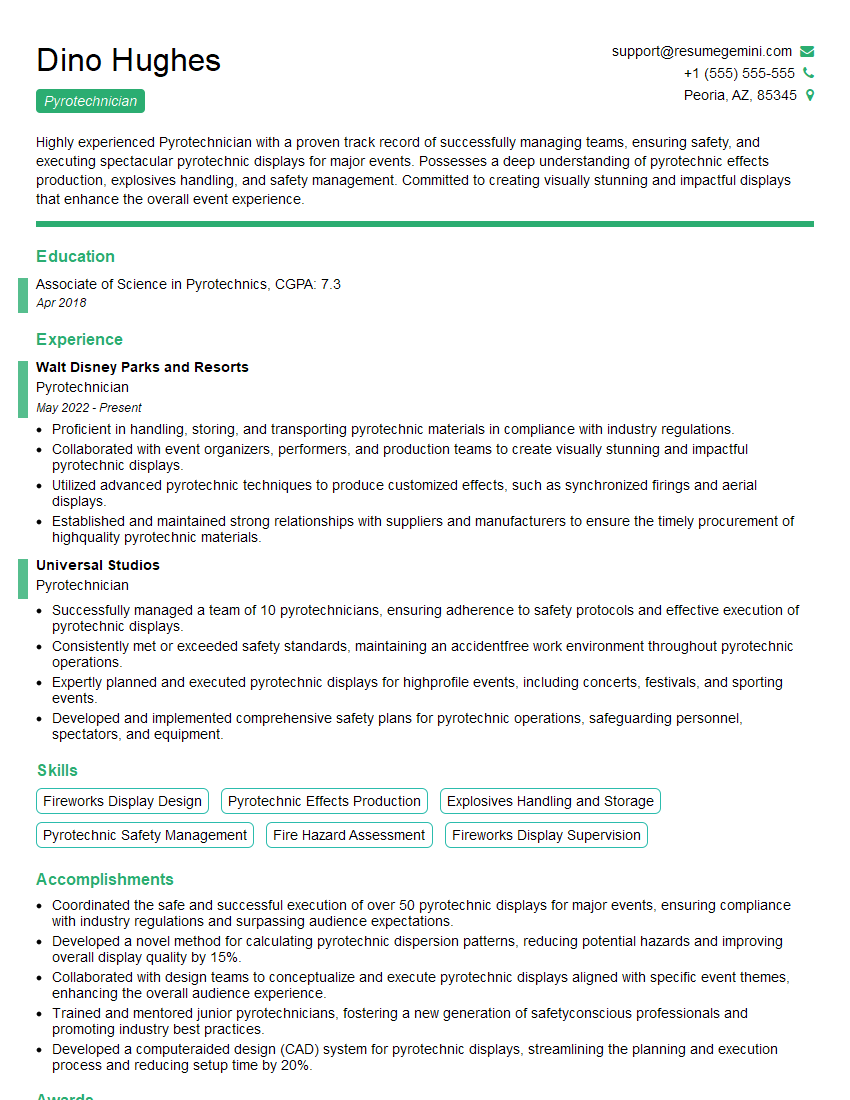
Mastering Fireworks Display Design opens doors to a rewarding career filled with creativity and spectacle. To significantly increase your job prospects, it’s crucial to present your skills and experience effectively. An ATS-friendly resume is key to getting noticed by recruiters and hiring managers. We highly recommend using ResumeGemini to craft a compelling resume that highlights your unique qualifications. ResumeGemini offers a streamlined process and provides examples of resumes tailored specifically for Fireworks Display Design professionals, helping you stand out from the competition.
Explore more articles
Users Rating of Our Blogs
Share Your Experience
We value your feedback! Please rate our content and share your thoughts (optional).
What Readers Say About Our Blog
Very informative content, great job.
good