Are you ready to stand out in your next interview? Understanding and preparing for Flameworking interview questions is a game-changer. In this blog, we’ve compiled key questions and expert advice to help you showcase your skills with confidence and precision. Let’s get started on your journey to acing the interview.
Questions Asked in Flameworking Interview
Q 1. Describe your experience with different types of glass used in flameworking.
My experience with various glasses in flameworking is extensive. The choice of glass significantly impacts the final piece’s color, texture, and durability. I regularly work with borosilicate glass, known for its low thermal expansion coefficient, making it ideal for intricate designs without cracking. This is my go-to for most projects because of its strength and workability. I also use soda-lime glass, which is less expensive and easier to find, but requires more careful handling due to its higher thermal expansion. It’s great for simpler projects or when a specific color palette is needed, as soda-lime offers a wider range of colors. Occasionally, I’ll incorporate other specialty glasses like dichroic glass (which displays different colors depending on the viewing angle), or colored glass frit (small, pre-made pieces of glass) to add unique visual effects.
For example, when creating a detailed, delicate hummingbird, borosilicate is essential for its strength and resistance to cracking during the intricate shaping process. Conversely, a simple, colorful paperweight might be perfectly suitable made with soda-lime glass, focusing on achieving a vibrant color scheme.
Q 2. Explain the process of annealing glass and its importance.
Annealing is a crucial post-production step in flameworking, involving slowly cooling the hot glass to relieve internal stresses. Think of it like slowly letting a hot metal cool – rapid cooling creates stress points that can cause future cracking or breakage. Without annealing, even a seemingly perfect piece can spontaneously shatter days or even weeks later. I usually anneal my pieces in a digitally controlled kiln, following a carefully programmed temperature schedule. This slow cooling process eliminates internal stresses and enhances the structural integrity and durability of the finished piece, ensuring its longevity.
The annealing process typically involves placing the glass in the kiln at a high temperature (often around 900-1000°F depending on the glass type) before gradually reducing the temperature over several hours to room temperature. Improper annealing, or skipping this vital step entirely, is a common cause of broken artwork. It’s a testament to the precision needed in this craft.
Q 3. What safety precautions do you take while working with a torch and molten glass?
Safety is paramount in flameworking. I always wear safety glasses to protect my eyes from flying glass fragments or intense light. A full-face shield provides additional protection. Heavy-duty gloves prevent burns and provide grip on the hot glass. I work in a well-ventilated area to minimize inhalation of fumes, particularly from the propane and oxygen gases, always making sure the area is clear of flammable materials. I never leave the torch unattended and ensure that the oxygen and propane tanks are securely fastened and stored appropriately.
Furthermore, I always keep a fire extinguisher nearby and am familiar with its operation. I also maintain a clean and organized workspace to prevent accidental injuries, including appropriate storage for tools and finished pieces. Regular maintenance of the torch and equipment is also a crucial safety aspect.
Q 4. How do you troubleshoot common flameworking issues such as bubbles or cracks?
Troubleshooting issues like bubbles and cracks requires a keen understanding of the glass’s behavior and the flame’s characteristics. Bubbles often result from insufficient heating, air trapped during the shaping process, or using contaminated glass. To prevent bubbles, ensure that the glass is evenly heated before working with it and avoid rapid movements that could trap air. If bubbles appear, sometimes careful reheating allows them to dissipate. However, severely bubbled work often needs to be discarded.
Cracks, on the other hand, usually stem from thermal shock—rapid changes in temperature. This can happen due to uneven heating, too high a flame temperature or introducing cold glass into a hot section. Preventing cracks involves slow, consistent heating, using the appropriate flame size, and avoiding extreme temperature gradients. A cracked piece unfortunately often needs to be discarded as the damage is structural.
Q 5. Describe your experience with different flameworking techniques (e.g., implosion, murrini).
My flameworking experience encompasses a variety of techniques. Implosion involves creating a hollow form by carefully manipulating molten glass, often incorporating multiple colors and textures. I frequently utilize implosion techniques to create glass beads with intricate internal patterns. Murrini, on the other hand, involves creating small, decorative glass canes with intricate patterns. These canes are then sliced and fused into larger pieces, adding a unique aesthetic dimension. I have also mastered other advanced techniques such as fuming (applying metallic salts to add colors), and incorporating various embellishments like precious metals. I find the creative possibilities endless with these techniques. Each project allows me to explore and combine different techniques for a unique outcome.
For example, I once crafted a stunning pendant using the implosion technique, creating a vibrant blue orb with swirling internal patterns of white and gold, and accented it with a murrini cane for an added layer of visual interest.
Q 6. How do you maintain and clean your torch and equipment?
Maintaining and cleaning my torch and equipment is crucial for both safety and optimal performance. After each session, I clean the torch tip meticulously, removing any glass residue that could clog it and affect the flame. I typically use a torch tip cleaner and a brass brush. The workspace is also cleaned of any glass shards and dust. For the rest of my tools, a simple cleaning with soap and water often suffices. However, more extensive cleaning might be needed occasionally depending on the types of glass used. Regular inspection for wear and tear is important, and any damaged or worn parts are promptly replaced to ensure optimal functionality and safety.
For example, a clogged torch tip will lead to an inconsistent flame, making it challenging to control the glass’s heating. Regular maintenance significantly extends the lifespan of the torch and keeps my workspace safe and efficient.
Q 7. What are the different types of torches used in flameworking and their applications?
Different torches cater to various needs in flameworking. The most common are hand torches, which are versatile and portable, ideal for smaller projects and detailed work. Bench torches offer greater power and stability, suitable for larger pieces and more intense heating. These are often used for glassblowing techniques. There are also oxygen/propane torches that are the workhorses of most flameworkers, providing a highly adjustable and consistent flame for precise glass manipulation. The choice of torch depends on the project’s scale, complexity, and the glass being used. For instance, a small hand torch is perfect for intricate beads, while a large bench torch is better suited for sculpting larger glass vessels.
For extremely intricate work, a microtorch might be the ideal choice, while bigger pieces may necessitate a larger, more powerful torch. The gas mixture, pressure, and tip size all influence the flame’s characteristics, and careful control over these factors is essential for successful flameworking.
Q 8. Explain your understanding of glass chemistry and its impact on flameworking.
Understanding glass chemistry is fundamental to successful flameworking. Different glasses melt at different temperatures and have varying coefficients of thermal expansion (CTE). This means they expand and contract at different rates when heated and cooled. In flameworking, using incompatible glasses can lead to cracking or shattering during the process or even after the piece has cooled.
For instance, borosilicate glass (like Pyrex) has a lower CTE than soda-lime glass (common window glass). Combining these without careful consideration can cause stress within the piece, leading to failure. The chemical composition also impacts color and how the glass reacts to different flame temperatures and reducing agents. A higher silica content generally leads to a harder, more durable glass, while the addition of metal oxides creates color. For example, adding cobalt oxide produces blue glass, while copper produces various shades of green and blue depending on the oxidation state.
In my work, I always carefully select glasses with compatible CTEs to prevent stress fractures. I also understand how different glass compositions impact the final color and finish, allowing me to choose the right glass for the desired aesthetic and function of the piece.
Q 9. How do you create unique and intricate designs using flameworking techniques?
Creating unique and intricate designs in flameworking involves a combination of technical skill and artistic vision. It’s not just about melting and shaping glass; it’s about layering, manipulating, and combining different colors and textures to achieve a specific aesthetic. I often begin with a sketch or a digital design, but the process is very much iterative, and I often find myself improvising as I work.
- Layering: Building up layers of different colored glass allows for depth and complexity. Think of it like painting with glass; each layer adds another dimension to the piece.
- Implosion/Explosion techniques: Using controlled air pressure to manipulate molten glass allows for the creation of intricate patterns and textures. This technique requires a high degree of skill and precision.
- Frit and stringer manipulation: I use small pieces of pre-made glass (frit) and long strands (stringers) to create detailed elements, add texture and intricate designs, like flowers or patterns.
- Marvering and shaping: Rolling the molten glass on a flat surface (marvering) creates smooth surfaces while shaping tools and gravity are used to mould the glass into different forms.
For example, I recently created a series of pendants featuring delicate floral designs. I achieved this by layering different shades of clear, opaque, and colored glass, using implosion techniques to create subtle textures and stringers for the fine details of the petals.
Q 10. Describe your experience with designing and creating custom pieces.
I have extensive experience in designing and creating custom flameworked pieces. This often involves close collaboration with clients to understand their vision and translate it into a tangible artwork. The process typically starts with a consultation where we discuss the client’s preferences, budget, and desired use for the piece. I then create sketches and sometimes digital renderings to showcase potential designs.
For example, I recently worked with a client who wanted a unique paperweight for their office. We discussed their preferred colors and style, and I created a design incorporating their company logo in glass. This involved precise planning and execution to ensure the logo was clearly visible and integrated seamlessly into the design of the paperweight.
The most rewarding aspect of creating custom pieces is the opportunity to bring a client’s vision to life and create something truly unique and meaningful for them. The collaborative nature of the process allows for a highly personalized experience and a piece of art that reflects the client’s individuality.
Q 11. How do you manage your time and prioritize tasks in a busy studio environment?
Managing time and prioritizing tasks in a busy studio environment requires a structured approach. I use a combination of planning tools and techniques to stay organized and efficient. This includes:
- Project planning: I create detailed project plans for each commission or series of pieces. This includes outlining the steps involved, materials needed, and estimated timeframes. This allows me to break down large projects into smaller, more manageable tasks.
- Daily task lists: I create daily task lists prioritizing tasks based on urgency and importance. This ensures that I focus on the most critical tasks first.
- Time blocking: I allocate specific time blocks for different tasks. This helps me to stay focused and avoid distractions. For example, I may dedicate two hours in the morning to intensive flameworking and an hour in the afternoon to administrative tasks.
- Batching similar tasks: I group similar tasks together to improve efficiency. For example, I might complete all my glass cutting and preparation in one go before starting the flameworking process.
Regular review and adjustment of my schedule is key. Unexpected issues sometimes arise, so flexibility is important. But by using these methods, I am able to manage my workload effectively and meet deadlines consistently.
Q 12. Describe your experience working with different types of glass colors and effects.
My experience working with different types of glass colors and effects is extensive. The possibilities are virtually limitless. I use various techniques to achieve different color effects and textures, including:
- Using different glass compositions: Different metal oxides create unique colors. For example, uranium glass creates a striking yellow-green fluorescence under UV light, while cadmium sulfide produces vibrant yellows.
- Dichroic glass: This glass exhibits different colors depending on the viewing angle, adding an extra dimension of complexity to the finished piece.
- Murrini: These are cane-like structures composed of multiple layers of glass, which when sliced and incorporated into a piece create stunning patterns and effects.
- Millefiori: Similar to Murrini, it’s a technique that involves combining multiple small glass canes to create intricate floral or other designs.
- Encasing and layering: Encasing one color within another creates depth and visual interest. Layering multiple colors allows for blending and creating unique color combinations.
I’m constantly experimenting with new colors and techniques to expand my creative palette. It’s a never-ending learning process, and a key part of my creative process.
Q 13. How do you ensure consistency in your work and maintain high quality standards?
Consistency and high-quality standards are paramount in my work. To ensure this, I follow a strict set of procedures and employ a range of quality control measures.
- Precise measurements and planning: Careful planning and accurate measurements are crucial. This avoids waste and ensures the final product meets the design specifications.
- Thorough annealing: Annealing is a crucial step to remove internal stresses in the glass and prevent cracking. I always adhere to the specific annealing schedule recommended for the type of glass used.
- Regular maintenance of equipment: Regular maintenance of my torch and other equipment is essential to ensure consistent performance and prevent unexpected issues.
- Self-critique and continuous improvement: Regularly reviewing my work and identifying areas for improvement is vital. I use photography and videos to document my work, which helps to track progress and identify any recurring issues. I’m always striving to refine my techniques and achieve even higher levels of quality.
- Standard Operating Procedures (SOPs): I’ve developed SOPs for various aspects of my work, from glass preparation to finishing techniques. This consistency across different projects helps in maintaining high-quality results.
By adhering to these measures, I can ensure consistency in my work and maintain the high-quality standards my clients expect.
Q 14. What software or tools do you use for designing flameworked pieces?
While flameworking is largely a hands-on craft, I do utilize several software and tools in my design process. They assist in planning and visualizing complex designs.
- Sketching: I start with traditional sketching to develop initial ideas and explore various design possibilities. It’s crucial for translating the overall concept and aesthetic.
- Adobe Illustrator/Photoshop: For more complex designs, I use these software programs to create digital renderings. This allows me to refine details, experiment with color palettes, and visualize the final product more accurately.
- 3D Modeling Software (optional): For particularly complex or three-dimensional projects, 3D modeling software can be helpful in visualizing the construction process and potential challenges before starting the flameworking process.
- Photography and Videography: I use high-quality photography and videography to document my work, track progress, and refine techniques. This also aids client communication and serves as a valuable record of the artistic process.
These tools help me translate my creative vision into a tangible piece, but the core of my process remains the hands-on work of manipulating molten glass in the flame.
Q 15. Describe your experience working with clients to design and create custom pieces.
Collaborating with clients on custom flameworked pieces is a rewarding process that involves careful listening, skillful design translation, and transparent communication. I begin by scheduling a consultation to understand the client’s vision, preferences (color palettes, styles, intended use), and budget. We explore different design possibilities, often sketching ideas together or showing examples from my portfolio to find a suitable starting point.
For example, one client wanted a unique paperweight incorporating their company logo. We discussed various glass colors, potential textures, and the best way to integrate the logo without compromising the structural integrity of the piece. The process involved several iterations of sketches and digital mock-ups before we finalized the design. Once approved, I meticulously craft the piece, providing regular updates and photos throughout the process. Finally, we discuss any minor adjustments before the final delivery.
Another client commissioned a series of decorative bowls, emphasizing intricate marbling techniques. This required careful selection of compatible glass colors and meticulous control of the flameworking process to achieve the desired visual effect. We engaged in several virtual meetings using video conferencing to review sample marbling techniques before settling on the final design and color scheme.
Career Expert Tips:
- Ace those interviews! Prepare effectively by reviewing the Top 50 Most Common Interview Questions on ResumeGemini.
- Navigate your job search with confidence! Explore a wide range of Career Tips on ResumeGemini. Learn about common challenges and recommendations to overcome them.
- Craft the perfect resume! Master the Art of Resume Writing with ResumeGemini’s guide. Showcase your unique qualifications and achievements effectively.
- Don’t miss out on holiday savings! Build your dream resume with ResumeGemini’s ATS optimized templates.
Q 16. How do you handle constructive criticism and feedback on your work?
Constructive criticism is invaluable for growth. I actively seek feedback at various stages of the creation process – from initial design concepts to the finished product. I see feedback not as personal critique but as an opportunity to refine my skills and better understand client expectations. I listen carefully to the feedback, asking clarifying questions if needed to fully grasp the concerns.
For instance, a client once commented that the color gradient in a particular piece was less vibrant than they anticipated. This feedback prompted me to re-evaluate my flameworking technique and explore different glass combinations to achieve a more intense color transition. I then presented revised options, resulting in a piece the client was extremely pleased with. I always aim to have a collaborative, solution-oriented approach to incorporating feedback, and I document all adjustments and changes made in response to this feedback to continually improve my process.
Q 17. Describe your experience with different types of glass finishing techniques.
My experience encompasses a wide range of glass finishing techniques, crucial for achieving the desired aesthetic and durability of flameworked pieces. These techniques are often applied in combination to achieve a particular effect.
- Polishing: This smooths rough edges and surfaces, enhancing the clarity and shine of the glass. I use both rotary and hand polishing tools depending on the piece’s shape and size.
- Sandblasting: This technique creates a matte finish or intricate patterns by eroding the glass surface with pressurized air and abrasive particles. I utilize this for creating textures and adding subtle details to designs.
- Acid Etching: This chemically etches the glass, producing frosted or semi-transparent effects. It’s ideal for creating subtle designs or highlighting specific areas.
- Fuming: This involves exposing the glass to metallic fumes at high temperatures, adding vibrant iridescent colors or a metallic sheen. This is a more advanced technique requiring specialized equipment and safety precautions.
The choice of finishing technique depends greatly on the piece’s intended function and aesthetic design. For example, a delicate, intricately designed pendant might require only gentle polishing, while a sturdy vase could benefit from sandblasting to add texture and prevent slippage.
Q 18. How do you handle unexpected problems or challenges during the flameworking process?
Unexpected challenges are inherent in flameworking. My approach involves a combination of proactive measures and problem-solving skills. A key strategy is meticulous planning. This ensures the right glass types and tools are available, and potential issues are identified beforehand. However, things can still go wrong.
For example, a glass rod might crack unexpectedly due to internal stress. In such cases, I immediately assess the damage and determine whether repair is possible or if restarting with a new rod is necessary. I never compromise on safety; if the damage risks injury, I will stop and address the issue before continuing. I also maintain detailed records of my process to troubleshoot problems later. Over time, I’ve learned to recognize patterns that can predict potential issues. This includes recognizing inconsistencies in the glass itself, identifying signs of overheating, or recognizing when a particular technique needs adjustment.
Q 19. Explain your experience in troubleshooting equipment malfunctions.
Troubleshooting equipment malfunctions is a crucial aspect of flameworking. My experience involves familiarity with various torch systems (including oxygen/propane and oxygen/natural gas), kilns, and finishing tools. I start by systematically identifying the source of the problem. Is it a gas supply issue, a faulty torch head, a power outage, or a problem with the kiln’s controller?
I follow a checklist approach: I check all connections, inspect fuel lines for leaks, and test each component individually. If the problem persists, I consult the equipment’s manual or contact the manufacturer for support. I also keep a detailed log of maintenance activities and any repairs carried out to ensure preventive maintenance and identify potential recurring issues. Maintaining my equipment is a high priority, understanding that downtime due to malfunction can significantly impact project timelines.
Q 20. What are your strengths and weaknesses as a flameworker?
My strengths lie in my meticulous attention to detail, my creative problem-solving skills, and my ability to translate clients’ visions into tangible pieces. I’m adept at mastering new techniques, and I’m passionate about continually improving my craft. My artistic vision allows me to create unique, high-quality pieces.
However, I acknowledge that my perfectionism can sometimes lead to spending more time on a project than initially planned. I’m actively working on improving my time management skills to efficiently balance the pursuit of excellence with meeting deadlines. I recognize that learning to prioritize tasks and delegate when appropriate will be a key element in managing time effectively, without sacrificing quality.
Q 21. What are your salary expectations for this role?
My salary expectations are commensurate with my experience and skill set, aligned with industry standards for a flameworker with my level of expertise and track record of successful projects. I am open to discussing a competitive compensation package that reflects the value I bring to the role.
Q 22. What are your long-term career goals in flameworking?
My long-term career goals in flameworking revolve around establishing myself as a leading artist and innovator in the field. This includes expanding my technical skills to encompass more complex techniques like intricate sculpting and advanced glassblowing, alongside developing my artistic vision. I aim to exhibit my work internationally, collaborate with other artists on large-scale installations, and potentially teach workshops or masterclasses to share my knowledge and passion for flameworking with aspiring artists. Ultimately, I envision creating a legacy that contributes significantly to the advancement and appreciation of this beautiful art form.
Q 23. Describe your experience in a team-based work environment.
I thrive in team-based environments. In my previous studio, we collaborated on large-scale projects, requiring seamless coordination of individual tasks. For example, we worked on a commissioned sculpture where one team member focused on the flameworking of intricate components, another on the structural design, and a third on the kiln scheduling and annealing process. Effective communication, clear role definition, and mutual respect were crucial for success. My role often involved not only completing my tasks efficiently but also mentoring junior members and troubleshooting technical challenges, fostering a supportive and collaborative atmosphere. I am adept at leveraging the strengths of each team member to achieve a shared vision.
Q 24. How do you stay updated on the latest trends and innovations in flameworking?
Staying current in the dynamic world of flameworking requires a multi-pronged approach. I actively participate in online forums and communities, engaging in discussions with other artists and learning from their experiences. I subscribe to relevant magazines and journals, and regularly attend workshops and conferences. Observing the work of established artists, both in person and online, provides constant inspiration and exposure to innovative techniques. Experimentation is also key; I dedicate time to exploring new glass compositions, tools, and firing techniques in my own studio, pushing boundaries and developing my personal style.
Q 25. What inspires your creative process in flameworking?
My creative process is deeply influenced by nature’s intricate designs – the delicate branching of a tree, the swirling patterns of a seashell, the vibrant colors of a sunset. I translate these natural forms into glass, using the flame as my brush to create pieces that capture the essence of these inspirations. Moreover, music plays a significant role; the rhythm and melody often dictate the pace and flow of my work, influencing the shape and movement within a piece. Sometimes, a specific emotion or memory acts as a catalyst, leading to spontaneous experimentation and unexpected results. The process is always a blend of careful planning and intuitive improvisation.
Q 26. Describe your experience working with different types of kilns.
My experience encompasses various kiln types, including electric, gas, and even some experience with small, propane-fired kilns for smaller projects. Each kiln type presents unique advantages and disadvantages. Electric kilns offer precise temperature control, making them ideal for annealing delicate pieces or working with glass that requires a slow, even cooling process. Gas kilns provide faster heating rates, which can be advantageous for larger projects. Understanding the specific capabilities and limitations of each type is vital for achieving the desired results. For example, the ability to create precise temperature profiles for annealing different types of glass is crucial. I’ve learned to adapt my processes to suit the characteristics of each kiln type.
Q 27. How do you calculate the appropriate annealing schedule for different glass compositions?
Calculating an appropriate annealing schedule requires a deep understanding of the glass composition’s thermal properties – specifically its annealing point (the temperature at which internal stresses begin to relax significantly) and its strain point (the temperature below which stresses become effectively permanent). There’s no single formula; it’s a complex process that involves several factors, including the glass type, piece thickness, and the kiln’s heating and cooling rates. I generally use a combination of established guidelines, software simulations, and my own experience to develop a custom annealing schedule for each piece. The process typically involves a slow controlled cooling from the annealing point down to the strain point, avoiding rapid temperature changes that could introduce stresses and cause cracking. For example, borosilicate glass requires a different schedule compared to soda-lime glass because of its higher thermal resistance.
Q 28. Explain your understanding of the different properties of borosilicate glass compared to soda-lime glass.
Borosilicate glass and soda-lime glass possess significantly different properties that dictate their suitability for various applications. Borosilicate glass, also known as Pyrex, boasts superior heat resistance due to its lower thermal expansion coefficient compared to soda-lime glass. This makes it ideal for applications involving rapid temperature changes, like cookware or laboratory glassware. Soda-lime glass, commonly used in window panes and bottles, is more susceptible to thermal shock. Borosilicate is also more chemically resistant, making it suitable for handling aggressive chemicals. However, soda-lime glass is generally less expensive and easier to work with at lower temperatures. Understanding these differences is essential for selecting the appropriate glass for a given project and for adjusting techniques to accommodate the specific properties of each.
Key Topics to Learn for Your Flameworking Interview
- Glass Properties and Behavior: Understanding the thermal and chemical properties of various glasses (borosilicate, soda-lime, etc.) and how they influence your working process. This includes knowing about annealing and the potential for devitrification.
- Flame Control and Manipulation: Mastering the different flame types (reducing, oxidizing), adjusting gas flow and pressure for precise control, and understanding the impact of different flame temperatures on glass.
- Essential Techniques: Proficiency in techniques such as gathering, marvering, shaping, pulling, implosion, and incorporating other materials (frit, stringer, etc.). Be prepared to discuss the nuances and challenges of each.
- Safety Procedures and Precautions: Demonstrating a deep understanding of safety regulations, equipment handling, and the prevention of accidents related to high temperatures and molten glass.
- Design and Conceptualization: Ability to translate design ideas into tangible glass creations. Discuss your design process, from initial sketch to final product, and how you overcome creative challenges.
- Troubleshooting and Problem-Solving: Be prepared to discuss common issues encountered during flameworking (e.g., bubbles, cracks, color inconsistencies) and your approach to resolving them. Highlight your ability to adapt and find solutions.
- Kiln Annealing and Finishing: Understanding the importance of proper annealing to prevent breakage and various finishing techniques to enhance the final product.
- Maintenance and Equipment Knowledge: Familiarity with the maintenance and upkeep of flameworking equipment (torches, furnaces, etc.).
Next Steps
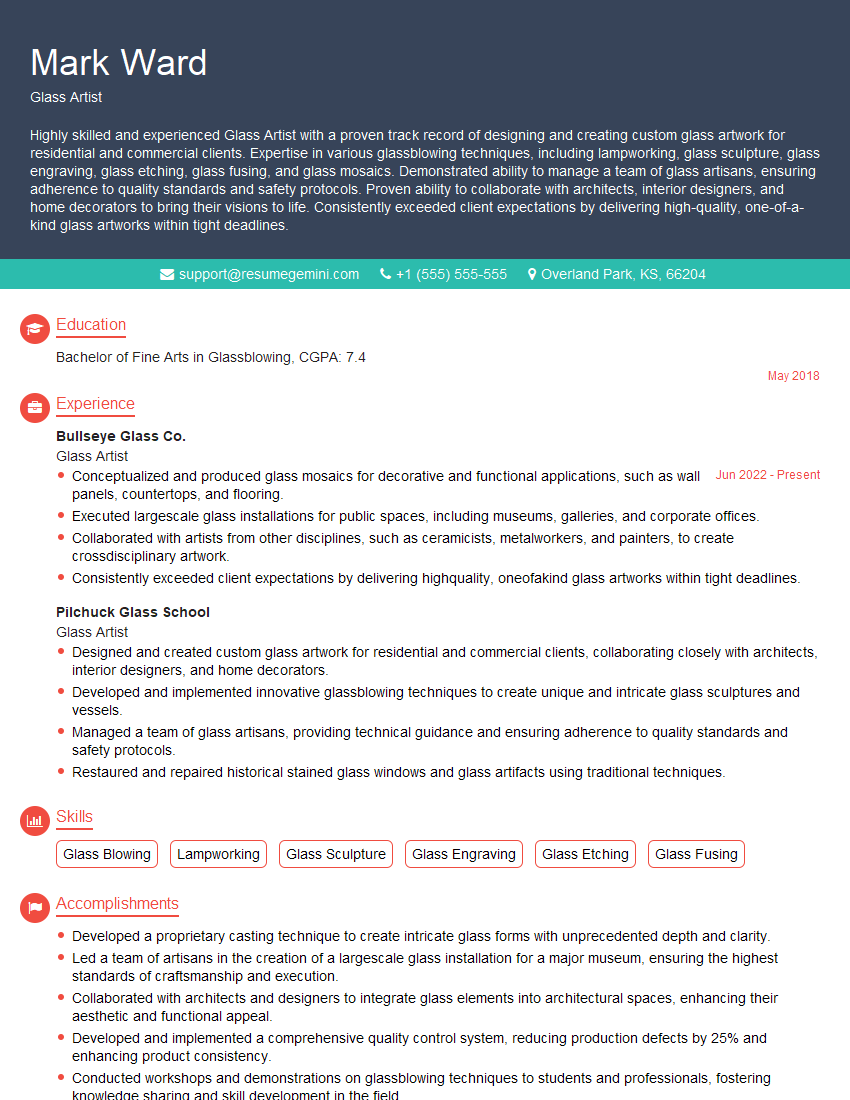
Mastering flameworking opens doors to exciting career opportunities in art, design, and even scientific research. To maximize your job prospects, it’s crucial to present your skills and experience effectively. Creating an ATS-friendly resume is essential for getting your application noticed by potential employers. ResumeGemini is a valuable resource to help you build a professional and impactful resume tailored to the specific demands of the flameworking industry. Examples of resumes specifically designed for flameworking professionals are available to guide you. Invest the time to craft a strong resume – it’s your first impression, and it matters.
Explore more articles
Users Rating of Our Blogs
Share Your Experience
We value your feedback! Please rate our content and share your thoughts (optional).
What Readers Say About Our Blog
Hello,
we currently offer a complimentary backlink and URL indexing test for search engine optimization professionals.
You can get complimentary indexing credits to test how link discovery works in practice.
No credit card is required and there is no recurring fee.
You can find details here:
https://wikipedia-backlinks.com/indexing/
Regards
NICE RESPONSE TO Q & A
hi
The aim of this message is regarding an unclaimed deposit of a deceased nationale that bears the same name as you. You are not relate to him as there are millions of people answering the names across around the world. But i will use my position to influence the release of the deposit to you for our mutual benefit.
Respond for full details and how to claim the deposit. This is 100% risk free. Send hello to my email id: [email protected]
Luka Chachibaialuka
Hey interviewgemini.com, just wanted to follow up on my last email.
We just launched Call the Monster, an parenting app that lets you summon friendly ‘monsters’ kids actually listen to.
We’re also running a giveaway for everyone who downloads the app. Since it’s brand new, there aren’t many users yet, which means you’ve got a much better chance of winning some great prizes.
You can check it out here: https://bit.ly/callamonsterapp
Or follow us on Instagram: https://www.instagram.com/callamonsterapp
Thanks,
Ryan
CEO – Call the Monster App
Hey interviewgemini.com, I saw your website and love your approach.
I just want this to look like spam email, but want to share something important to you. We just launched Call the Monster, a parenting app that lets you summon friendly ‘monsters’ kids actually listen to.
Parents are loving it for calming chaos before bedtime. Thought you might want to try it: https://bit.ly/callamonsterapp or just follow our fun monster lore on Instagram: https://www.instagram.com/callamonsterapp
Thanks,
Ryan
CEO – Call A Monster APP
To the interviewgemini.com Owner.
Dear interviewgemini.com Webmaster!
Hi interviewgemini.com Webmaster!
Dear interviewgemini.com Webmaster!
excellent
Hello,
We found issues with your domain’s email setup that may be sending your messages to spam or blocking them completely. InboxShield Mini shows you how to fix it in minutes — no tech skills required.
Scan your domain now for details: https://inboxshield-mini.com/
— Adam @ InboxShield Mini
Reply STOP to unsubscribe
Hi, are you owner of interviewgemini.com? What if I told you I could help you find extra time in your schedule, reconnect with leads you didn’t even realize you missed, and bring in more “I want to work with you” conversations, without increasing your ad spend or hiring a full-time employee?
All with a flexible, budget-friendly service that could easily pay for itself. Sounds good?
Would it be nice to jump on a quick 10-minute call so I can show you exactly how we make this work?
Best,
Hapei
Marketing Director
Hey, I know you’re the owner of interviewgemini.com. I’ll be quick.
Fundraising for your business is tough and time-consuming. We make it easier by guaranteeing two private investor meetings each month, for six months. No demos, no pitch events – just direct introductions to active investors matched to your startup.
If youR17;re raising, this could help you build real momentum. Want me to send more info?
Hi, I represent an SEO company that specialises in getting you AI citations and higher rankings on Google. I’d like to offer you a 100% free SEO audit for your website. Would you be interested?
Hi, I represent an SEO company that specialises in getting you AI citations and higher rankings on Google. I’d like to offer you a 100% free SEO audit for your website. Would you be interested?
good